
Englands Empire By Reagan Cassidy Anna Haley What
England’s Empire By: Reagan, Cassidy, Anna & Haley
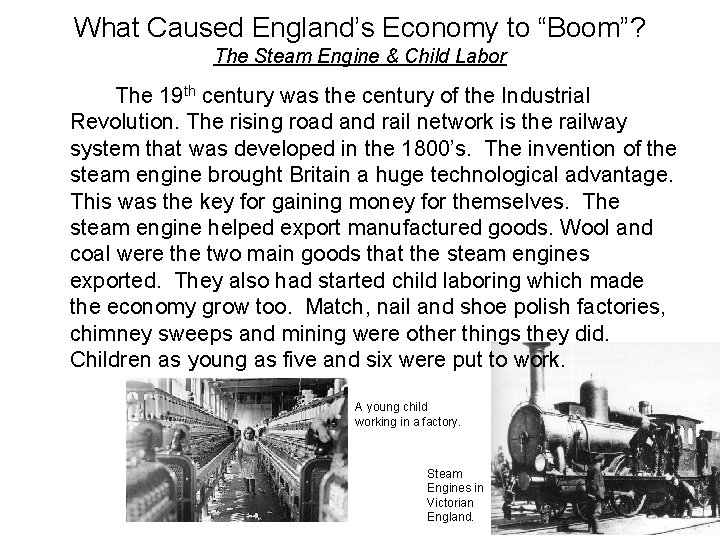
What Caused England’s Economy to “Boom”? The Steam Engine & Child Labor The 19 th century was the century of the Industrial Revolution. The rising road and rail network is the railway system that was developed in the 1800’s. The invention of the steam engine brought Britain a huge technological advantage. This was the key for gaining money for themselves. The steam engine helped export manufactured goods. Wool and coal were the two main goods that the steam engines exported. They also had started child laboring which made the economy grow too. Match, nail and shoe polish factories, chimney sweeps and mining were other things they did. Children as young as five and six were put to work. A young child working in a factory. Steam Engines in Victorian England.
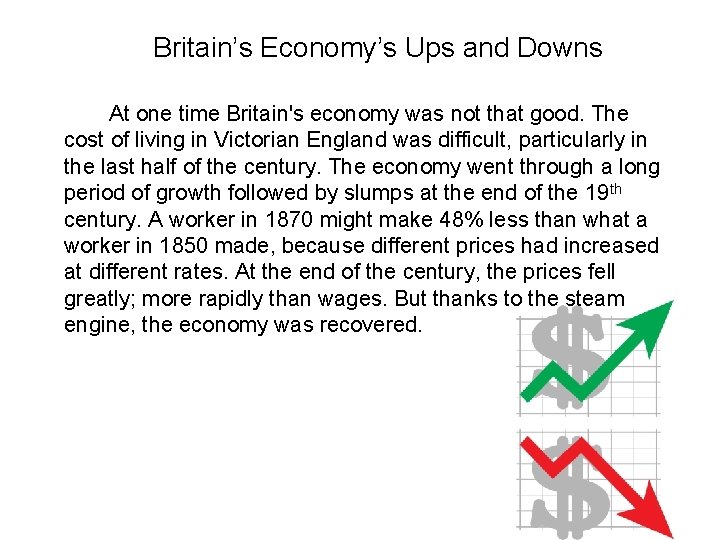
Britain’s Economy’s Ups and Downs At one time Britain's economy was not that good. The cost of living in Victorian England was difficult, particularly in the last half of the century. The economy went through a long period of growth followed by slumps at the end of the 19 th century. A worker in 1870 might make 48% less than what a worker in 1850 made, because different prices had increased at different rates. At the end of the century, the prices fell greatly; more rapidly than wages. But thanks to the steam engine, the economy was recovered.
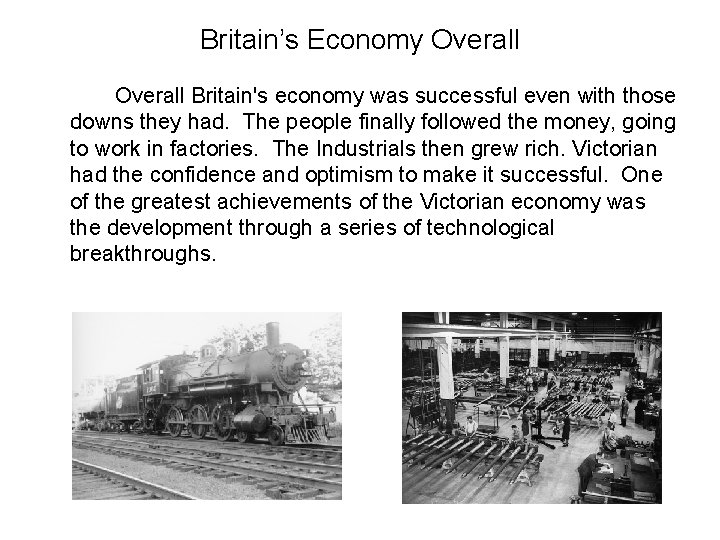
Britain’s Economy Overall Britain's economy was successful even with those downs they had. The people finally followed the money, going to work in factories. The Industrials then grew rich. Victorian had the confidence and optimism to make it successful. One of the greatest achievements of the Victorian economy was the development through a series of technological breakthroughs.

Britain’s Population Expansion The British Empire expanded rapidly between the 1870’s and 1900’s. It was during the time that Queen Victoria ruled the British Empire. There is no simple explanation on why it expanded because nobody really knows but there a couple of factors on why. The British empire had a major population growth in population during this time. This graph shows how the population increased and decreased.
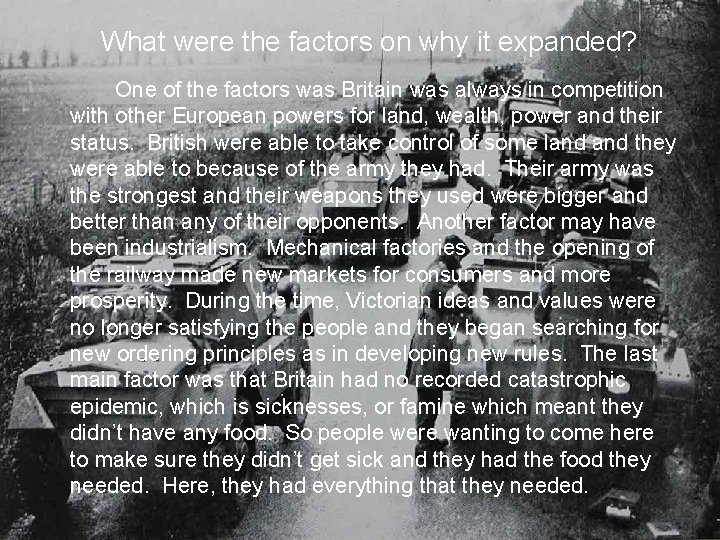
What were the factors on why it expanded? One of the factors was Britain was always in competition with other European powers for land, wealth, power and their status. British were able to take control of some land they were able to because of the army they had. Their army was the strongest and their weapons they used were bigger and better than any of their opponents. Another factor may have been industrialism. Mechanical factories and the opening of the railway made new markets for consumers and more prosperity. During the time, Victorian ideas and values were no longer satisfying the people and they began searching for new ordering principles as in developing new rules. The last main factor was that Britain had no recorded catastrophic epidemic, which is sicknesses, or famine which meant they didn’t have any food. So people were wanting to come here to make sure they didn’t get sick and they had the food they needed. Here, they had everything that they needed.
Major Problem & Population Expansion Overall Even though the empire did have all these good things, there was one major problem. When all these people decided to come to Britain, they wanted and needed jobs. There was so many people they didn’t have enough jobs for everyone. That’s what made the people underclassmen. The population made the economy go down because of this. But overall the was really nothing specific that caused the British Empire to expand so rapidly but rather the factors. Mainly it happened because of Britain and how strong they were. Their power allowed them to take control. Generally, the British Empire was successful because of everything that they had.
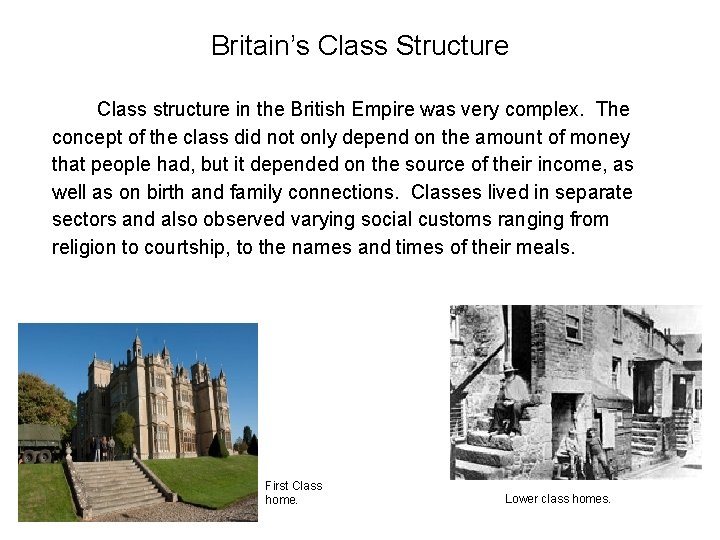
Britain’s Class Structure Class structure in the British Empire was very complex. The concept of the class did not only depend on the amount of money that people had, but it depended on the source of their income, as well as on birth and family connections. Classes lived in separate sectors and also observed varying social customs ranging from religion to courtship, to the names and times of their meals. First Class home. Lower class homes.
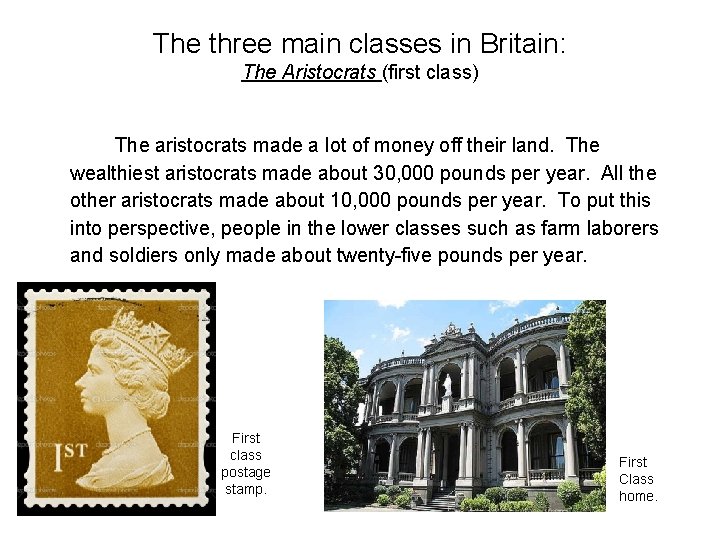
The three main classes in Britain: The Aristocrats (first class) The aristocrats made a lot of money off their land. The wealthiest aristocrats made about 30, 000 pounds per year. All the other aristocrats made about 10, 000 pounds per year. To put this into perspective, people in the lower classes such as farm laborers and soldiers only made about twenty-five pounds per year. First class postage stamp. First Class home.
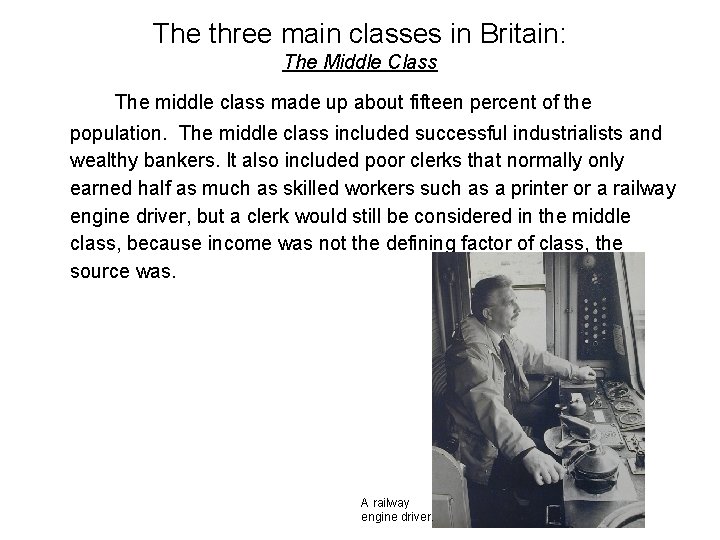
The three main classes in Britain: The Middle Class The middle class made up about fifteen percent of the population. The middle class included successful industrialists and wealthy bankers. It also included poor clerks that normally only earned half as much as skilled workers such as a printer or a railway engine driver, but a clerk would still be considered in the middle class, because income was not the defining factor of class, the source was. A railway engine driver.
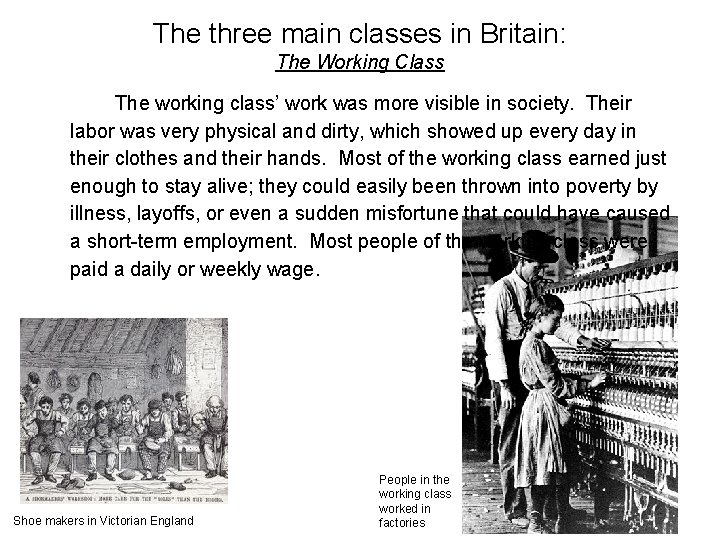
The three main classes in Britain: The Working Class The working class’ work was more visible in society. Their labor was very physical and dirty, which showed up every day in their clothes and their hands. Most of the working class earned just enough to stay alive; they could easily been thrown into poverty by illness, layoffs, or even a sudden misfortune that could have caused a short-term employment. Most people of the working class were paid a daily or weekly wage. Shoe makers in Victorian England People in the working class worked in factories
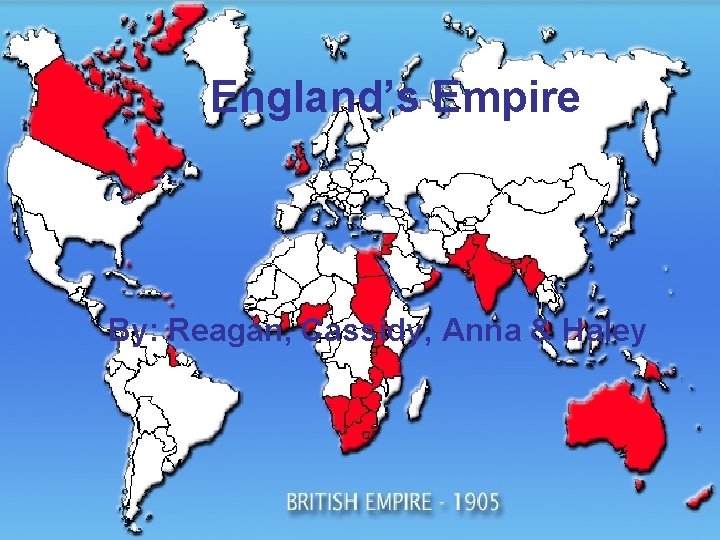
Global Empire The British Empire is considered one of the greatest empires in the history of the world. It began in the 15 th and 16 th centuries when exploration across the planet began establishing overseas colonies. Colonies were established in North America, the Caribbean, Africa, and Asia. The British Empire grew to such a big size that the phrase “The sun never sets on the British Empire” was true.
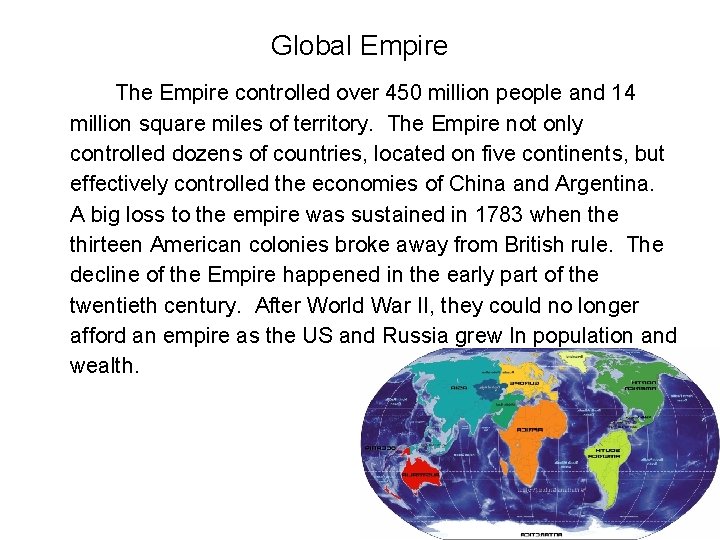
Global Empire The Empire controlled over 450 million people and 14 million square miles of territory. The Empire not only controlled dozens of countries, located on five continents, but effectively controlled the economies of China and Argentina. A big loss to the empire was sustained in 1783 when the thirteen American colonies broke away from British rule. The decline of the Empire happened in the early part of the twentieth century. After World War II, they could no longer afford an empire as the US and Russia grew In population and wealth.
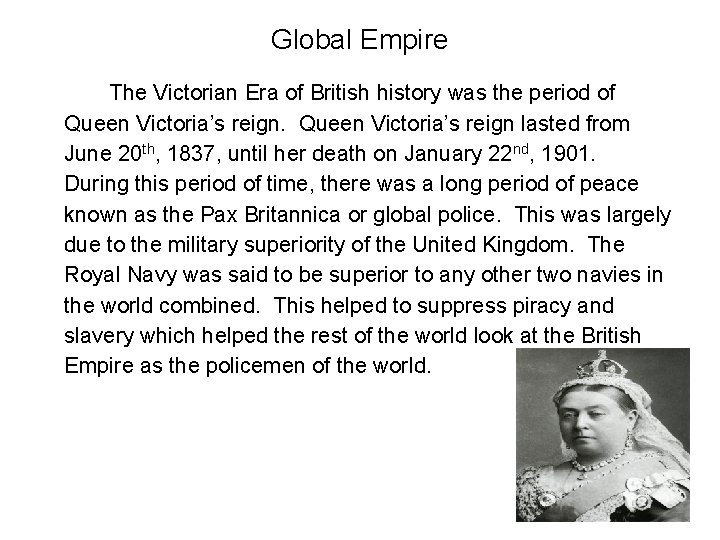
Global Empire The Victorian Era of British history was the period of Queen Victoria’s reign lasted from June 20 th, 1837, until her death on January 22 nd, 1901. During this period of time, there was a long period of peace known as the Pax Britannica or global police. This was largely due to the military superiority of the United Kingdom. The Royal Navy was said to be superior to any other two navies in the world combined. This helped to suppress piracy and slavery which helped the rest of the world look at the British Empire as the policemen of the world.
Resources: • • • http: //ushistoryclass. files. wordpress. com/2011/08/borsig_steam_locomotive. jpg http: //thegreatchessboard. files. wordpress. com/2011/08/british_empire. jpg http: //www. collectedcomicslibrary. com/wp-content/uploads/2012/01/up_down. jpg • • http: //www. ameshistoricalsociety. org/exhibits/dinkey/c_nw_train 3. jpg http: //i. telegraph. co. uk/multimedia/archive/00681/munitions-factory 40_681048 n. jpg • • • http: //www. google. com/imgres? q=britain%27 s+population+expansion&um=1&hl=en http: //ww 2 today. com/wp-content/uploads/2010/08/British-Army-1940. jpg http: //www. google. com/imgres? q=check+mark&um=1&hl=en&safe=active&sa=N&biw =1024&bih=584&tbm=isch&tbnid=7 xi 1 LVPs. Rlh. Og. M: &imgrefurl=http: //en. wikipedia. or g/wiki/File: Checkmark. png&docid=c. Uw. KCf. Zk. D 10 HM&imgurl=http: //upload. wikimedia. org/wikipedia/en/5/5 a/Checkmark. png&w=36 4&h=318&ei=LGa. AUKK 5 NYGc 9 g. TRh. ICYBA&zoom=1&iact=hc&vpx=229&vpy=144& dur=41&hovh=210&hovw=240&tx=144&ty=133&sig=108408162132712164994&pag e=1&tbnh=140&tbnw=152&start=0&ndsp=17&ved=1 t: 429, r: 1, s: 0, i: 74
- Slides: 15