
Engineering Workforce Development 1 Executive Summary ASME will




- Slides: 57
Engineering Workforce Development 1
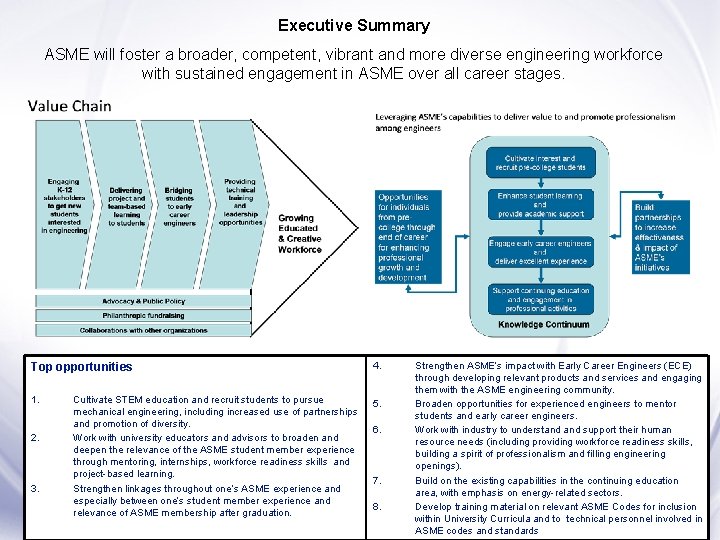
Executive Summary ASME will foster a broader, competent, vibrant and more diverse engineering workforce with sustained engagement in ASME over all career stages. Top opportunities 4. 1. 5. 2. 3. Cultivate STEM education and recruit students to pursue mechanical engineering, including increased use of partnerships and promotion of diversity. Work with university educators and advisors to broaden and deepen the relevance of the ASME student member experience through mentoring, internships, workforce readiness skills and project-based learning. Strengthen linkages throughout one’s ASME experience and especially between one’s student member experience and relevance of ASME membership after graduation. 6. 7. 8. Strengthen ASME’s impact with Early Career Engineers (ECE) through developing relevant products and services and engaging them with the ASME engineering community. Broaden opportunities for experienced engineers to mentor students and early career engineers. Work with industry to understand support their human resource needs (including providing workforce readiness skills, building a spirit of professionalism and filling engineering openings). Build on the existing capabilities in the continuing education area, with emphasis on energy-related sectors. 2 Develop training material on relevant ASME Codes for inclusion within University Curricula and to technical personnel involved in ASME codes and standards
Strategy Statement – Engineering Workforce Development Short Version • ASME will foster a broader, competent, vibrant and more diverse engineering workforce with sustained engagement in ASME over all career stages. Statement • ASME will foster a broader, competent, vibrant and more diverse engineering workforce with sustained engagement in ASME over all career stages. We will achieve this by promoting public awareness of the value of the engineering profession, expanding the capacity of the engineering workforce, improving retention in the profession and ASME, and increasing technical competency. 3 3
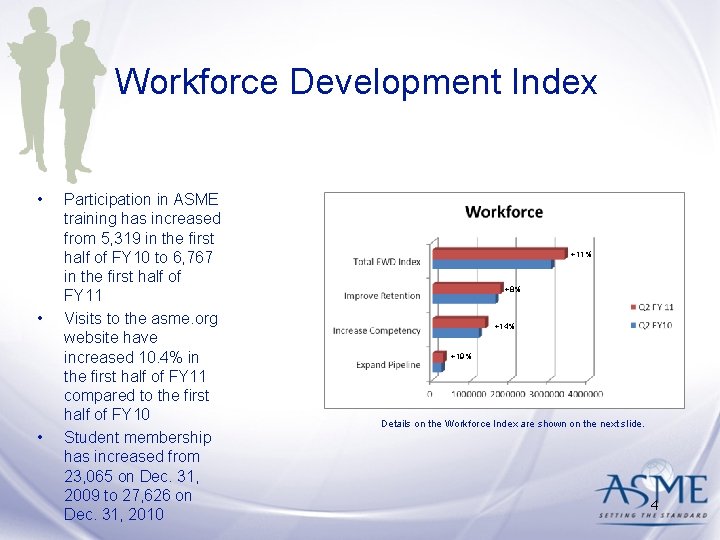
Workforce Development Index • • • Participation in ASME training has increased from 5, 319 in the first half of FY 10 to 6, 767 in the first half of FY 11 Visits to the asme. org website have increased 10. 4% in the first half of FY 11 compared to the first half of FY 10 Student membership has increased from 23, 065 on Dec. 31, 2009 to 27, 626 on Dec. 31, 2010 +11% +8% +14% +19% Details on the Workforce Index are shown on the next slide. 4
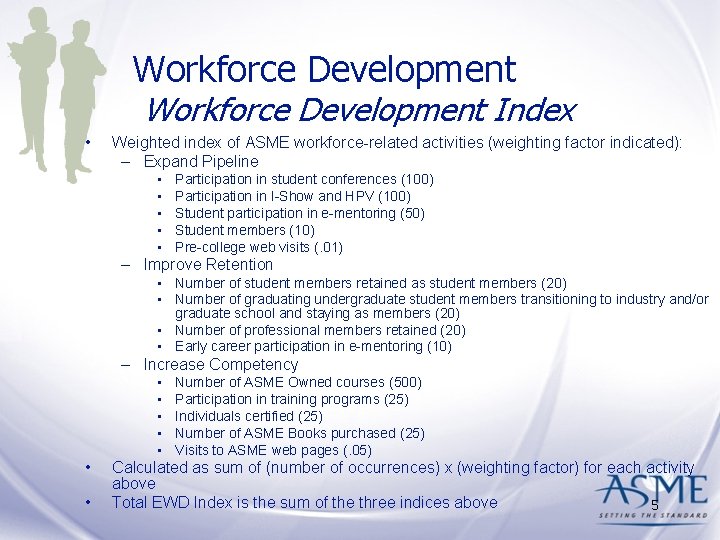
Workforce Development Index • Weighted index of ASME workforce-related activities (weighting factor indicated): – Expand Pipeline • • • Participation in student conferences (100) Participation in I-Show and HPV (100) Student participation in e-mentoring (50) Student members (10) Pre-college web visits (. 01) – Improve Retention • Number of student members retained as student members (20) • Number of graduating undergraduate student members transitioning to industry and/or graduate school and staying as members (20) • Number of professional members retained (20) • Early career participation in e-mentoring (10) – Increase Competency • • Number of ASME Owned courses (500) Participation in training programs (25) Individuals certified (25) Number of ASME Books purchased (25) Visits to ASME web pages (. 05) Calculated as sum of (number of occurrences) x (weighting factor) for each activity above Total EWD Index is the sum of the three indices above 5
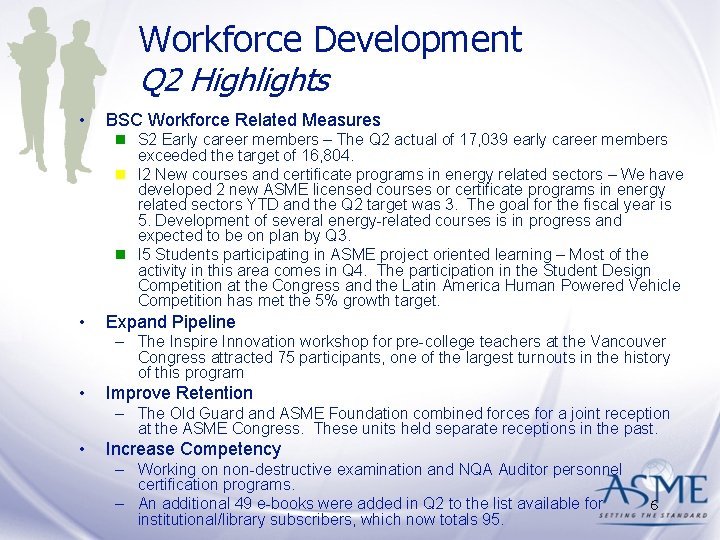
Workforce Development Q 2 Highlights • BSC Workforce Related Measures n S 2 Early career members – The Q 2 actual of 17, 039 early career members exceeded the target of 16, 804. n I 2 New courses and certificate programs in energy related sectors – We have developed 2 new ASME licensed courses or certificate programs in energy related sectors YTD and the Q 2 target was 3. The goal for the fiscal year is 5. Development of several energy-related courses is in progress and expected to be on plan by Q 3. n I 5 Students participating in ASME project oriented learning – Most of the activity in this area comes in Q 4. The participation in the Student Design Competition at the Congress and the Latin America Human Powered Vehicle Competition has met the 5% growth target. • Expand Pipeline – The Inspire Innovation workshop for pre-college teachers at the Vancouver Congress attracted 75 participants, one of the largest turnouts in the history of this program • Improve Retention – The Old Guard and ASME Foundation combined forces for a joint reception at the ASME Congress. These units held separate receptions in the past. • Increase Competency – Working on non-destructive examination and NQA Auditor personnel certification programs. – An additional 49 e-books were added in Q 2 to the list available for institutional/library subscribers, which now totals 95. 6
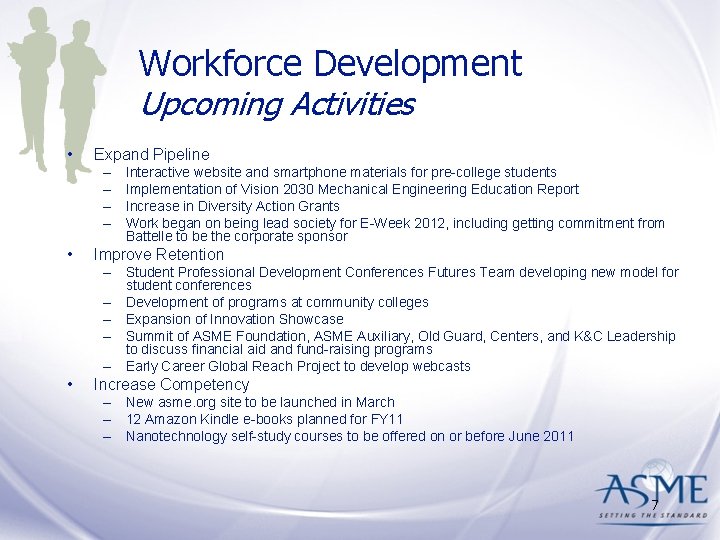
Workforce Development Upcoming Activities • Expand Pipeline – – • Interactive website and smartphone materials for pre-college students Implementation of Vision 2030 Mechanical Engineering Education Report Increase in Diversity Action Grants Work began on being lead society for E-Week 2012, including getting commitment from Battelle to be the corporate sponsor Improve Retention – Student Professional Development Conferences Futures Team developing new model for student conferences – Development of programs at community colleges – Expansion of Innovation Showcase – Summit of ASME Foundation, ASME Auxiliary, Old Guard, Centers, and K&C Leadership to discuss financial aid and fund-raising programs – Early Career Global Reach Project to develop webcasts • Increase Competency – New asme. org site to be launched in March – 12 Amazon Kindle e-books planned for FY 11 – Nanotechnology self-study courses to be offered on or before June 2011 7
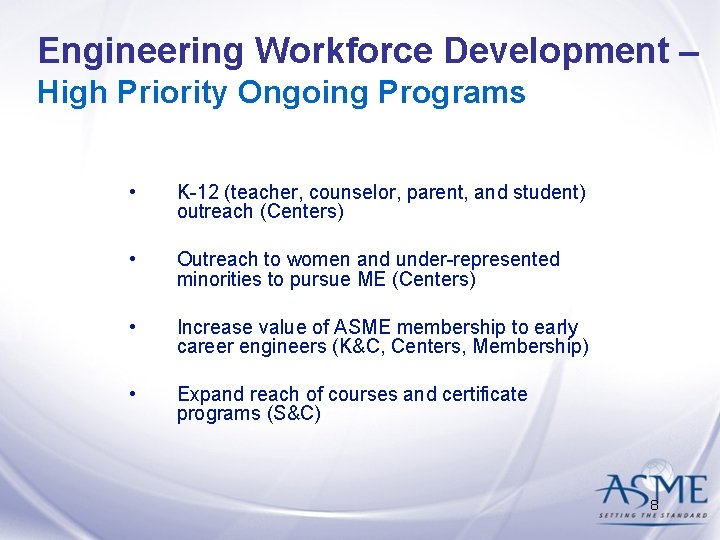
Engineering Workforce Development – High Priority Ongoing Programs • K-12 (teacher, counselor, parent, and student) outreach (Centers) • Outreach to women and under-represented minorities to pursue ME (Centers) • Increase value of ASME membership to early career engineers (K&C, Centers, Membership) • Expand reach of courses and certificate programs (S&C) 8
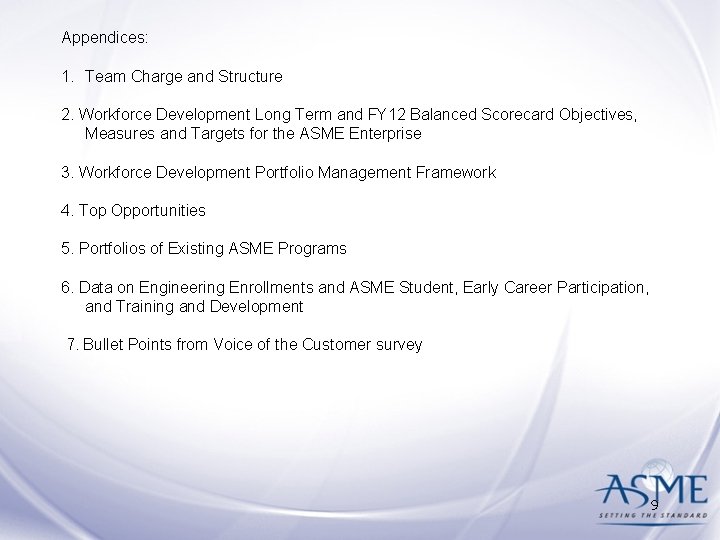
Appendices: 1. Team Charge and Structure 2. Workforce Development Long Term and FY 12 Balanced Scorecard Objectives, Measures and Targets for the ASME Enterprise 3. Workforce Development Portfolio Management Framework 4. Top Opportunities 5. Portfolios of Existing ASME Programs 6. Data on Engineering Enrollments and ASME Student, Early Career Participation, and Training and Development 7. Bullet Points from Voice of the Customer survey 9
Appendix 1: Team Charge and Structure 10
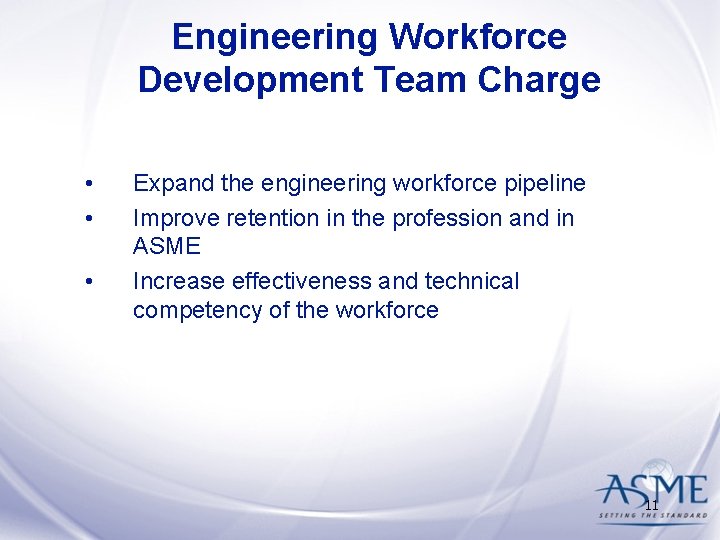
Engineering Workforce Development Team Charge • • • Expand the engineering workforce pipeline Improve retention in the profession and in ASME Increase effectiveness and technical competency of the workforce 11
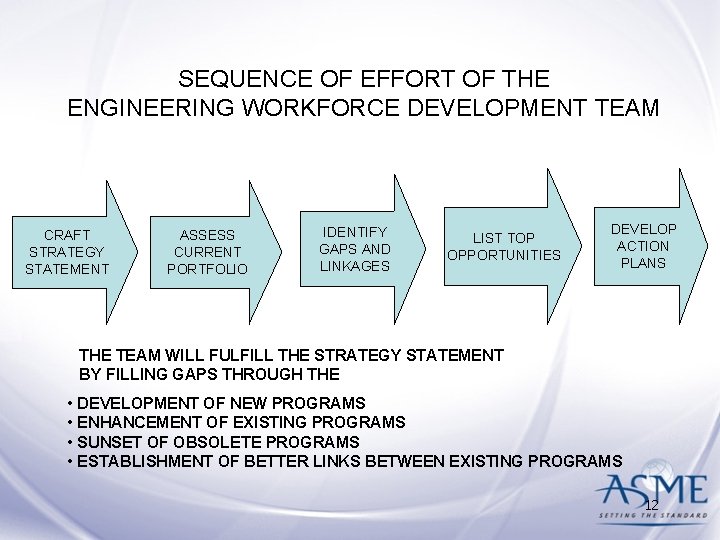
SEQUENCE OF EFFORT OF THE ENGINEERING WORKFORCE DEVELOPMENT TEAM CRAFT STRATEGY STATEMENT ASSESS CURRENT PORTFOLIO IDENTIFY GAPS AND LINKAGES LIST TOP OPPORTUNITIES DEVELOP ACTION PLANS THE TEAM WILL FULFILL THE STRATEGY STATEMENT BY FILLING GAPS THROUGH THE • DEVELOPMENT OF NEW PROGRAMS • ENHANCEMENT OF EXISTING PROGRAMS • SUNSET OF OBSOLETE PROGRAMS • ESTABLISHMENT OF BETTER LINKS BETWEEN EXISTING PROGRAMS 12
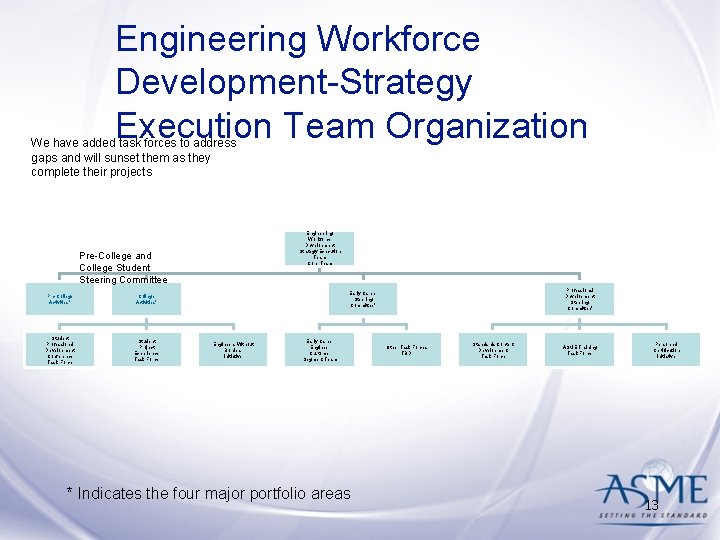
Engineering Workforce Development-Strategy Execution Team Organization We have added task forces to address gaps and will sunset them as they complete their projects Engineering Workforce Development Strategy Execution Team Core Team Pre-College and College Student Steering Committee Pre-College Activities* Student Professional Development Conference Task Force Student Project Experience Task Force Professional Development Steering Committee* Early Career Steering Committee* Engineers Without Borders Initiative Early Career Engineer Customer Segment Team * Indicates the four major portfolio areas Other Task Forces TBD Standards Content Development Task Force ASME Training Task Force Personnel Certification Initiative 13
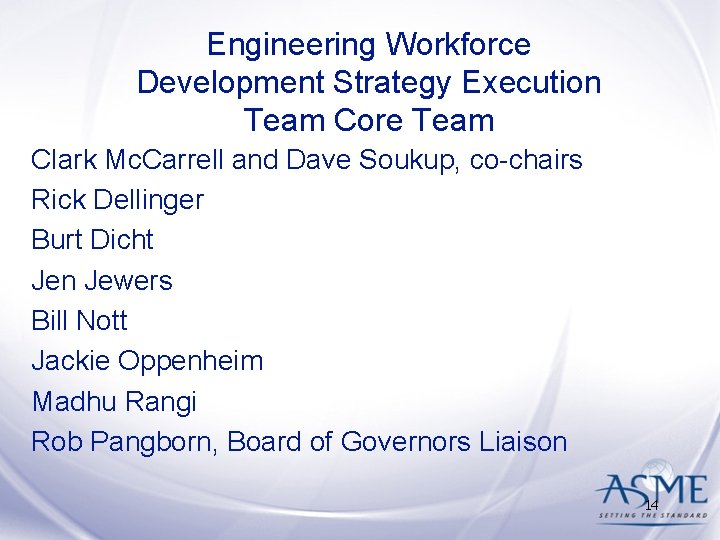
Engineering Workforce Development Strategy Execution Team Core Team Clark Mc. Carrell and Dave Soukup, co-chairs Rick Dellinger Burt Dicht Jen Jewers Bill Nott Jackie Oppenheim Madhu Rangi Rob Pangborn, Board of Governors Liaison 14
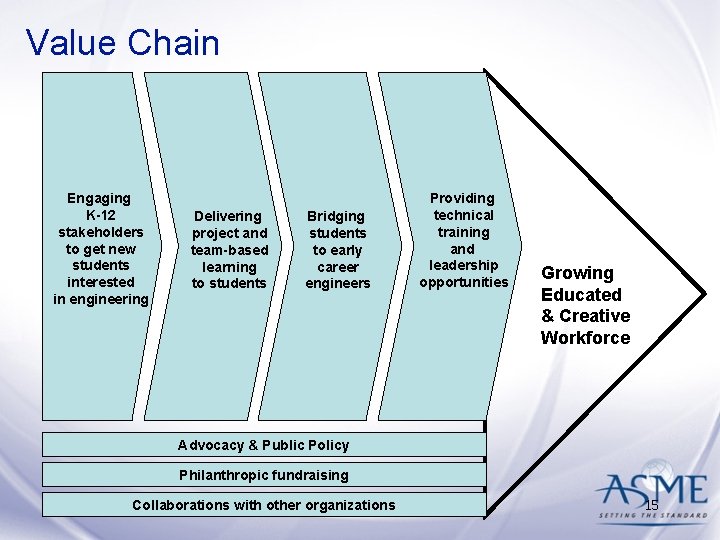
Value Chain Engaging K-12 stakeholders to get new students interested in engineering Delivering project and team-based learning to students Bridging students to early career engineers Providing technical training and leadership opportunities Growing Educated & Creative Workforce Advocacy & Public Policy Philanthropic fundraising Collaborations with other organizations 15
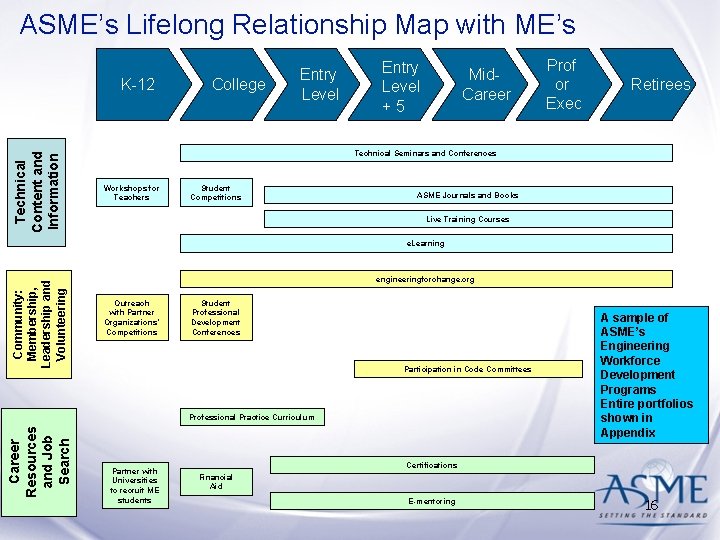
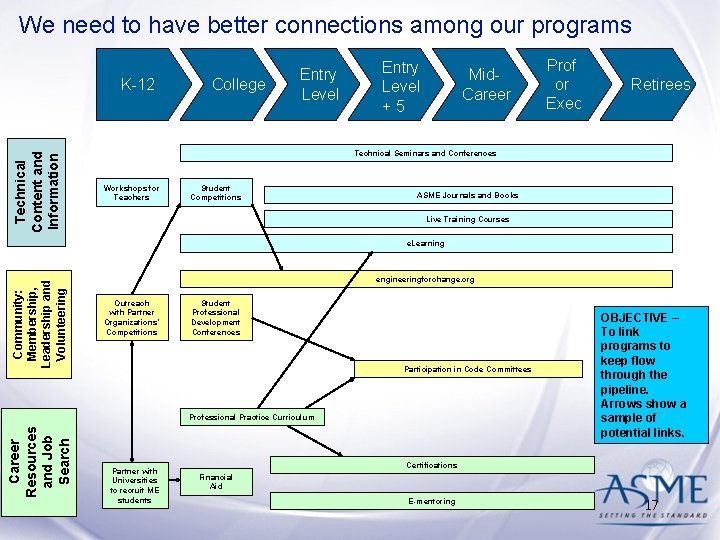
ASME’s Lifelong Relationship Map with ME’s Technical Content and Information K-12 College Entry Level + 5 Mid Career Prof or Exec Retirees Technical Seminars and Conferences Workshops for Teachers Student Competitions ASME Journals and Books Live Training Courses Community: Membership, Leadership and Volunteering e. Learning engineeringforchange. org Outreach with Partner Organizations’ Competitions Student Professional Development Conferences Participation in Code Committees Career Resources and Job Search Professional Practice Curriculum Partner with Universities to recruit ME students A sample of ASME’s Engineering Workforce Development Programs Entire portfolios shown in Appendix Certifications Financial Aid E-mentoring 16
We need to have better connections among our programs Technical Content and Information K-12 College Entry Level + 5 Mid Career Prof or Exec Retirees Technical Seminars and Conferences Workshops for Teachers Student Competitions ASME Journals and Books Live Training Courses Community: Membership, Leadership and Volunteering e. Learning engineeringforchange. org Outreach with Partner Organizations’ Competitions Student Professional Development Conferences Participation in Code Committees Career Resources and Job Search Professional Practice Curriculum Partner with Universities to recruit ME students OBJECTIVE – To link programs to keep flow through the pipeline. Arrows show a sample of potential links. Certifications Financial Aid E-mentoring 17
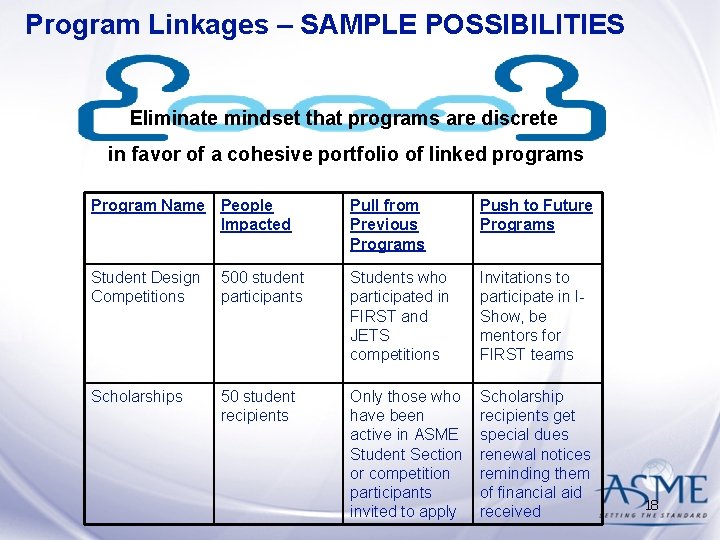
Program Linkages – SAMPLE POSSIBILITIES Eliminate mindset that programs are discrete in favor of a cohesive portfolio of linked programs Program Name People Impacted Pull from Previous Programs Push to Future Programs Student Design 500 student Competitions participants Students who participated in FIRST and JETS competitions Invitations to participate in IShow, be mentors for FIRST teams Scholarships Only those who have been active in ASME Student Section or competition participants invited to apply Scholarship recipients get special dues renewal notices reminding them of financial aid received 50 student recipients 18
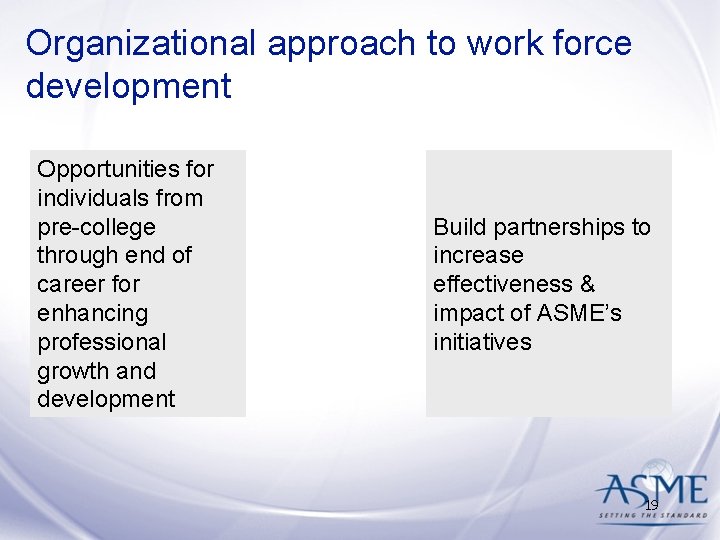
Organizational approach to work force development Opportunities for individuals from pre-college through end of career for enhancing professional growth and development Build partnerships to increase effectiveness & impact of ASME’s initiatives 19
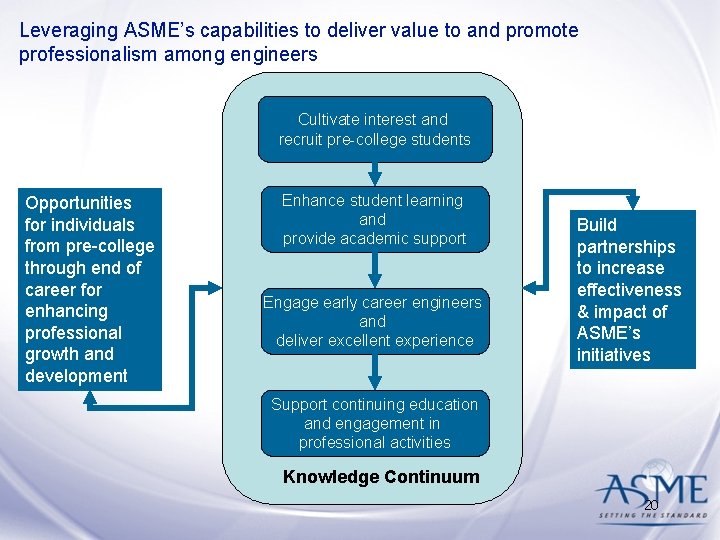
Leveraging ASME’s capabilities to deliver value to and promote professionalism among engineers Cultivate interest and recruit pre-college students Opportunities for individuals from pre-college through end of career for enhancing professional growth and development Enhance student learning and provide academic support Engage early career engineers and deliver excellent experience Build partnerships to increase effectiveness & impact of ASME’s initiatives Support continuing education and engagement in professional activities Knowledge Continuum 20
Appendix 2: Workforce Development Long Term and FY 12 Balanced Scorecard Objectives, Measures and Targets for the ASME Enterprise 21
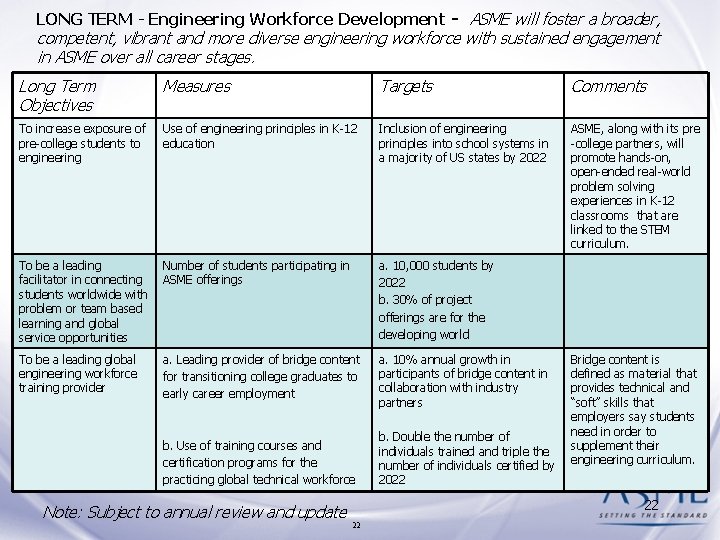
LONG TERM - Engineering Workforce Development - ASME will foster a broader, competent, vibrant and more diverse engineering workforce with sustained engagement in ASME over all career stages. Long Term Objectives Measures Targets Comments To increase exposure of pre-college students to engineering Use of engineering principles in K-12 education Inclusion of engineering principles into school systems in a majority of US states by 2022 ASME, along with its pre -college partners, will promote hands-on, open-ended real-world problem solving experiences in K-12 classrooms that are linked to the STEM curriculum. To be a leading facilitator in connecting students worldwide with problem or team based learning and global service opportunities Number of students participating in ASME offerings a. 10, 000 students by 2022 b. 30% of project offerings are for the developing world To be a leading global engineering workforce training provider a. Leading provider of bridge content for transitioning college graduates to early career employment a. 10% annual growth in participants of bridge content in collaboration with industry partners b. Use of training courses and certification programs for the practicing global technical workforce b. Double the number of individuals trained and triple the number of individuals certified by 2022 Note: Subject to annual review and update Bridge content is defined as material that provides technical and “soft” skills that employers say students need in order to supplement their engineering curriculum. 22 22
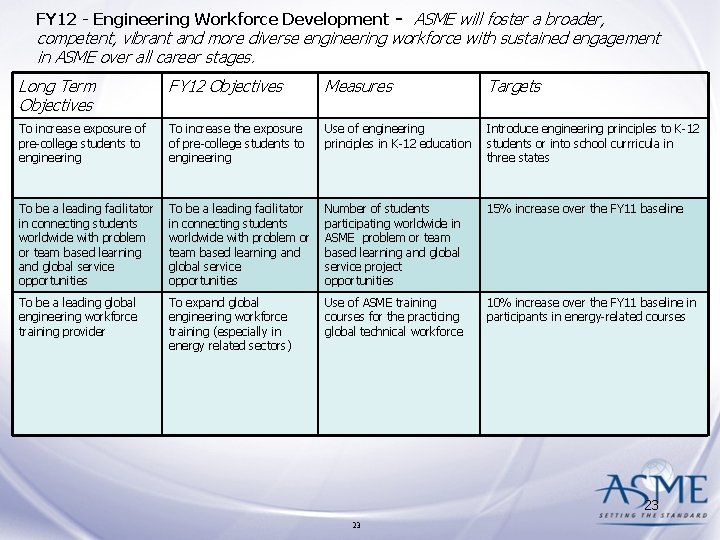
FY 12 - Engineering Workforce Development - ASME will foster a broader, competent, vibrant and more diverse engineering workforce with sustained engagement in ASME over all career stages. Long Term Objectives FY 12 Objectives Measures Targets To increase exposure of pre-college students to engineering To increase the exposure of pre-college students to engineering Use of engineering principles in K-12 education Introduce engineering principles to K-12 students or into school currricula in three states To be a leading facilitator in connecting students worldwide with problem or team based learning and global service opportunities Number of students participating worldwide in ASME problem or team based learning and global service project opportunities 15% increase over the FY 11 baseline To be a leading global engineering workforce training provider To expand global engineering workforce training (especially in energy related sectors) Use of ASME training courses for the practicing global technical workforce 10% increase over the FY 11 baseline in participants in energy-related courses 23 23
Appendix 3: Workforce Development Portfolio Management Framework 24
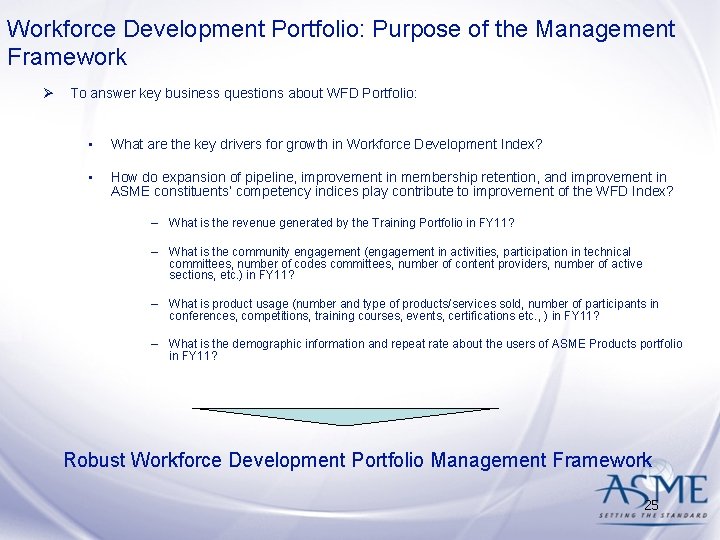
Workforce Development Portfolio: Purpose of the Management Framework Ø To answer key business questions about WFD Portfolio: • What are the key drivers for growth in Workforce Development Index? • How do expansion of pipeline, improvement in membership retention, and improvement in ASME constituents’ competency indices play contribute to improvement of the WFD Index? – What is the revenue generated by the Training Portfolio in FY 11? – What is the community engagement (engagement in activities, participation in technical committees, number of codes committees, number of content providers, number of active sections, etc. ) in FY 11? – What is product usage (number and type of products/services sold, number of participants in conferences, competitions, training courses, events, certifications etc. , ) in FY 11? – What is the demographic information and repeat rate about the users of ASME Products portfolio in FY 11? Robust Workforce Development Portfolio Management Framework 25
Workforce Development Portfolio Management Framework Project Scope • Functions Included – Framework for WFD portfolio management system • Data attributes, product list, standard definitions for classification system – Framework Prototype • Functions Not Included – Integration with TIMSS and Great plains – Dynamic update of data – Analysis and recommendations on growth and management of WFD Portfolio • Key Deliverables – WFD team targets for FY’ 12 – Requirements for WFD portfolio management framework – Prototype of WFD portfolio management framework • Plan – Product Managers will provide informational content about the products – Portfolio management team will develop the classification scheme that governs the portfolio management system 26 – Portfolio management team will develop the prototype for the system
Development Plan for WFD Portfolio Management Framework 27
Workforce Development Portfolio Management Framework: Data Attributes WFD Portfolio management framework will include following attributes: 1. Financial attributes – Demand, revenue, cost and margin data where appropriate for 2 most recently completed fiscal years 2. Classification attributes – Type of Product: Technical, Seminars and Conferences, Publications, Training courses, Workshops, Competitions, mentoring etc. – Type of Segment: K-12, College, Entry level, Mid Career, industry Professional/Executive (small medium, large co. ), Retired, Self employed, academicians, regulatory bodies – Type of Content: Career, Community, Technical, Non Technical – Type of Energy: nuclear, fossil, alternative, renewable – Type of Technology: energy generation, transmission, transportation, storage, efficiency, disposal etc, – Type of delivery mechanism: Live, Online, Self study, publications, wireless, interactive games, social media etc. 3. Community engagement attributes – Geographic and Professional; Outreach with other organizations through competitions, participation in Technical committee, codes committee, editorial board, division, CRTD committee, etc. 4. Product stage of development – Plans for implementation – Product general ledger number 28
Next Steps 1. 2. Follow the proposed plan to develop WFD Portfolio Management Framework Regularly update WFD team on the progress 29
Appendix 4: Top Opportunities 30
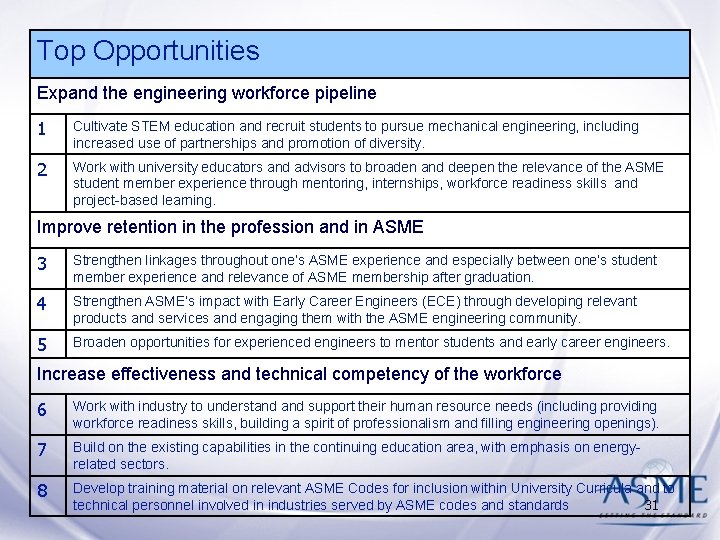
Top Opportunities Expand the engineering workforce pipeline 1 Cultivate STEM education and recruit students to pursue mechanical engineering, including increased use of partnerships and promotion of diversity. 2 Work with university educators and advisors to broaden and deepen the relevance of the ASME student member experience through mentoring, internships, workforce readiness skills and project-based learning. Improve retention in the profession and in ASME 3 Strengthen linkages throughout one’s ASME experience and especially between one’s student member experience and relevance of ASME membership after graduation. 4 Strengthen ASME’s impact with Early Career Engineers (ECE) through developing relevant products and services and engaging them with the ASME engineering community. 5 Broaden opportunities for experienced engineers to mentor students and early career engineers. Increase effectiveness and technical competency of the workforce 6 Work with industry to understand support their human resource needs (including providing workforce readiness skills, building a spirit of professionalism and filling engineering openings). 7 Build on the existing capabilities in the continuing education area, with emphasis on energyrelated sectors. 8 Develop training material on relevant ASME Codes for inclusion within University Curricula and to 31 technical personnel involved in industries served by ASME codes and standards
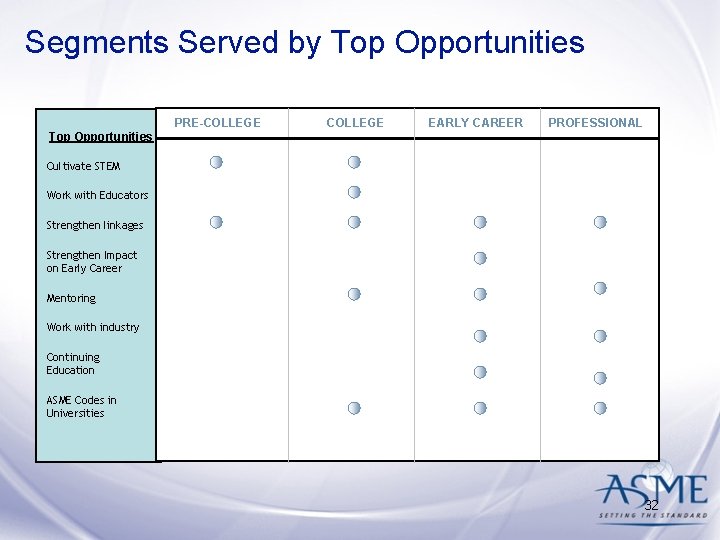
Segments Served by Top Opportunities PRE-COLLEGE EARLY CAREER PROFESSIONAL Top Opportunities Cultivate STEM Work with Educators Strengthen linkages Strengthen Impact on Early Career Mentoring Work with industry Continuing Education ASME Codes in Universities 32
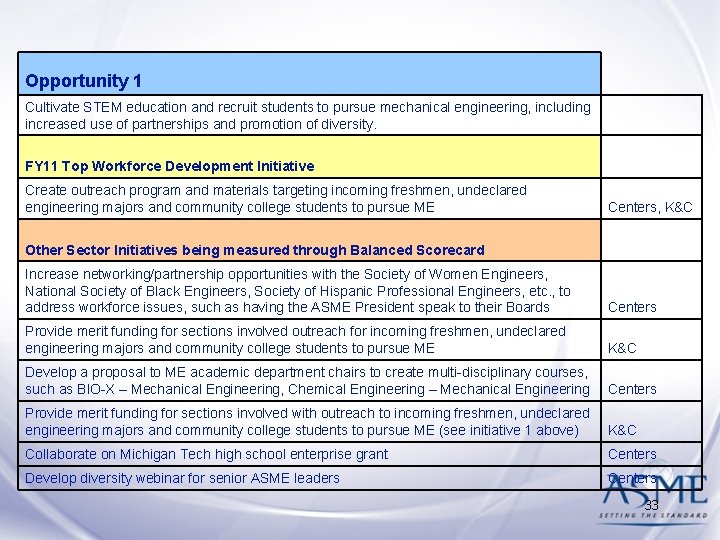
Opportunity 1 Cultivate STEM education and recruit students to pursue mechanical engineering, including increased use of partnerships and promotion of diversity. FY 11 Top Workforce Development Initiative Create outreach program and materials targeting incoming freshmen, undeclared engineering majors and community college students to pursue ME Centers, K&C Other Sector Initiatives being measured through Balanced Scorecard Increase networking/partnership opportunities with the Society of Women Engineers, National Society of Black Engineers, Society of Hispanic Professional Engineers, etc. , to address workforce issues, such as having the ASME President speak to their Boards Centers Provide merit funding for sections involved outreach for incoming freshmen, undeclared engineering majors and community college students to pursue ME K&C Develop a proposal to ME academic department chairs to create multi-disciplinary courses, such as BIO-X – Mechanical Engineering, Chemical Engineering – Mechanical Engineering Centers Provide merit funding for sections involved with outreach to incoming freshmen, undeclared engineering majors and community college students to pursue ME (see initiative 1 above) K&C Collaborate on Michigan Tech high school enterprise grant Centers Develop diversity webinar for senior ASME leaders Centers 33
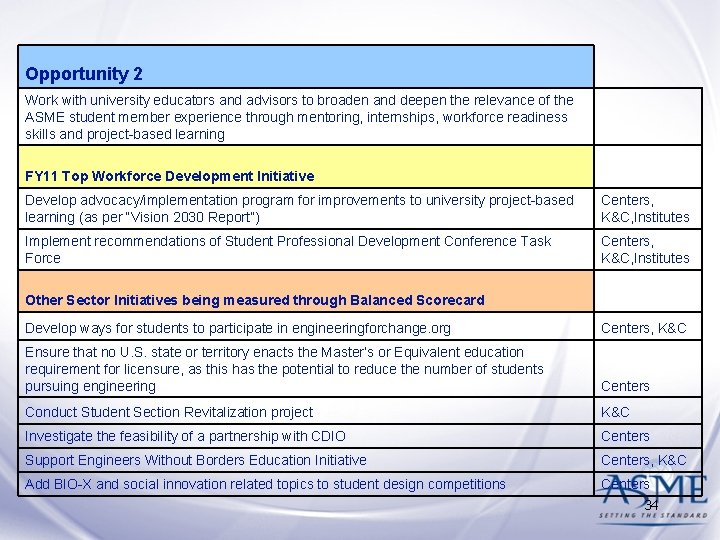
Opportunity 2 Work with university educators and advisors to broaden and deepen the relevance of the ASME student member experience through mentoring, internships, workforce readiness skills and project-based learning FY 11 Top Workforce Development Initiative Develop advocacy/implementation program for improvements to university project-based learning (as per “Vision 2030 Report”) Centers, K&C, Institutes Implement recommendations of Student Professional Development Conference Task Force Centers, K&C, Institutes Other Sector Initiatives being measured through Balanced Scorecard Develop ways for students to participate in engineeringforchange. org Centers, K&C Ensure that no U. S. state or territory enacts the Master’s or Equivalent education requirement for licensure, as this has the potential to reduce the number of students pursuing engineering Centers Conduct Student Section Revitalization project K&C Investigate the feasibility of a partnership with CDIO Centers Support Engineers Without Borders Education Initiative Centers, K&C Add BIO-X and social innovation related topics to student design competitions Centers 34
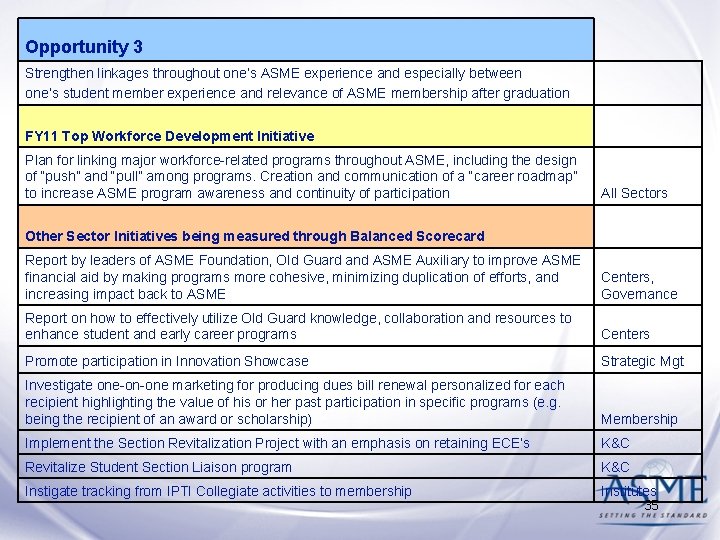
Opportunity 3 Strengthen linkages throughout one’s ASME experience and especially between one’s student member experience and relevance of ASME membership after graduation FY 11 Top Workforce Development Initiative Plan for linking major workforce-related programs throughout ASME, including the design of “push” and “pull” among programs. Creation and communication of a “career roadmap” to increase ASME program awareness and continuity of participation All Sectors Other Sector Initiatives being measured through Balanced Scorecard Report by leaders of ASME Foundation, OId Guard and ASME Auxiliary to improve ASME financial aid by making programs more cohesive, minimizing duplication of efforts, and increasing impact back to ASME Centers, Governance Report on how to effectively utilize Old Guard knowledge, collaboration and resources to enhance student and early career programs Centers Promote participation in Innovation Showcase Strategic Mgt Investigate one-on-one marketing for producing dues bill renewal personalized for each recipient highlighting the value of his or her past participation in specific programs (e. g. being the recipient of an award or scholarship) Membership Implement the Section Revitalization Project with an emphasis on retaining ECE’s K&C Revitalize Student Section Liaison program K&C Instigate tracking from IPTI Collegiate activities to membership Institutes 35
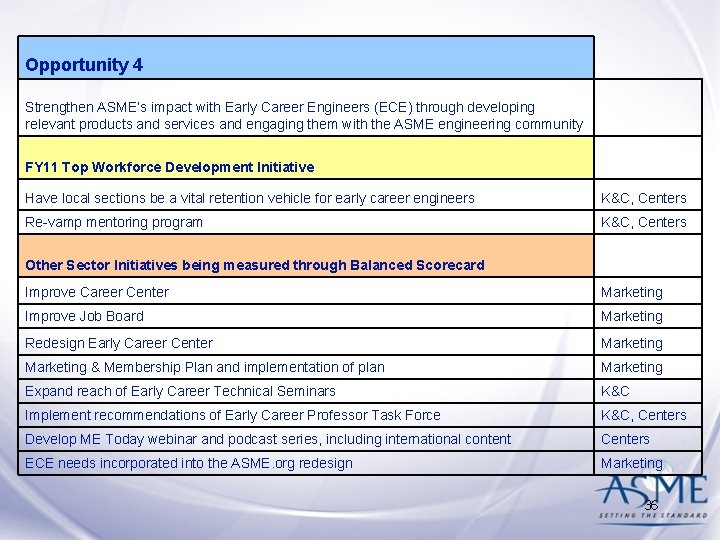
Opportunity 4 Strengthen ASME’s impact with Early Career Engineers (ECE) through developing relevant products and services and engaging them with the ASME engineering community FY 11 Top Workforce Development Initiative Have local sections be a vital retention vehicle for early career engineers K&C, Centers Re-vamp mentoring program K&C, Centers Other Sector Initiatives being measured through Balanced Scorecard Improve Career Center Marketing Improve Job Board Marketing Redesign Early Career Center Marketing & Membership Plan and implementation of plan Marketing Expand reach of Early Career Technical Seminars K&C Implement recommendations of Early Career Professor Task Force K&C, Centers Develop ME Today webinar and podcast series, including international content Centers ECE needs incorporated into the ASME. org redesign Marketing 36
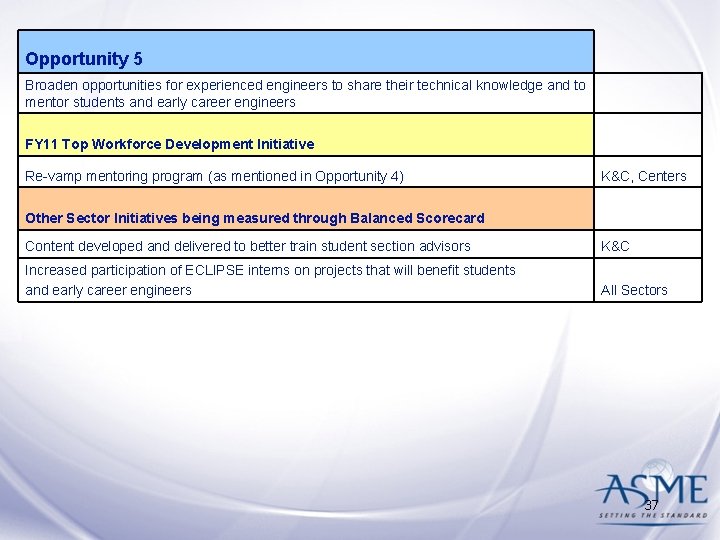
Opportunity 5 Broaden opportunities for experienced engineers to share their technical knowledge and to mentor students and early career engineers FY 11 Top Workforce Development Initiative Re-vamp mentoring program (as mentioned in Opportunity 4) K&C, Centers Other Sector Initiatives being measured through Balanced Scorecard Content developed and delivered to better train student section advisors K&C Increased participation of ECLIPSE interns on projects that will benefit students and early career engineers All Sectors 37
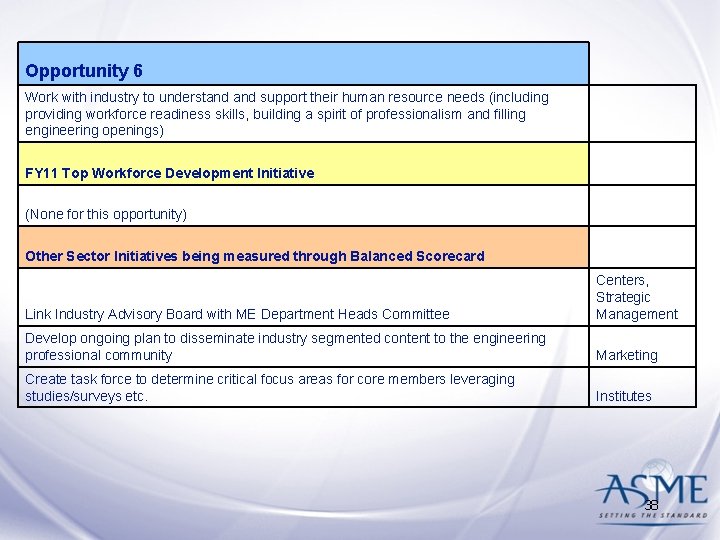
Opportunity 6 Work with industry to understand support their human resource needs (including providing workforce readiness skills, building a spirit of professionalism and filling engineering openings) FY 11 Top Workforce Development Initiative (None for this opportunity) Other Sector Initiatives being measured through Balanced Scorecard Link Industry Advisory Board with ME Department Heads Committee Centers, Strategic Management Develop ongoing plan to disseminate industry segmented content to the engineering professional community Marketing Create task force to determine critical focus areas for core members leveraging studies/surveys etc. Institutes 38
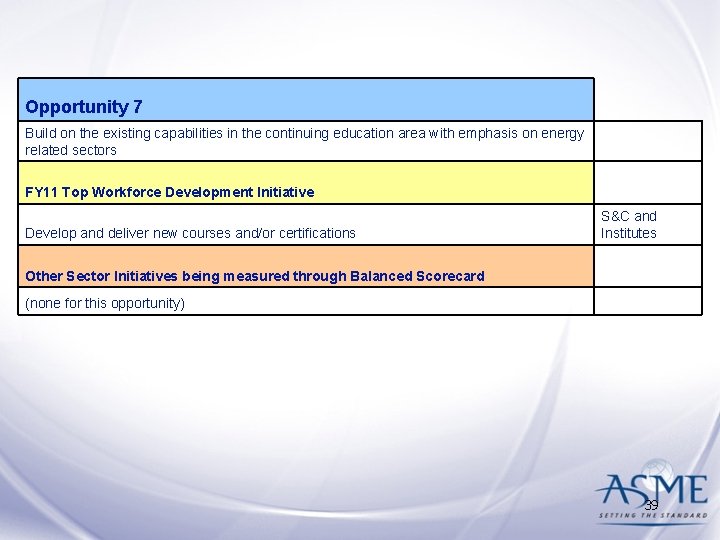
Opportunity 7 Build on the existing capabilities in the continuing education area with emphasis on energy related sectors FY 11 Top Workforce Development Initiative Develop and deliver new courses and/or certifications S&C and Institutes Other Sector Initiatives being measured through Balanced Scorecard (none for this opportunity) 39
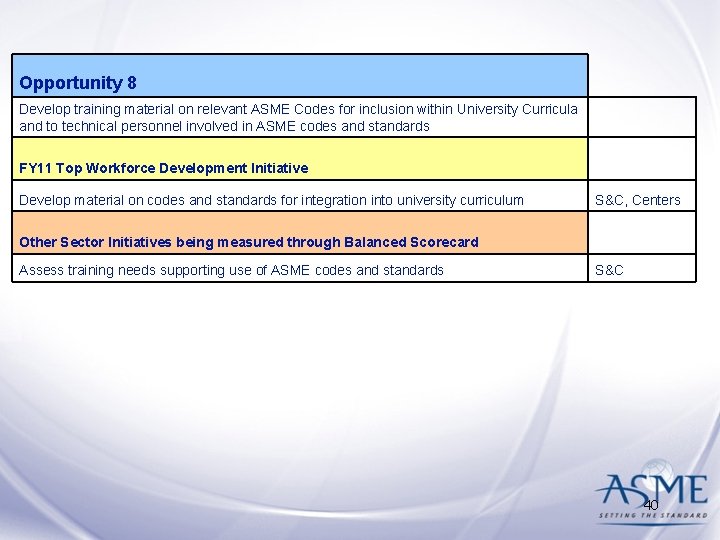
Opportunity 8 Develop training material on relevant ASME Codes for inclusion within University Curricula and to technical personnel involved in ASME codes and standards FY 11 Top Workforce Development Initiative Develop material on codes and standards for integration into university curriculum S&C, Centers Other Sector Initiatives being measured through Balanced Scorecard Assess training needs supporting use of ASME codes and standards S&C 40
Appendix 5: Portfolio of Existing ASME Programs 41
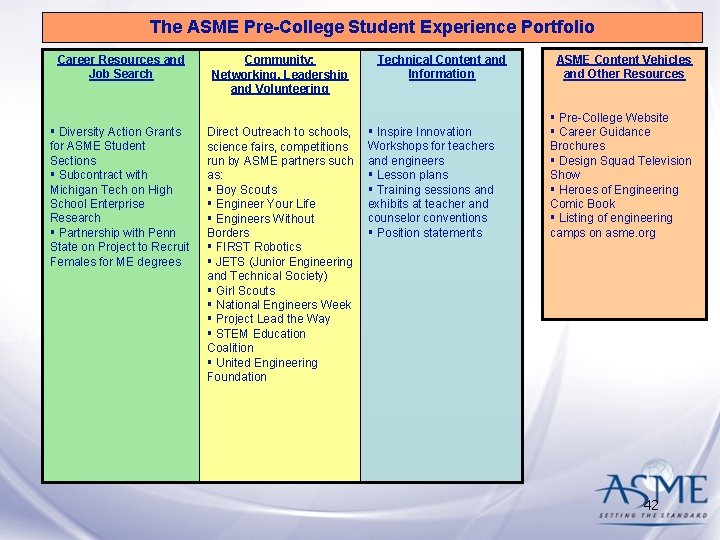
The ASME Pre-College Student Experience Portfolio Career Resources and Job Search § Diversity Action Grants for ASME Student Sections § Subcontract with Michigan Tech on High School Enterprise Research § Partnership with Penn State on Project to Recruit Females for ME degrees Community: Networking, Leadership and Volunteering Direct Outreach to schools, science fairs, competitions run by ASME partners such as: § Boy Scouts § Engineer Your Life § Engineers Without Borders § FIRST Robotics § JETS (Junior Engineering and Technical Society) § Girl Scouts § National Engineers Week § Project Lead the Way § STEM Education Coalition § United Engineering Foundation Technical Content and Information § Inspire Innovation Workshops for teachers and engineers § Lesson plans § Training sessions and exhibits at teacher and counselor conventions § Position statements ASME Content Vehicles and Other Resources § Pre-College Website § Career Guidance Brochures § Design Squad Television Show § Heroes of Engineering Comic Book § Listing of engineering camps on asme. org 42
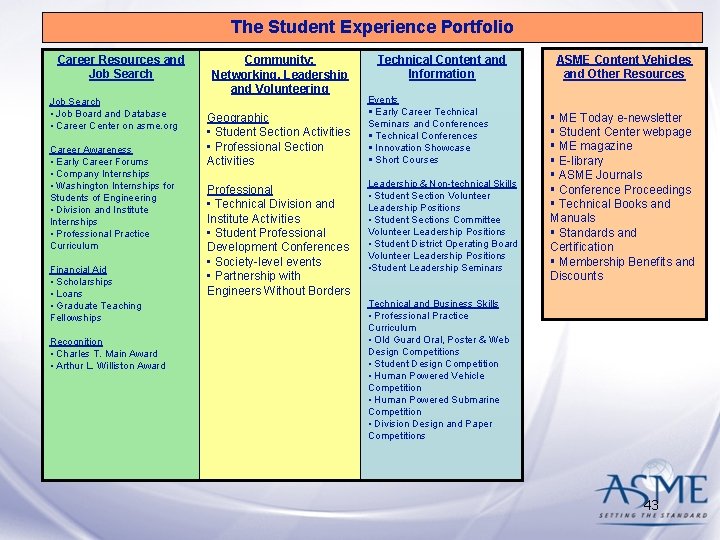
The Student Experience Portfolio Career Resources and Job Search • Job Board and Database • Career Center on asme. org Career Awareness • Early Career Forums • Company Internships • Washington Internships for Students of Engineering • Division and Institute Internships • Professional Practice Curriculum Financial Aid • Scholarships • Loans • Graduate Teaching Fellowships Recognition • Charles T. Main Award • Arthur L. Williston Award Community: Networking, Leadership and Volunteering Geographic • Student Section Activities • Professional Section Activities Professional • Technical Division and Institute Activities • Student Professional Development Conferences • Society-level events • Partnership with Engineers Without Borders Technical Content and Information Events § Early Career Technical Seminars and Conferences § Technical Conferences § Innovation Showcase § Short Courses Leadership & Non-technical Skills • Student Section Volunteer Leadership Positions • Student Sections Committee Volunteer Leadership Positions • Student District Operating Board Volunteer Leadership Positions • Student Leadership Seminars ASME Content Vehicles and Other Resources § ME Today e-newsletter § Student Center webpage § ME magazine § E-library § ASME Journals § Conference Proceedings § Technical Books and Manuals § Standards and Certification § Membership Benefits and Discounts Technical and Business Skills • Professional Practice Curriculum • Old Guard Oral, Poster & Web Design Competitions • Student Design Competition • Human Powered Vehicle Competition • Human Powered Submarine Competition • Division Design and Paper Competitions 43
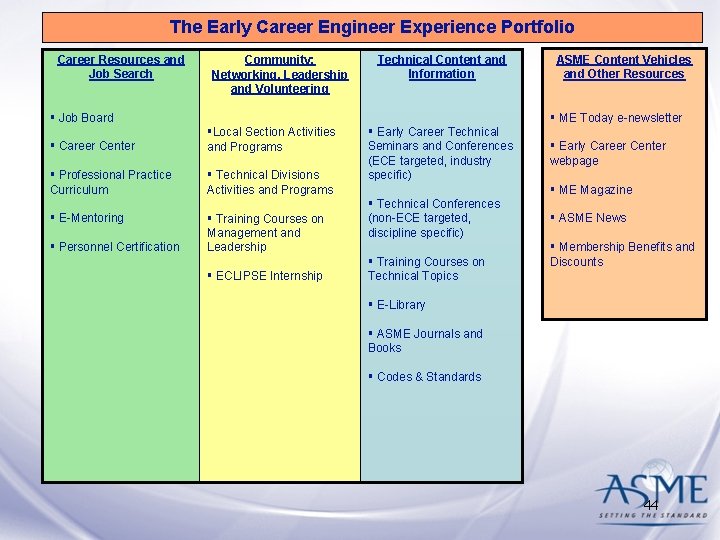
The Early Career Engineer Experience Portfolio Career Resources and Job Search Community: Networking, Leadership and Volunteering Technical Content and Information § Job Board § ME Today e-newsletter § Career Center §Local Section Activities and Programs § Professional Practice Curriculum § Technical Divisions Activities and Programs § E-Mentoring § Training Courses on Management and Leadership § Personnel Certification ASME Content Vehicles and Other Resources § ECLIPSE Internship § Early Career Technical Seminars and Conferences (ECE targeted, industry specific) § Early Career Center webpage § ME Magazine § Technical Conferences (non-ECE targeted, discipline specific) § Training Courses on Technical Topics § ASME News § Membership Benefits and Discounts § E-Library § ASME Journals and Books § Codes & Standards 44
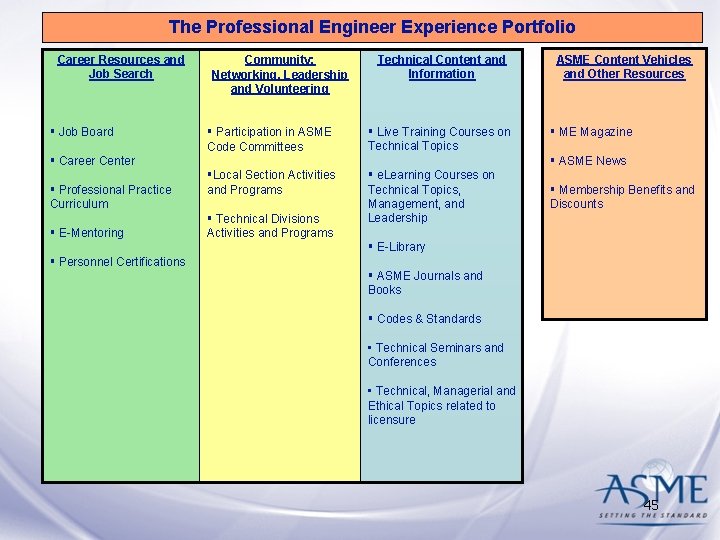
The Professional Engineer Experience Portfolio Career Resources and Job Search § Job Board Community: Networking, Leadership and Volunteering Technical Content and Information § Participation in ASME Code Committees § Live Training Courses on Technical Topics §Local Section Activities and Programs § e. Learning Courses on Technical Topics, Management, and Leadership § Career Center § Professional Practice Curriculum § E-Mentoring ASME Content Vehicles and Other Resources § ME Magazine § ASME News § Technical Divisions Activities and Programs § Membership Benefits and Discounts § E-Library § Personnel Certifications § ASME Journals and Books § Codes & Standards • Technical Seminars and Conferences • Technical, Managerial and Ethical Topics related to licensure 45
Appendix 6: Data on Engineering Enrollments and ASME Student, Early Career Participation and Training and Development 46
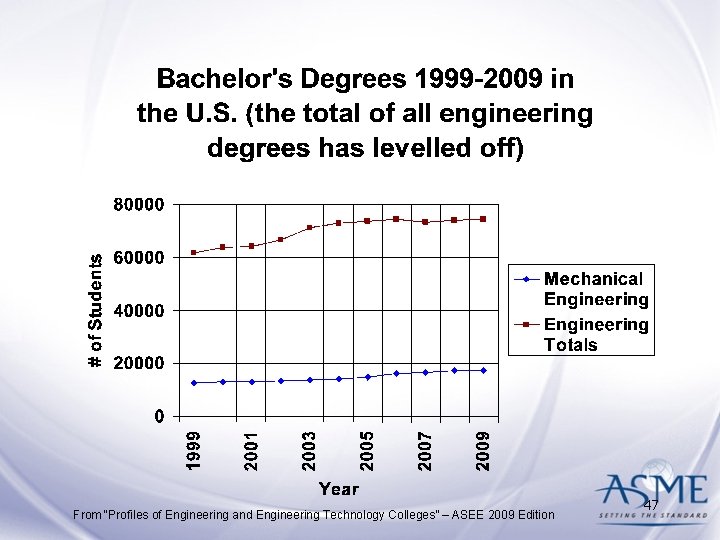
From “Profiles of Engineering and Engineering Technology Colleges” – ASEE 2009 Edition 47
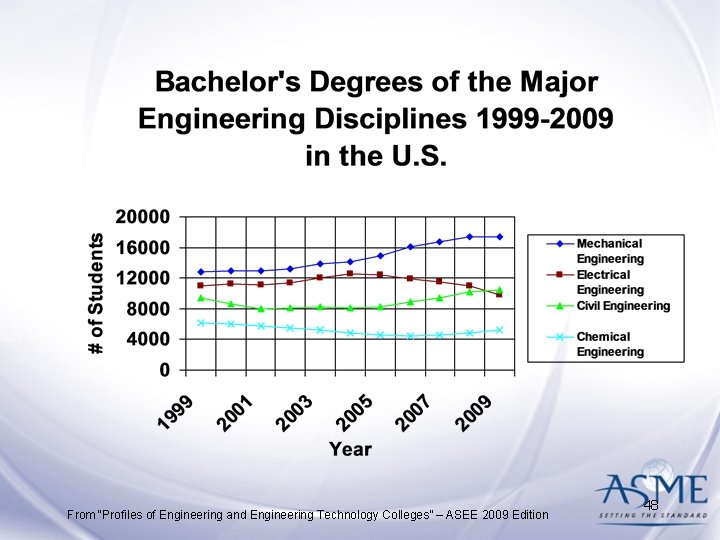
From “Profiles of Engineering and Engineering Technology Colleges” – ASEE 2009 Edition 48
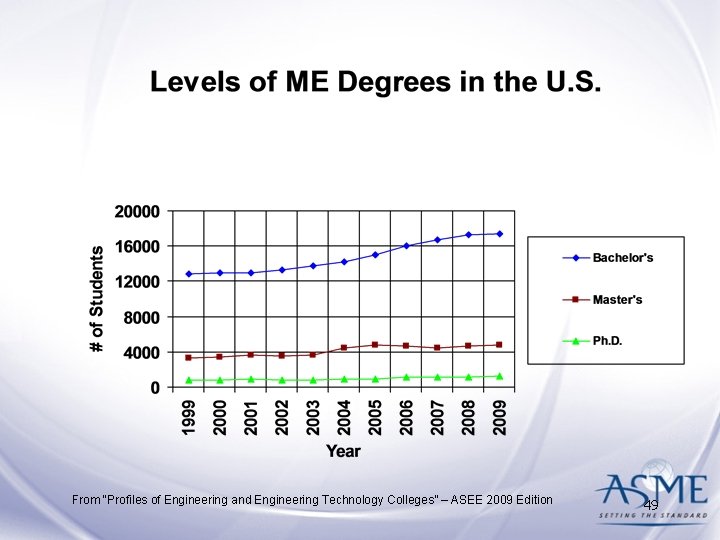
From “Profiles of Engineering and Engineering Technology Colleges” – ASEE 2009 Edition 49
From “Science and Engineering Indicators 2010, ” National Science Foundation 50
From “Science and Engineering Indicators 2010, ” National Science Foundation (data from India was not included in this study) 51
52
53
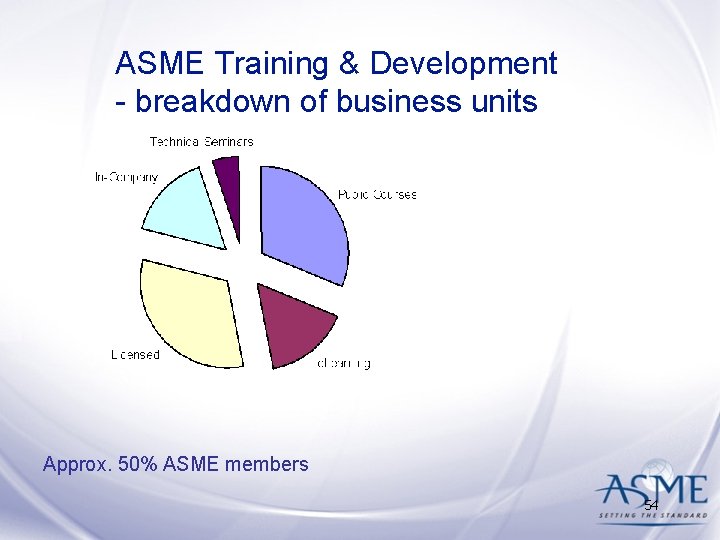
ASME Training & Development - breakdown of business units Approx. 50% ASME members 54
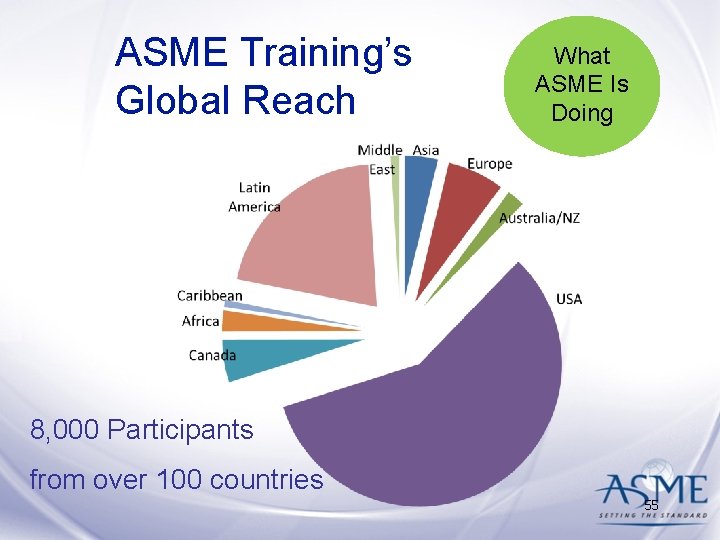
ASME Training’s Global Reach What ASME Is Doing 8, 000 Participants from over 100 countries 55
Appendix 7: Bullet Points from Voice of the Customer Survey 56
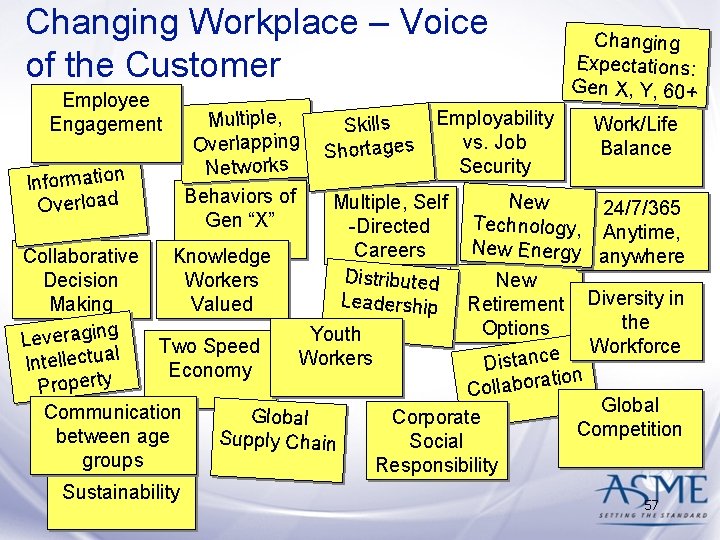
Changing Workplace – Voice of the Customer Employee Engagement Information Overload Multiple, Skills Overlapping Shortages Networks Employability vs. Job Security Changing Expectations: Gen X, Y, 60+ Work/Life Balance Behaviors of Gen “X” New Multiple, Self 24/7/365 Technology, Anytime, -Directed New Energy anywhere Careers Collaborative Knowledge Distributed New Decision Workers Leadership Retirement Diversity in Making Valued the Options g n i g Youth a r e Lev Two Speed Workforce l a e u c t n c Workers e a l t l Dis Inte Economy ation r o b a l Property l o C Global Communication Global Corporate Competition between age Supply Chain Social groups Responsibility Sustainability 57