
Engineering Using Newtons Laws of Motion Strandbeest An
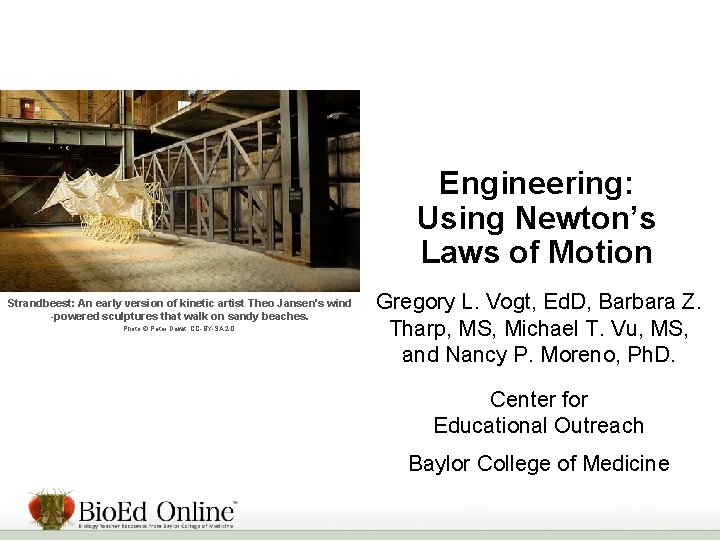
Engineering: Using Newton’s Laws of Motion Strandbeest: An early version of kinetic artist Theo Jansen's wind -powered sculptures that walk on sandy beaches. Photo © Peter Dewit. CC-BY-SA 2. 0. Gregory L. Vogt, Ed. D, Barbara Z. Tharp, MS, Michael T. Vu, MS, and Nancy P. Moreno, Ph. D. Center for Educational Outreach Baylor College of Medicine
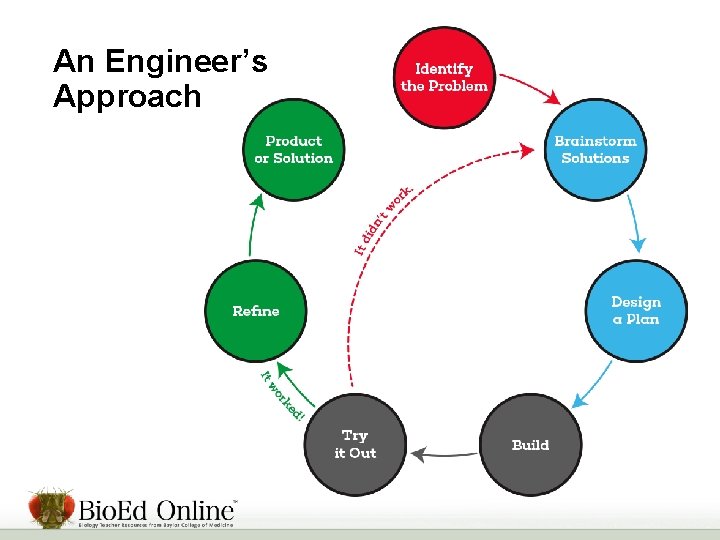
An Engineer’s Approach
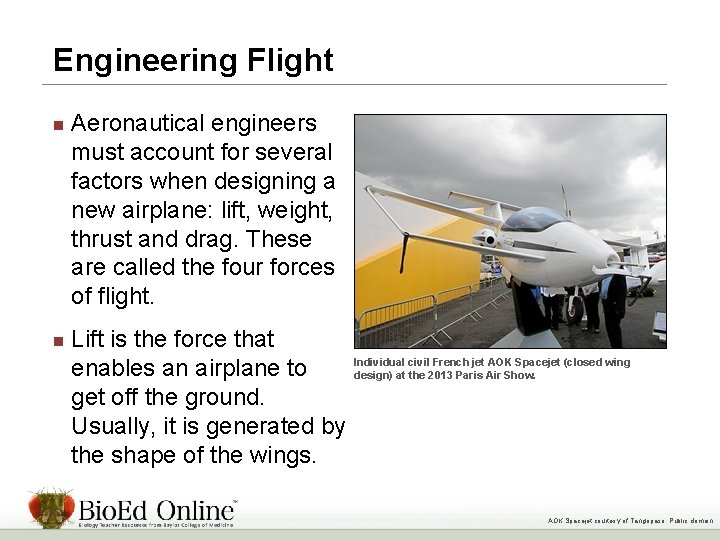
Engineering Flight n n Aeronautical engineers must account for several factors when designing a new airplane: lift, weight, thrust and drag. These are called the four forces of flight. Lift is the force that enables an airplane to get off the ground. Usually, it is generated by the shape of the wings. Individual civil French jet AOK Spacejet (closed wing design) at the 2013 Paris Air Show. AOK Spacejet courtesy of Tangopaso. Public domain.
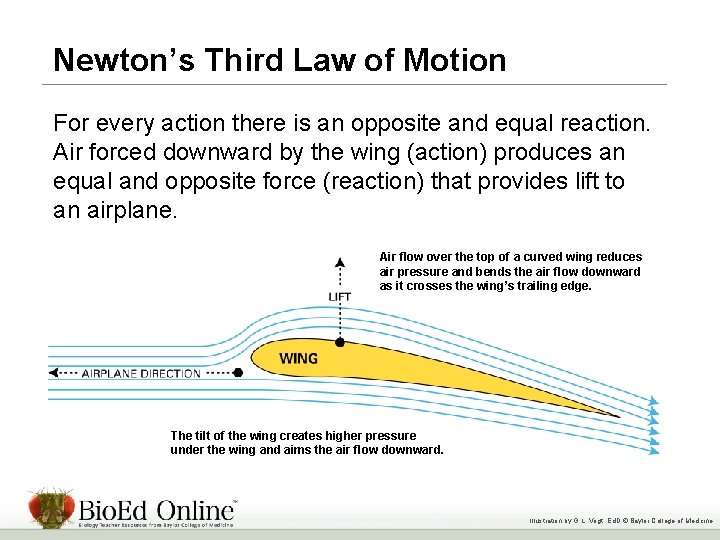
Newton’s Third Law of Motion For every action there is an opposite and equal reaction. Air forced downward by the wing (action) produces an equal and opposite force (reaction) that provides lift to an airplane. Air flow over the top of a curved wing reduces air pressure and bends the air flow downward as it crosses the wing’s trailing edge. The tilt of the wing creates higher pressure under the wing and aims the air flow downward. Illustration by G. L. Vogt, Ed. D © Baylor College of Medicine.
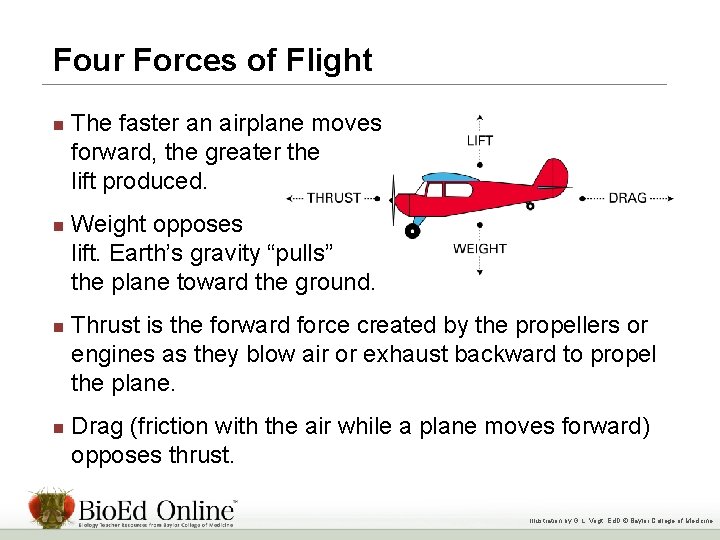
Four Forces of Flight n n The faster an airplane moves forward, the greater the lift produced. Weight opposes lift. Earth’s gravity “pulls” the plane toward the ground. Thrust is the forward force created by the propellers or engines as they blow air or exhaust backward to propel the plane. Drag (friction with the air while a plane moves forward) opposes thrust. Illustration by G. L. Vogt, Ed. D © Baylor College of Medicine.
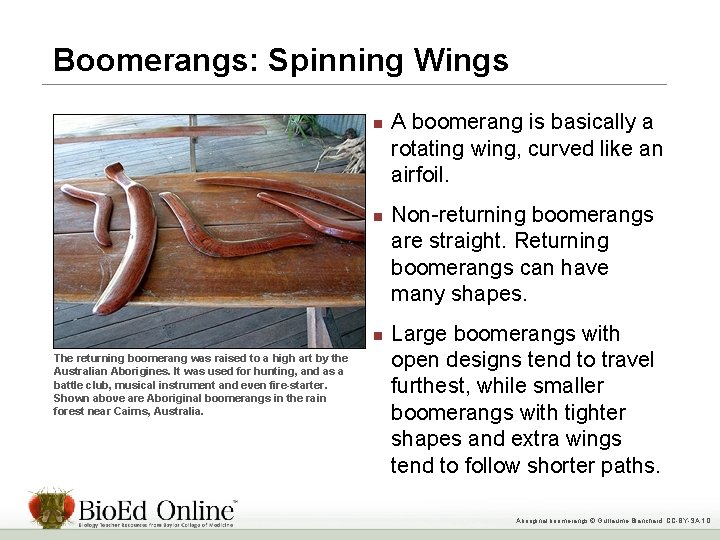
Boomerangs: Spinning Wings n n n The returning boomerang was raised to a high art by the Australian Aborigines. It was used for hunting, and as a battle club, musical instrument and even fire-starter. Shown above are Aboriginal boomerangs in the rain forest near Cairns, Australia. A boomerang is basically a rotating wing, curved like an airfoil. Non-returning boomerangs are straight. Returning boomerangs can have many shapes. Large boomerangs with open designs tend to travel furthest, while smaller boomerangs with tighter shapes and extra wings tend to follow shorter paths. Aboriginal boomerangs © Guillaume Blanchard. CC-BY-SA 1. 0.
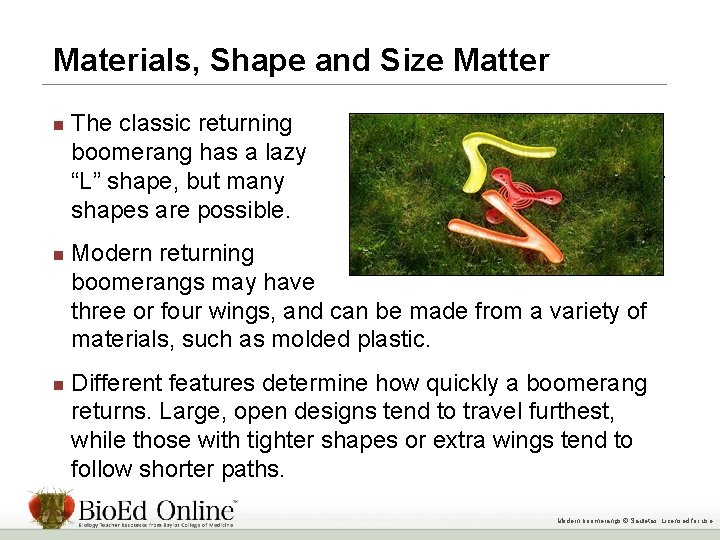
Materials, Shape and Size Matter n n n The classic returning boomerang has a lazy “L” shape, but many shapes are possible. other Modern returning boomerangs may have three or four wings, and can be made from a variety of materials, such as molded plastic. Different features determine how quickly a boomerang returns. Large, open designs tend to travel furthest, while those with tighter shapes or extra wings tend to follow shorter paths. Modern boomerangs © Sauletas. Licensed for use.
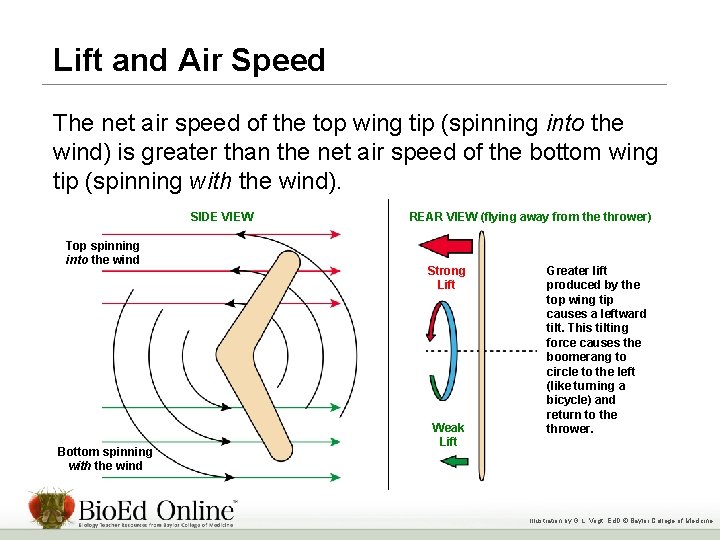
Lift and Air Speed The net air speed of the top wing tip (spinning into the wind) is greater than the net air speed of the bottom wing tip (spinning with the wind). SIDE VIEW Top spinning into the wind Bottom spinning with the wind REAR VIEW (flying away from the thrower) Strong Lift Weak Lift Greater lift produced by the top wing tip causes a leftward tilt. This tilting force causes the boomerang to circle to the left (like turning a bicycle) and return to the thrower. Illustration by G. L. Vogt, Ed. D © Baylor College of Medicine.
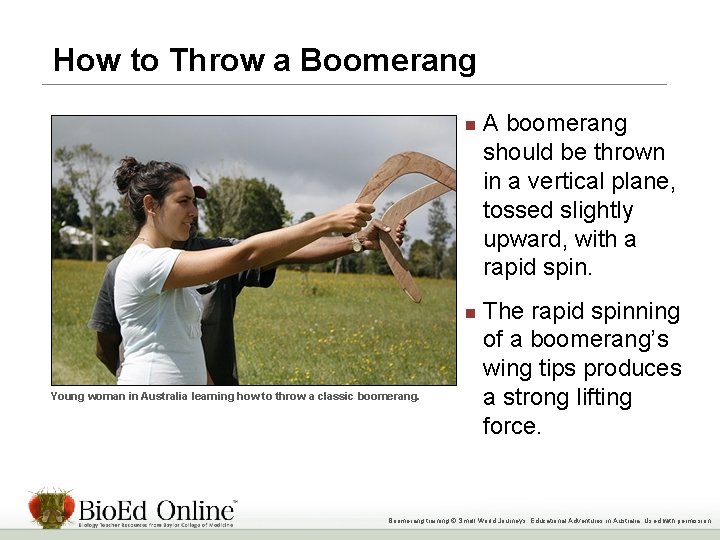
How to Throw a Boomerang n n Young woman in Australia learning how to throw a classic boomerang. A boomerang should be thrown in a vertical plane, tossed slightly upward, with a rapid spin. The rapid spinning of a boomerang’s wing tips produces a strong lifting force. Boomerang training © Small World Journeys: Educational Adventures in Australia. Used with permission.
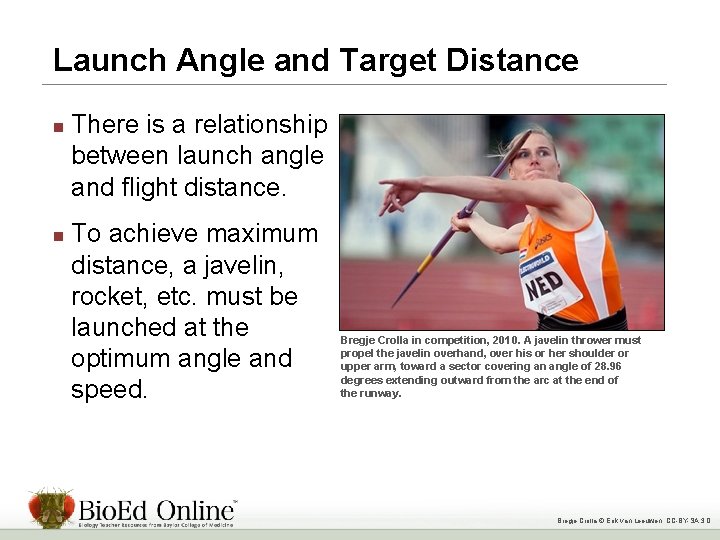
Launch Angle and Target Distance n n There is a relationship between launch angle and flight distance. To achieve maximum distance, a javelin, rocket, etc. must be launched at the optimum angle and speed. Bregje Crolla in competition, 2010. A javelin thrower must propel the javelin overhand, over his or her shoulder or upper arm, toward a sector covering an angle of 28. 96 degrees extending outward from the arc at the end of the runway. Bregje Crolla © Erik van Leeuwen. CC-BY-SA 3. 0.
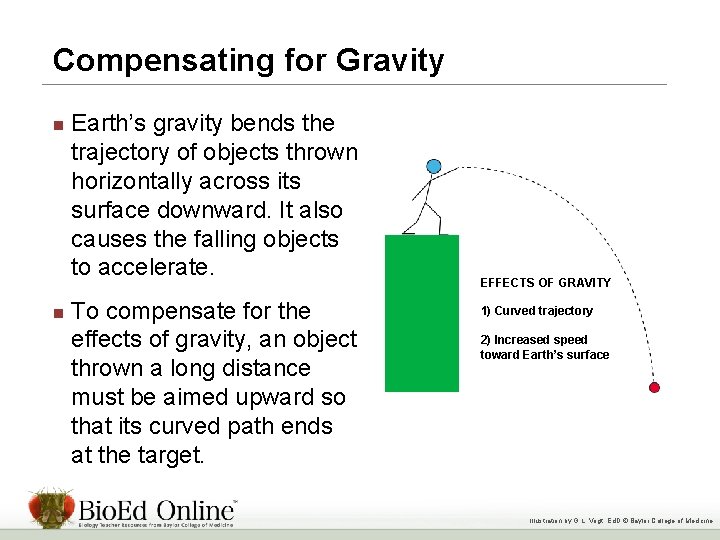
Compensating for Gravity n n Earth’s gravity bends the trajectory of objects thrown horizontally across its surface downward. It also causes the falling objects to accelerate. To compensate for the effects of gravity, an object thrown a long distance must be aimed upward so that its curved path ends at the target. EFFECTS OF GRAVITY 1) Curved trajectory 2) Increased speed toward Earth’s surface Illustration by G. L. Vogt, Ed. D © Baylor College of Medicine.
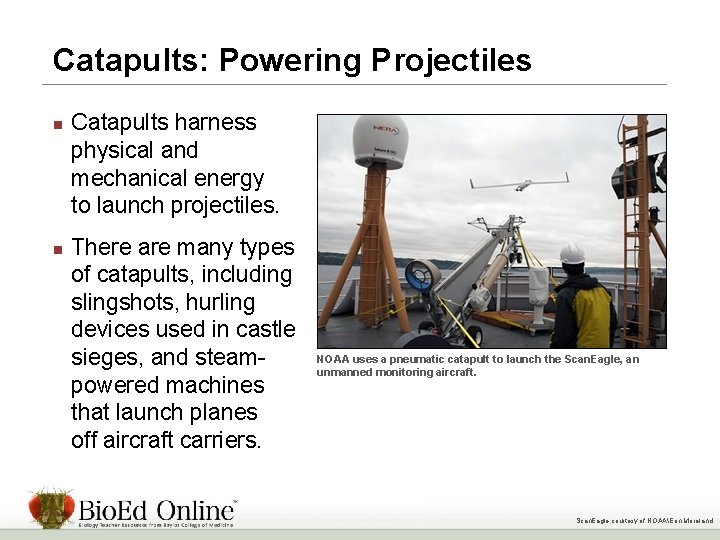
Catapults: Powering Projectiles n n Catapults harness physical and mechanical energy to launch projectiles. There are many types of catapults, including slingshots, hurling devices used in castle sieges, and steampowered machines that launch planes off aircraft carriers. such as NOAA uses a pneumatic catapult to launch the Scan. Eagle, an unmanned monitoring aircraft. Scan. Eagle courtesy of NOAAErin Moreland.
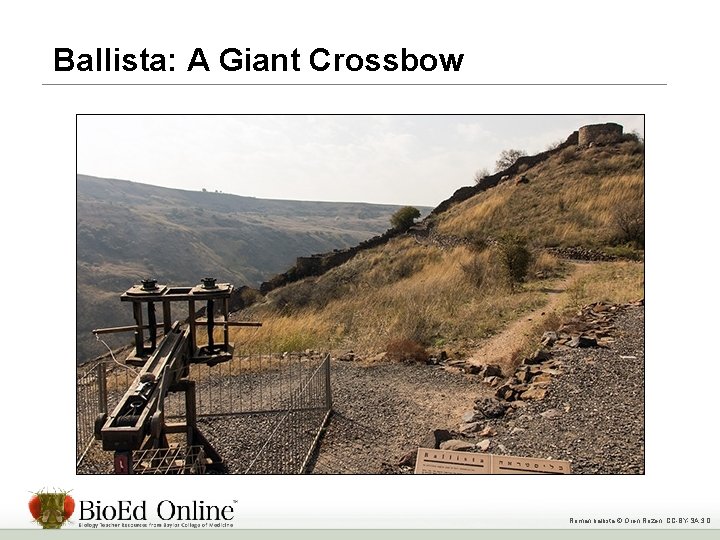
Ballista: A Giant Crossbow Roman ballista © Oren Rozen. CC-BY-SA 3. 0.
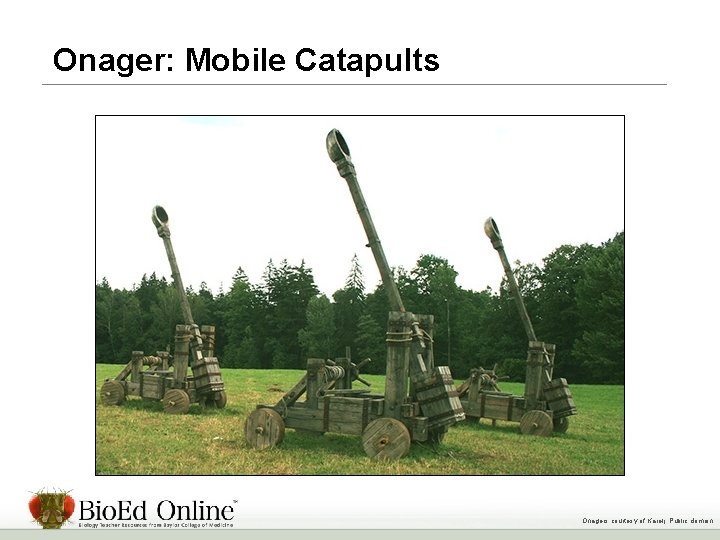
Onager: Mobile Catapults Onagers courtesy of Karelj. Public domain.
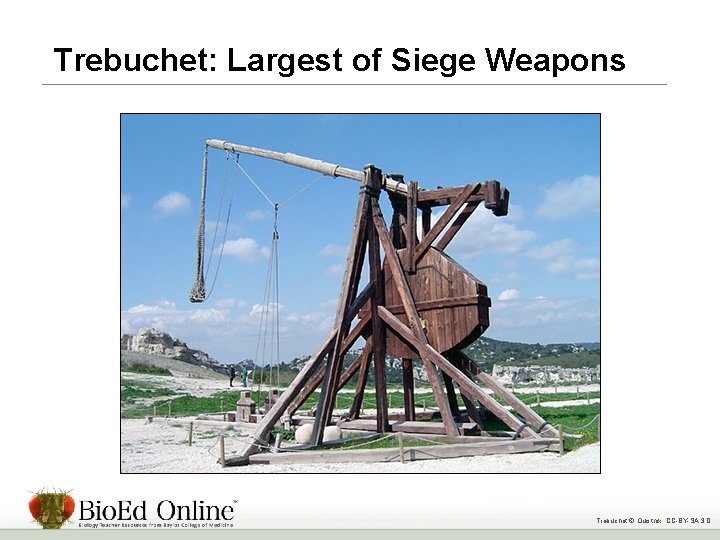
Trebuchet: Largest of Siege Weapons Trebuchet © Quistnix. CC-BY-SA 3. 0.
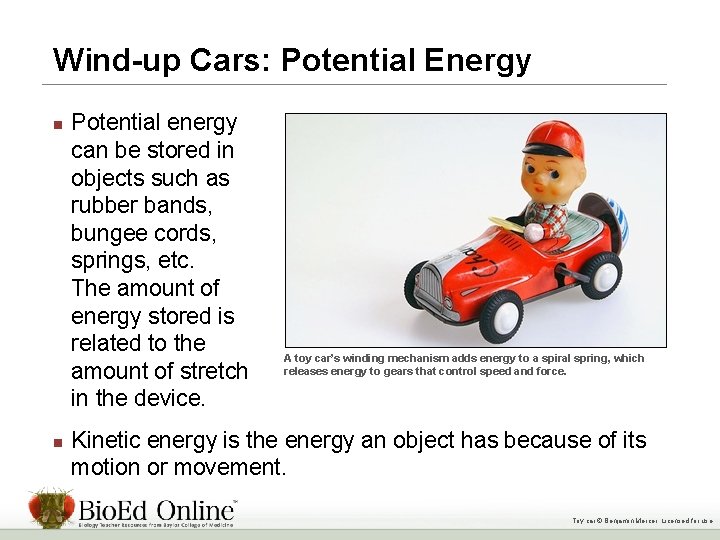
Wind-up Cars: Potential Energy n n Potential energy can be stored in objects such as rubber bands, bungee cords, springs, etc. The amount of energy stored is related to the amount of stretch in the device. A toy car’s winding mechanism adds energy to a spiral spring, which releases energy to gears that control speed and force. Kinetic energy is the energy an object has because of its motion or movement. Toy car © Benjamin Mercer. Licensed for use.
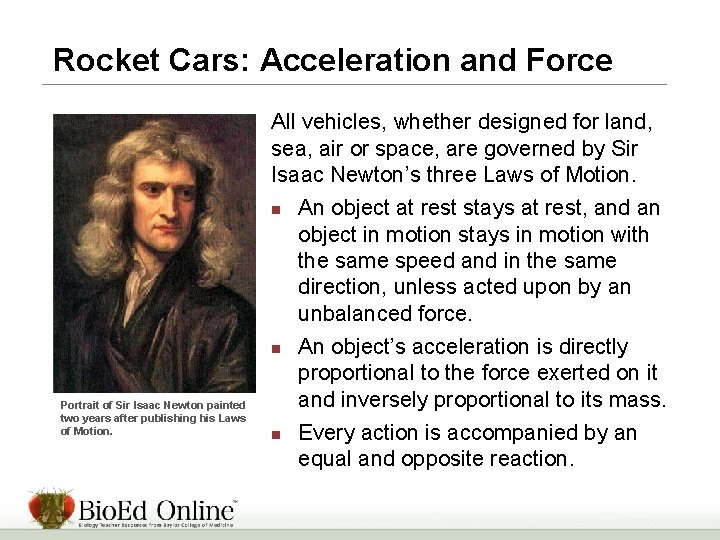
Rocket Cars: Acceleration and Force Portrait of Sir Isaac Newton painted two years after publishing his Laws of Motion. All vehicles, whether designed for land, sea, air or space, are governed by Sir Isaac Newton’s three Laws of Motion. n An object at rest stays at rest, and an object in motion stays in motion with the same speed and in the same direction, unless acted upon by an unbalanced force. n An object’s acceleration is directly proportional to the force exerted on it and inversely proportional to its mass. n Every action is accompanied by an equal and opposite reaction.
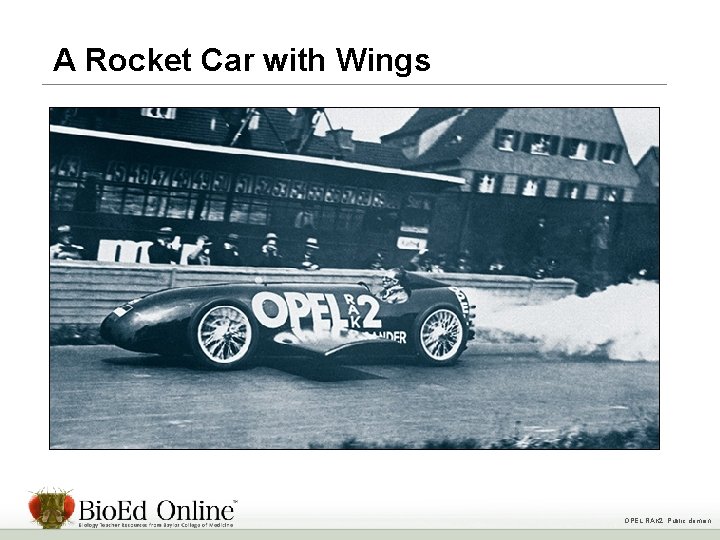
A Rocket Car with Wings OPEL RAK 2: Public domain.
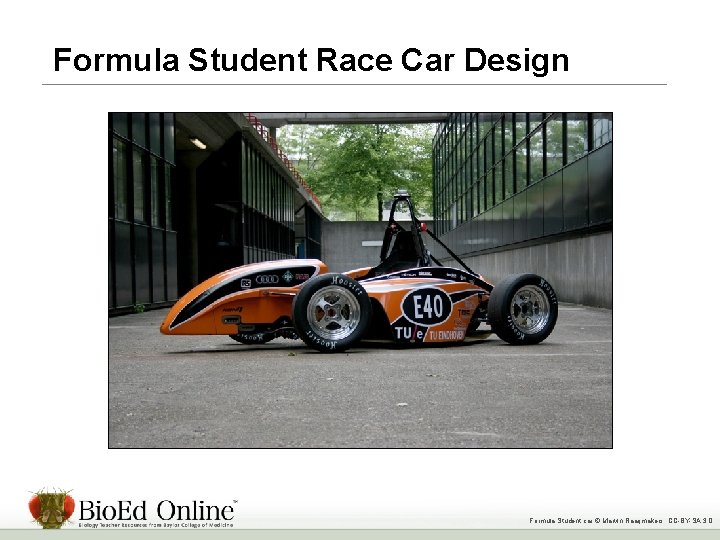
Formula Student Race Car Design Formula Student car © Marvin Raaijmakers, CC-BY-SA 3. 0.
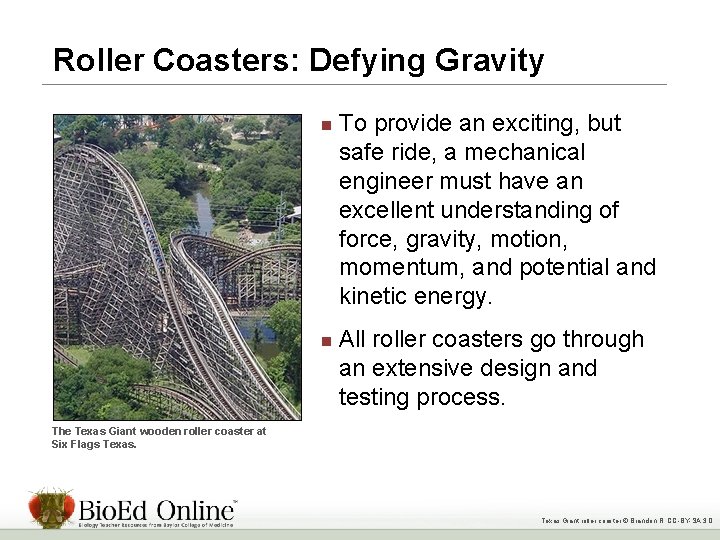
Roller Coasters: Defying Gravity n n To provide an exciting, but safe ride, a mechanical engineer must have an excellent understanding of force, gravity, motion, momentum, and potential and kinetic energy. All roller coasters go through an extensive design and testing process. The Texas Giant wooden roller coaster at Six Flags Texas Giant roller coaster © Brandon R. CC-BY-SA 3. 0.
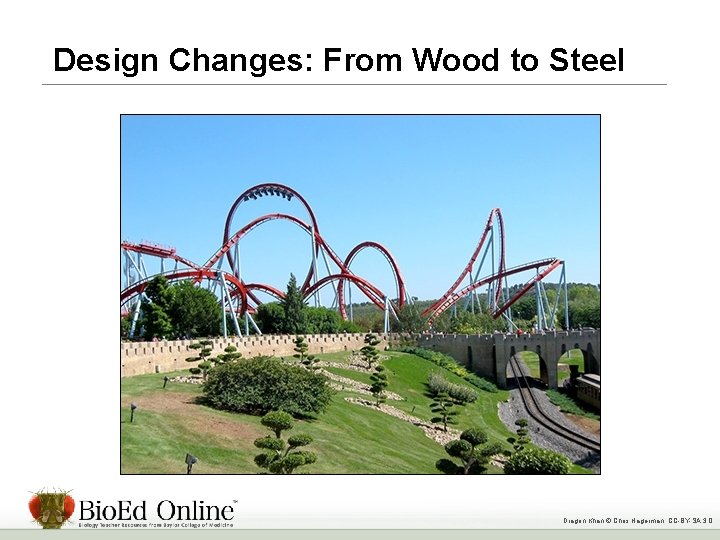
Design Changes: From Wood to Steel Dragon Khan © Chris Hagerman. CC-BY-SA 3. 0.
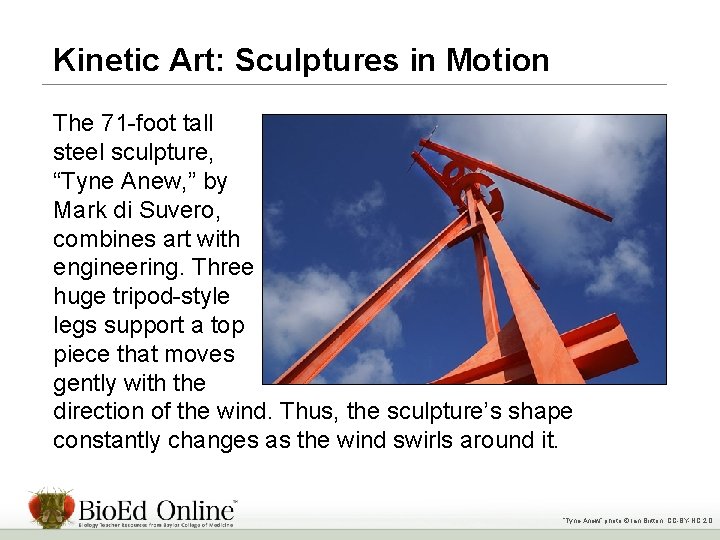
Kinetic Art: Sculptures in Motion The 71 -foot tall steel sculpture, “Tyne Anew, ” by Mark di Suvero, combines art with engineering. Three huge tripod-style legs support a top piece that moves gently with the direction of the wind. Thus, the sculpture’s shape constantly changes as the wind swirls around it. “Tyne Anew” photo © Ian Britton. CC-BY-NC 2. 0.
Artists as Engineers Anthony Howe’s Otherworldly Theo Jansen: Kinetic Sculptures Strandbeest Evolution http: //www. youtube. com/watch? v=Rsh. Sa. F_ju. Gs http: //www. youtube. com/watch? v=MYGJ 9 jrbpvg Kinetic Sculptor Puts Cyber Dreams in Motion Theo Jansen’s Strandbeests http: //www. youtube. com/watch? v=HSKy. Hmjyrk. A http: //www. youtube. com/watch? v=Fo. M 8 Uo. Muvl 8 Reuben Margolin http: //www. youtube. com/watch? v=deh. Xio-MIKg 0 Reuben Heyday Margolin: Waves http: //www. reubenmargolin. com Time-Lapse: Mark Di Suvero Installation http: //www. sfmoma. org/explore/multimedia/videos/563
- Slides: 23