
Engineering Systems Chapter 1 Introduction Systems Electrical and
- Slides: 17
Engineering Systems Chapter 1 § Introduction § Systems § Electrical and Electronic Systems § System Inputs and Outputs § Physical Quantities and Electrical Signals § System Block Diagrams Storey: Electrical & Electronic Systems © Pearson Education Limited 2004 OHT 1. 1
Introduction 1. 1 § Engineering is inherently interdisciplinary § Electrical and Electronic Systems represent a major enabling technology – important to all engineers and scientist § A systems approach to engineering – combines: § a systematic/top-down approach § a systemic approach Storey: Electrical & Electronic Systems © Pearson Education Limited 2004 OHT 1. 2
Systems 1. 2 § A system can be defined as Any closed volume for which all the inputs and output are known § Examples include: – – an engine management system an automotive system a transportation system an ecosystem § Inputs and outputs will reflect the nature of the system Storey: Electrical & Electronic Systems © Pearson Education Limited 2004 OHT 1. 3
Electrical and Electronic Systems 1. 3 § Basic functions include elements concerned with the manipulation of electrical energy § Common functions are: – – – generation transmission of communication control or processing utilisation storage Storey: Electrical & Electronic Systems © Pearson Education Limited 2004 OHT 1. 4
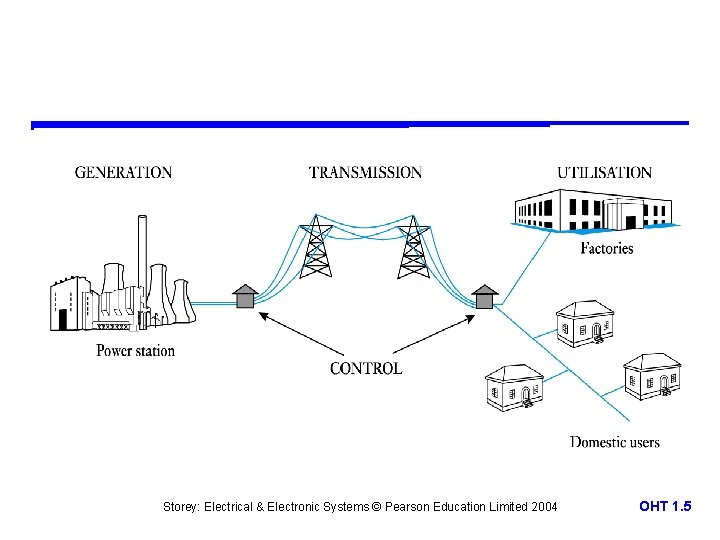
§ An example – a power distribution system Storey: Electrical & Electronic Systems © Pearson Education Limited 2004 OHT 1. 5
§ System examples – electrical and electronic systems often fall within a range of categories, such as those responsible for: § § § power generation and distribution monitoring of some equipment or process control of some equipment or process signal processing communications Storey: Electrical & Electronic Systems © Pearson Education Limited 2004 OHT 1. 6
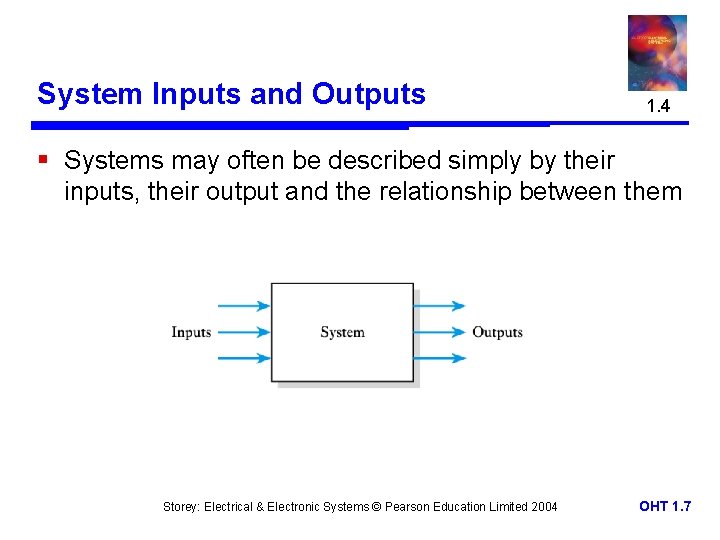
System Inputs and Outputs 1. 4 § Systems may often be described simply by their inputs, their output and the relationship between them Storey: Electrical & Electronic Systems © Pearson Education Limited 2004 OHT 1. 7
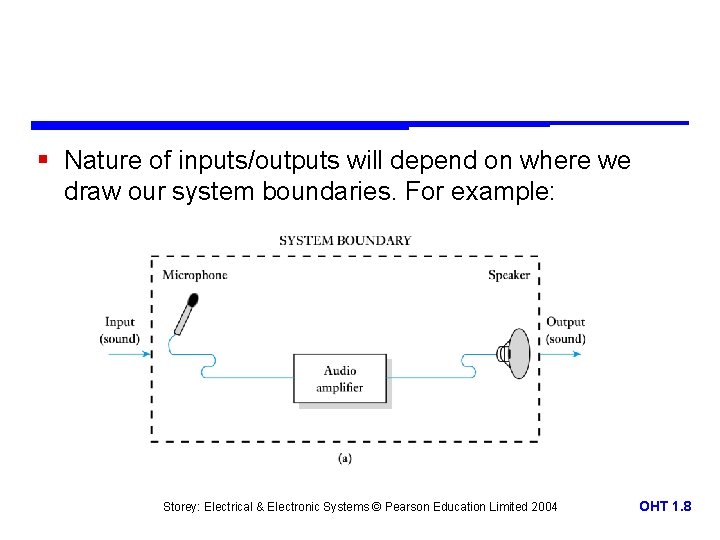
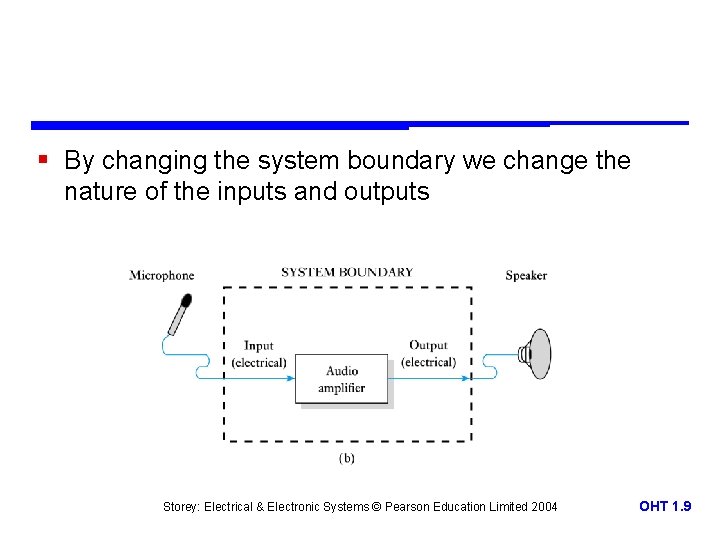
§ Nature of inputs/outputs will depend on where we draw our system boundaries. For example: Storey: Electrical & Electronic Systems © Pearson Education Limited 2004 OHT 1. 8
§ By changing the system boundary we change the nature of the inputs and outputs Storey: Electrical & Electronic Systems © Pearson Education Limited 2004 OHT 1. 9
§ Components that interact with the outside world are termed sensors and actuators – in the previous example the microphone represents a sensor – in the previous example the loudspeaker represents an actuator § We will look at sensors and actuators in more detail in later lectures Storey: Electrical & Electronic Systems © Pearson Education Limited 2004 OHT 1. 10
Physical Quantities & Electrical Signals 1. 5 § The world about us is characterised by a number of physical properties or quantities – e. g. temperature, pressure, humidity, etc. § Physical quantities may be continuous or discrete. § Continuous quantities change smoothly and can take an infinite number of values § Discrete quantities change abruptly from one value to another. – most real-world quantities are continuous – many man-made quantities are discrete Storey: Electrical & Electronic Systems © Pearson Education Limited 2004 OHT 1. 11
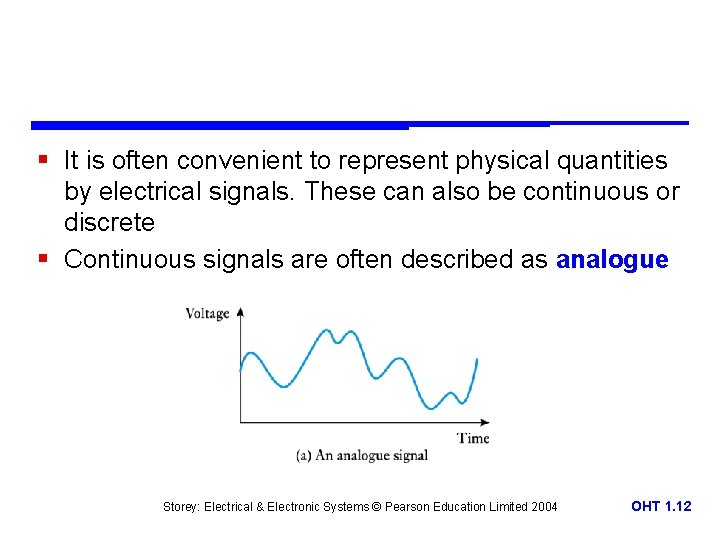
§ It is often convenient to represent physical quantities by electrical signals. These can also be continuous or discrete § Continuous signals are often described as analogue Storey: Electrical & Electronic Systems © Pearson Education Limited 2004 OHT 1. 12
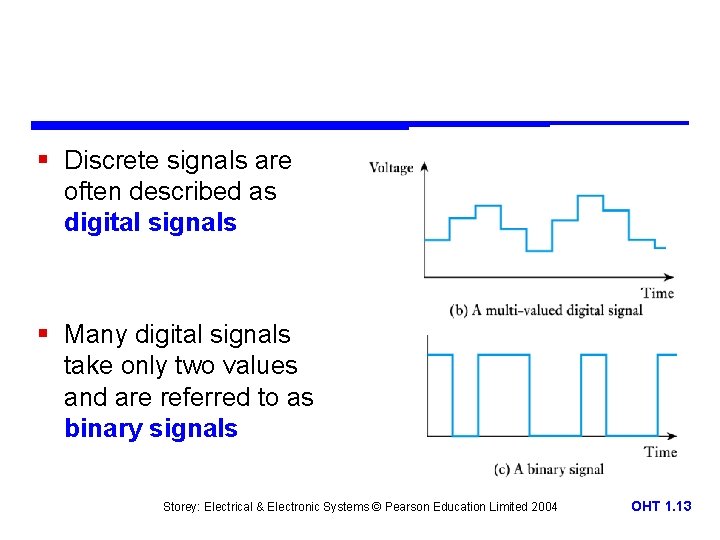
§ Discrete signals are often described as digital signals § Many digital signals take only two values and are referred to as binary signals Storey: Electrical & Electronic Systems © Pearson Education Limited 2004 OHT 1. 13
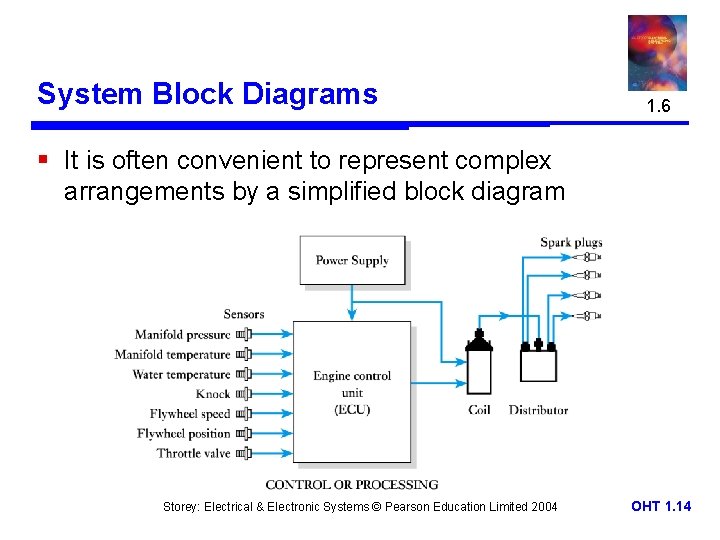
System Block Diagrams 1. 6 § It is often convenient to represent complex arrangements by a simplified block diagram Storey: Electrical & Electronic Systems © Pearson Education Limited 2004 OHT 1. 14
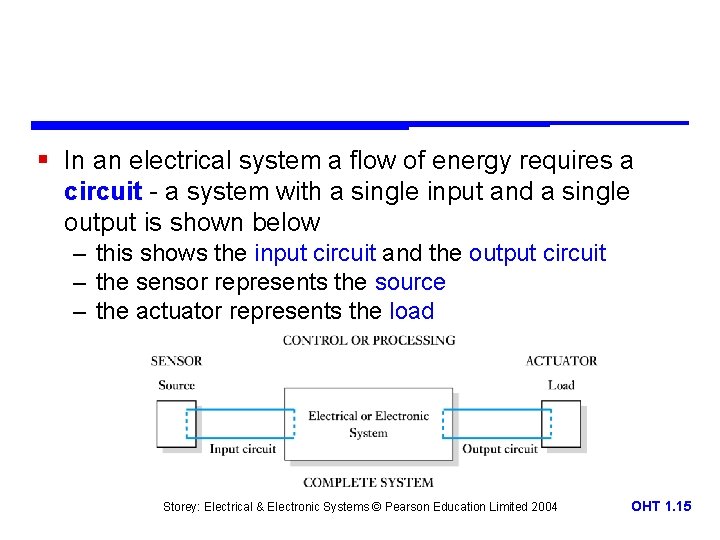
§ In an electrical system a flow of energy requires a circuit - a system with a single input and a single output is shown below – this shows the input circuit and the output circuit – the sensor represents the source – the actuator represents the load Storey: Electrical & Electronic Systems © Pearson Education Limited 2004 OHT 1. 15
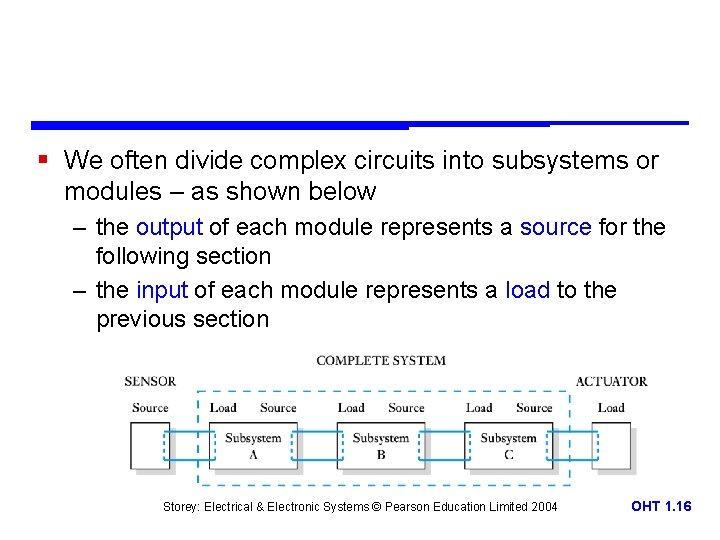
§ We often divide complex circuits into subsystems or modules – as shown below – the output of each module represents a source for the following section – the input of each module represents a load to the previous section Storey: Electrical & Electronic Systems © Pearson Education Limited 2004 OHT 1. 16
Key Points § Engineering is inherently interdisciplinary § Engineers often adopt a ‘systems approach’ § Systems may be defined by their inputs, their outputs and the relationship between them § Systems interact with the world using sensors and actuators § Physical quantities can be either continuous or discrete § Physical quantities are often represented by signals § Complex systems are often represented by block diagrams Storey: Electrical & Electronic Systems © Pearson Education Limited 2004 OHT 1. 17