
Engineering Surveying Curve Ranging By Mohd Arif Sulaiman
Engineering Surveying Curve Ranging By Mohd Arif Sulaiman Faculty of Civil Engineering & Earth Resources mdarif@ump. edu Introduction To Survey Engineering, by Mohd Arif
Chapter Description Expected Outcomes • Able to make necessary calculation to fix positions of foaming a horizontal and vertical curve. References • Barry F. Kavanagh, "Surveying with Construction Application", 0 -13 -048215 -3 Pearson, Prentice Halll, 2004. • Bannister, Raymond, Baker, "Surveying", 0 -582 -302498, Prentice Hall 1998. • William Irvine, "Surveying for Construction", 4 th Ed. , 0 -07 -707998 -1, Mc. Graw-Hill, 1998.
Introduction • In the design of roads and railways, straight sections of road or track are connected by curves of constant or varying radius. The purpose of the curves is to deflect the road through the angle between the two straights, θ. For these reason, θ is known as the deflection angle.
• In construction surveying, curves have to be set out on the ground for a variety of purposes. A curve may form the major part of route, it may form a kerb line at a junction or may be the shape of an ornamantel rose bed in a town centre. • Obviously different techniques would be required in the setting out of the curves mentioned above, but in all of them a few geometrical theorems are fundamental and it is wise to begin the study of curves by recalling those theorems.
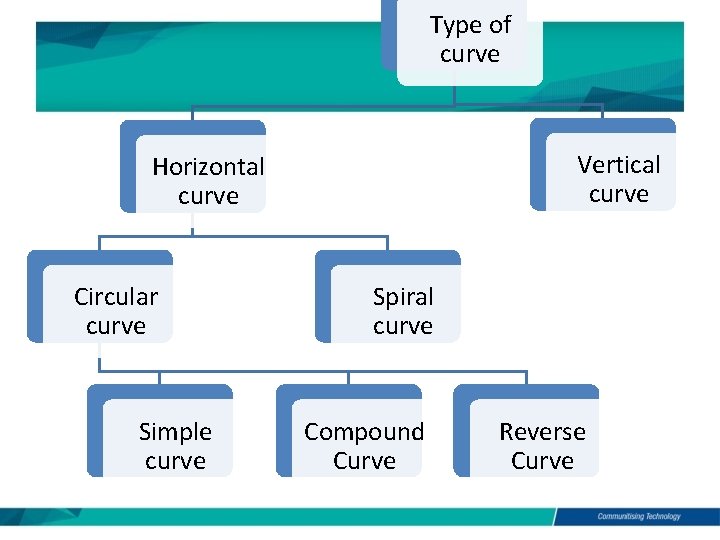
Type of curve Vertical curve Horizontal curve Circular curve Simple curve Spiral curve Compound Curve Reverse Curve

VERTICAL CURVE HORIZONTAL CURVE
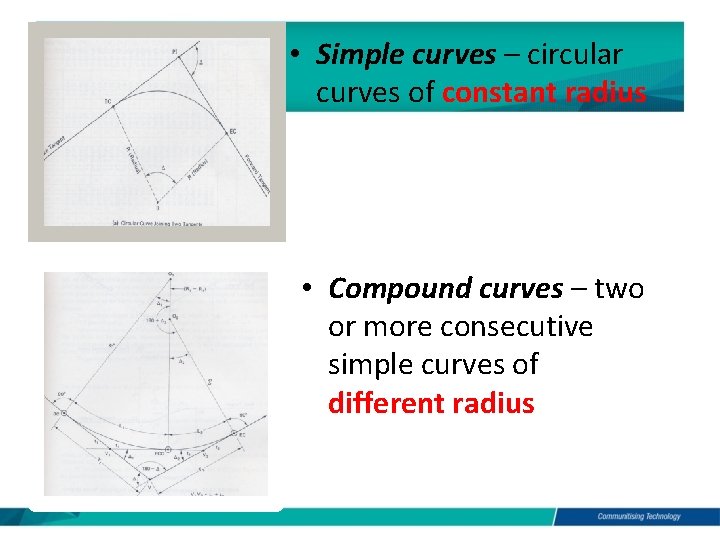
• Simple curves – circular curves of constant radius • Compound curves – two or more consecutive simple curves of different radius
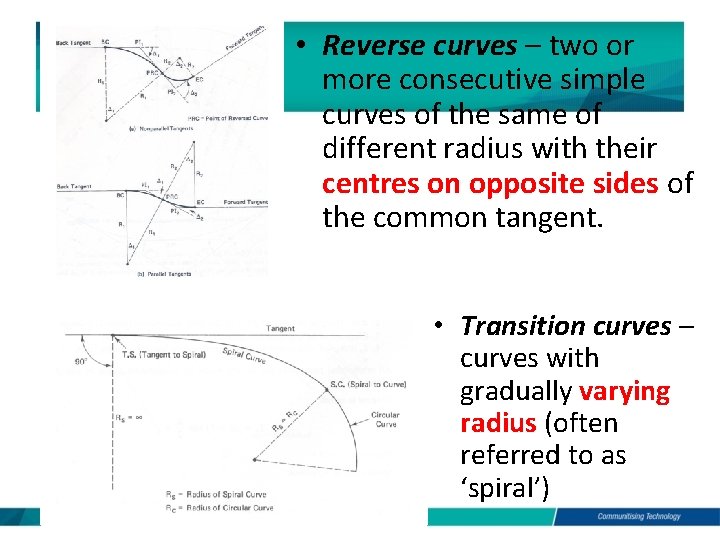
• Reverse curves – two or more consecutive simple curves of the same of different radius with their centres on opposite sides of the common tangent. • Transition curves – curves with gradually varying radius (often referred to as ‘spiral’)
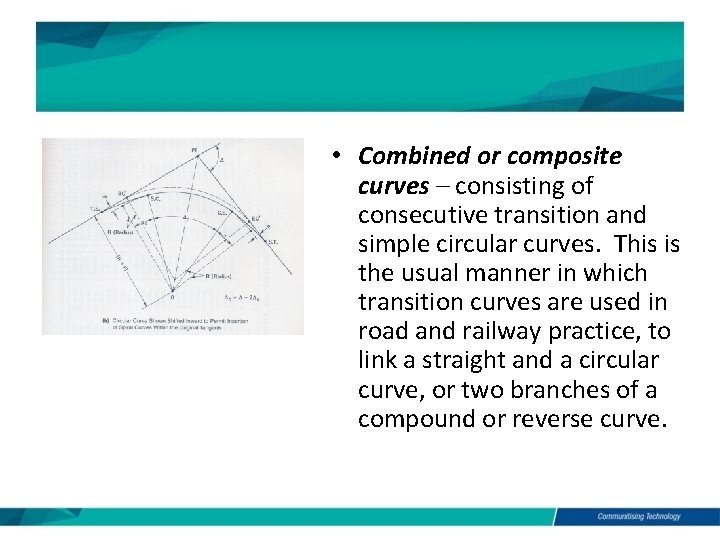
• Combined or composite curves – consisting of consecutive transition and simple circular curves. This is the usual manner in which transition curves are used in road and railway practice, to link a straight and a circular curve, or two branches of a compound or reverse curve.
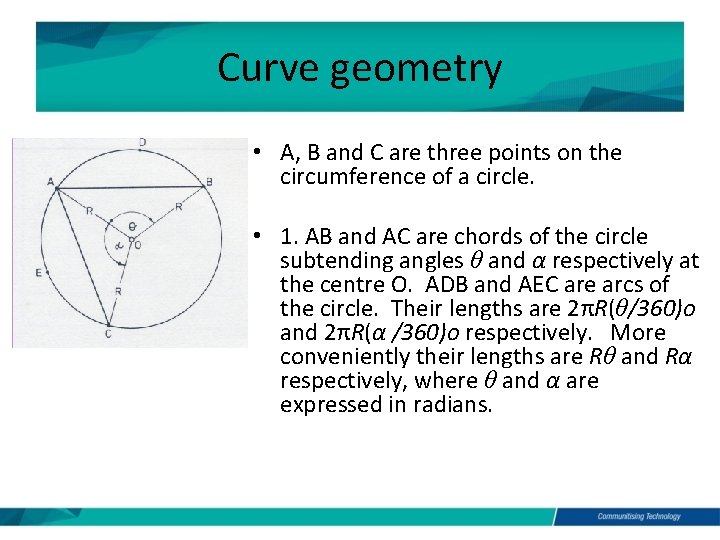
Curve geometry • A, B and C are three points on the circumference of a circle. • 1. AB and AC are chords of the circle subtending angles θ and α respectively at the centre O. ADB and AEC are arcs of the circle. Their lengths are 2πR(θ/360)o and 2πR(α /360)o respectively. More conveniently their lengths are Rθ and Rα respectively, where θ and α are expressed in radians.
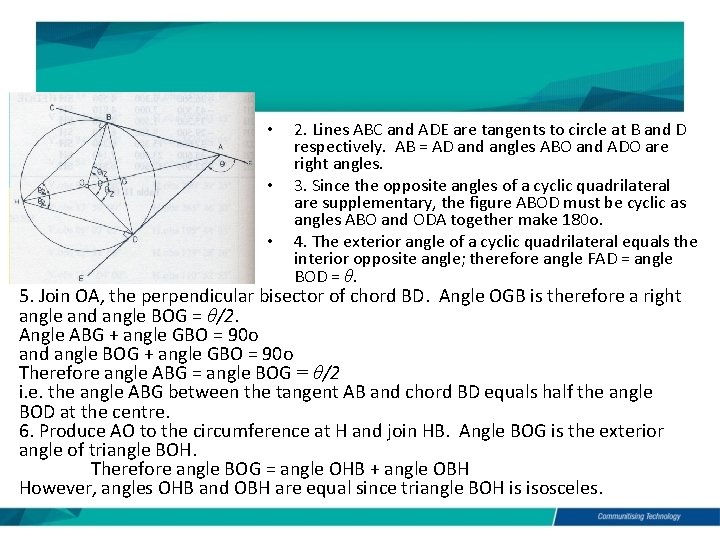
• • • 2. Lines ABC and ADE are tangents to circle at B and D respectively. AB = AD and angles ABO and ADO are right angles. 3. Since the opposite angles of a cyclic quadrilateral are supplementary, the figure ABOD must be cyclic as angles ABO and ODA together make 180 o. 4. The exterior angle of a cyclic quadrilateral equals the interior opposite angle; therefore angle FAD = angle BOD = θ. 5. Join OA, the perpendicular bisector of chord BD. Angle OGB is therefore a right angle and angle BOG = θ/2. Angle ABG + angle GBO = 90 o and angle BOG + angle GBO = 90 o Therefore angle ABG = angle BOG = θ/2 i. e. the angle ABG between the tangent AB and chord BD equals half the angle BOD at the centre. 6. Produce AO to the circumference at H and join HB. Angle BOG is the exterior angle of triangle BOH. Therefore angle BOG = angle OHB + angle OBH However, angles OHB and OBH are equal since triangle BOH is isosceles.
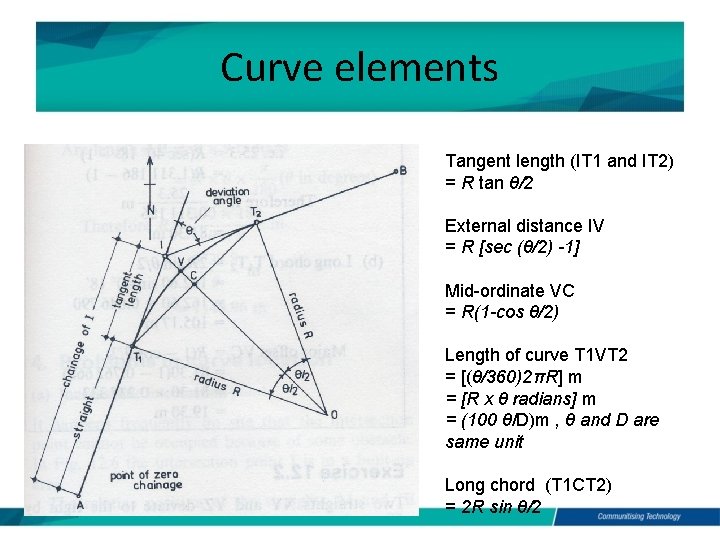
Curve elements Tangent length (IT 1 and IT 2) = R tan θ/2 External distance IV = R [sec (θ/2) -1] Mid-ordinate VC = R(1 -cos θ/2) Length of curve T 1 VT 2 = [(θ/360)2πR] m = [R x θ radians] m = (100 θ/D)m , θ and D are same unit Long chord (T 1 CT 2) = 2 R sin θ/2
Draw the curve base on information given Bearing of line AB and BC were 18 o 24’ 00” and 20 o 40’ 00” respectively. Bearing of line BA is 18 o 24’ 00” and deflected angle is 13 o 40’ 00” to the right. B is intersection point of line AB and BC. Bearing of line AB is 78 o 44’ 00” and deflected angle is 20 o 40’ 00” to the left.
Setting out circular curves method • Traditional method – Method 1: Offset from chords produced – Method 2: Setting by tangential angles – Method 3: Using two theodolites • Coordinate method – Method 4: Setting out by coordinates
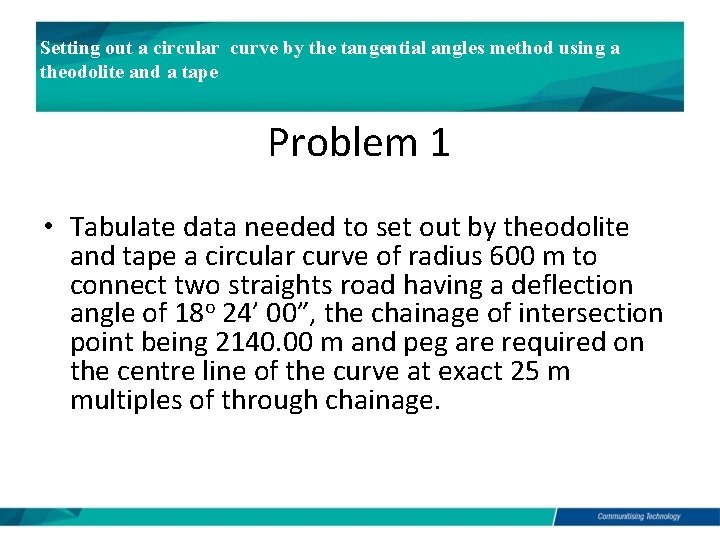
Setting out a circular curve by the tangential angles method using a theodolite and a tape Problem 1 • Tabulate data needed to set out by theodolite and tape a circular curve of radius 600 m to connect two straights road having a deflection angle of 18 o 24’ 00”, the chainage of intersection point being 2140. 00 m and peg are required on the centre line of the curve at exact 25 m multiples of through chainage.
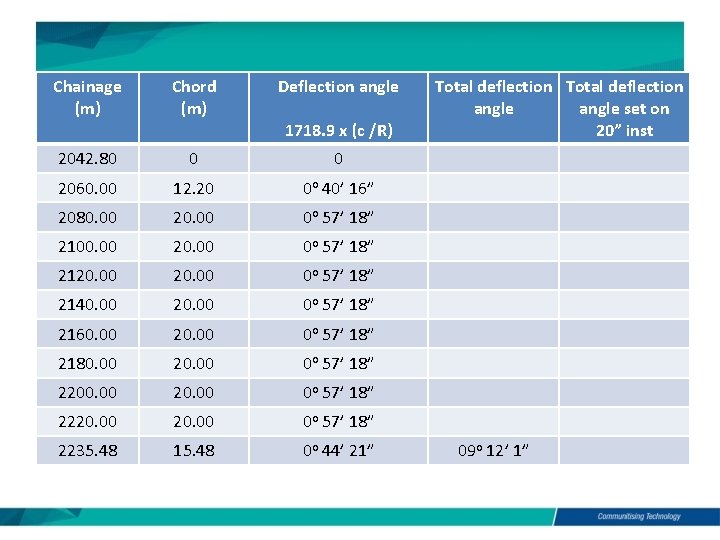
Chainage (m) Chord (m) Deflection angle 2042. 80 0 0 2060. 00 12. 20 0 o 40’ 16” 2080. 00 20. 00 0 o 57’ 18” 2100. 00 20. 00 0 o 57’ 18” 2120. 00 0 o 57’ 18” 2140. 00 20. 00 0 o 57’ 18” 2160. 00 20. 00 0 o 57’ 18” 2180. 00 20. 00 0 o 57’ 18” 2200. 00 20. 00 0 o 57’ 18” 2220. 00 0 o 57’ 18” 2235. 48 15. 48 0 o 44’ 21” 1718. 9 x (c /R) Total deflection angle set on 20” inst 09 o 12’ 1”
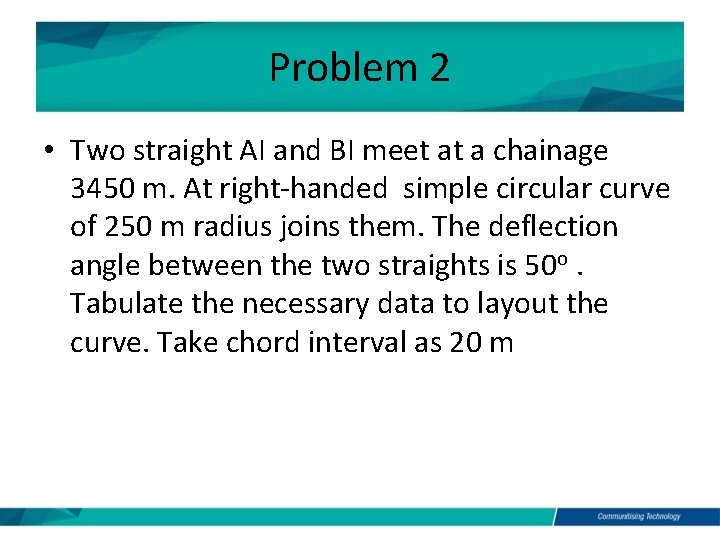
Problem 2 • Two straight AI and BI meet at a chainage 3450 m. At right-handed simple circular curve of 250 m radius joins them. The deflection angle between the two straights is 50 o. Tabulate the necessary data to layout the curve. Take chord interval as 20 m
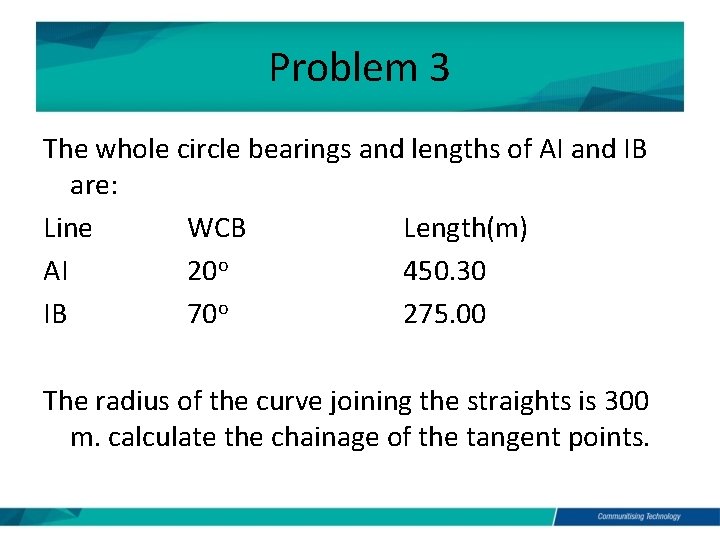
Problem 3 The whole circle bearings and lengths of AI and IB are: Line WCB Length(m) AI 20 o 450. 30 IB 70 o 275. 00 The radius of the curve joining the straights is 300 m. calculate the chainage of the tangent points.
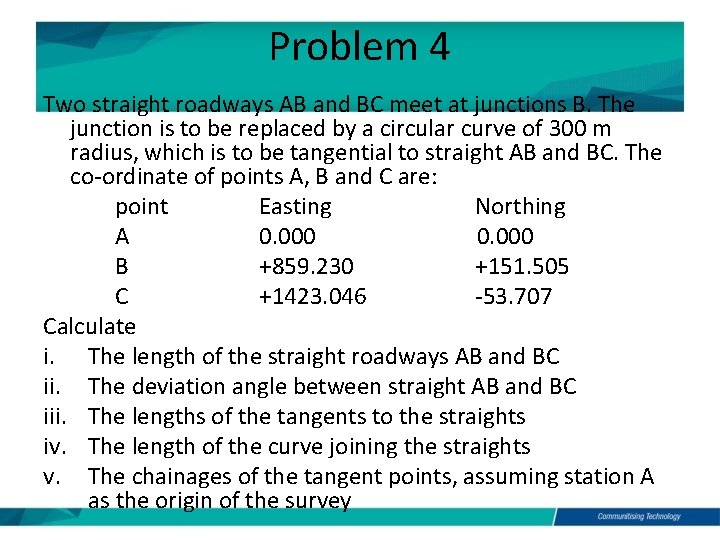
Problem 4 Two straight roadways AB and BC meet at junctions B. The junction is to be replaced by a circular curve of 300 m radius, which is to be tangential to straight AB and BC. The co-ordinate of points A, B and C are: point Easting Northing A 0. 000 B +859. 230 +151. 505 C +1423. 046 -53. 707 Calculate i. The length of the straight roadways AB and BC ii. The deviation angle between straight AB and BC iii. The lengths of the tangents to the straights iv. The length of the curve joining the straights v. The chainages of the tangent points, assuming station A as the origin of the survey
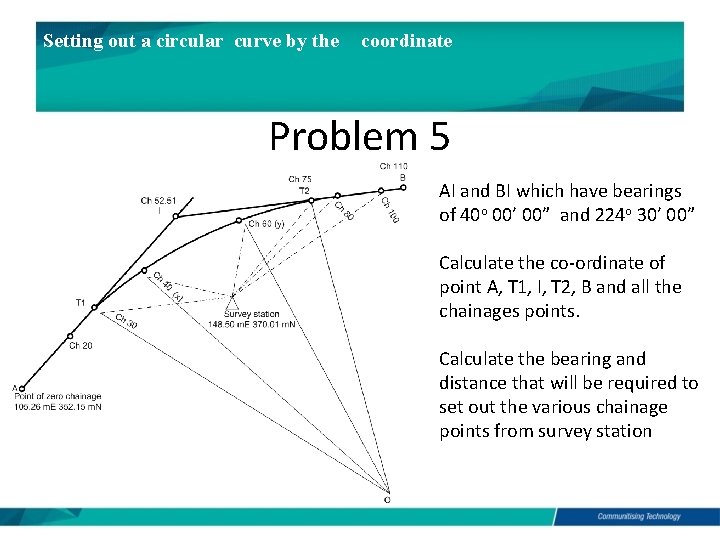
Setting out a circular curve by the coordinate Problem 5 AI and BI which have bearings of 40 o 00’ 00” and 224 o 30’ 00” Calculate the co-ordinate of point A, T 1, I, T 2, B and all the chainages points. Calculate the bearing and distance that will be required to set out the various chainage points from survey station
Vertical Curve
Summit and valley curves • Whenever roads or railways change gradient, a vertical curve is required to take traffic smoothly from one gradient to the other. When the two gradients form a hill, the curve is called a summit curve and when the gradients form a valley, sag or valley curve is produced.
Percentage Gradients • The gradients are expressed as percentages. A gradient of 1 in 50 is a 2 per cent gradient, i. e. the gradient rises or falls by 2 units. Similarly a gradient of 1 in 200 is a 0. 5 per cent gradient. • In vertical curve calculations, the left-hand gradient is p per cent and the right-hand gradient is q per cent.
Since the change of gradient from slope to curve is required to be smooth and gradual, parabolic curves are chosen. This form of curve is flat near the tangent point and calculations are reasonably simple. The form of the curves is y = ax 2 + bx + c, where y – reduced level of any point on the curve x – distance to that point measured from the start of the curve a – multiplying coefficient, b – value of the left-hand gradient c – reduced level of the first point on the curve

Author Information Dr Idris bin Ali Dr Cheng Hock Tian
- Slides: 25