
ENGINEERING STUDENT GRAND CHALLENGES COMPETITION Planning Workshop University






- Slides: 43
ENGINEERING STUDENT GRAND CHALLENGES COMPETITION Planning Workshop University of Southern California, Los Angeles 18 September 2017
Welcome and Introductions Welcome to the Engineering Student Grand Challenges Competition Workshop! Yannis Yortsos, Dean, Viterbi School of Engineering, USC Asad Madni, Distinguished Adjunct Professor, UCLA Engineering Burt Dicht, Director, IEEE Student and Academic Education Programs Ken Jarboe, Senior Program Officer, Manufacturing, Design and Innovation, National Academy of Engineering (NAE) B. L. Ramakrishna, Director, NAE Grand Challenges Scholars Program Network Introductions: Please identify yourself, your position and organization and why you are attending the workshop
Expectations and Outcomes Gain a shared understanding on: • The Competition Concept • Competition Launch Date (Aug 2018 or Jan 2019) • Judging Criteria • Levels of Society Commitment (including budgets) Outline: • A Communications Plan (for inviting other societies) • An Implementation Plan and Timetable.
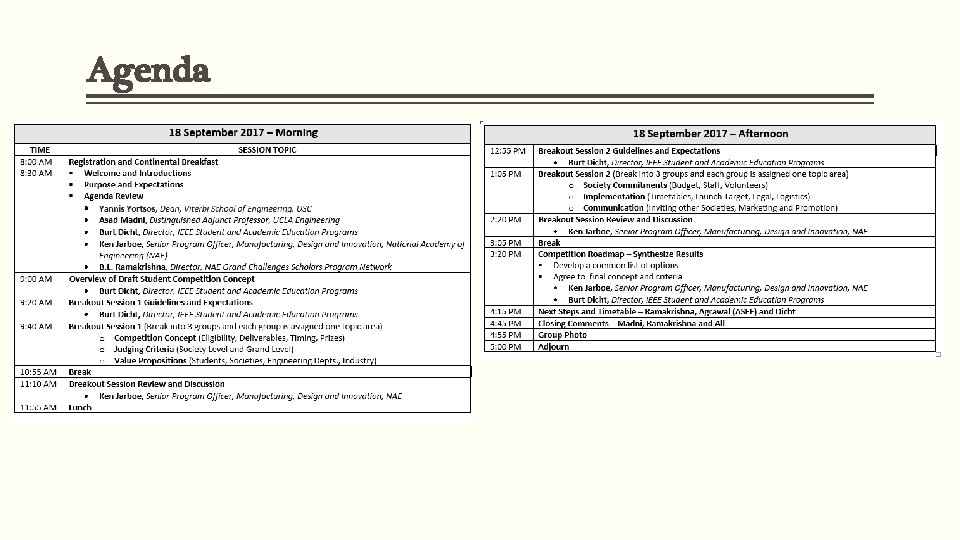
Agenda
Disclaimer Participation in this workshop and any follow-on planning does not obligate any organization/society to be part of the competition or to commit any resources. Any statements and opinions expressed are those of the participants and have not been endorsed by other participants, the planning committee, the National Academies of Sciences, Engineering, and Medicine or the “Engineering Societies and Undergraduate Engineering Education” project sponsor.
Background • NAE Workshop on the "Engagement of Engineering Societies in Undergraduate Engineering Education (Jan 2017) • Outcome – Proposal to create a "Joint-Society" student challenge that encourages and demonstrates multidisciplinary solutions to the NAE Grand Challenges for Engineering • Multiple Societies Express Interest • Follow-Up meetings (Core group) to develop draft concept (March to June) • Concept circulated for review and comment • F 2 F Planning Workshop (Sept 2017)
DRAFT STUDENT COMPETITION CONCEPT: AN OVERVIEW
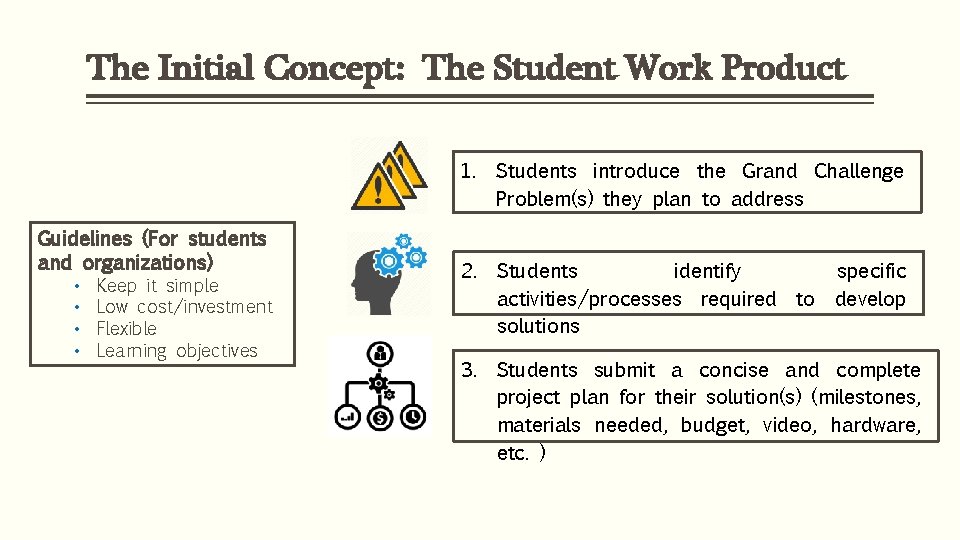
The Initial Concept: The Student Work Product 1. Students introduce the Grand Challenge Problem(s) they plan to address Guidelines (For students and organizations) • • Keep it simple Low cost/investment Flexible Learning objectives 2. Students identify specific activities/processes required to develop solutions 3. Students submit a concise and complete project plan for their solution(s) (milestones, materials needed, budget, video, hardware, etc. )
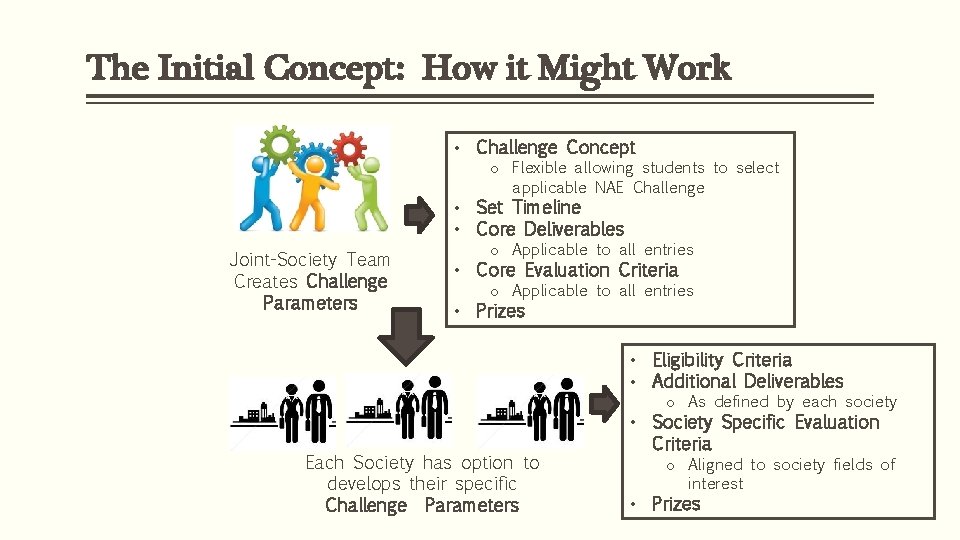
The Initial Concept: How it Might Work • Challenge Concept o Flexible allowing students to select applicable NAE Challenge • Set Timeline • Core Deliverables Joint-Society Team Creates Challenge Parameters o Applicable to all entries • Core Evaluation Criteria o Applicable to all entries • Prizes • Eligibility Criteria • Additional Deliverables o As defined by each society Each Society has option to develops their specific Challenge Parameters • Society Specific Evaluation Criteria o Aligned to society fields of interest • Prizes
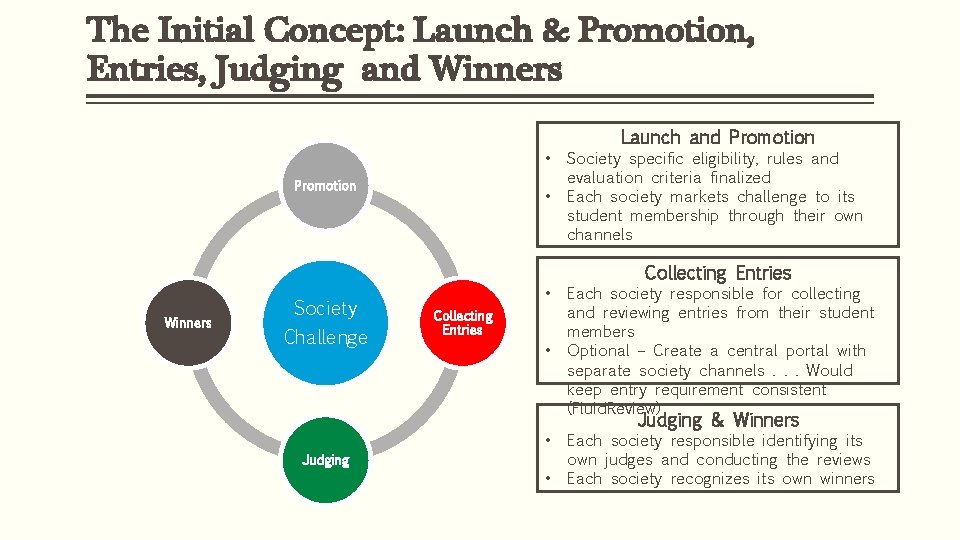
The Initial Concept: Launch & Promotion, Entries, Judging and Winners Launch and Promotion • Society specific eligibility, rules and evaluation criteria finalized Each society markets challenge to its student membership through their own channels Collecting Entries Winners Society Challenge • Collecting Entries • Each society responsible for collecting and reviewing entries from their student members Optional – Create a central portal with separate society channels. . . Would keep entry requirement consistent (Fluid. Review) Judging & Winners • Judging • Each society responsible identifying its own judges and conducting the reviews Each society recognizes its own winners
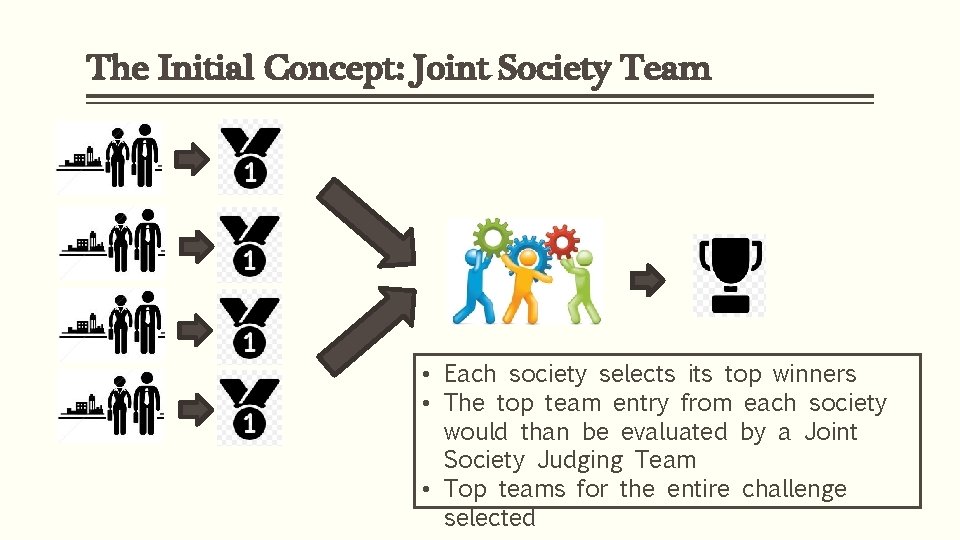
The Initial Concept: Joint Society Team • Each society selects its top winners • The top team entry from each society would than be evaluated by a Joint Society Judging Team • Top teams for the entire challenge selected
BREAKOUT SESSION DIRECTIONS
Breakout Session Directions Two Sessions: 09: 40 AM to 10: 55 AM and 1: 05 PM to 2: 20 PM • For each breakout session we divide the attendees into 3 groups, each group will be assigned a specific discussion topic • Each group to select a spokesperson and a recorder • Review and Discussion Sessions will run from 11: 10 AM to 11: 55 AM and 2: 20 PM to 3: 05 PM. Each group will have 10 minutes to report out and 5 minutes to answer questions
Breakout Session Directions (2) Topic Areas: Breakout Session 1 • Competition Concept (Facilitator – Asad) • Judging Criteria (Facilitator - Burt) • Value Proposition (Facilitator – Rama) Breakout Session 2 • Society Commitments (Facilitator - Burt) • Implementation (Facilitator – Rama) • Communication (Facilitator – Asad)
Breakout Session Directions (3) Process • Breakout Sessions o Note, there is a scheduled break time, but feel free to take additional breaks as needed o There will be periodic announcements on the time remaining o Templates have been developed to frame the discussion o Use whichever method you prefer to track your discussion and ideas (Power. Point, Word, Flip Chart, Hand notes, etc. ) o For final reporting of outcomes please use the Power. Point Template
Breakout Session Directions (4) Expected Work Product • Establishment of framework for following topic areas: o Basic approach o Benefits o Challenges o Resources Needed o Tasks o Responsible Parties o Preliminary Timeline o Communication Plan o Other Items Note: Address the areas that you feel have priority
Breakout Session Directions (5) Guidelines • Keep discussions at a high level. . . This is the start of process and we’ll be working over the next months to finalize the details • Focus on the ideas and concepts. . . Do not get stuck trying to solve every issue • Document any concerns or issues in a “parking lot” • Give everyone a chance to speak. . . and Have fun! Report-out • One spokesperson from each group will have an opportunity to report their discussion results • 10 minutes per Group and 5 minutes for questions and discussion
Main Objective/Some Guiding Questions/Issues • Proposed Overall Goal: o Identifying the steps, procedures and resources necessary for launching the student competition • Some Guiding Questions: • What are our immediate priorities? • What resources are needed (Human, Financial, Logistical, etc. ) • What organizations/stakeholders can we count on for support and resources? • What are the main obstacles and challenges involved?
SESSION 1 – TOPIC ISSUES
BREAKOUT SESSION 1 – GROUP 1 Competition Concept
Draft Concept • Competition Concept o Flexible allowing students to select applicable NAE Challenge o It is workable? • Obstacles? • Resources needed? • Suggested modifications for improvement? • Alternate Approaches?
Eligibility • Membership Requirement? How many team members must have membership in the society they are submitting project to? • Team size? How large? • Multi-disciplinary requirement? • Undergraduates only? • Individual student can only be part of one team • An individual project can only be submitted to the sponsoring society of choice and not multiple societies • Pool approach to submitting projects?
Deliverables • What will students be required to deliver to be evaluated? o Project plans o Video o Demonstrations o Hardware o Other Needs to be synced with Judging Criteria
Prizes • Certificates of Participation for each student • How many prizes on the Society Level? On the Grand Level? (1 st to 3 rd place, 1 st to 5 th place, etc. ) • Special Prizes (most innovative, most unique, etc. )? • Prizes: o Cash Prizes on Society Level? On the Grand Level? make it worthwhile? ) o Other types - Travel - Merchandise (How much to Note: Suggested that prizes on the society level be consistent. If Society A offers prizes much greater than society B, student teams will submit projects to Society A.
BREAKOUT SESSION 1 – GROUP 2 Judging Criteria
Core Criteria – Draft § Basic Requirements: Have all of the required aspects of eligibility been met? o Team size o Membership in one society o Multidisciplinary Team § Relevance: Does the project align to one or more of the NAE Grand Challenges? § Originality of Idea/Project: Does the project represent a new or innovative approach or concept? § Feasibility: Does the data and proposal content support the project objectives and how likely is it that a completed project will accomplish or solve the stated problem? § Viability: Does it address viability from the business or economics perspectives? § Desirability: Does it take into account desirability from the societal perspectives? § Project Proposal Format: o Are the proposal and video presented in a professional manner? o Are all of the items listed above in the “Application” section included in the proposal? Note: the video and the proposal will receive equal weight in the scoring process.
Judging Criteria Issues § Should we have a core set of judging criteria that all entries are judged by? § Criteria weighting? Are some areas more important than others? § Total scoring value? 100 points? § Should each sponsoring society (those marketing to students) have their own specific criteria based on their fields of interest? This could be optional. § What criteria should be used for the second level of judging to select the overall winners? § Judge requirements? Should we have minimum qualifications?
BREAKOUT SESSION 1 – GROUP 3 Value Proposition
Value Proposition Issues § How do we sell the benefits of this competition? § Why will students want to participate ? § Why will other technical professional societies want to sponsor this competition? § What benefits to we offer engineering departments? Industry? § What is our 30 second elevator speech?
Student Value Proposition – Draft § Develop multidisciplinary and teamwork skills necessary the workplace § Develop and apply knowledge and skills within their field of study and necessary for the workplace § Connect and collaborate with students in other fields and professional associations § Gain an appreciation and understanding of the NAE Grand Challenges and how engineering can solve real-world problems § Prizes § Fun and Recognition
Professional Society Value Proposition – Draft § Engage students into society activities and programs § Reinforce society as an academic and professional development resource § New members and membership retention § Promotion. . . See what our students can accomplish o Opportunity to demonstrate to the public how the engineering profession § Create and facilitate opportunities for cross society collaboration
Value Proposition § For University Departments? § For Industry?
SESSION 2 – TOPIC ISSUES
BREAKOUT SESSION 2 – GROUP 1 Society Commitments
Issues – Levels of Commitment • Contributing o All in financially and operationally as challenge is marketed to student members ü ü Funding (prize money) Staff Time Volunteer Time Marketing and Promotion • Sponsoring o A degree of financial support, marketing, and promotion o Might also provide judges • Legal o MOU or Cooperation Agreement ü What is each society committed to contributing?
BREAKOUT SESSION 2 – GROUP 2 Implementation
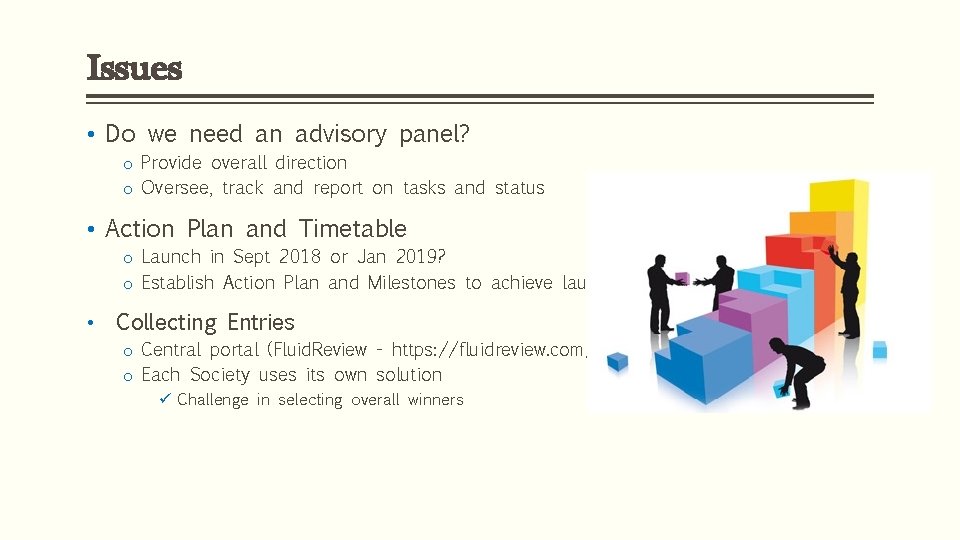
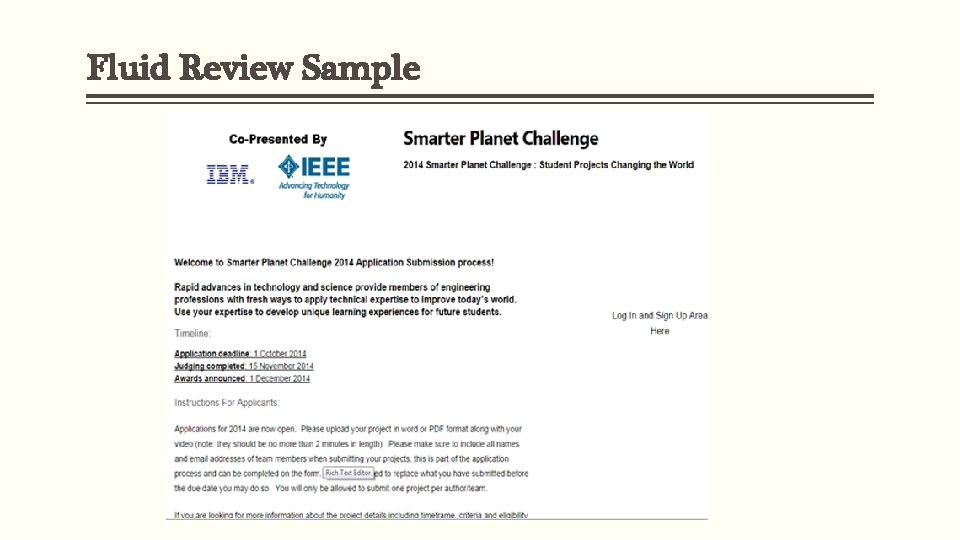
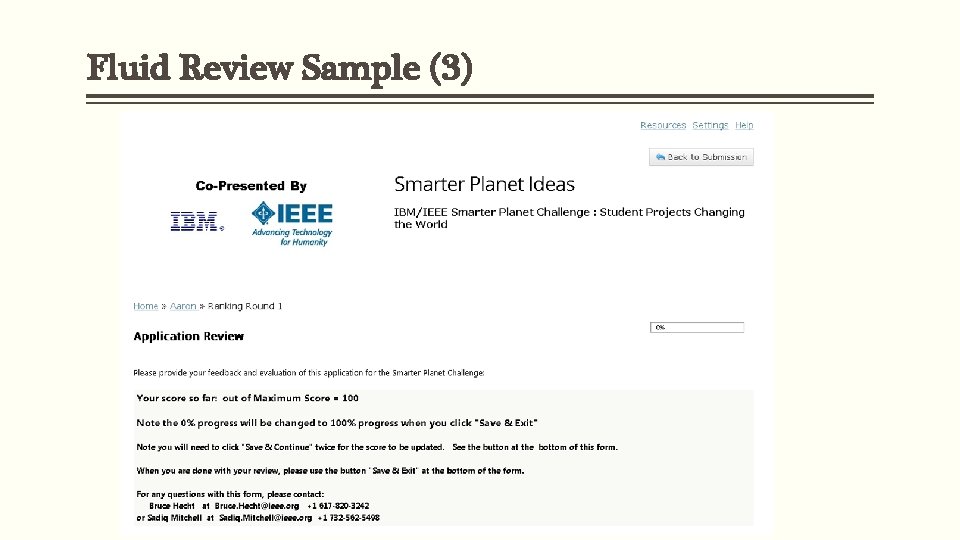
Issues • Do we need an advisory panel? o Provide overall direction o Oversee, track and report on tasks and status • Action Plan and Timetable o Launch in Sept 2018 or Jan 2019? o Establish Action Plan and Milestones to achieve launch • Collecting Entries o Central portal (Fluid. Review - https: //fluidreview. com/) o Each Society uses its own solution ü Challenge in selecting overall winners
Fluid Review Sample
Fluid Review Sample (2)
Fluid Review Sample (3)
BREAKOUT SESSION 2 – GROUP 3 Communications
Issues Promotional Aspects – to additional society sponsors/partners (industry) • Marketing Materials (Logo? ) • Invite Letters (inviting other societies to participate) • Other Promotional Aspects – to students and universities • Creation of core marketing materials that could be used and adapted by each society • Website • Social Media • Marketing Campaign o Development o Implementation • Other
Issues (2) • Who is responsible? • Budgets?