
Engineering Services in Italy ISIC 71 Cristina Cecconi

- Slides: 19
Engineering Services in Italy (ISIC 71) Cristina Cecconi, Salvatore Cavallaro Istat Speaker: Fabrizio Marinucci 32 nd Voorburg Group Meeting New Delhi, India 23 -27 October 2017
Contents 1. The Italian classification 2. Market conditions 3. Specific characteristics of the industry 4. Measurement of SPPI 5. Description of pricing method 6. Evaluation of measurement C. Cecconi, S. Cavallaro – 32 nd Voorburg Group Meeting 2/10
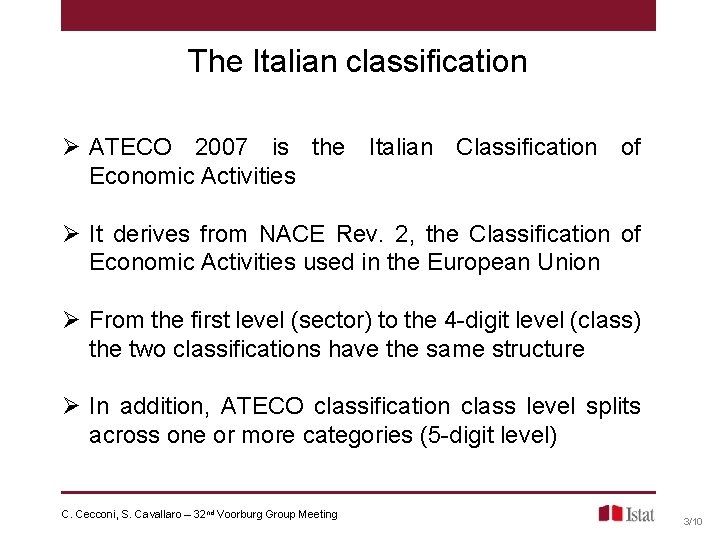
The Italian classification Ø ATECO 2007 is the Italian Classification of Economic Activities Ø It derives from NACE Rev. 2, the Classification of Economic Activities used in the European Union Ø From the first level (sector) to the 4 -digit level (class) the two classifications have the same structure Ø In addition, ATECO classification class level splits across one or more categories (5 -digit level) C. Cecconi, S. Cavallaro – 32 nd Voorburg Group Meeting 3/10
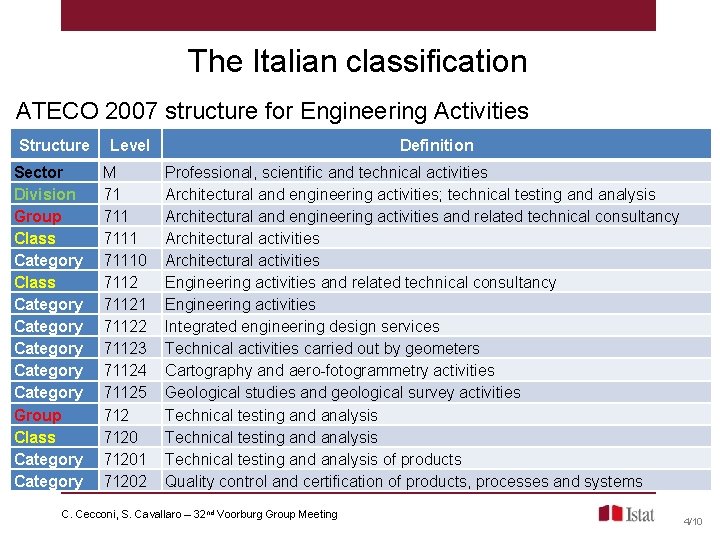
The Italian classification ATECO 2007 structure for Engineering Activities Structure Sector Division Group Class Category Category Group Class Category Level M 71 71110 71121 71122 71123 71124 71125 71201 71202 Definition Professional, scientific and technical activities Architectural and engineering activities; technical testing and analysis Architectural and engineering activities and related technical consultancy Architectural activities Engineering activities and related technical consultancy Engineering activities Integrated engineering design services Technical activities carried out by geometers Cartography and aero-fotogrammetry activities Geological studies and geological survey activities Technical testing and analysis of products Quality control and certification of products, processes and systems C. Cecconi, S. Cavallaro – 32 nd Voorburg Group Meeting 4/10
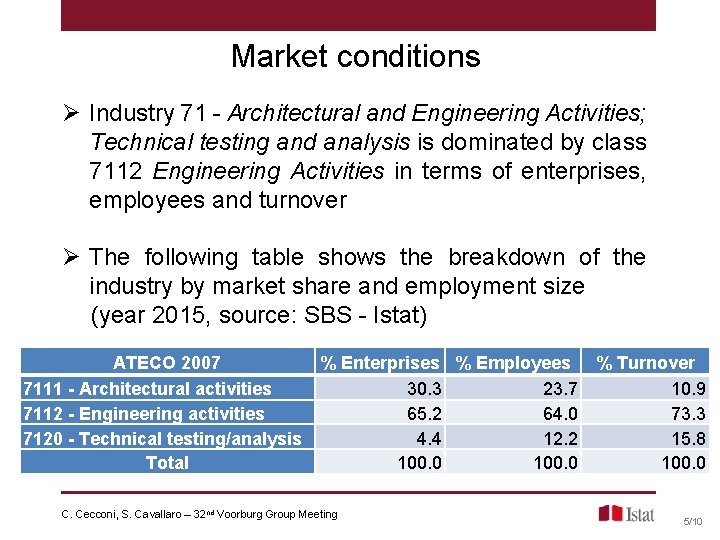
Market conditions Ø Industry 71 - Architectural and Engineering Activities; Technical testing and analysis is dominated by class 7112 Engineering Activities in terms of enterprises, employees and turnover Ø The following table shows the breakdown of the industry by market share and employment size (year 2015, source: SBS - Istat) ATECO 2007 % Enterprises % Employees 7111 - Architectural activities 30. 3 23. 7 7112 - Engineering activities 65. 2 64. 0 7120 - Technical testing/analysis 4. 4 12. 2 Total 100. 0 C. Cecconi, S. Cavallaro – 32 nd Voorburg Group Meeting % Turnover 10. 9 73. 3 15. 8 100. 0 5/10
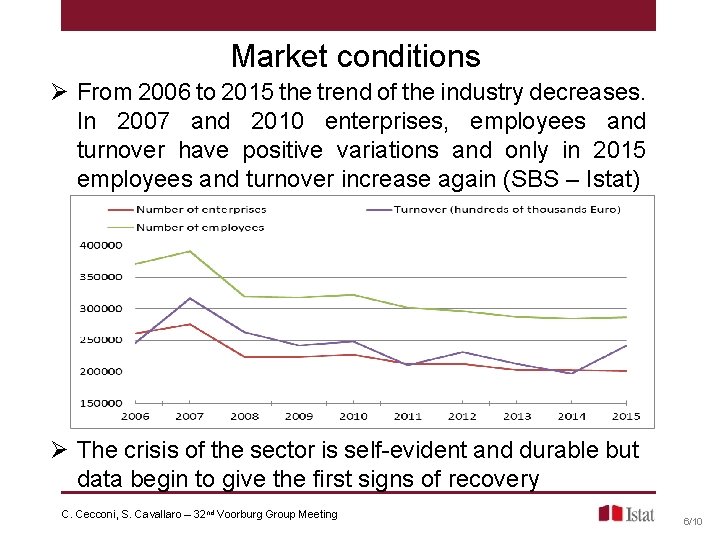
Market conditions Ø From 2006 to 2015 the trend of the industry decreases. In 2007 and 2010 enterprises, employees and turnover have positive variations and only in 2015 employees and turnover increase again (SBS – Istat) Ø The crisis of the sector is self-evident and durable but data begin to give the first signs of recovery C. Cecconi, S. Cavallaro – 32 nd Voorburg Group Meeting 6/10
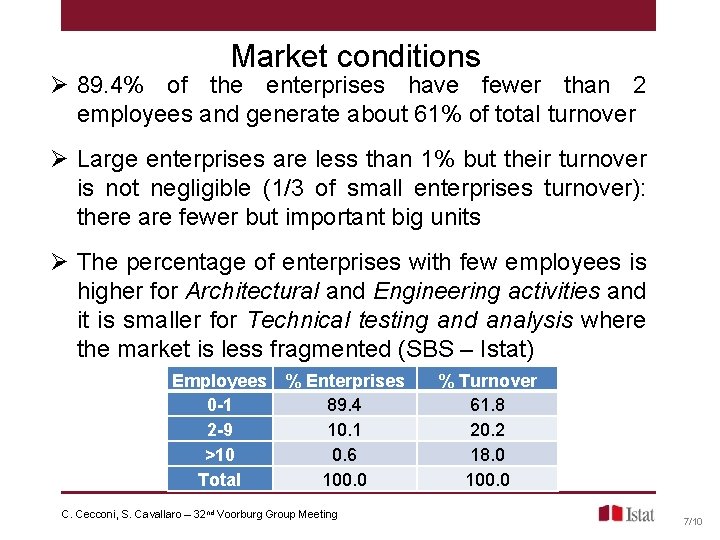
Market conditions Ø 89. 4% of the enterprises have fewer than 2 employees and generate about 61% of total turnover Ø Large enterprises are less than 1% but their turnover is not negligible (1/3 of small enterprises turnover): there are fewer but important big units Ø The percentage of enterprises with few employees is higher for Architectural and Engineering activities and it is smaller for Technical testing and analysis where the market is less fragmented (SBS – Istat) Employees % Enterprises 0 -1 89. 4 2 -9 10. 1 >10 0. 6 Total 100. 0 C. Cecconi, S. Cavallaro – 32 nd Voorburg Group Meeting % Turnover 61. 8 20. 2 18. 0 100. 0 7/10
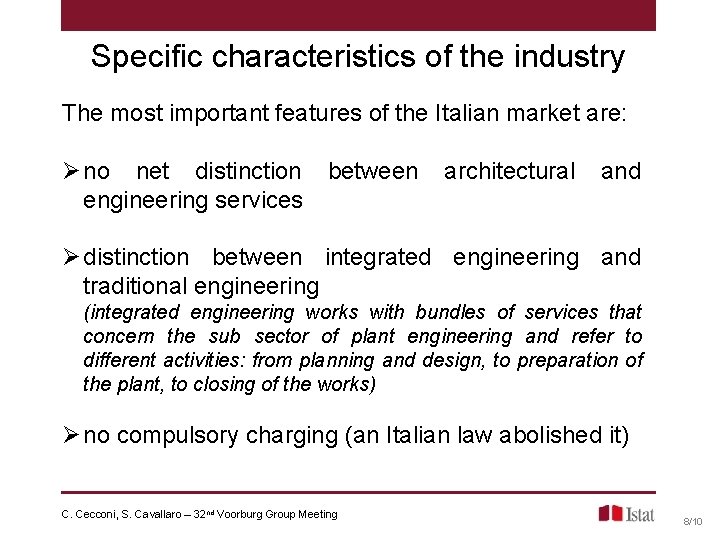
Specific characteristics of the industry The most important features of the Italian market are: Ø no net distinction between engineering services architectural and Ø distinction between integrated engineering and traditional engineering (integrated engineering works with bundles of services that concern the sub sector of plant engineering and refer to different activities: from planning and design, to preparation of the plant, to closing of the works) Ø no compulsory charging (an Italian law abolished it) C. Cecconi, S. Cavallaro – 32 nd Voorburg Group Meeting 8/10
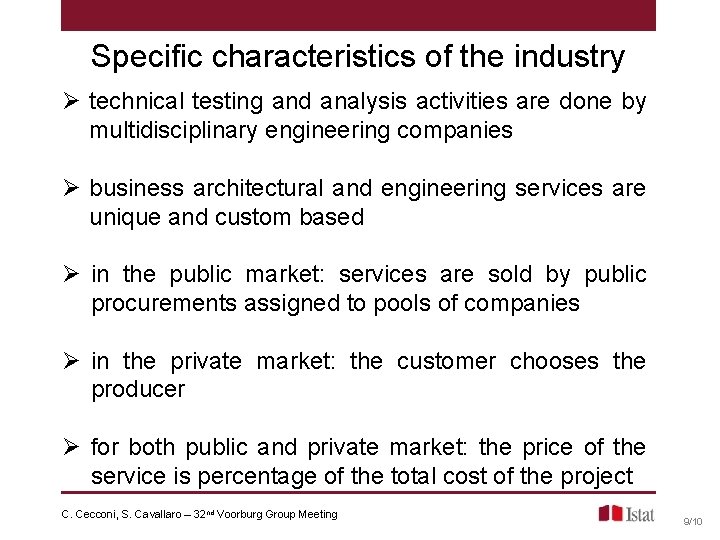
Specific characteristics of the industry Ø technical testing and analysis activities are done by multidisciplinary engineering companies Ø business architectural and engineering services are unique and custom based Ø in the public market: services are sold by public procurements assigned to pools of companies Ø in the private market: the customer chooses the producer Ø for both public and private market: the price of the service is percentage of the total cost of the project C. Cecconi, S. Cavallaro – 32 nd Voorburg Group Meeting 9/10
Measurement of SPPI Ø The Italian Engineering Services producer price index was developed in 2014 Ø National Accounts began to use it last February to compute annual and quarterly national accounts benchmark (time series from 2014) Ø The index includes both architectural and engineering activities as well as technical testing and analysis Ø Prices and turnover are collected by a quarterly electronic questionnaire C. Cecconi, S. Cavallaro – 32 nd Voorburg Group Meeting 10/10
Measurement of SPPI Ø The sample of enterprises is stratified by turnover and in each stratum PPS sampling is used Ø Large companies are integrally sampled Ø A chained Laspeyres index is used (basket of services, sample of units and weights are annually updated) Ø The model price method is used to capture movements in prices for engineering services C. Cecconi, S. Cavallaro – 32 nd Voorburg Group Meeting 11/10
Description of pricing method Ø In the first compilation of the questionnaire each enterprise has to provide the description of three different projects for architecture and engineering services Ø Projects can be hypothetical or based on real transactions made in recent past Ø Real transactions are preferable because: (i) a model based on actual data is more realistic (ii) it is easier for respondents to estimate prices (iii) the representativeness of the service is better satisfied C. Cecconi, S. Cavallaro – 32 nd Voorburg Group Meeting 12/10
Description of pricing method Ø Each project is identified both by descriptive variables and by a short description Ø Projects are type models that must be kept constant for a period of time sufficient to ensure the observation of the quarterly prices of a representative service among the following five types: (i) design/execution (ii) legal advice (iii) consulting services (iv) collaborations with other professional firms (v) topographic surveys and other activities C. Cecconi, S. Cavallaro – 32 nd Voorburg Group Meeting 13/10
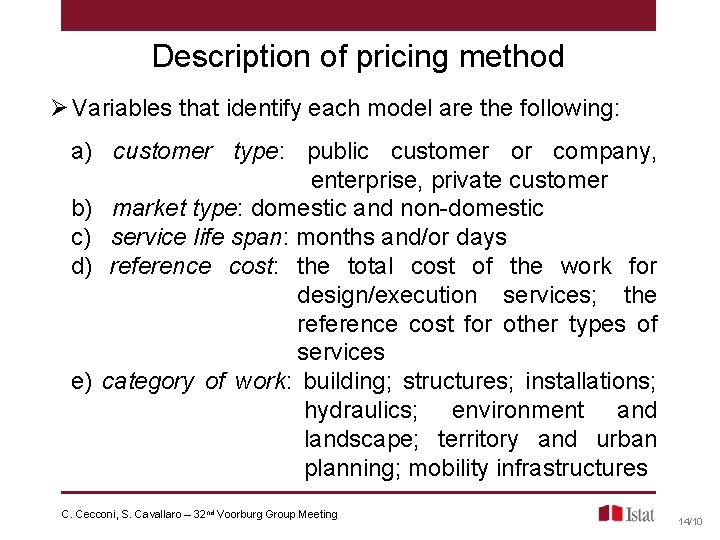
Description of pricing method Ø Variables that identify each model are the following: a) customer type: public customer or company, enterprise, private customer b) market type: domestic and non-domestic c) service life span: months and/or days d) reference cost: the total cost of the work for design/execution services; the reference cost for other types of services e) category of work: building; structures; installations; hydraulics; environment and landscape; territory and urban planning; mobility infrastructures C. Cecconi, S. Cavallaro – 32 nd Voorburg Group Meeting 14/10
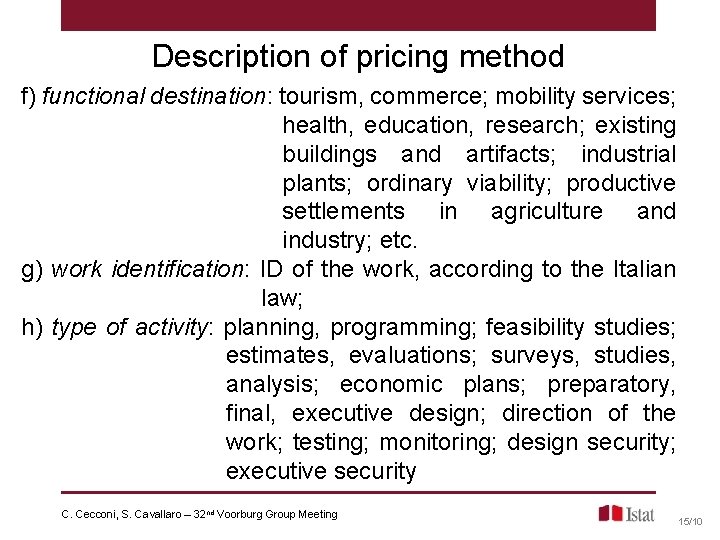
Description of pricing method f) functional destination: tourism, commerce; mobility services; health, education, research; existing buildings and artifacts; industrial plants; ordinary viability; productive settlements in agriculture and industry; etc. g) work identification: ID of the work, according to the Italian law; h) type of activity: planning, programming; feasibility studies; estimates, evaluations; surveys, studies, analysis; economic plans; preparatory, final, executive design; direction of the work; testing; monitoring; design security; executive security C. Cecconi, S. Cavallaro – 32 nd Voorburg Group Meeting 15/10
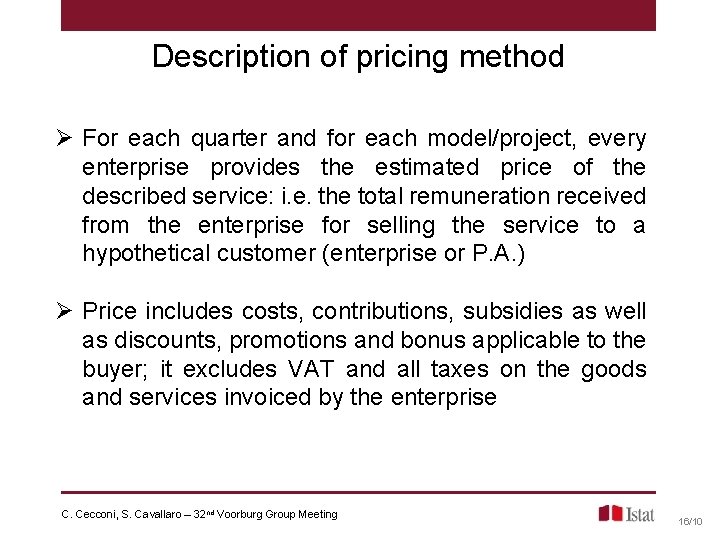
Description of pricing method Ø For each quarter and for each model/project, every enterprise provides the estimated price of the described service: i. e. the total remuneration received from the enterprise for selling the service to a hypothetical customer (enterprise or P. A. ) Ø Price includes costs, contributions, subsidies as well as discounts, promotions and bonus applicable to the buyer; it excludes VAT and all taxes on the goods and services invoiced by the enterprise C. Cecconi, S. Cavallaro – 32 nd Voorburg Group Meeting 16/10
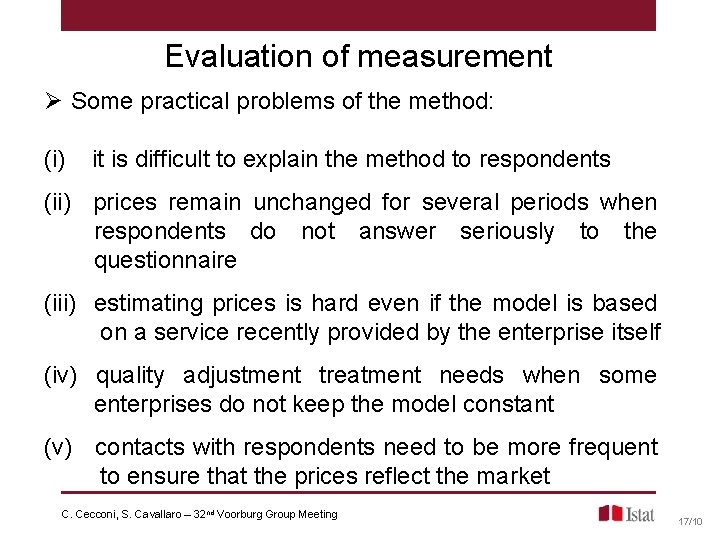
Evaluation of measurement Ø Some practical problems of the method: (i) it is difficult to explain the method to respondents (ii) prices remain unchanged for several periods when respondents do not answer seriously to the questionnaire (iii) estimating prices is hard even if the model is based on a service recently provided by the enterprise itself (iv) quality adjustment treatment needs when some enterprises do not keep the model constant (v) contacts with respondents need to be more frequent to ensure that the prices reflect the market C. Cecconi, S. Cavallaro – 32 nd Voorburg Group Meeting 17/10
Evaluation of measurement However… Ø Model price method is undoubtedly a good choice when services are unique and custom based and it is impossible to collect over time the same identical service to measure its price evolution Ø Despite everything, the engineering sector fits well to the model price even if it needs to be improved in the quality adjustments treatment C. Cecconi, S. Cavallaro – 32 nd Voorburg Group Meeting 18/10
Thank you! Cristina Cecconi (cecconi@istat. it) Salvatore Cavallaro (cavallaro@istat. it) C. Cecconi, S. Cavallaro – 32 nd Voorburg Group Meeting 19/10