
Engineering Secure Software THREAT MODELING Uses of Risk
- Slides: 13
Engineering Secure Software THREAT MODELING
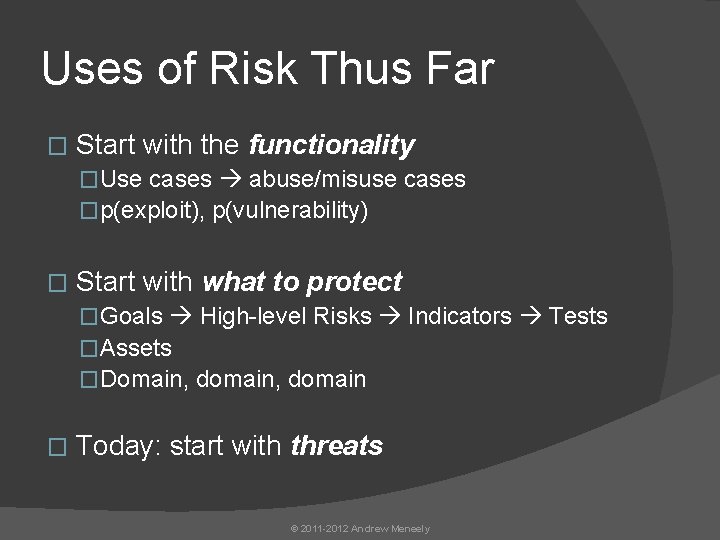
Uses of Risk Thus Far � Start with the functionality �Use cases abuse/misuse cases �p(exploit), p(vulnerability) � Start with what to protect �Goals High-level Risks Indicators Tests �Assets �Domain, domain � Today: start with threats © 2011 -2012 Andrew Meneely
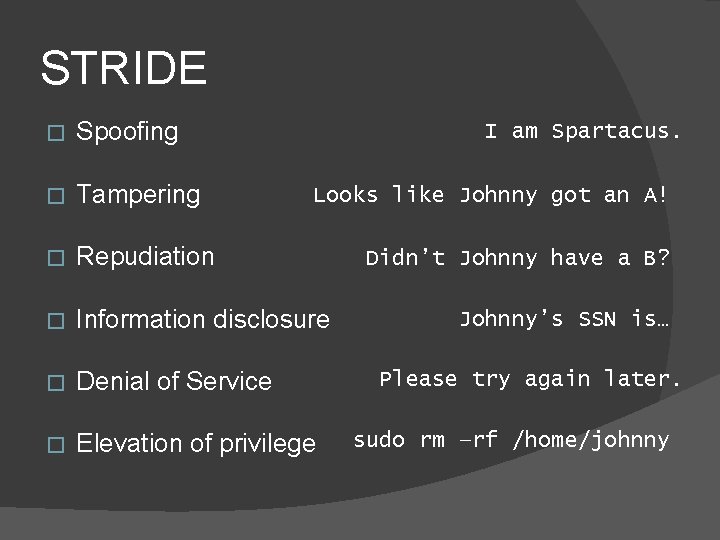
STRIDE � Spoofing � Tampering � Repudiation � Information disclosure � Denial of Service � Elevation of privilege I am Spartacus. Looks like Johnny got an A! Didn’t Johnny have a B? Johnny’s SSN is… Please try again later. sudo rm –rf /home/johnny
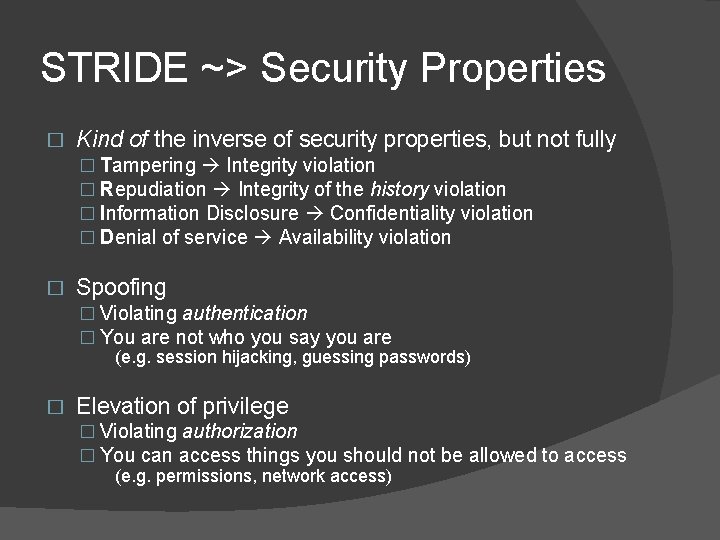
STRIDE ~> Security Properties � Kind of the inverse of security properties, but not fully � Tampering Integrity violation � Repudiation Integrity of the history violation � Information Disclosure Confidentiality violation � Denial of service Availability violation � Spoofing � Violating authentication � You are not who you say you are (e. g. session hijacking, guessing passwords) � Elevation of privilege � Violating authorization � You can access things you should not be allowed to access (e. g. permissions, network access)
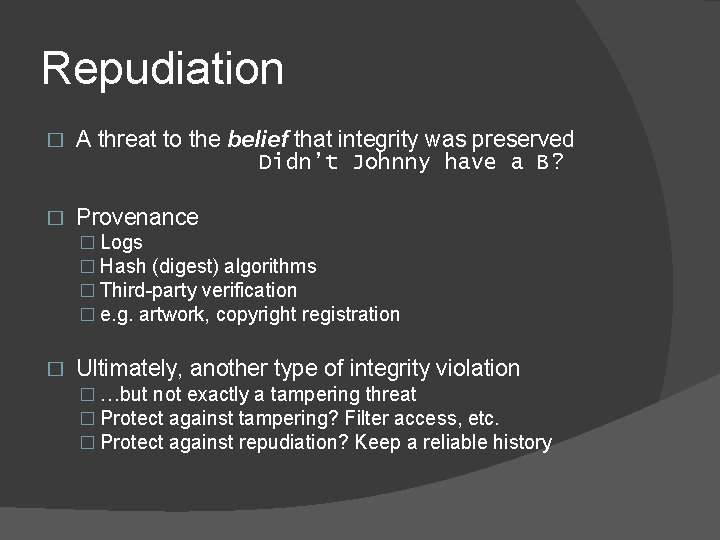
Repudiation � A threat to the belief that integrity was preserved Didn’t Johnny have a B? � Provenance � Logs � Hash (digest) algorithms � Third-party verification � e. g. artwork, copyright registration � Ultimately, another type of integrity violation � …but not exactly a tampering threat � Protect against tampering? Filter access, etc. � Protect against repudiation? Keep a reliable history
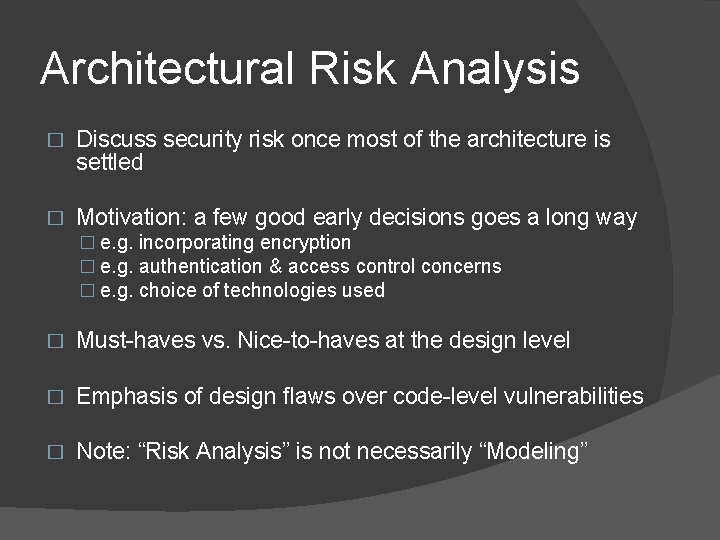
Architectural Risk Analysis � Discuss security risk once most of the architecture is settled � Motivation: a few good early decisions goes a long way � e. g. incorporating encryption � e. g. authentication & access control concerns � e. g. choice of technologies used � Must-haves vs. Nice-to-haves at the design level � Emphasis of design flaws over code-level vulnerabilities � Note: “Risk Analysis” is not necessarily “Modeling”
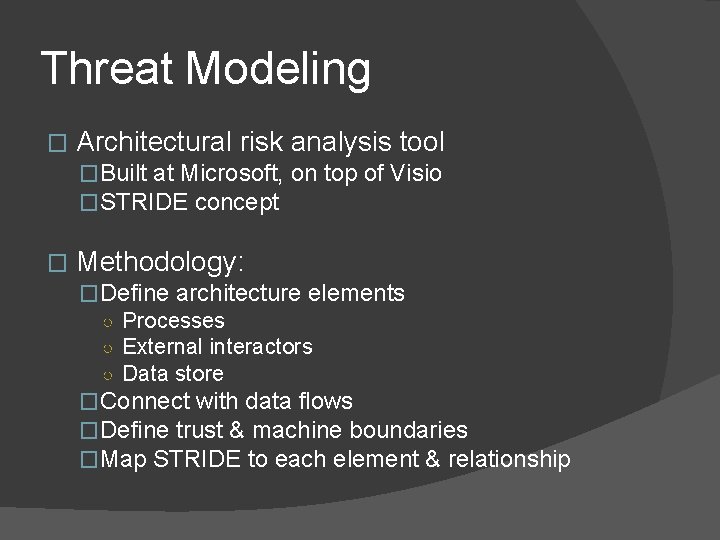
Threat Modeling � Architectural risk analysis tool �Built at Microsoft, on top of Visio �STRIDE concept � Methodology: �Define architecture elements ○ Processes ○ External interactors ○ Data store �Connect with data flows �Define trust & machine boundaries �Map STRIDE to each element & relationship
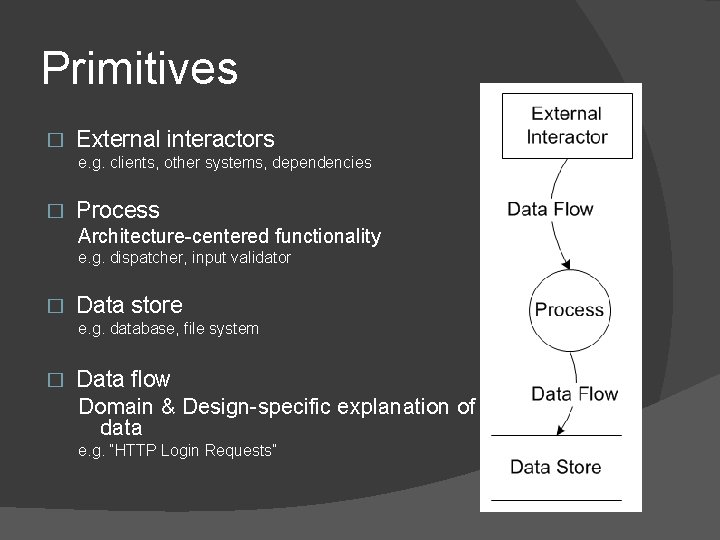
Primitives � External interactors e. g. clients, other systems, dependencies � Process Architecture-centered functionality e. g. dispatcher, input validator � Data store e. g. database, file system � Data flow Domain & Design-specific explanation of data e. g. “HTTP Login Requests”
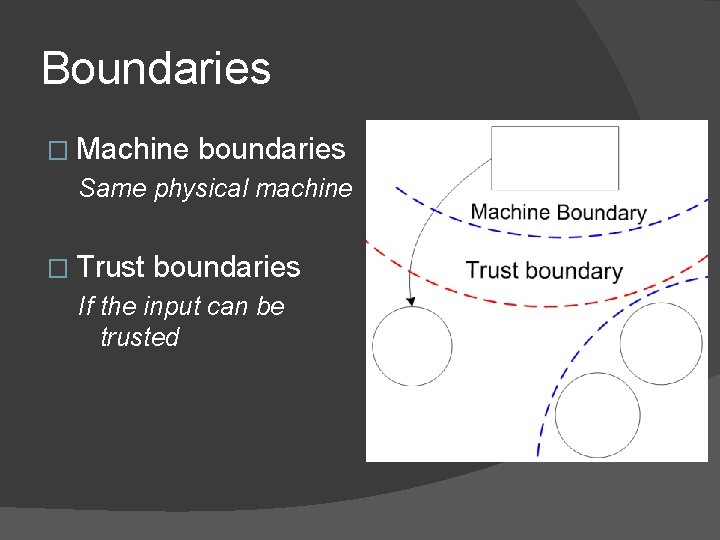
Boundaries � Machine boundaries Same physical machine � Trust boundaries If the input can be trusted
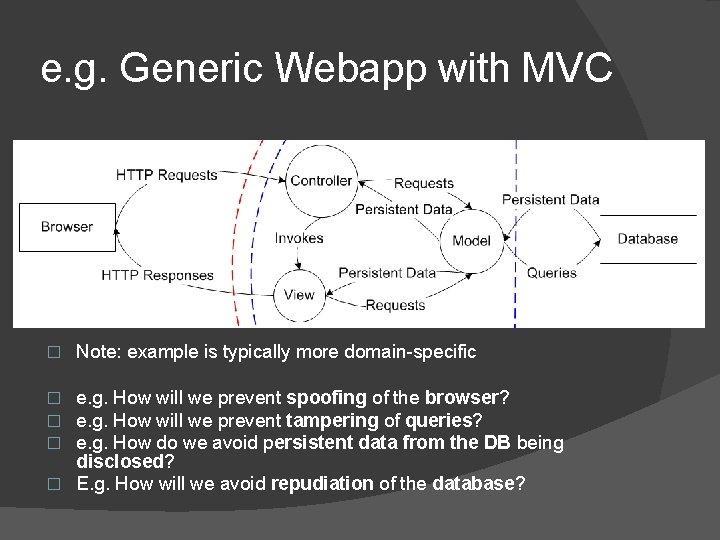
e. g. Generic Webapp with MVC � Note: example is typically more domain-specific e. g. How will we prevent spoofing of the browser? e. g. How will we prevent tampering of queries? e. g. How do we avoid persistent data from the DB being disclosed? � E. g. How will we avoid repudiation of the database? � � �
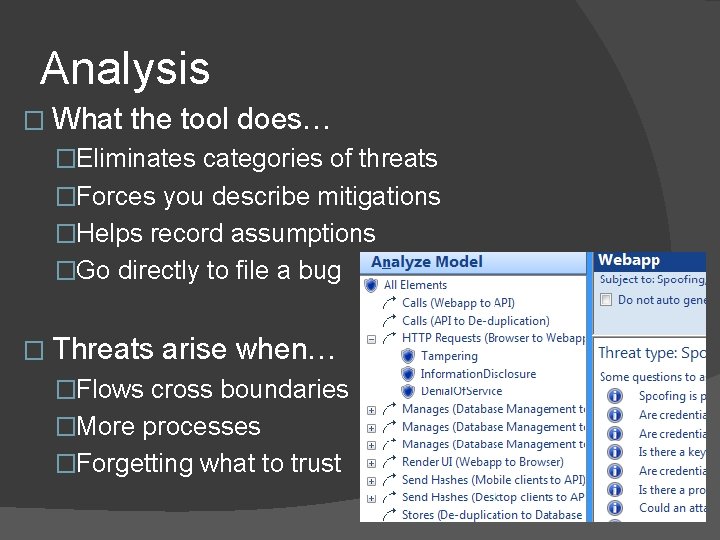
Analysis � What the tool does… �Eliminates categories of threats �Forces you describe mitigations �Helps record assumptions �Go directly to file a bug � Threats arise when… �Flows cross boundaries �More processes �Forgetting what to trust
Tips for Threat Modeling � Be honest with the process � Make sure the model represents reality (or what you really believe reality will be) � Consider all types of threats – code-level vulns are just a “for example” � As with all modeling, use appropriate complexity � Overly-simplified? ○ Departs from reality ○ You get exactly what you put into it – no new knowledge � Overly-complicated? ○ Too much to analyze ○ “Check it off the list” syndrome � Test your model Think of a specific security concern, then try to see where it fits in your threat model
Today’s Activity � Groups of 2 -3 �Go through the Threat Modeling activity �Tool: c: Program Files (x 86)MicrosoftSDL Threat ModelingSDLTM. exe � For attendance, find me to check you off for today before leaving