
Engineering Secure Software COMMON VULNERABILITY SCORING SYSTEM How
Engineering Secure Software COMMON VULNERABILITY SCORING SYSTEM
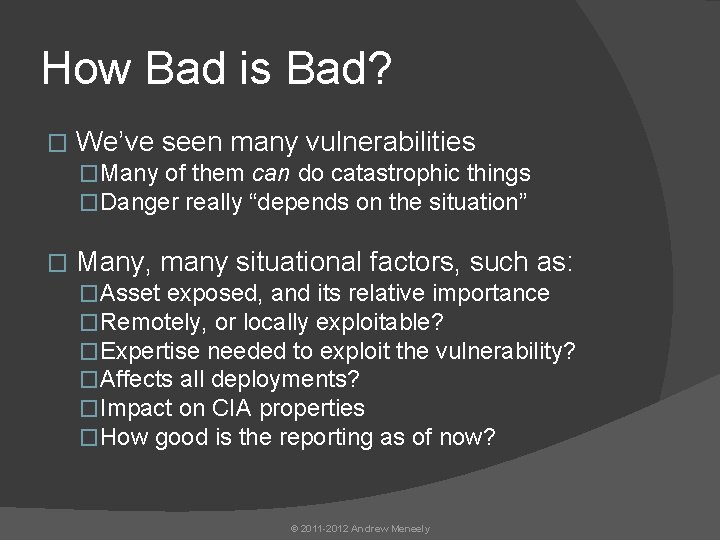
How Bad is Bad? � We’ve seen many vulnerabilities �Many of them can do catastrophic things �Danger really “depends on the situation” � Many, many situational factors, such as: �Asset exposed, and its relative importance �Remotely, or locally exploitable? �Expertise needed to exploit the vulnerability? �Affects all deployments? �Impact on CIA properties �How good is the reporting as of now? © 2011 -2012 Andrew Meneely

CVSS � Common Vulnerability Scoring System � Adopted by NIST � Required for reporting a vulnerability in CVE � An open scoring system from FIRST � FIRST: Forum for Incident Response & Security Teams � http: //www. first. org/cvss � A group of researchers & practitioners � Three levels � Base: no changes over time or environment � Environmental: might vary in different deployments � Temporal: might change over time � Essentially a weighted average
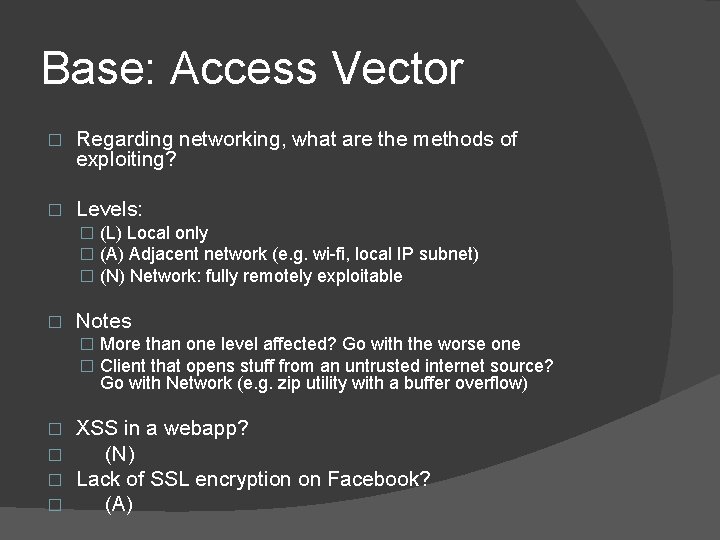
Base: Access Vector � Regarding networking, what are the methods of exploiting? � Levels: � (L) Local only � (A) Adjacent network (e. g. wi-fi, local IP subnet) � (N) Network: fully remotely exploitable � Notes � More than one level affected? Go with the worse one � Client that opens stuff from an untrusted internet source? Go with Network (e. g. zip utility with a buffer overflow) � � XSS in a webapp? (N) Lack of SSL encryption on Facebook? (A)
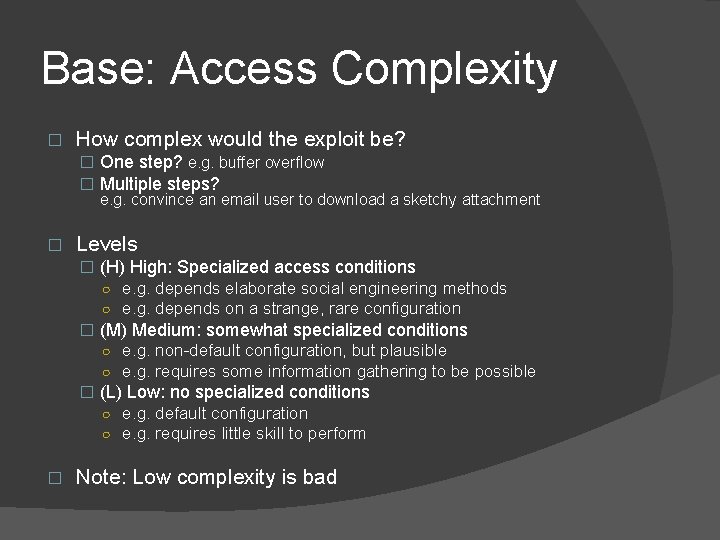
Base: Access Complexity � How complex would the exploit be? � One step? e. g. buffer overflow � Multiple steps? e. g. convince an email user to download a sketchy attachment � Levels � (H) High: Specialized access conditions ○ e. g. depends elaborate social engineering methods ○ e. g. depends on a strange, rare configuration � (M) Medium: somewhat specialized conditions ○ e. g. non-default configuration, but plausible ○ e. g. requires some information gathering to be possible � (L) Low: no specialized conditions ○ e. g. default configuration ○ e. g. requires little skill to perform � Note: Low complexity is bad
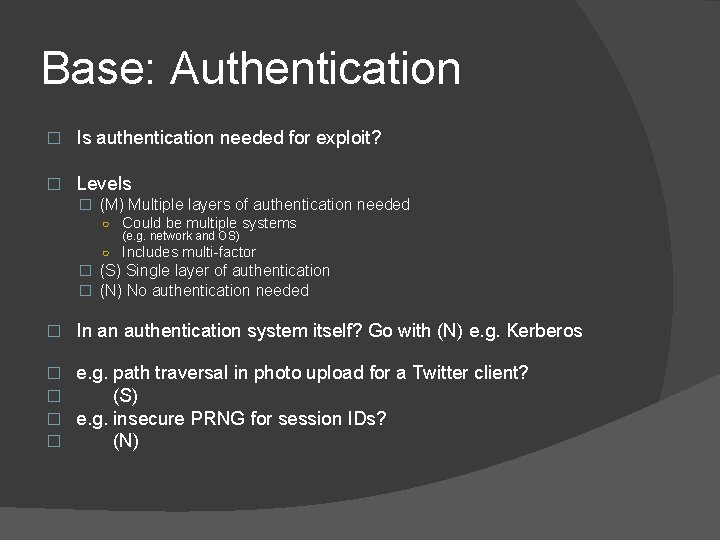
Base: Authentication � Is authentication needed for exploit? � Levels � (M) Multiple layers of authentication needed ○ Could be multiple systems (e. g. network and OS) ○ Includes multi-factor � (S) Single layer of authentication � (N) No authentication needed � In an authentication system itself? Go with (N) e. g. Kerberos � � e. g. path traversal in photo upload for a Twitter client? (S) e. g. insecure PRNG for session IDs? (N)
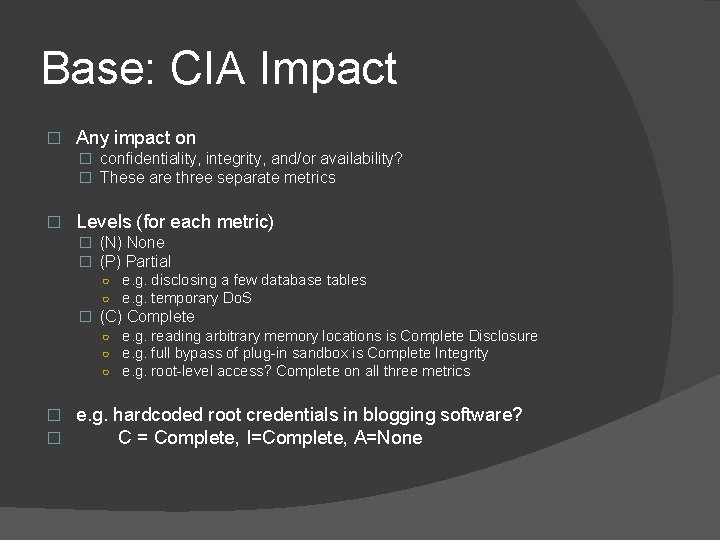
Base: CIA Impact � Any impact on � confidentiality, integrity, and/or availability? � These are three separate metrics � Levels (for each metric) � (N) None � (P) Partial ○ e. g. disclosing a few database tables ○ e. g. temporary Do. S � (C) Complete ○ e. g. reading arbitrary memory locations is Complete Disclosure ○ e. g. full bypass of plug-in sandbox is Complete Integrity ○ e. g. root-level access? Complete on all three metrics � � e. g. hardcoded root credentials in blogging software? C = Complete, I=Complete, A=None
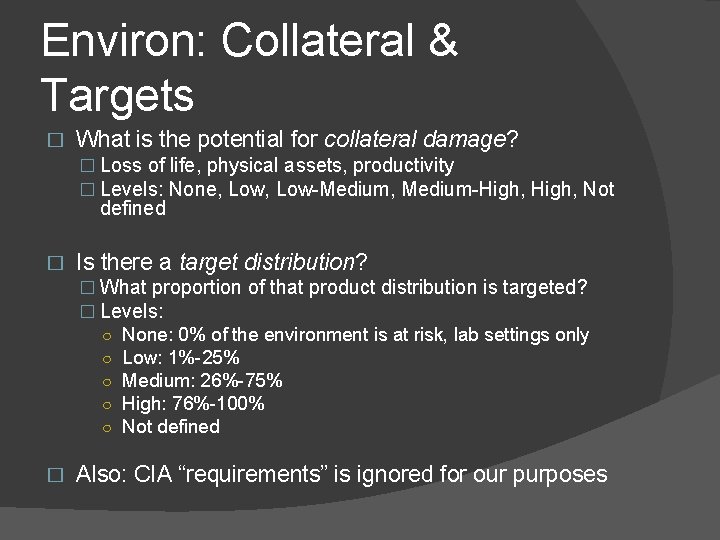
Environ: Collateral & Targets � What is the potential for collateral damage? � Loss of life, physical assets, productivity � Levels: None, Low-Medium, Medium-High, Not defined � Is there a target distribution? � What proportion of that product distribution is targeted? � Levels: ○ None: 0% of the environment is at risk, lab settings only ○ Low: 1%-25% ○ Medium: 26%-75% ○ High: 76%-100% ○ Not defined � Also: CIA “requirements” is ignored for our purposes
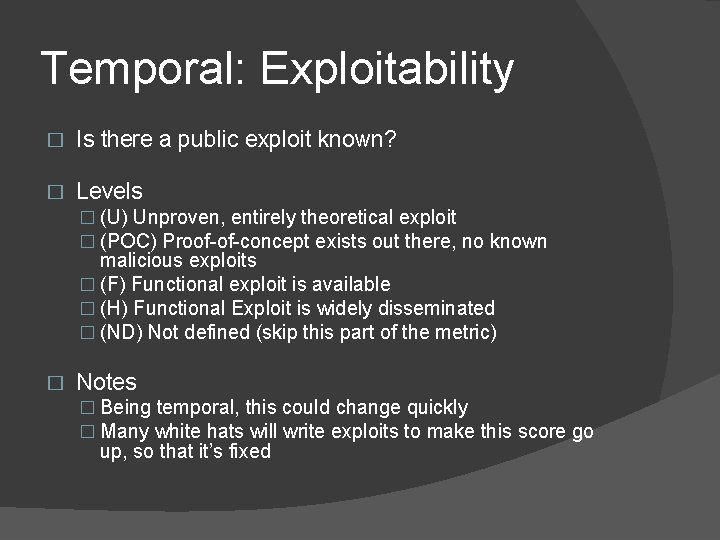
Temporal: Exploitability � Is there a public exploit known? � Levels � (U) Unproven, entirely theoretical exploit � (POC) Proof-of-concept exists out there, no known malicious exploits � (F) Functional exploit is available � (H) Functional Exploit is widely disseminated � (ND) Not defined (skip this part of the metric) � Notes � Being temporal, this could change quickly � Many white hats will write exploits to make this score go up, so that it’s fixed
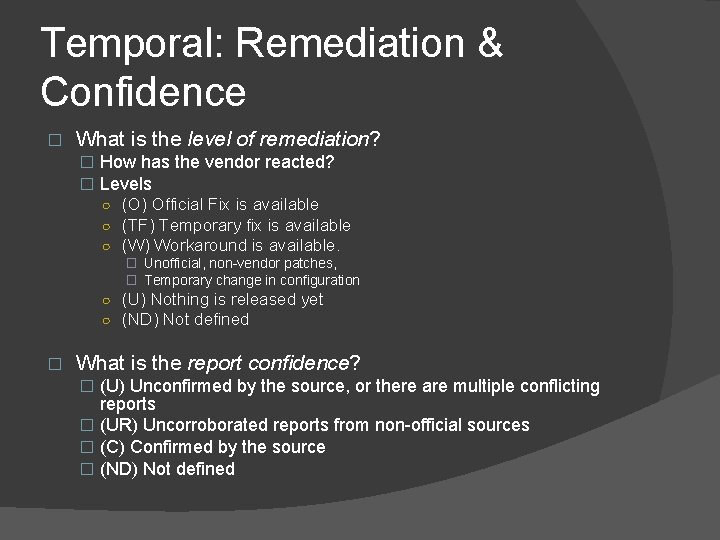
Temporal: Remediation & Confidence � What is the level of remediation? � How has the vendor reacted? � Levels ○ (O) Official Fix is available ○ (TF) Temporary fix is available ○ (W) Workaround is available. � Unofficial, non-vendor patches, � Temporary change in configuration ○ (U) Nothing is released yet ○ (ND) Not defined � What is the report confidence? � (U) Unconfirmed by the source, or there are multiple conflicting reports � (UR) Uncorroborated reports from non-official sources � (C) Confirmed by the source � (ND) Not defined
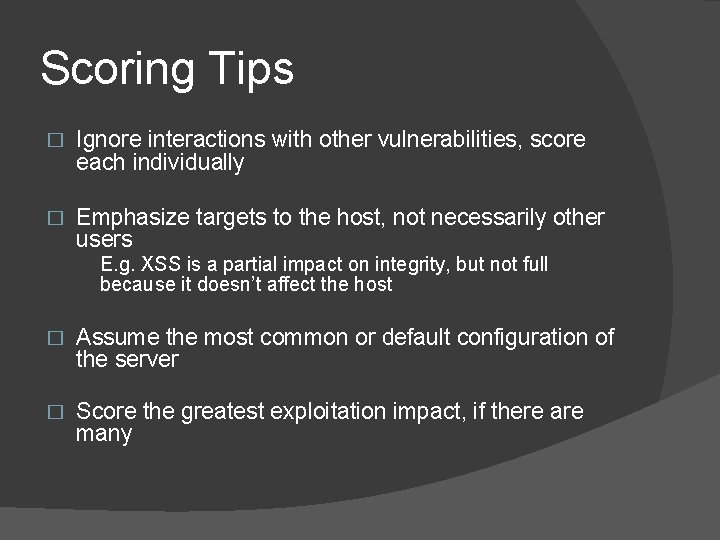
Scoring Tips � Ignore interactions with other vulnerabilities, score each individually � Emphasize targets to the host, not necessarily other users E. g. XSS is a partial impact on integrity, but not full because it doesn’t affect the host � Assume the most common or default configuration of the server � Score the greatest exploitation impact, if there are many
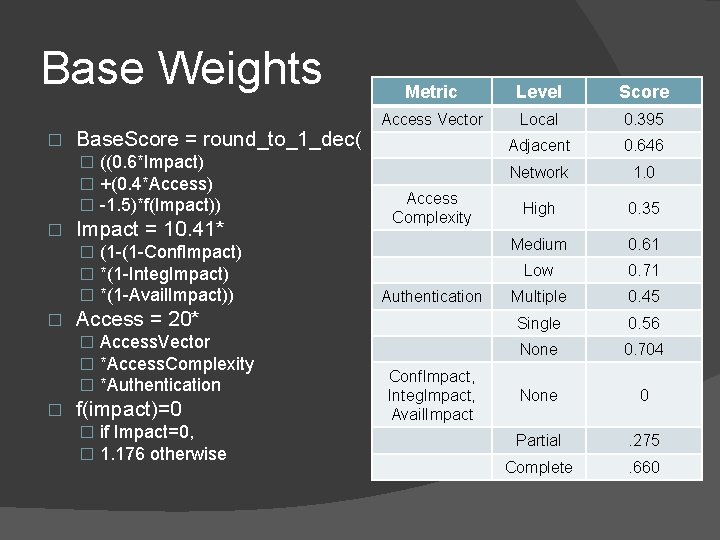
Base Weights � Base. Score = round_to_1_dec( � ((0. 6*Impact) � +(0. 4*Access) � -1. 5)*f(Impact)) � Impact = 10. 41* � (1 -(1 -Conf. Impact) � *(1 -Integ. Impact) � *(1 -Avail. Impact)) � Level Score Access Vector Local 0. 395 Adjacent 0. 646 Network 1. 0 High 0. 35 Medium 0. 61 Low 0. 71 Multiple 0. 45 Single 0. 56 None 0. 704 None 0 Partial . 275 Complete . 660 Access Complexity Authentication Access = 20* � Access. Vector � *Access. Complexity � *Authentication � Metric f(impact)=0 � if Impact=0, � 1. 176 otherwise Conf. Impact, Integ. Impact, Avail. Impact
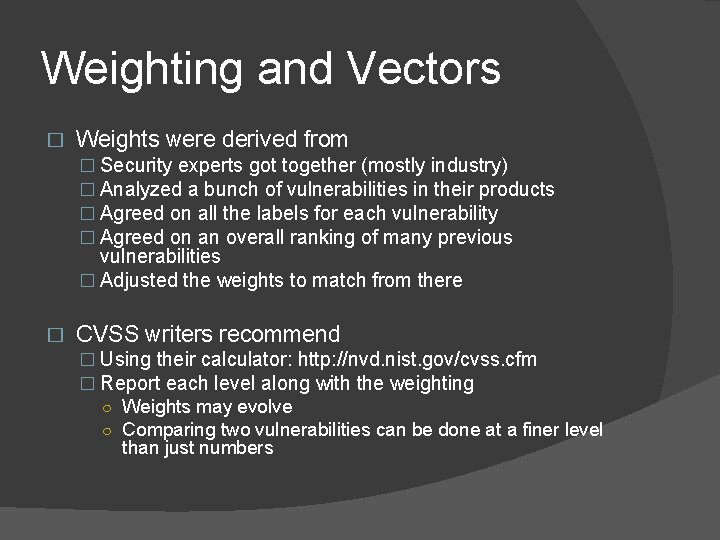
Weighting and Vectors � Weights were derived from � Security experts got together (mostly industry) � Analyzed a bunch of vulnerabilities in their products � Agreed on all the labels for each vulnerability � Agreed on an overall ranking of many previous vulnerabilities � Adjusted the weights to match from there � CVSS writers recommend � Using their calculator: http: //nvd. nist. gov/cvss. cfm � Report each level along with the weighting ○ Weights may evolve ○ Comparing two vulnerabilities can be done at a finer level than just numbers
Alternative: CWSS � Common WEAKNESS Scoring System � Relatively recent (~2010) response to CVSS � More detailed, but not as widely-adopted � http: //cwe. mitre. org/cwss/ � Categories: Base, Attack Surface, Environmental � Base Finding Metric Group � 5 metrics in this group � e. g. Acquired Privilege ○ User-level access acquired. Admin? � e. g. Acquired Privilege Layer ○ Access to Network, App, entire Enterprise � e. g. Internal Control Effectiveness ○ Would our internal detection measures have been effective? Would we have known this was exploited?
Alternative: CWSS (cont. ) � Attack Surface Metric Group � 7 metrics in this group � e. g. Required Privilege AND Required Privilege Layer ○ How much authentication was needed? � e. g. Level of Interaction How much social engineering is required? � Environmental Impact Group � 6 metrics in this group � e. g. Business Impact � e. g. Likelihood of Discovery � e. g. Likelihood of Exploit � e. g. Remediation Effort ○ Is this a really difficult fix? Should we be worried about this coming up again or being incorrectly fixed?
Today’s Activity � Let’s assess four vulnerabilities from industry � One from: PHP, Chromium, Tomcat, Linux kernel ○ Patches and reports are linked in ○ Feel free to use the internet to make your decisions (but don’t look at any CVSS scorings online!) � CVSS base scores only � Also: two “detection” questions ○ Domain-specific ○ New code or changed code? � In groups of 4 -6 � Planning Poker-like discussion � First: answer all four vulnerabilities for one question � Then: focus on one vulnerability at a time, for all questions
- Slides: 16