
Engineering Science of applying scientific knowledge in order
- Slides: 14
Engineering Science of applying scientific knowledge in order to design and build structures machines, devices, systems, materials and processes To think about, design, build and test something
Engineering Perspectives When designing something we must look at it from 6 different perspectives. • The Physical perspective • The Technical perspective • The Economic perspective • The Industrial perspective • The Human perspective • The Environmental perspective
Engineering Perspectives The Physical perspective The physical perspective must take into account the natural elements. Wind, Water, Earth. Can the object you are designing stand up to these elements The Technical perspective The technical perspective takes into account the factors that affect the operation of the object. Ex: Battery life, speed, power etc
Engineering Perspectives The Economic perspective looks into the costs of creating, selling, and maintaining this product. The Industrial perspective This perspective takes into account the where and how the object will be produced. The designer must consider skilled labour, factory size and equipment, and completion deadlines
Engineering Perspectives The Human perspective This perspective takes into account who will use the product, will they like it? Will they be able to maintain it? Aesthetics(looks), safety and comfort are all considered The Environmental perspective This is where the designer considers the effect of the object on the environment, both during production(Pollution/waste), and after purchase(Pollution/Recyclability).
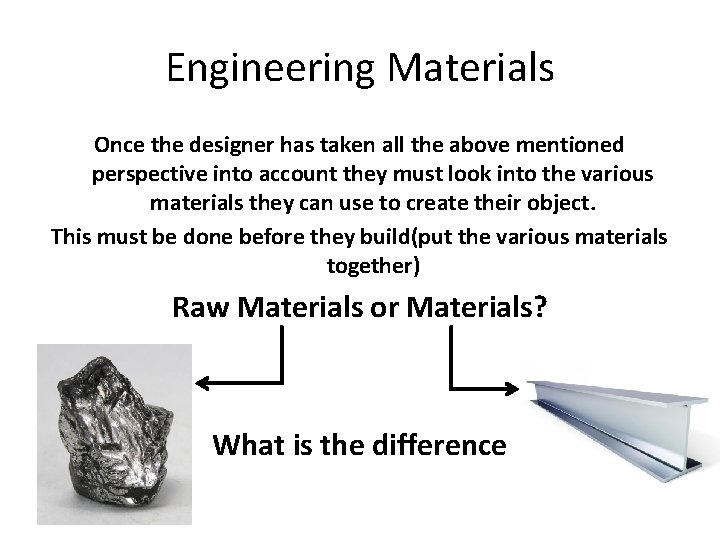
Engineering Materials Once the designer has taken all the above mentioned perspective into account they must look into the various materials they can use to create their object. This must be done before they build(put the various materials together) Raw Materials or Materials? What is the difference
Engineering Materials When engineers look at materials they divide them into categories depending on their use. When building a structure the materials are divided into: • Connection materials: things you use to link (join) together other materials • Extension materials: things you use to extend the height, width and depth of the building you make. A materials advantages and disadvantages help designer decide which type of material something is. Ex: light and strong = extension material, soft & sticky =connective material
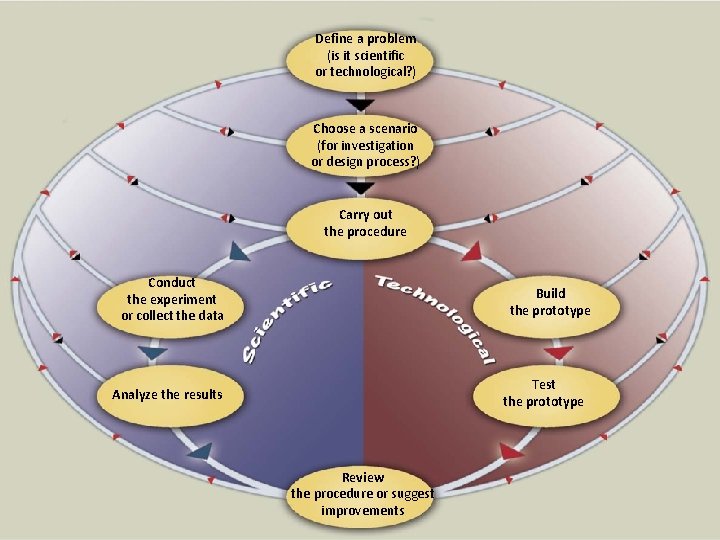
Define a problem (is it scientific or technological? ) Choose a scenario (for investigation or design process? ) Carry out the procedure Conduct the experiment or collect the data Build the prototype Test the prototype Analyze the results Review the procedure or suggest improvements
In order to explain how mechanical objects function we need some tools • We need to make a sketch and then add as much labeling as we think is necessary to help others understand what we are trying to show with our diagram. • We need to use common symbols for movement and simple mechanisms. 9
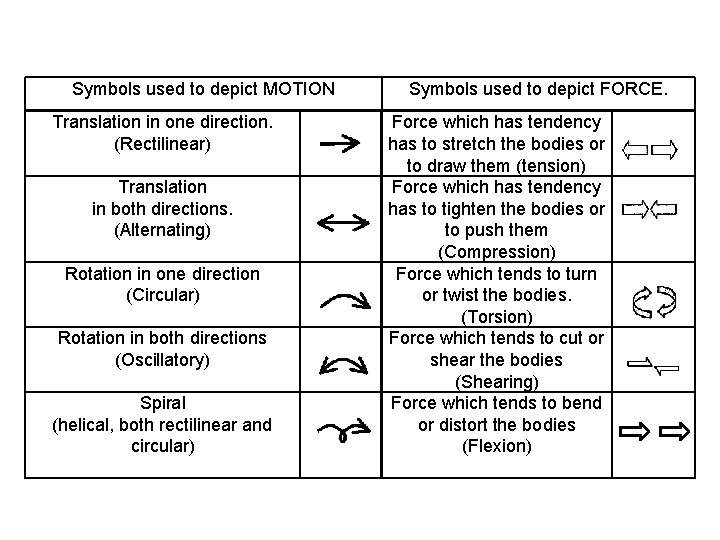
Symbols used to depict MOTION Translation in one direction. (Rectilinear) Translation in both directions. (Alternating) Rotation in one direction (Circular) Rotation in both directions (Oscillatory) Spiral (helical, both rectilinear and circular) Symbols used to depict FORCE. Force which has tendency has to stretch the bodies or to draw them (tension) Force which has tendency has to tighten the bodies or to push them (Compression) Force which tends to turn or twist the bodies. (Torsion) Force which tends to cut or shear the bodies (Shearing) Force which tends to bend or distort the bodies (Flexion)
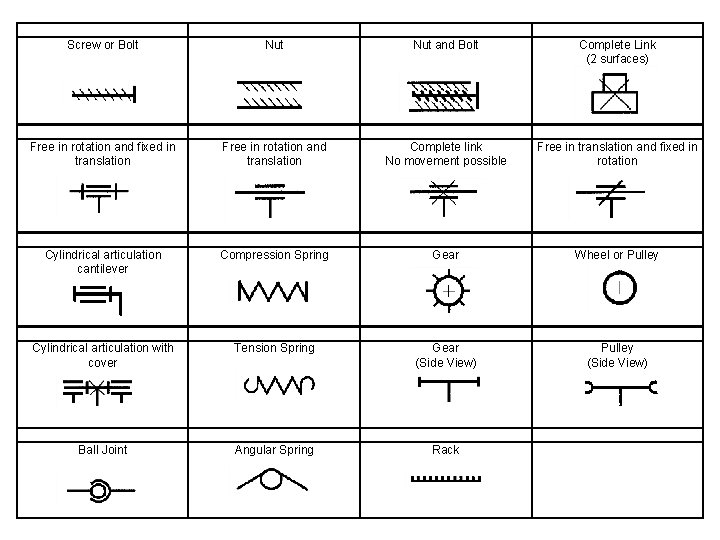
Screw or Bolt Nut and Bolt Complete Link (2 surfaces) Free in rotation and fixed in translation Free in rotation and translation Complete link No movement possible Free in translation and fixed in rotation Cylindrical articulation cantilever Compression Spring Gear Wheel or Pulley Cylindrical articulation with cover Tension Spring Gear (Side View) Pulley (Side View) Ball Joint Angular Spring Rack
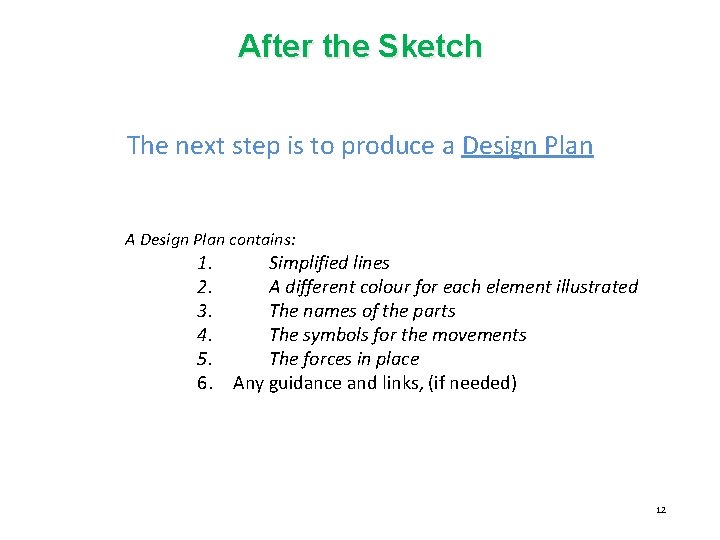
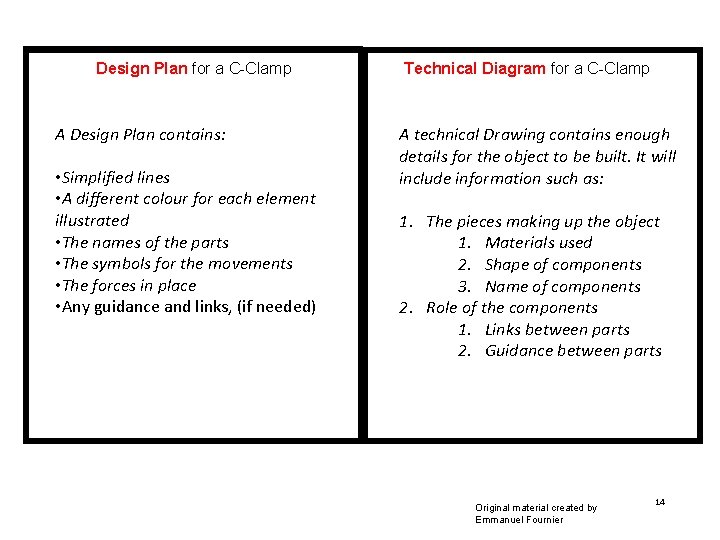
After the Sketch The next step is to produce a Design Plan A Design Plan contains: 1. Simplified lines 2. A different colour for each element illustrated 3. The names of the parts 4. The symbols for the movements 5. The forces in place 6. Any guidance and links, (if needed) 12
Design Plan for a C-Clamp A Design Plan contains: • Simplified lines • A different colour for each element illustrated • The names of the parts • The symbols for the movements • The forces in place • Any guidance and links, (if needed) Technical Diagram for a C-Clamp A technical Drawing contains enough details for the object to be built. It will include information such as: 1. The pieces making up the object 1. Materials used 2. Shape of components 3. Name of components 2. Role of the components 1. Links between parts 2. Guidance between parts Original material created by Emmanuel Fournier 14