
Engineering Principle 1 Neutral Buoyancy Stability Weight W
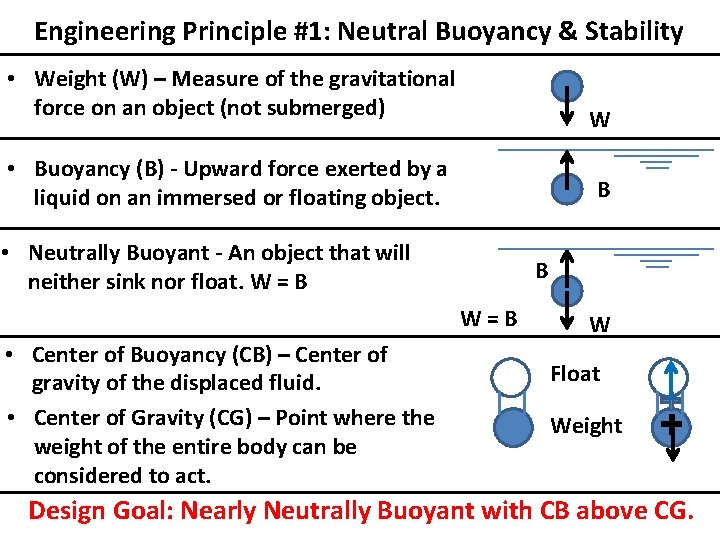
Engineering Principle #1: Neutral Buoyancy & Stability • Weight (W) – Measure of the gravitational force on an object (not submerged) W • Buoyancy (B) - Upward force exerted by a liquid on an immersed or floating object. B • Neutrally Buoyant - An object that will neither sink nor float. W = B B W=B • Center of Buoyancy (CB) – Center of gravity of the displaced fluid. • Center of Gravity (CG) – Point where the weight of the entire body can be considered to act. W Float Weight Design Goal: Nearly Neutrally Buoyant with CB above CG.
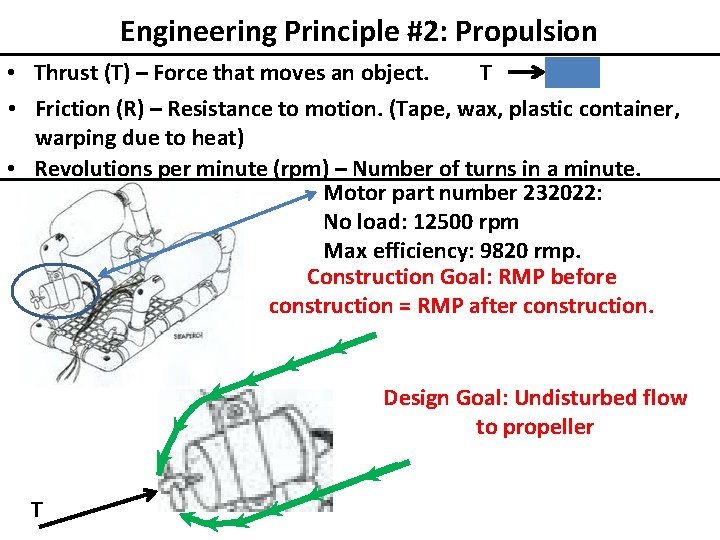
Engineering Principle #2: Propulsion T • Thrust (T) – Force that moves an object. • Friction (R) – Resistance to motion. (Tape, wax, plastic container, warping due to heat) • Revolutions per minute (rpm) – Number of turns in a minute. Motor part number 232022: No load: 12500 rpm Max efficiency: 9820 rmp. Construction Goal: RMP before construction = RMP after construction. Design Goal: Undisturbed flow to propeller T
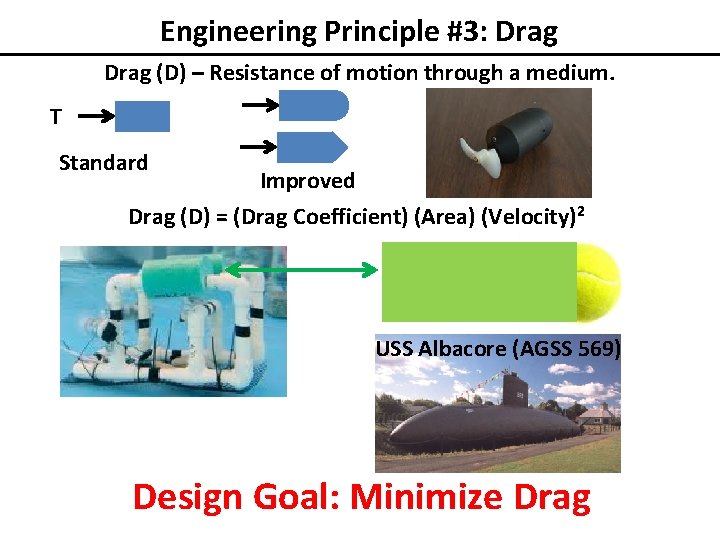
Engineering Principle #3: Drag (D) – Resistance of motion through a medium. T Standard Improved Drag (D) = (Drag Coefficient) (Area) (Velocity)2 USS Albacore (AGSS 569) Design Goal: Minimize Drag
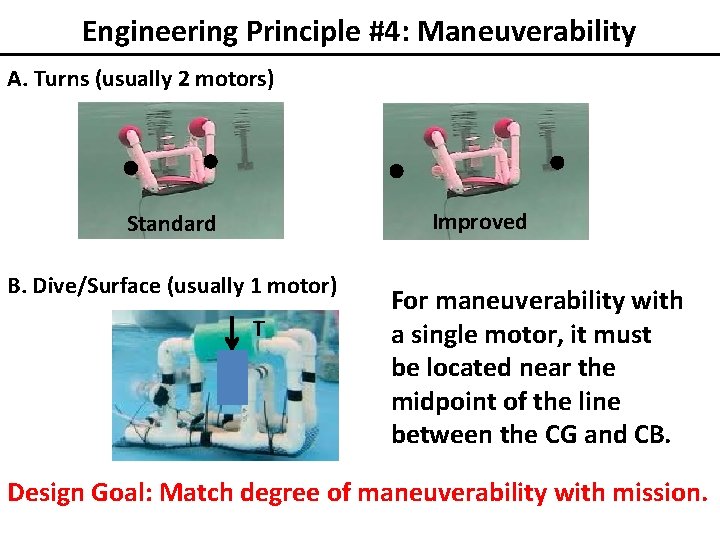
Engineering Principle #4: Maneuverability A. Turns (usually 2 motors) Improved Standard B. Dive/Surface (usually 1 motor) T For maneuverability with a single motor, it must be located near the midpoint of the line between the CG and CB. Design Goal: Match degree of maneuverability with mission.
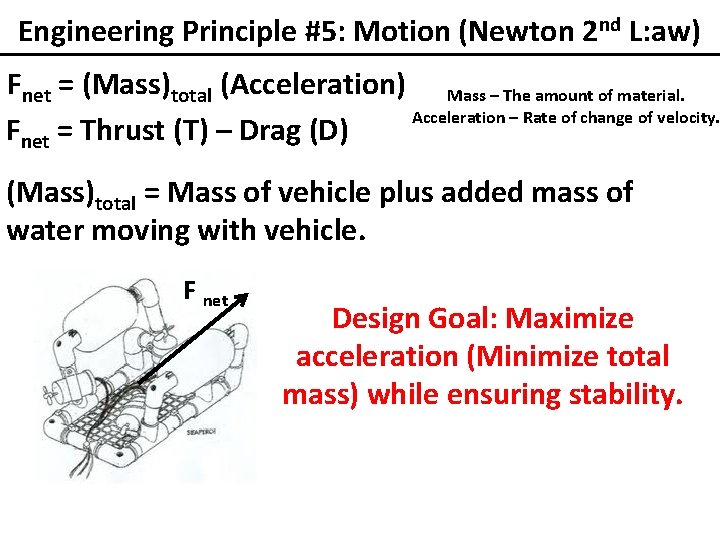
Engineering Principle #5: Motion (Newton 2 nd L: aw) Fnet = (Mass)total (Acceleration) Mass – The amount of material. Acceleration – Rate of change of velocity. Fnet = Thrust (T) – Drag (D) (Mass)total = Mass of vehicle plus added mass of water moving with vehicle. F net Design Goal: Maximize acceleration (Minimize total mass) while ensuring stability.
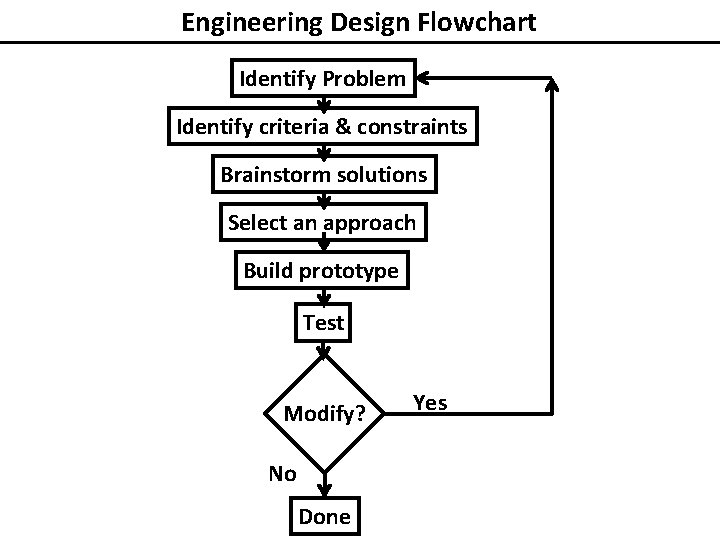
Engineering Design Flowchart Identify Problem Identify criteria & constraints Brainstorm solutions Select an approach Build prototype Test Modify? No Done Yes
- Slides: 6