
Engineering Merit Badge Requirements 1 Select a manufactured
Engineering Merit Badge

Requirements 1. Select a manufactured item in your home (such as a toy or an appliance) and, under adult supervision and with the approval of your counselor, investigate how and why it works as it does. Find out what sort of engineering activities were needed to create it. Discuss with your counselor what you learned and how you got the information. 2. Select an engineering achievement that has had a major impact on society. Using resources such as the Internet (with your parent's permission), books, and magazines, find out about the engineers who made this engineering feat possible, the special obstacles they had to overcome, and how this achievement has influenced the world today. Tell your counselor what you learned. 3. Explain the work of six types of engineers. Pick two of the six and explain how their work is related. 2
Requirements 4. Visit with an engineer (who may be your counselor or parent) and do the following: a. b. c. d. e. Discuss the work this engineer does and the tools the engineer uses. Discuss with the engineer a current project and the engineer’s particular role in it. Find out how the engineer’s work is done and how results are achieved. Ask to see the reports that the engineer writes concerning the project. Discuss with your counselor what you learned about engineering from this visit. 5. Do ONE of the following: a. Use the systems engineering approach to make step-by-step plans for your next campout. List alternative ideas for such items as program schedule, campsites, transportation, and costs. Tell why you made the choices you did and what improvements were made. b. Make an original design for a piece of patrol equipment. Use the systems engineering approach to help you decide how it should work and look. Draw plans for it. Show the plans to your counselor, explain why you designed it the way you did, and explain how you would make it. 3

Requirements 6. Do TWO of the following: a. Transforming motion. Using common material or a construction set, make a simple model that will demonstrate motion. Explain how the model uses basic mechanical concepts like levers and inclined planes to demonstrate motion. Describe an example where this mechanism is used in a real product. b. Using electricity. Make a list of 10 electrical appliances in your home. Find out approximately how much electricity each uses in one month. Learn how to find out the amount and cost of electricity used in your home during periods of light and heavy use. List five ways to conserve electricity. c. Understanding electronics. Using an electronic device such as a mobile telephone or portable digital media player, find out how sound travels from one location to another. Explain how the device was designed for ease of use, function, and durability. d. Using materials. Do experiments to show the differences in strength and heat conductivity in wood, metal, and plastic. Discuss with your counselor what you have learned. e. Converting energy. Do an experiment to show mechanical, heat, chemical, solar, and/or electrical energy may be converted from one or more types of energy to another. Explain your results. Describe to your counselor what energy is and how energy is converted and used in your surroundings. f. Moving people. Find out the different ways people in your community get to work. Make a study of traffic flow (number of vehicles and relative speed) in both heavy and light traffic periods. Discuss with your counselor what might be improved to make it easier for people in your community to get where they need to go. g. Building an engineering project. Enter a project in a science or engineering fair or similar competition. (This requirement may be met by participation on an engineering competition project team. ) Discuss with your counselor what your project demonstrates, the kinds of questions visitors to the fair asked you about it, and how well were you able to answer their questions. 4
Requirements 7. Explain what it means to be a registered Professional Engineer (PE). Name the types of engineering work for which registration is most important? 8. Study the Engineer's Code of Ethics. Explain how it is like the Scout Oath and Scout Law. 9. Find out about three career opportunities in engineering. Pick one and research the education, training, and experience required for this profession. Discuss this with your counselor, and explain why this profession might interest you. 5
Requirement #1 • Select a manufactured item in your home (such as a toy or an appliance) and, under adult supervision and with the approval of your counselor, investigate how and why it works as it does. Find out what sort of engineering activities were needed to create it. Discuss with your counselor what you learned and how you got the information. 6
Requirement #2 • Select an engineering achievement that has had a major impact on society. Using resources such as the Internet (with your parent's permission), books, and magazines, find out about the engineers who made this engineering feat possible, the special obstacles they had to overcome, and how this achievement has influenced the world today. Tell your counselor what you learned. • Examples include the following: – – – Interstate Road System Roman Aquaducts Apollo Missions to the Moon Telephone Light Bulb Transcontinental Railroad 7
Requirement #3 • Explain the work of six types of engineers. Pick two of the six and explain how their work is related. 8
What is Engineering? • Engineering is the application of science and mathematics to improve society • Engineers exist to design, construct, operate, or maintain the systems and devices that drive our society, making them as effective and efficient as possible • The bottom line: engineering is problem solving Engineering is the art or science of making practical. ~ Samuel C. Florman 9
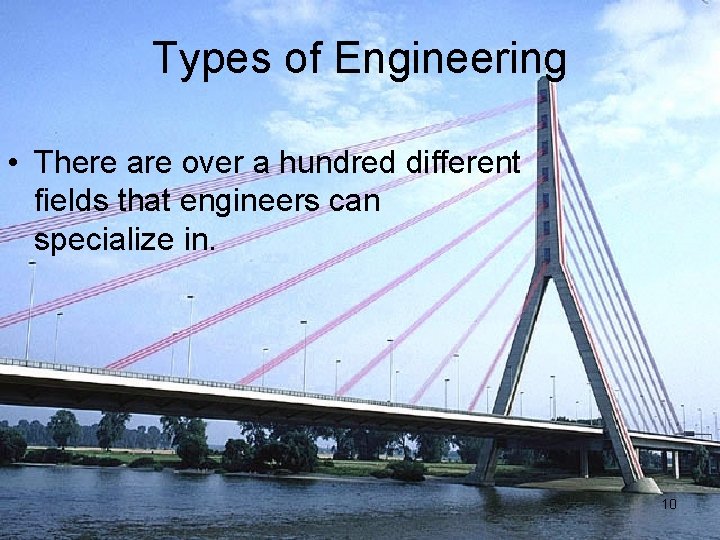
Types of Engineering • There are over a hundred different fields that engineers can specialize in. 10
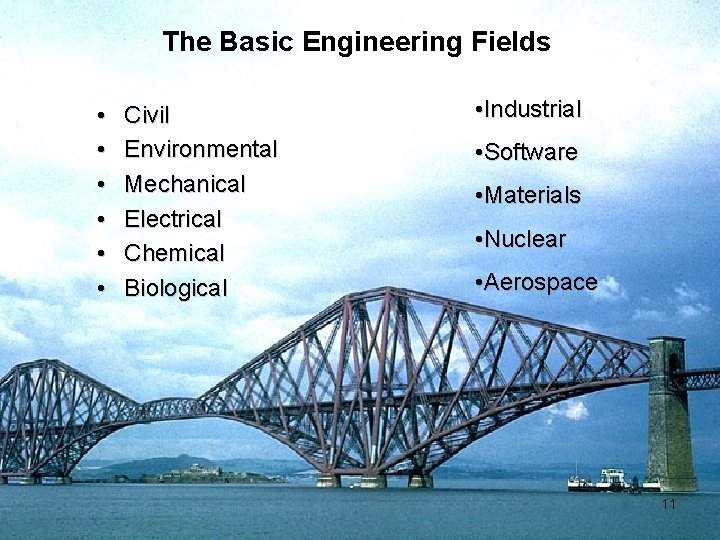
The Basic Engineering Fields • • • Civil Environmental Mechanical Electrical Chemical Biological • Industrial • Software • Materials • Nuclear • Aerospace 11
Common Characteristics • • Strong math background Effective speakers Good communication skills Good writers 12

Which direction to choose? ? ? Do You Fit the Profile to be an Engineer? ? ? http: //www. tame. org/engquiz/engineer 1 a/ind exframe. htm 13
14
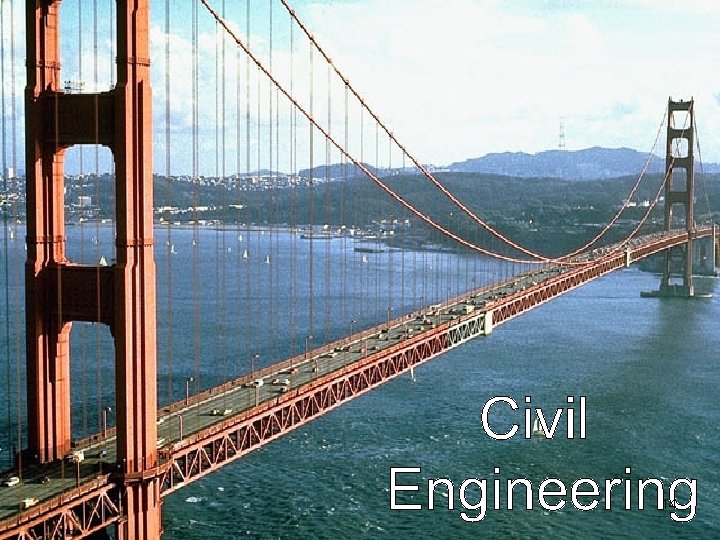
Civil Engineering • Civil engineers meet societies need for infrastructure and water systems. • Civil Engineering is the most diverse discipline because of the wide range of subcategories: 15

Civil Engineering • A civil engineer might be asked to: – – – Design a bridge Build a dam Determine the safest speed of a road Analyze data on the soil for a foundation Interpret numbers to forecast future traffic problems 16
Civil Engineering • Subcategories: – – – Structures Geotechnical Transportation Water Resources Surveying Environment 17

Civil Engineering: Structures • Design and construction of adequate buildings, bridges, skyscrapers. 18
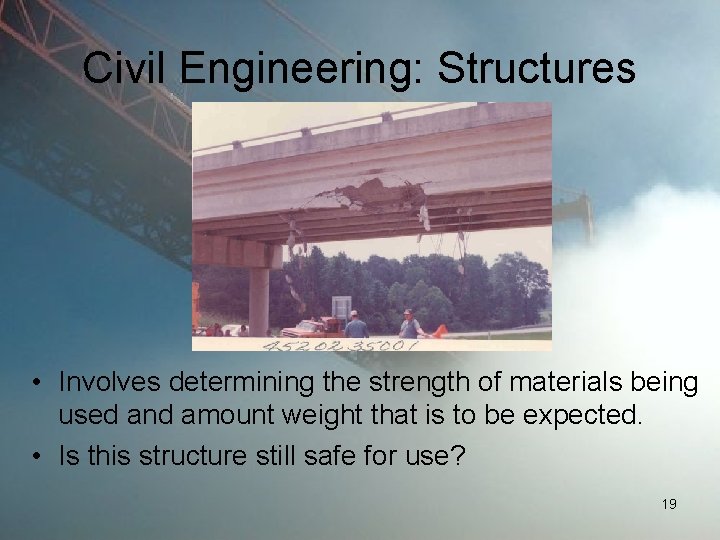
Civil Engineering: Structures • Involves determining the strength of materials being used and amount weight that is to be expected. • Is this structure still safe for use? 19
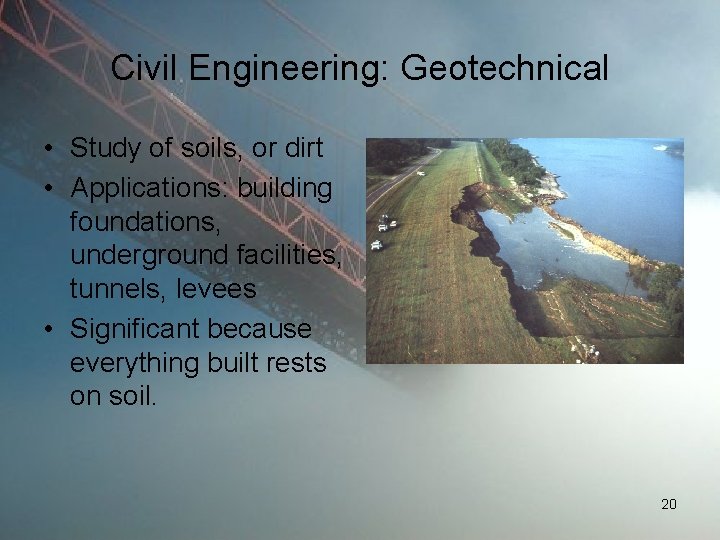
Civil Engineering: Geotechnical • Study of soils, or dirt • Applications: building foundations, underground facilities, tunnels, levees • Significant because everything built rests on soil. 20
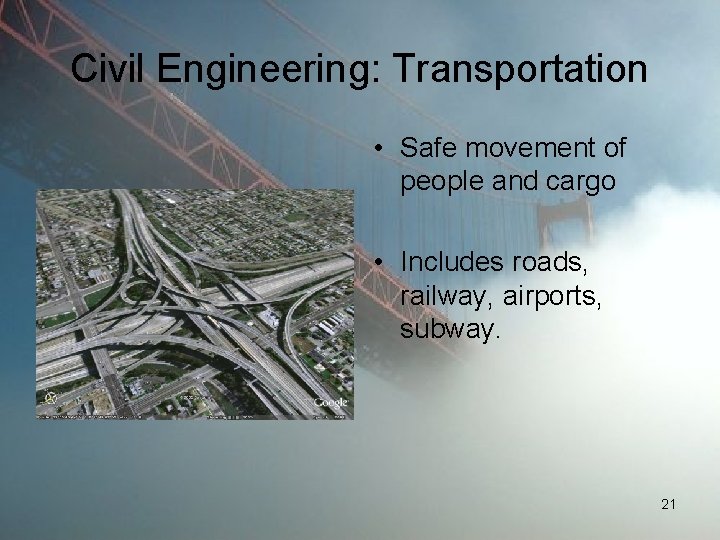
Civil Engineering: Transportation • Safe movement of people and cargo • Includes roads, railway, airports, subway. 21
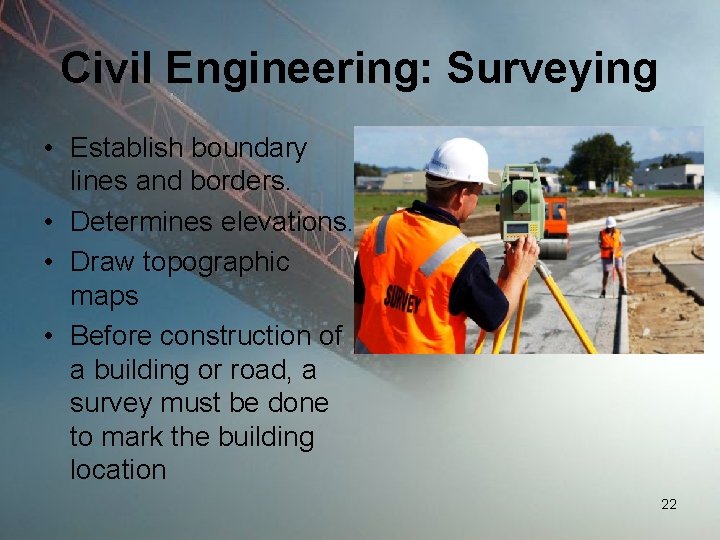
Civil Engineering: Surveying • Establish boundary lines and borders. • Determines elevations. • Draw topographic maps • Before construction of a building or road, a survey must be done to mark the building location 22
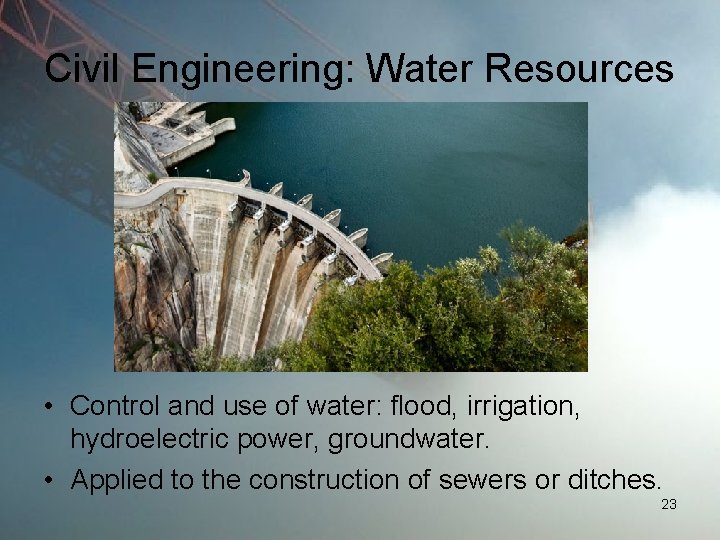
Civil Engineering: Water Resources • Control and use of water: flood, irrigation, hydroelectric power, groundwater. • Applied to the construction of sewers or ditches. 23
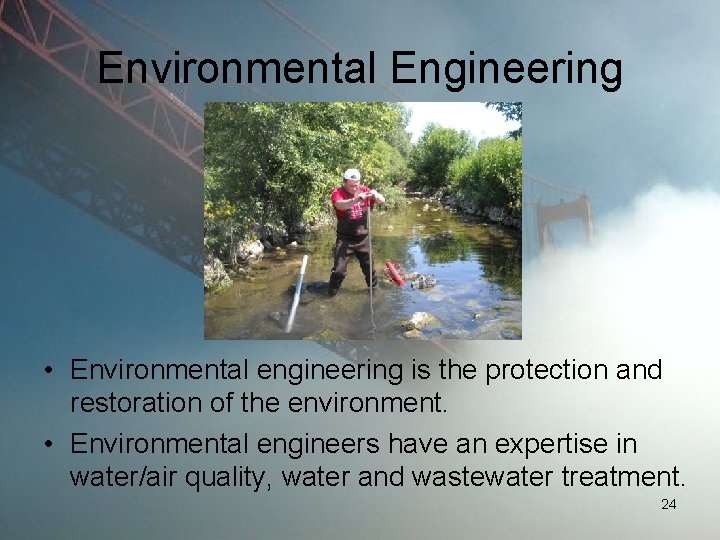
Environmental Engineering • Environmental engineering is the protection and restoration of the environment. • Environmental engineers have an expertise in water/air quality, water and wastewater treatment. 24

Environmental Engineering An environmental engineer might be asked to: • Design a wastewater treatment facility • Determine how to dispose of toxic chemicals • Use computer models to figure out how much pollution a city will create 25
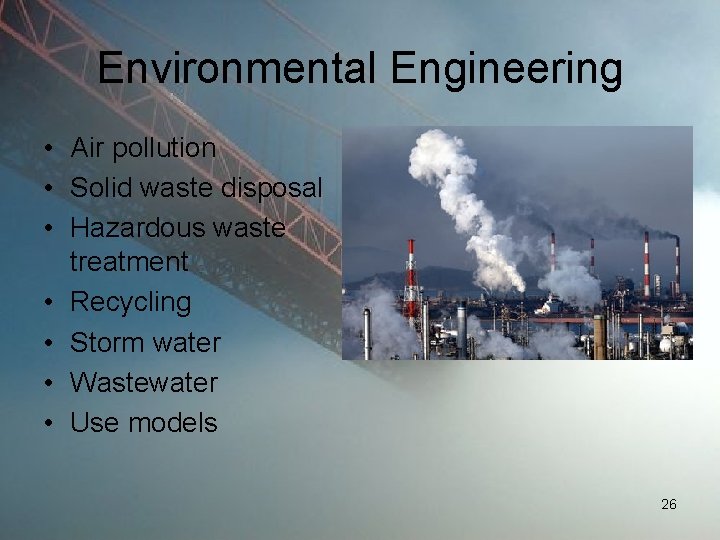
Environmental Engineering • Air pollution • Solid waste disposal • Hazardous waste treatment • Recycling • Storm water • Wastewater • Use models 26
Engineering Job Functions • • Design Analysis Testing Research Sales Management Consulting Teaching 27
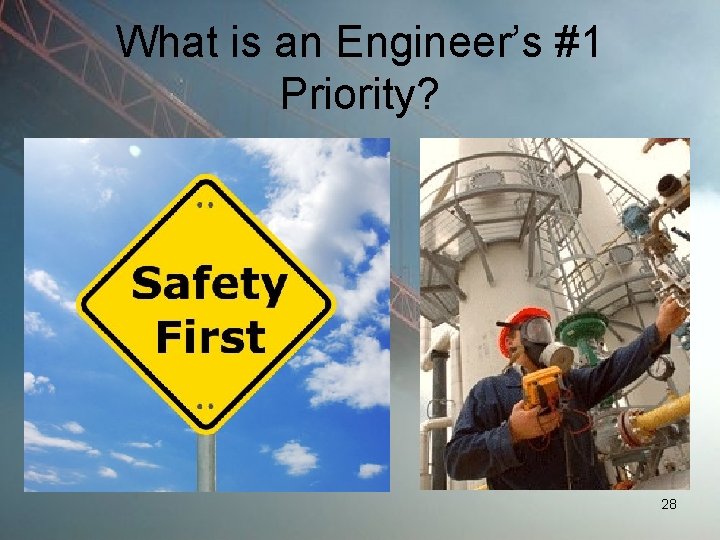
What is an Engineer’s #1 Priority? 28
Requirement #5 • Do ONE of the following: a. Use the systems engineering approach to make step-by-step plans for your next campout. List alternative ideas for such items as program schedule, campsites, transportation, and costs. Tell why you made the choices you did and what improvements were made. b. Make an original design for a piece of patrol equipment. Use the systems engineering approach to help you decide how it should work and look. Draw plans for it. Show the plans to your counselor, explain why you designed it the way you did, and explain how you would make it. 29
The Systems Engineering Process 1. State the problem. Stating the problem is the most important systems engineering task. It entails identifying customers, understanding customer needs, establishing the need for change, discovering requirements and defining system functions. 2. Investigate alternatives. Alternative solutions are investigated and evaluated based on performance, cost and risk. 30

The Systems Engineering Process 3. Model the system. Running models clarifies requirements, reveals bottlenecks and fragmented activities, reduces cost and exposes duplication of efforts. 4. Integrate. Integration means designing interfaces and bringing system elements together so they work as a whole. This requires extensive communication and coordination among all participants. 31
The Systems Engineering Process 5. Launch the system. Launching the system means running the system and producing outputs -- making the system do what it was intended to do. 6. Assess performance. Performance is assessed using evaluation criteria and performance measures. Measurement is the key. If you cannot measure it, you cannot control it. If you cannot control it, you cannot improve it. 32
The Systems Engineering Process 7. Re-evaluation should be a continual and repeating process with the results of one repetition being used as the starting point for the next. 33

Let’s Do an Example • An environmentally concerned client wants to change her home heating system from electricity to gas in order to dramatically reduce her heating costs. 34
Redefine • What is the most cost-effective change the woman can make to reduce her energy costs? 35
Identify Constraints • Home is heated by an electric system • House has single pane windows and little insulation in the attic • Energy costs are significantly higher than those of others in her area with comparable homes • Environmentally concerned 36

Add Specifications Your solution must be… • • Feasible Safe Legal Practical 37
• Look at Potential Causes – What would create a high electricity bill? • Identify Possible Solutions – Brainstorm possible solutions • Analyze the Alternatives – Construct a matrix and time chart 38

One Kind of Matrix Solution Cost Time Appearance $5000 2 Weeks No Change Add Insulation $450 5 Days No Change Brick in existing windows $300 2 Days Big Change $2500 10 Days Small Change $500 8 Days Small Change Switch from electricity to gas Install high-efficiency pump Add two-pane window Time Chart Event Day Number 1 2 3 4 5 Order Insulation X Delivery X X Remove Wall Panels X Install X Completion X 39

Requirement #6 • Do the following : – Transforming motion. Using common material or a construction set, make a simple model that will demonstrate motion. Explain how the model uses basic mechanical concepts like levers and inclined planes to demonstrate motion. Describe an example where this mechanism is used in a real product. – Converting energy. Do an experiment to show mechanical, heat, chemical, solar, and/or electrical energy may be converted from one or more types of energy to another. Explain your results. Describe to your counselor what energy is and how energy is converted and used in your surroundings. – Building an engineering project. Enter a project in a science or engineering fair or similar competition. (This requirement may be met by participation on an engineering competition project team. ) Discuss with your counselor what your project demonstrates, the kinds of questions visitors to the fair asked you about it, and how well were you able to answer their questions. • To meet requirements #5 and #6 we will do a Rube Goldberg Contest – See handout for contest rules and requirements. 40
Want to get into an engineering school? High School Courses to take… Math Science Electives • • • Biology • Chemistry • Physics • Drafting • Computer Science Algebra Trigonometry Geometry Pre-Calculus - Don’t forget English and foreign languages… 41
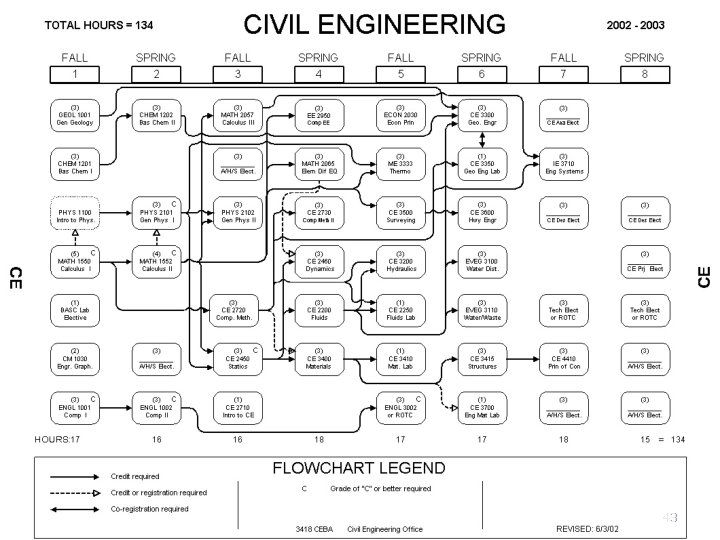
The College Education • Can’t decide which engineering you like? First year is the same for everyone. • All students take the same math and science courses. • Purpose of engineering classes: – Develop the “engineering mind” 42
43

Concrete Canoe Contest 44
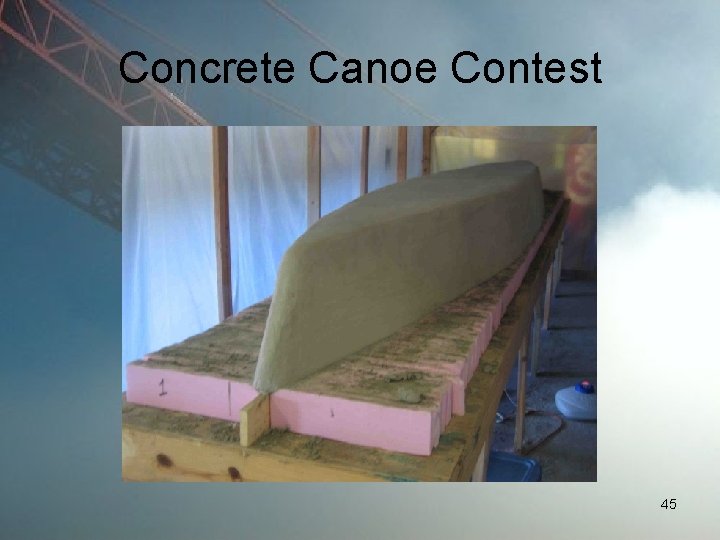
Concrete Canoe Contest 45

Concrete Canoe Contest 46
Requirement # 7 • Explain what it means to be a registered Professional Engineer (PE). Name the types of engineering work for which registration is most important? 47
The Registered Professional Engineer • “Qualified” individual who holds a license to practice engineering in their state • Specific discipline oriented (Civil, Mechanical, etc. ) • Not necessary, but encouraged 48
Requirements to become a registered engineer • Earn a four-year engineering degree • Pass the Fundamentals of Engineering Exam – 8 Hour Test!!!!! • Complete four years of engineering work experience • Pass the Professional Engineering exam – Another 8 hour test! 49
Requirement #8 • Study the Engineer's Code of Ethics. Explain how it is like the Scout Oath and Scout Law. 50
Engineer’s Code of Ethics • Use knowledge and skill for development of human welfare. • Be honest, impartial, and faithfully serve the public, employers, and clients. • Strive to increase the competence and prestige of the profession. • Support the profession and societies of their disciplines. 51
Requirement #9 • Find out about three career opportunities in engineering. Pick one and research the education, training, and experience required for this profession. Discuss this with your counselor, and explain why this profession might interest you. 52
- Slides: 52