
Engineering Mechanics Trusses Definition of a Truss A


- Slides: 31
Engineering Mechanics Trusses
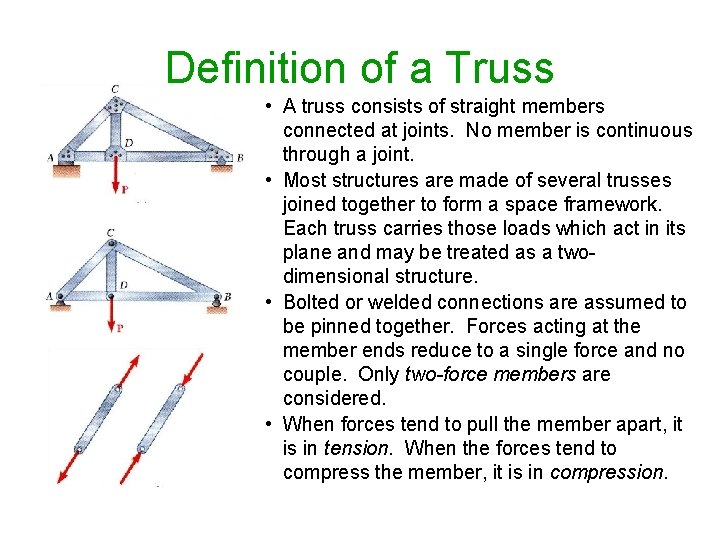
Definition of a Truss • A truss consists of straight members connected at joints. No member is continuous through a joint. • Most structures are made of several trusses joined together to form a space framework. Each truss carries those loads which act in its plane and may be treated as a twodimensional structure. • Bolted or welded connections are assumed to be pinned together. Forces acting at the member ends reduce to a single force and no couple. Only two-force members are considered. • When forces tend to pull the member apart, it is in tension. When the forces tend to compress the member, it is in compression.
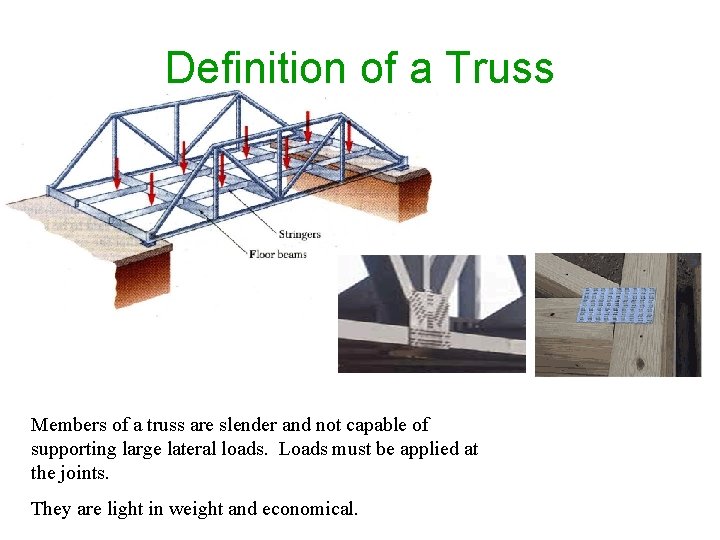
Definition of a Truss Members of a truss are slender and not capable of supporting large lateral loads. Loads must be applied at the joints. They are light in weight and economical.
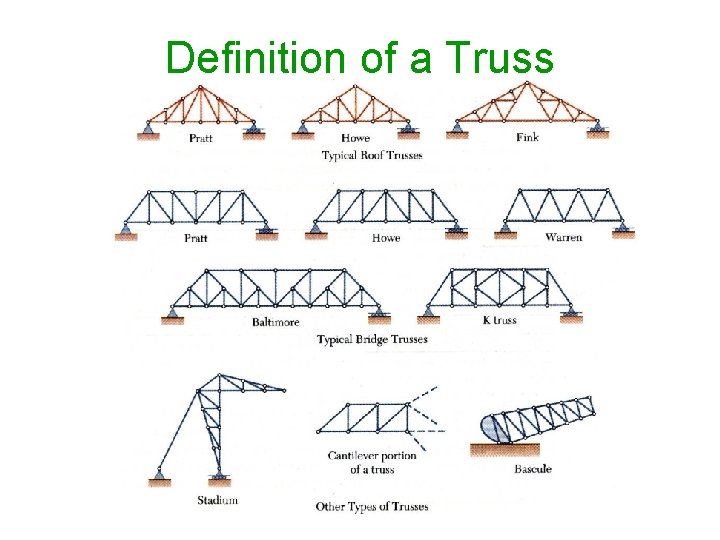
Definition of a Truss
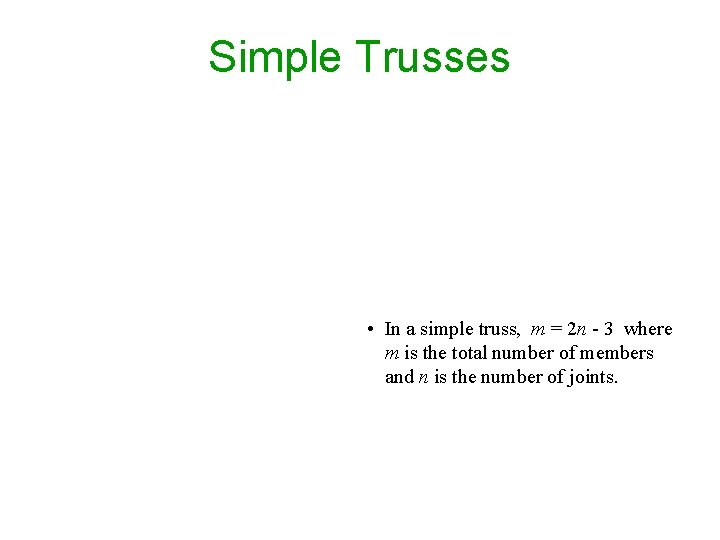
Simple Trusses • In a simple truss, m = 2 n - 3 where m is the total number of members and n is the number of joints.
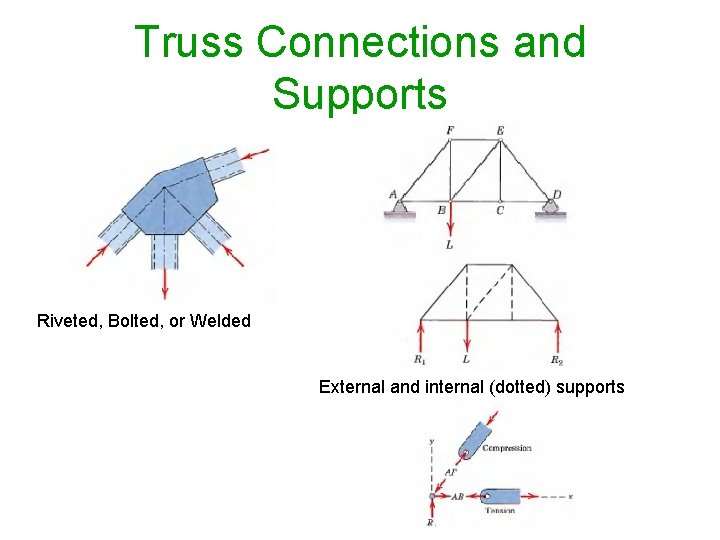
Truss Connections and Supports Riveted, Bolted, or Welded External and internal (dotted) supports
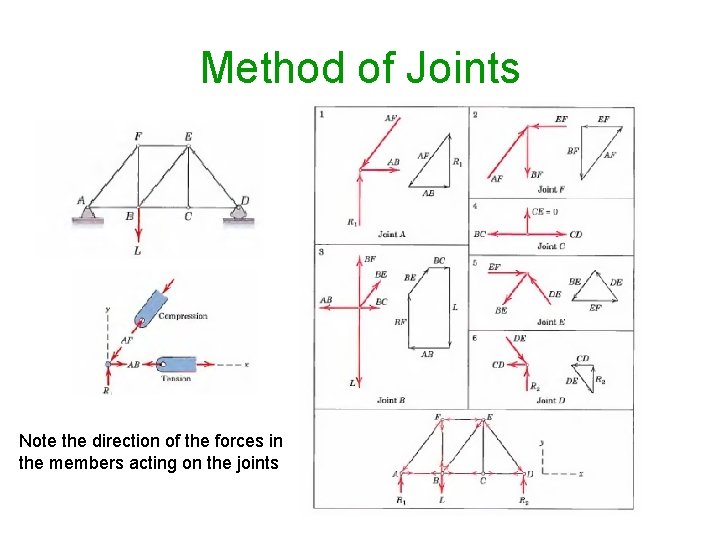
Method of Joints Note the direction of the forces in the members acting on the joints
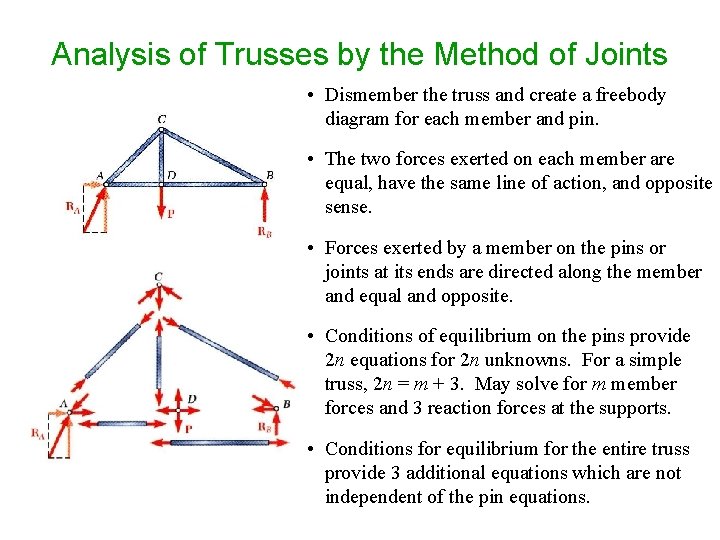
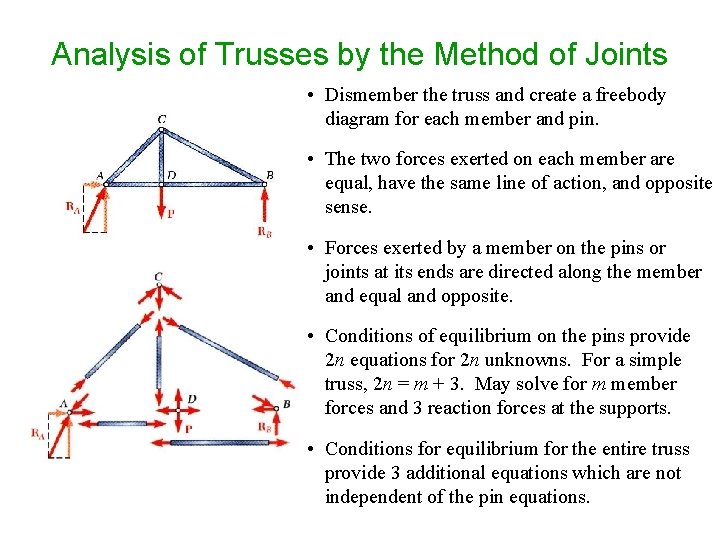
Analysis of Trusses by the Method of Joints • Dismember the truss and create a freebody diagram for each member and pin. • The two forces exerted on each member are equal, have the same line of action, and opposite sense. • Forces exerted by a member on the pins or joints at its ends are directed along the member and equal and opposite. • Conditions of equilibrium on the pins provide 2 n equations for 2 n unknowns. For a simple truss, 2 n = m + 3. May solve for m member forces and 3 reaction forces at the supports. • Conditions for equilibrium for the entire truss provide 3 additional equations which are not independent of the pin equations.
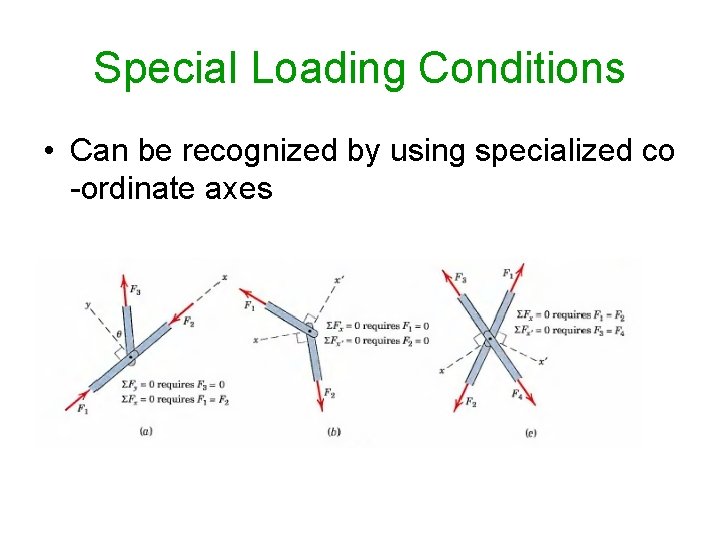
Special Loading Conditions • Can be recognized by using specialized co -ordinate axes
Analysis of Trusses by the Method of Joints • Dismember the truss and create a freebody diagram for each member and pin. • The two forces exerted on each member are equal, have the same line of action, and opposite sense. • Forces exerted by a member on the pins or joints at its ends are directed along the member and equal and opposite. • Conditions of equilibrium on the pins provide 2 n equations for 2 n unknowns. For a simple truss, 2 n = m + 3. May solve for m member forces and 3 reaction forces at the supports. • Conditions for equilibrium for the entire truss provide 3 additional equations which are not independent of the pin equations.
Joints Under Special Loading Conditions
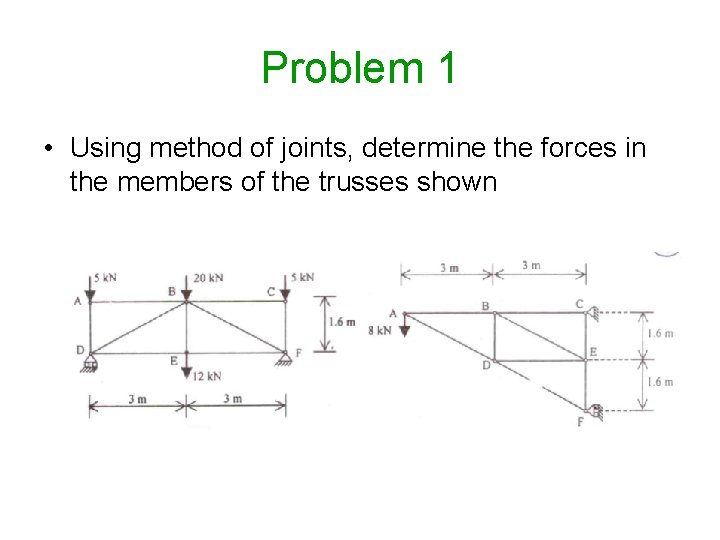
Problem 1 • Using method of joints, determine the forces in the members of the trusses shown
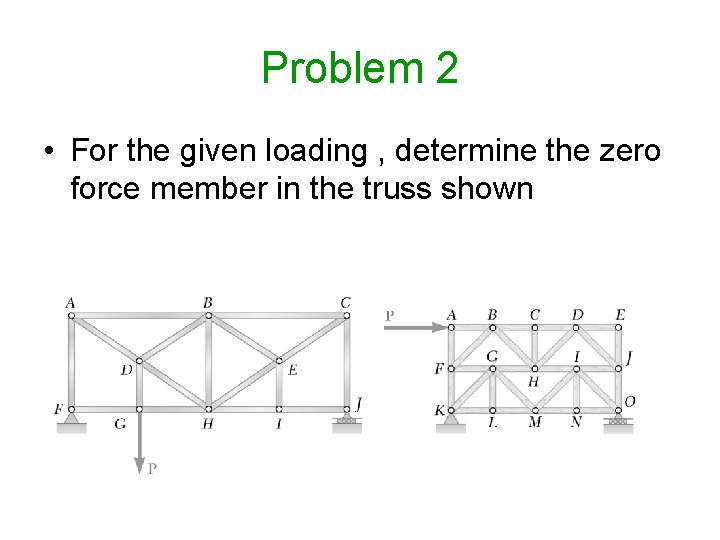
Problem 2 • For the given loading , determine the zero force member in the truss shown
Problem 5 • Find the forces in members EF, KL, and GL for the Fink truss shown.
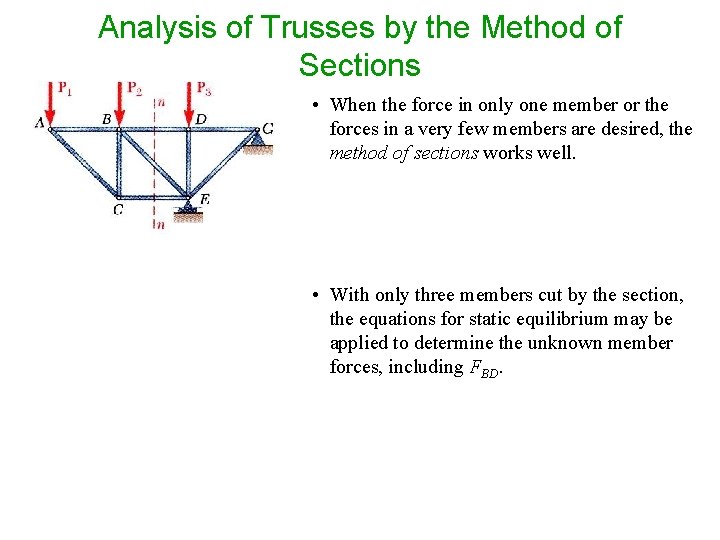
Analysis of Trusses by the Method of Sections • When the force in only one member or the forces in a very few members are desired, the method of sections works well. • With only three members cut by the section, the equations for static equilibrium may be applied to determine the unknown member forces, including FBD.
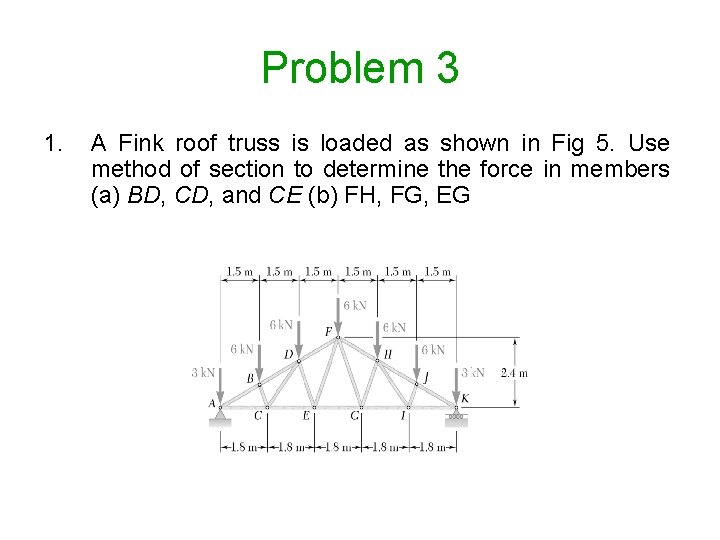
Problem 3 1. A Fink roof truss is loaded as shown in Fig 5. Use method of section to determine the force in members (a) BD, CD, and CE (b) FH, FG, EG
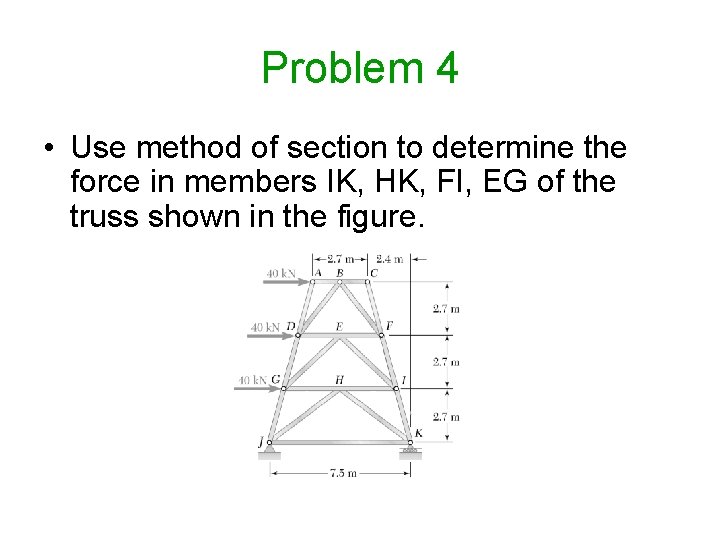
Problem 4 • Use method of section to determine the force in members IK, HK, FI, EG of the truss shown in the figure.
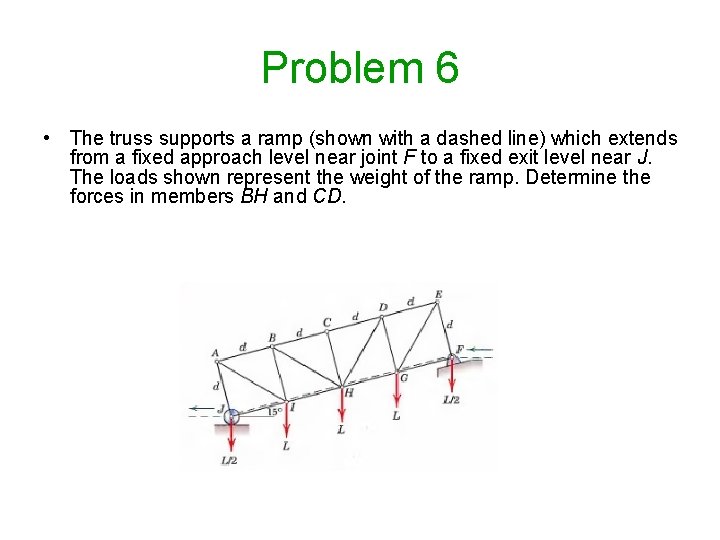
Problem 6 • The truss supports a ramp (shown with a dashed line) which extends from a fixed approach level near joint F to a fixed exit level near J. The loads shown represent the weight of the ramp. Determine the forces in members BH and CD.
Trusses Made of Several Simple Trusses Compound Trusses (or Non-Simple)
Important Notes • For a truss to be properly constrained: – It should be able to stay in equilibrium for any combination of loading. – Equilibrium implies both global equilibrium and internal equilibrium. • Note that if 2 j > m + r, the truss is most definitely partially constrained (and is unstable to certain loadings). But 2 j ≥ m + r, is no guarantee that the truss is stable. • If 2 j < m + r, the truss can never be statically determinate.
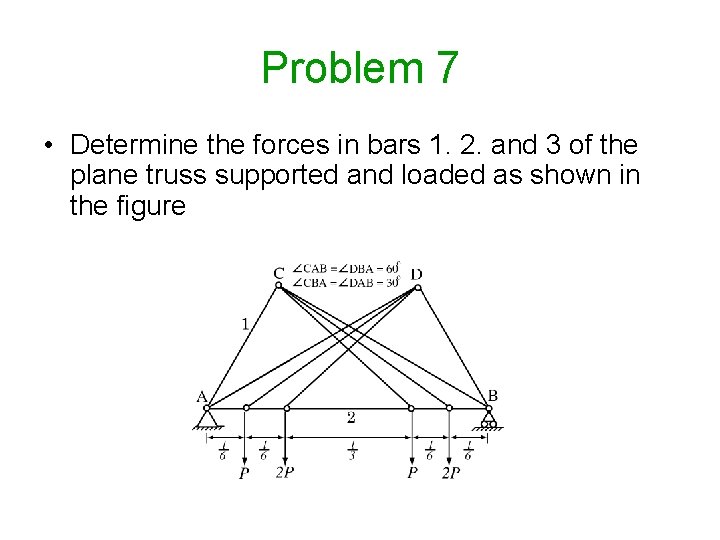
Problem 7 • Determine the forces in bars 1. 2. and 3 of the plane truss supported and loaded as shown in the figure
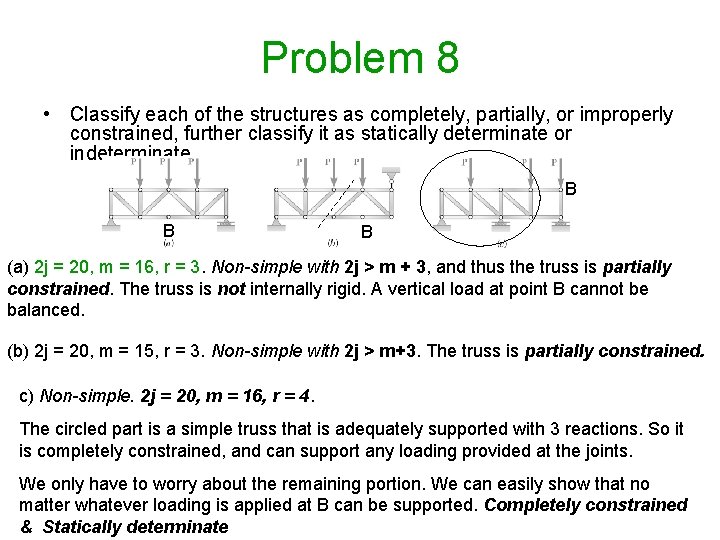
Problem 8 • Classify each of the structures as completely, partially, or improperly constrained, further classify it as statically determinate or indeterminate. B B B (a) 2 j = 20, m = 16, r = 3. Non-simple with 2 j > m + 3, and thus the truss is partially constrained. The truss is not internally rigid. A vertical load at point B cannot be balanced. (b) 2 j = 20, m = 15, r = 3. Non-simple with 2 j > m+3. The truss is partially constrained. c) Non-simple. 2 j = 20, m = 16, r = 4. The circled part is a simple truss that is adequately supported with 3 reactions. So it is completely constrained, and can support any loading provided at the joints. We only have to worry about the remaining portion. We can easily show that no matter whatever loading is applied at B can be supported. Completely constrained & Statically determinate
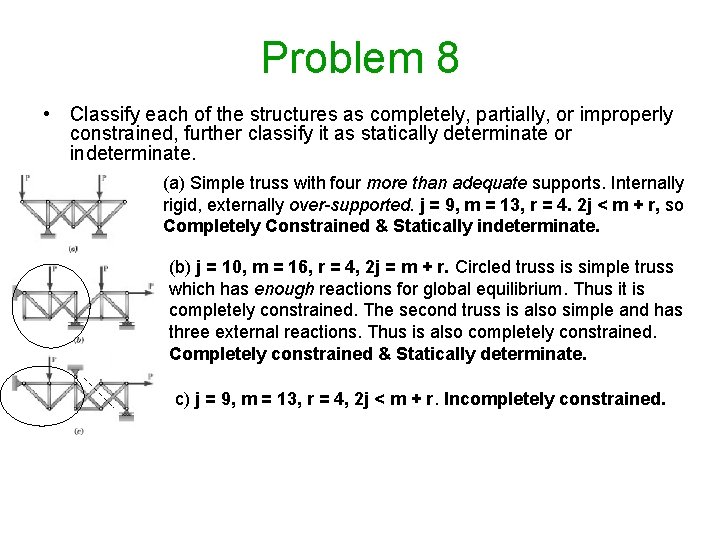
Problem 8 • Classify each of the structures as completely, partially, or improperly constrained, further classify it as statically determinate or indeterminate. (a) Simple truss with four more than adequate supports. Internally rigid, externally over-supported. j = 9, m = 13, r = 4. 2 j < m + r, so Completely Constrained & Statically indeterminate. (b) j = 10, m = 16, r = 4, 2 j = m + r. Circled truss is simple truss which has enough reactions for global equilibrium. Thus it is completely constrained. The second truss is also simple and has three external reactions. Thus is also completely constrained. Completely constrained & Statically determinate. c) j = 9, m = 13, r = 4, 2 j < m + r. Incompletely constrained.
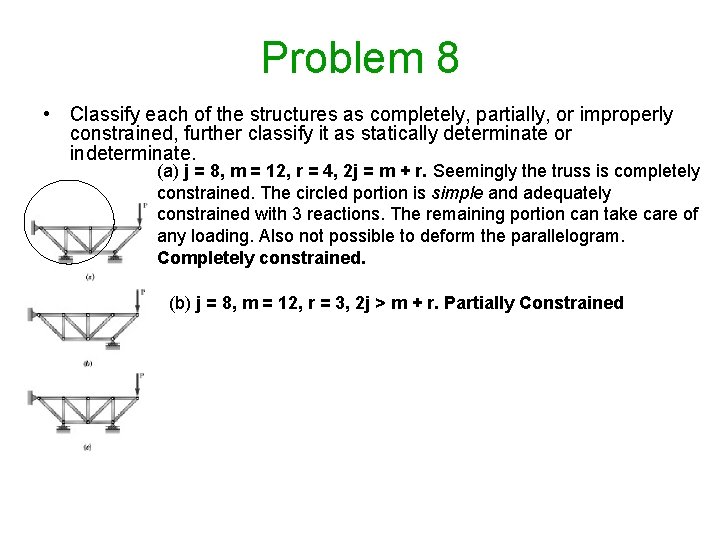
Problem 8 • Classify each of the structures as completely, partially, or improperly constrained, further classify it as statically determinate or indeterminate. (a) j = 8, m = 12, r = 4, 2 j = m + r. Seemingly the truss is completely constrained. The circled portion is simple and adequately constrained with 3 reactions. The remaining portion can take care of any loading. Also not possible to deform the parallelogram. Completely constrained. (b) j = 8, m = 12, r = 3, 2 j > m + r. Partially Constrained
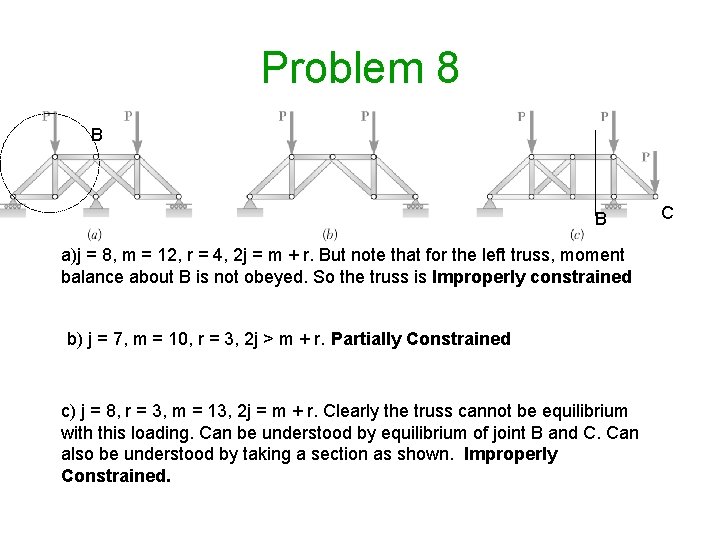
Problem 8 B B a)j = 8, m = 12, r = 4, 2 j = m + r. But note that for the left truss, moment balance about B is not obeyed. So the truss is Improperly constrained b) j = 7, m = 10, r = 3, 2 j > m + r. Partially Constrained c) j = 8, r = 3, m = 13, 2 j = m + r. Clearly the truss cannot be equilibrium with this loading. Can be understood by equilibrium of joint B and C. Can also be understood by taking a section as shown. Improperly Constrained. C
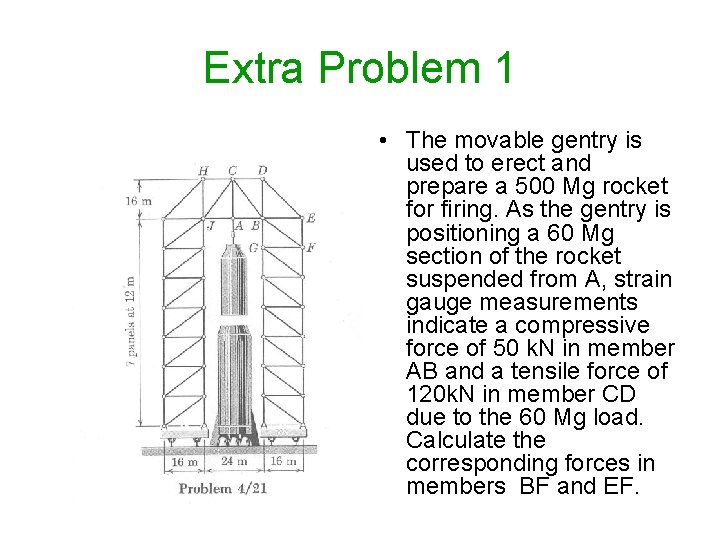
Extra Problem 1 • The movable gentry is used to erect and prepare a 500 Mg rocket for firing. As the gentry is positioning a 60 Mg section of the rocket suspended from A, strain gauge measurements indicate a compressive force of 50 k. N in member AB and a tensile force of 120 k. N in member CD due to the 60 Mg load. Calculate the corresponding forces in members BF and EF.
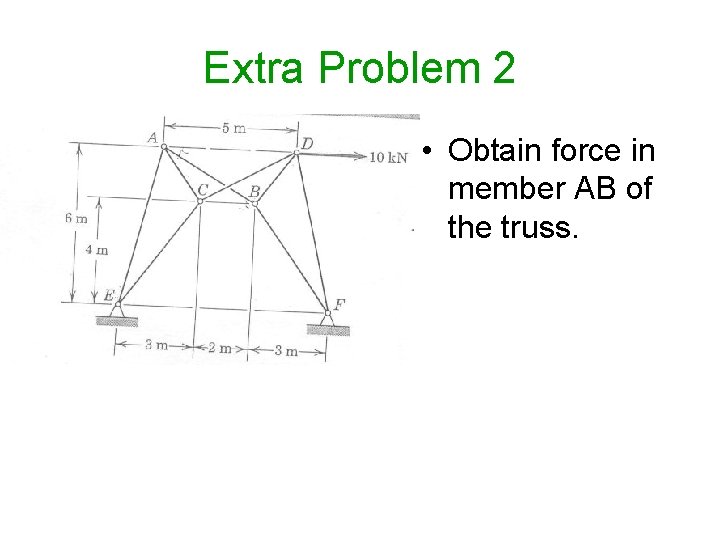
Extra Problem 2 • Obtain force in member AB of the truss.
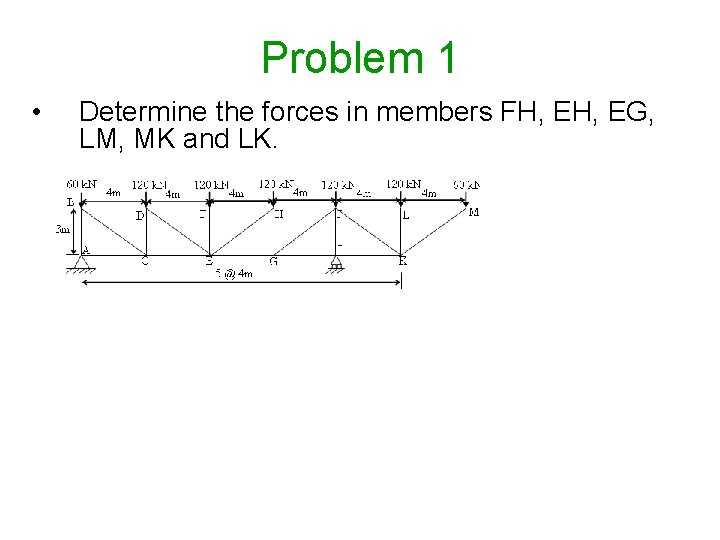
Problem 1 • Determine the forces in members FH, EG, LM, MK and LK.
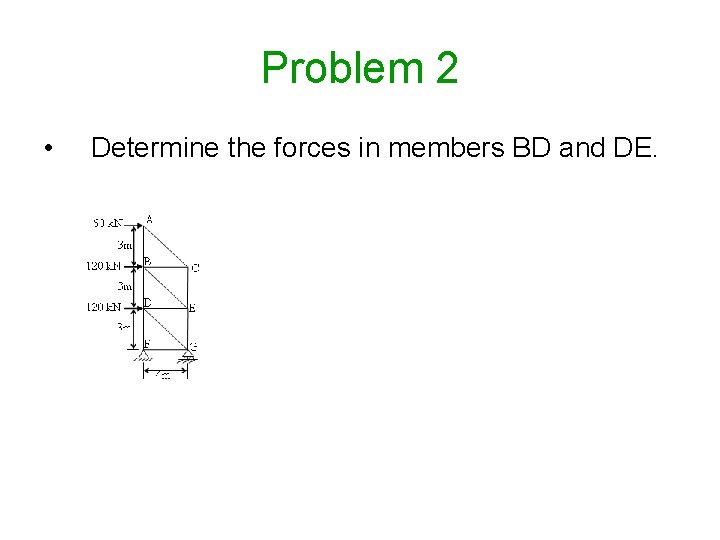
Problem 2 • Determine the forces in members BD and DE.
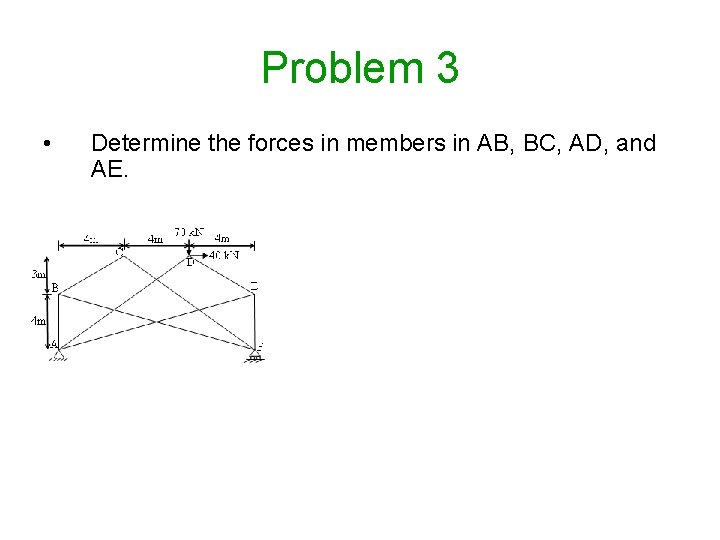
Problem 3 • Determine the forces in members in AB, BC, AD, and AE.
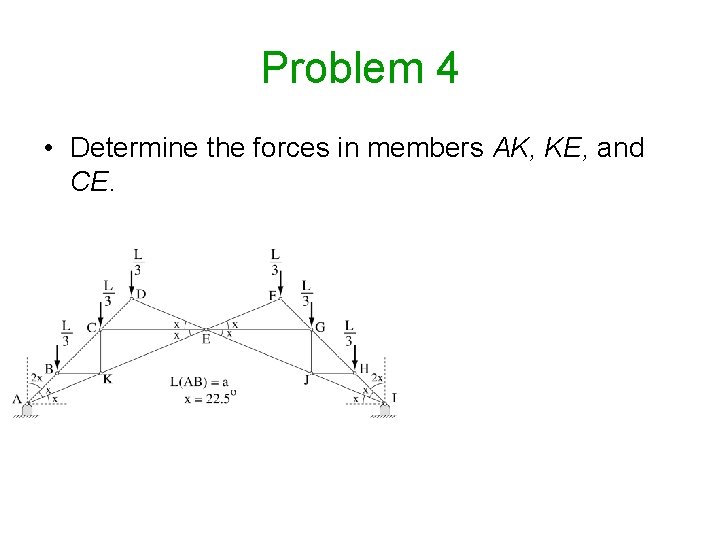
Problem 4 • Determine the forces in members AK, KE, and CE.