
Engineering Mechanics STATICS PDT 181 Lecture 11 By
Engineering Mechanics : STATICS PDT 181 Lecture #11 By, MOHD RIDUAN BIN JAMALLUDIN
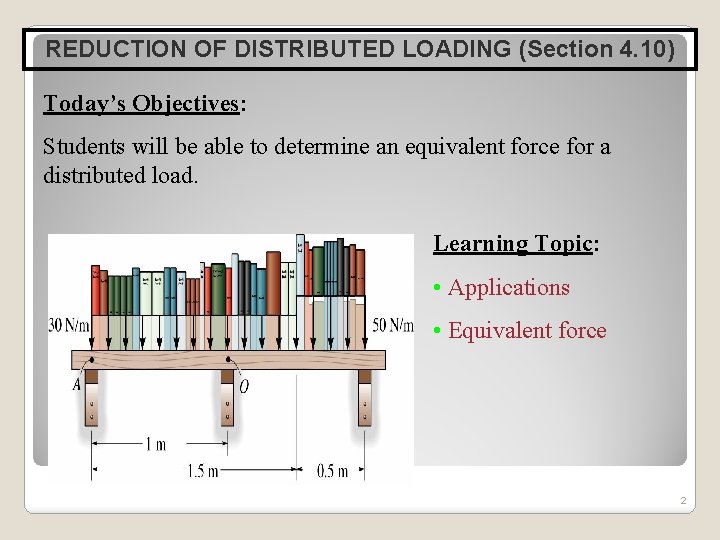
REDUCTION OF DISTRIBUTED LOADING (Section 4. 10) Today’s Objectives: Students will be able to determine an equivalent force for a distributed load. Learning Topic: • Applications • Equivalent force 2
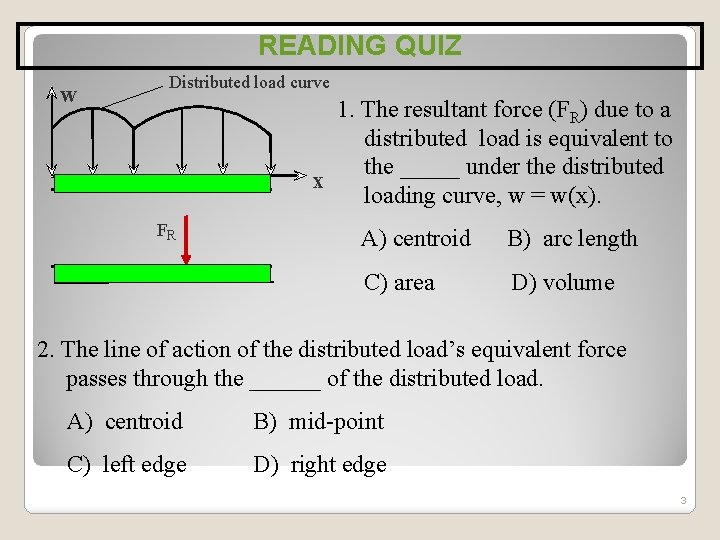
READING QUIZ w Distributed load curve 1. The resultant force (FR) due to a distributed load is equivalent to the _____ under the distributed x loading curve, w = w(x). FR A) centroid B) arc length C) area D) volume 2. The line of action of the distributed load’s equivalent force passes through the ______ of the distributed load. A) centroid B) mid-point C) left edge D) right edge 3
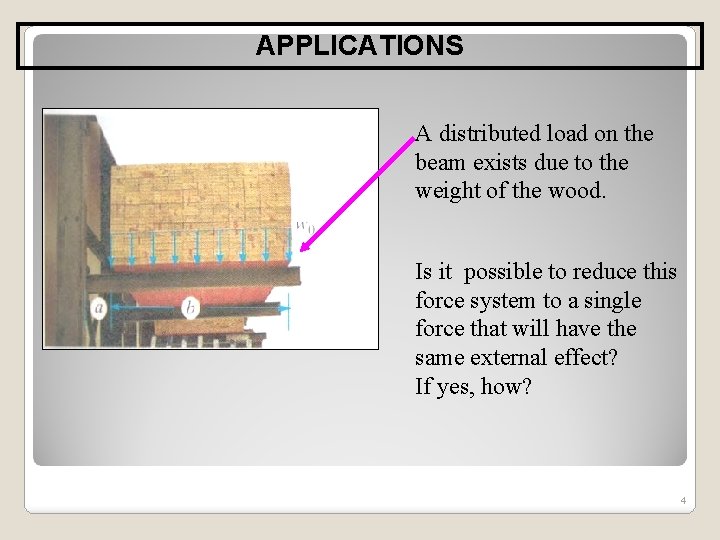
APPLICATIONS A distributed load on the beam exists due to the weight of the wood. Is it possible to reduce this force system to a single force that will have the same external effect? If yes, how? 4
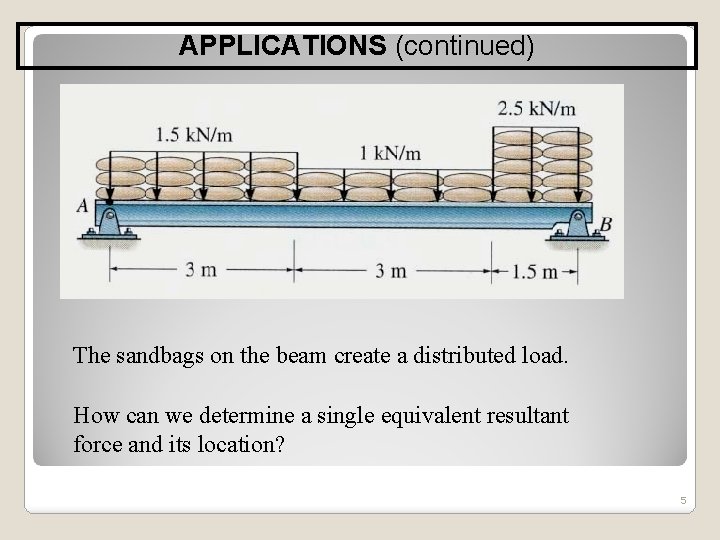
APPLICATIONS (continued) The sandbags on the beam create a distributed load. How can we determine a single equivalent resultant force and its location? 5
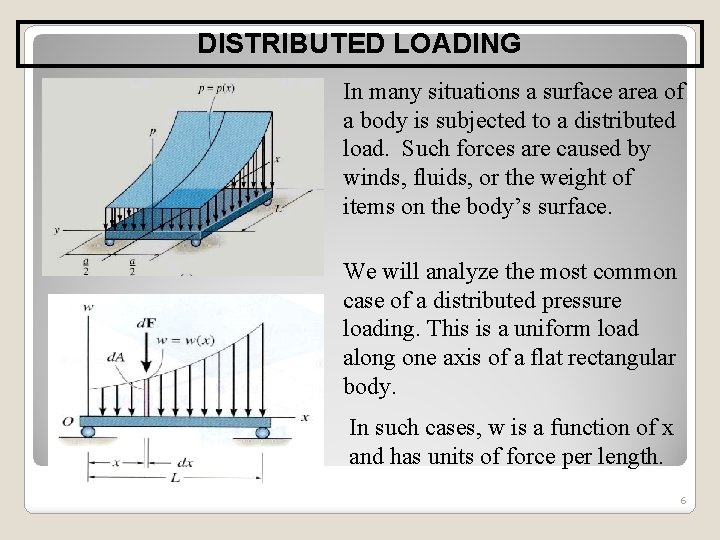
DISTRIBUTED LOADING In many situations a surface area of a body is subjected to a distributed load. Such forces are caused by winds, fluids, or the weight of items on the body’s surface. We will analyze the most common case of a distributed pressure loading. This is a uniform load along one axis of a flat rectangular body. In such cases, w is a function of x and has units of force per length. 6
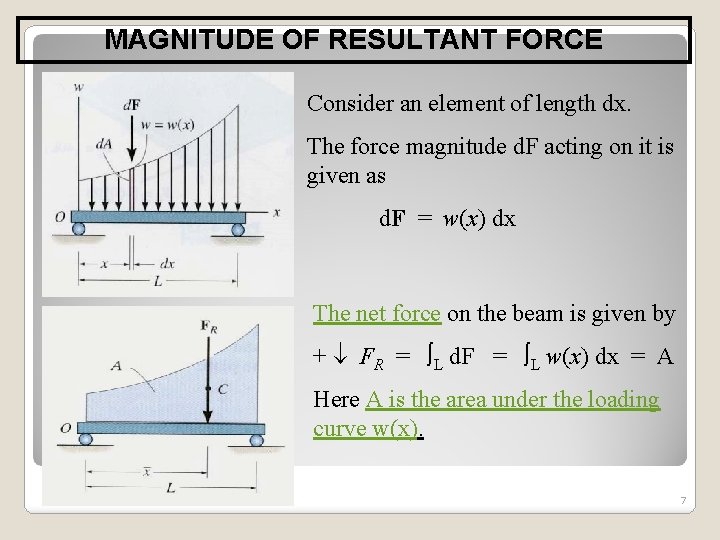
MAGNITUDE OF RESULTANT FORCE Consider an element of length dx. The force magnitude d. F acting on it is given as d. F = w(x) dx The net force on the beam is given by + FR = L d. F = L w(x) dx = A Here A is the area under the loading curve w(x). 7
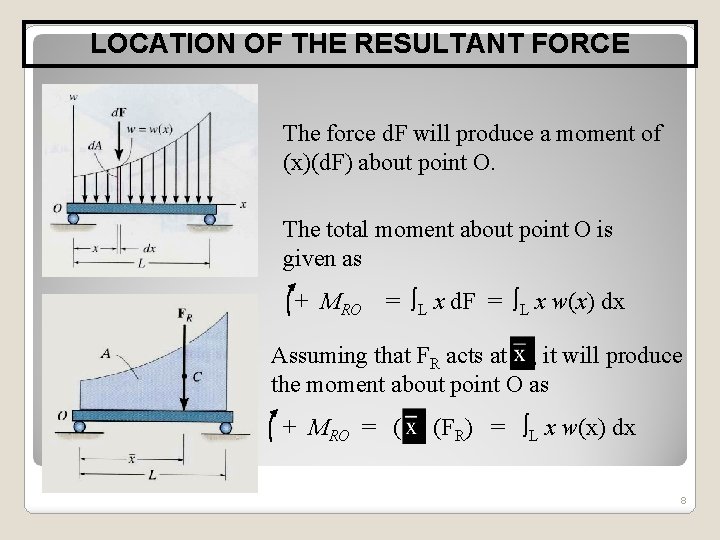
LOCATION OF THE RESULTANT FORCE The force d. F will produce a moment of (x)(d. F) about point O. The total moment about point O is given as + MRO = L x d. F = L x w(x) dx Assuming that FR acts at , it will produce the moment about point O as + MRO = ( ) (FR) = L x w(x) dx 8
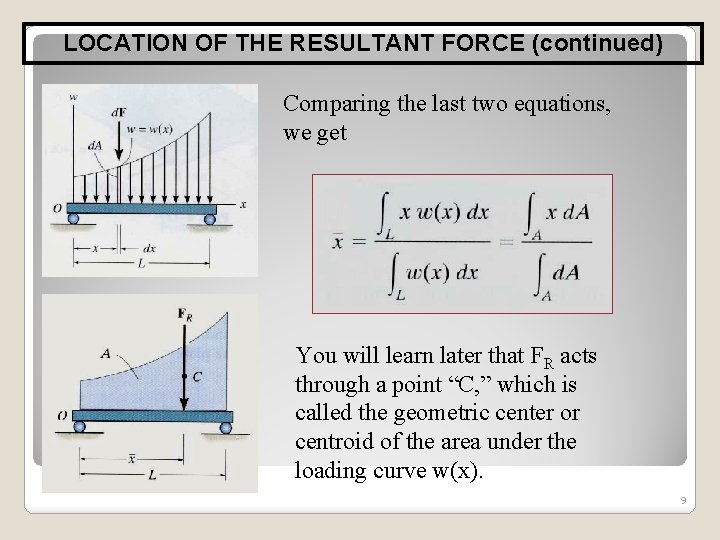
LOCATION OF THE RESULTANT FORCE (continued) Comparing the last two equations, we get You will learn later that FR acts through a point “C, ” which is called the geometric center or centroid of the area under the loading curve w(x). 9
IMPORTANT POINTS • Distributed loading are defined by using a loading w = w(x) that indicates the intensity of the loading along the length of the member. This intensity is measured in N/m. • The external effects caused by a coplanar distributed load acting on a body can be represented by a single resultant force • The resultant force is equivalent to the area under the distributed loading diagram, and has a line of action that passes through the centroid or geometric center of this area. 10
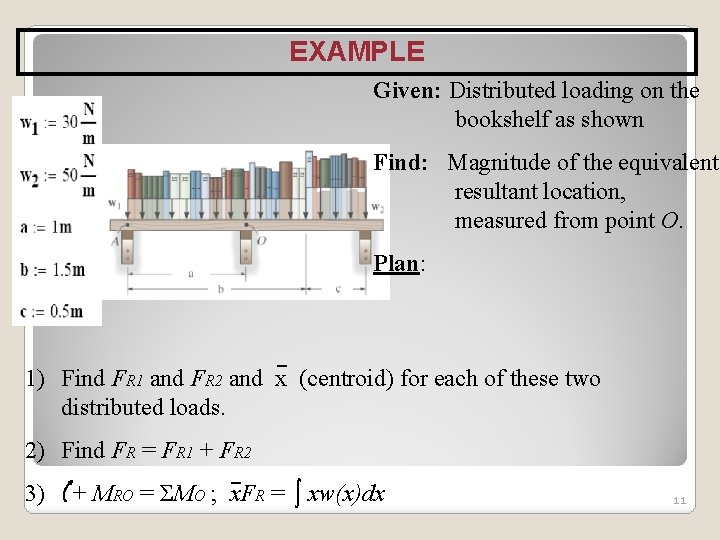
EXAMPLE Given: Distributed loading on the bookshelf as shown Find: Magnitude of the equivalent resultant location, measured from point O. Plan: _ 1) Find FR 1 and FR 2 and x (centroid) for each of these two distributed loads. 2) Find FR = FR 1 + FR 2 3) _ + MRO = ΣMO ; x. FR = ∫ xw(x)dx 11
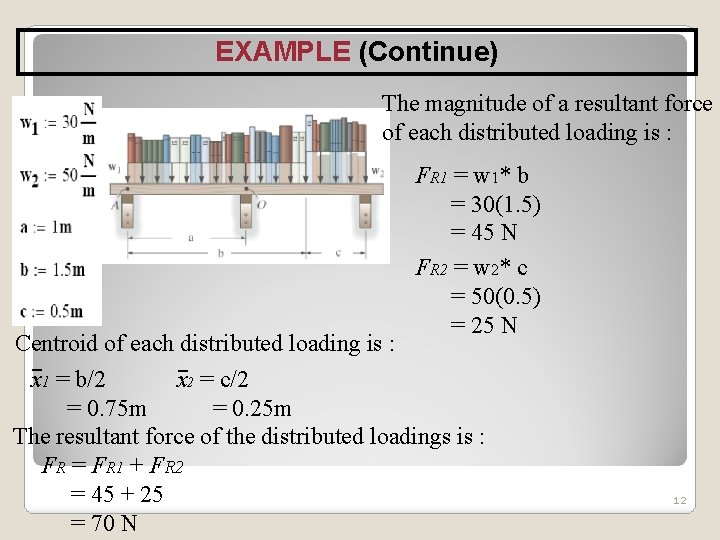
EXAMPLE (Continue) The magnitude of a resultant force of each distributed loading is : FR 1 = w 1* b = 30(1. 5) = 45 N FR 2 = w 2* c = 50(0. 5) = 25 N Centroid of each distributed loading is : _ _ x 1 = b/2 x 2 = c/2 = 0. 75 m = 0. 25 m The resultant force of the distributed loadings is : FR = FR 1 + FR 2 = 45 + 25 = 70 N 12
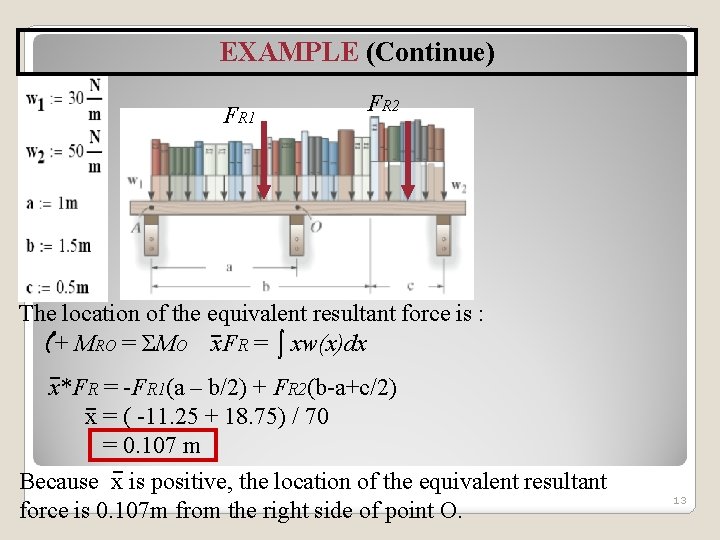
EXAMPLE (Continue) FR 1 FR 2 The location of the equivalent resultant force is : _ + MRO = ΣMO x. FR = ∫ xw(x)dx _ x*F_R = -FR 1(a – b/2) + FR 2(b-a+c/2) x = ( -11. 25 + 18. 75) / 70 = 0. 107 m _ Because x is positive, the location of the equivalent resultant force is 0. 107 m from the right side of point O. 13
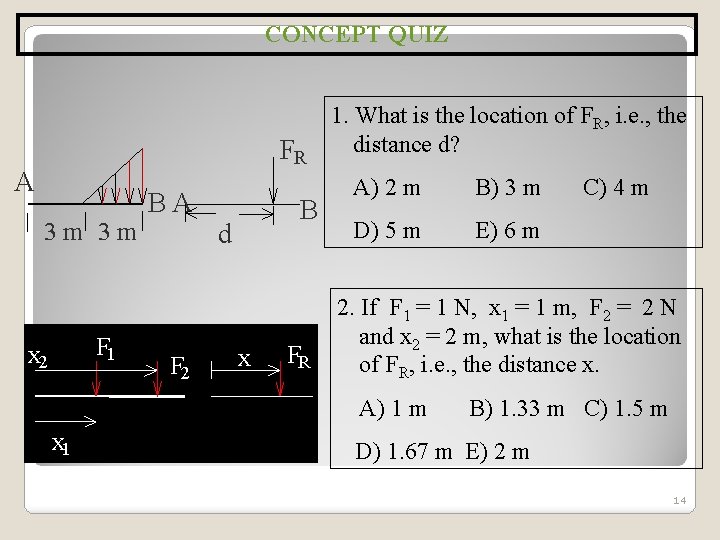
CONCEPT QUIZ FR A 3 m 3 m F 1 x 2 BA F 2 B d x FR 1. What is the location of FR, i. e. , the distance d? A) 2 m B) 3 m D) 5 m E) 6 m 2. If F 1 = 1 N, x 1 = 1 m, F 2 = 2 N and x 2 = 2 m, what is the location of FR, i. e. , the distance x. A) 1 m x 1 C) 4 m B) 1. 33 m C) 1. 5 m D) 1. 67 m E) 2 m 14
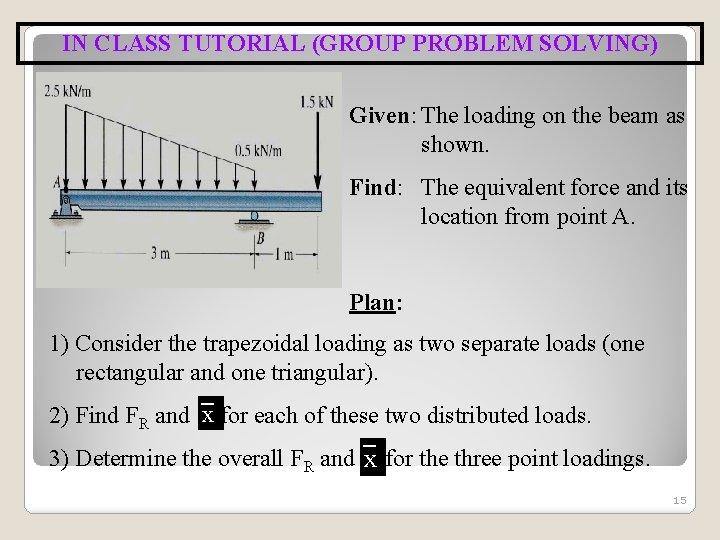
IN CLASS TUTORIAL (GROUP PROBLEM SOLVING) Given: The loading on the beam as shown. Find: The equivalent force and its location from point A. Plan: 1) Consider the trapezoidal loading as two separate loads (one rectangular and one triangular). 2) Find FR and x for each of these two distributed loads. 3) Determine the overall FR and x for the three point loadings. 15
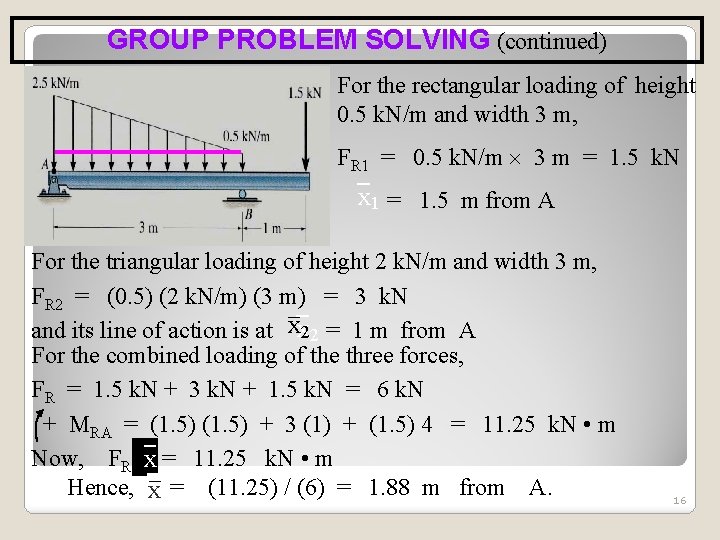
GROUP PROBLEM SOLVING (continued) For the rectangular loading of height 0. 5 k. N/m and width 3 m, FR 1 = 0. 5 k. N/m 3 m = 1. 5 k. N x 1 = 1. 5 m from A For the triangular loading of height 2 k. N/m and width 3 m, FR 2 = (0. 5) (2 k. N/m) (3 m) _ = 3 k. N and its line of action is at xx 22 = 1 m from A For the combined loading of the three forces, FR = 1. 5 k. N + 3 k. N + 1. 5 k. N = 6 k. N + MRA = (1. 5) + 3 (1) + (1. 5) 4 = 11. 25 k. N • m Now, FR x_ = 11. 25 k. N • m Hence, x = (11. 25) / (6) = 1. 88 m from A. 16
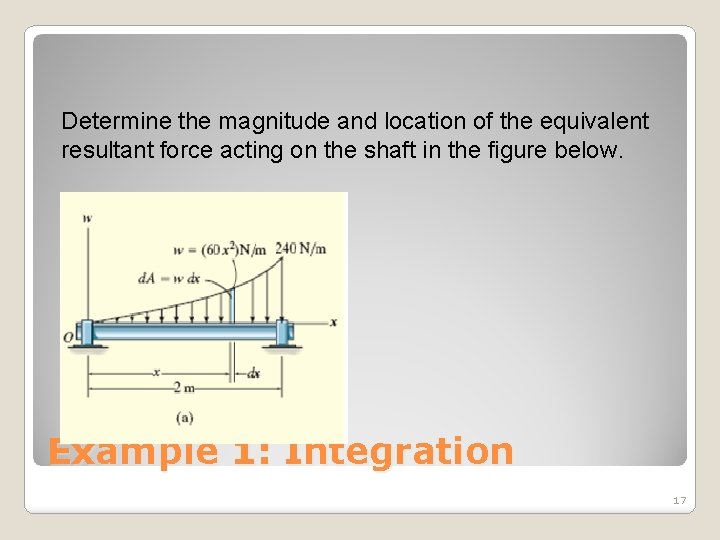
Determine the magnitude and location of the equivalent resultant force acting on the shaft in the figure below. Example 1: Integration 17
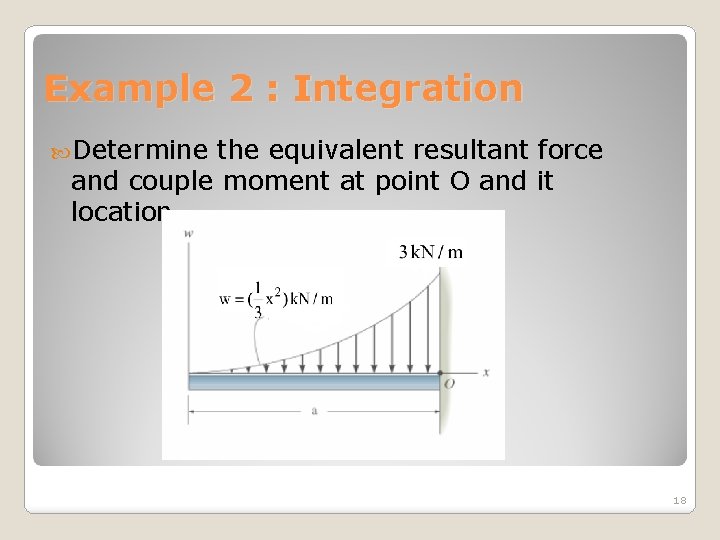
Example 2 : Integration Determine the equivalent resultant force and couple moment at point O and it location. 18
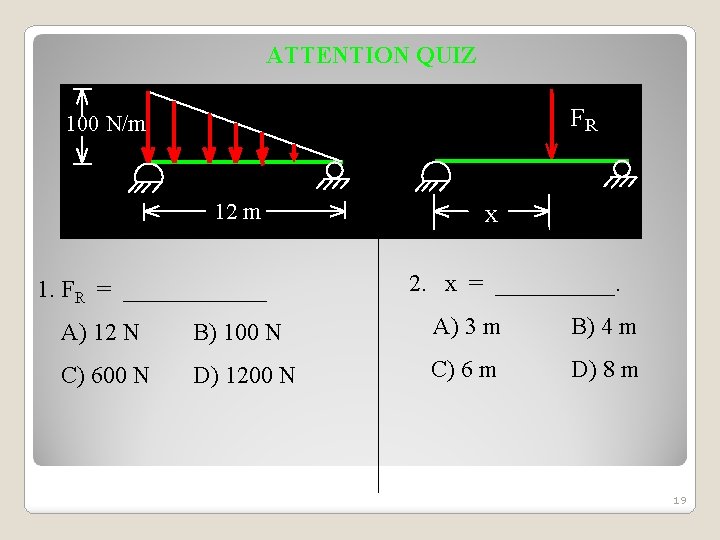
ATTENTION QUIZ FR 100 N/m 12 m 1. FR = ______ x 2. x = _____. A) 12 N B) 100 N A) 3 m B) 4 m C) 600 N D) 1200 N C) 6 m D) 8 m 19
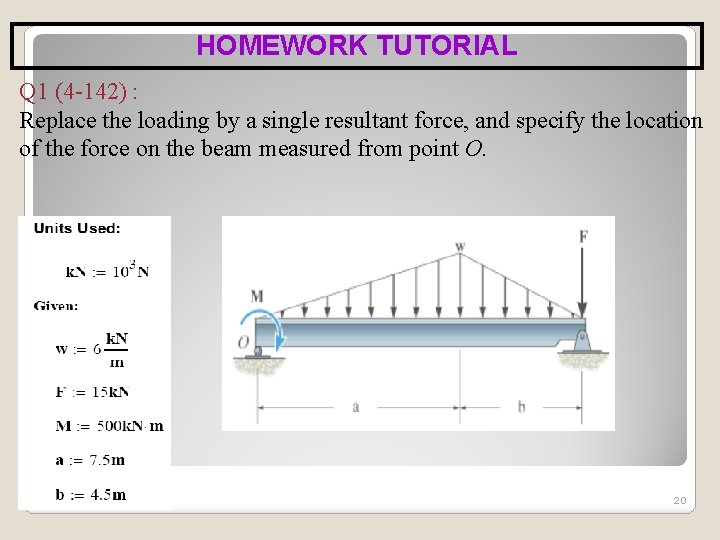
HOMEWORK TUTORIAL Q 1 (4 -142) : Replace the loading by a single resultant force, and specify the location of the force on the beam measured from point O. 20
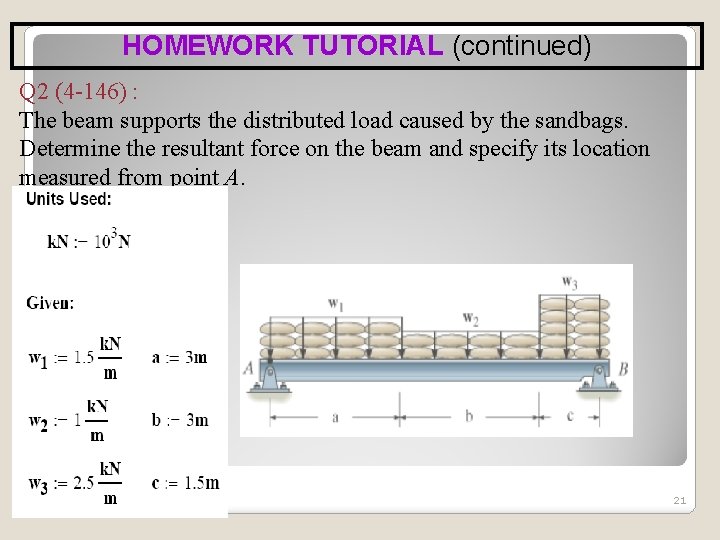
HOMEWORK TUTORIAL (continued) Q 2 (4 -146) : The beam supports the distributed load caused by the sandbags. Determine the resultant force on the beam and specify its location measured from point A. 21
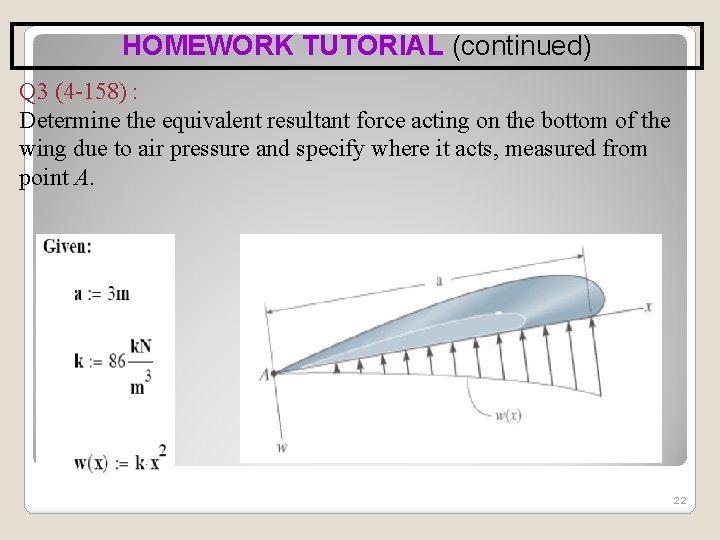
HOMEWORK TUTORIAL (continued) Q 3 (4 -158) : Determine the equivalent resultant force acting on the bottom of the wing due to air pressure and specify where it acts, measured from point A. 22

23
- Slides: 23