
Engineering Mechanics Spring Systems and Associated Work Lab
Engineering Mechanics Spring Systems and Associated Work Lab. Rat Scientific © 2019 1
What is Mechanical Work WORK is done when a FORCE is applied over some DISTANCE. Work = Force (N) x Distance (m) The FORCE can come from any number of sources: • • Gravity Wind Pressure Springs • Etc… 2
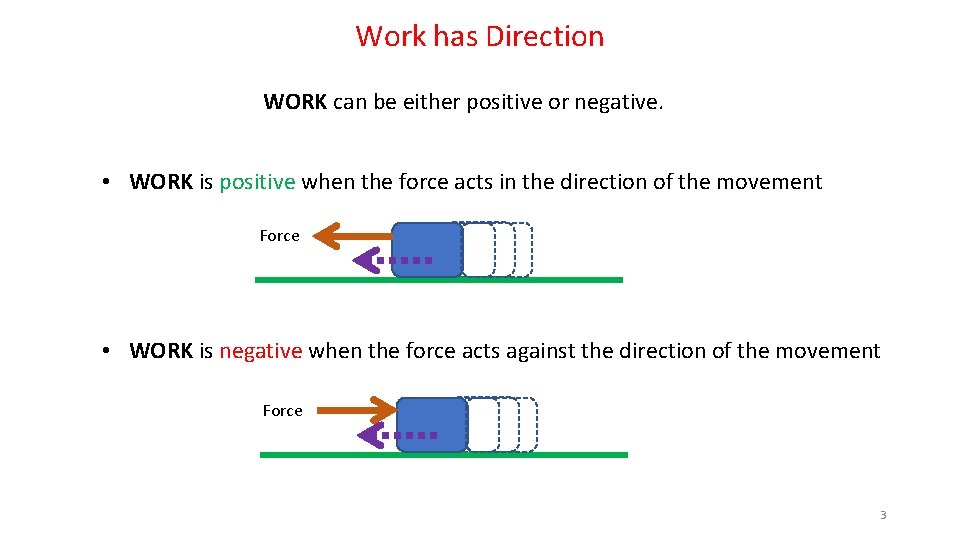
Work has Direction WORK can be either positive or negative. • WORK is positive when the force acts in the direction of the movement Force • WORK is negative when the force acts against the direction of the movement Force 3
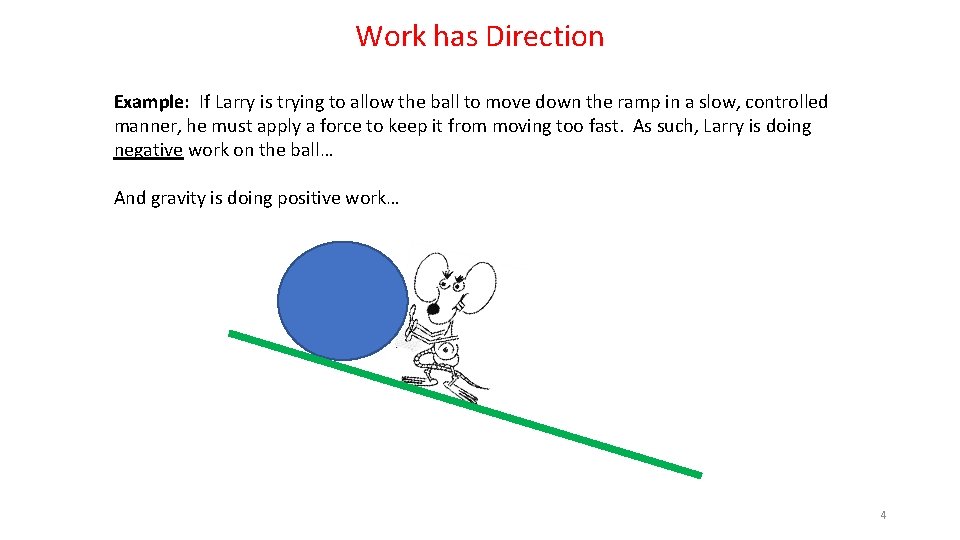
Work has Direction Example: If Larry is trying to allow the ball to move down the ramp in a slow, controlled manner, he must apply a force to keep it from moving too fast. As such, Larry is doing negative work on the ball… And gravity is doing positive work… 4
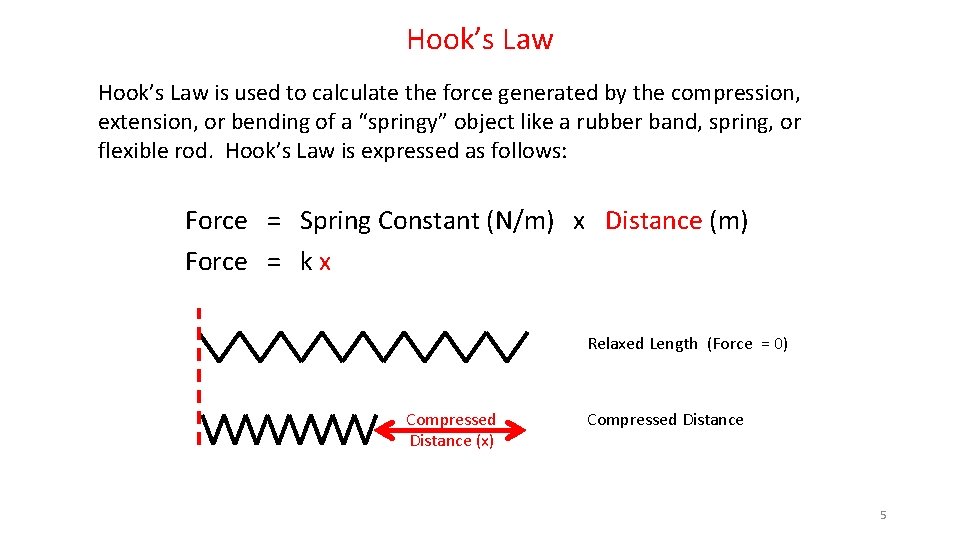
Hook’s Law is used to calculate the force generated by the compression, extension, or bending of a “springy” object like a rubber band, spring, or flexible rod. Hook’s Law is expressed as follows: Force = Spring Constant (N/m) x Distance (m) Force = k x Relaxed Length (Force = 0) Compressed Distance (x) Compressed Distance 5
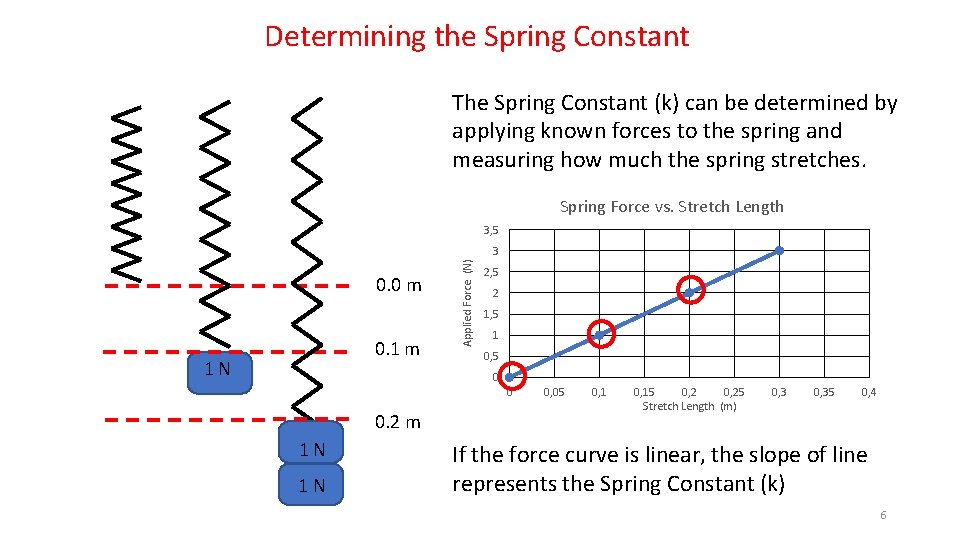
Determining the Spring Constant The Spring Constant (k) can be determined by applying known forces to the spring and measuring how much the spring stretches. Spring Force vs. Stretch Length 3, 5 0. 0 m 0. 1 m 1 N Applied Force (N) 3 2, 5 2 1, 5 1 0, 5 0 0 0. 2 m 1 N 1 N 0, 05 0, 15 0, 25 Stretch Length (m) 0, 35 0, 4 If the force curve is linear, the slope of line represents the Spring Constant (k) 6
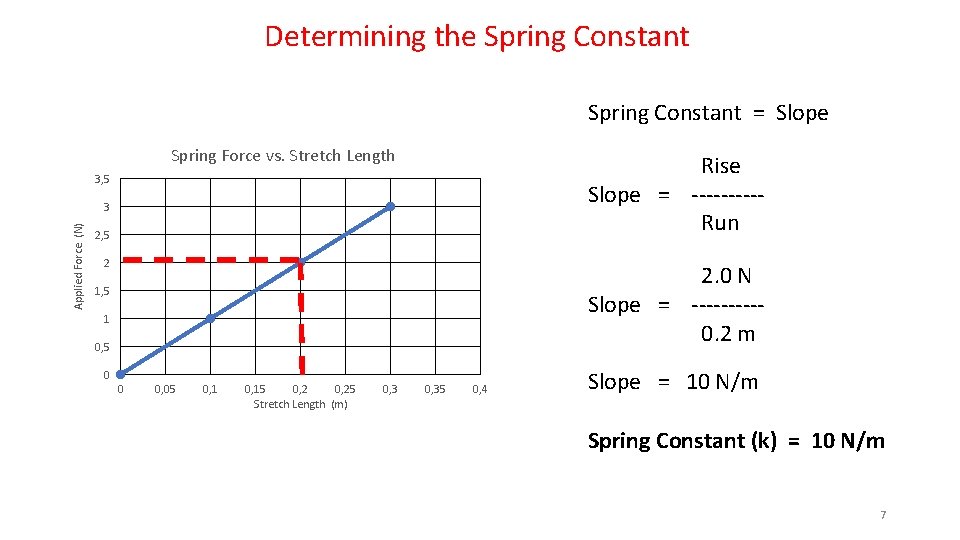
Determining the Spring Constant = Slope Spring Force vs. Stretch Length Rise Slope = -----Run 3, 5 Applied Force (N) 3 2, 5 2 2. 0 N Slope = -----0. 2 m 1, 5 1 0, 5 0 0 0, 05 0, 15 0, 25 Stretch Length (m) 0, 35 0, 4 Slope = 10 N/m Spring Constant (k) = 10 N/m 7
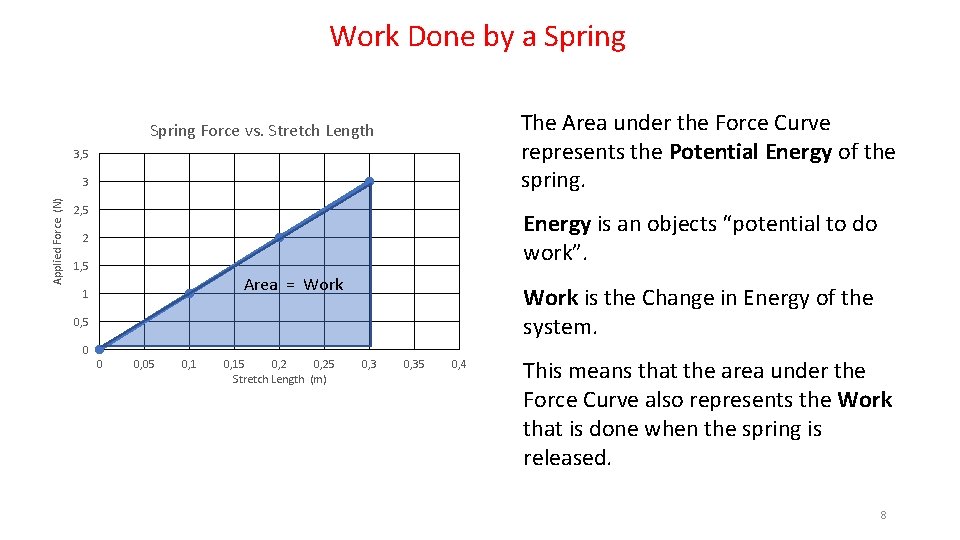
Work Done by a Spring The Area under the Force Curve represents the Potential Energy of the spring. Spring Force vs. Stretch Length 3, 5 Applied Force (N) 3 2, 5 Energy is an objects “potential to do work”. 2 1, 5 Area = Work 1 Work is the Change in Energy of the system. 0, 5 0 0 0, 05 0, 15 0, 25 Stretch Length (m) 0, 35 0, 4 This means that the area under the Force Curve also represents the Work that is done when the spring is released. 8
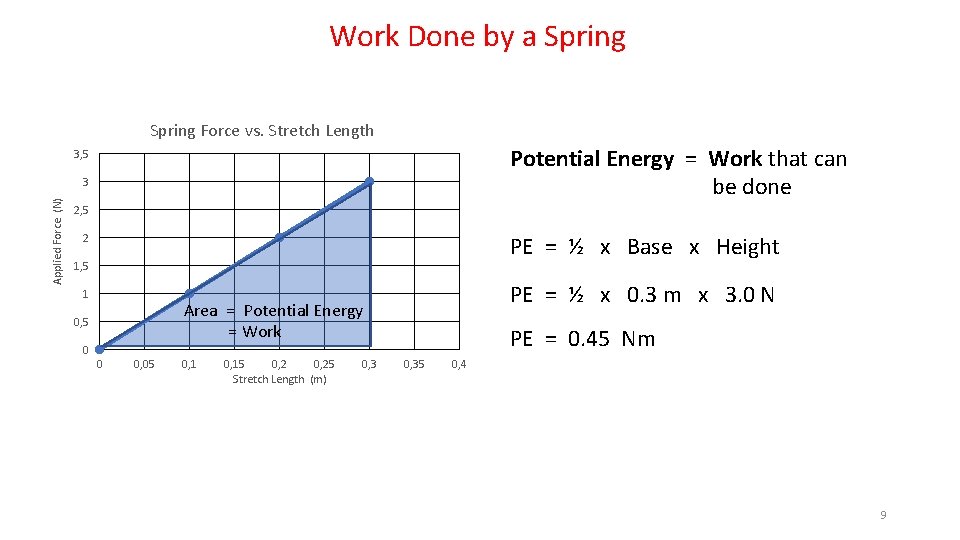
Work Done by a Spring Force vs. Stretch Length Potential Energy = Work that can be done 3, 5 Applied Force (N) 3 2, 5 2 PE = ½ x Base x Height 1, 5 1 PE = ½ x 0. 3 m x 3. 0 N Area = Potential Energy = Work 0, 5 0 0 0, 05 0, 15 0, 25 Stretch Length (m) 0, 3 PE = 0. 45 Nm 0, 35 0, 4 9
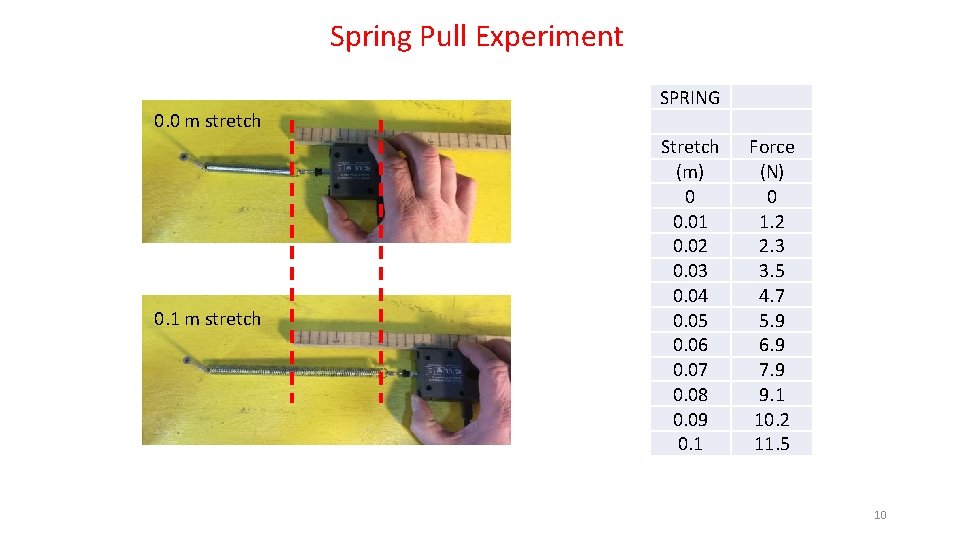
Spring Pull Experiment 0. 0 m stretch 0. 1 m stretch SPRING Stretch (m) 0 0. 01 0. 02 0. 03 0. 04 0. 05 0. 06 0. 07 0. 08 0. 09 0. 1 Force (N) 0 1. 2 2. 3 3. 5 4. 7 5. 9 6. 9 7. 9 9. 1 10. 2 11. 5 10
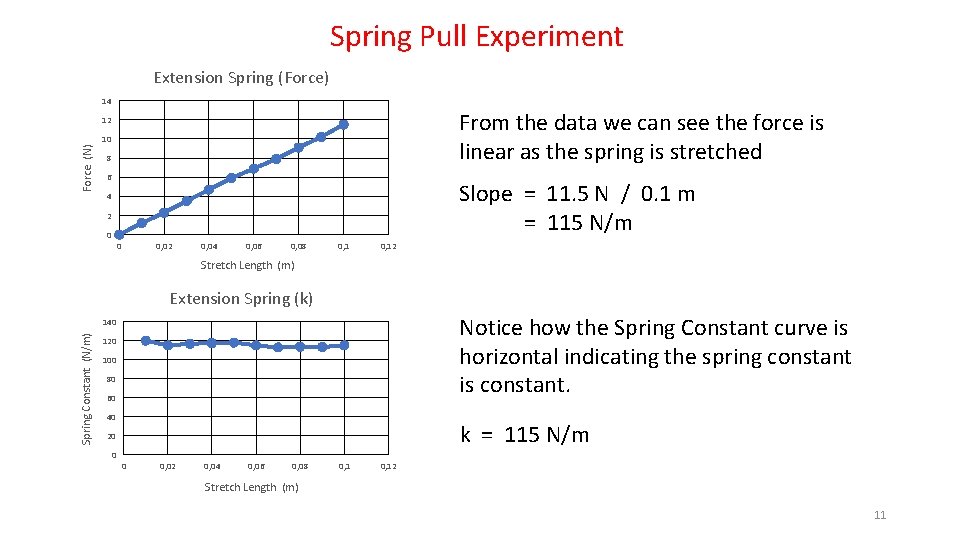
Spring Pull Experiment Extension Spring (Force) 14 From the data we can see the force is linear as the spring is stretched 12 Force (N) 10 8 6 Slope = 11. 5 N / 0. 1 m = 115 N/m 4 2 0 0 0, 02 0, 04 0, 06 0, 08 0, 12 Stretch Length (m) Extension Spring (k) Notice how the Spring Constant curve is horizontal indicating the spring constant is constant. Spring Constant (N/m) 140 120 100 80 60 40 k = 115 N/m 20 0 0 0, 02 0, 04 0, 06 0, 08 0, 12 Stretch Length (m) 11
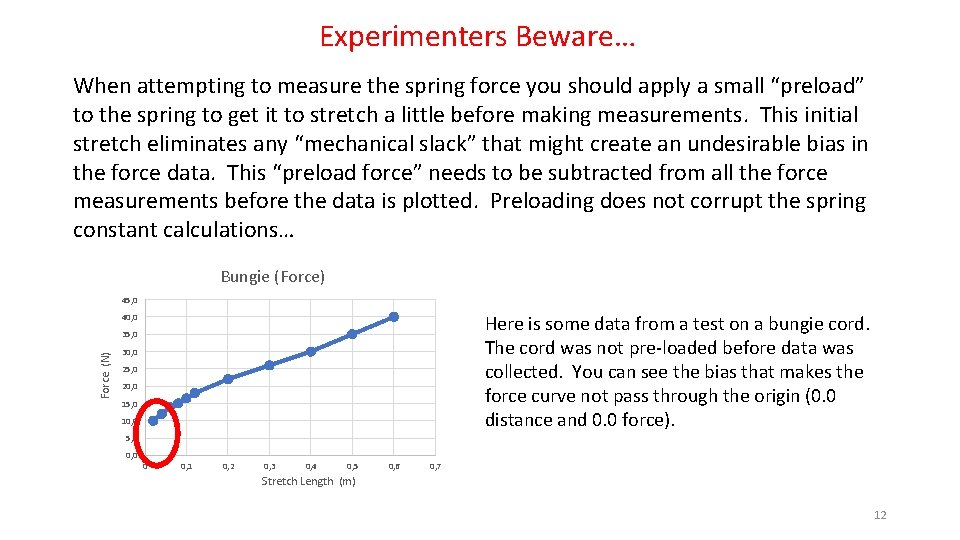
Experimenters Beware… When attempting to measure the spring force you should apply a small “preload” to the spring to get it to stretch a little before making measurements. This initial stretch eliminates any “mechanical slack” that might create an undesirable bias in the force data. This “preload force” needs to be subtracted from all the force measurements before the data is plotted. Preloading does not corrupt the spring constant calculations… Bungie (Force) 45, 0 Here is some data from a test on a bungie cord. The cord was not pre-loaded before data was collected. You can see the bias that makes the force curve not pass through the origin (0. 0 distance and 0. 0 force). 40, 0 Force (N) 35, 0 30, 0 25, 0 20, 0 15, 0 10, 0 5, 0 0 0, 1 0, 2 0, 3 0, 4 0, 5 0, 6 0, 7 Stretch Length (m) 12
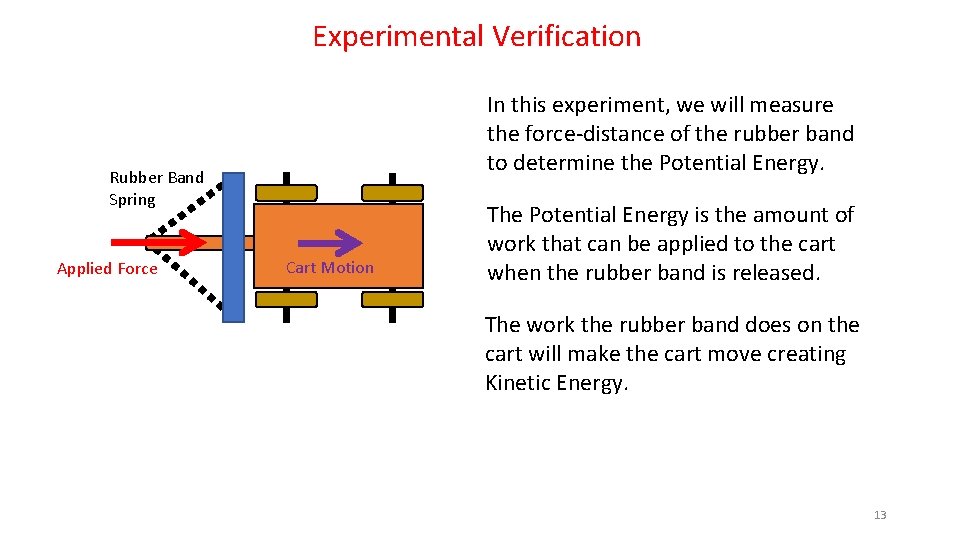
Experimental Verification In this experiment, we will measure the force-distance of the rubber band to determine the Potential Energy. Rubber Band Spring Applied Force Cart Motion The Potential Energy is the amount of work that can be applied to the cart when the rubber band is released. The work the rubber band does on the cart will make the cart move creating Kinetic Energy. 13
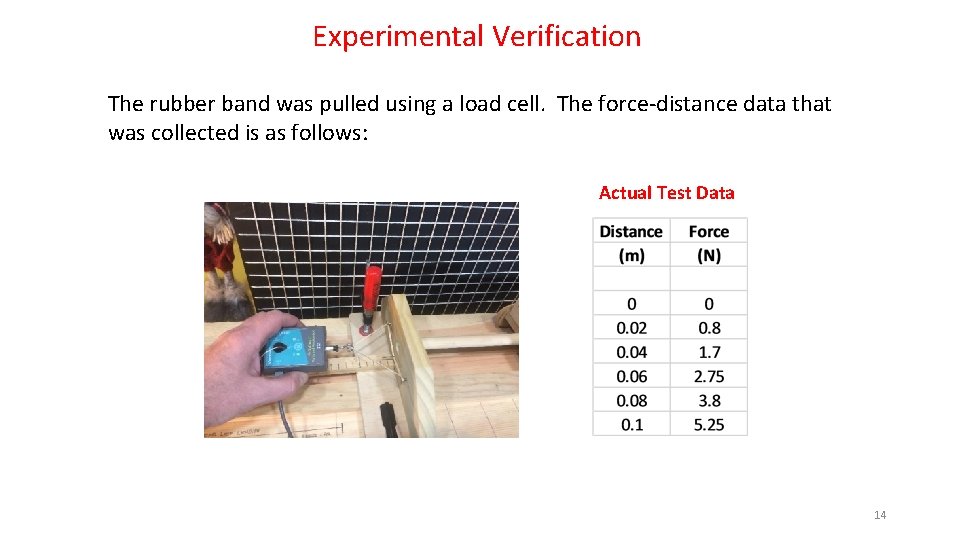
Experimental Verification The rubber band was pulled using a load cell. The force-distance data that was collected is as follows: Actual Test Data 14
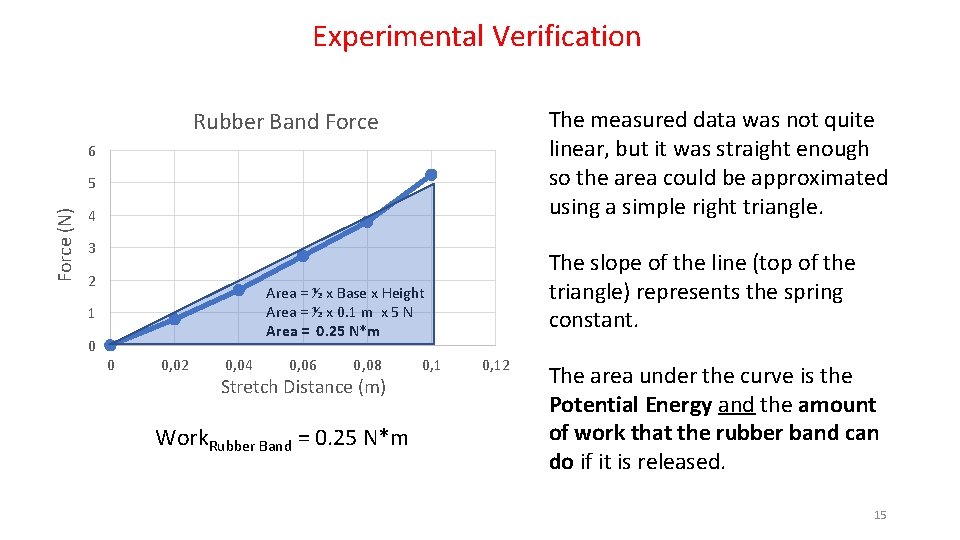
Experimental Verification The measured data was not quite linear, but it was straight enough so the area could be approximated using a simple right triangle. Rubber Band Force 6 Force (N) 5 4 3 2 The slope of the line (top of the triangle) represents the spring constant. Area = ½ x Base x Height Area = ½ x 0. 1 m x 5 N Area = 0. 25 N*m 1 0 0 0, 02 0, 04 0, 06 0, 08 Stretch Distance (m) Work. Rubber Band = 0. 25 N*m 0, 12 The area under the curve is the Potential Energy and the amount of work that the rubber band can do if it is released. 15
Theoretical Computations Potential Energy = Work that can be done When the rubber band is released it can start performing work on the cart. As work is performed, the cart is accelerated and as the cart accelerates its kinetic energy increases. The Work-Energy Theorem states: The change in kinetic energy of a system is equal to the amount of work done on that object. Mathematically speaking: Work = Kinetic Energy. Final - Kinetic Energy. Initial 16
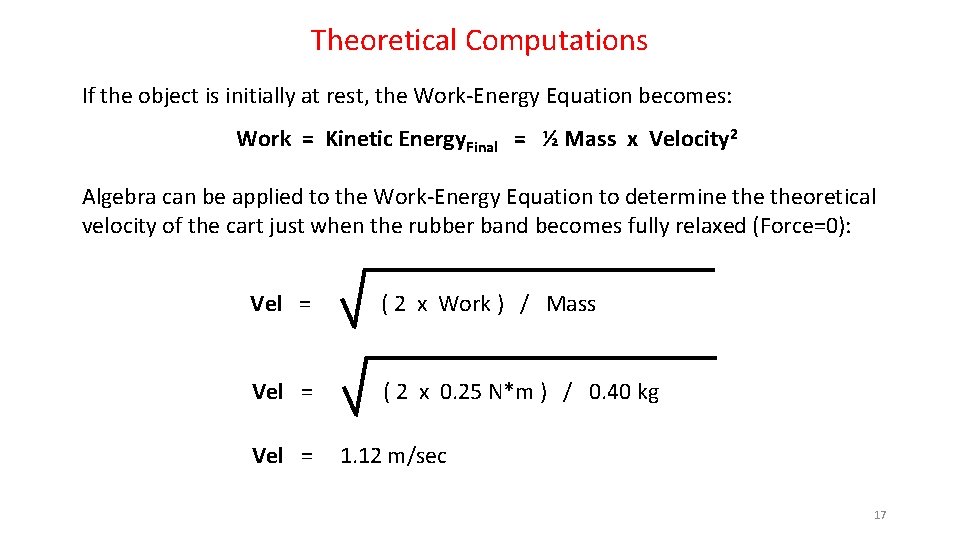
Theoretical Computations If the object is initially at rest, the Work-Energy Equation becomes: Work = Kinetic Energy. Final = ½ Mass x Velocity 2 Algebra can be applied to the Work-Energy Equation to determine theoretical velocity of the cart just when the rubber band becomes fully relaxed (Force=0): Vel = ( 2 x Work ) / Mass Vel = ( 2 x 0. 25 N*m ) / 0. 40 kg Vel = 1. 12 m/sec 17
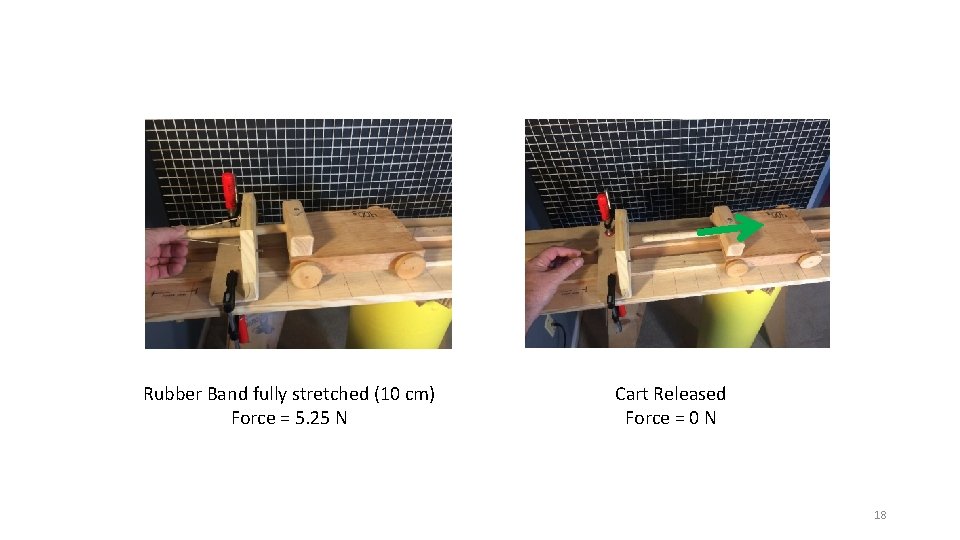
Rubber Band fully stretched (10 cm) Force = 5. 25 N Cart Released Force = 0 N 18
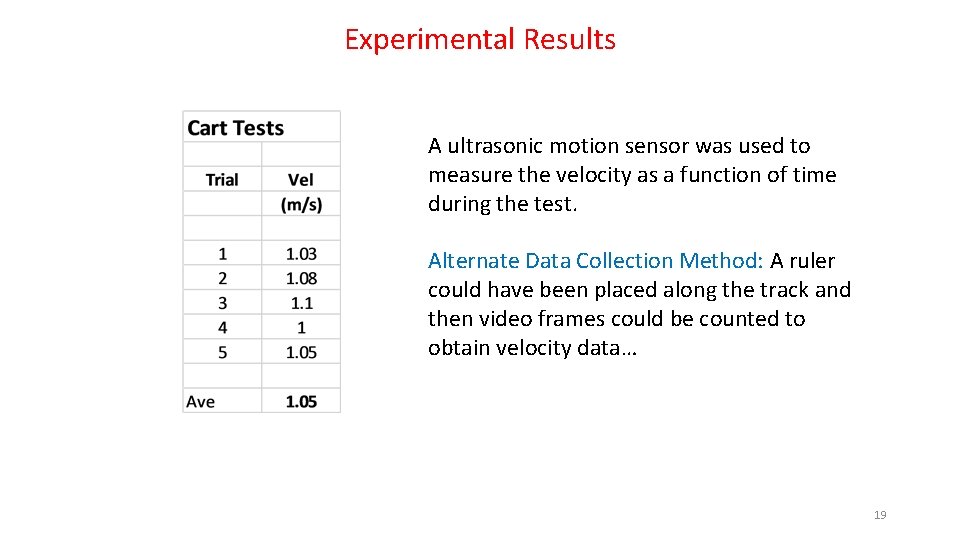
Experimental Results A ultrasonic motion sensor was used to measure the velocity as a function of time during the test. Alternate Data Collection Method: A ruler could have been placed along the track and then video frames could be counted to obtain velocity data… 19
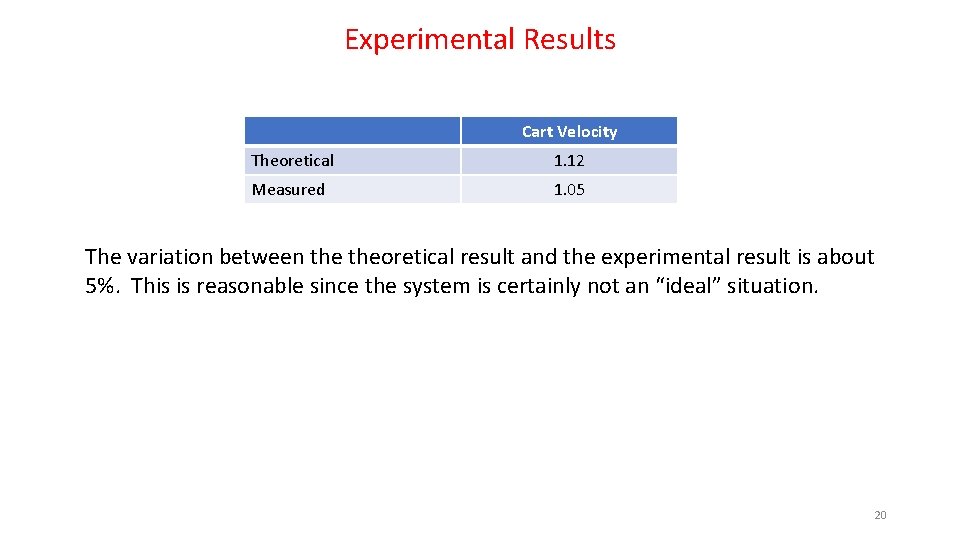
Experimental Results Cart Velocity Theoretical 1. 12 Measured 1. 05 The variation between theoretical result and the experimental result is about 5%. This is reasonable since the system is certainly not an “ideal” situation. 20
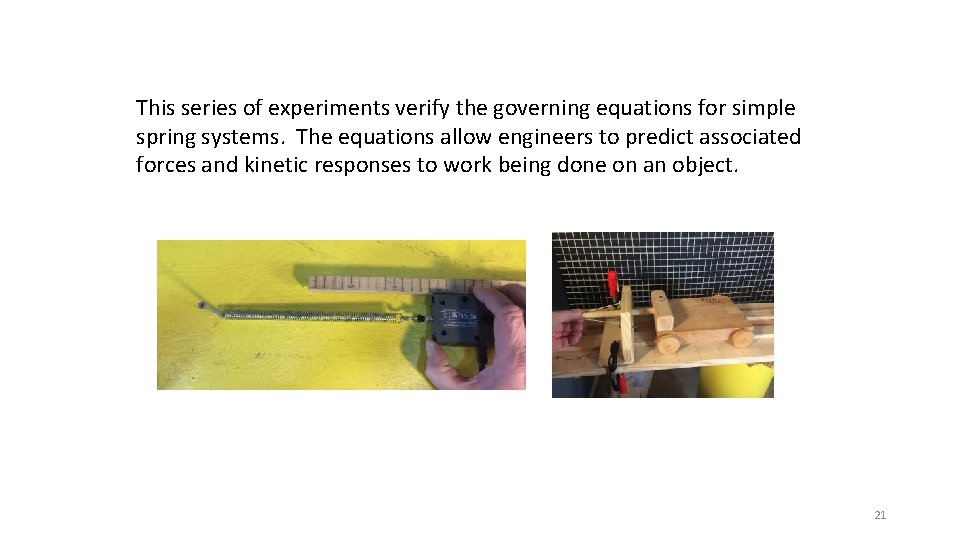
This series of experiments verify the governing equations for simple spring systems. The equations allow engineers to predict associated forces and kinetic responses to work being done on an object. 21
Questions ? 22
- Slides: 22