
Engineering Mechanics Equilibrium of Rigid Bodies Equilibrium System

Engineering Mechanics Equilibrium of Rigid Bodies

Equilibrium • System is in equilibrium if and only if the sum of all the forces and moment (about any point) equals zero.

Supports and Equilibrium • Any structure is made of many components. • The components are the be connected by linkages. • Other wise the structure will lose its integrity. • Different component of structure talk to each other via linkages. • The structure should be globally supported to prevent it from falling over.
Different Structural Supports • Supports are required to maintain system in equilibrium. • Too few supports makes system unstable general loading • Too many supports make the system over-rigid.
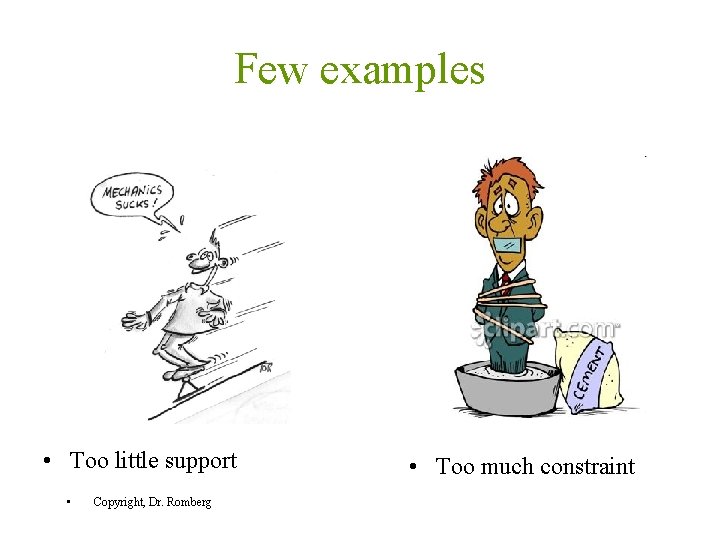
Few examples • Too little support • Copyright, Dr. Romberg • Too much constraint
Constraints and Reactions • • There is an intricate relationship between kinematics and reactions. Always note that in the case of supports displacement (rotation) and force (torque) in any given direction are complementary. If a support rigidly constrains a given degree of freedom (DOF) for a rigid body then it gives rise to a reaction corresponding to that DOF. Similarly if a support freely allows motion of particular DOF then there is no reaction from the support in that direction.
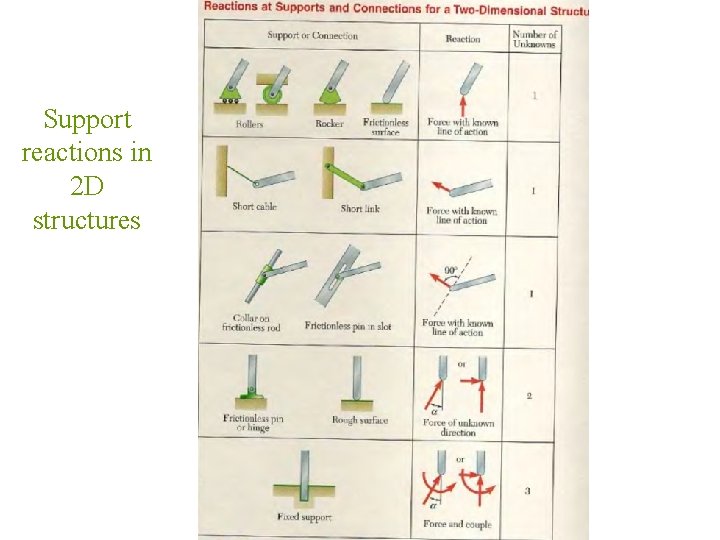
Support reactions in 2 D structures
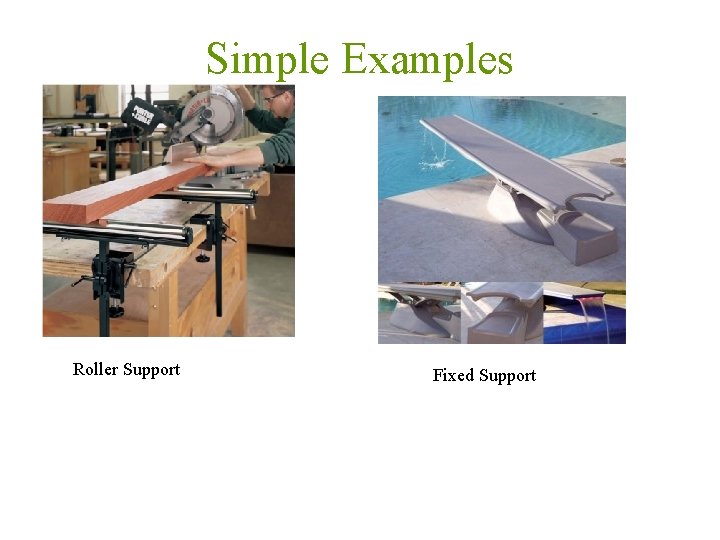
Simple Examples Roller Support Fixed Support
Free Body Diagram (FBD) • Single most important concept in engineering mechanics. • Zoom in on a given component of a structure. • Means replace supports (connections) with the corresponding reactions. • Replace kinematic constraints with corresponding reactions. • Concepts will get more clear as we proceed further.
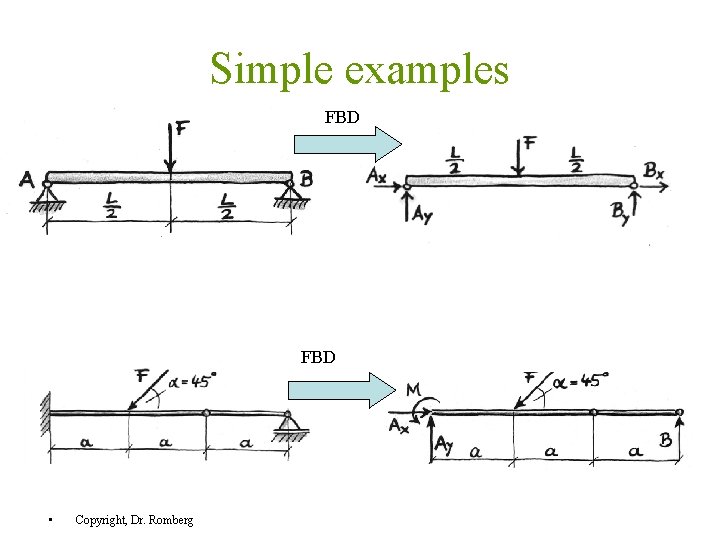
Simple examples FBD • Copyright, Dr. Romberg
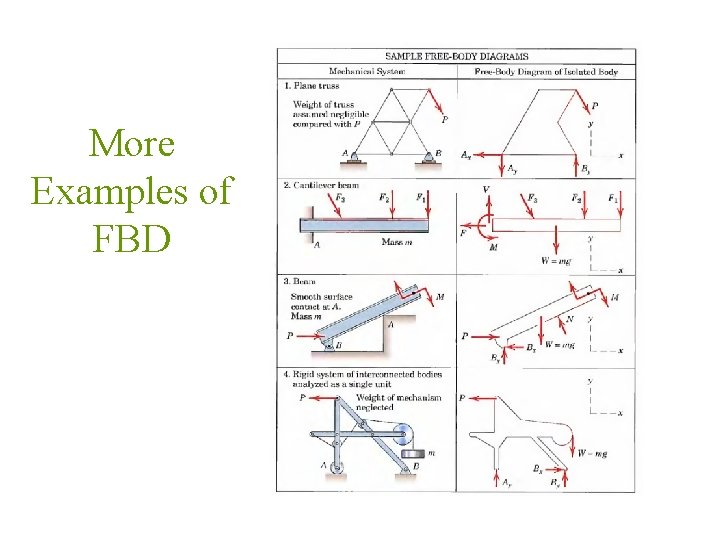
More Examples of FBD
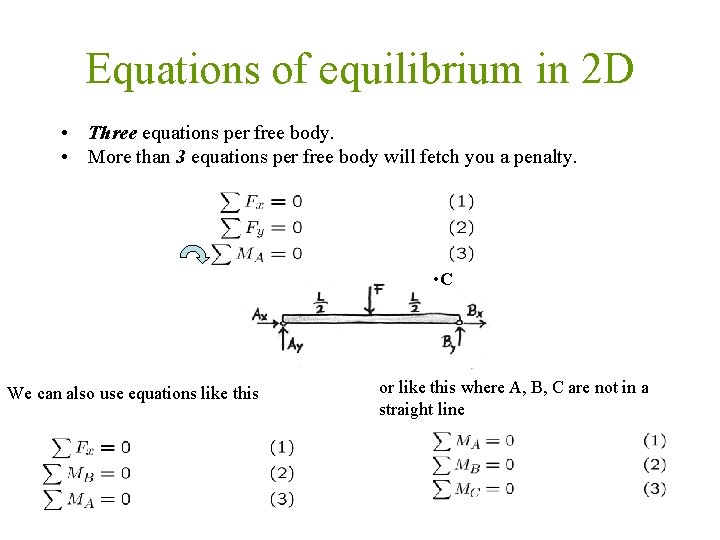
Equations of equilibrium in 2 D • Three equations per free body. • More than 3 equations per free body will fetch you a penalty. • C We can also use equations like this or like this where A, B, C are not in a straight line
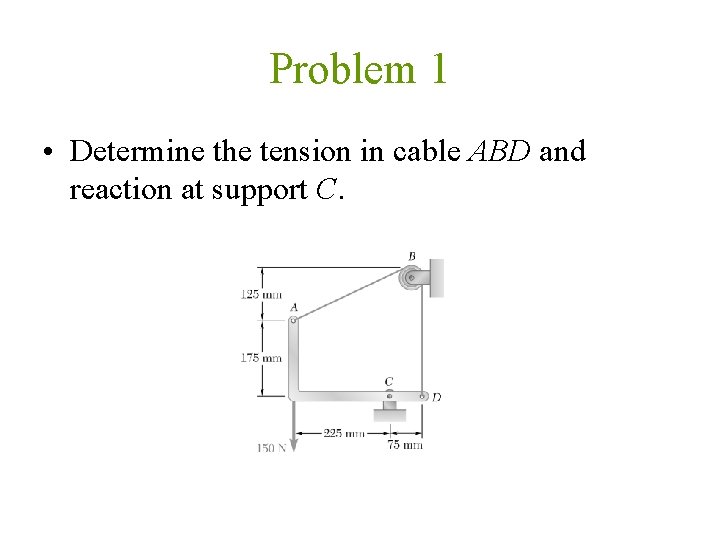
Problem 1 • Determine the tension in cable ABD and reaction at support C.
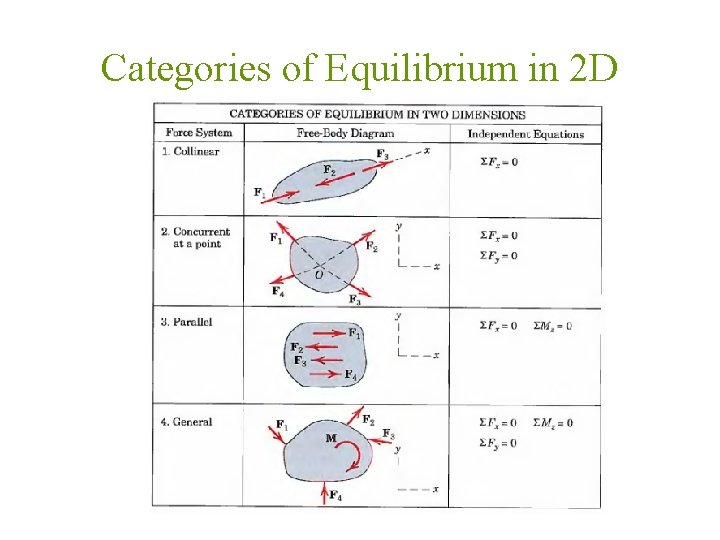
Categories of Equilibrium in 2 D
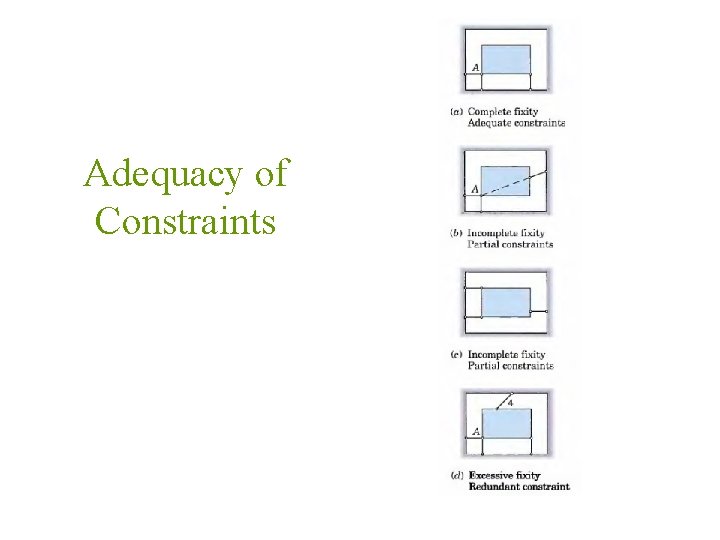
Adequacy of Constraints

Single Rigid Body Supported Globally
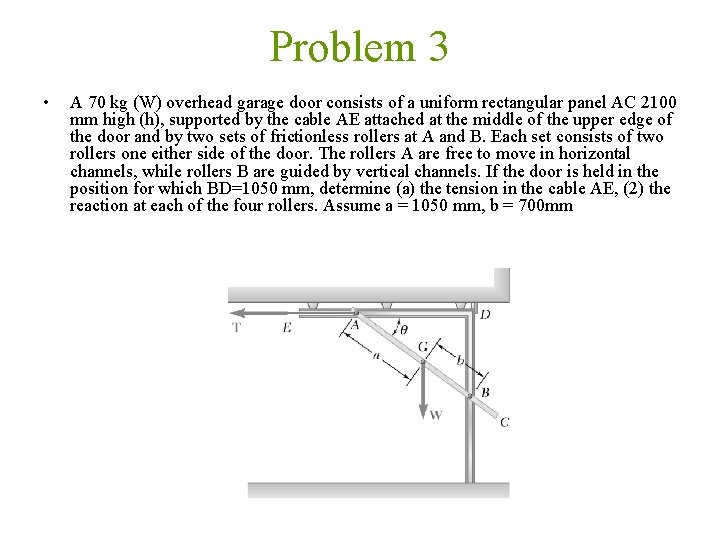
Problem 3 • A 70 kg (W) overhead garage door consists of a uniform rectangular panel AC 2100 mm high (h), supported by the cable AE attached at the middle of the upper edge of the door and by two sets of frictionless rollers at A and B. Each set consists of two rollers one either side of the door. The rollers A are free to move in horizontal channels, while rollers B are guided by vertical channels. If the door is held in the position for which BD=1050 mm, determine (a) the tension in the cable AE, (2) the reaction at each of the four rollers. Assume a = 1050 mm, b = 700 mm
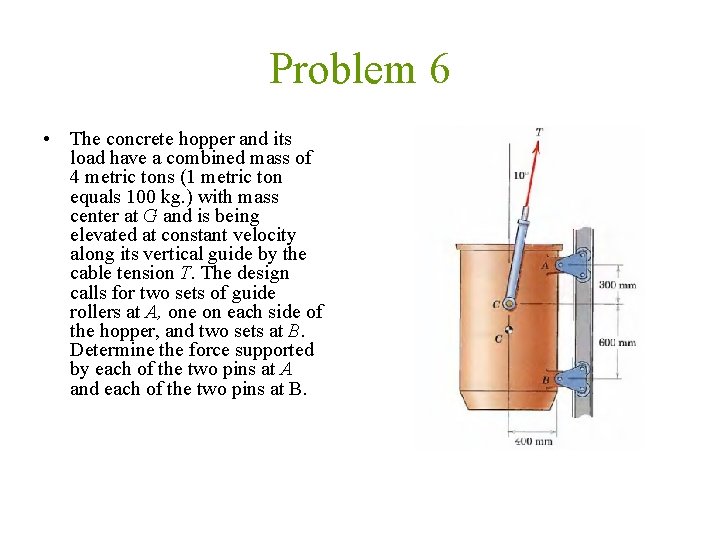
Problem 6 • The concrete hopper and its load have a combined mass of 4 metric tons (1 metric ton equals 100 kg. ) with mass center at G and is being elevated at constant velocity along its vertical guide by the cable tension T. The design calls for two sets of guide rollers at A, one on each side of the hopper, and two sets at B. Determine the force supported by each of the two pins at A and each of the two pins at B.

Multiple Rigid Bodies Connected To Each Other
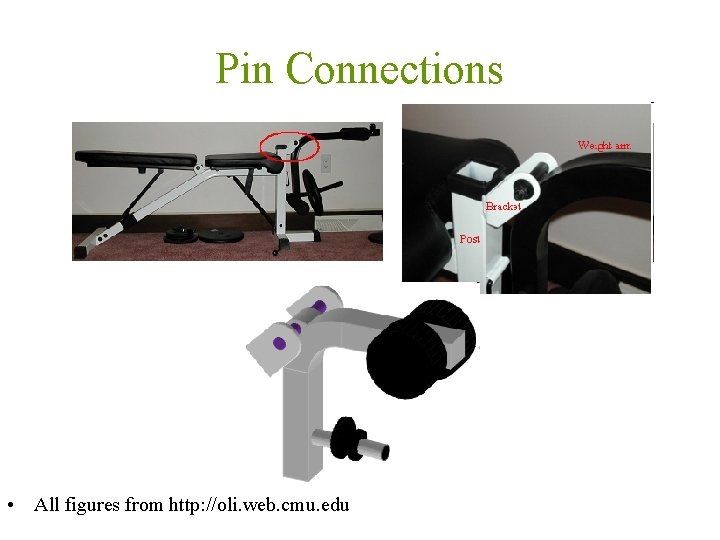
Pin Connections • All figures from http: //oli. web. cmu. edu
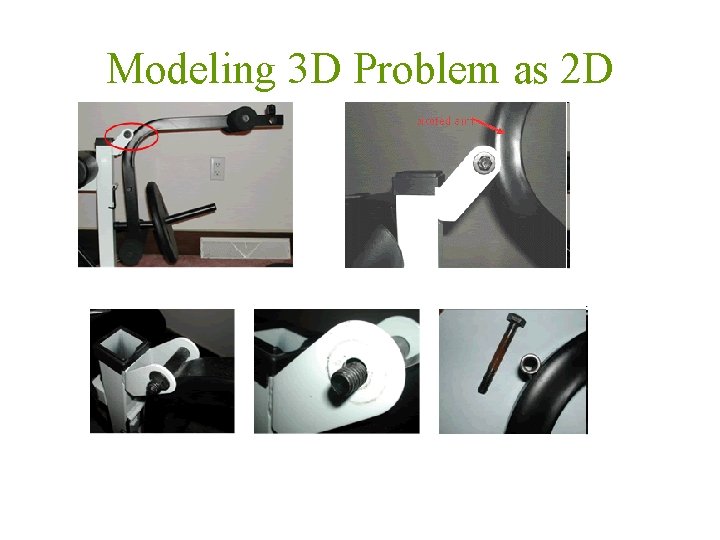
Modeling 3 D Problem as 2 D
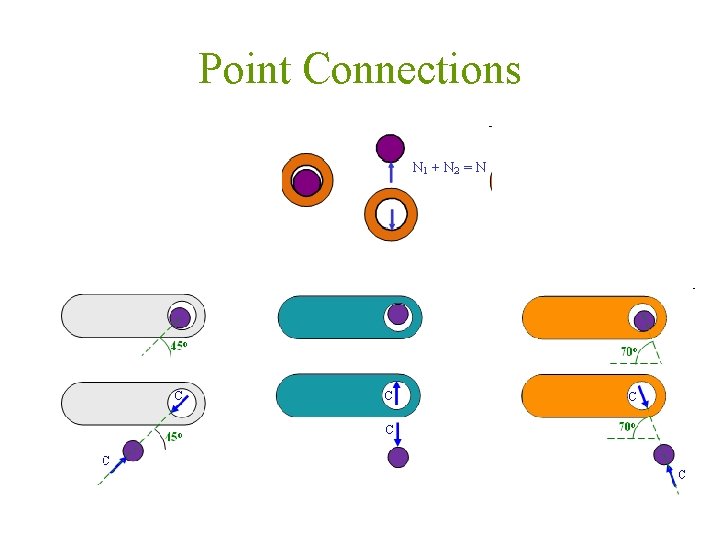
Point Connections
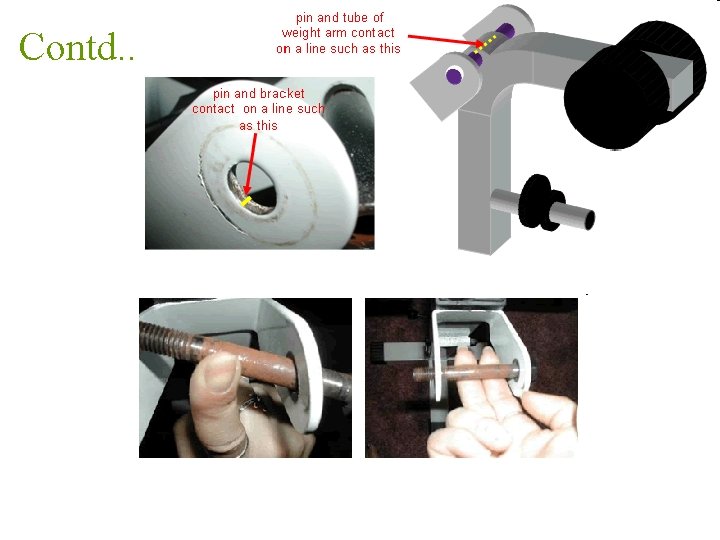
Contd. .

Contd. .
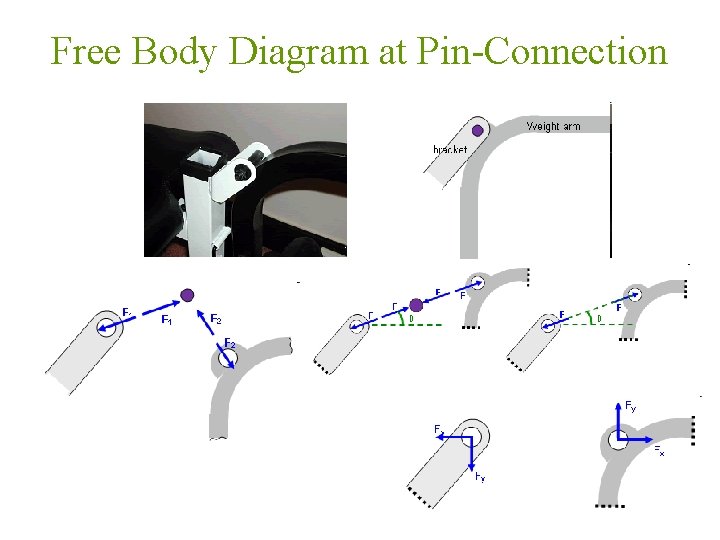
Free Body Diagram at Pin-Connection
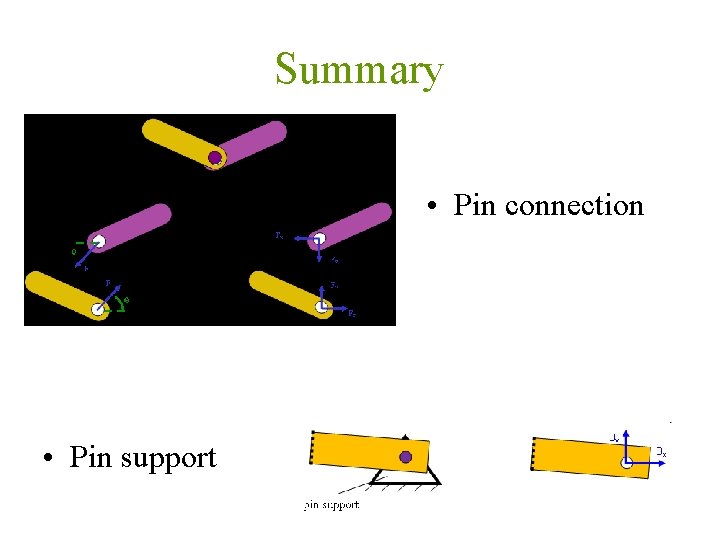
Summary • Pin connection • Pin support
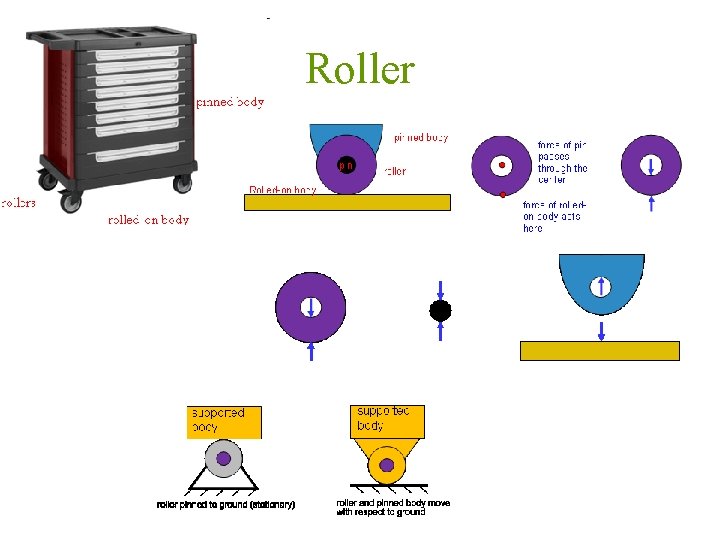
Roller

Slot Connection
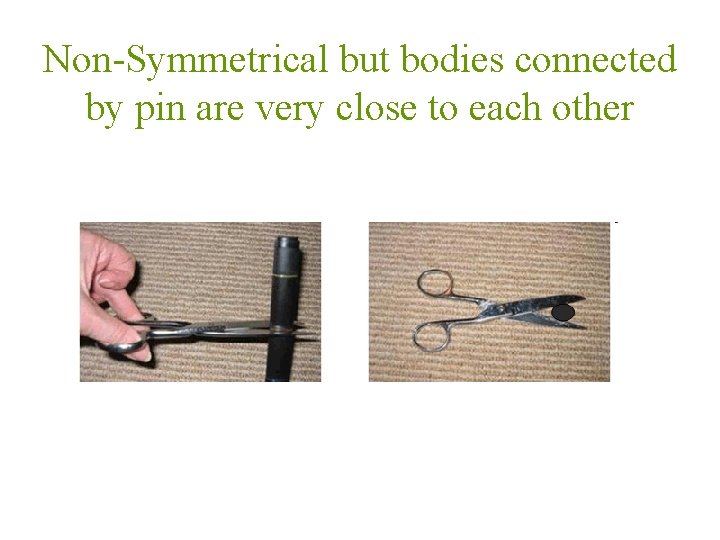
Non-Symmetrical but bodies connected by pin are very close to each other
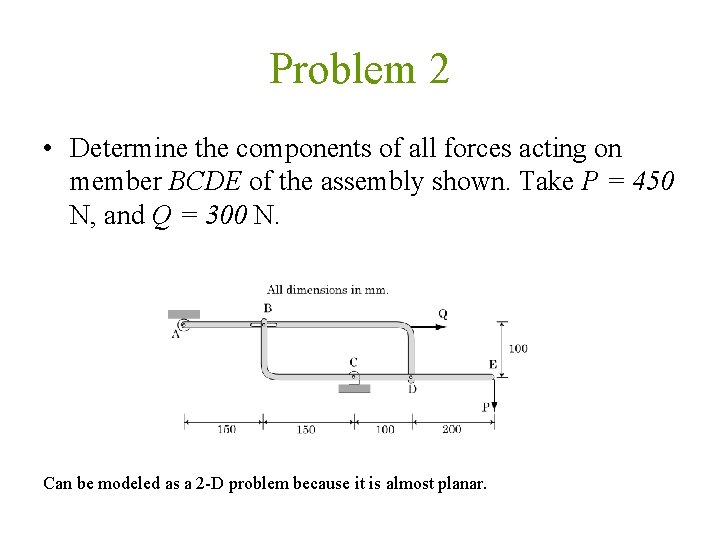
Problem 2 • Determine the components of all forces acting on member BCDE of the assembly shown. Take P = 450 N, and Q = 300 N. Can be modeled as a 2 -D problem because it is almost planar.
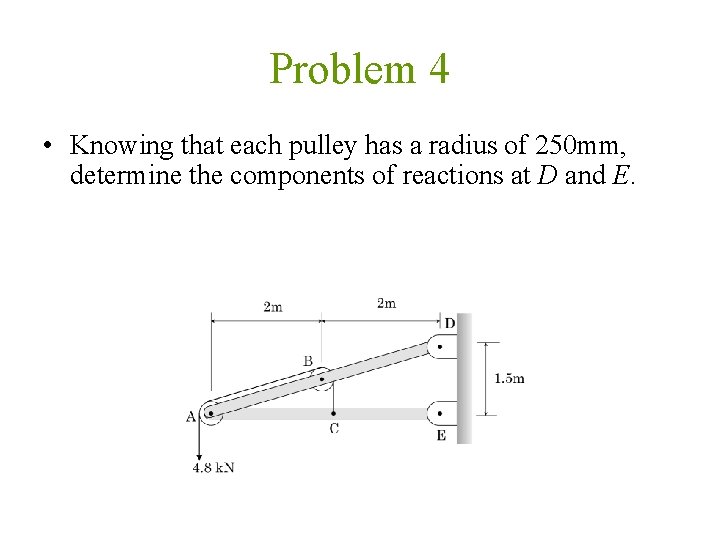
Problem 4 • Knowing that each pulley has a radius of 250 mm, determine the components of reactions at D and E.
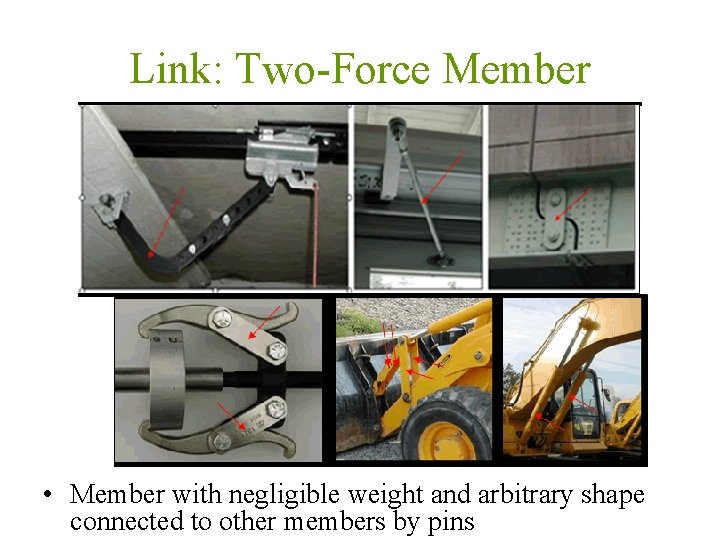
Link: Two-Force Member • Member with negligible weight and arbitrary shape connected to other members by pins
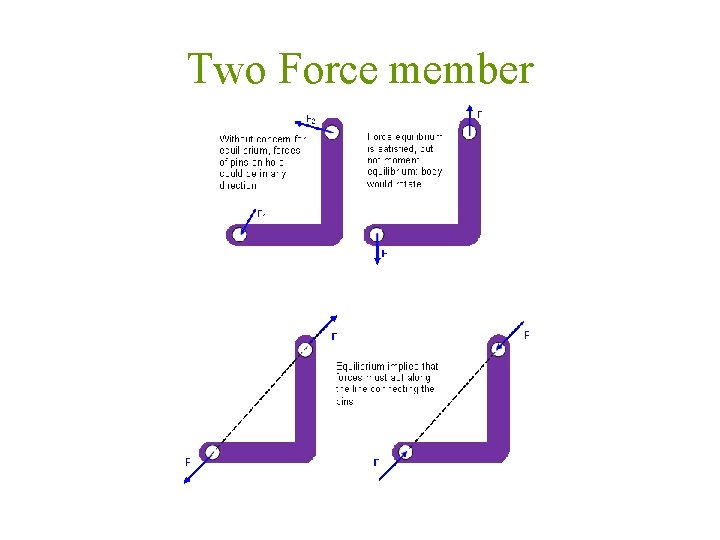
Two Force member
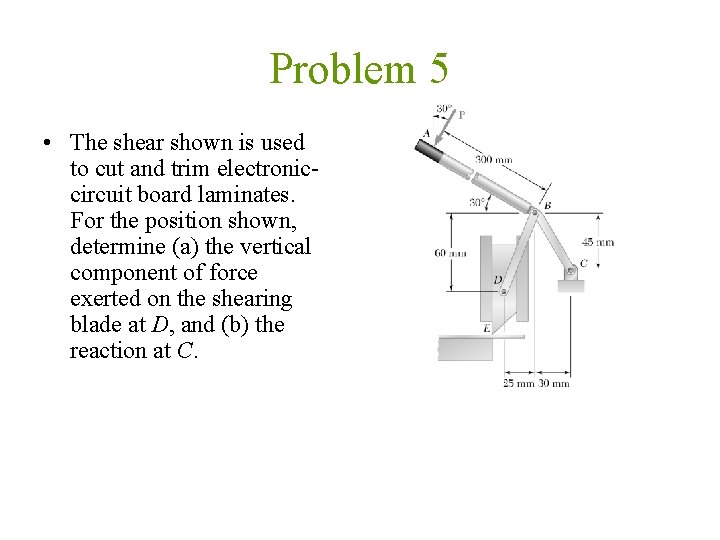
Problem 5 • The shear shown is used to cut and trim electroniccircuit board laminates. For the position shown, determine (a) the vertical component of force exerted on the shearing blade at D, and (b) the reaction at C.
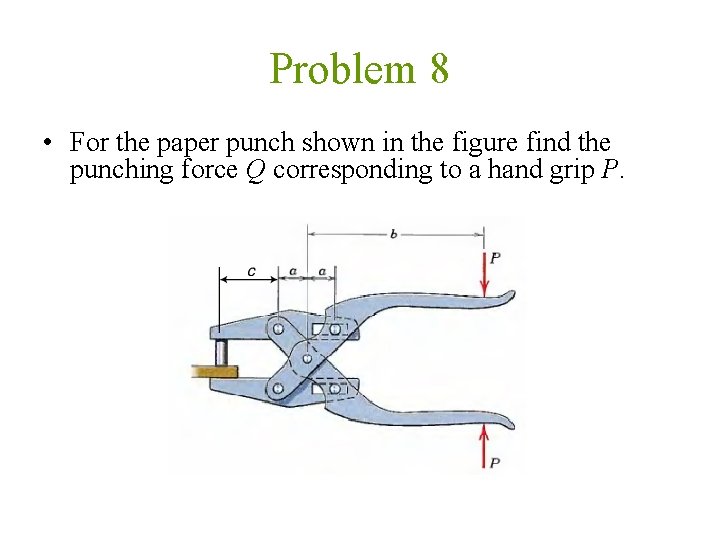
Problem 8 • For the paper punch shown in the figure find the punching force Q corresponding to a hand grip P.
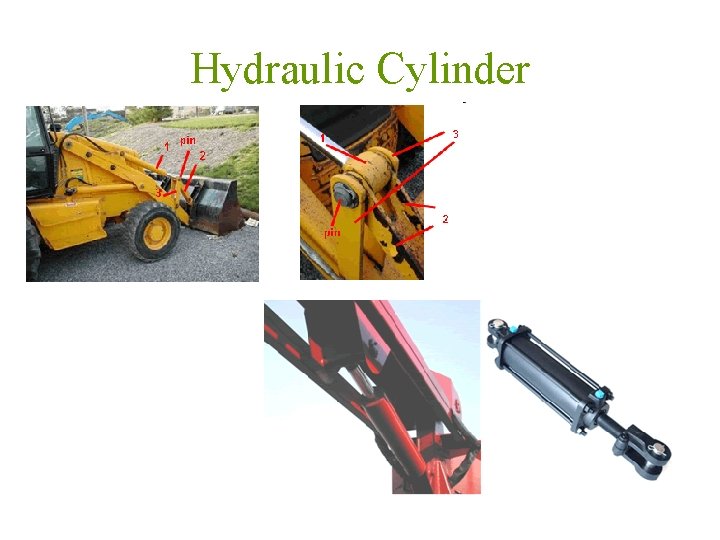
Hydraulic Cylinder
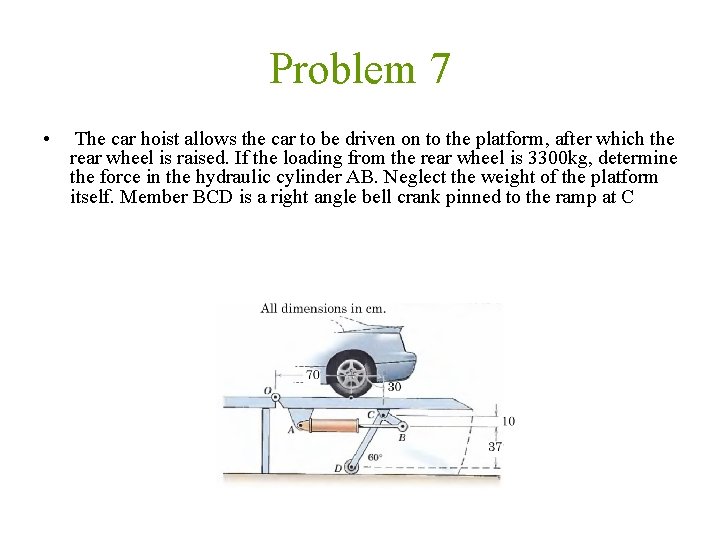
Problem 7 • The car hoist allows the car to be driven on to the platform, after which the rear wheel is raised. If the loading from the rear wheel is 3300 kg, determine the force in the hydraulic cylinder AB. Neglect the weight of the platform itself. Member BCD is a right angle bell crank pinned to the ramp at C
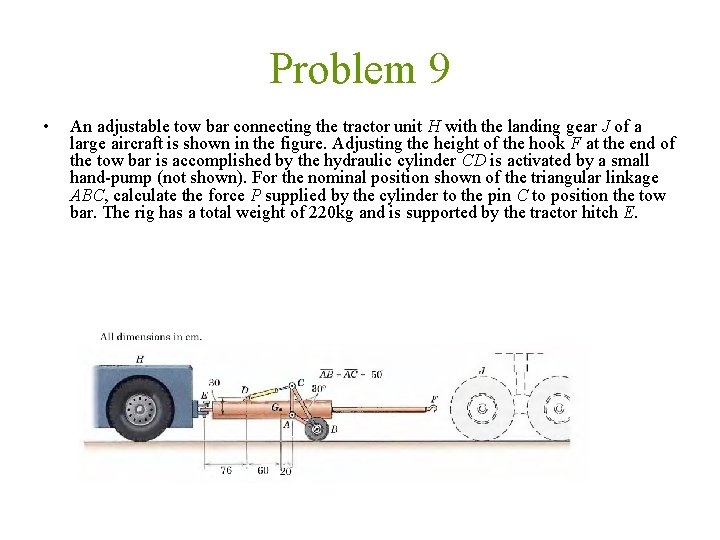
Problem 9 • An adjustable tow bar connecting the tractor unit H with the landing gear J of a large aircraft is shown in the figure. Adjusting the height of the hook F at the end of the tow bar is accomplished by the hydraulic cylinder CD is activated by a small hand-pump (not shown). For the nominal position shown of the triangular linkage ABC, calculate the force P supplied by the cylinder to the pin C to position the tow bar. The rig has a total weight of 220 kg and is supported by the tractor hitch E.
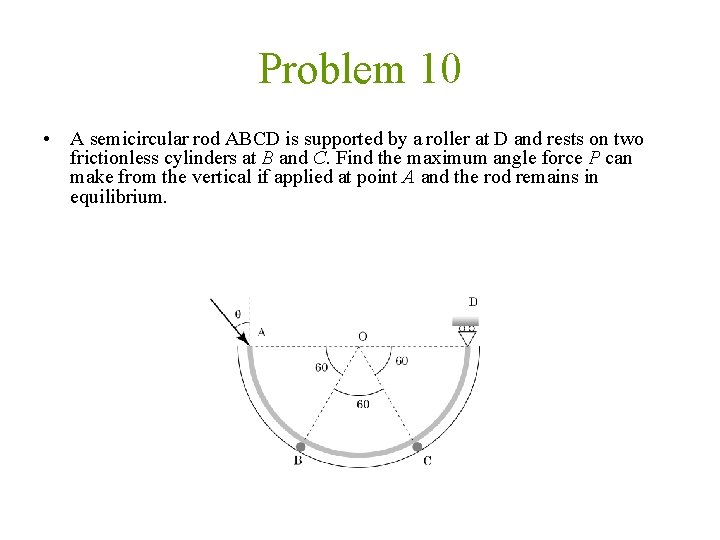
Problem 10 • A semicircular rod ABCD is supported by a roller at D and rests on two frictionless cylinders at B and C. Find the maximum angle force P can make from the vertical if applied at point A and the rod remains in equilibrium.
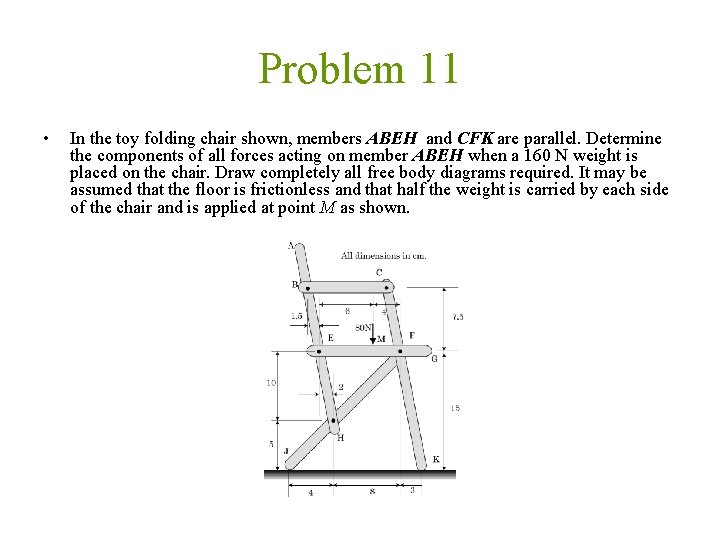
Problem 11 • In the toy folding chair shown, members ABEH and CFK are parallel. Determine the components of all forces acting on member ABEH when a 160 N weight is placed on the chair. Draw completely all free body diagrams required. It may be assumed that the floor is frictionless and that half the weight is carried by each side of the chair and is applied at point M as shown.

System constrained to various degrees

- Slides: 42