
ENGINEERING MATERIALS INTRODUCTION TO CERAMICS Ref 1 cap



- Slides: 27
ENGINEERING MATERIALS ІІ INTRODUCTION TO CERAMICS Ref. 1 (cap. 17) y Ref. 2 (cap. 15)
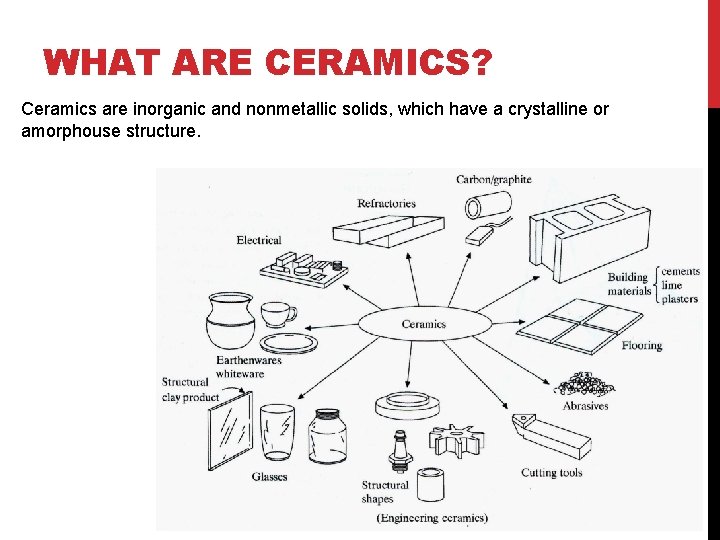
WHAT ARE CERAMICS? Ceramics are inorganic and nonmetallic solids, which have a crystalline or amorphouse structure.
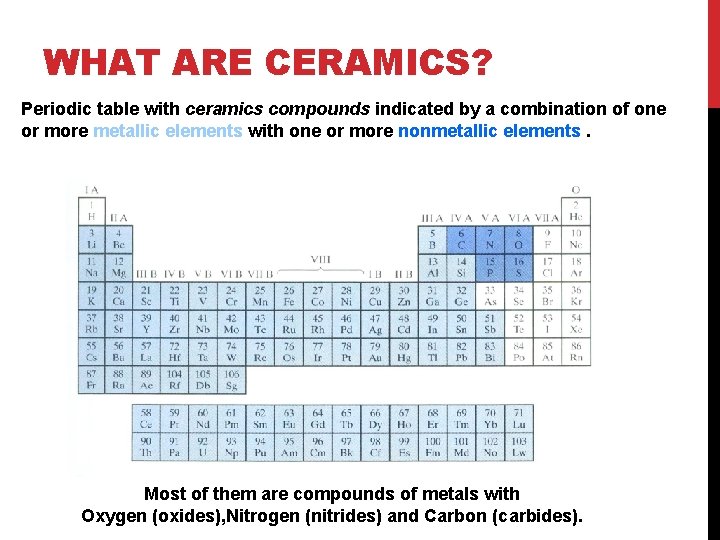
WHAT ARE CERAMICS? Periodic table with ceramics compounds indicated by a combination of one or more metallic elements with one or more nonmetallic elements. Most of them are compounds of metals with Oxygen (oxides), Nitrogen (nitrides) and Carbon (carbides).
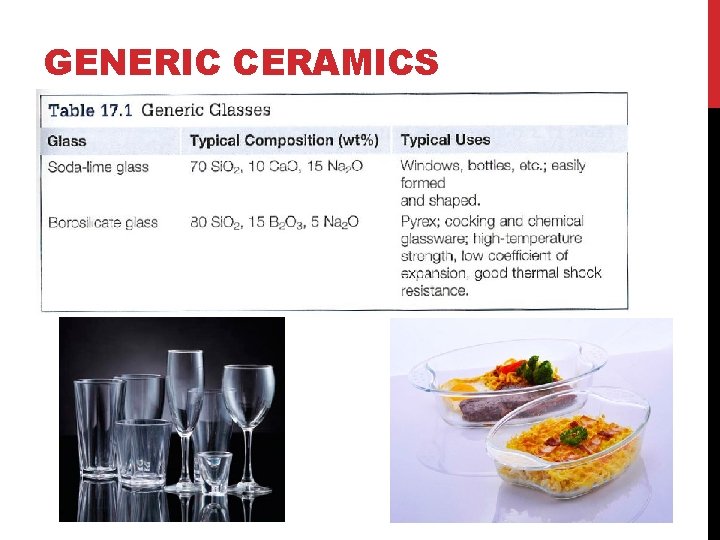
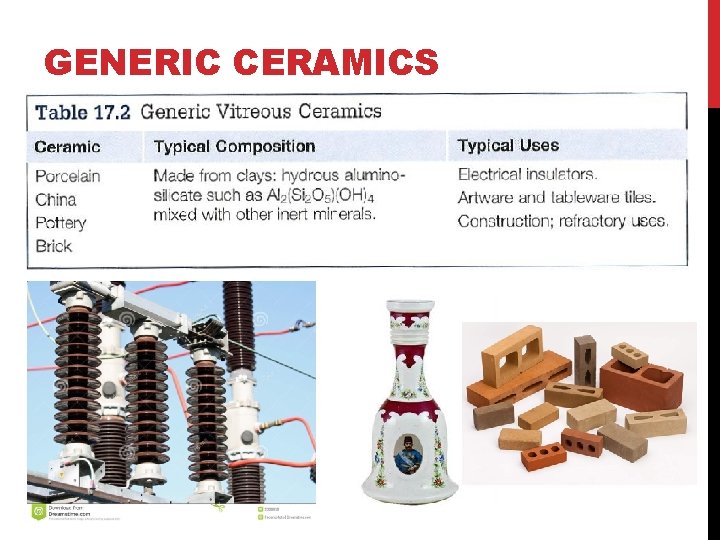
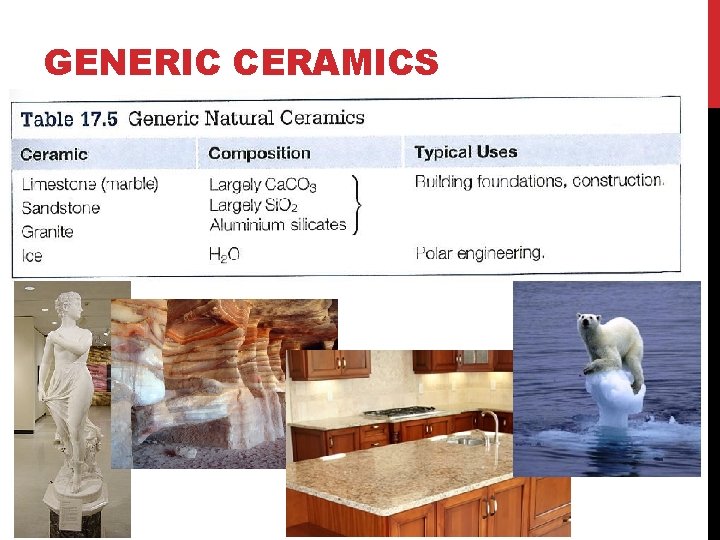
GENERIC CERAMICS • Glasses • Vitreous • Cement & Concrete • Natural Ceramics
GENERIC CERAMICS
GENERIC CERAMICS
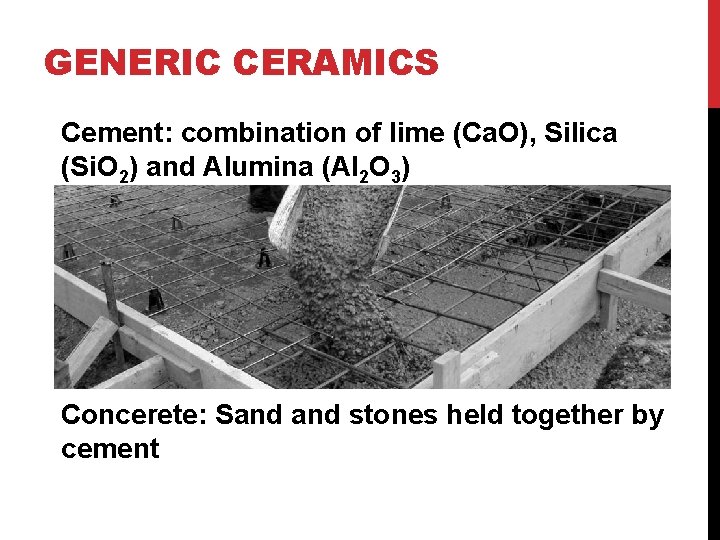
GENERIC CERAMICS Cement: combination of lime (Ca. O), Silica (Si. O 2) and Alumina (Al 2 O 3) Concerete: Sand stones held together by cement
GENERIC CERAMICS
MODERN CERAMICS • High Temperature Applications • Wear & Corrosion Resistance • Cutting & Grinding • Electrical Applications
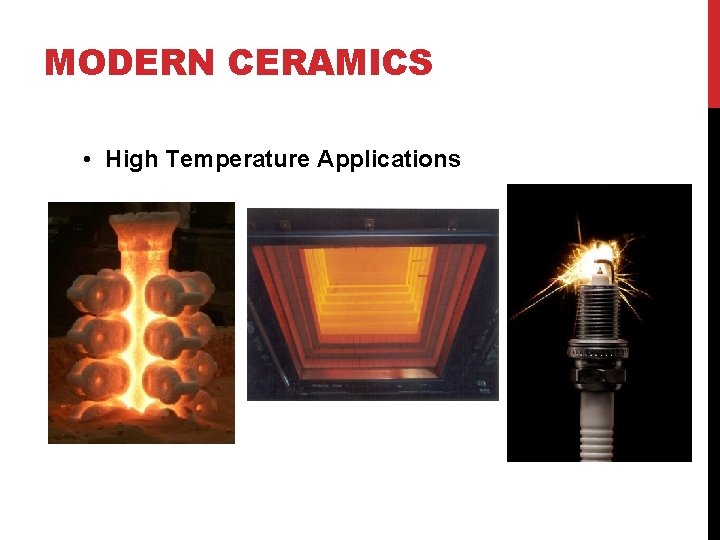
MODERN CERAMICS • High Temperature Applications
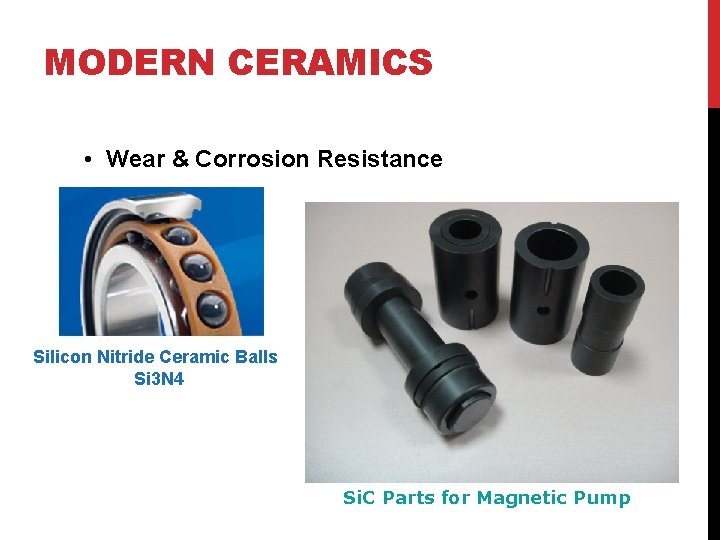
MODERN CERAMICS • Wear & Corrosion Resistance Silicon Nitride Ceramic Balls Si 3 N 4 Si. C Parts for Magnetic Pump
MODERN CERAMICS • Cutting & Grinding WC-Co Cuitting tools Silicon Carbide Grinding Wheel
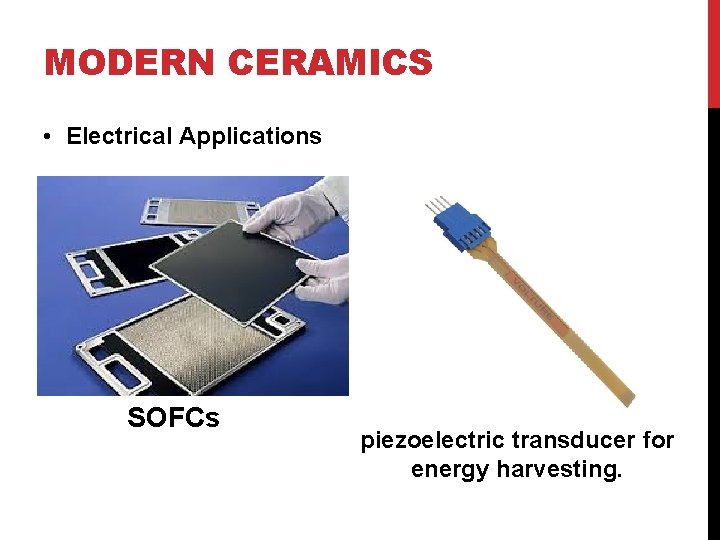
MODERN CERAMICS • Electrical Applications SOFCs piezoelectric transducer for energy harvesting.
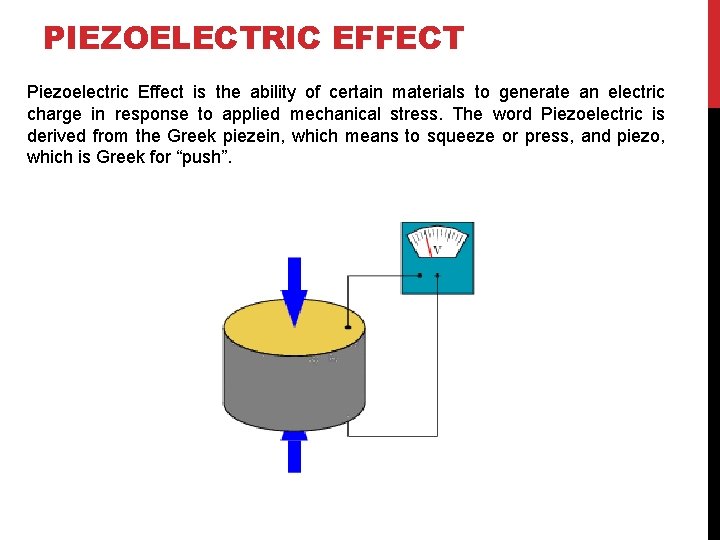
PIEZOELECTRIC EFFECT Piezoelectric Effect is the ability of certain materials to generate an electric charge in response to applied mechanical stress. The word Piezoelectric is derived from the Greek piezein, which means to squeeze or press, and piezo, which is Greek for “push”.
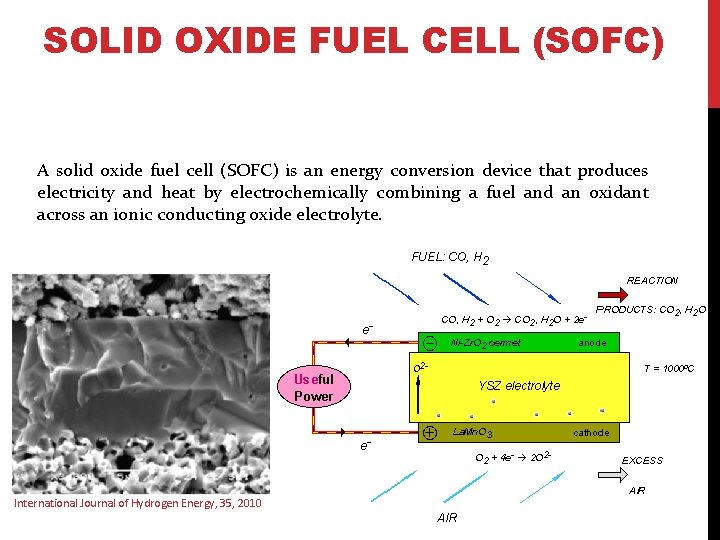
SOLID OXIDE FUEL CELL (SOFC) A solid oxide fuel cell (SOFC) is an energy conversion device that produces electricity and heat by electrochemically combining a fuel and an oxidant across an ionic conducting oxide electrolyte. International Journal of Hydrogen Energy, 35, 2010
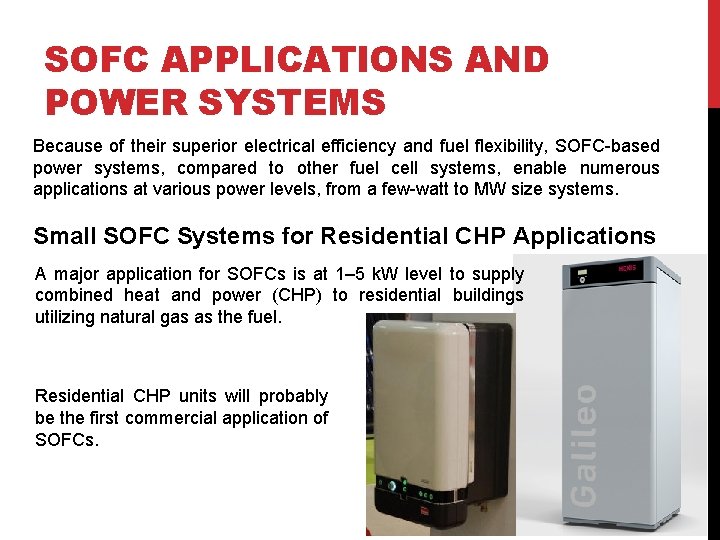
SOFC APPLICATIONS AND POWER SYSTEMS Because of their superior electrical efficiency and fuel flexibility, SOFC-based power systems, compared to other fuel cell systems, enable numerous applications at various power levels, from a few-watt to MW size systems. Small SOFC Systems for Residential CHP Applications A major application for SOFCs is at 1– 5 k. W level to supply combined heat and power (CHP) to residential buildings utilizing natural gas as the fuel. Residential CHP units will probably be the first commercial application of SOFCs.
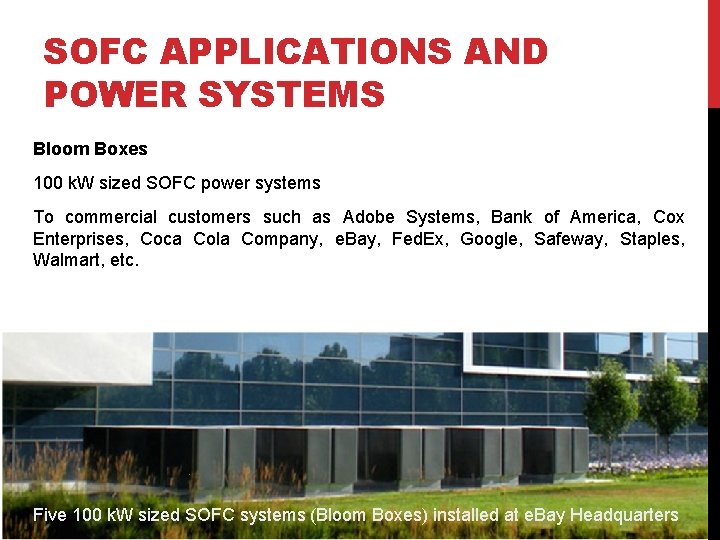
SOFC APPLICATIONS AND POWER SYSTEMS Bloom Boxes 100 k. W sized SOFC power systems To commercial customers such as Adobe Systems, Bank of America, Cox Enterprises, Coca Cola Company, e. Bay, Fed. Ex, Google, Safeway, Staples, Walmart, etc. Five 100 k. W sized SOFC systems (Bloom Boxes) installed at e. Bay Headquarters
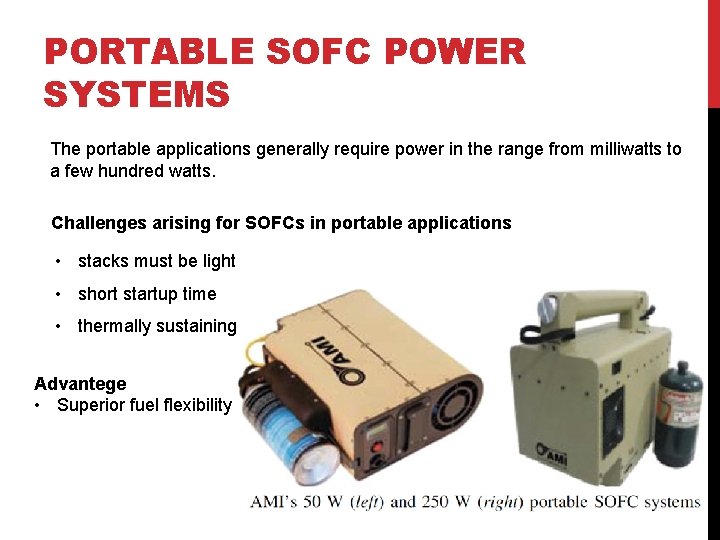
PORTABLE SOFC POWER SYSTEMS The portable applications generally require power in the range from milliwatts to a few hundred watts. Challenges arising for SOFCs in portable applications • stacks must be light • short startup time • thermally sustaining Advantege • Superior fuel flexibility
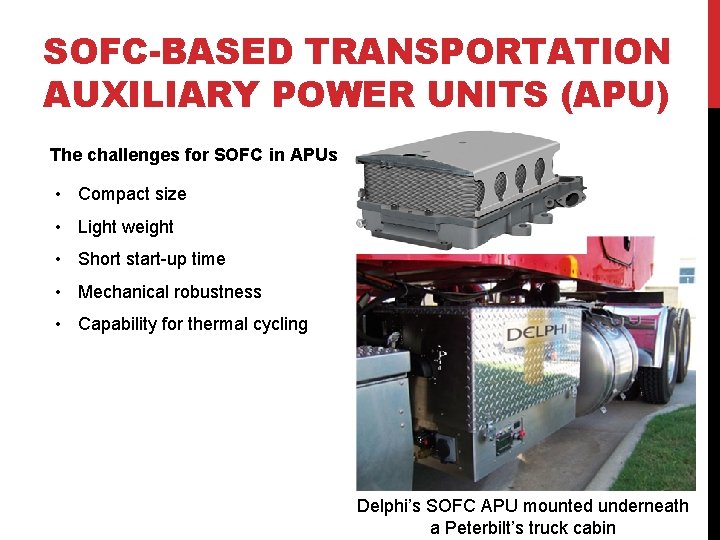
SOFC-BASED TRANSPORTATION AUXILIARY POWER UNITS (APU) The challenges for SOFC in APUs • Compact size • Light weight • Short start-up time • Mechanical robustness • Capability for thermal cycling Delphi’s SOFC APU mounted underneath a Peterbilt’s truck cabin
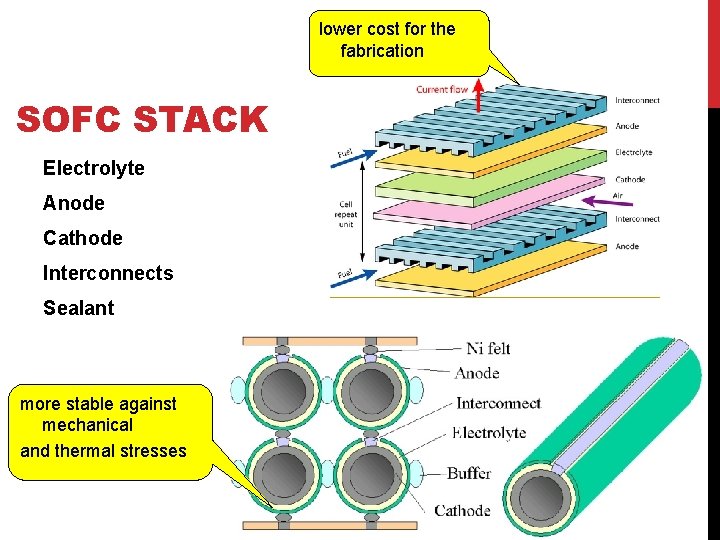
lower cost for the fabrication SOFC STACK Electrolyte Anode Cathode Interconnects Sealant more stable against mechanical and thermal stresses
SOFCS ADVANTEGE High-energy conversion efficiency Less pollution Low noise or acoustical pollution Effective reduction of greenhouse gas (CO 2) Process simplicity Generating excessive heat
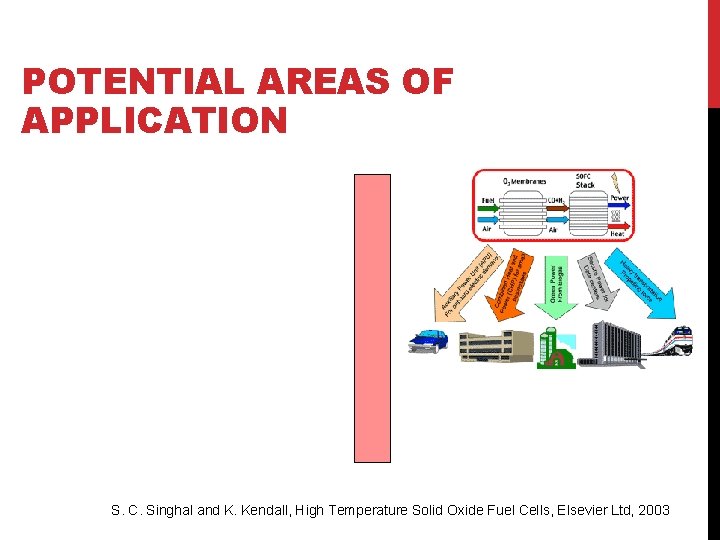
POTENTIAL AREAS OF APPLICATION S. C. Singhal and K. Kendall, High Temperature Solid Oxide Fuel Cells, Elsevier Ltd, 2003
DISADVANTAGE The costs of fuel cells are still considerably higher than conventional power plants per k. W. High working temperature o Long start-up time o Material costs o high cost of the balance-of-plant (BOP) parts Research objective: Decreasing the operation temperature
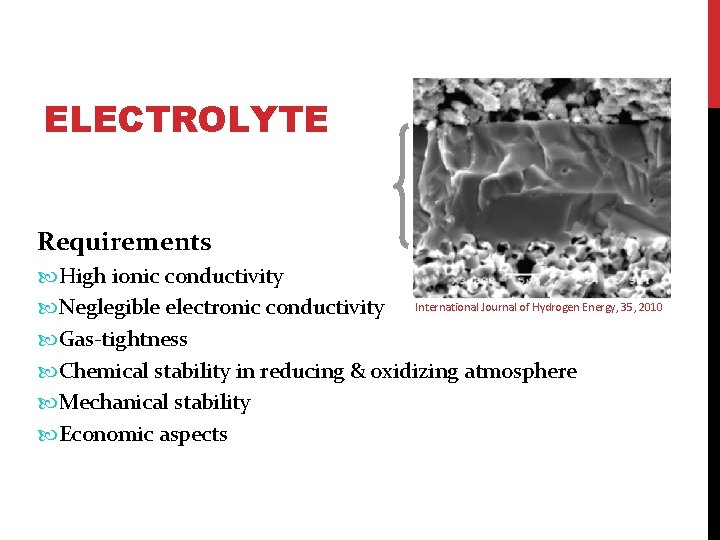
ELECTROLYTE Requirements High ionic conductivity Neglegible electronic conductivity International Journal of Hydrogen Energy, 35, 2010 Gas-tightness Chemical stability in reducing & oxidizing atmosphere Mechanical stability Economic aspects
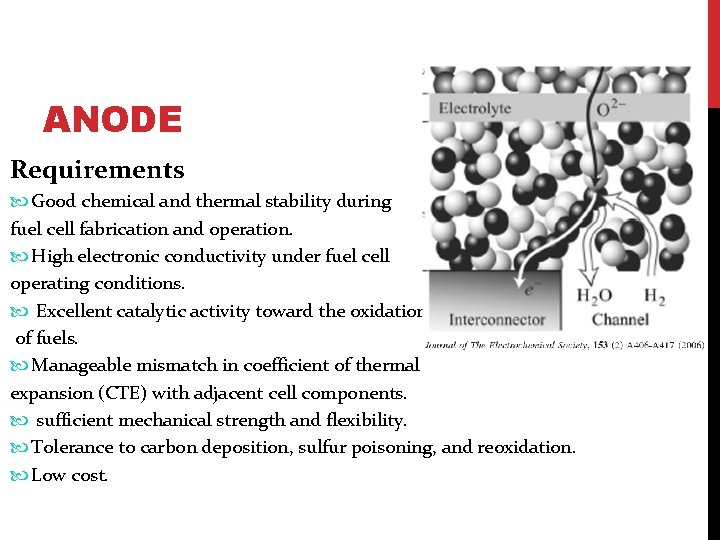
ANODE Requirements Good chemical and thermal stability during fuel cell fabrication and operation. High electronic conductivity under fuel cell operating conditions. Excellent catalytic activity toward the oxidation of fuels. Manageable mismatch in coefficient of thermal expansion (CTE) with adjacent cell components. sufficient mechanical strength and flexibility. Tolerance to carbon deposition, sulfur poisoning, and reoxidation. Low cost.
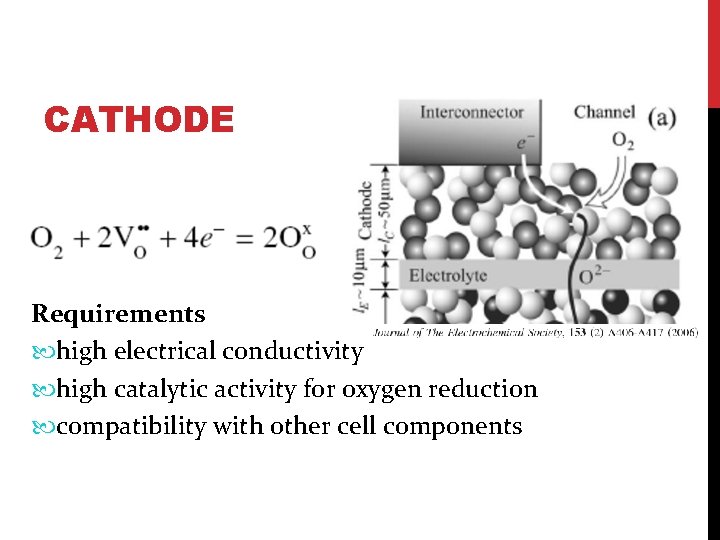
CATHODE Requirements high electrical conductivity high catalytic activity for oxygen reduction compatibility with other cell components
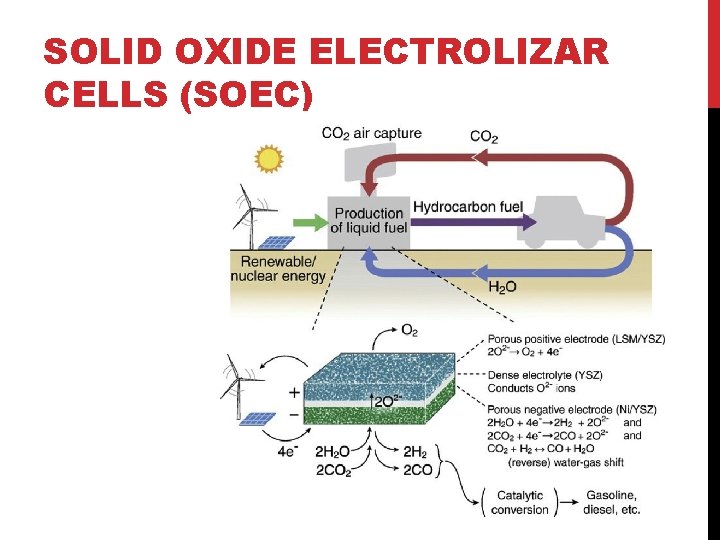
SOLID OXIDE ELECTROLIZAR CELLS (SOEC)