
Engineering Lesson Plan Toolkit A Quick Start Guide


- Slides: 27
Engineering Lesson Plan Toolkit: A Quick Start Guide for IEEE Volunteers & Members
Introduction • The Lesson Plan Tool Kit is intended as a "self-contained, how-to kit” to enable IEEE operating units to conduct teacher and/or student workshops: • Teacher workshops are designed to introduce lesson plans to teachers so they can bring engineering into their classrooms. Our approach is to model how to implement the lesson plan by conducting the design challenge with teachers and providing opportunities for the teachers to reflect and debrief on how they can modify the lesson to meet their students’ needs. • Student workshops* are designed to engage students in engineering design challenges to introduce them to engineering. Ideally the workshop would include a teacher and be held in partnership with a school(s) or other community organization(s). *IEEE recommends all unit volunteers familiarize themselves with guidelines and procedures for working with children.
Lesson Plan Toolkit Library • Currently, there are five lesson plans in the toolkit library* • • • Build Your Own Robot Arm Tall Tower Challenge Toxic Popcorn Working with Wind Energy Electric Dough • Each lesson plan resource contains the following: • Full Lesson Plan • Slide Deck • Overview Video *Additional lesson plans will be added as the toolkit expands
Assessing Local Needs and Resources
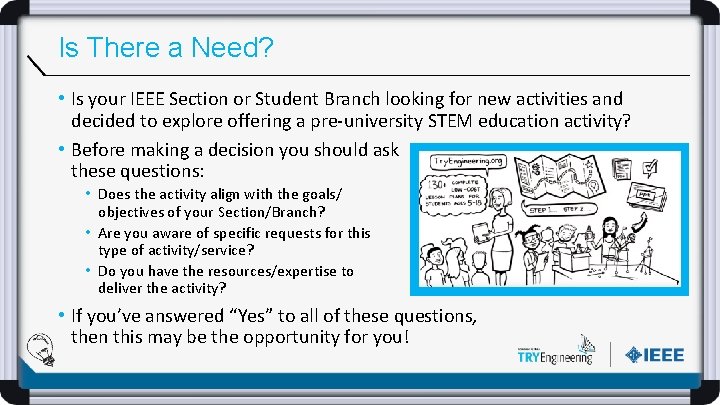
Is There a Need? • Is your IEEE Section or Student Branch looking for new activities and decided to explore offering a pre-university STEM education activity? • Before making a decision you should ask these questions: • Does the activity align with the goals/ objectives of your Section/Branch? • Are you aware of specific requests for this type of activity/service? • Do you have the resources/expertise to deliver the activity? • If you’ve answered “Yes” to all of these questions, then this may be the opportunity for you!
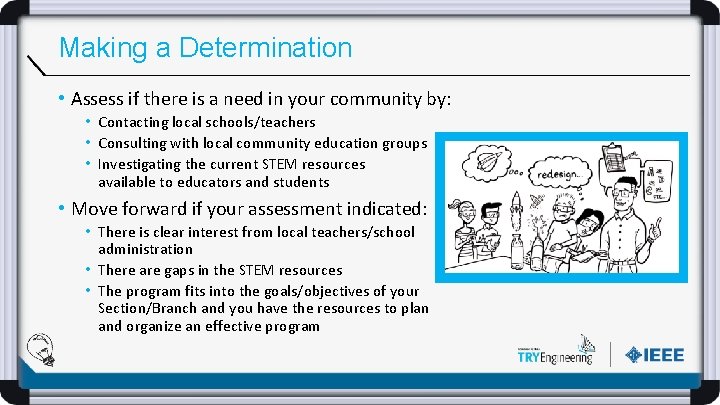
Making a Determination • Assess if there is a need in your community by: • Contacting local schools/teachers • Consulting with local community education groups • Investigating the current STEM resources available to educators and students • Move forward if your assessment indicated: • There is clear interest from local teachers/school administration • There are gaps in the STEM resources • The program fits into the goals/objectives of your Section/Branch and you have the resources to plan and organize an effective program
Lesson Plan Overview
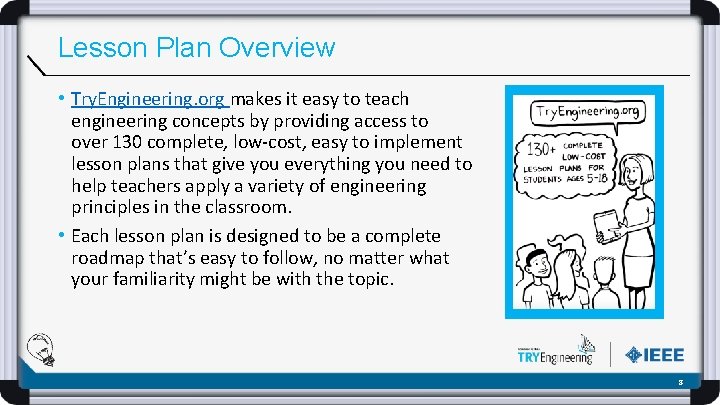
Lesson Plan Overview • Try. Engineering. org makes it easy to teach engineering concepts by providing access to over 130 complete, low-cost, easy to implement lesson plans that give you everything you need to help teachers apply a variety of engineering principles in the classroom. • Each lesson plan is designed to be a complete roadmap that’s easy to follow, no matter what your familiarity might be with the topic. 8
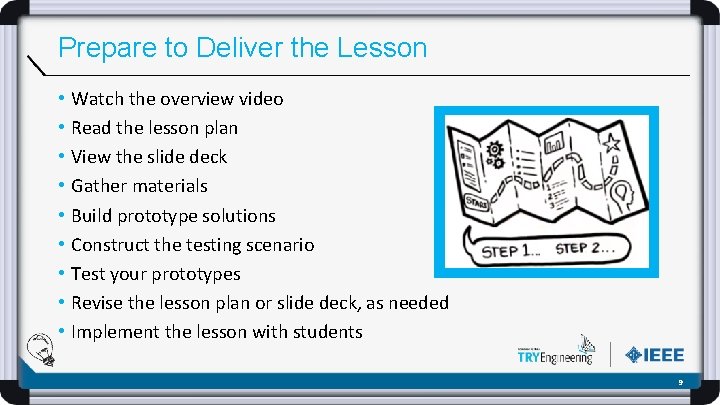
Prepare to Deliver the Lesson • • • Watch the overview video Read the lesson plan View the slide deck Gather materials Build prototype solutions Construct the testing scenario Test your prototypes Revise the lesson plan or slide deck, as needed Implement the lesson with students 9
Critical Elements
Critical Elements for Engineering Education • Teachers must be explicit about the link between the engineering design challenges they do with students and engineering careers. Each of the slide decks include these key elements to help make those critical connections: • • What is Engineering? Engineering Design Process (EDP) Productive Failure Engineering Notebook Engineering Habits of Mind (EHM) Engineering Design Challenge Engineering Applications, Dig Deeper, and Materials Engineering Fields • See these elements in the following slides 11
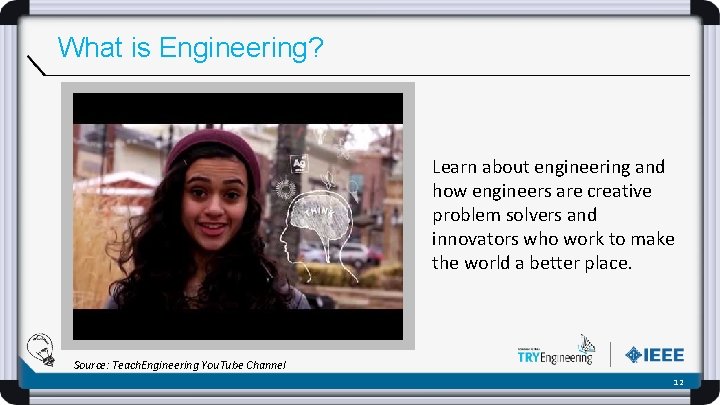
What is Engineering? Learn about engineering and how engineers are creative problem solvers and innovators who work to make the world a better place. Source: Teach. Engineering You. Tube Channel 12
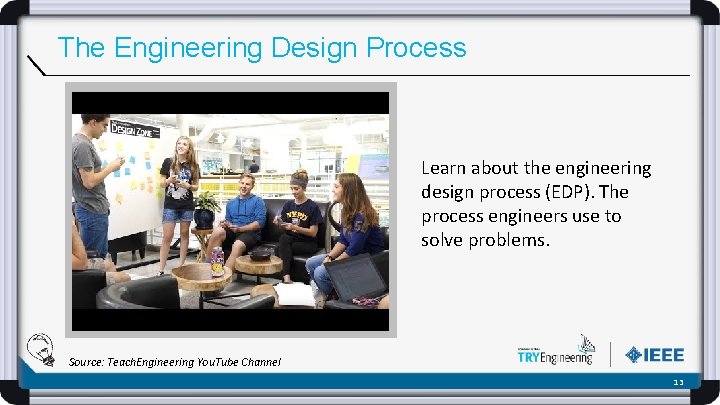
The Engineering Design Process Learn about the engineering design process (EDP). The process engineers use to solve problems. Source: Teach. Engineering You. Tube Channel 13
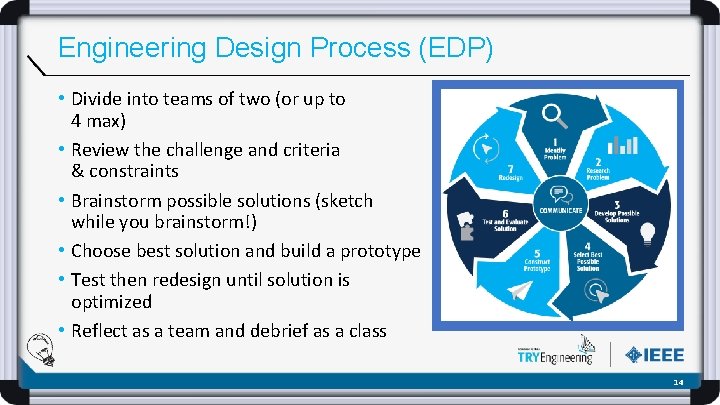
Engineering Design Process (EDP) • Divide into teams of two (or up to 4 max) • Review the challenge and criteria & constraints • Brainstorm possible solutions (sketch while you brainstorm!) • Choose best solution and build a prototype • Test then redesign until solution is optimized • Reflect as a team and debrief as a class 14
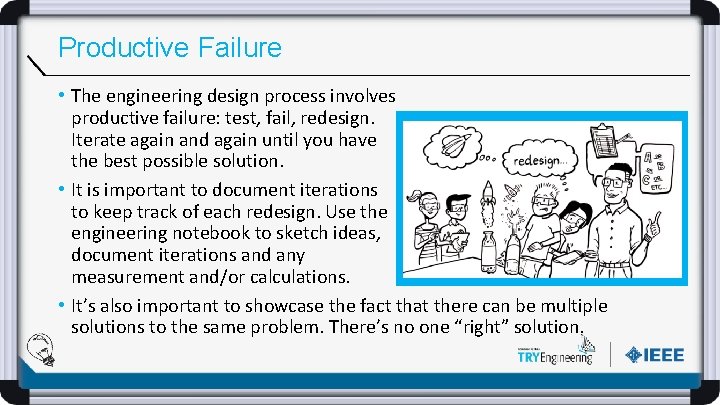
Productive Failure • The engineering design process involves productive failure: test, fail, redesign. Iterate again and again until you have the best possible solution. • It is important to document iterations to keep track of each redesign. Use the engineering notebook to sketch ideas, document iterations and any measurement and/or calculations. • It’s also important to showcase the fact that there can be multiple solutions to the same problem. There’s no one “right” solution.
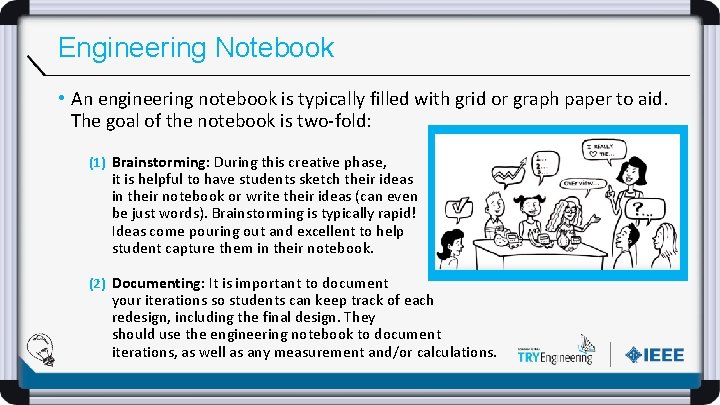
Engineering Notebook • An engineering notebook is typically filled with grid or graph paper to aid. The goal of the notebook is two-fold: (1) Brainstorming: During this creative phase, it is helpful to have students sketch their ideas in their notebook or write their ideas (can even be just words). Brainstorming is typically rapid! Ideas come pouring out and excellent to help student capture them in their notebook. (2) Documenting: It is important to document your iterations so students can keep track of each redesign, including the final design. They should use the engineering notebook to document iterations, as well as any measurement and/or calculations.
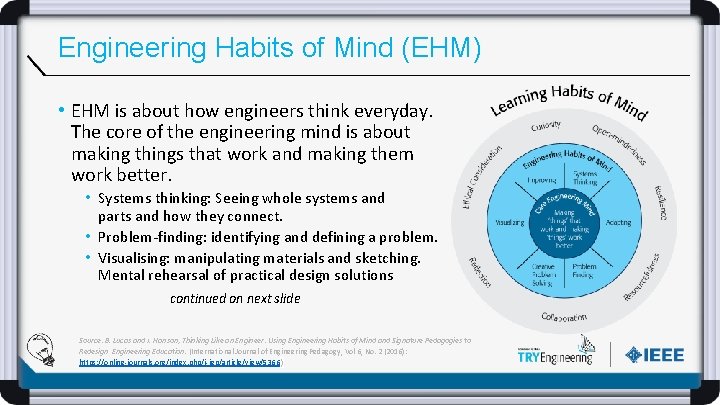
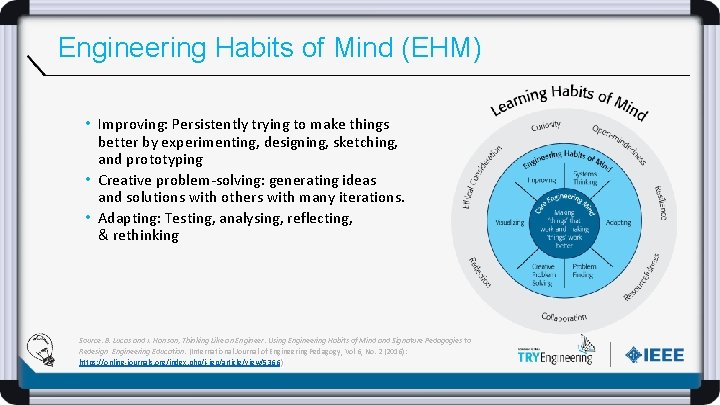
Engineering Habits of Mind (EHM) • EHM is about how engineers think everyday. The core of the engineering mind is about making things that work and making them work better. • Systems thinking: Seeing whole systems and parts and how they connect. • Problem-finding: identifying and defining a problem. • Visualising: manipulating materials and sketching. Mental rehearsal of practical design solutions continued on next slide Source: B. Lucas and J. Hanson, Thinking Like an Engineer: Using Engineering Habits of Mind and Signature Pedagogies to Redesign Engineering Education. (International Journal of Engineering Pedagogy, Vol 6, No. 2 (2016): https: //online-journals. org/index. php/i-jep/article/view/5366 )
Engineering Habits of Mind (EHM) • Improving: Persistently trying to make things better by experimenting, designing, sketching, and prototyping • Creative problem-solving: generating ideas and solutions with others with many iterations. • Adapting: Testing, analysing, reflecting, & rethinking Source: B. Lucas and J. Hanson, Thinking Like an Engineer: Using Engineering Habits of Mind and Signature Pedagogies to Redesign Engineering Education. (International Journal of Engineering Pedagogy, Vol 6, No. 2 (2016): https: //online-journals. org/index. php/i-jep/article/view/5366 )
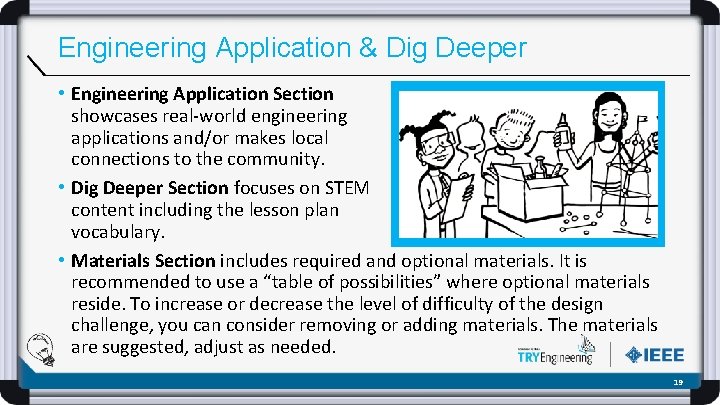
Engineering Application & Dig Deeper • Engineering Application Section showcases real-world engineering applications and/or makes local connections to the community. • Dig Deeper Section focuses on STEM content including the lesson plan vocabulary. • Materials Section includes required and optional materials. It is recommended to use a “table of possibilities” where optional materials reside. To increase or decrease the level of difficulty of the design challenge, you can consider removing or adding materials. The materials are suggested, adjust as needed. 19
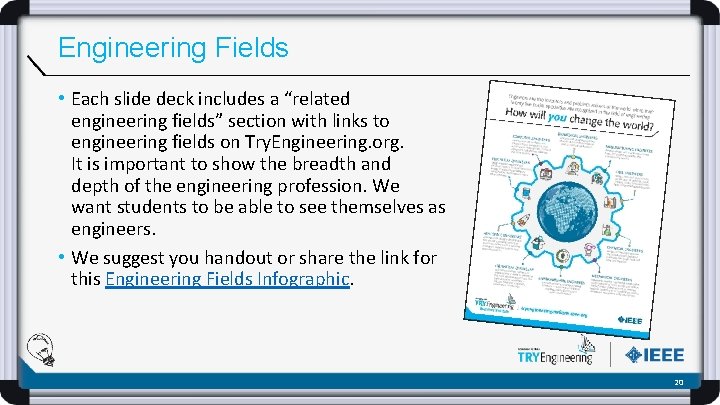
Engineering Fields • Each slide deck includes a “related engineering fields” section with links to engineering fields on Try. Engineering. org. It is important to show the breadth and depth of the engineering profession. We want students to be able to see themselves as engineers. • We suggest you handout or share the link for this Engineering Fields Infographic. 20
Organizing Workshops
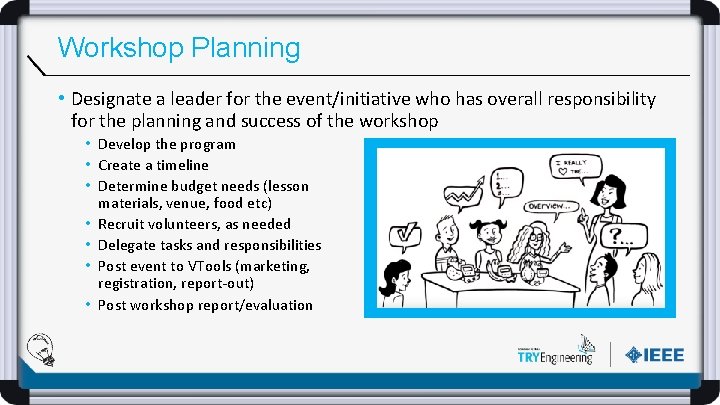
Workshop Planning • Designate a leader for the event/initiative who has overall responsibility for the planning and success of the workshop • Develop the program • Create a timeline • Determine budget needs (lesson materials, venue, food etc) • Recruit volunteers, as needed • Delegate tasks and responsibilities • Post event to VTools (marketing, registration, report-out) • Post workshop report/evaluation
Measuring Success • Develop 3 to 4 SMART Goals: • • • Specific – the goal needs to be clear and unambiguous Measurable – the goal must have measurable criteria Attainable – the goal must be able to be accomplished Relevant – the goal must be relevant to your mission and needs Timely – the goal must have a set time-frame for completion • Examples: • Hold three 1 -hour teacher training workshops during the year (event focused); Attract an average attendance of 10 -15 teachers per session (attendance focused); In the post activity survey, 75% of the teacher attendees indicate they found the session valuable (satisfaction focused)
Evaluation/Survey • Develop an evaluation/survey to distribute to the participants that specifically address your SMART goals • Google forms is a great tool for creating digital surveys • Consider giving a pre- and post- survey so you know if your engagement with the teacher or student had a minimal or significant impact • Consider asking knowledge and/or attitudinal questions. For example “Can you see yourself as an engineer? ” (student); “Do you feel confident teaching engineering into your classroom? ” (teacher)
Fundraising and Sponsorship • Compile a list of corporations around your area (include small and medium sized businesses). Ask for money and in-kind contributions (such as food, giveaways, etc. ) • Talk to everyone in your Section - ask for contacts in corporations & for an introduction • Check with your Section/Chapter about guidelines/restrictions for contacting corporations • Don’t forget about individuals. Student Chapters can reach out to alumni. • Use “Crowdfunding” sites like Go. Fund. Me • Develop a basic 'script' and the marketing materials • Thank your sponsors publicly and feature their names/logos in printed and online material *Donations to IEEE, whether cash or in-kind, may be tax-deductible for the donor.
Post Workshop • Send thank you notes to the speakers/ presenters and sponsors • Review the session evaluations • Assess what worked well and areas that need improvement • Write up a lessons learned to be used in planning future events • Start planning your next event
For more engineering lesson plans and resources like games, engineering careers, and STEM opportunities visit IEEE’s Try. Engineering. org