
Engineering Graphics Basic Drafting Facts and Tools Copyright
Engineering Graphics Basic Drafting Facts and Tools Copyright © Texas Education Agency, 2012. All rights reserved.
What is the difference between Sketching & Drafting? o Essentially the difference is that when you are sketching, you ONLY use a pencil and your hand. o The minute you use a tool like a triangle, you are drafting, because a tool helps you draw things more precisely. Copyright © Texas Education Agency, 2012. All rights reserved. 2
How many views does every object have? o They are six (6) views we could draw, but we only draw three (3). o Top, Front, & Right Side. n We will cover these more in depth later. Copyright © Texas Education Agency, 2012. All rights reserved. 3
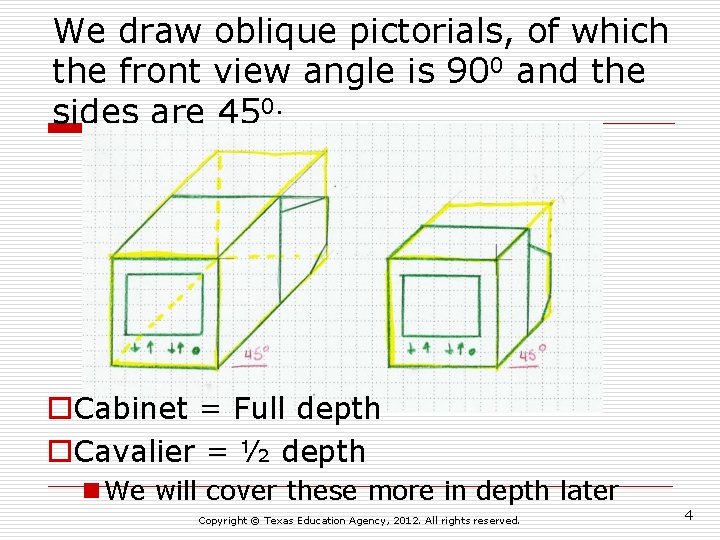
We draw oblique pictorials, of which the front view angle is 900 and the sides are 450. o. Cabinet = Full depth o. Cavalier = ½ depth n We will cover these more in depth later Copyright © Texas Education Agency, 2012. All rights reserved. 4
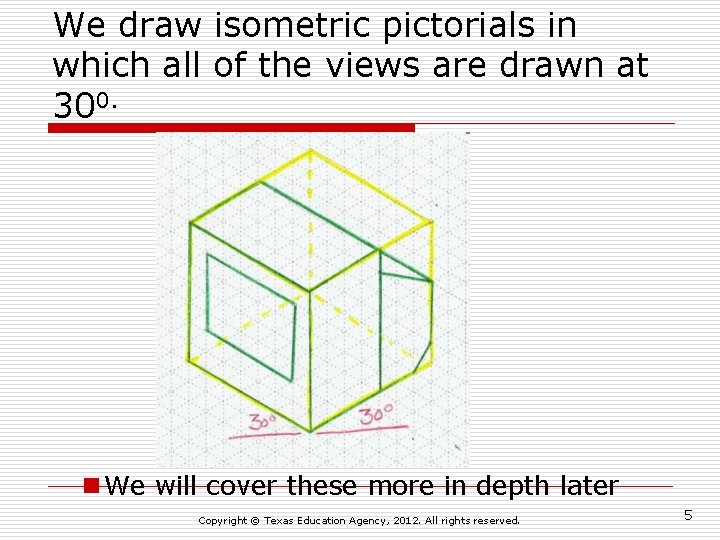
We draw isometric pictorials in which all of the views are drawn at 300. n We will cover these more in depth later Copyright © Texas Education Agency, 2012. All rights reserved. 5
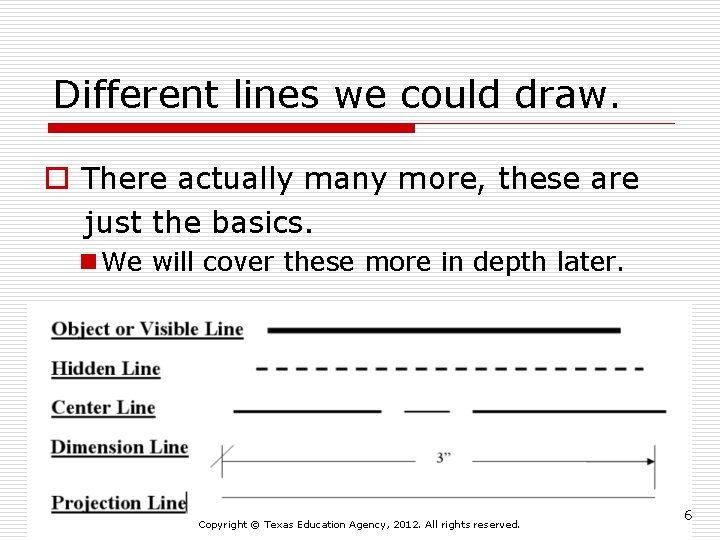
Different lines we could draw. o There actually many more, these are just the basics. n We will cover these more in depth later. Copyright © Texas Education Agency, 2012. All rights reserved. 6
Drafting Tools & The Uses Copyright © Texas Education Agency, 2012. All rights reserved. 7
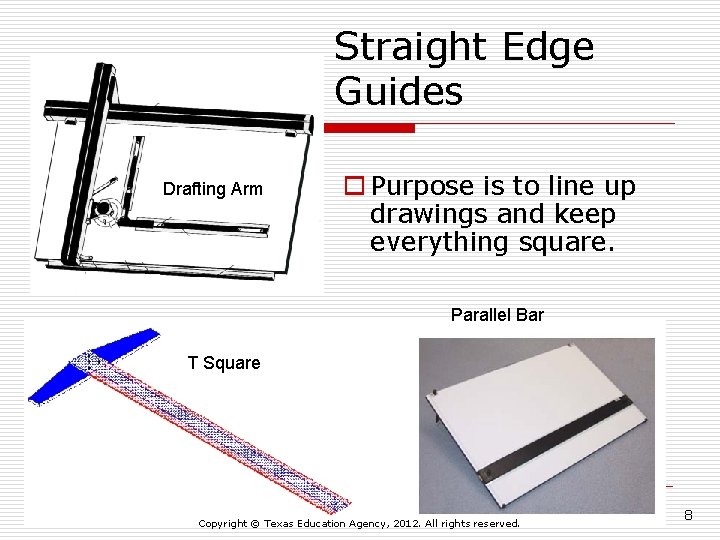
Straight Edge Guides Drafting Arm o Purpose is to line up drawings and keep everything square. Parallel Bar T Square Copyright © Texas Education Agency, 2012. All rights reserved. 8
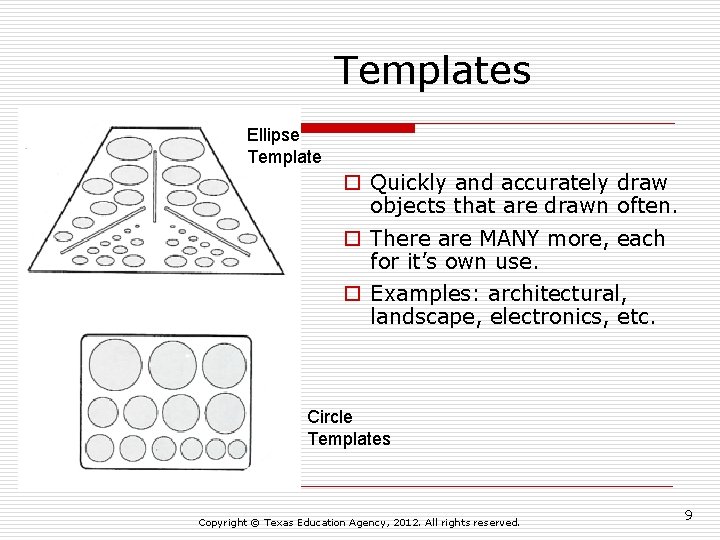
Templates Ellipse Template o Quickly and accurately draw objects that are drawn often. o There are MANY more, each for it’s own use. o Examples: architectural, landscape, electronics, etc. Circle Templates Copyright © Texas Education Agency, 2012. All rights reserved. 9
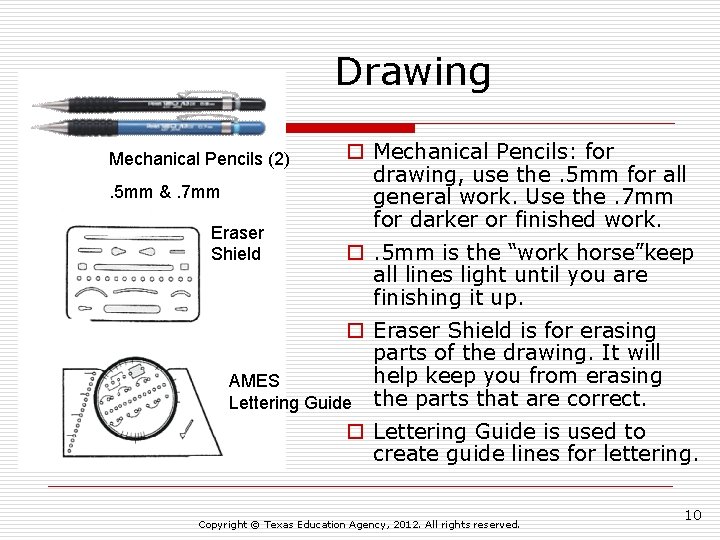
Drawing Mechanical Pencils (2). 5 mm &. 7 mm Eraser Shield o Mechanical Pencils: for drawing, use the. 5 mm for all general work. Use the. 7 mm for darker or finished work. o. 5 mm is the “work horse”keep all lines light until you are finishing it up. o Eraser Shield is for erasing parts of the drawing. It will help keep you from erasing AMES Lettering Guide the parts that are correct. o Lettering Guide is used to create guide lines for lettering. Copyright © Texas Education Agency, 2012. All rights reserved. 10
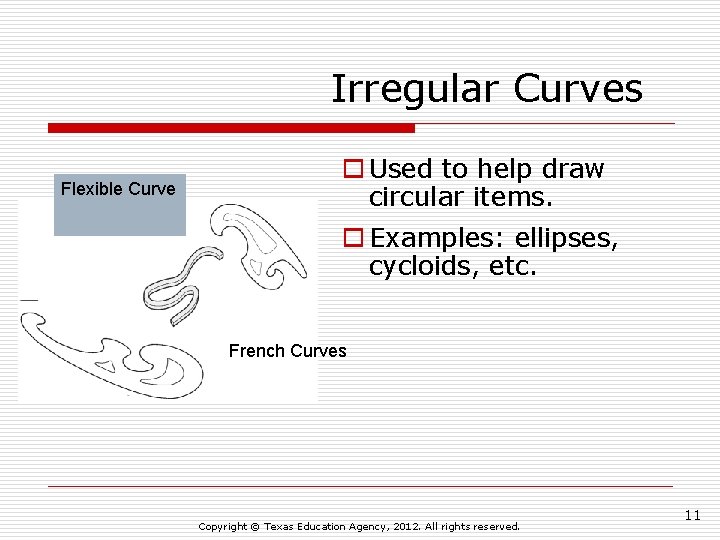
Irregular Curves Flexible Curve o Used to help draw circular items. o Examples: ellipses, cycloids, etc. French Curves Copyright © Texas Education Agency, 2012. All rights reserved. 11
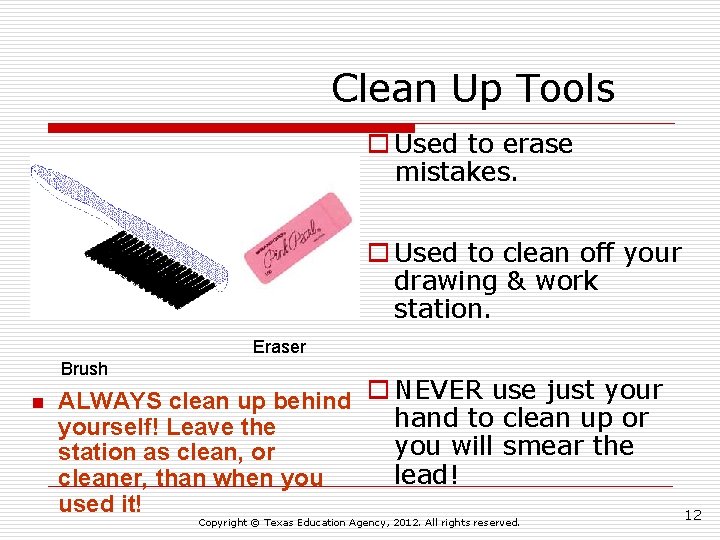
Clean Up Tools o Used to erase mistakes. o Used to clean off your drawing & work station. Eraser Brush n ALWAYS clean up behind o NEVER use just your hand to clean up or yourself! Leave the you will smear the station as clean, or lead! cleaner, than when you used it! Copyright © Texas Education Agency, 2012. All rights reserved. 12
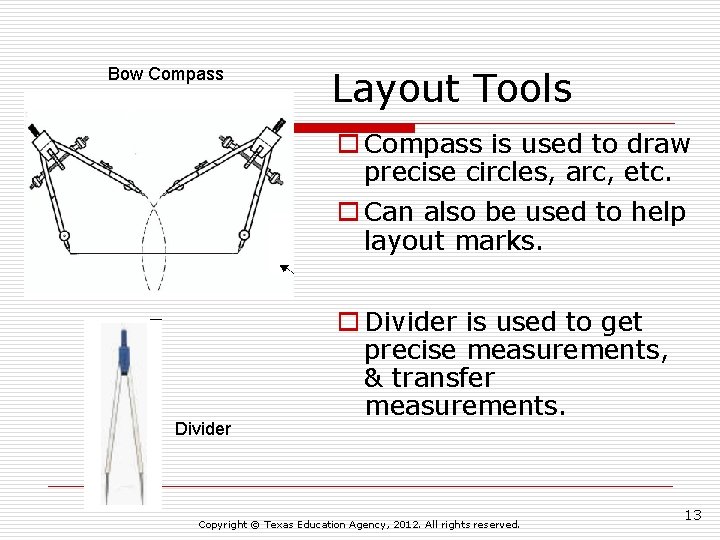
Bow Compass Layout Tools o Compass is used to draw precise circles, arc, etc. o Can also be used to help layout marks. Divider o Divider is used to get precise measurements, & transfer measurements. Copyright © Texas Education Agency, 2012. All rights reserved. 13
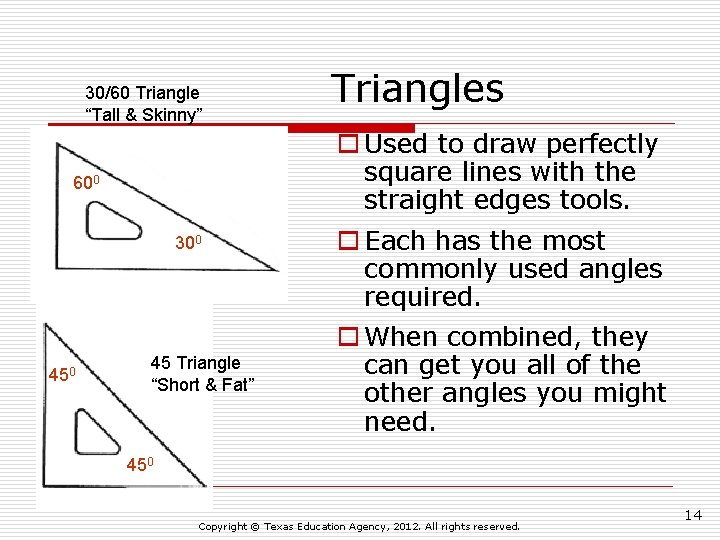
30/60 Triangle “Tall & Skinny” o Used to draw perfectly square lines with the straight edges tools. 600 300 450 Triangles 45 Triangle “Short & Fat” o Each has the most commonly used angles required. o When combined, they can get you all of the other angles you might need. 450 Copyright © Texas Education Agency, 2012. All rights reserved. 14
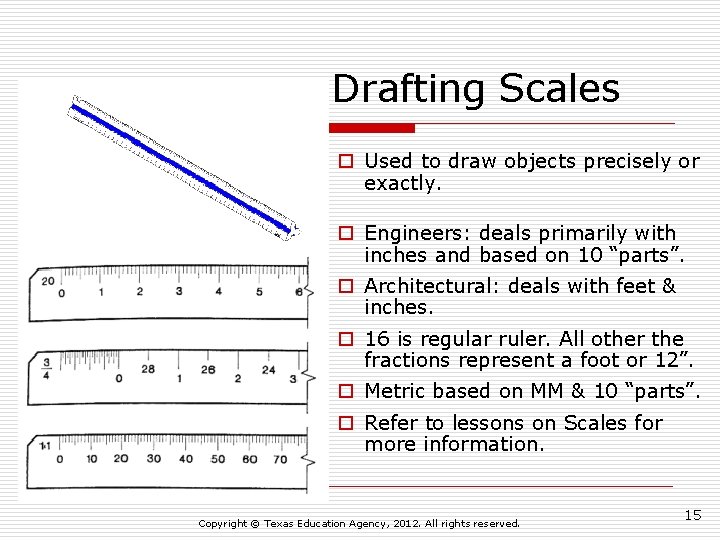
Drafting Scales o Used to draw objects precisely or exactly. o Engineers: deals primarily with inches and based on 10 “parts”. o Architectural: deals with feet & inches. o 16 is regular ruler. All other the fractions represent a foot or 12”. o Metric based on MM & 10 “parts”. o Refer to lessons on Scales for more information. Copyright © Texas Education Agency, 2012. All rights reserved. 15
Summary o You need to know your tools and how to correctly use them. o Yes, Auto CAD is the most used tool, but you must understand how the process works. Then, you’ll become a better drafter. o Also, very often you maybe called upon to draw something with no computer around, so you will be better prepared if you know these tools and how to use them. Copyright © Texas Education Agency, 2012. All rights reserved. 16
Remember to…. o Use this information to complete the “ABC” Review Sheet for this lecture. Copyright © Texas Education Agency, 2012. All rights reserved. 17
BONUS: Want to learn more about the history of drafting? o Essentially, drafting has been around since man first started drawings. o Write a 1 page synopsis about what you learn about the History of Drafting. o This website has an excellent explanation of the History of Drafting. http: //www. uen. org/utahlink/tours/tour. View. C ategory. cgi? category_id=21312&tour_id=1 4435 Copyright © Texas Education Agency, 2012. All rights reserved. 18
Textbook Texas approved publishers are: o Goodheart-Willcox o Delmar Learning o Prentice Hall n All have a companion workbook’s with more problems. I recommend using it, or any other approved textbook, i. e. , if you are ATC or Tech. Prep and must teach using local colleges textbook. Copyright © Texas Education Agency, 2012. All rights reserved. b 19
- Slides: 19