
Engineering Elegant Systems Principles of System Engineering 21

- Slides: 28
Engineering Elegant Systems: Principles of System Engineering 21 September 2016 Michael D. Watson, Ph. D. www. nasa. gov/sls Consortium Team UAH George Washington University Iowa State MIT Texas A&M University of Colorado at Colorado Springs (UCCS) University of Dayton Missouri University of S&T University of Michigan Shafer Corporation AFRL Wright Patterson Space Launch System National Aeronautics and Space Administration
Outline u Understanding Systems Engineering u Systems Engineering Domain • Primary ‒ System Design and Integration ‒ Discipline Integration • Supporting ‒ Processes u System Integration Methods: System Value u Summary 2
Motivation u System Engineering of Complex Systems is not well understood u System Engineering of Complex Systems is Challenging • System Engineering can produce elegant solutions in some instances • System Engineering can produce embarrassing failures in some instances • Within NASA, System Engineering does is frequently unable to maintain complex system designs within budget, schedule, and performance constraints u “How do we Fix System Engineering? ” • Michael D. Griffin, 61 st International Astronautical Congress, Prague, Czech Republic, September 27 -October 1, 2010 • Successful practice in System Engineering is frequently based on the ability of the lead system engineer, rather than on the approach of system engineering in general • The rules and properties that govern complex systems are not well defined in order to define system elegance u 4 characteristics of system elegance proposed as: • System Effectiveness • System Efficiency • System Robustness • Minimizing Unintended Consequences 3
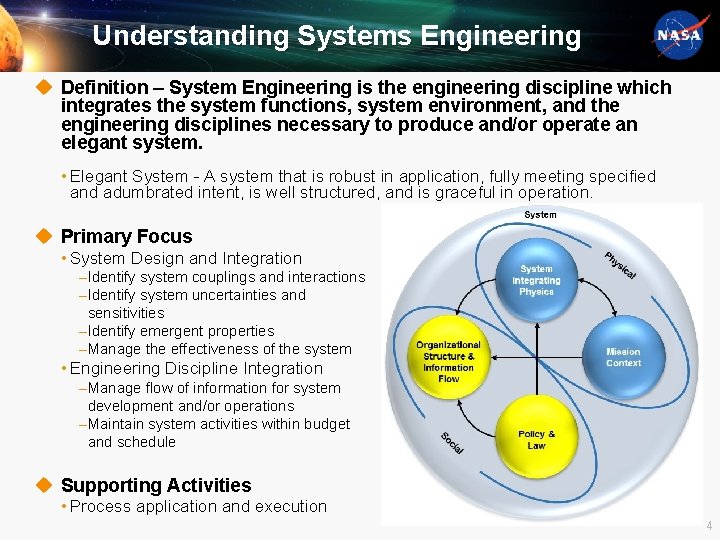
Understanding Systems Engineering u Definition – System Engineering is the engineering discipline which integrates the system functions, system environment, and the engineering disciplines necessary to produce and/or operate an elegant system. • Elegant System - A system that is robust in application, fully meeting specified and adumbrated intent, is well structured, and is graceful in operation. u Primary Focus • System Design and Integration ‒ Identify system couplings and interactions ‒ Identify system uncertainties and sensitivities ‒ Identify emergent properties ‒ Manage the effectiveness of the system • Engineering Discipline Integration ‒ Manage flow of information for system development and/or operations ‒ Maintain system activities within budget and schedule u Supporting Activities • Process application and execution 4
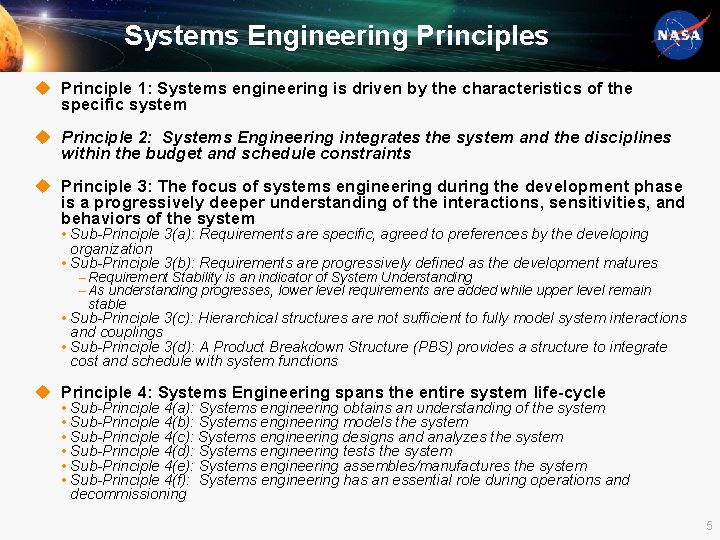
Systems Engineering Principles u Principle 1: Systems engineering is driven by the characteristics of the specific system u Principle 2: Systems Engineering integrates the system and the disciplines within the budget and schedule constraints u Principle 3: The focus of systems engineering during the development phase is a progressively deeper understanding of the interactions, sensitivities, and behaviors of the system • Sub-Principle 3(a): Requirements are specific, agreed to preferences by the developing organization • Sub-Principle 3(b): Requirements are progressively defined as the development matures ‒ Requirement Stability is an indicator of System Understanding ‒ As understanding progresses, lower level requirements are added while upper level remain stable • Sub-Principle 3(c): Hierarchical structures are not sufficient to fully model system interactions and couplings • Sub-Principle 3(d): A Product Breakdown Structure (PBS) provides a structure to integrate cost and schedule with system functions u Principle 4: Systems Engineering spans the entire system life-cycle • Sub-Principle 4(a): Systems engineering obtains an understanding of the system • Sub-Principle 4(b): Systems engineering models the system • Sub-Principle 4(c): Systems engineering designs and analyzes the system • Sub-Principle 4(d): Systems engineering tests the system • Sub-Principle 4(e): Systems engineering assembles/manufactures the system • Sub-Principle 4(f): Systems engineering has an essential role during operations and decommissioning 5
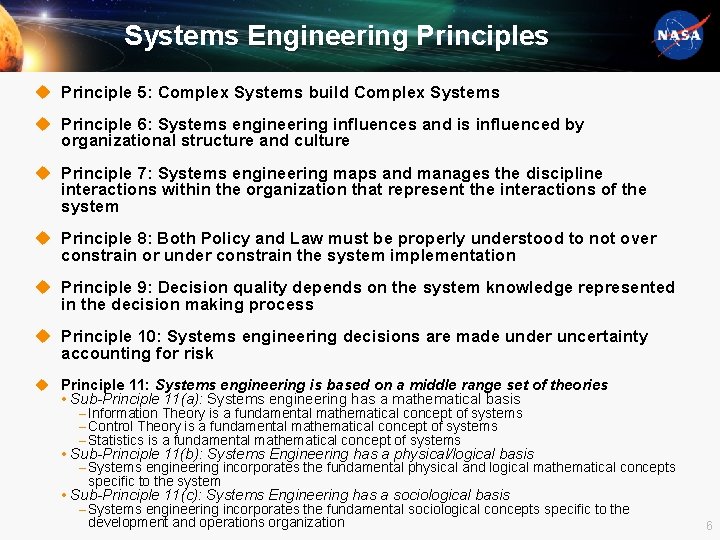
Systems Engineering Principles u Principle 5: Complex Systems build Complex Systems u Principle 6: Systems engineering influences and is influenced by organizational structure and culture u Principle 7: Systems engineering maps and manages the discipline interactions within the organization that represent the interactions of the system u Principle 8: Both Policy and Law must be properly understood to not over constrain or under constrain the system implementation u Principle 9: Decision quality depends on the system knowledge represented in the decision making process u Principle 10: Systems engineering decisions are made under uncertainty accounting for risk u Principle 11: Systems engineering is based on a middle range set of theories • Sub-Principle 11(a): Systems engineering has a mathematical basis ‒ Information Theory is a fundamental mathematical concept of systems ‒ Control Theory is a fundamental mathematical concept of systems ‒ Statistics is a fundamental mathematical concept of systems • Sub-Principle 11(b): Systems Engineering has a physical/logical basis ‒ Systems engineering incorporates the fundamental physical and logical mathematical concepts specific to the system • Sub-Principle 11(c): Systems Engineering has a sociological basis ‒ Systems engineering incorporates the fundamental sociological concepts specific to the development and operations organization 6
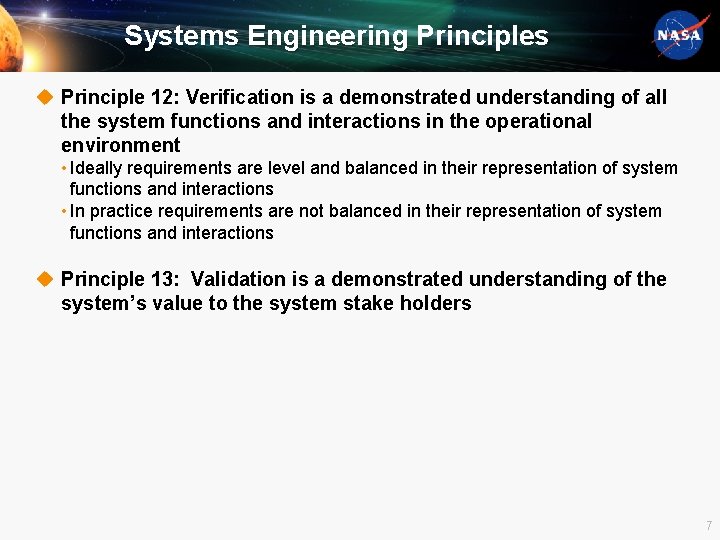
Systems Engineering Principles u Principle 12: Verification is a demonstrated understanding of all the system functions and interactions in the operational environment • Ideally requirements are level and balanced in their representation of system functions and interactions • In practice requirements are not balanced in their representation of system functions and interactions u Principle 13: Validation is a demonstrated understanding of the system’s value to the system stake holders 7
Methods of System Integration Goal: Techniques to Enable Integrated System Design and Assessments by the Systems Engineer
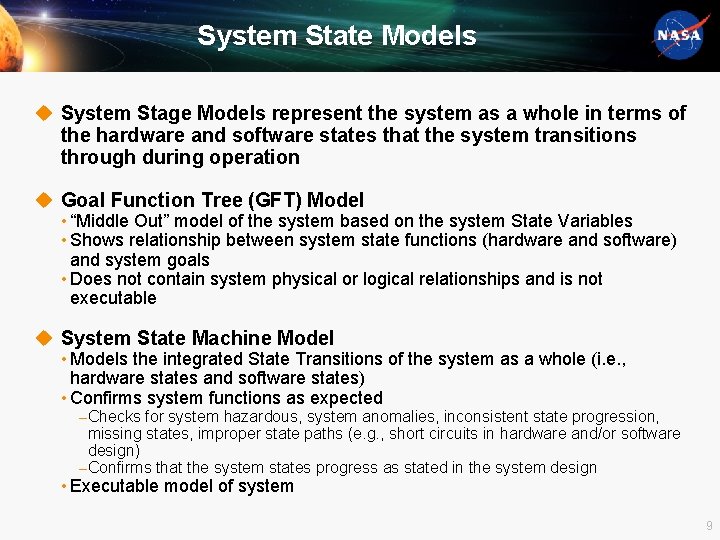
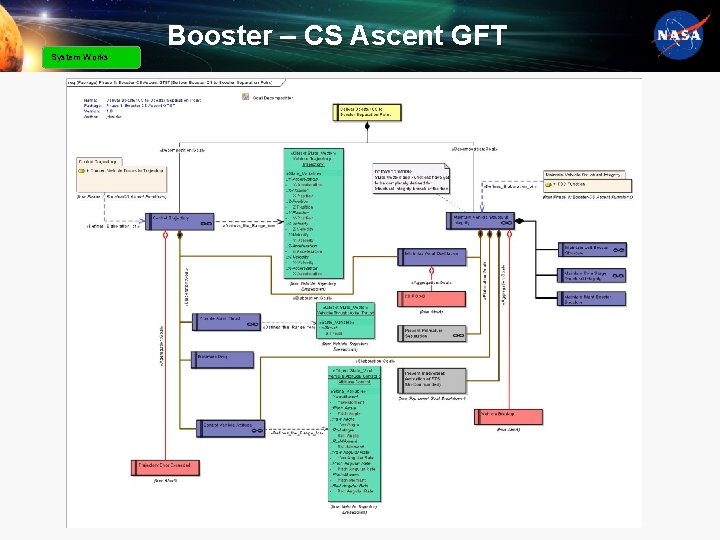
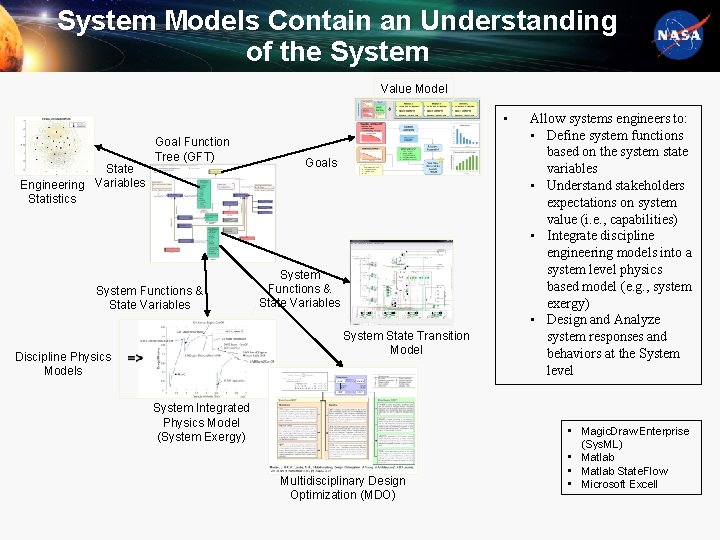
System State Models u System Stage Models represent the system as a whole in terms of the hardware and software states that the system transitions through during operation u Goal Function Tree (GFT) Model • “Middle Out” model of the system based on the system State Variables • Shows relationship between system state functions (hardware and software) and system goals • Does not contain system physical or logical relationships and is not executable u System State Machine Model • Models the integrated State Transitions of the system as a whole (i. e. , hardware states and software states) • Confirms system functions as expected ‒ Checks for system hazardous, system anomalies, inconsistent state progression, missing states, improper state paths (e. g. , short circuits in hardware and/or software design) ‒ Confirms that the system states progress as stated in the system design • Executable model of system 9
System Works Booster – CS Ascent GFT
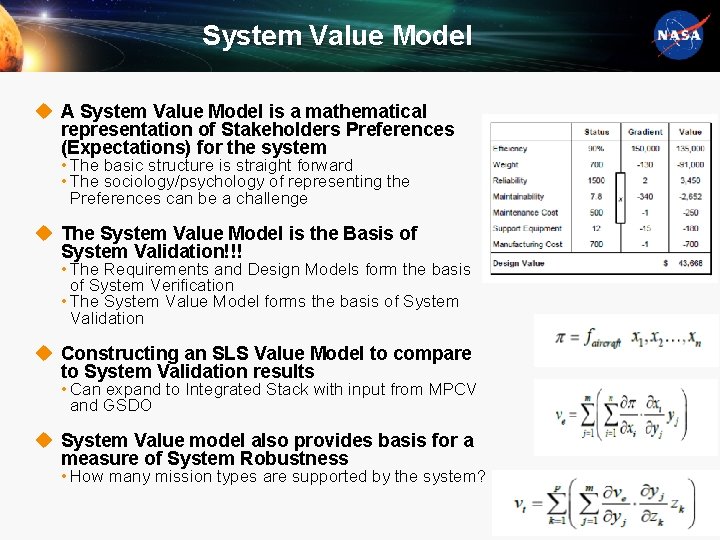
System Value Model u A System Value Model is a mathematical representation of Stakeholders Preferences (Expectations) for the system • The basic structure is straight forward • The sociology/psychology of representing the Preferences can be a challenge u The System Value Model is the Basis of System Validation!!! • The Requirements and Design Models form the basis of System Verification • The System Value Model forms the basis of System Validation u Constructing an SLS Value Model to compare to System Validation results • Can expand to Integrated Stack with input from MPCV and GSDO u System Value model also provides basis for a measure of System Robustness • How many mission types are supported by the system? 11
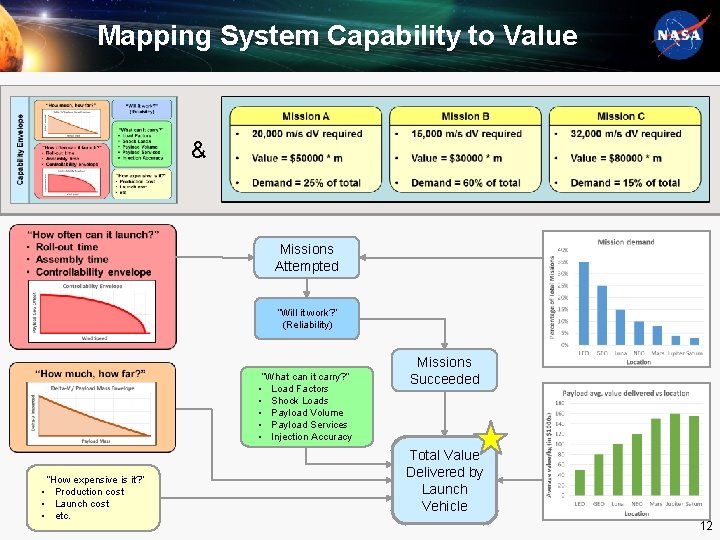
Mapping System Capability to Value & Missions Attempted “Will it work? ” (Reliability) “What can it carry? ” • Load Factors • Shock Loads • Payload Volume • Payload Services • Injection Accuracy “How expensive is it? ” • Production cost • Launch cost • etc. Missions Succeeded Total Value Delivered by Launch Vehicle 12
Methods of System Integration Goal: System Design and Analysis
System Models Contain an Understanding of the System Value Model • State Variables Engineering Statistics Goal Function Tree (GFT) System Functions & State Variables Goals System Functions & State Variables System State Transition Model Discipline Physics Models System Integrated Physics Model (System Exergy) Multidisciplinary Design Optimization (MDO) Allow systems engineers to: • Define system functions based on the system state variables • Understand stakeholders expectations on system value (i. e. , capabilities) • Integrate discipline engineering models into a system level physics based model (e. g. , system exergy) • Design and Analyze system responses and behaviors at the System level • Magic. Draw Enterprise (Sys. ML) • Matlab State. Flow • Microsoft Excell
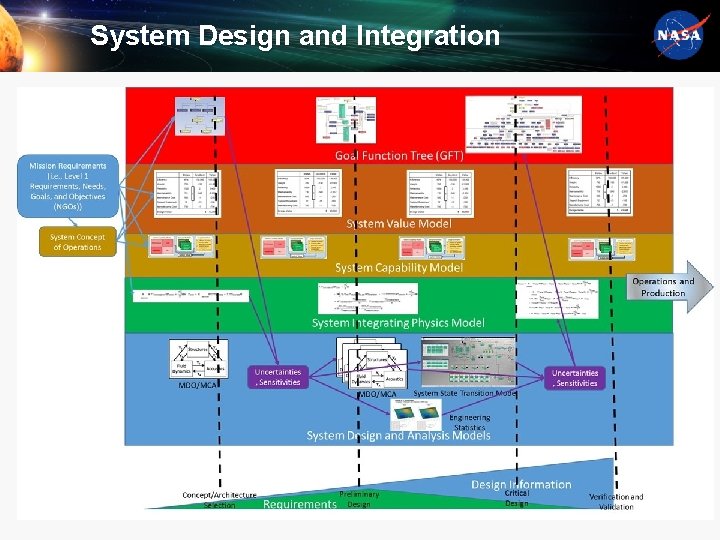
System Design and Integration
Summary u Discussed approach to Engineering an Elegant System u Discussed Systems Engineering Framework and Principles • System Integration • Engineering Discipline Integration u There are several methods and tools for conducting integrated system design and analysis • System Integration ‒ System Integrating Physics ‒ System Design and Optimization ‒ Engineering Statistics ‒ State Variable Analysis ‒ System Value • Discipline Integration ‒ Sociological Principles and Cognitive Science ‒ Decision Making ‒ Policy and Law Application • Processes Application u Systems Engineering Approach defined in two documents • “Engineering Elegant Systems: Theory of Systems Engineering” • “Engineering Elegant Systems: The Practice of Systems Engineering” 16
Back Up 17
Consortium u Research Process • Multi-disciplinary research group that spans systems engineering areas • Selected researchers who are product rather than process focused u List of Consortium Members • Schafer Corporation: Michael D. Griffin, Ph. D. • Air Force Research Laboratory – Wright Patterson, Multidisciplinary Science and Technology Center: Jose A. Camberos, Ph. D. , Kirk L. Yerkes, Ph. D. • George Washington University: Zoe Szajnfarber, Ph. D. • Iowa State University: Christina L. Bloebaum, Ph. D. , Michael C. Dorneich, Ph. D. • Massachusetts Institute of Technology: Maria C. Yang, Ph. D. • Missouri University of Science & Technology: David Riggins, Ph. D. • NASA Langley Research Center: Anna R. Mc. Gowan, Ph. D. , Peter A. Parker, Ph. D. • Texas A&M University: Richard Malak, Ph. D. • Tri-Vector Corporation: Joey Shelton, Ph. D. , Robert S. Ryan • The University of Alabama in Huntsville: Phillip A. Farrington, Ph. D. , Dawn R. Utley, Ph. D. , Laird Burns, Ph. D. , Paul Collopy, Ph. D. , Bryan Mesmer, Ph. D. , P. J. Benfield, Ph. D. , Wes Colley, Ph. D. • The University of Colorado – Colorado Springs: Stephen B. Johnson, Ph. D. • The University of Dayton: John Doty, Ph. D. • The University of Michigan: Panos Y. Papalambros, Ph. D. • The University of Texas, Arlington: Paul Componation, Ph. D. u Previous Consortium Members • Stevens Institute of Technology – Dinesh Verma • Spaceworks – John Olds (Cost Modeling Statistics) • Alabama A&M – Emeka Dunu (Supply Chain Management) • George Mason – John Gero (Agent Based Modeling) • Oregon State – Irem Tumer (Electrical Power Grid Robustness) • Arkansas – David Jensen (Failure Categorization) 30 graduate students and 5 undergraduate students supported to date 18
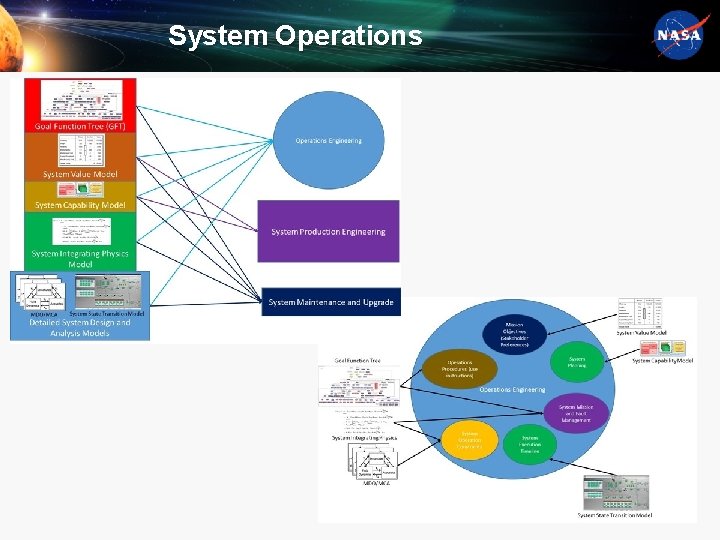
System Operations
System Engineering Standards in Practice 20
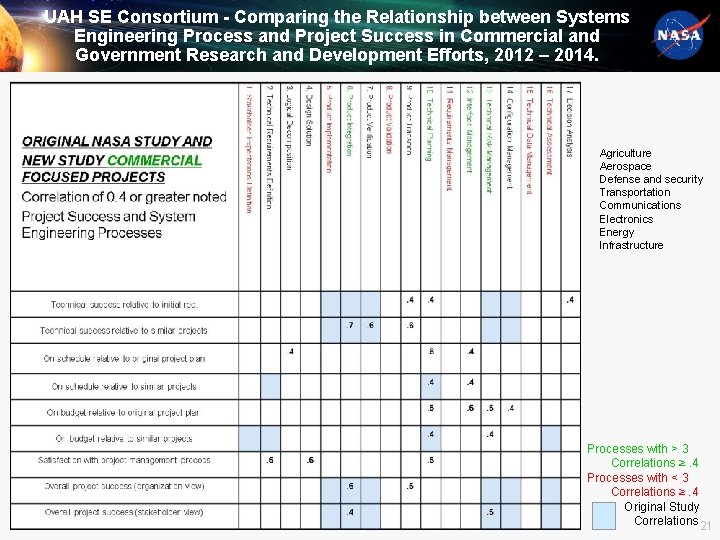
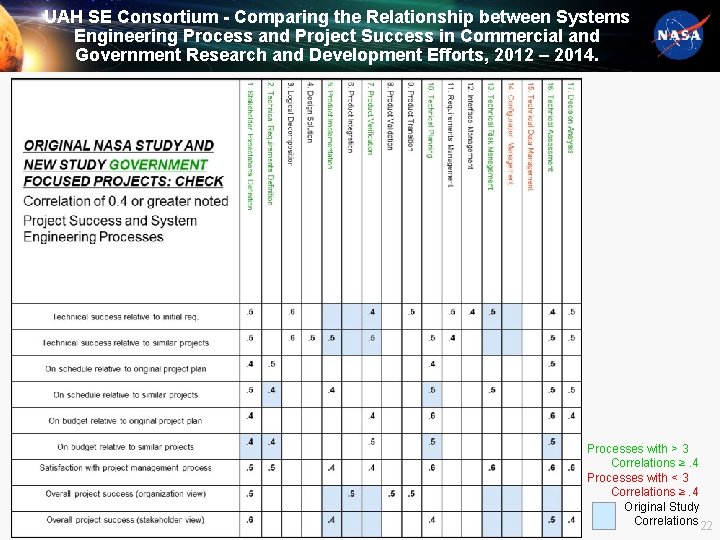
UAH SE Consortium - Comparing the Relationship between Systems Engineering Process and Project Success in Commercial and Government Research and Development Efforts, 2012 – 2014. Agriculture Aerospace Defense and security Transportation Communications Electronics Energy Infrastructure Processes with > 3 Correlations ≥. 4 Processes with < 3 Correlations ≥. 4 Original Study Correlations 21
UAH SE Consortium - Comparing the Relationship between Systems Engineering Process and Project Success in Commercial and Government Research and Development Efforts, 2012 – 2014. Processes with > 3 Correlations ≥. 4 Processes with < 3 Correlations ≥. 4 Original Study Correlations 22
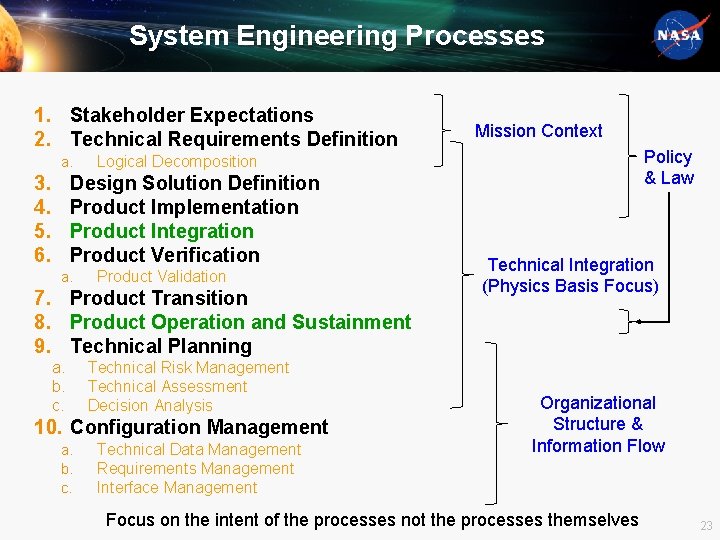
System Engineering Processes 1. Stakeholder Expectations 2. Technical Requirements Definition a. 3. 4. 5. 6. Product Validation 7. Product Transition 8. Product Operation and Sustainment 9. Technical Planning a. b. c. Technical Risk Management Technical Assessment Decision Analysis 10. Configuration Management a. b. c. Policy & Law Logical Decomposition Design Solution Definition Product Implementation Product Integration Product Verification a. Mission Context Technical Data Management Requirements Management Interface Management Technical Integration (Physics Basis Focus) Organizational Structure & Information Flow Focus on the intent of the processes not the processes themselves 23
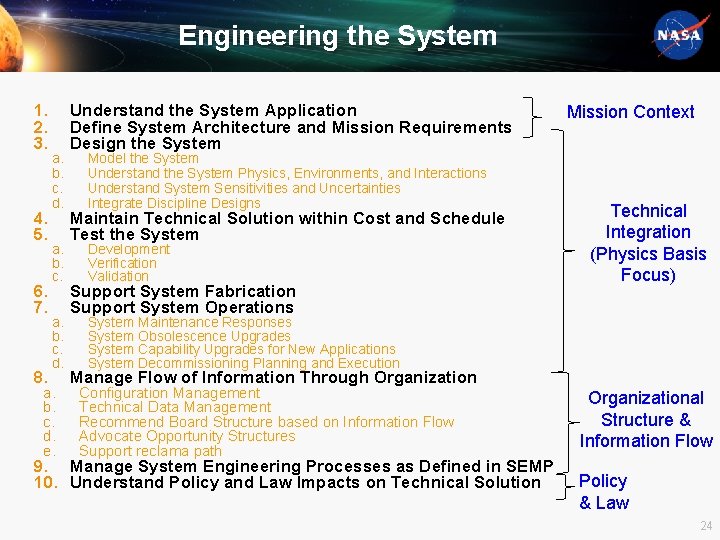
Engineering the System 1. 2. 3. 4. 5. 6. 7. 8. a. b. c. d. e. Understand the System Application Define System Architecture and Mission Requirements Design the System Model the System Understand the System Physics, Environments, and Interactions Understand System Sensitivities and Uncertainties Integrate Discipline Designs Maintain Technical Solution within Cost and Schedule Test the System Development Verification Validation Support System Fabrication Support System Operations Mission Context Technical Integration (Physics Basis Focus) System Maintenance Responses System Obsolescence Upgrades System Capability Upgrades for New Applications System Decommissioning Planning and Execution Manage Flow of Information Through Organization Configuration Management Technical Data Management Recommend Board Structure based on Information Flow Advocate Opportunity Structures Support reclama path 9. Manage System Engineering Processes as Defined in SEMP 10. Understand Policy and Law Impacts on Technical Solution Organizational Structure & Information Flow Policy & Law 24
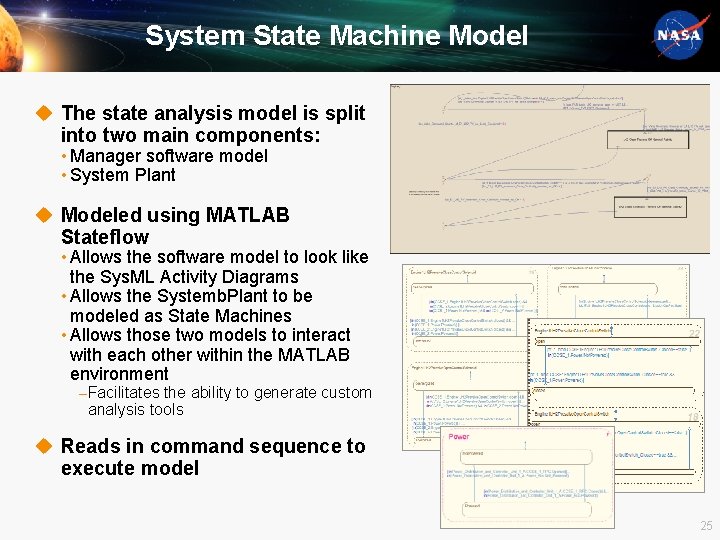
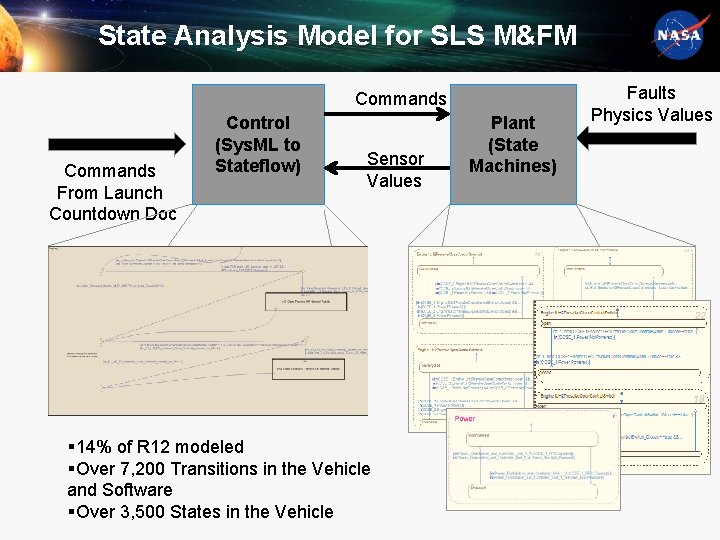
System State Machine Model u The state analysis model is split into two main components: • Manager software model • System Plant u Modeled using MATLAB Stateflow • Allows the software model to look like the Sys. ML Activity Diagrams • Allows the Systemb. Plant to be modeled as State Machines • Allows those two models to interact with each other within the MATLAB environment ‒ Facilitates the ability to generate custom analysis tools u Reads in command sequence to execute model 25
State Analysis Model for SLS M&FM Commands From Launch Countdown Doc Control (Sys. ML to Stateflow) Sensor Values § 14% of R 12 modeled §Over 7, 200 Transitions in the Vehicle and Software §Over 3, 500 States in the Vehicle Plant (State Machines) Faults Physics Values
Sociological Concepts in Systems Engineering u Specification of Ignorance is important in the advancement of the understanding of the system u Consistent use of Terminology is important for Communication within the Organization u Opportunity Structures • Provide opportunity to mature ideas ‒ Task teams, working groups, communities of practice, etc. u Socially Expected Durations will exist about the project u Both Manifest and Latent Social Functions exist in the organization u Social Role Sets • Individuals have a set of roles for their position u Cultural Subsets will form • i. e. , disciplines can be a subset within the organization • Insider and Outsider attitudes can form ‒ Be Aware of the Self-Fulfilling Prophecy, Social Polarization u Reconsiderations Process (i. e. , Reclama Process) • Provides ability to manage social ambivalence • Must be able to recognize social beliefs that may be contributing to the disagreement • Helps to avoid putting people in to social dysfunction or complete social anomie ‒ Conformity ‒ Innovation ‒ Ritualism ‒ Retreatism ‒ Rebellion 27
Processes u Well defined in NASA/SP-2007 -6105 Rev 1, NASA Systems Engineering Handbook u SEMP is essential to capture appropriate application of processes to the specific system • Process application is specific to the system being developed ‒ Tailoring is not a special exception, it is the norm