
Engineering Economy Review John D Lee Industrial Engineering
![10. 3 Sum of year digits Year Dep/year Cumulative Dep (P-S)[(N-J+1)/(N(N+1)/2)] 0 1 2](https://slidetodoc.com/presentation_image_h/0b98cee83013510f9c3adb92d12663db/image-48.jpg "10. 3 Sum of year digits Year Dep/year Cumulative Dep (P-S)[(N-J+1)/(N(N+1)/2)] 0 1 2")
- Slides: 60
Engineering Economy Review John D. Lee Industrial Engineering 1
Main concepts n Models are approximations of reality (THINK) n Time value of money, cash flow diagrams, and equivalence n Comparison of alternatives n Depreciation, inflation, and interest rates 2
Suggestions for solving problems n n n Lookup unfamiliar terms in the index Draw cash flow diagrams Identify P, A, F, i Be flexible in using equations and tables Check with alternate methods 3
Cash flows n n Cash flows describe income and outflow of money over time Disbursements =outflows “-” Receipts =inflows “+” Beginning of first year is traditionally defined as “Time 0” 4
Equivalence n Translating cashflows over time into common units n Present values of future payments Future value of present payments Present value of continuous uniform payments Continuous payments equivalent to present payment n n n 5
Single Payment Compound Interest n n n P= (P)resent sum of money i= (i)nterest per time period (usually years) MARR=Minimal Acceptable Rate of Return n= (n)umber of time periods (usually years) F= (F)uture sum of money that is equivalent to P given an interest rate i for n periods 6
Bank example n n n You 1000 deposit 12% per year 5 years How much do you have at end if compounded yearly? How much do you have at end if compounded monthly? 7
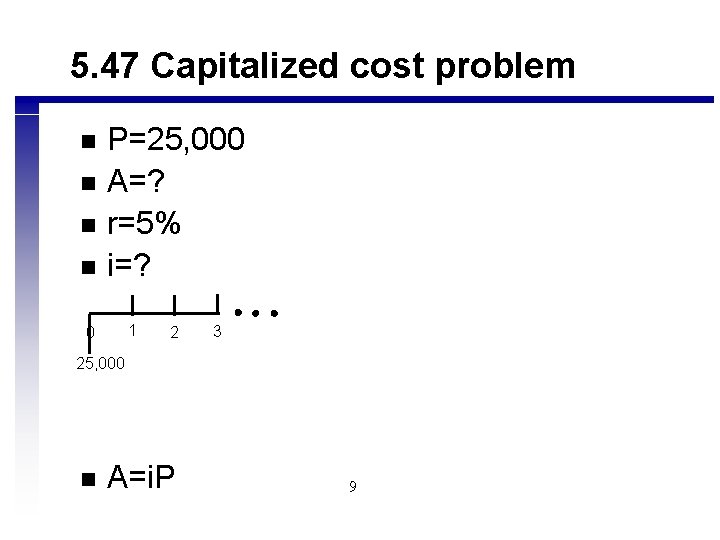
5. 47 Income from savings n n $25, 000 deposited Account pays 5% compounded semiannually Withdrawals in one year and continuing forever Maximum equal annual withdrawal equals? 8
5. 47 Capitalized cost problem n n P=25, 000 A=? r=5% i=? 1 0 2 3 25, 000 n A=i. P 9
Key points to remember n Time value of money • $1000 today is not the same as $1000 one hundred years from now • Money in the future is worth less than present sums n Cash flow diagrams • Starts at year zero • Superposition to convert to standard forms n Equivalence • Functional notation, F=P(F/P, i, n) • i and n must match units • Capitalized cost, A=Pi, P=A/i 1 0
Comparison of alternatives n n n Present/Future worth Cash flow Rate of return Cost benefit Payback period Breakeven analysis 1 1
Present/Future worth n n Determine time period for analysis, least common multiple Calculate present value for each alternative • Draw cashflow diagram • Identify/calculate A, i, P, F, n • Use present value equations to determine P n Compare costs 1 2
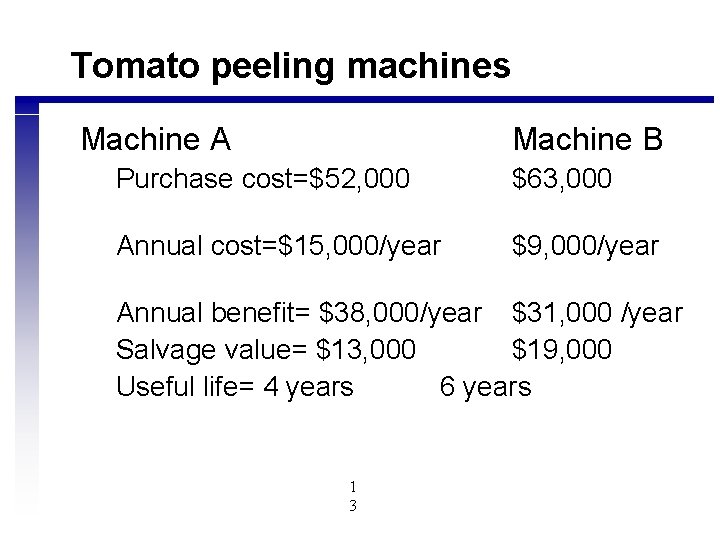
Tomato peeling machines Machine A Machine B Purchase cost=$52, 000 $63, 000 Annual cost=$15, 000/year $9, 000/year Annual benefit= $38, 000/year $31, 000 /year Salvage value= $13, 000 $19, 000 Useful life= 4 years 6 years 1 3
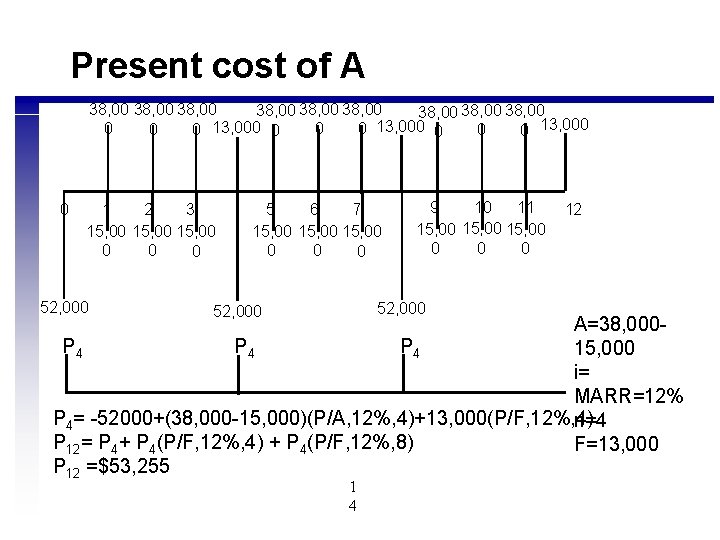
Present cost of A 38, 00 38, 00 38, 00 13, 000 0 13, 000 0 0 1 2 3 15, 00 0 52, 000 5 6 7 15, 00 0 9 10 11 15, 00 0 52, 000 12 A=38, 000 P 4 P 4 15, 000 i= MARR=12% P 4= -52000+(38, 000 -15, 000)(P/A, 12%, 4)+13, 000(P/F, 12%, 4) n=4 P 12= P 4+ P 4(P/F, 12%, 4) + P 4(P/F, 12%, 8) F=13, 000 P 12 =$53, 255 1 4
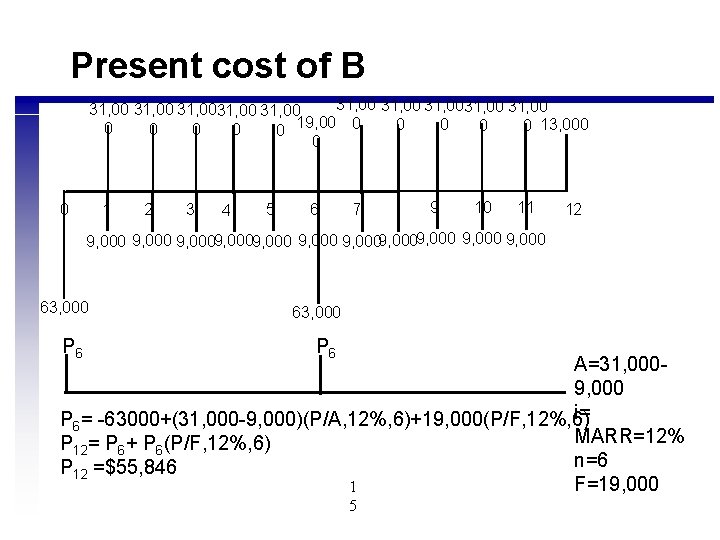
Present cost of B 31, 00 31, 0031, 00 0 0 13, 000 0 0 19, 00 0 1 2 3 4 5 6 7 9 10 11 12 9, 0009, 0009, 000 9, 000 63, 000 P 6 A=31, 0009, 000 i= P 6= -63000+(31, 000 -9, 000)(P/A, 12%, 6)+19, 000(P/F, 12%, 6) MARR=12% P 12= P 6+ P 6(P/F, 12%, 6) n=6 P 12 =$55, 846 F=19, 000 1 5
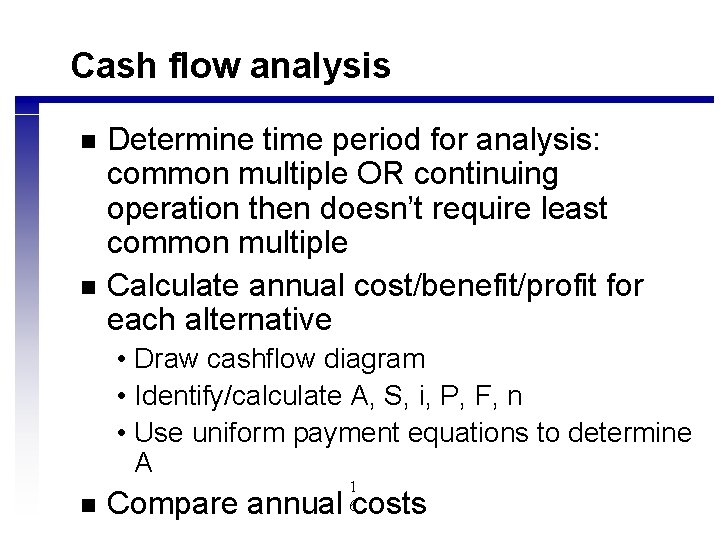
Cash flow analysis n n Determine time period for analysis: common multiple OR continuing operation then doesn’t require least common multiple Calculate annual cost/benefit/profit for each alternative • Draw cashflow diagram • Identify/calculate A, S, i, P, F, n • Use uniform payment equations to determine A n 1 6 Compare annual costs
Cash flow analysis n n Provides a shortcut for long/infinite analysis periods or when least common multiple might be a long time period with lots of calculations Compare on the basis of annual cost if EITHER • Common multiple (e. g. , 2 years and 8 years) OR • Continuing operation (e. g. , business will keep operating indefinitely with ability to replace 1 equipment) 7
Rate of return analysis n n Draw cash flow diagram of each alternative Draw combined cash flow diagram (higher initial cost- lower initial cost) n Convert to Present worth and Present costs OR Convert to EUAB and EUAC n Write equation Solve for i 1 8 If ROR MARR, choose higher-cost n n
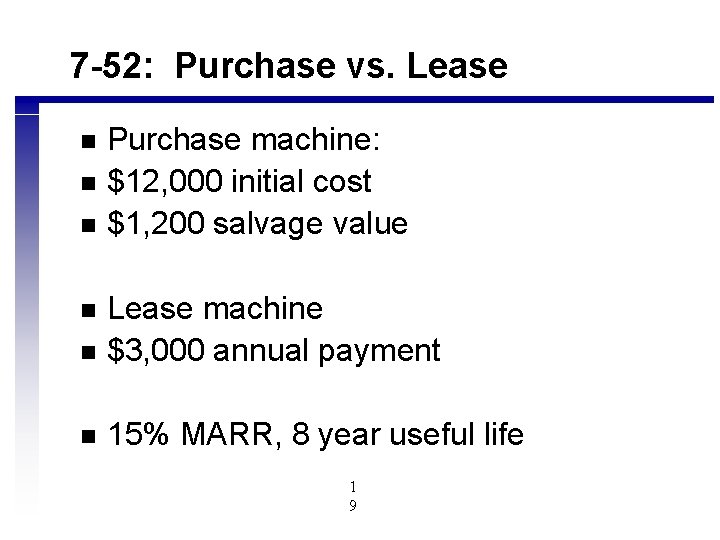
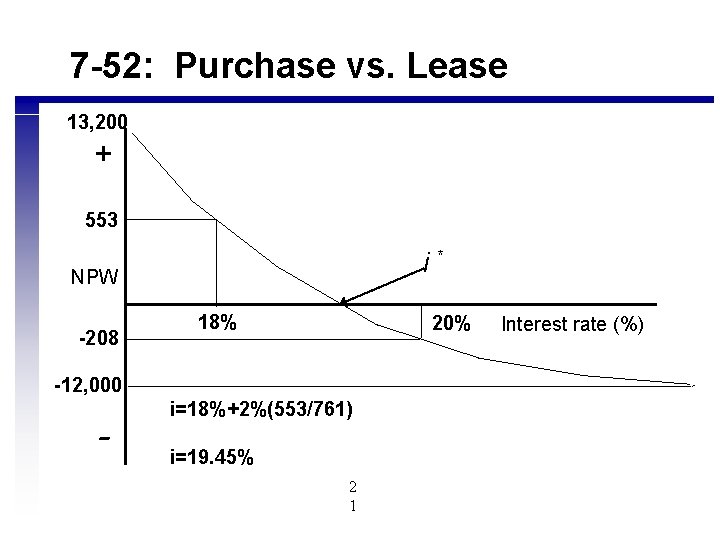
7 -52: Purchase vs. Lease n n n Purchase machine: $12, 000 initial cost $1, 200 salvage value n Lease machine $3, 000 annual payment n 15% MARR, 8 year useful life n 1 9
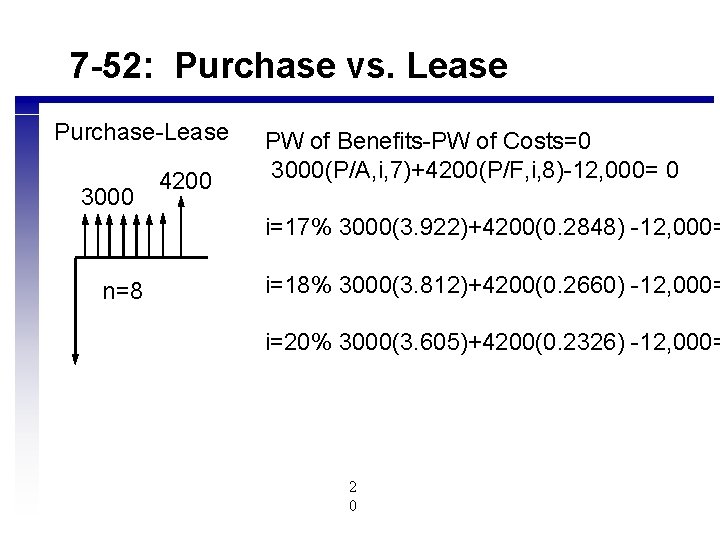
7 -52: Purchase vs. Lease Purchase-Lease 3000 4200 PW of Benefits-PW of Costs=0 3000(P/A, i, 7)+4200(P/F, i, 8)-12, 000= 0 i=17% 3000(3. 922)+4200(0. 2848) -12, 000= n=8 i=18% 3000(3. 812)+4200(0. 2660) -12, 000= i=20% 3000(3. 605)+4200(0. 2326) -12, 000= 2 0
7 -52: Purchase vs. Lease 13, 200 + 553 i* NPW -208 18% 20% -12, 000 - i=18%+2%(553/761) i=19. 45% 2 1 Interest rate (%)
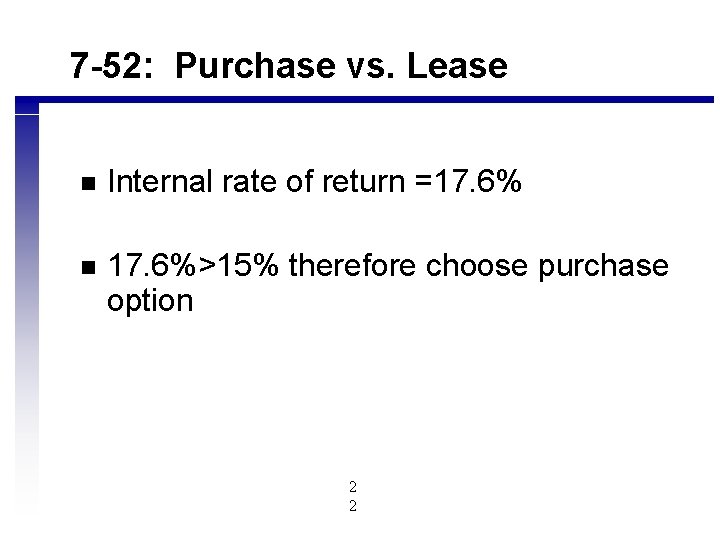
7 -52: Purchase vs. Lease n Internal rate of return =17. 6% n 17. 6%>15% therefore choose purchase option 2 2
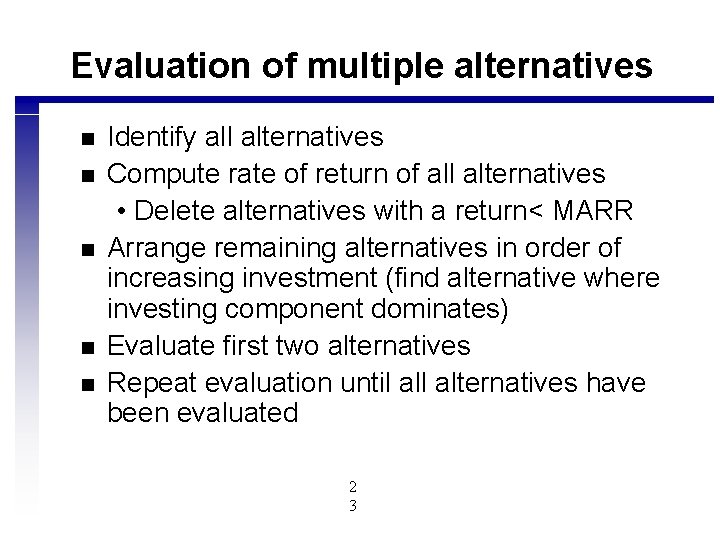
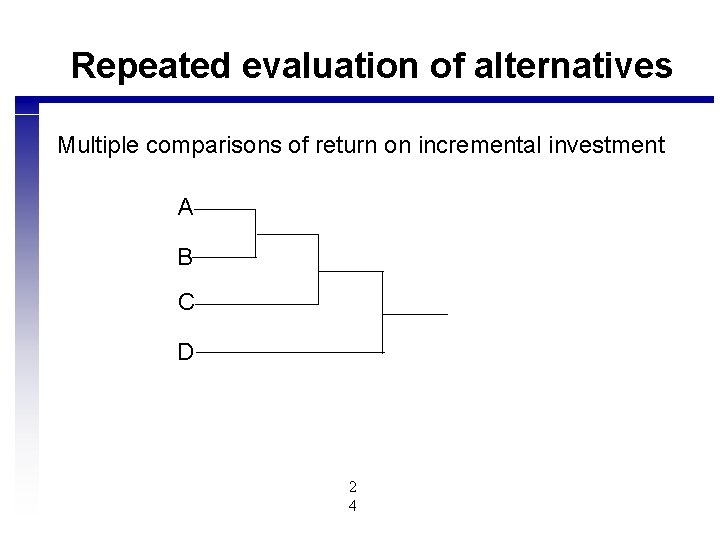
Evaluation of multiple alternatives n n n Identify all alternatives Compute rate of return of all alternatives • Delete alternatives with a return< MARR Arrange remaining alternatives in order of increasing investment (find alternative where investing component dominates) Evaluate first two alternatives Repeat evaluation until alternatives have been evaluated 2 3
Repeated evaluation of alternatives Multiple comparisons of return on incremental investment A B C D 2 4
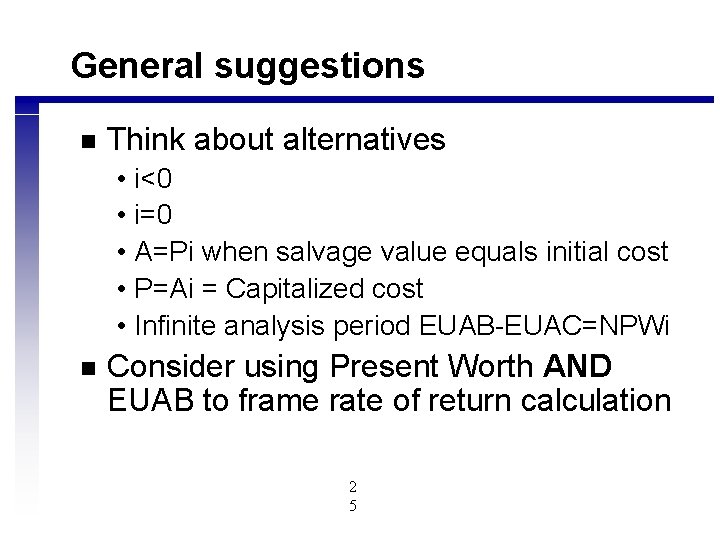
General suggestions n Think about alternatives • i<0 • i=0 • A=Pi when salvage value equals initial cost • P=Ai = Capitalized cost • Infinite analysis period EUAB-EUAC=NPWi n Consider using Present Worth AND EUAB to frame rate of return calculation 2 5
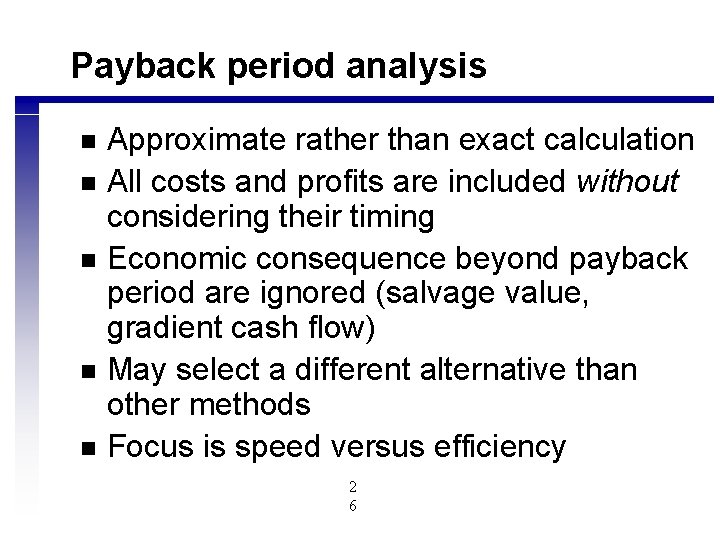
Payback period analysis n n n Approximate rather than exact calculation All costs and profits are included without considering their timing Economic consequence beyond payback period are ignored (salvage value, gradient cash flow) May select a different alternative than other methods Focus is speed versus efficiency 2 6
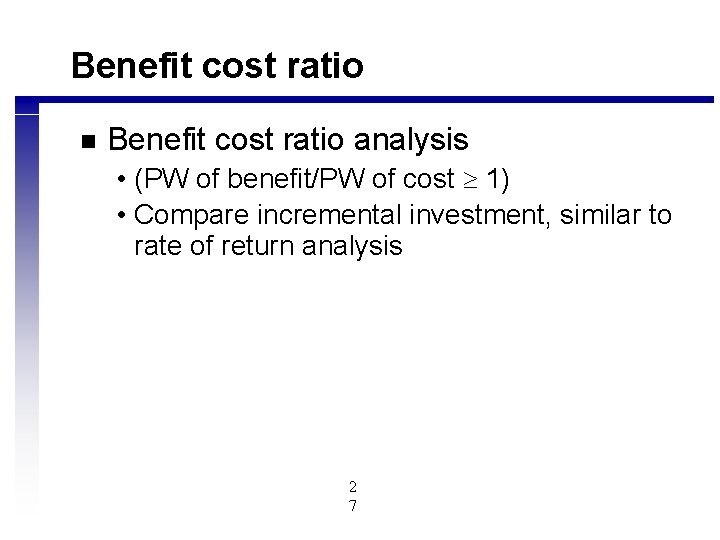
Benefit cost ratio n Benefit cost ratio analysis • (PW of benefit/PW of cost 1) • Compare incremental investment, similar to rate of return analysis 2 7
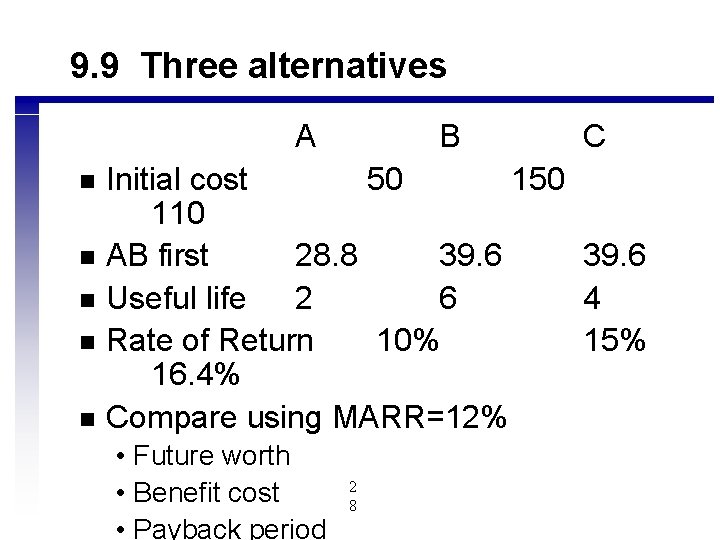
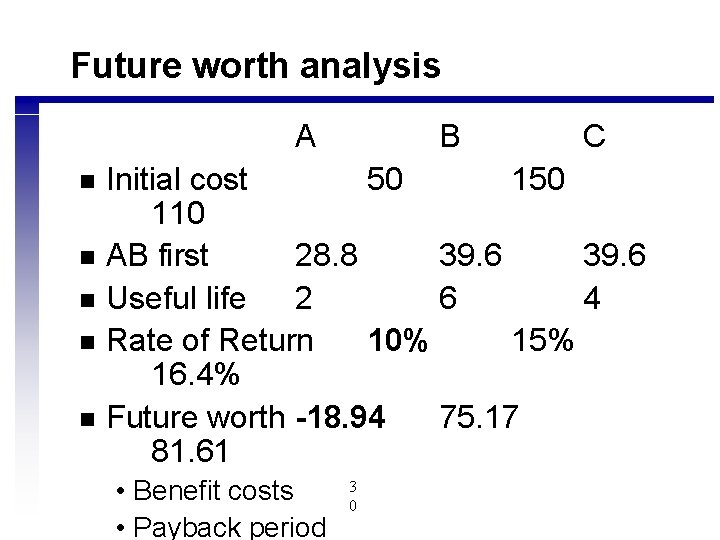
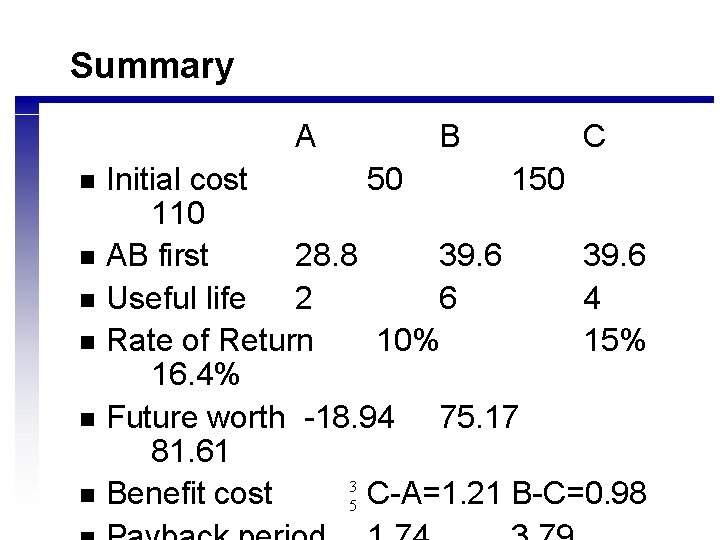
9. 9 Three alternatives A n n n B C Initial cost 50 110 AB first 28. 8 39. 6 Useful life 2 6 4 Rate of Return 10% 15% 16. 4% Compare using MARR=12% • Future worth • Benefit cost • Payback period 2 8
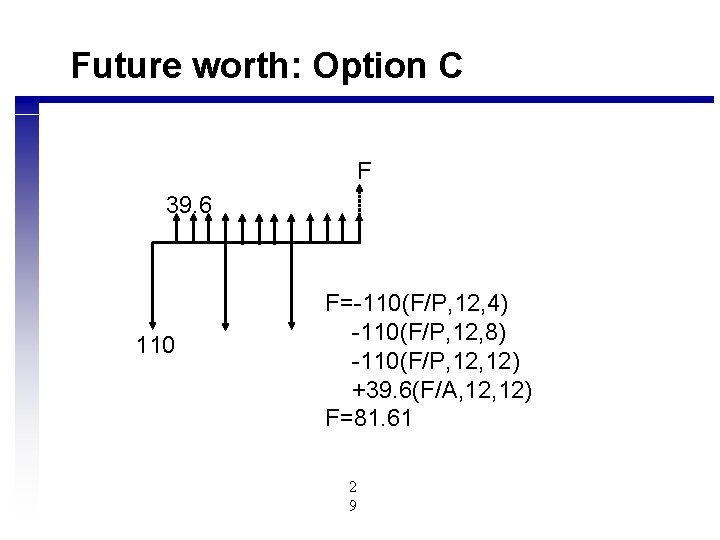
Future worth: Option C F 39. 6 110 F=-110(F/P, 12, 4) -110(F/P, 12, 8) -110(F/P, 12) +39. 6(F/A, 12) F=81. 61 2 9
Future worth analysis A n n n B C Initial cost 50 110 AB first 28. 8 39. 6 Useful life 2 6 4 Rate of Return 10% 15% 16. 4% Future worth -18. 94 75. 17 81. 61 • Benefit costs • Payback period 3 0
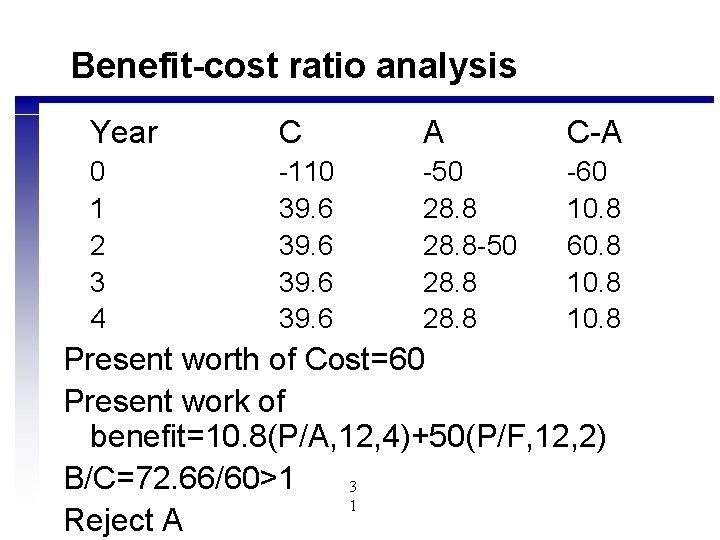
Benefit-cost ratio analysis Year C A C-A 0 1 2 3 4 -110 39. 6 -50 28. 8 -60 10. 8 60. 8 10. 8 Present worth of Cost=60 Present work of benefit=10. 8(P/A, 12, 4)+50(P/F, 12, 2) B/C=72. 66/60>1 3 1 Reject A
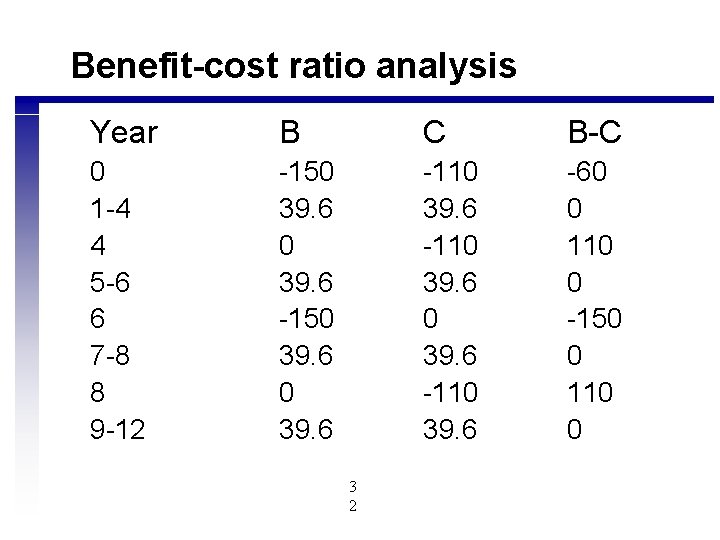
Benefit-cost ratio analysis Year B C B-C 0 1 -4 4 5 -6 6 7 -8 8 9 -12 -150 39. 6 -110 39. 6 -60 0 110 0 -150 0 110 0 3 2
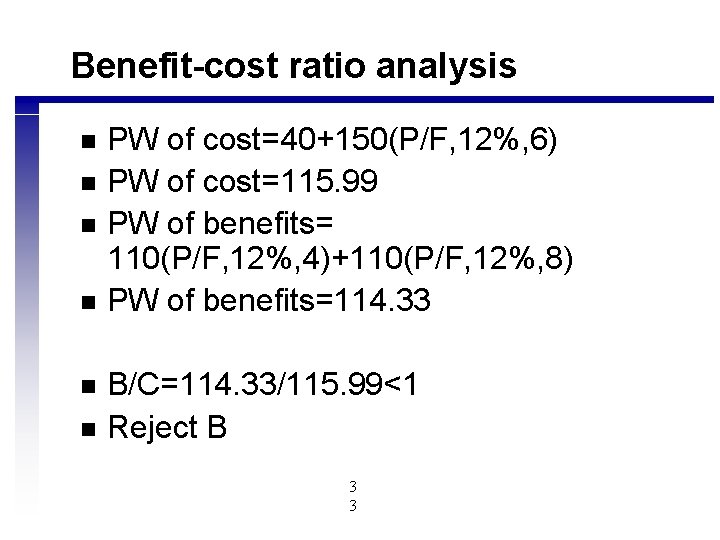
Benefit-cost ratio analysis n n n PW of cost=40+150(P/F, 12%, 6) PW of cost=115. 99 PW of benefits= 110(P/F, 12%, 4)+110(P/F, 12%, 8) PW of benefits=114. 33 B/C=114. 33/115. 99<1 Reject B 3 3
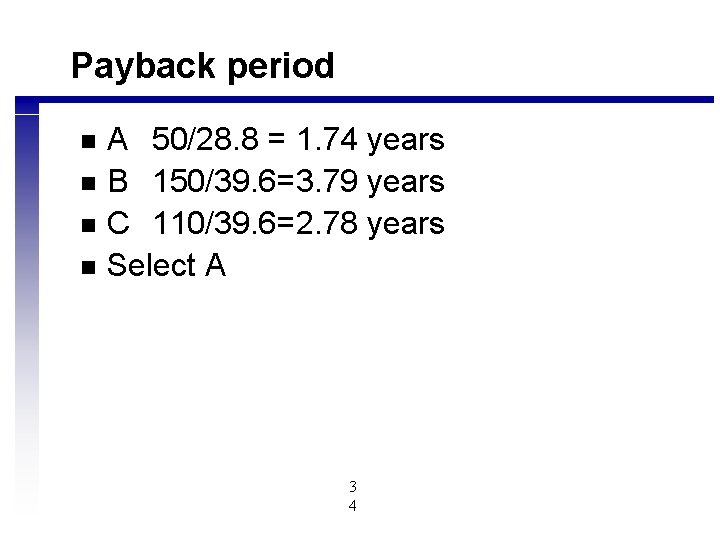
Payback period n n A 50/28. 8 = 1. 74 years B 150/39. 6=3. 79 years C 110/39. 6=2. 78 years Select A 3 4
Summary A n n n B C Initial cost 50 110 AB first 28. 8 39. 6 Useful life 2 6 4 Rate of Return 10% 15% 16. 4% Future worth -18. 94 75. 17 81. 61 3 Benefit cost 5 C-A=1. 21 B-C=0. 98
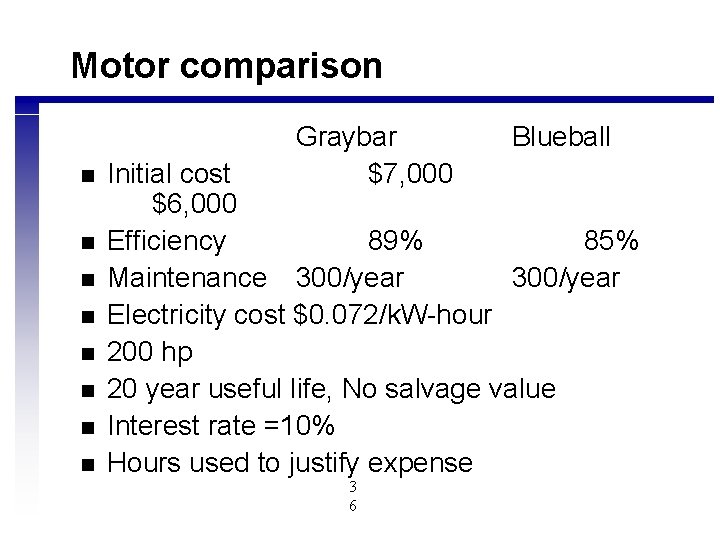
Motor comparison n n n n Graybar $7, 000 Blueball Initial cost $6, 000 Efficiency 89% 85% Maintenance 300/year Electricity cost $0. 072/k. W-hour 200 hp 20 year useful life, No salvage value Interest rate =10% Hours used to justify expense 3 6
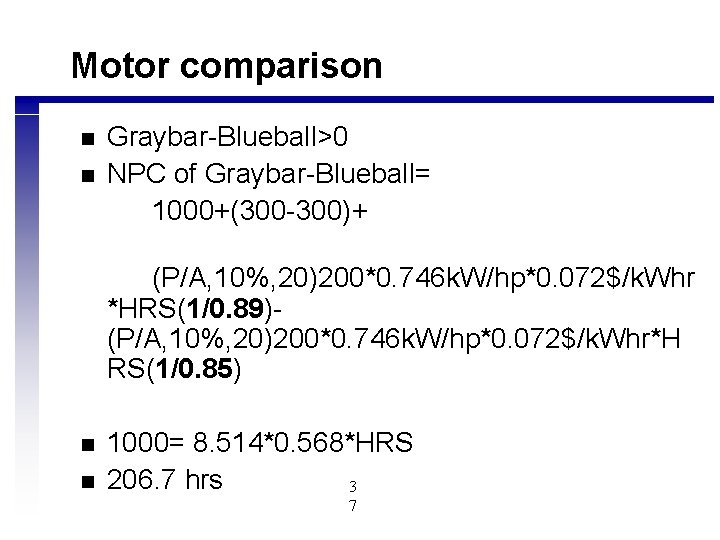
Motor comparison n n Graybar-Blueball>0 NPC of Graybar-Blueball= 1000+(300 -300)+ (P/A, 10%, 20)200*0. 746 k. W/hp*0. 072$/k. Whr *HRS(1/0. 89)(P/A, 10%, 20)200*0. 746 k. W/hp*0. 072$/k. Whr*H RS(1/0. 85) n n 1000= 8. 514*0. 568*HRS 206. 7 hrs 3 7
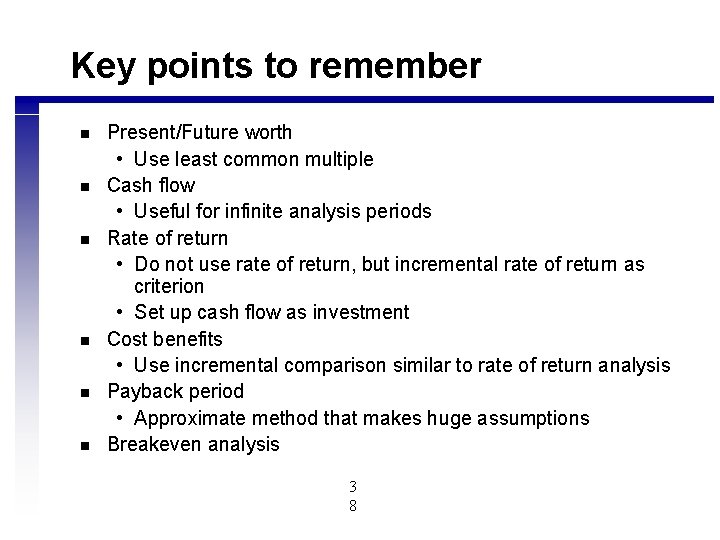
Key points to remember n n n Present/Future worth • Use least common multiple Cash flow • Useful for infinite analysis periods Rate of return • Do not use rate of return, but incremental rate of return as criterion • Set up cash flow as investment Cost benefits • Use incremental comparison similar to rate of return analysis Payback period • Approximate method that makes huge assumptions Breakeven analysis 3 8
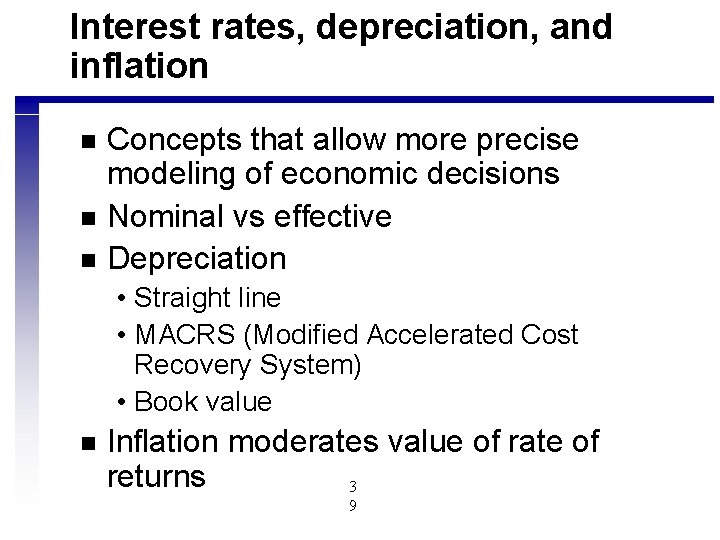
Interest rates, depreciation, and inflation n Concepts that allow more precise modeling of economic decisions Nominal vs effective Depreciation • Straight line • MACRS (Modified Accelerated Cost Recovery System) • Book value n Inflation moderates value of rate of returns 3 9
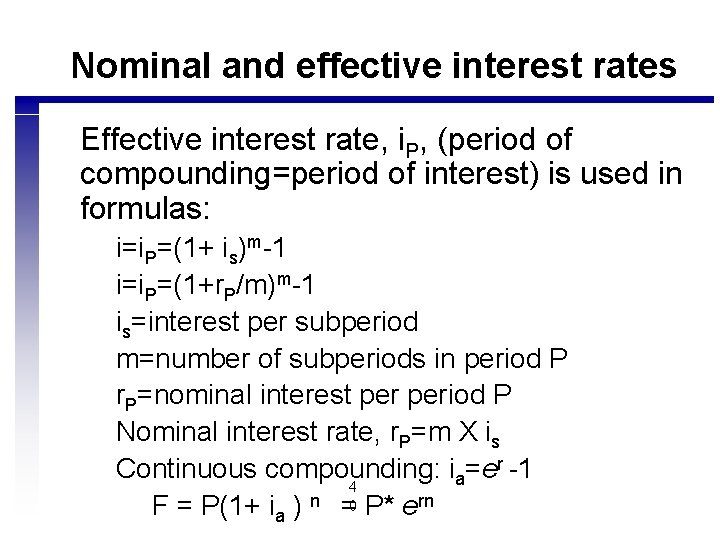
Nominal and effective interest rates Effective interest rate, i. P, (period of compounding=period of interest) is used in formulas: i=i. P=(1+ is)m-1 i=i. P=(1+r. P/m)m-1 is=interest per subperiod m=number of subperiods in period P r. P=nominal interest period P Nominal interest rate, r. P=m X is r -1 Continuous compounding: i =e a 4 F = P(1+ ia ) n =0 P* ern
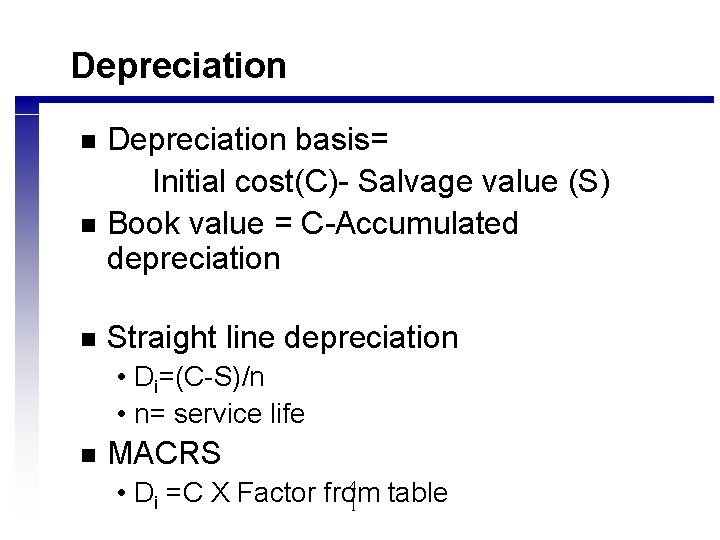
Depreciation n Depreciation basis= Initial cost(C)- Salvage value (S) Book value = C-Accumulated depreciation Straight line depreciation • Di=(C-S)/n • n= service life n MACRS 4 • Di =C X Factor from table 1
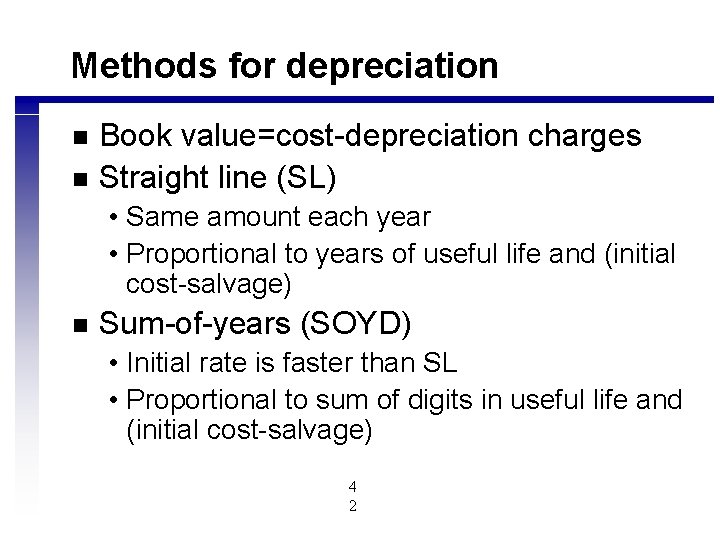
Methods for depreciation n n Book value=cost-depreciation charges Straight line (SL) • Same amount each year • Proportional to years of useful life and (initial cost-salvage) n Sum-of-years (SOYD) • Initial rate is faster than SL • Proportional to sum of digits in useful life and (initial cost-salvage) 4 2
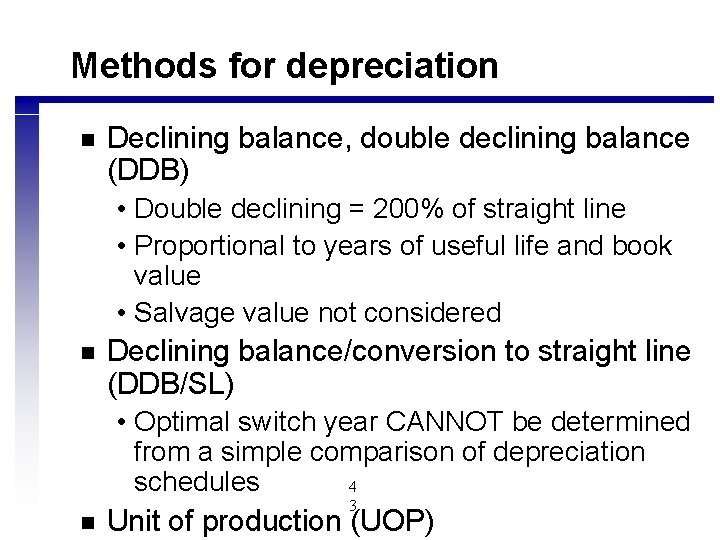
Methods for depreciation n Declining balance, double declining balance (DDB) • Double declining = 200% of straight line • Proportional to years of useful life and book value • Salvage value not considered n Declining balance/conversion to straight line (DDB/SL) • Optimal switch year CANNOT be determined from a simple comparison of depreciation schedules 4 n 3 Unit of production (UOP)
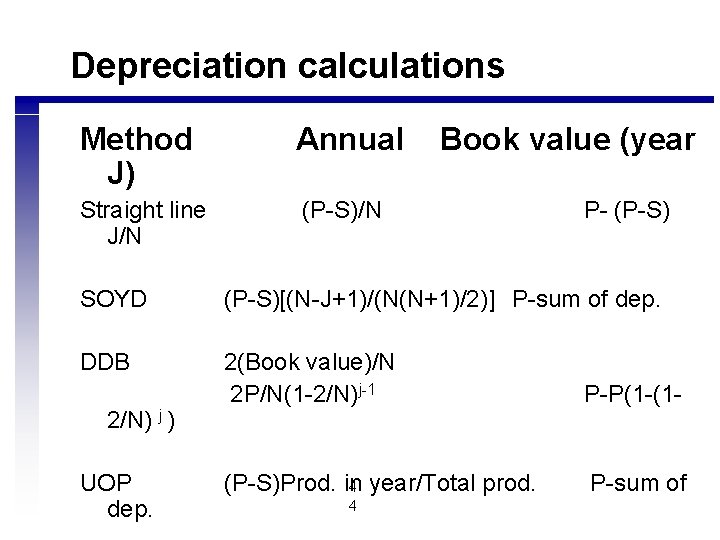
Depreciation calculations Method J) Annual Straight line J/N (P-S)/N Book value (year P- (P-S) SOYD (P-S)[(N-J+1)/(N(N+1)/2)] P-sum of dep. DDB 2(Book value)/N 2 P/N(1 -2/N)j-1 P-P(1 -(1 - (P-S)Prod. in 4 year/Total prod. P-sum of 2/N) j ) UOP dep. 4
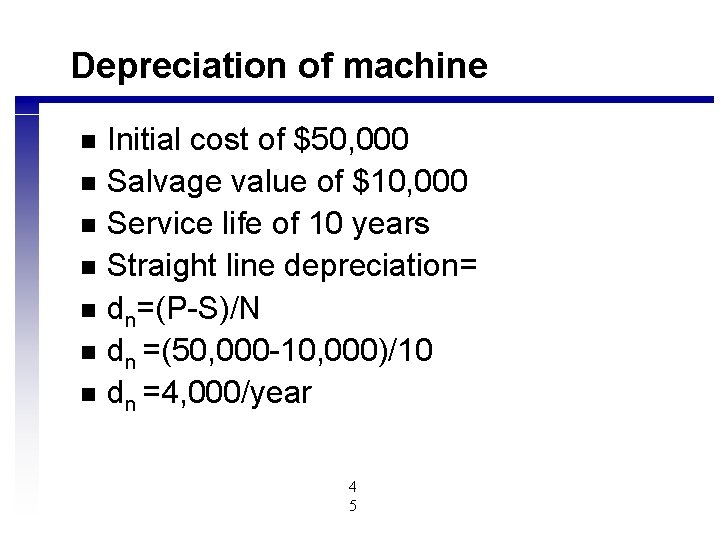
Depreciation of machine n n n n Initial cost of $50, 000 Salvage value of $10, 000 Service life of 10 years Straight line depreciation= dn=(P-S)/N dn =(50, 000 -10, 000)/10 dn =4, 000/year 4 5
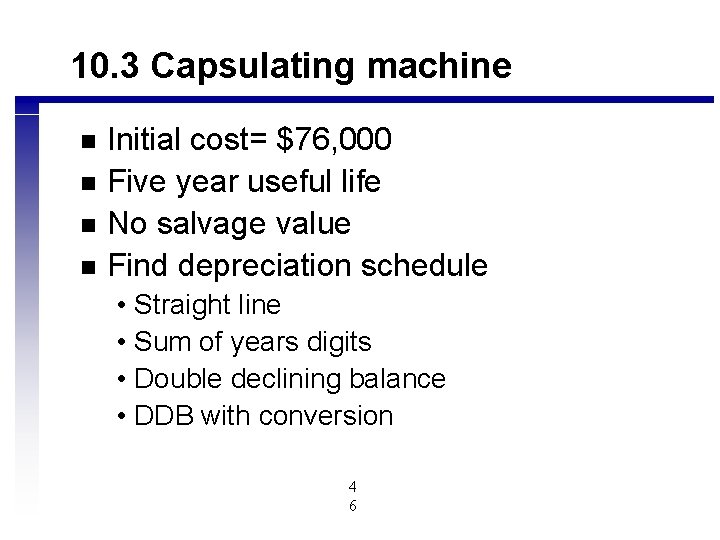
10. 3 Capsulating machine n n Initial cost= $76, 000 Five year useful life No salvage value Find depreciation schedule • Straight line • Sum of years digits • Double declining balance • DDB with conversion 4 6
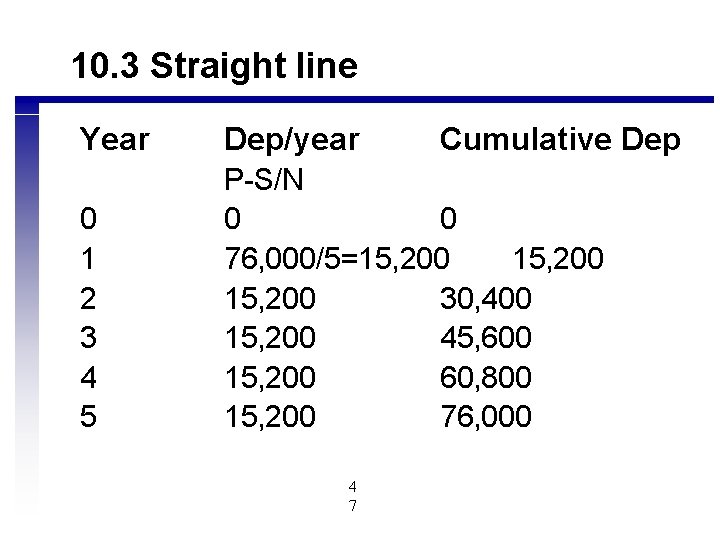
10. 3 Straight line Year Dep/year 0 1 2 3 4 5 P-S/N 0 0 76, 000/5=15, 200 30, 400 15, 200 45, 600 15, 200 60, 800 15, 200 76, 000 4 7 Cumulative Dep
10. 3 Sum of year digits Year Dep/year Cumulative Dep (P-S)[(N-J+1)/(N(N+1)/2)] 0 1 2 3 4 5 0 76, 000(5)/15 20, 267 15, 200 10, 133 5, 067 4 8 0 =25, 333 45, 600 60, 800 70, 933 76, 000
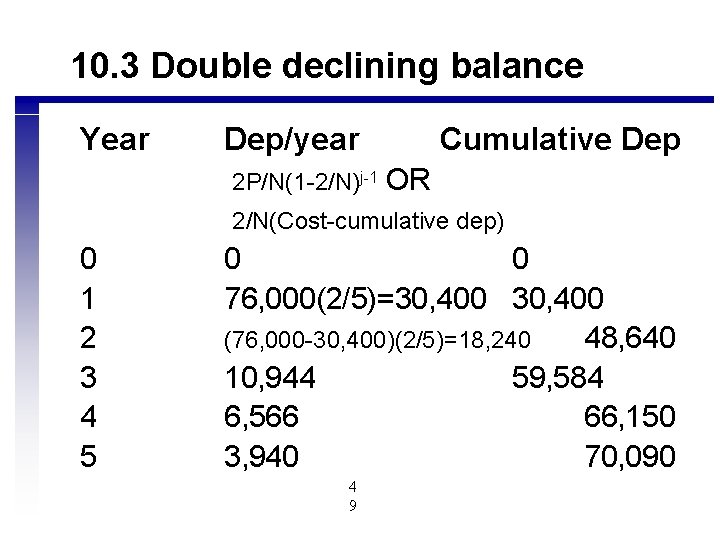
10. 3 Double declining balance Year Dep/year 2 P/N(1 -2/N)j-1 Cumulative Dep OR 2/N(Cost-cumulative dep) 0 1 2 3 4 5 0 0 76, 000(2/5)=30, 400 (76, 000 -30, 400)(2/5)=18, 240 48, 640 10, 944 59, 584 6, 566 66, 150 3, 940 70, 090 4 9
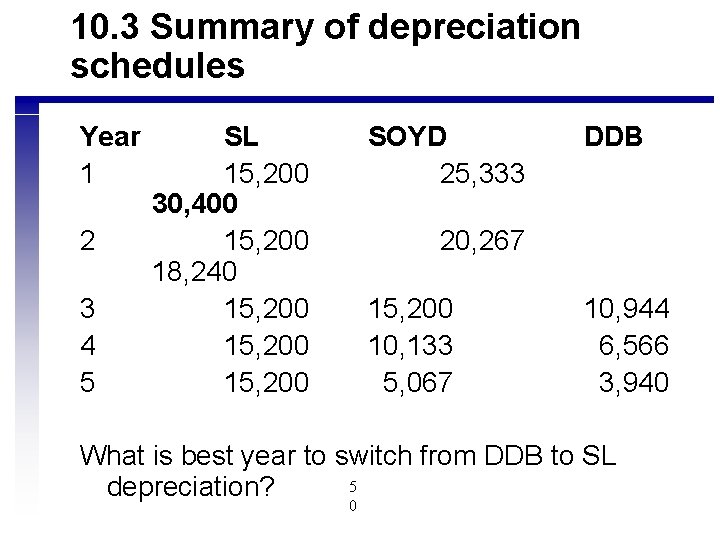
10. 3 Summary of depreciation schedules Year 1 2 3 4 5 SL 15, 200 30, 400 15, 200 18, 240 15, 200 SOYD 25, 333 DDB 20, 267 15, 200 10, 133 5, 067 10, 944 6, 566 3, 940 What is best year to switch from DDB to SL 5 depreciation? 0
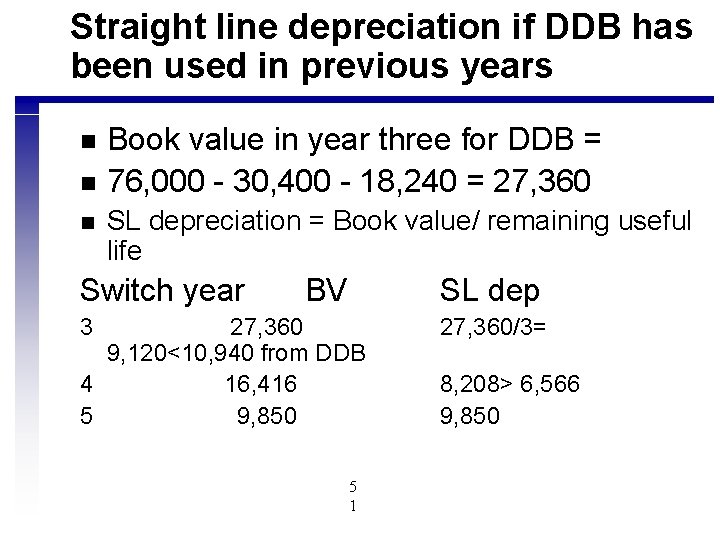
Straight line depreciation if DDB has been used in previous years n n n Book value in year three for DDB = 76, 000 - 30, 400 - 18, 240 = 27, 360 SL depreciation = Book value/ remaining useful life Switch year BV SL dep 3 27, 360 9, 120<10, 940 from DDB 4 16, 416 5 9, 850 5 1 27, 360/3= 8, 208> 6, 566 9, 850
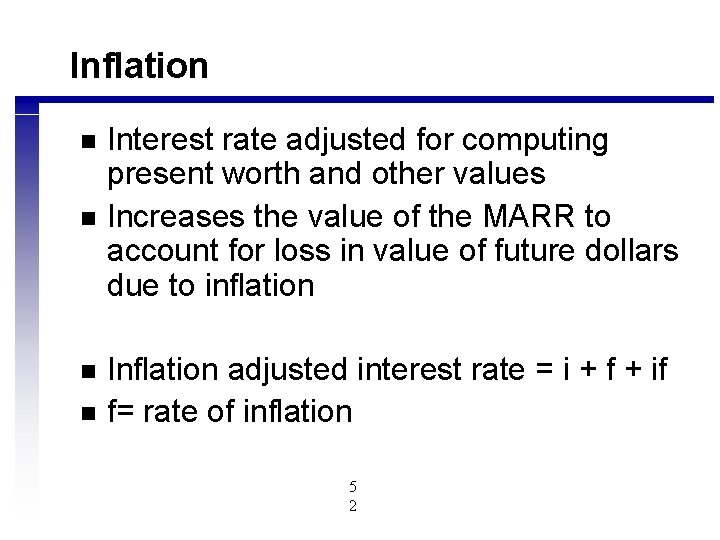
Inflation n n Interest rate adjusted for computing present worth and other values Increases the value of the MARR to account for loss in value of future dollars due to inflation Inflation adjusted interest rate = i + f + if f= rate of inflation 5 2
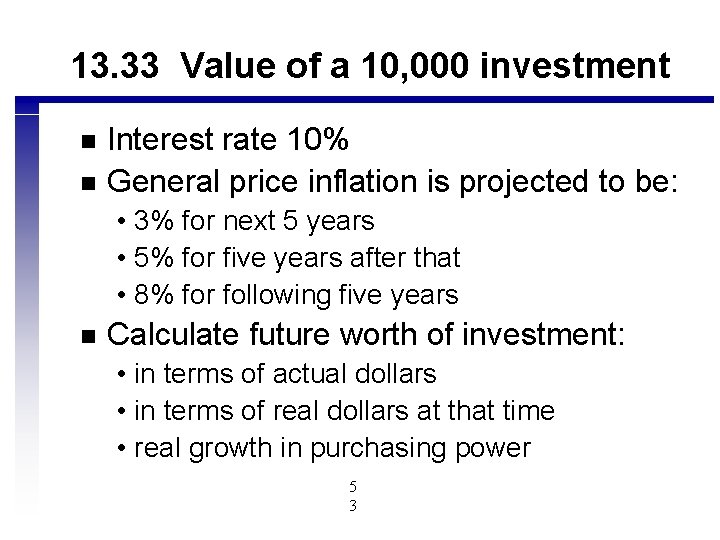
13. 33 Value of a 10, 000 investment n n Interest rate 10% General price inflation is projected to be: • 3% for next 5 years • 5% for five years after that • 8% for following five years n Calculate future worth of investment: • in terms of actual dollars • in terms of real dollars at that time • real growth in purchasing power 5 3
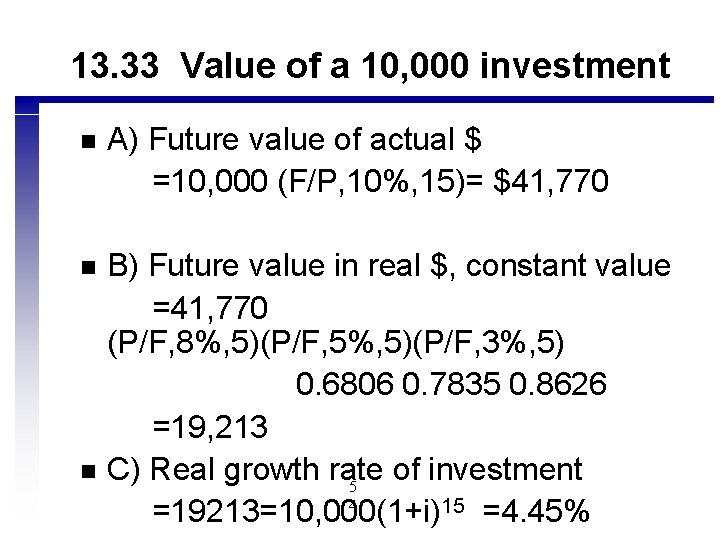
13. 33 Value of a 10, 000 investment n A) Future value of actual $ =10, 000 (F/P, 10%, 15)= $41, 770 n B) Future value in real $, constant value =41, 770 (P/F, 8%, 5)(P/F, 5%, 5)(P/F, 3%, 5) 0. 6806 0. 7835 0. 8626 =19, 213 C) Real growth rate of investment 5 4 15 =4. 45% =19213=10, 000(1+i) n
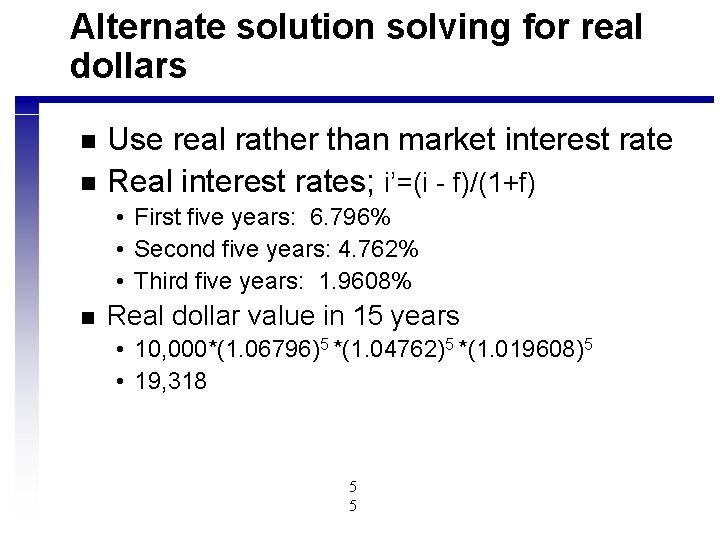
Alternate solution solving for real dollars n n Use real rather than market interest rate Real interest rates; i’=(i - f)/(1+f) • First five years: 6. 796% • Second five years: 4. 762% • Third five years: 1. 9608% n Real dollar value in 15 years • 10, 000*(1. 06796)5 *(1. 04762)5 *(1. 019608)5 • 19, 318 5 5
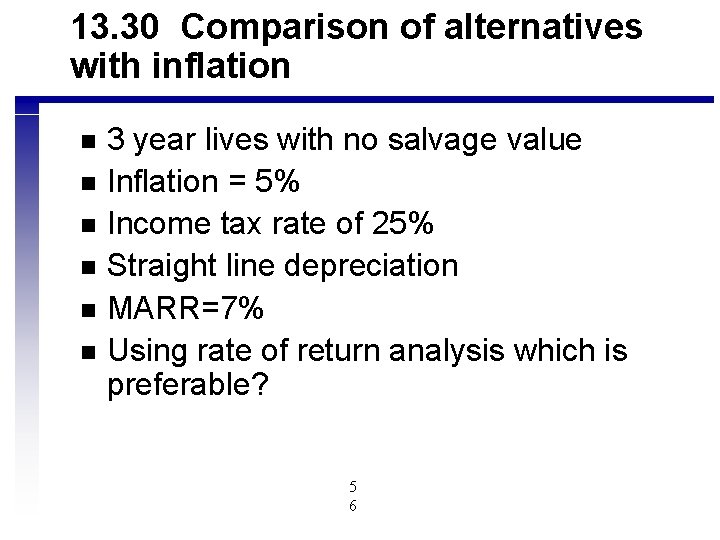
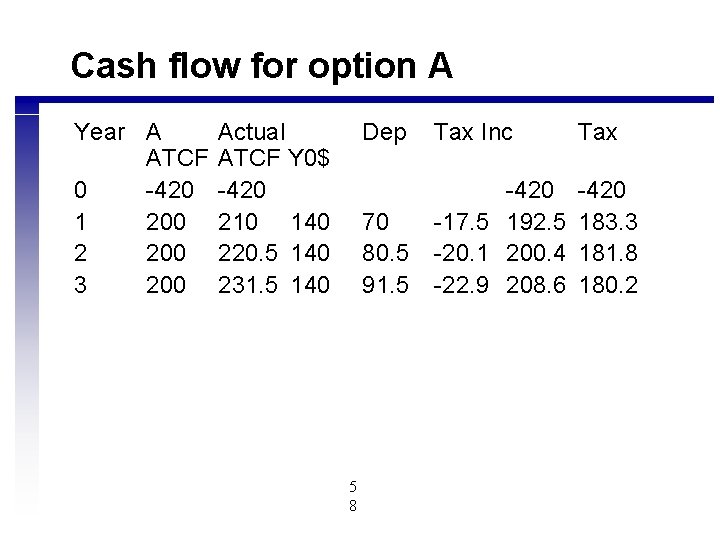
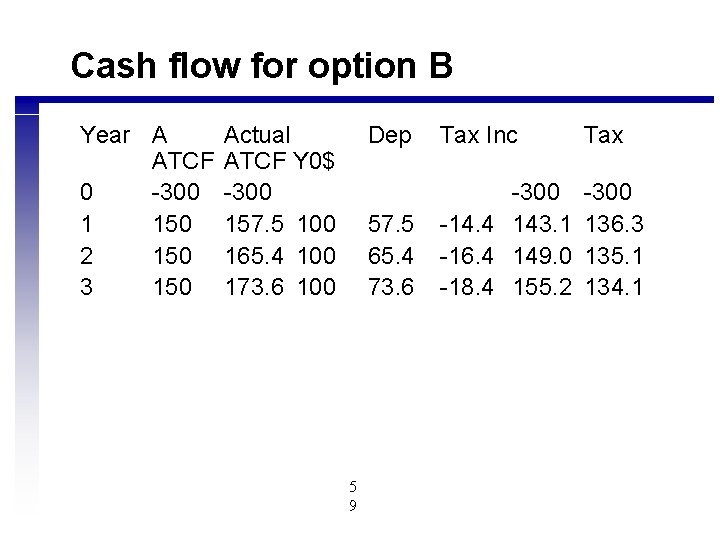
13. 30 Comparison of alternatives with inflation n n n 3 year lives with no salvage value Inflation = 5% Income tax rate of 25% Straight line depreciation MARR=7% Using rate of return analysis which is preferable? 5 6
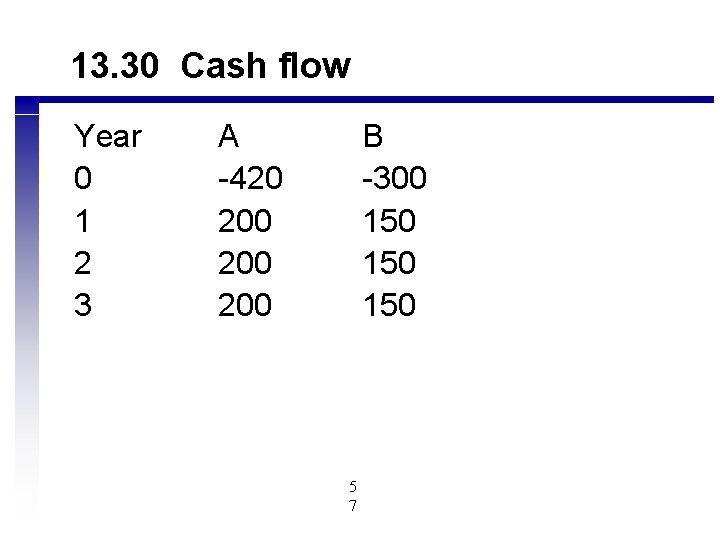
13. 30 Cash flow Year 0 1 2 3 A -420 200 200 B -300 150 150 5 7
Cash flow for option A Year A ATCF 0 -420 1 200 2 200 3 200 Actual ATCF Y 0$ -420 210 140 220. 5 140 231. 5 140 5 8 Dep Tax Inc Tax 70 80. 5 91. 5 -420 -17. 5 192. 5 -20. 1 200. 4 -22. 9 208. 6 -420 183. 3 181. 8 180. 2
Cash flow for option B Year A ATCF 0 -300 1 150 2 150 3 150 Actual ATCF Y 0$ -300 157. 5 100 165. 4 100 173. 6 100 5 9 Dep Tax Inc Tax 57. 5 65. 4 73. 6 -300 -14. 4 143. 1 -16. 4 149. 0 -18. 4 155. 2 -300 136. 3 135. 1 134. 1
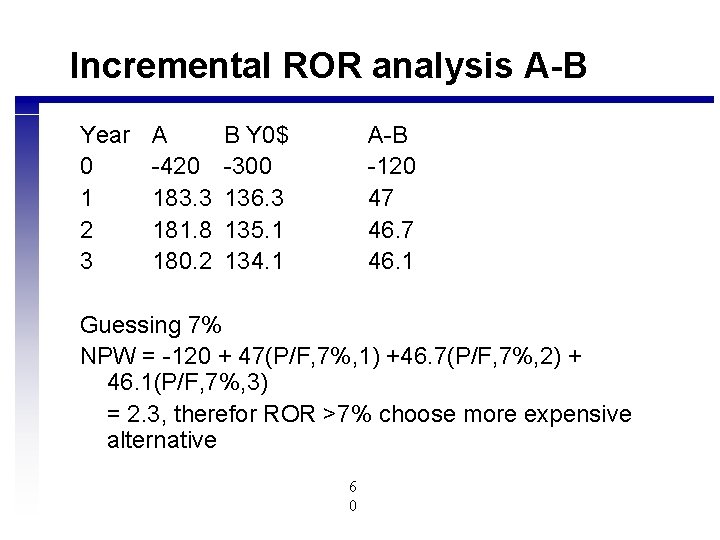
Incremental ROR analysis A-B Year 0 1 2 3 A -420 183. 3 181. 8 180. 2 B Y 0$ -300 136. 3 135. 1 134. 1 A-B -120 47 46. 1 Guessing 7% NPW = -120 + 47(P/F, 7%, 1) +46. 7(P/F, 7%, 2) + 46. 1(P/F, 7%, 3) = 2. 3, therefor ROR >7% choose more expensive alternative 6 0