
Engineering Economic Analysis Chapter 7 RATE OF RETURN
- Slides: 23
Engineering Economic Analysis Chapter 7 RATE OF RETURN ANALYSIS Engineering Economic Analysis - Ninth Edition Newnan/Eschenbach/Lavelle Copyright 2004 by Oxford University Press, Inc. 1
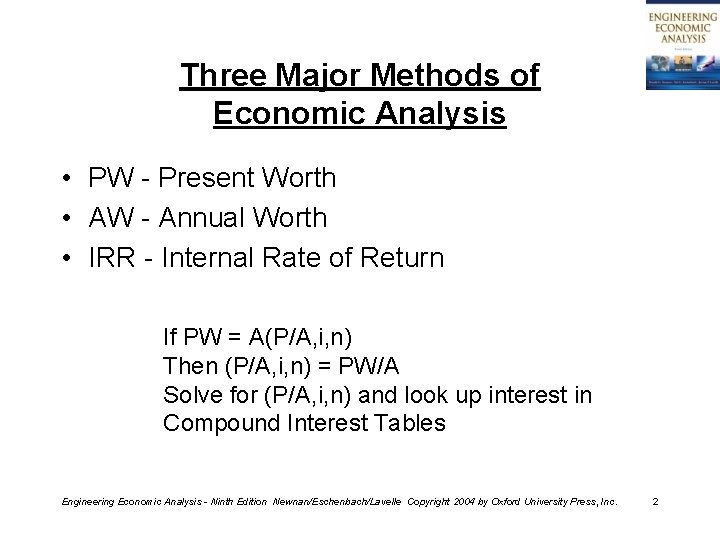
Three Major Methods of Economic Analysis • PW - Present Worth • AW - Annual Worth • IRR - Internal Rate of Return If PW = A(P/A, i, n) Then (P/A, i, n) = PW/A Solve for (P/A, i, n) and look up interest in Compound Interest Tables Engineering Economic Analysis - Ninth Edition Newnan/Eschenbach/Lavelle Copyright 2004 by Oxford University Press, Inc. 2
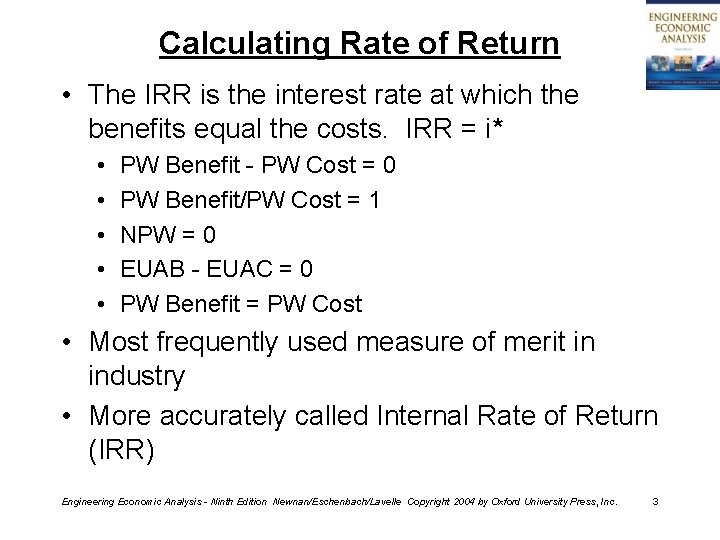
Calculating Rate of Return • The IRR is the interest rate at which the benefits equal the costs. IRR = i* • • • PW Benefit - PW Cost = 0 PW Benefit/PW Cost = 1 NPW = 0 EUAB - EUAC = 0 PW Benefit = PW Cost • Most frequently used measure of merit in industry • More accurately called Internal Rate of Return (IRR) Engineering Economic Analysis - Ninth Edition Newnan/Eschenbach/Lavelle Copyright 2004 by Oxford University Press, Inc. 3
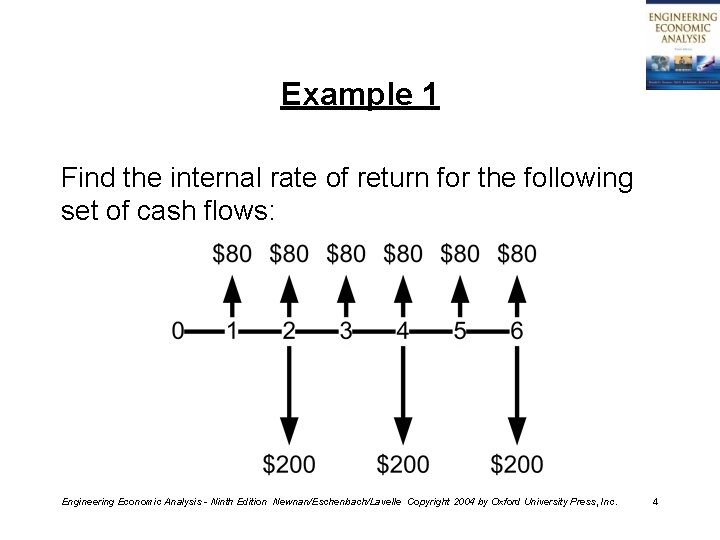
Example 1 Find the internal rate of return for the following set of cash flows: Engineering Economic Analysis - Ninth Edition Newnan/Eschenbach/Lavelle Copyright 2004 by Oxford University Press, Inc. 4
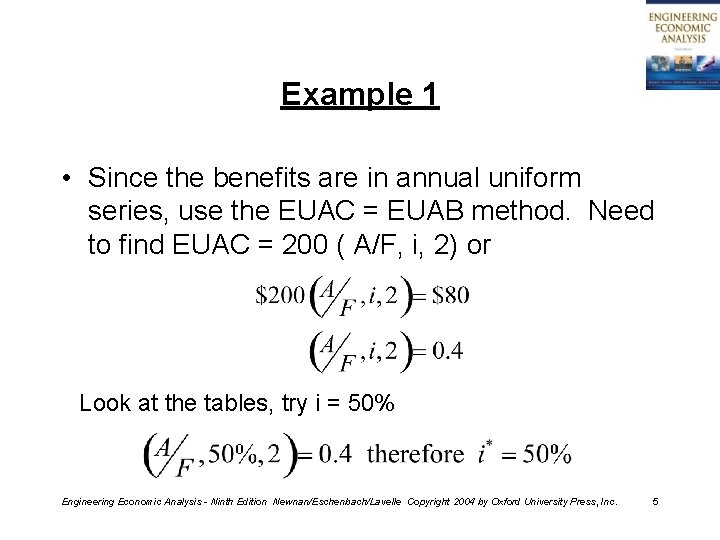
Example 1 • Since the benefits are in annual uniform series, use the EUAC = EUAB method. Need to find EUAC = 200 ( A/F, i, 2) or Look at the tables, try i = 50% Engineering Economic Analysis - Ninth Edition Newnan/Eschenbach/Lavelle Copyright 2004 by Oxford University Press, Inc. 5
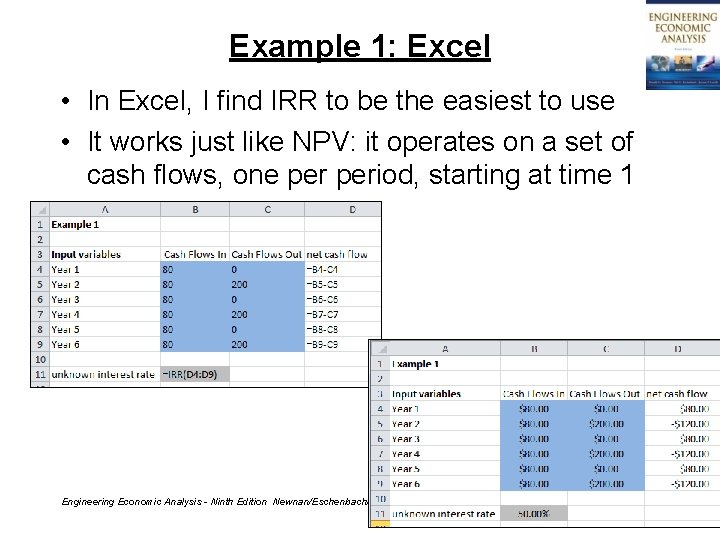
Example 1: Excel • In Excel, I find IRR to be the easiest to use • It works just like NPV: it operates on a set of cash flows, one period, starting at time 1 Engineering Economic Analysis - Ninth Edition Newnan/Eschenbach/Lavelle Copyright 2004 by Oxford University Press, Inc. 6
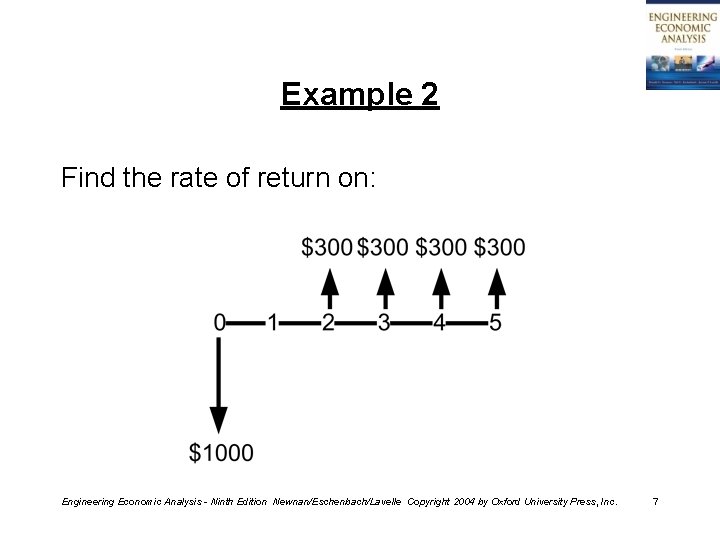
Example 2 Find the rate of return on: Engineering Economic Analysis - Ninth Edition Newnan/Eschenbach/Lavelle Copyright 2004 by Oxford University Press, Inc. 7
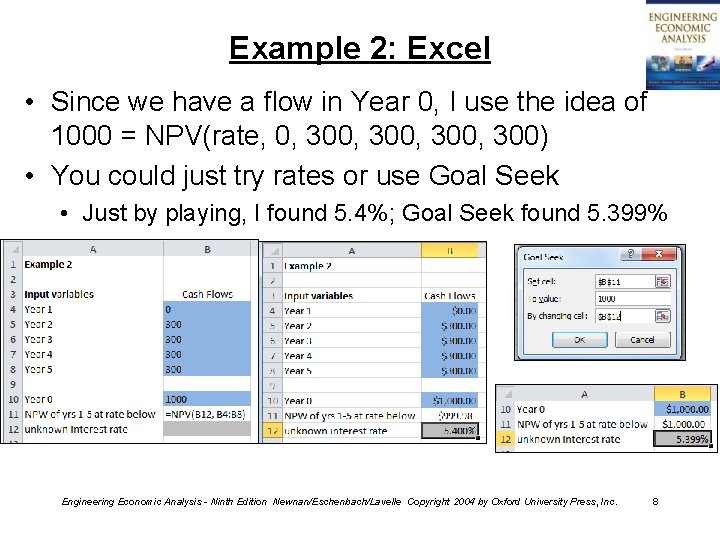
Example 2: Excel • Since we have a flow in Year 0, I use the idea of 1000 = NPV(rate, 0, 300, 300) • You could just try rates or use Goal Seek • Just by playing, I found 5. 4%; Goal Seek found 5. 399% Engineering Economic Analysis - Ninth Edition Newnan/Eschenbach/Lavelle Copyright 2004 by Oxford University Press, Inc. 8
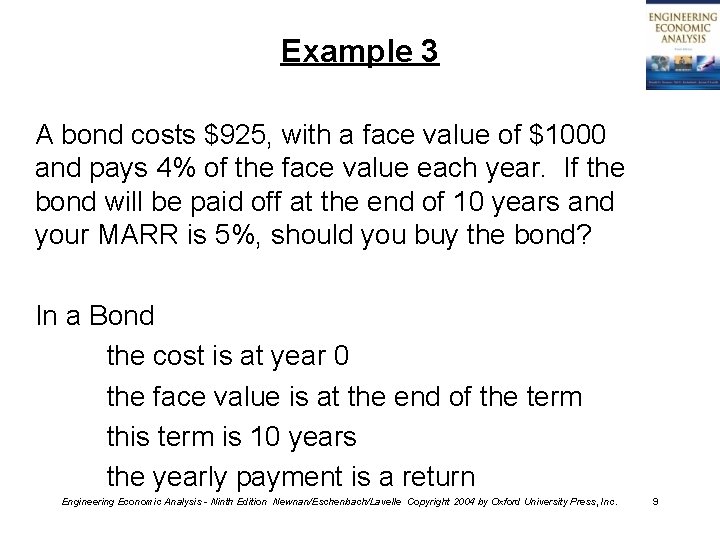
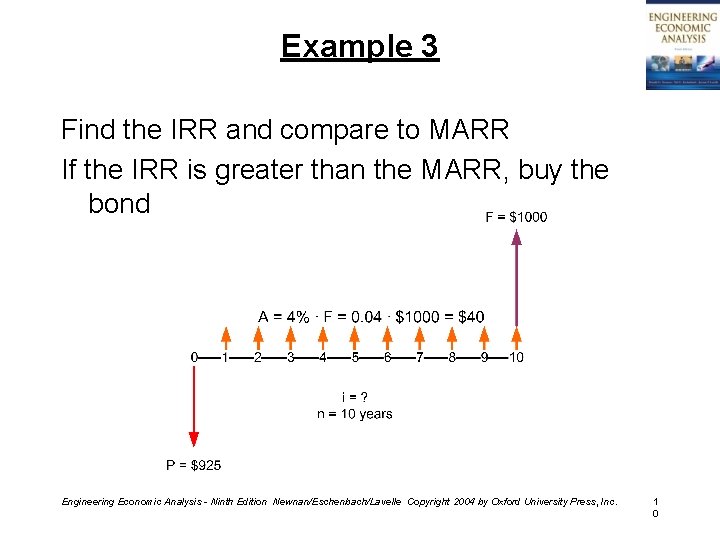
Example 3 A bond costs $925, with a face value of $1000 and pays 4% of the face value each year. If the bond will be paid off at the end of 10 years and your MARR is 5%, should you buy the bond? In a Bond the cost is at year 0 the face value is at the end of the term this term is 10 years the yearly payment is a return Engineering Economic Analysis - Ninth Edition Newnan/Eschenbach/Lavelle Copyright 2004 by Oxford University Press, Inc. 9
Example 3 Find the IRR and compare to MARR If the IRR is greater than the MARR, buy the bond Engineering Economic Analysis - Ninth Edition Newnan/Eschenbach/Lavelle Copyright 2004 by Oxford University Press, Inc. 1 0
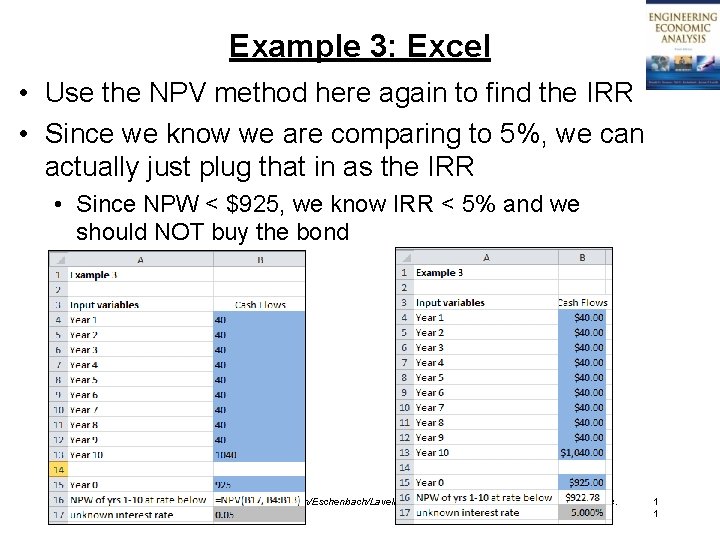
Example 3: Excel • Use the NPV method here again to find the IRR • Since we know we are comparing to 5%, we can actually just plug that in as the IRR • Since NPW < $925, we know IRR < 5% and we should NOT buy the bond Engineering Economic Analysis - Ninth Edition Newnan/Eschenbach/Lavelle Copyright 2004 by Oxford University Press, Inc. 1 1
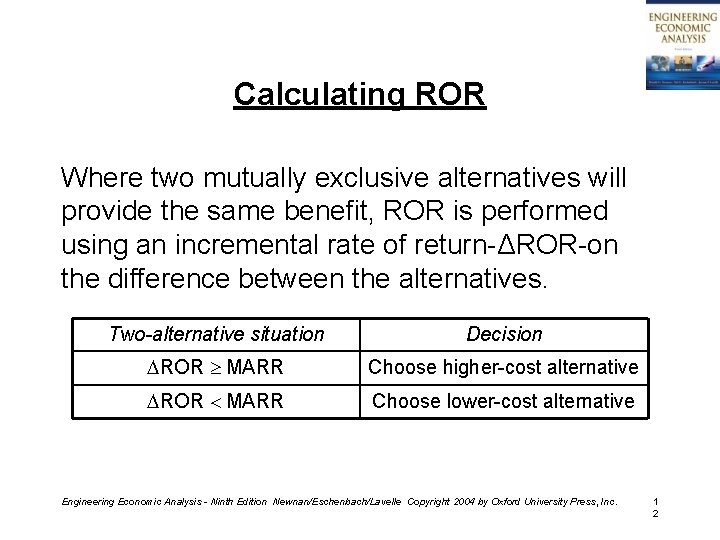
Calculating ROR Where two mutually exclusive alternatives will provide the same benefit, ROR is performed using an incremental rate of return-ΔROR-on the difference between the alternatives. Two-alternative situation Decision DROR ³ MARR Choose higher-cost alternative DROR < MARR Choose lower-cost alternative Engineering Economic Analysis - Ninth Edition Newnan/Eschenbach/Lavelle Copyright 2004 by Oxford University Press, Inc. 1 2
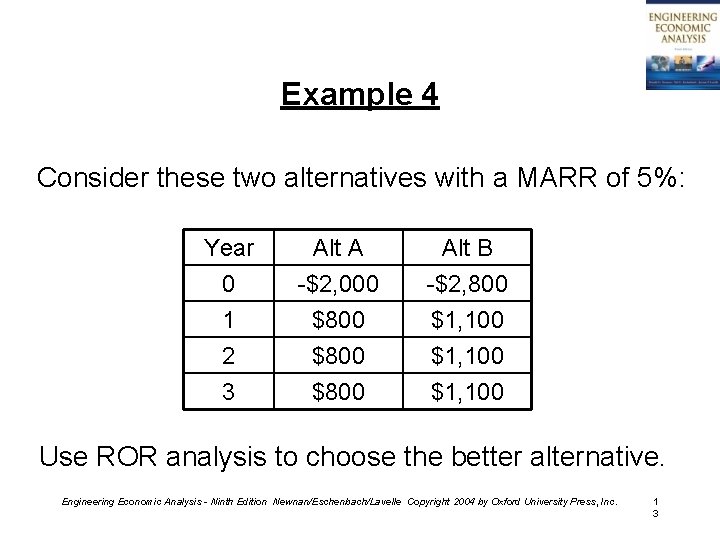
Example 4 Consider these two alternatives with a MARR of 5%: Year 0 1 2 Alt A -$2, 000 $800 Alt B -$2, 800 $1, 100 3 $800 $1, 100 Use ROR analysis to choose the better alternative. Engineering Economic Analysis - Ninth Edition Newnan/Eschenbach/Lavelle Copyright 2004 by Oxford University Press, Inc. 1 3
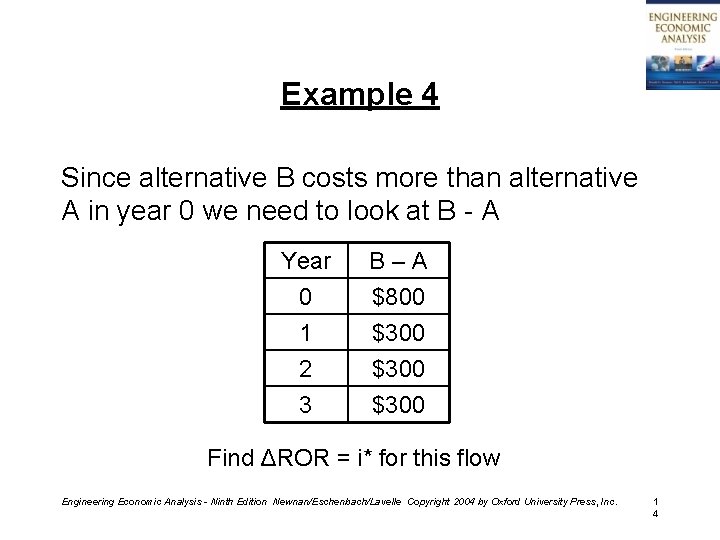
Example 4 Since alternative B costs more than alternative A in year 0 we need to look at B - A Year 0 1 2 B–A $800 $300 3 $300 Find ΔROR = i* for this flow Engineering Economic Analysis - Ninth Edition Newnan/Eschenbach/Lavelle Copyright 2004 by Oxford University Press, Inc. 1 4
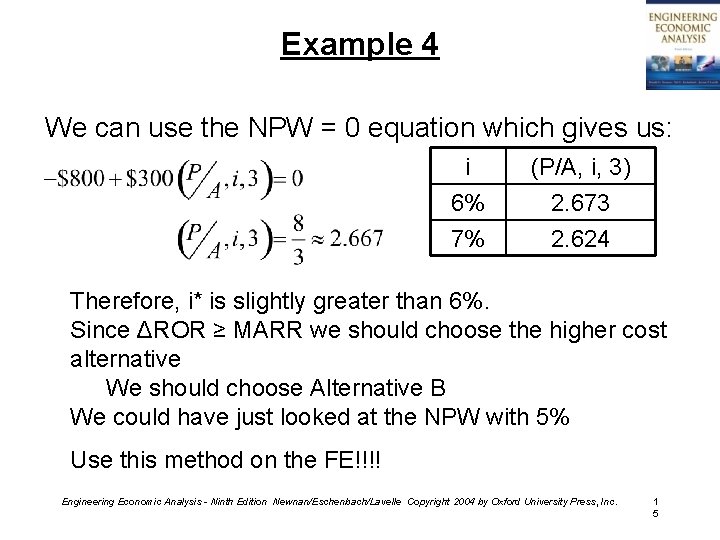
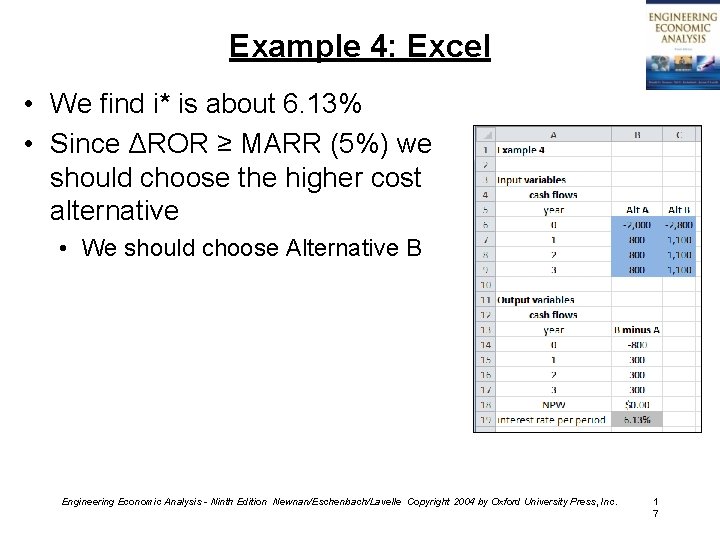
Example 4 We can use the NPW = 0 equation which gives us: i 6% 7% (P/A, i, 3) 2. 673 2. 624 Therefore, i* is slightly greater than 6%. Since ΔROR ≥ MARR we should choose the higher cost alternative We should choose Alternative B We could have just looked at the NPW with 5% Use this method on the FE!!!! Engineering Economic Analysis - Ninth Edition Newnan/Eschenbach/Lavelle Copyright 2004 by Oxford University Press, Inc. 1 5
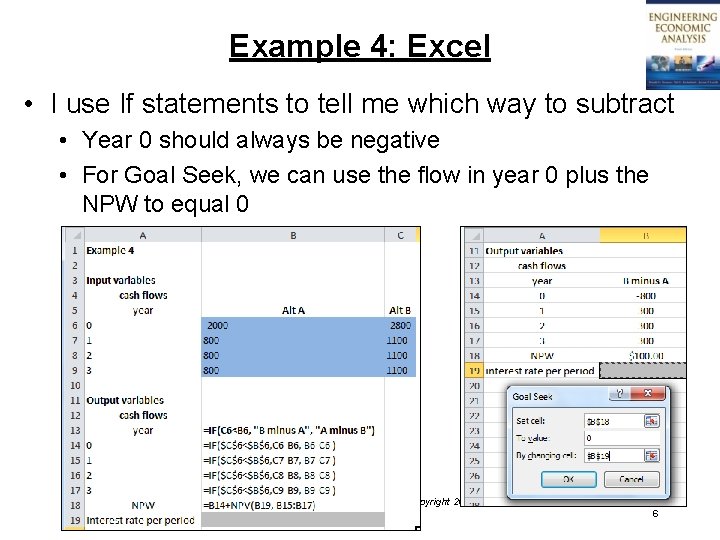
Example 4: Excel • I use If statements to tell me which way to subtract • Year 0 should always be negative • For Goal Seek, we can use the flow in year 0 plus the NPW to equal 0 Engineering Economic Analysis - Ninth Edition Newnan/Eschenbach/Lavelle Copyright 2004 by Oxford University Press, Inc. 1 6
Example 4: Excel • We find i* is about 6. 13% • Since ΔROR ≥ MARR (5%) we should choose the higher cost alternative • We should choose Alternative B Engineering Economic Analysis - Ninth Edition Newnan/Eschenbach/Lavelle Copyright 2004 by Oxford University Press, Inc. 1 7
Analysis Period • Just as in PW and AW analysis, the analysis period must be considered: • Useful life of the alternative equals the analysis period • Alternatives have useful lives different from the analysis period • The analysis period is infinite, n = ∞ Engineering Economic Analysis - Ninth Edition Newnan/Eschenbach/Lavelle Copyright 2004 by Oxford University Press, Inc. 1 8
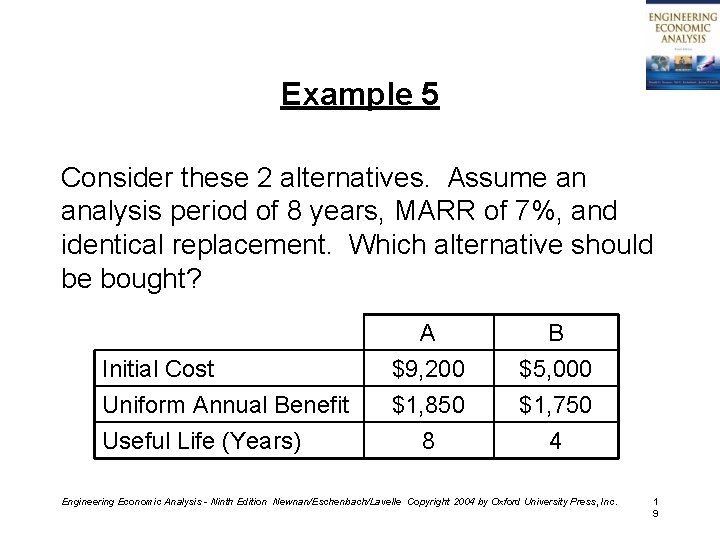
Example 5 Consider these 2 alternatives. Assume an analysis period of 8 years, MARR of 7%, and identical replacement. Which alternative should be bought? Initial Cost Uniform Annual Benefit Useful Life (Years) A $9, 200 $1, 850 8 B $5, 000 $1, 750 4 Engineering Economic Analysis - Ninth Edition Newnan/Eschenbach/Lavelle Copyright 2004 by Oxford University Press, Inc. 1 9
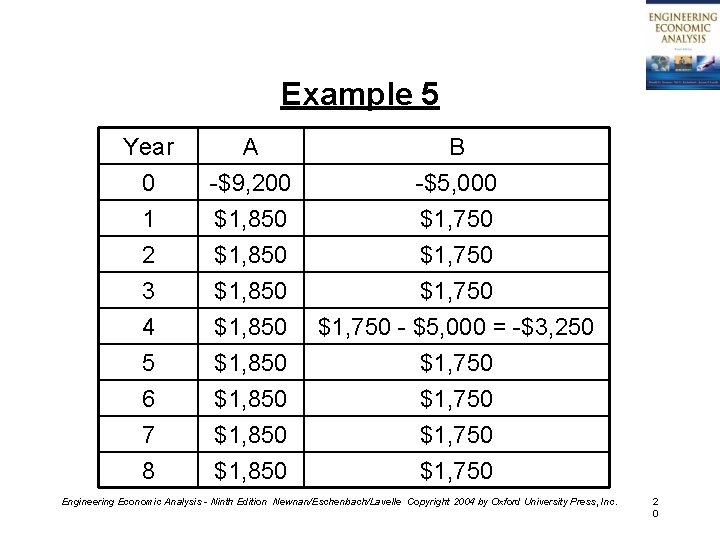
Example 5 Year 0 1 2 A -$9, 200 $1, 850 B -$5, 000 $1, 750 3 4 5 6 7 8 $1, 850 $1, 850 $1, 750 - $5, 000 = -$3, 250 $1, 750 Engineering Economic Analysis - Ninth Edition Newnan/Eschenbach/Lavelle Copyright 2004 by Oxford University Press, Inc. 2 0
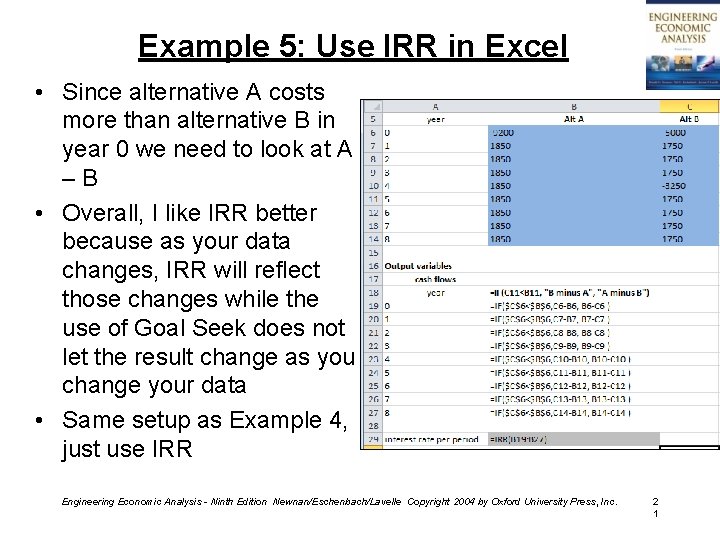
Example 5: Use IRR in Excel • Since alternative A costs more than alternative B in year 0 we need to look at A –B • Overall, I like IRR better because as your data changes, IRR will reflect those changes while the use of Goal Seek does not let the result change as you change your data • Same setup as Example 4, just use IRR Engineering Economic Analysis - Ninth Edition Newnan/Eschenbach/Lavelle Copyright 2004 by Oxford University Press, Inc. 2 1
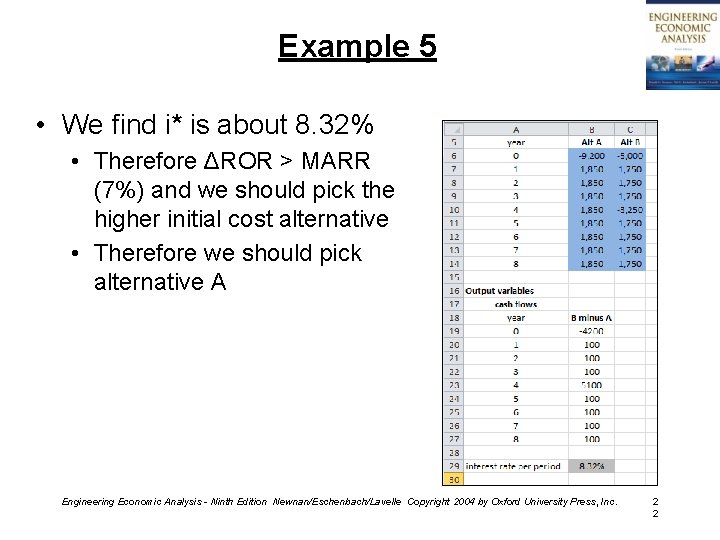
Example 5 • We find i* is about 8. 32% • Therefore ΔROR > MARR (7%) and we should pick the higher initial cost alternative • Therefore we should pick alternative A Engineering Economic Analysis - Ninth Edition Newnan/Eschenbach/Lavelle Copyright 2004 by Oxford University Press, Inc. 2 2
Borrowing Money • If 0 th year is an inflow, as in a loan, treat it like an investment • Change all of the signs, but choose the opposite alternative • Why? • Because, as a borrower, you want a lower rate, while as the investor, you want the higher rate Engineering Economic Analysis - Ninth Edition Newnan/Eschenbach/Lavelle Copyright 2004 by Oxford University Press, Inc. 2 3