
Engineering drawing is a language of all persons
- Slides: 95
Engineering drawing is a language of all persons involved in engineering activity. Engineering ideas are recorded by preparing drawings and execution of work is also carried out on the basis of drawings. Communication in engineering field is done by drawings. It is called as a “Language of Engineers”.
CHAPTER – 2 ENGINEERING CURVES
USES OF ENGINEERING CURVES Useful by their nature & characteristics. Laws of nature represented on graph. Useful in engineering in understanding laws, manufacturing of various items, designing mechanisms analysis of forces, construction of bridges, dams, water tanks etc.
CLASSIFICATION OF ENGG. CURVES 1. CONICS 2. CYCLOIDAL CURVES 3. INVOLUTE 4. SPIRAL 5. HELIX 6. SINE & COSINE
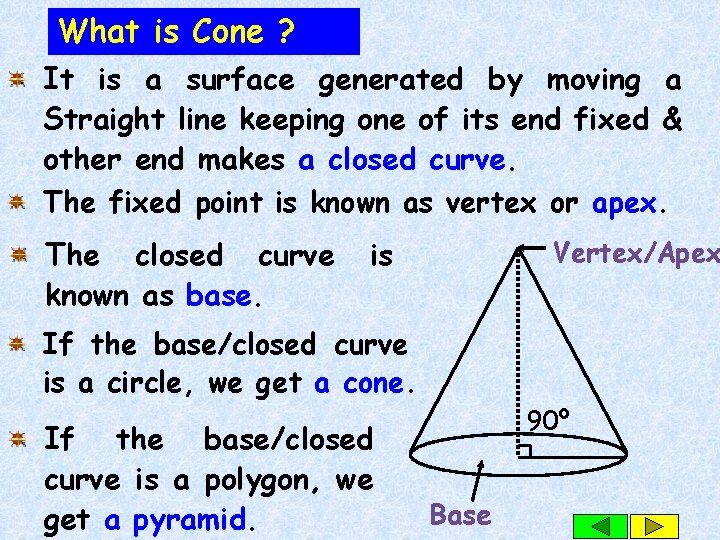
What is Cone ? It is a surface generated by moving a Straight line keeping one of its end fixed & other end makes a closed curve. The fixed point is known as vertex or apex. The closed curve known as base. Vertex/Apex is If the base/closed curve is a circle, we get a cone. If the base/closed curve is a polygon, we get a pyramid. 90º Base
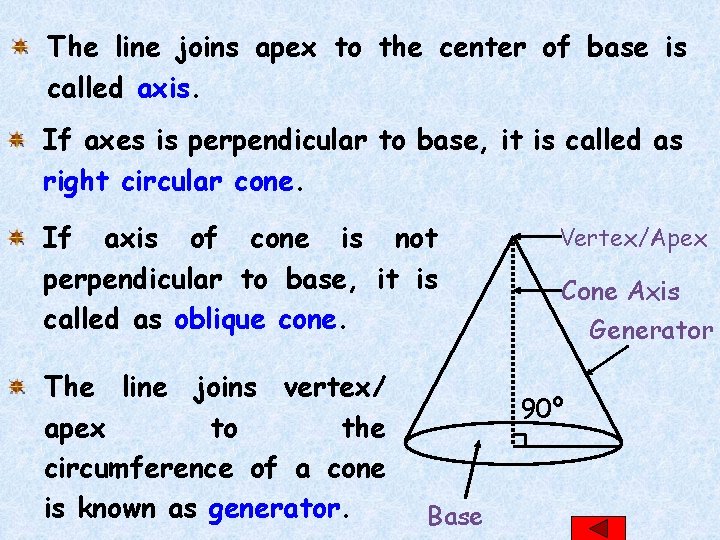
The line joins apex to the center of base is called axis. If axes is perpendicular to base, it is called as right circular cone. If axis of cone is not perpendicular to base, it is called as oblique cone. The line joins vertex/ apex to the circumference of a cone is known as generator. Vertex/Apex Cone Axis Generator 90º Base
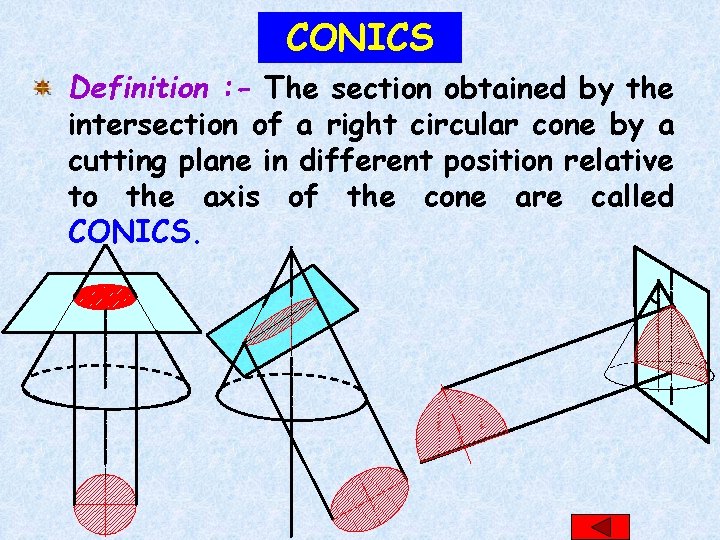
CONICS Definition : - The section obtained by the intersection of a right circular cone by a cutting plane in different position relative to the axis of the cone are called CONICS.
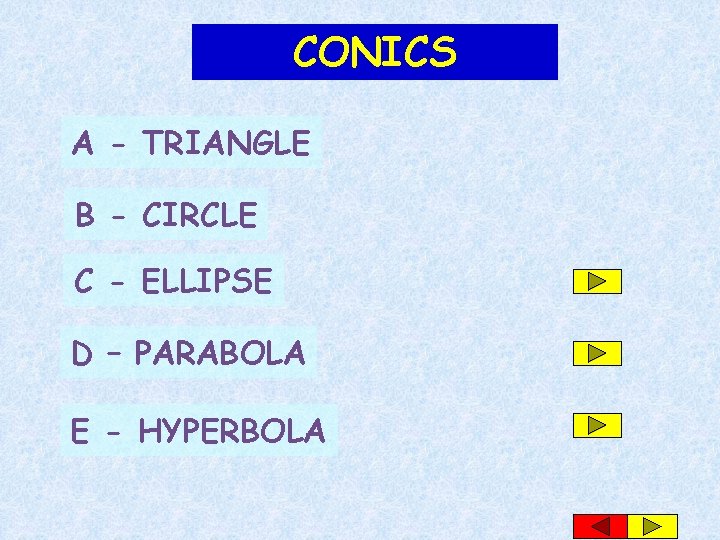
CONICS A - TRIANGLE B - CIRCLE C - ELLIPSE D – PARABOLA E - HYPERBOLA
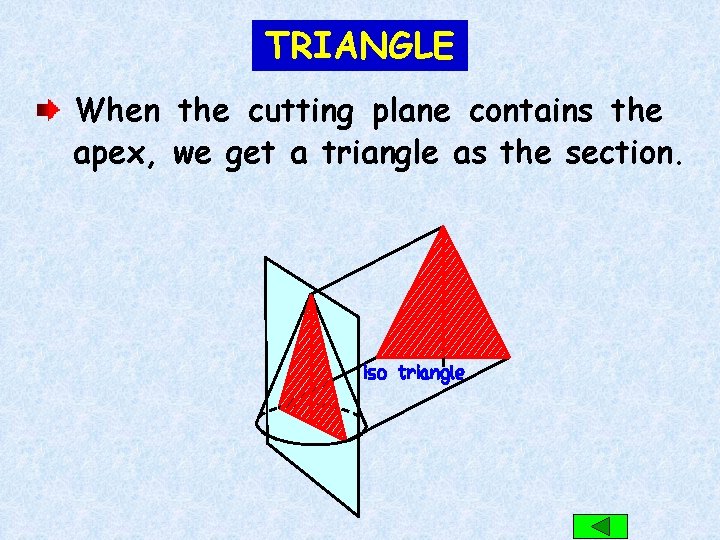
TRIANGLE When the cutting plane contains the apex, we get a triangle as the section.
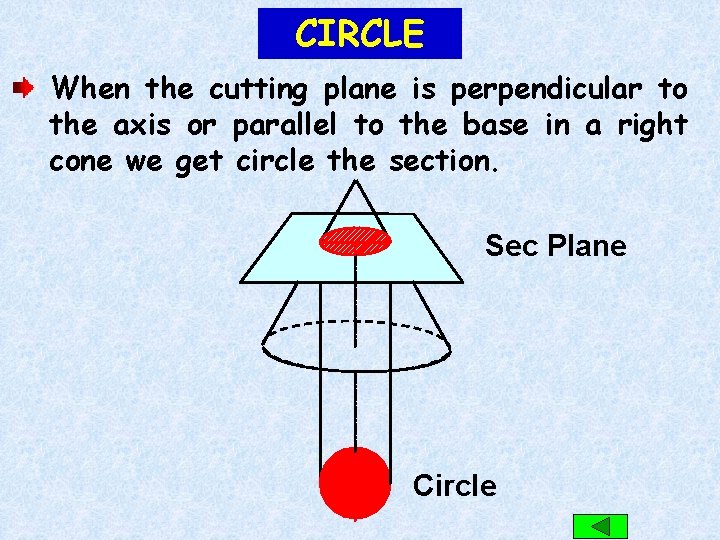
CIRCLE When the cutting plane is perpendicular to the axis or parallel to the base in a right cone we get circle the section. Sec Plane Circle
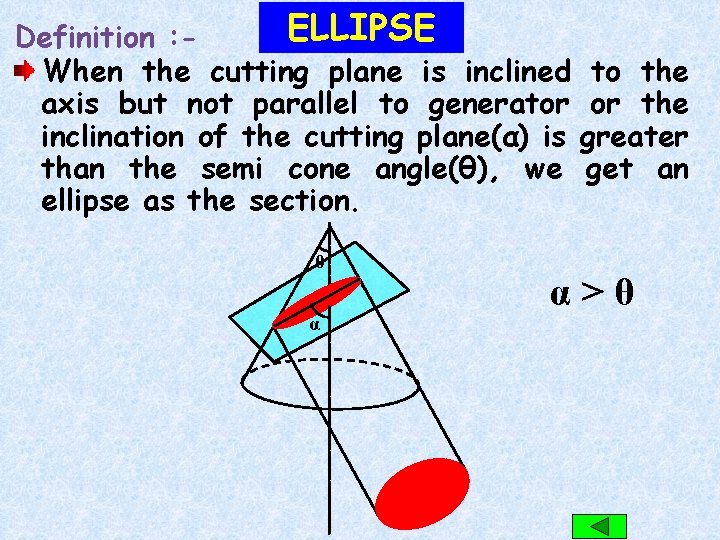
ELLIPSE Definition : When the cutting plane is inclined to the axis but not parallel to generator or the inclination of the cutting plane(α) is greater than the semi cone angle(θ), we get an ellipse as the section. θ α α>θ
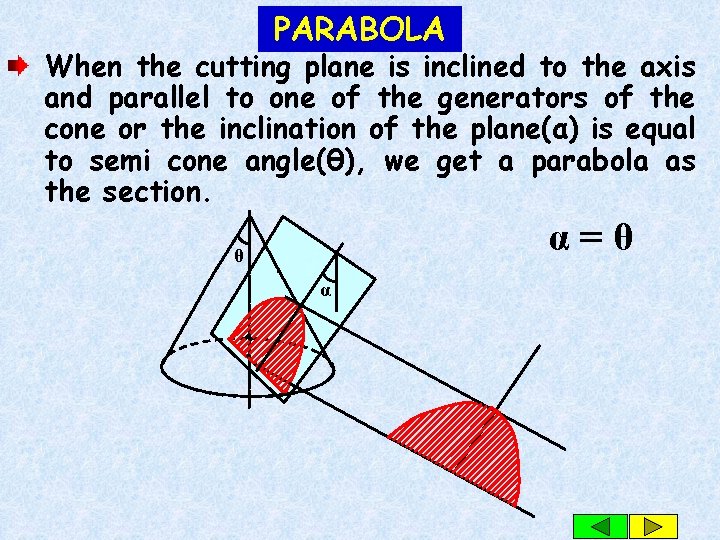
PARABOLA When the cutting plane is inclined to the axis and parallel to one of the generators of the cone or the inclination of the plane(α) is equal to semi cone angle(θ), we get a parabola as the section. α=θ θ α
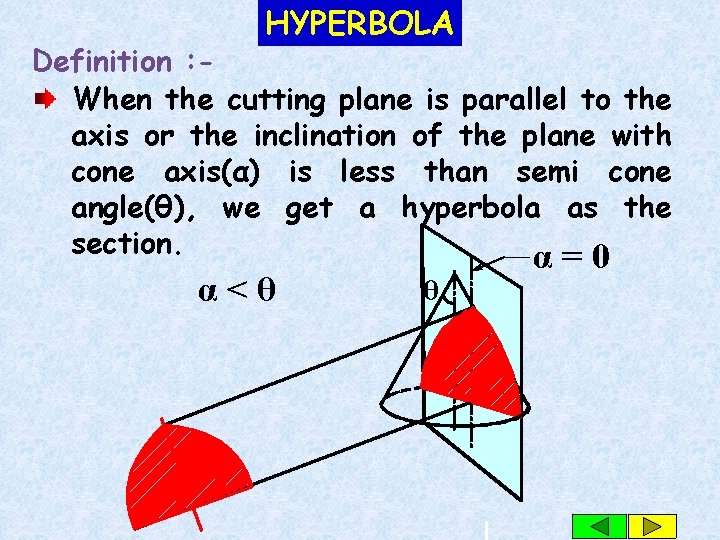
HYPERBOLA Definition : When the cutting plane is parallel to the axis or the inclination of the plane with cone axis(α) is less than semi cone angle(θ), we get a hyperbola as the section. α=0 α<θ θ θ
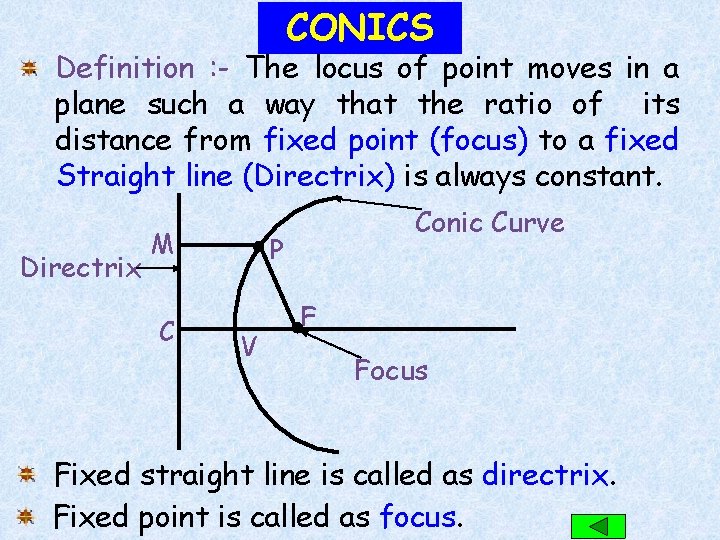
CONICS Definition : - The locus of point moves in a plane such a way that the ratio of its distance from fixed point (focus) to a fixed Straight line (Directrix) is always constant. Directrix M C Conic Curve P V F Focus Fixed straight line is called as directrix. Fixed point is called as focus.
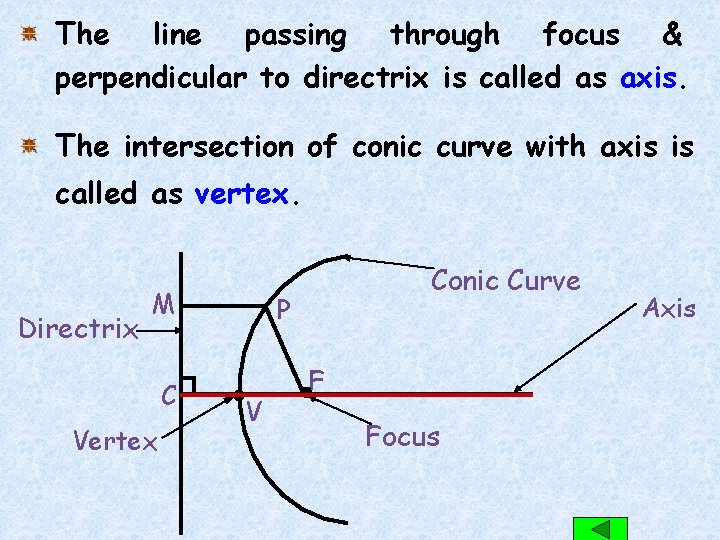
The line passing through focus & perpendicular to directrix is called as axis. The intersection of conic curve with axis is called as vertex. Directrix M C Vertex Conic Curve P V F Focus Axis
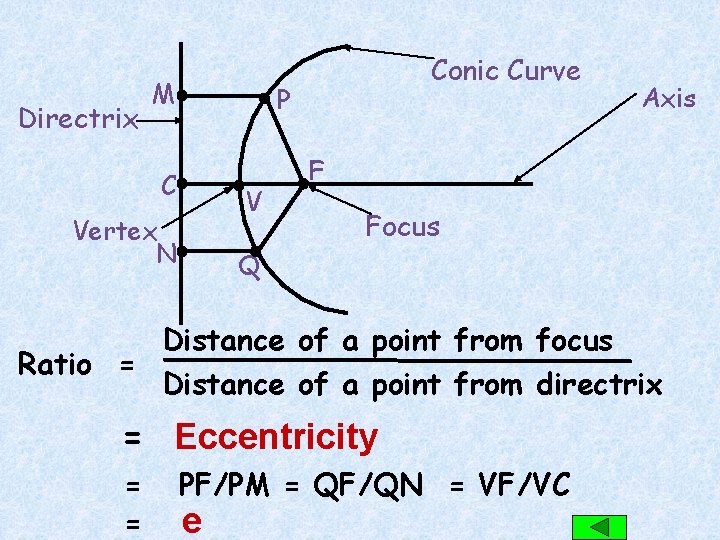
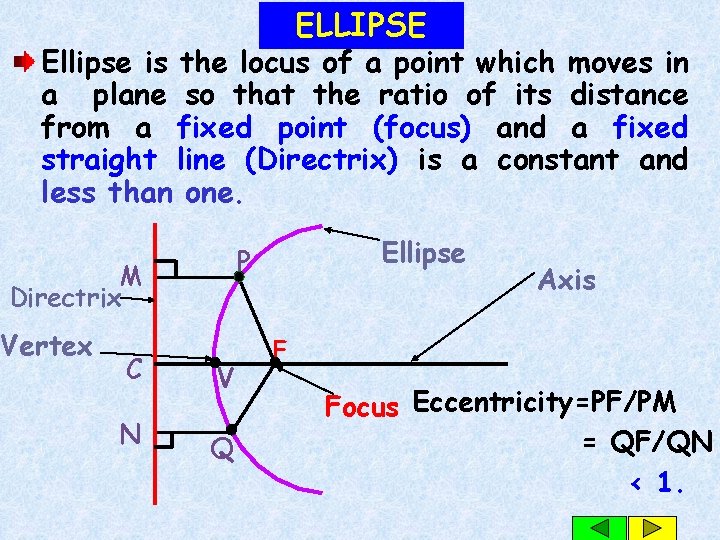
Directrix M Conic Curve P C V Vertex N Axis F Focus Q Distance of a point from focus Ratio = Distance of a point from directrix = Eccentricity = = PF/PM = QF/QN = VF/VC e
ELLIPSE Ellipse is the locus of a point which moves in a plane so that the ratio of its distance from a fixed point (focus) and a fixed straight line (Directrix) is a constant and less than one. M Directrix Vertex C N Ellipse P V Q Axis F Focus Eccentricity=PF/PM = QF/QN < 1.
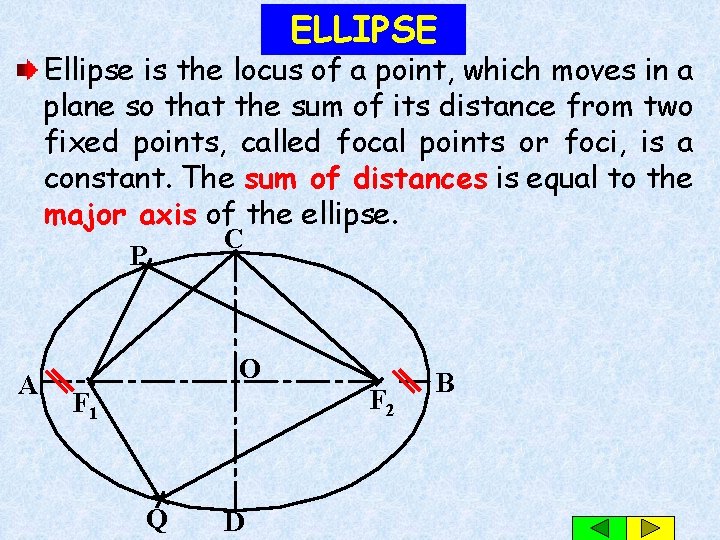
ELLIPSE Ellipse is the locus of a point, which moves in a plane so that the sum of its distance from two fixed points, called focal points or foci, is a constant. The sum of distances is equal to the major axis of the ellipse. P A C O F 2 F 1 Q D B
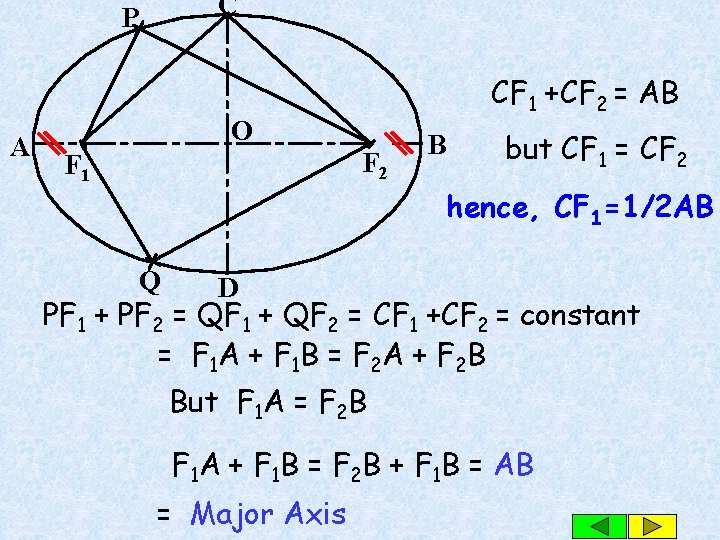
C P A CF 1 +CF 2 = AB O F 2 F 1 B but CF 1 = CF 2 hence, CF 1=1/2 AB Q D PF 1 + PF 2 = QF 1 + QF 2 = CF 1 +CF 2 = constant = F 1 A + F 1 B = F 2 A + F 2 B But F 1 A = F 2 B F 1 A + F 1 B = F 2 B + F 1 B = AB = Major Axis
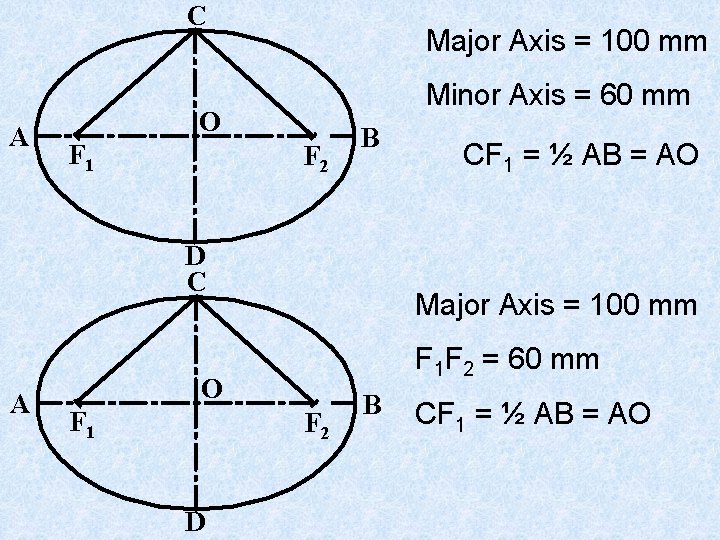
C A Major Axis = 100 mm Minor Axis = 60 mm O F 1 F 2 B D C A Major Axis = 100 mm F 1 F 2 = 60 mm O F 1 F 2 D CF 1 = ½ AB = AO B CF 1 = ½ AB = AO
Uses : - Shape of a man-hole. Shape of tank in a tanker. Flanges of pipes, glands and stuffing boxes. Shape used in bridges and arches. Monuments. Path of earth around the sun. Shape of trays etc.
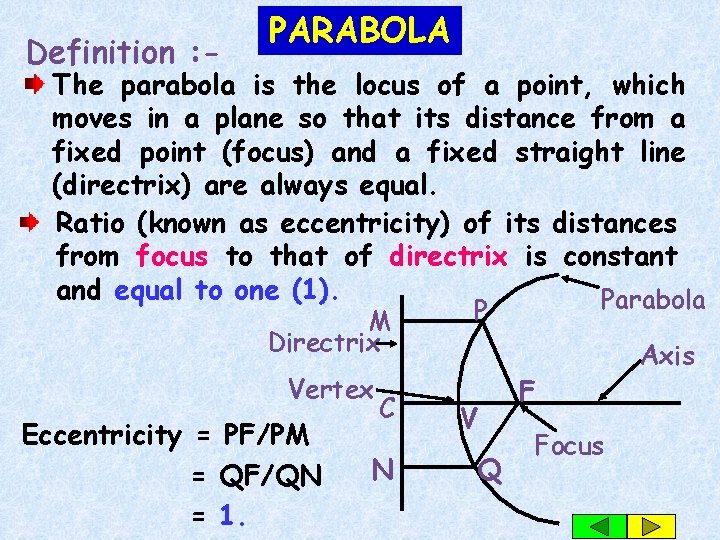
Definition : - PARABOLA The parabola is the locus of a point, which moves in a plane so that its distance from a fixed point (focus) and a fixed straight line (directrix) are always equal. Ratio (known as eccentricity) of its distances from focus to that of directrix is constant and equal to one (1). Parabola M Directrix Vertex Eccentricity = PF/PM = QF/QN = 1. C N P V Q F Focus Axis
Uses : Motor car head lamp reflector. Sound reflector and detector. Bridges and arches construction Shape of cooling towers. Path of particle thrown at any angle with earth, etc. Home
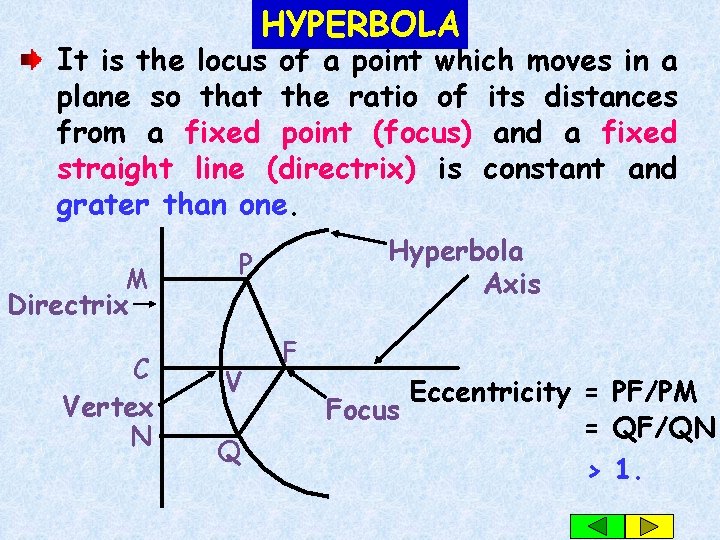
HYPERBOLA It is the locus of a point which moves in a plane so that the ratio of its distances from a fixed point (focus) and a fixed straight line (directrix) is constant and grater than one. M Hyperbola Axis P Directrix C Vertex N V Q F Eccentricity = PF/PM Focus = QF/QN > 1.
Uses : Nature of graph of Boyle’s law Shape of overhead water tanks Shape of cooling towers etc.
METHODS FOR DRAWING ELLIPSE 1. Arc of Circle’s Method 2. Directrix Focus Method
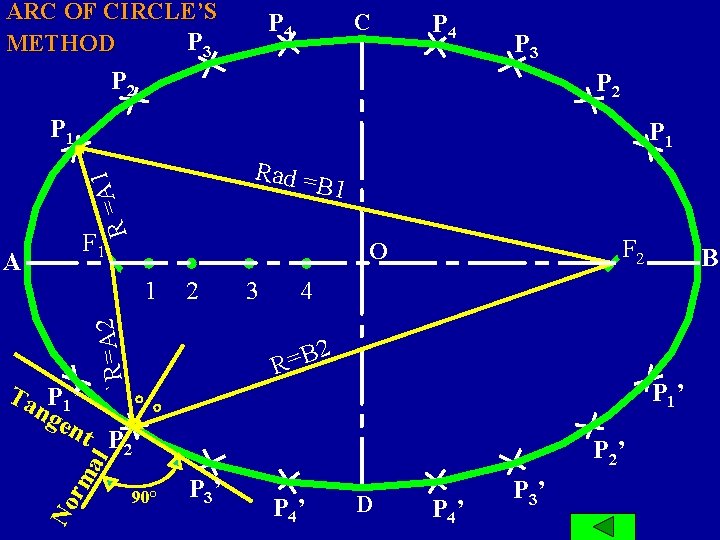
ARC OF CIRCLE’S P 3 METHOD P 4 C P 4 P 3 P 2 P 1 1 A = R Rad = B 1 F 1 A `R=A 2 1 2 3 2 B = R P 1’ P 2’ rm No 90° P 2’ P 3’ B 4 al Ta P 1’ ng ent F 2 O P 4’ D P 4’ P 3’
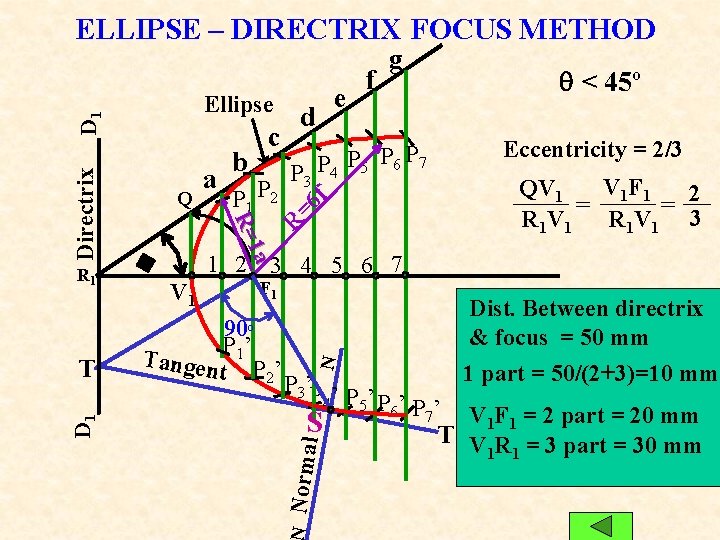
ELLIPSE – DIRECTRIX FOCUS METHOD D 1 d < 45º Eccentricity = 2/3 P 6 P 7 P P 5 P 3 4 R =6 f` V 1 F 1 QV 1 2 = = R 1 V 1 3 1 2 3 4 5 6 7 V 1 F 1 90° P’ Tangen 1 P ’ t 2 N T P 1 P 2 e P 3’P ’ 4 P 5’ P ’ 6 7 S Normal R 1 Q a b c 1 a R= Directrix D 1 Ellipse f g Dist. Between directrix & focus = 50 mm 1 part = 50/(2+3)=10 mm V 1 F 1 = 2 part = 20 mm T V R = 3 part = 30 mm 1 1
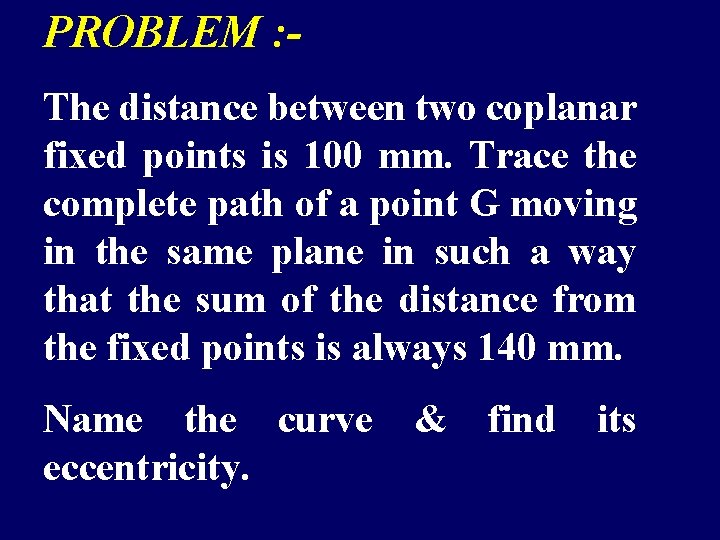
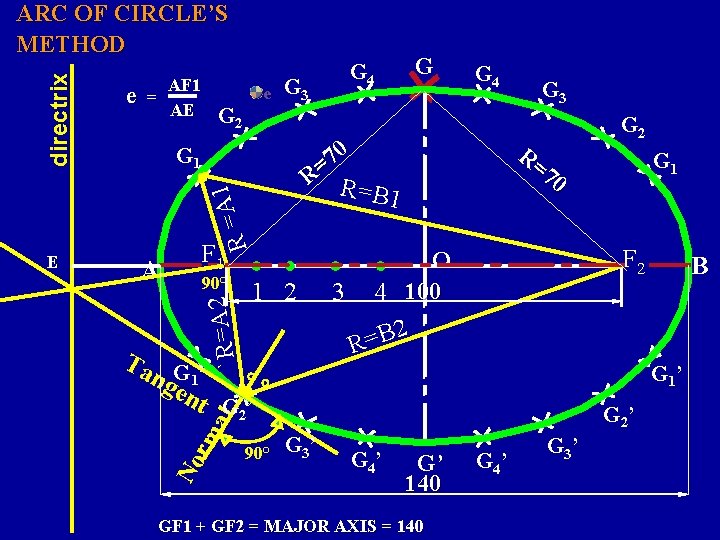
PROBLEM : The distance between two coplanar fixed points is 100 mm. Trace the complete path of a point G moving in the same plane in such a way that the sum of the distance from the fixed points is always 140 mm. Name the curve eccentricity. & find its
e AF 1 = AE G 2 90° 1 2 3 G 3 R= 70 R=B 1 F 1 `R=A 2 A G 4 0 7 R= G 1 F 2 O 4 100 B G 1’ G 2’ al rm 90° G 2 2 B = R Ta G ’ ng 1 ent G 2’ No E G G 4 e G 3 1 A = R directrix ARC OF CIRCLE’S METHOD G 3’ G 4’ G’ 140 GF 1 + GF 2 = MAJOR AXIS = 140 G 4’ G 3’
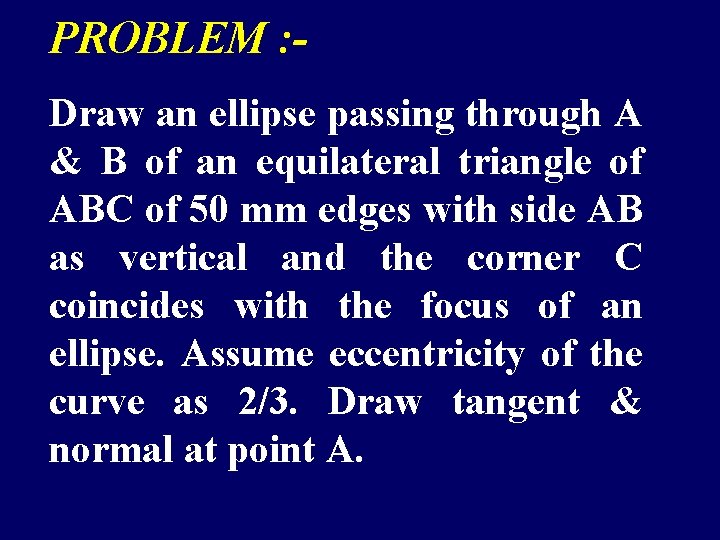
PROBLEM : Draw an ellipse passing through A & B of an equilateral triangle of ABC of 50 mm edges with side AB as vertical and the corner C coincides with the focus of an ellipse. Assume eccentricity of the curve as 2/3. Draw tangent & normal at point A.
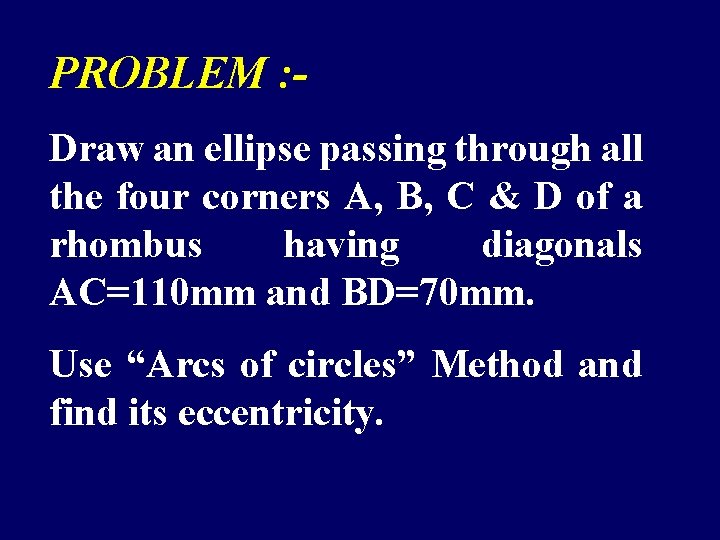
PROBLEM : Draw an ellipse passing through all the four corners A, B, C & D of a rhombus having diagonals AC=110 mm and BD=70 mm. Use “Arcs of circles” Method and find its eccentricity.
METHODS FOR DRAWING PARABOLA 1. Rectangle Method 2. Parabola in Parallelogram 3. Directrix Focus Method
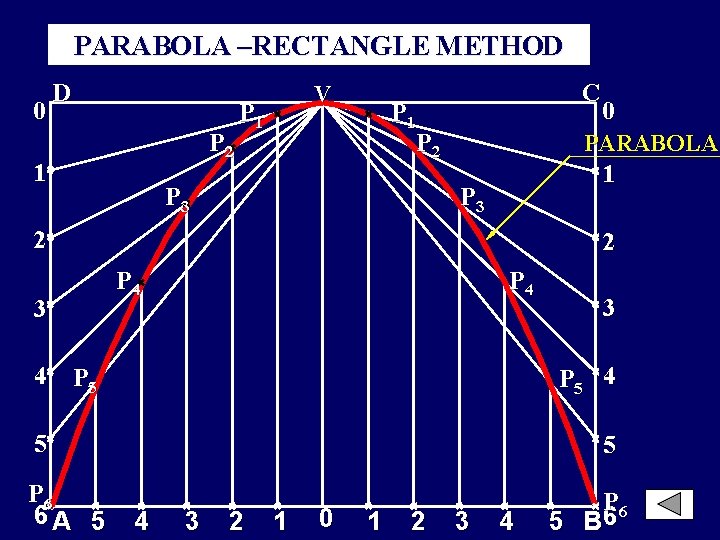
PARABOLA –RECTANGLE METHOD 0 D P 2 1 V P 1 C P 1 P 2 P 3 PARABOLA 1 P 3 2 P 4 4 P 5 3 P 5 4 5 P 6 6 A 5 0 5 4 3 2 1 0 1 2 3 4 P 6 5 B 6
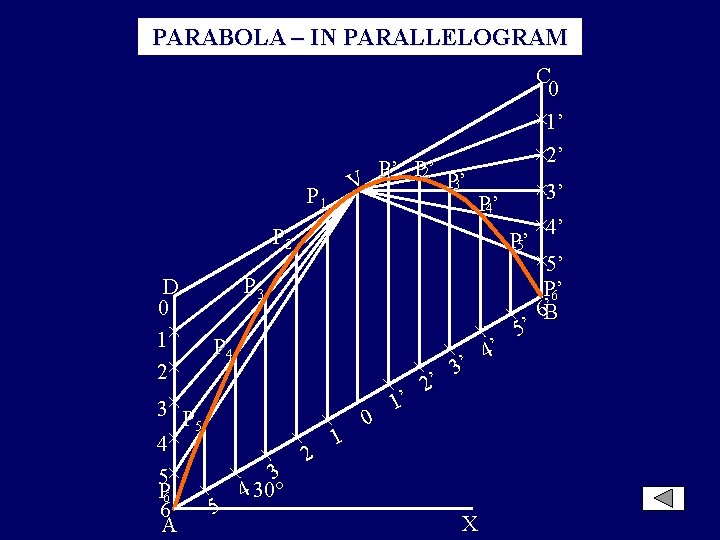
PARABOLA – IN PARALLELOGRAM P 1 P’ P’ 2 1 P’ 3 V C 0 1’ 2’ P 2 D 0 1 2 3’ P’ 4 P’ 5 P 3 P 4 1’ 3 P 0 5 1 4 2 3 5 P 6 4 30° 5 6 A 2’ 4’ 3’ X 5’ 4’ 5’ P’ 6 ’ 6 B
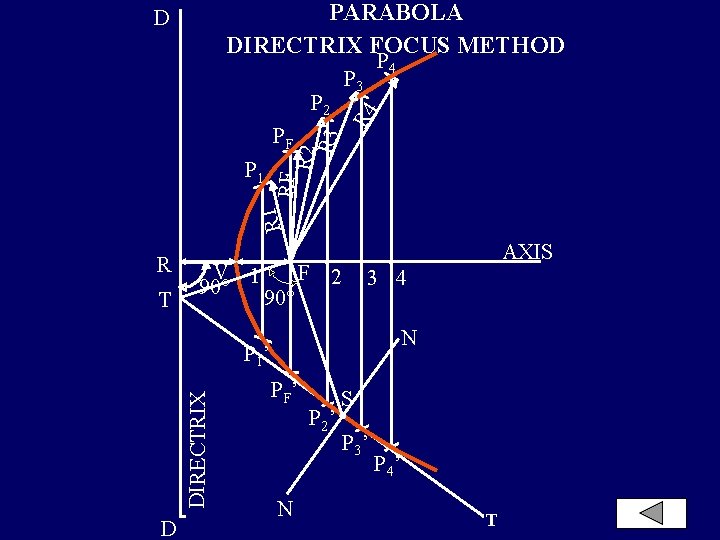
PARABOLA DIRECTRIX FOCUS METHOD D P 3 R 4 P 2 R 1 RF R 2 R 3 PF P 1 P 4 R T AXIS V 1 F 2 90° 3 4 N DIRECTRIX P 1’ D P F’ P 2’ N S P 3’ P 4’ T
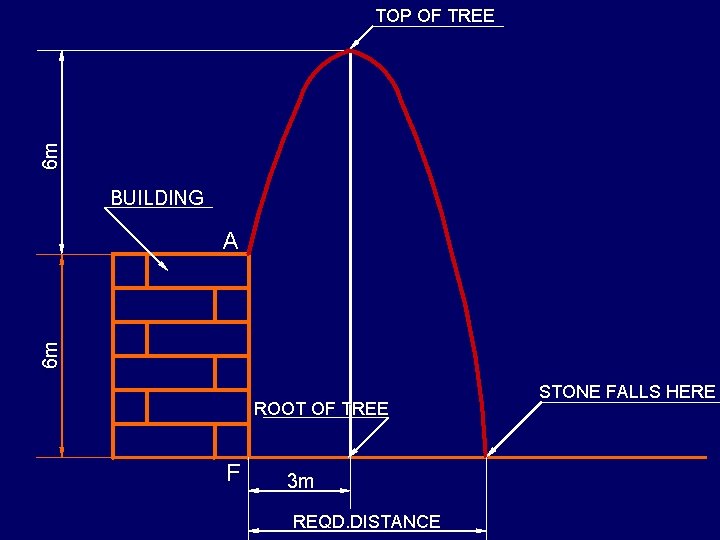
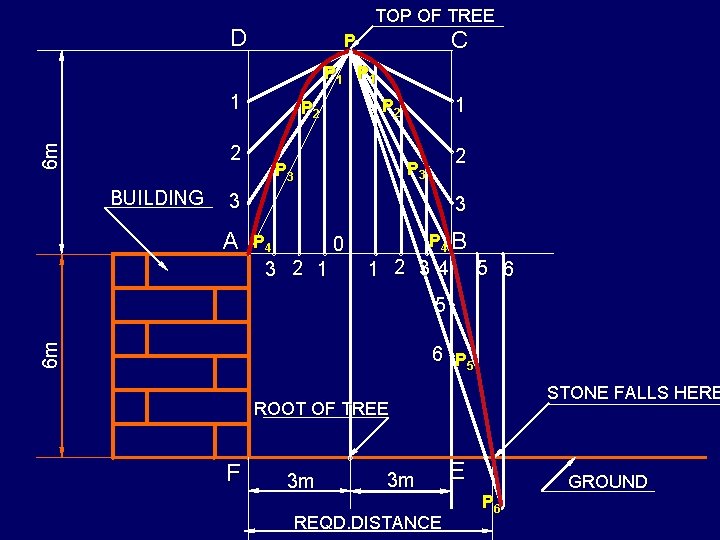
PROBLEM: A stone is thrown from a building 6 m high. It just crosses the top of a palm tree 12 m high. Trace the path of the projectile if the horizontal distance between the building and the palm tree is 3 m. Also find the distance of the point from the building where the stone falls on the ground.
6 m TOP OF TREE BUILDING 6 m A ROOT OF TREE F 3 m REQD. DISTANCE STONE FALLS HERE
TOP OF TREE D C P P 1 6 m 1 2 BUILDING 1 P 2 2 P 3 3 A 3 P 4 B 0 3 2 1 1 2 3 4 5 6 6 m 5 6 P 5 STONE FALLS HERE ROOT OF TREE F 3 m 3 m REQD. DISTANCE E P 6 GROUND
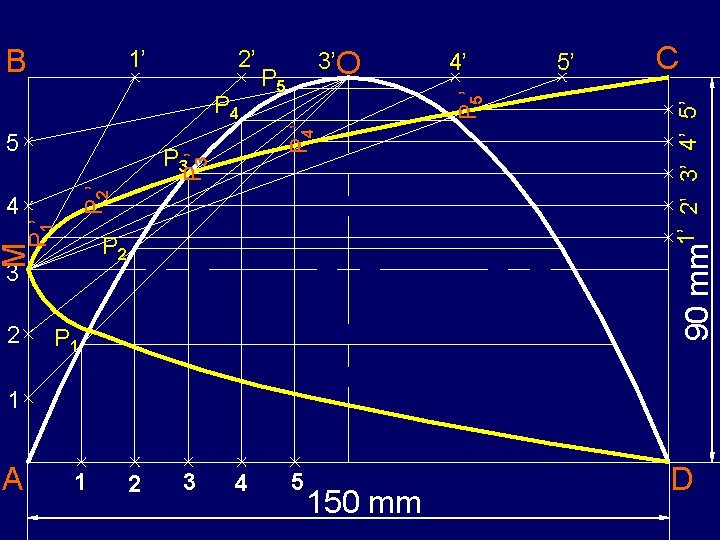
PROBLEM: In a rectangle of sides 150 mm and 90 mm, inscribe two parabola such that their axis bisect each other. Find out their focus points & positions of directrix.
P 4 5 3 2 4’ 5’ C 90 mm 1’ P 2’ P 3’ P 5 P 2 M 4 P 3 3’O 2’ 3’ 4’ 5’ 2’ P 5’ 1’ P 4’ B P 1 1 A 1 2 3 4 5 150 mm D
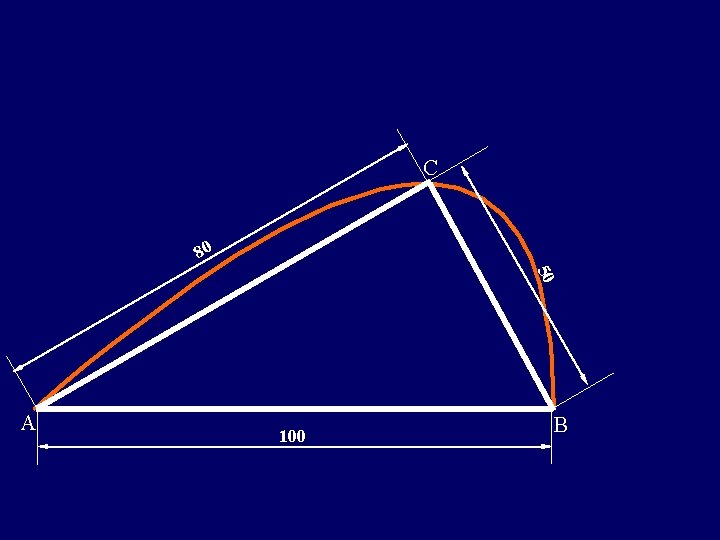
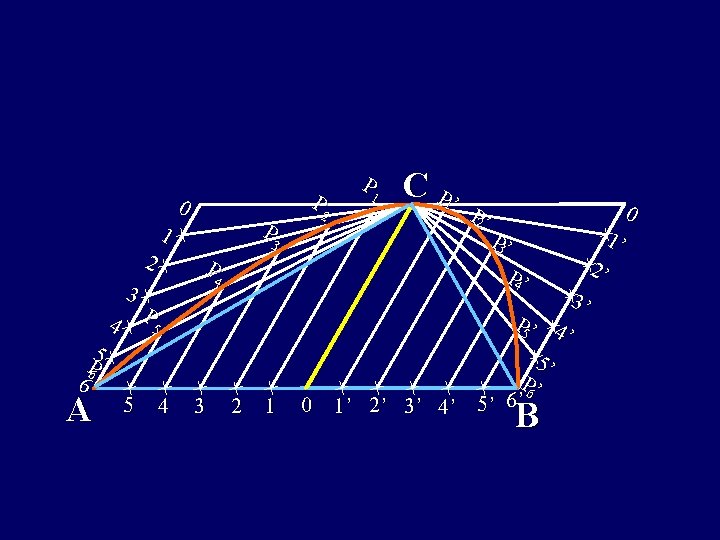
example Draw a parabola passing through three different points A, B and C such that AB = 100 mm, BC=50 mm respectively. and CA=80 mm
C 80 50 A 100 B
0 P 3 1 2 3 4 5 P 6 6 A P 4 P 5 5 4 3 2 1 P 2 P 1 C P 1’ P 2’ 0 P 3’ P 4’ P 5’ 4 ’ 5’ P 6’ 0 1’ 2’ 3’ 4’ 5’ 6’ B 2’ 3’ 1’
METHODS FOR DRAWING HYPERBOLA 1. Rectangle Method 2. Oblique Method 3. Directrix Focus Method
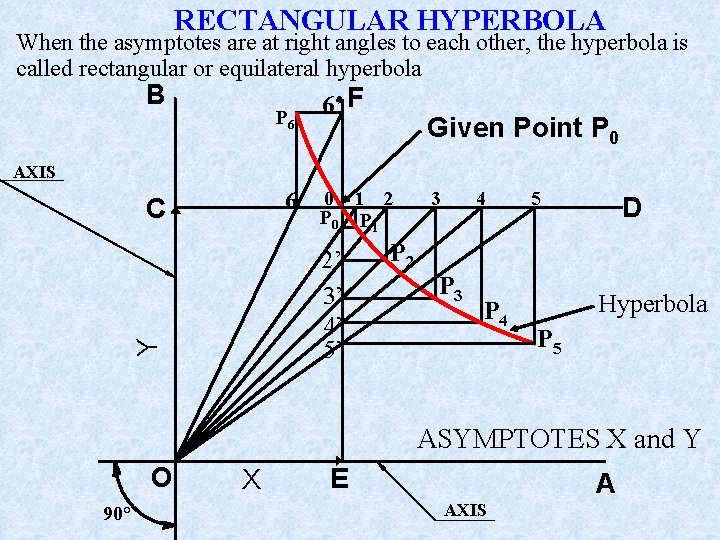
RECTANGULAR HYPERBOLA When the asymptotes are at right angles to each other, the hyperbola is called rectangular or equilateral hyperbola B P 6 6’ F Given Point P 0 AXIS 6 C 0 1 2 P 0 P 1 Y 2’ 3’ 4’ 5’ 3 4 5 D P 2 P 3 P 4 Hyperbola P 5 ASYMPTOTES X and Y O 90° X E A AXIS
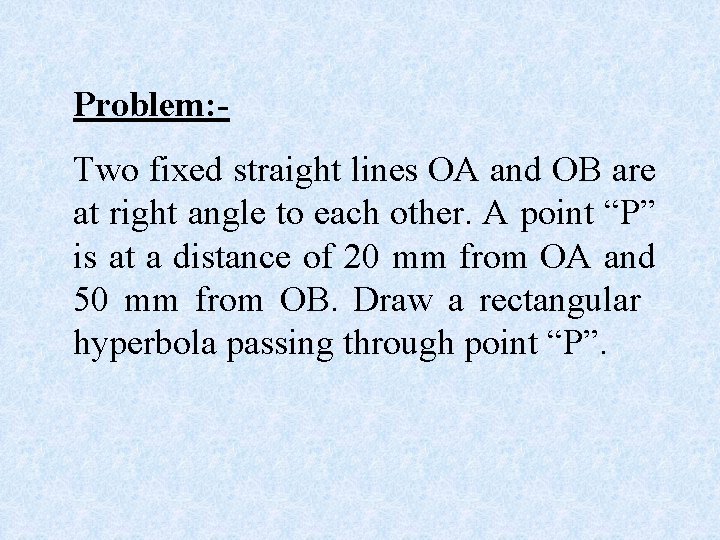
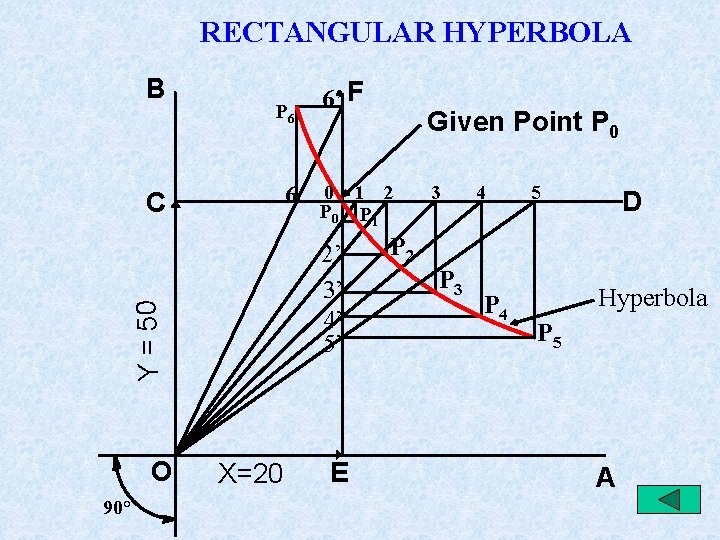
Problem: Two fixed straight lines OA and OB are at right angle to each other. A point “P” is at a distance of 20 mm from OA and 50 mm from OB. Draw a rectangular hyperbola passing through point “P”.
RECTANGULAR HYPERBOLA B P 6 6 C 90° X=20 Given Point P 0 0 1 2 P 0 P 1 2’ 3’ 4’ 5’ Y = 50 O 6’ F E 3 4 5 D P 2 P 3 P 4 Hyperbola P 5 A
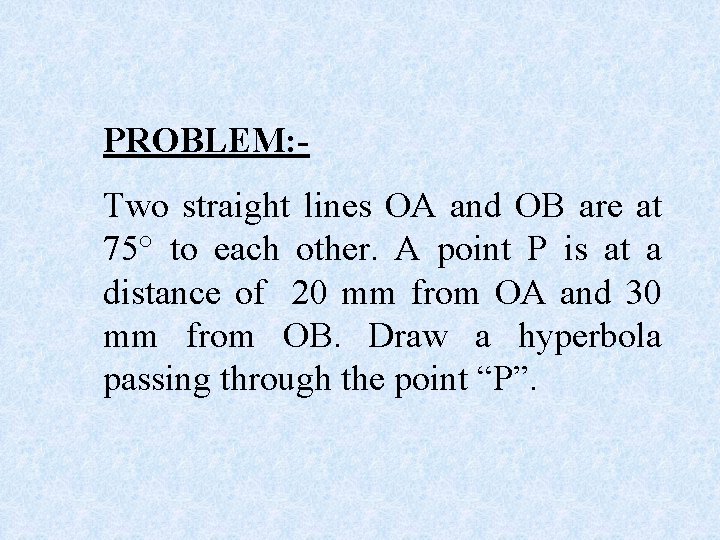
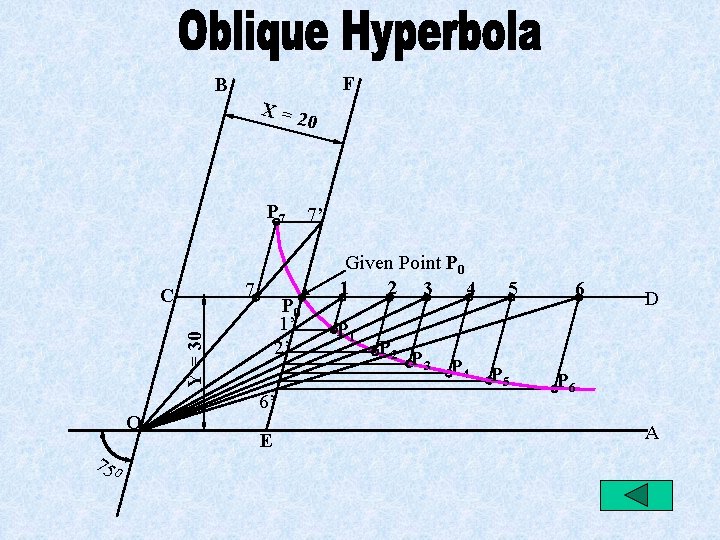
PROBLEM: Two straight lines OA and OB are at 75° to each other. A point P is at a distance of 20 mm from OA and 30 mm from OB. Draw a hyperbola passing through the point “P”.
F B X=2 0 P 7 7’ 7 P 0 1’ 2’ Y = 30 C O 75 0 6’ E Given Point P 0 1 2 3 4 P 1 P 2 P 3 P 4 5 P 5 6 D P 6 A
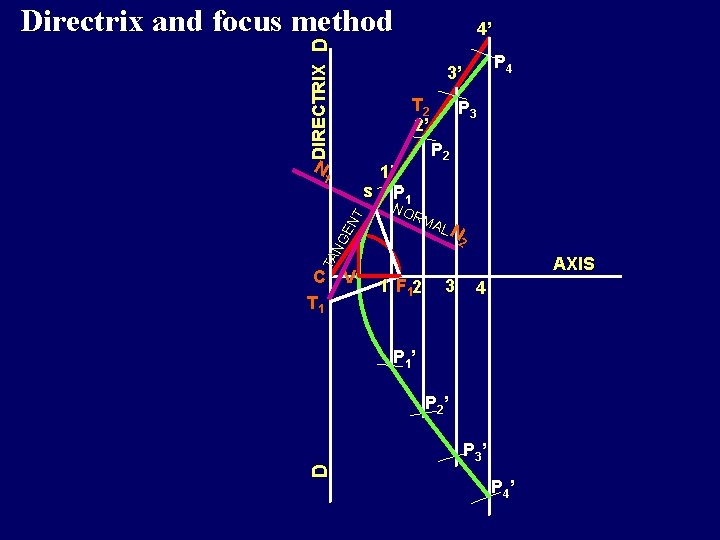
DIRECTRIX D Directrix and focus method N C V T 1 P 4 3’ T 2 2’ 1’ s P 1 TA NG EN T 1 4’ P 3 P 2 NO RM AL N 2 AXIS 1 F 12 3 4 P 1’ D P 2’ P 3’ P 4’
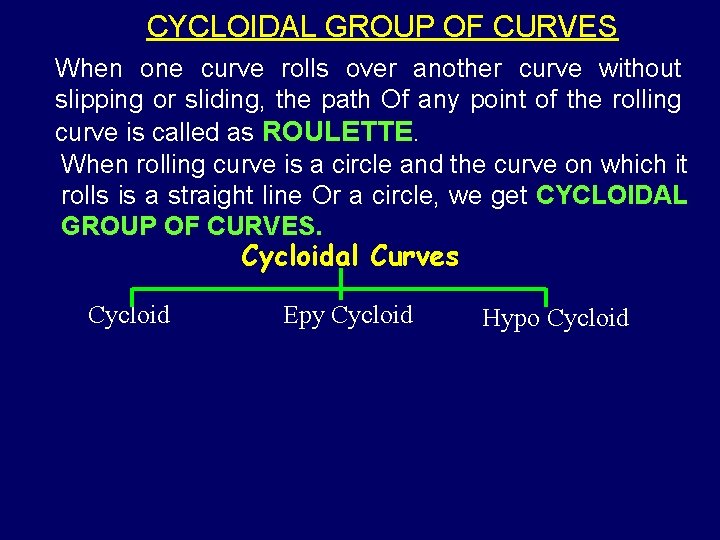
CYCLOIDAL GROUP OF CURVES When one curve rolls over another curve without slipping or sliding, the path Of any point of the rolling curve is called as ROULETTE. When rolling curve is a circle and the curve on which it rolls is a straight line Or a circle, we get CYCLOIDAL GROUP OF CURVES. Cycloidal Curves Cycloid Epy Cycloid Hypo Cycloid
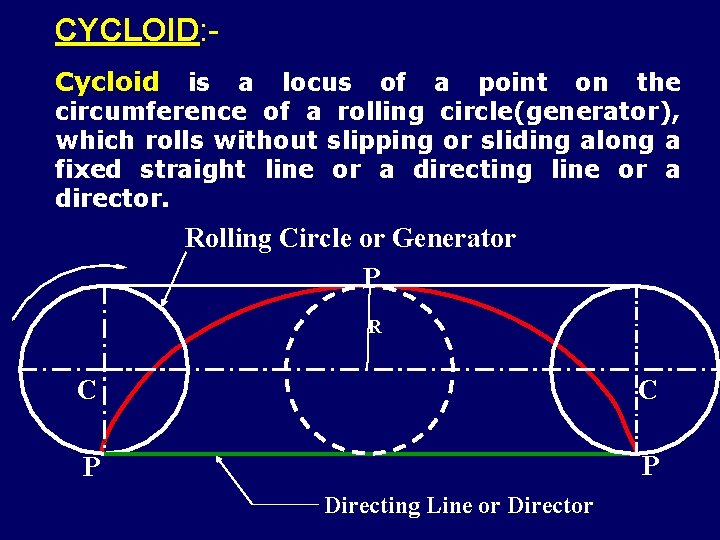
CYCLOID: Cycloid is a locus of a point on the circumference of a rolling circle(generator), which rolls without slipping or sliding along a fixed straight line or a directing line or a director. Rolling Circle or Generator P R C C P P Directing Line or Director
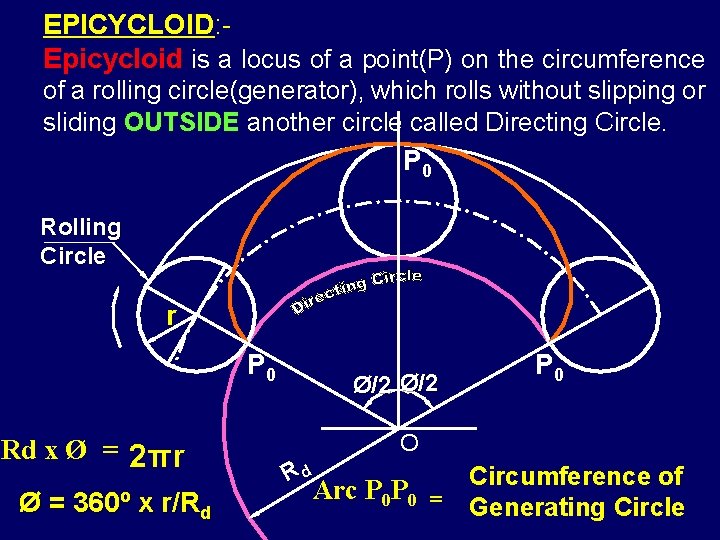
EPICYCLOID: Epicycloid is a locus of a point(P) on the circumference of a rolling circle(generator), which rolls without slipping or sliding OUTSIDE another circle called Directing Circle. P 0 Rolling Circle r P 0 Rd x Ø = 2πr Ø = 360º x r/Rd Ø/2 P 0 O Rd Circumference of Arc P 0 P 0 = Generating Circle
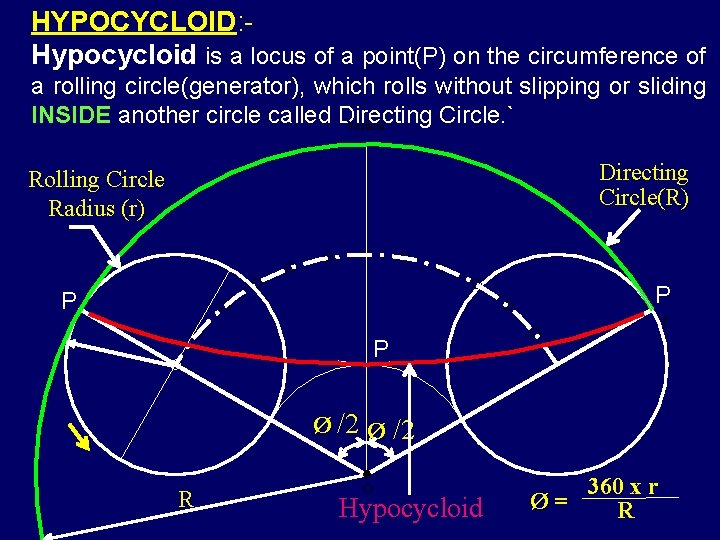
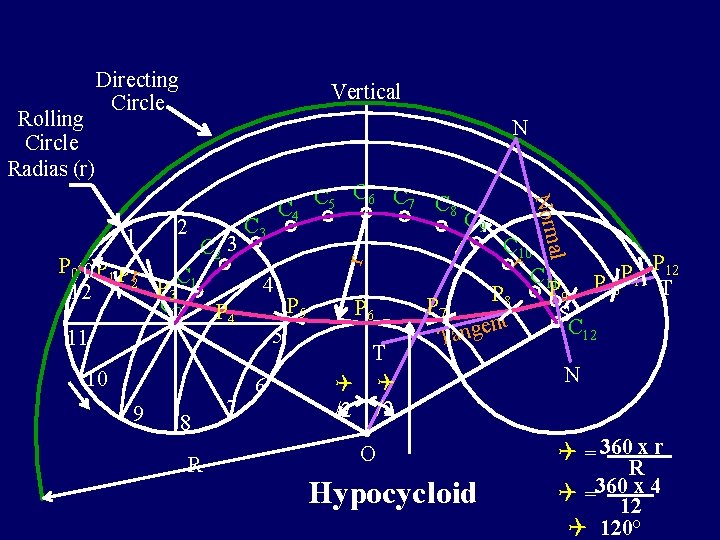
HYPOCYCLOID: Hypocycloid is a locus of a point(P) on the circumference of a rolling circle(generator), which rolls without slipping or sliding INSIDE another circle called Directing Circle. ` Vertical Directing Circle(R) Rolling Circle Radius (r) P P T P Ø /2 R O Hypocycloid 360 x r Ø= R
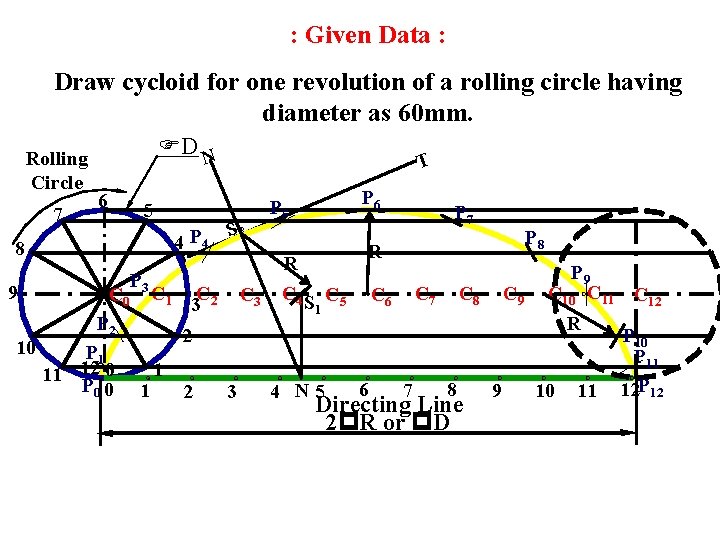
: Given Data : Draw cycloid for one revolution of a rolling circle having diameter as 60 mm. Rolling Circle 7 D N 6 5 8 4 P 4 T T S P 5 R P 6 P 7 R P 8 P 9 9 C 0 C 1 3 C 2 C 3 C 4 S C 5 C 6 C 7 C 8 C 9 C 10 C 11 C 12 1 P 2 R P 10 2 10 P 11 12 0 1 11 P 0 0 1 6 8 7 9 10 11 12 P 12 3 4 N 5 2 P 3 Directing Line 2 R or D
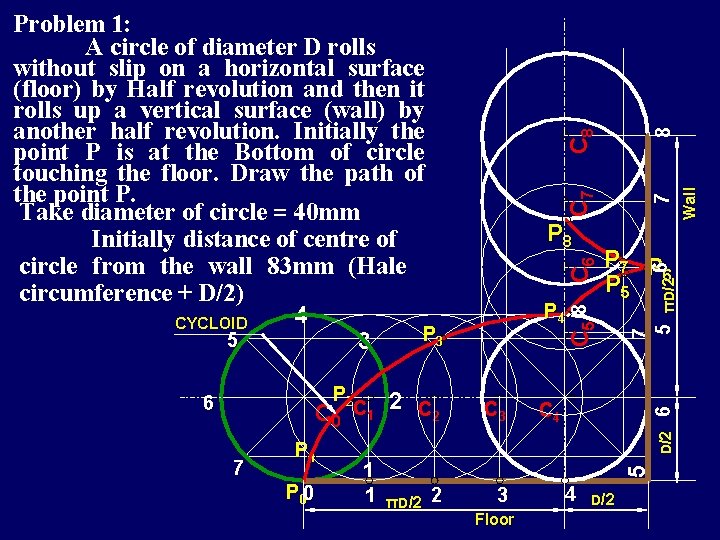
P 00 C 3 2 3 C 4 1 1 πD/2 Floor 4 D/2 Wall 8 πD/2 6 7 5 C 5 8 C 6 7 C 7 2 C 2 5 7 P 1 P 4 P 7 P P 5 6 D/2 0 P 8 6 P 2 C C 1 6 C 8 Problem 1: A circle of diameter D rolls without slip on a horizontal surface (floor) by Half revolution and then it rolls up a vertical surface (wall) by another half revolution. Initially the point P is at the Bottom of circle touching the floor. Draw the path of the point P. Take diameter of circle = 40 mm Initially distance of centre of circle from the wall 83 mm (Hale circumference + D/2) 4 CYCLOID P 3 5 3
Problem : 2 A circle of 25 mm radius rolls on the circumference of another circle of 150 mm diameter and outside it. Draw the locus of the point P on the circumference of the rolling circle for one complete revolution of it. Name the curve & draw tangent and normal to the curve at a point 115 mm from the centre of the bigger circle.
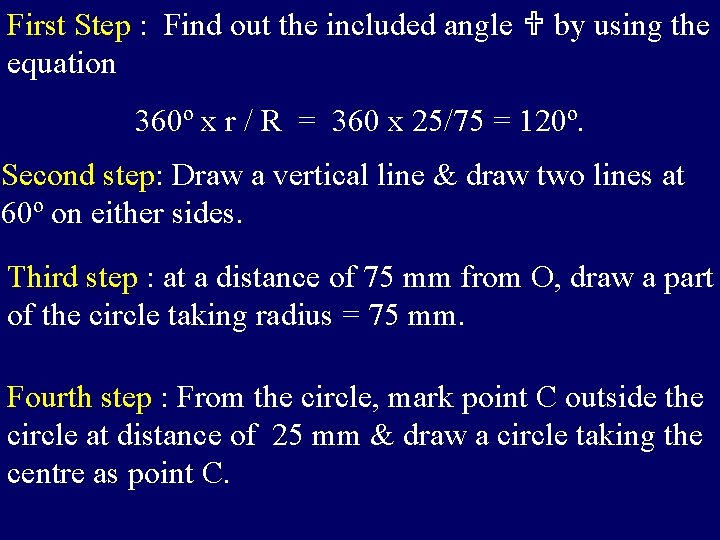
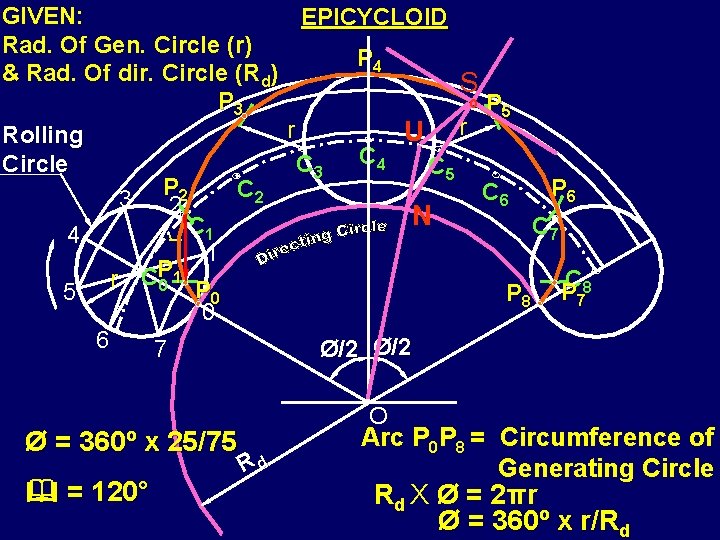
First Step : Find out the included angle by using the equation 360º x r / R = 360 x 25/75 = 120º. Second step: Draw a vertical line & draw two lines at 60º on either sides. Third step : at a distance of 75 mm from O, draw a part of the circle taking radius = 75 mm. Fourth step : From the circle, mark point C outside the circle at distance of 25 mm & draw a circle taking the centre as point C.
EPICYCLOID P 4 r C 3 C 4 S r U C 5 N º P 5 C 6 Ø = 360º x 25/75 = 120° P 6 C 7 r GIVEN: Rad. Of Gen. Circle (r) & Rad. Of dir. Circle (Rd) P 3 Rolling Circle C 2 3 P 22 C 1 4 1 1 r CP 0 5 0 6 7 P 8 C P 78 Ø/2 O Rd Arc P 0 P 8 = Circumference of Generating Circle Rd X Ø = 2πr Ø = 360º x r/Rd
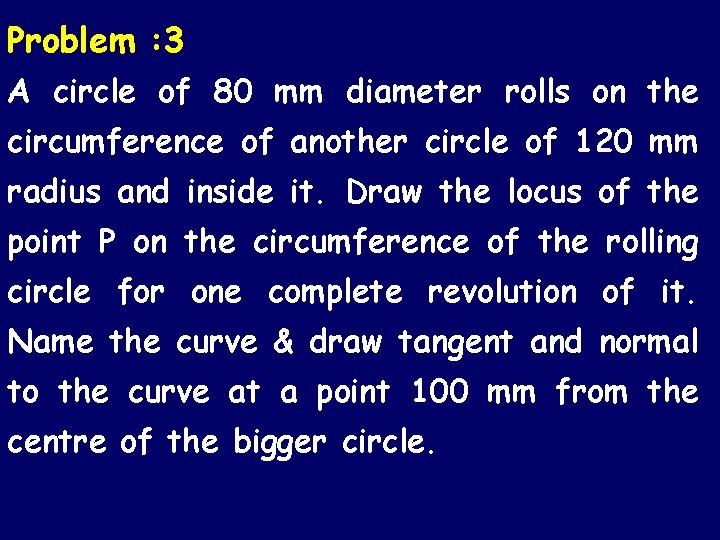
Problem : 3 A circle of 80 mm diameter rolls on the circumference of another circle of 120 mm radius and inside it. Draw the locus of the point P on the circumference of the rolling circle for one complete revolution of it. Name the curve & draw tangent and normal to the curve at a point 100 mm from the centre of the bigger circle.
Vertical N 10 9 8 R 7 4 5 6 P 5 P 6 T /2 /2 C 10 P 12 P C 11 11 P T 10 P P 8 9 P 7 S t n e C 12 Tang O Hypocycloid r P 0 0 P 1 P r 2 P C 1 12 3 C 0 P 4 11 C 9 al C 2 3 C 3 Norm 1 2 C 5 C 6 C 7 C C 4 8 r Rolling Circle Radias (r) Directing Circle N = 360 x r R =36012 x 4 120°
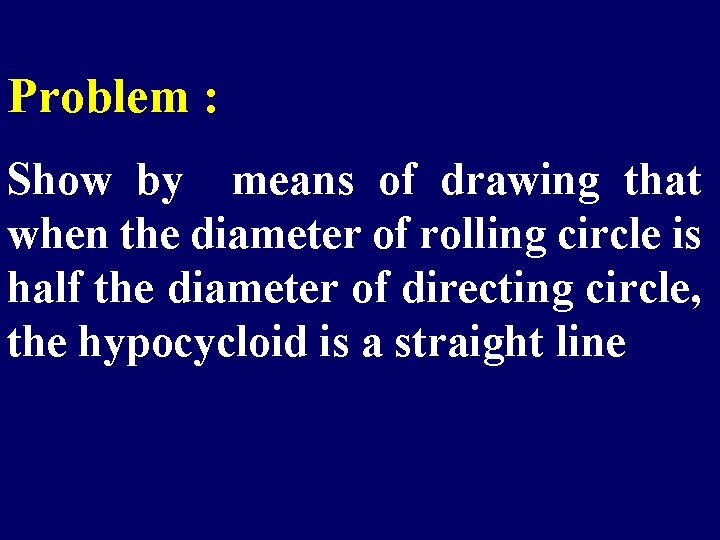
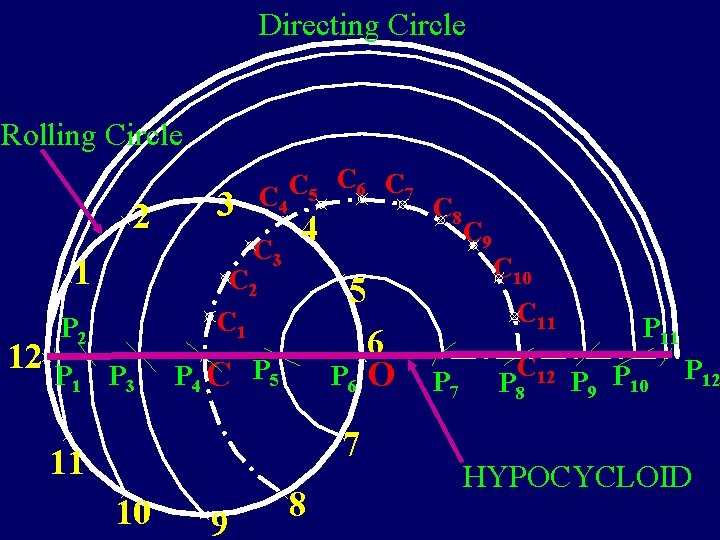
Problem : Show by means of drawing that when the diameter of rolling circle is half the diameter of directing circle, the hypocycloid is a straight line
Directing Circle Rolling Circle 2 1 12 3 C C C 4 5 6 C 7 C 8 4 C 9 C 3 C 2 C 1 P 2 P 1 P 3 5 6 P 6 O P 4 C P 5 7 11 10 9 8 C 10 C 11 P 7 P 11 C P 8 12 P 9 P 10 P 12 HYPOCYCLOID
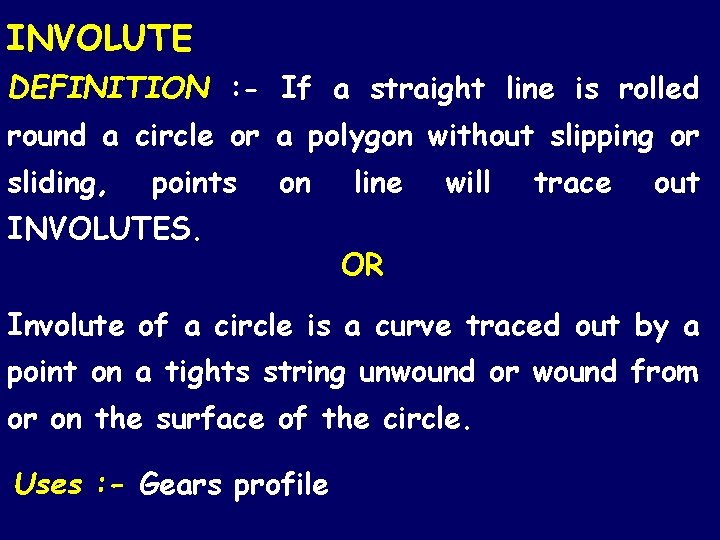
INVOLUTE DEFINITION : - If a straight line is rolled round a circle or a polygon without slipping or sliding, points on INVOLUTES. line will trace out OR Involute of a circle is a curve traced out by a point on a tights string unwound or wound from or on the surface of the circle. Uses : - Gears profile
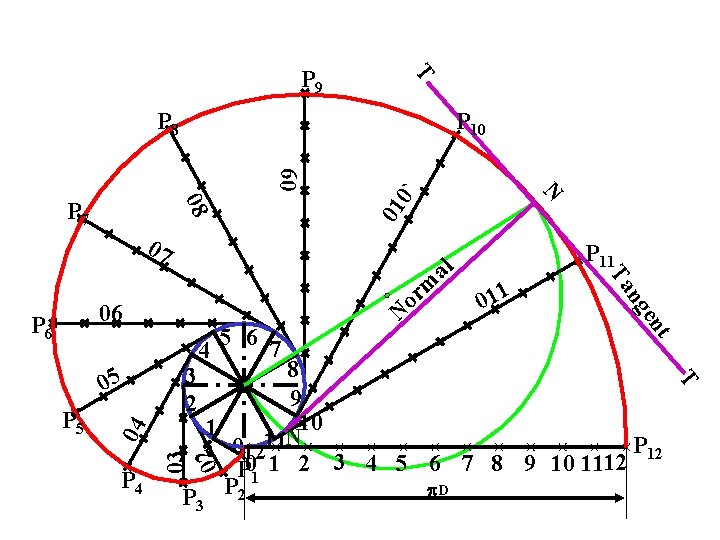
PROB: A string is unwound from a circle of 20 mm diameter. Draw the locus of string P for unwounding the string’s one turn. String is kept tight during unwound. Draw tangent & normal to the curve at any point.
T P 9 01 07 03 02 04 8 9 10 1 P 12 01211 N P 01 1 2 3 4 5 6 7 8 9 10 1112 D P 3 P 2 3 2 . T P 4 t P 5 011 en 05 5 6 7 P 11 ng 4 N m r o al Ta 06 P 6 N 08 P 7 0` P 10 09 P 8
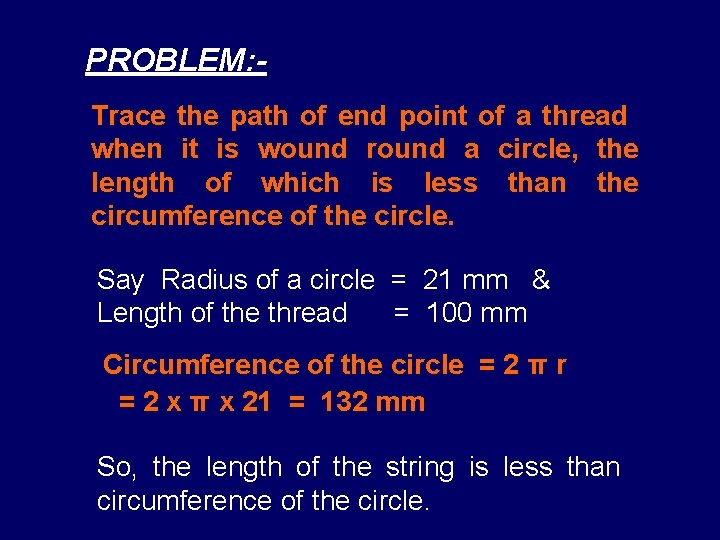
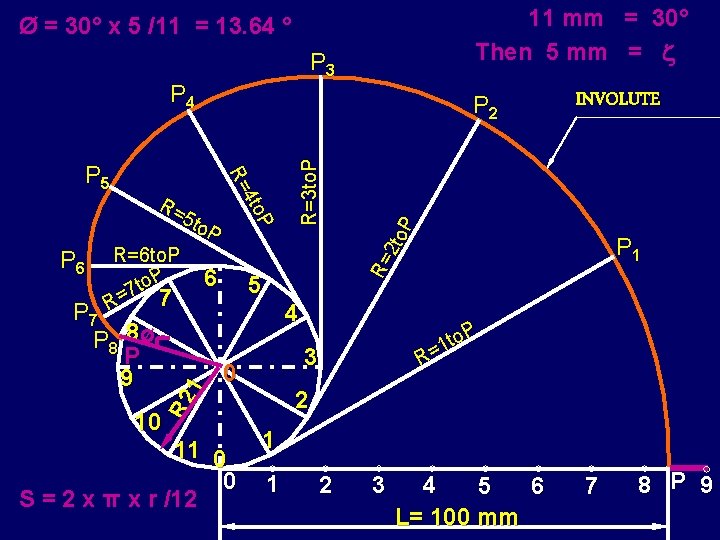
PROBLEM: Trace the path of end point of a thread when it is wound round a circle, the length of which is less than the circumference of the circle. Say Radius of a circle = 21 mm & Length of the thread = 100 mm Circumference of the circle = 2 π r = 2 x π x 21 = 132 mm So, the length of the string is less than circumference of the circle.
11 mm = 30° Then 5 mm = Ø = 30° x 5 /11 = 13. 64 ° P 3 P 4 P 7 P 8 8 ø P 9 R 2 1 R=3 to. P 5 4 10 11 0 0 S = 2 x π x r /12 P 1 P o t 1 R= 3 0 INVOLUTE R= 2 to P P 6 R= 5 to P R=6 to. P P 6 o t 7 R= 7 P 4 to R= P 5 P 2 2 1 1 2 3 4 5 6 L= 100 mm 7 8 P 9
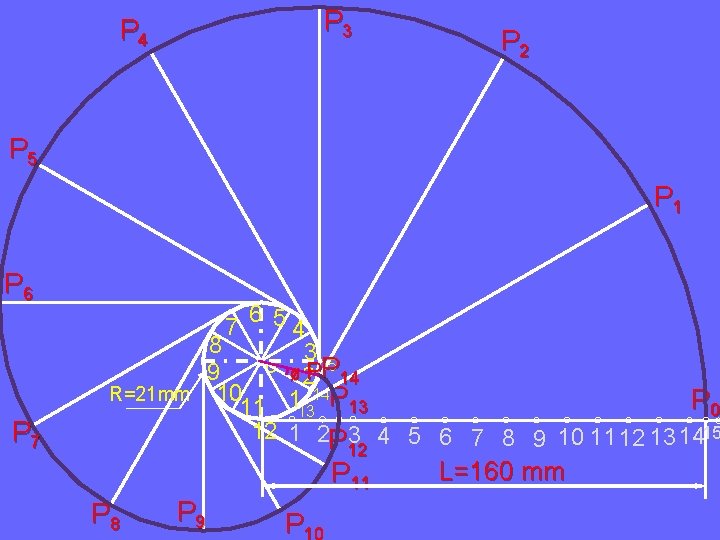
PROBLEM: Trace the path of end point of a thread when it is wound round a circle, the length of which is more than the circumference of the circle. Say Radius of a circle = 21 mm & Length of the thread = 160 mm Circumference of the circle = 2 π r = 2 x π x 21 = 132 mm So, the length of the string is more than circumference of the circle.
P 3 P 4 P 2 P 5 P 1 P 6 6 5 4 8 3 15 O ø PP 9 2 14 14 R=21 mm 10 P 0 11 113 P 13 12 1 2 P 3 4 5 6 7 8 9 10 11 12 13 1415 12 7 P 11 P 8 P 9 P 10 L=160 mm
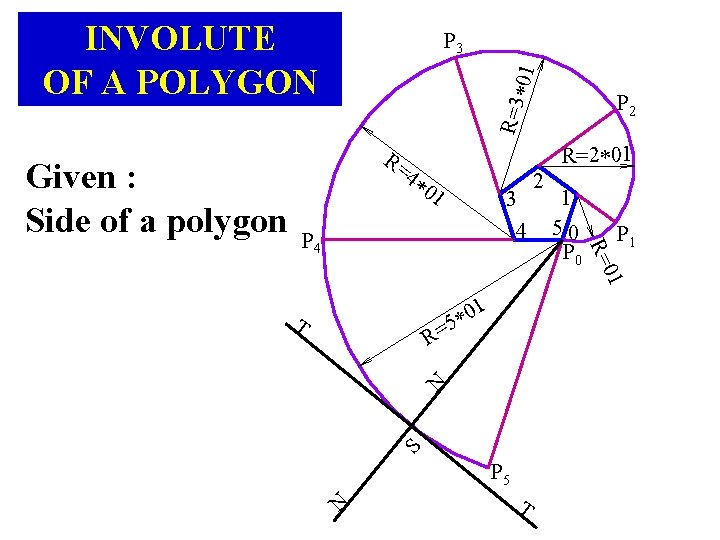
PROBLEM: Draw an involute of a pantagon having side as 20 mm.
INVOLUTE OF A POLYGON 01 P 2 R=3 R= R=2 01 4 01 3 4 2 1 50 P 1 01 R= P 4 1 0 5 T S N R= P 5 N Given : Side of a polygon P 3 T
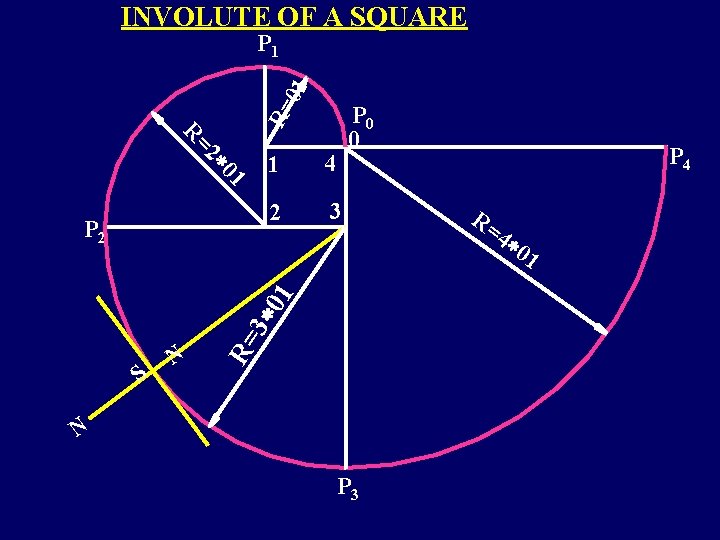
PROBLEM: Draw an involute of a square having side as 20 mm.
INVOLUTE OF A SQUARE 01 P 1 R= P 0 0 =2 R 4 2 3 P 4 1 0 1 S N R= 3 01 P 2 N P 3 R= 4 01
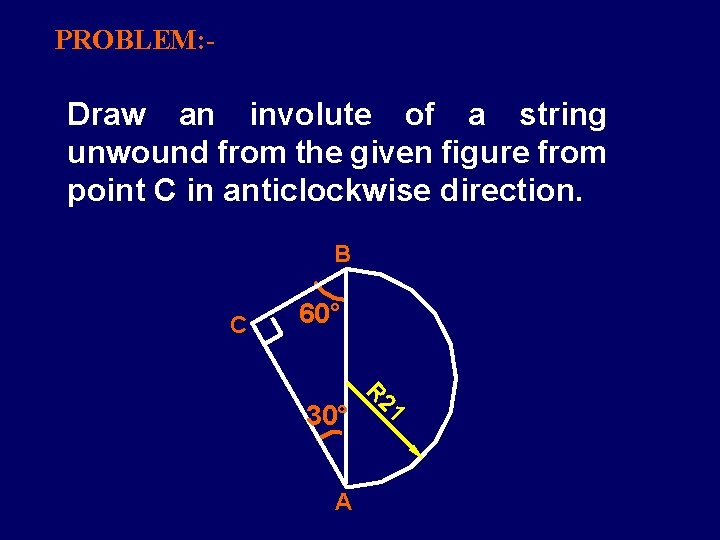
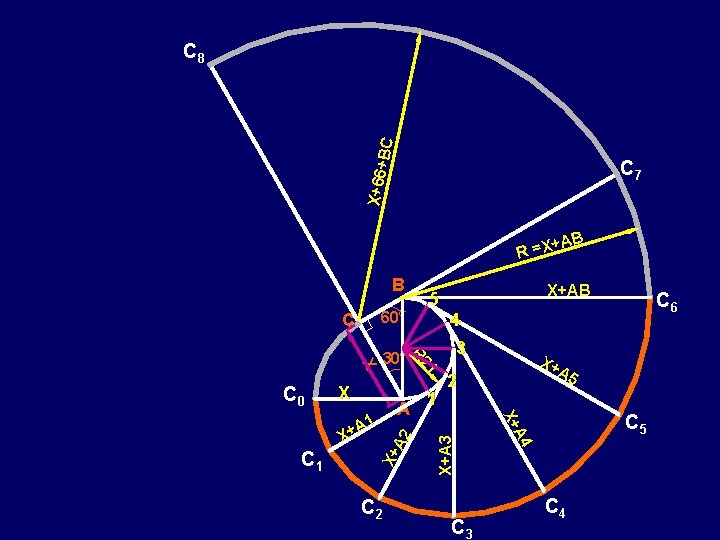
PROBLEM: - Draw an involute of a string unwound from the given figure from point C in anticlockwise direction. B C 60° A 21 R 30°
X+66 +BC C 8 C 7 +AB R =X B 60° X+ A 2 A C 2 1 X+ A 5 2 C 3 C 5 A 4 X+ A 1 + X C 1 21 R X C 0 3 30° X C 6 4 X+A 3 C X+AB 5 C 4
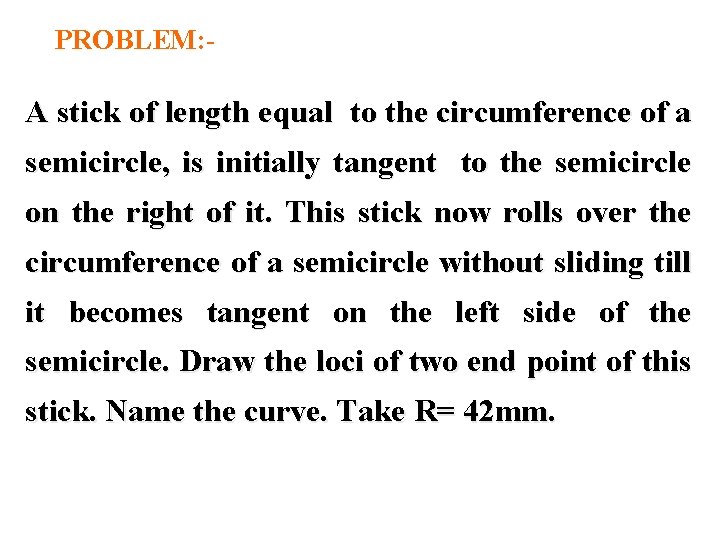
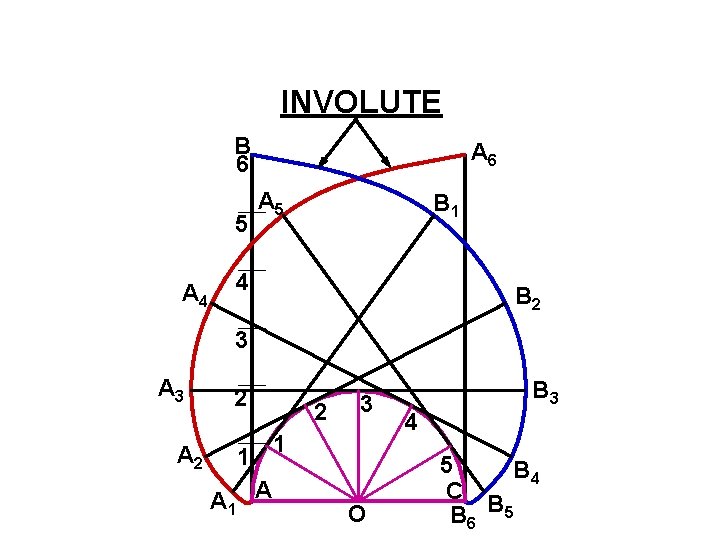
PROBLEM: - A stick of length equal to the circumference of a semicircle, is initially tangent to the semicircle on the right of it. This stick now rolls over the circumference of a semicircle without sliding till it becomes tangent on the left side of the semicircle. Draw the loci of two end point of this stick. Name the curve. Take R= 42 mm.
INVOLUTE B 6 5 A 4 A 6 A 5 B 1 4 B 2 3 A 2 2 1 A 2 3 1 O B 3 4 5 B 4 C B 6 B 5
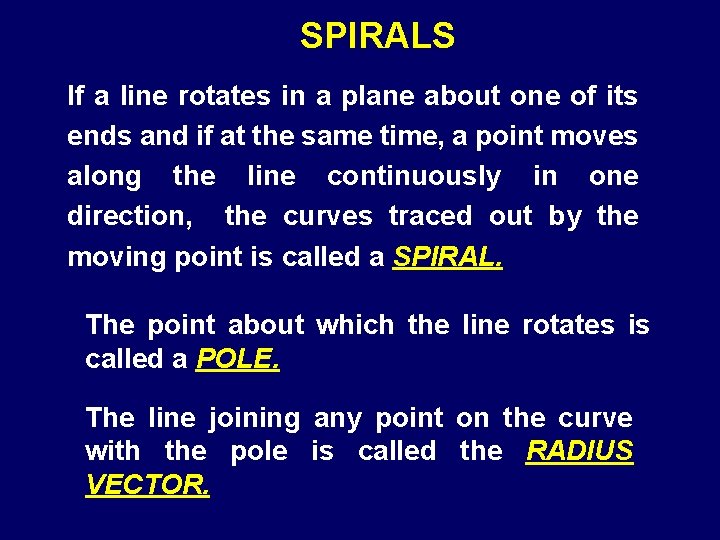
SPIRALS If a line rotates in a plane about one of its ends and if at the same time, a point moves along the line continuously in one direction, the curves traced out by the moving point is called a SPIRAL. The point about which the line rotates is called a POLE. The line joining any point on the curve with the pole is called the RADIUS VECTOR.
The angle between the radius vector and the line in its initial position is called the VECTORIAL ANGLE. Each complete revolution of the curve is termed as CONVOLUTION. Spiral Arche Median Spiral for Clock Semicircle Quarter Circle Logarithmic
ARCHEMEDIAN SPIRAL It is a curve traced out by a point moving in such a way that its movement towards or away from the pole is uniform with the increase of vectorial angle from the starting line. USES : Teeth profile of Helical gears. Profiles of cams etc.
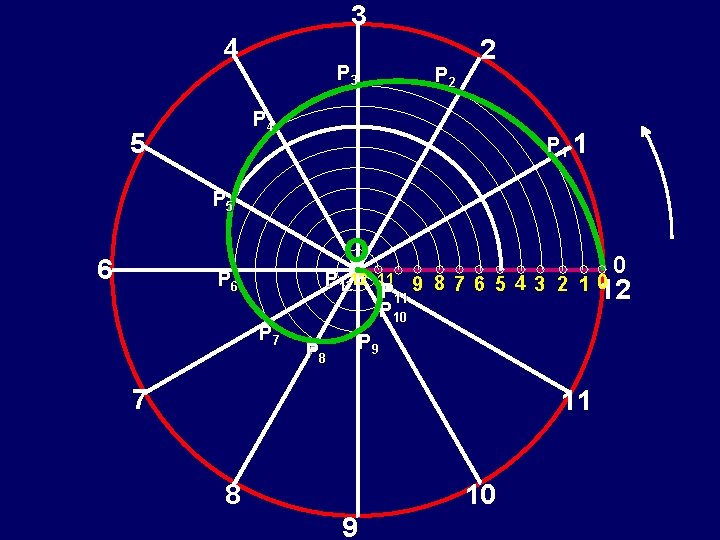
PROBLEM: To construct an Archemedian Spiral of one convolutions, given the radial movement of the point P during one convolution as 60 mm and the initial position of P is the farthest point on the line or free end of the line. Greatest radius = 60 Shortest radius = mm & 00 mm ( at centre or at pole)
3 4 P 3 P 2 2 P 4 5 P 1 1 P 5 6 o P 6 P 1212 P 7 0 11 P 11 9 8 7 6 5 4 3 2 1 012 P 10 P 9 P 8 7 11 8 10 9
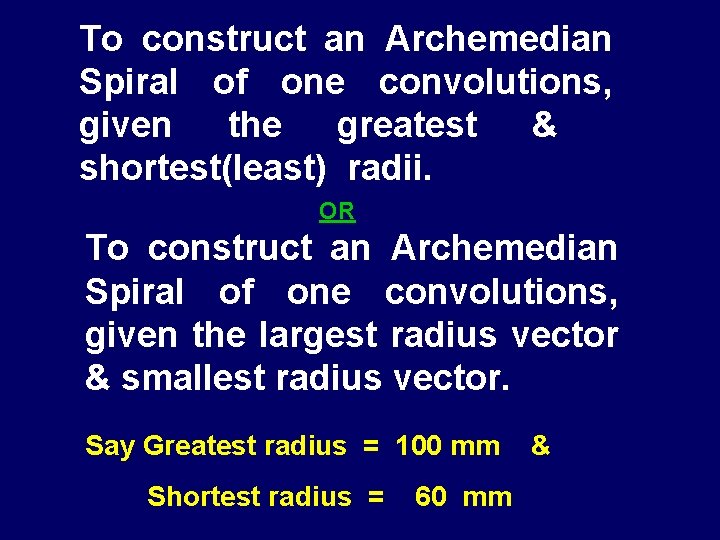
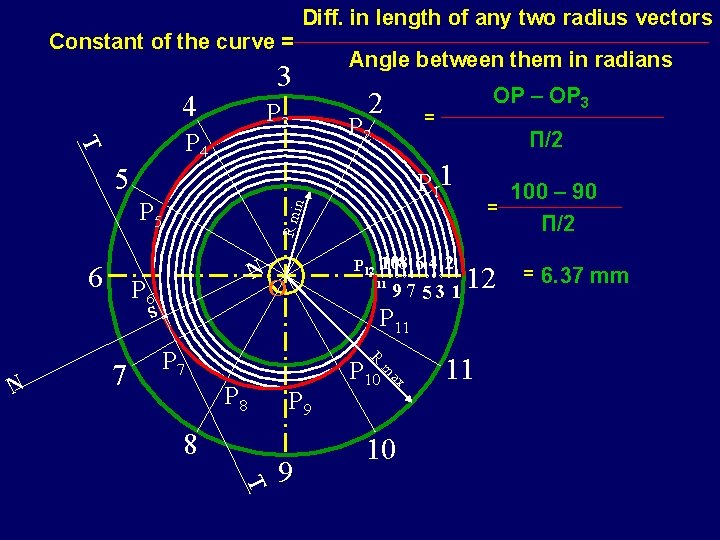
To construct an Archemedian Spiral of one convolutions, given the greatest & shortest(least) radii. OR To construct an Archemedian Spiral of one convolutions, given the largest radius vector & smallest radius vector. Say Greatest radius = 100 mm Shortest radius = 60 mm &
Constant of the curve = Diff. in length of any two radius vectors 3 4 P 3 T P 4 Angle between them in radians 2 P 2 n P 12 O P 11 R P 7 P 8 8 P 9 T 9 100 – 90 = Π/2 108 6 4 2 11 9 7 5 3 1 12 S N Π/2 R mi N 6 P 6 7 = P 11 5 P 5 OP – OP 3 P 10 max 10 11 = 6. 37 mm
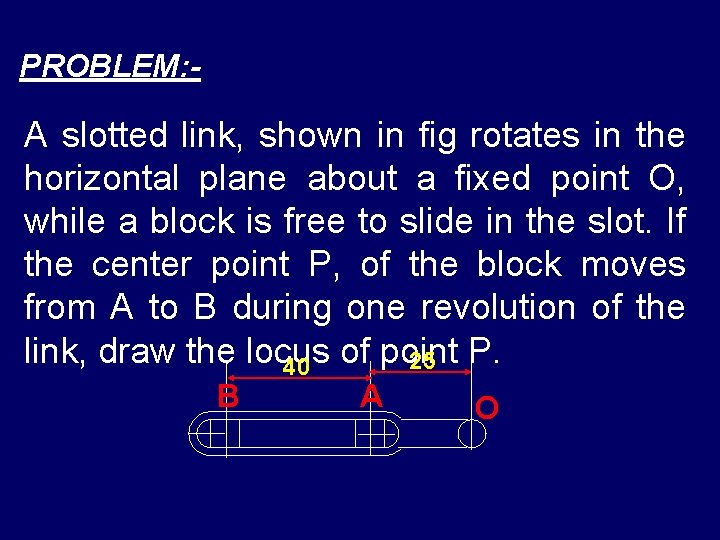
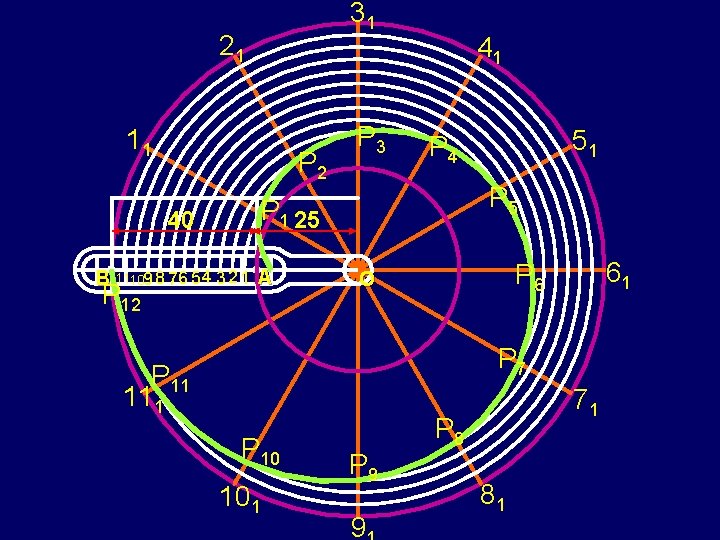
PROBLEM: - A slotted link, shown in fig rotates in the horizontal plane about a fixed point O, while a block is free to slide in the slot. If the center point P, of the block moves from A to B during one revolution of the link, draw the locus of point 25 P. 40 B A O
31 21 11 P 2 40 P 3 41 P 5 P 1 25 B 11109 8 76 5 4 3 2 1 A P 12 51 P 4 61 P 6 O P 7 P 11 111 P 10 101 P 9 9 71 P 8 81
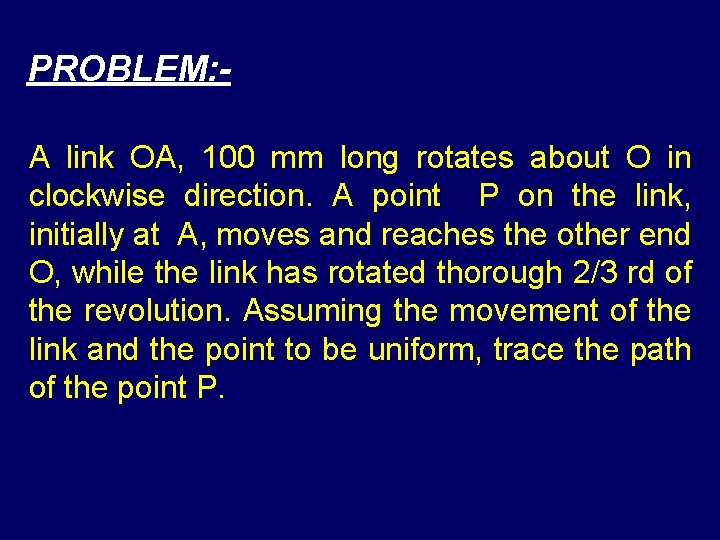
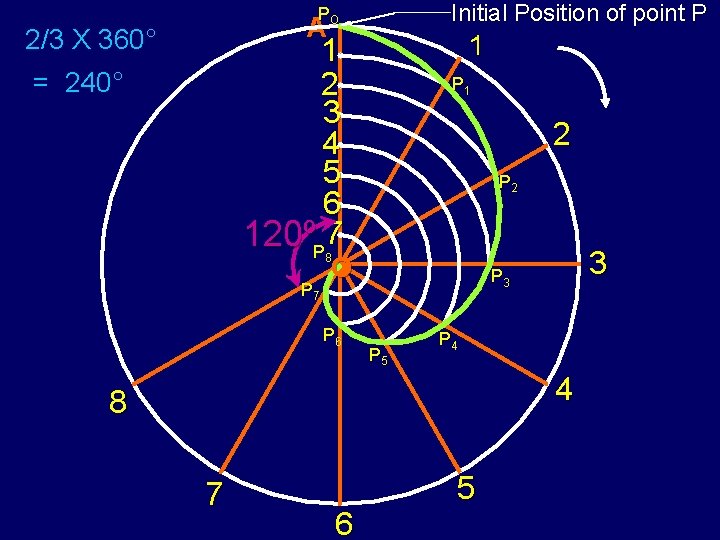
PROBLEM: A link OA, 100 mm long rotates about O in clockwise direction. A point P on the link, initially at A, moves and reaches the other end O, while the link has rotated thorough 2/3 rd of the revolution. Assuming the movement of the link and the point to be uniform, trace the path of the point P.
Initial Position of point P PO A 2/3 X 360° 1 1 2 3 4 5 6 120ºP 7 = 240° P 1 2 P 2 3 8 P 7 O P 6 P 3 P 5 P 4 4 8 7 6 5
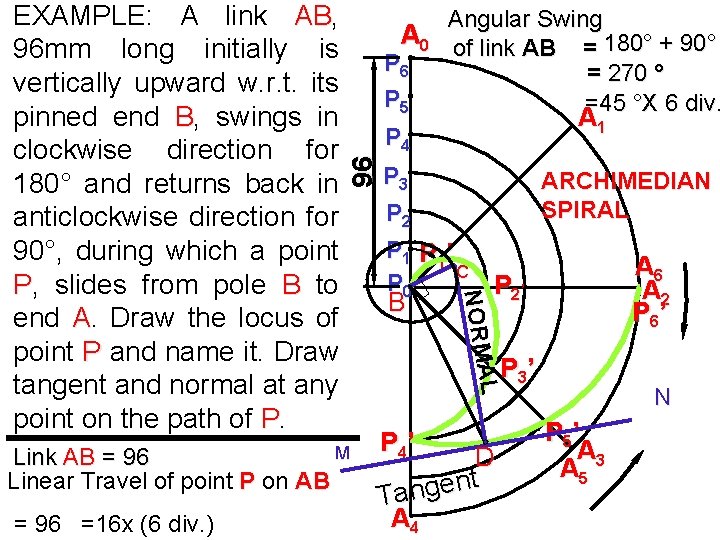
A 0 P 6 P 5 A 1 96 P 4 M Link AB = 96 Linear Travel of point P on AB = 96 =16 x (6 div. ) Angular Swing of link AB = 180° + 90° = 270 ° =45 °X 6 div. P 3 P 2 ARCHIMEDIAN SPIRAL P 1’ C P 0 B A 6 A 2 P 6’ P 2’ AL NORM EXAMPLE: A link AB, AB 96 mm long initially is vertically upward w. r. t. its pinned end B, swings in clockwise direction for 180° and returns back in anticlockwise direction for 90°, during which a point P, slides from pole B to end A. Draw the locus of point P and name it. Draw tangent and normal at any point on the path of P. P 3’ P 4’ D t n e g n Ta A 4 N P 5’ A 3 A 5
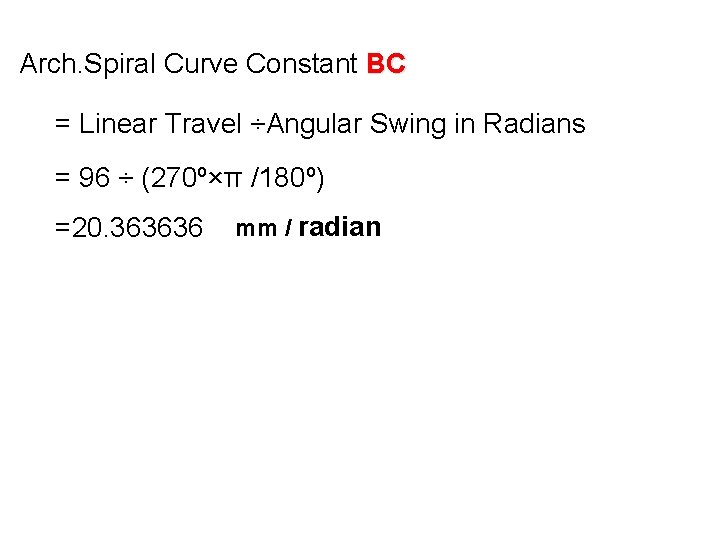
Arch. Spiral Curve Constant BC = Linear Travel ÷Angular Swing in Radians = 96 ÷ (270º×π /180º) =20. 363636 mm / radian
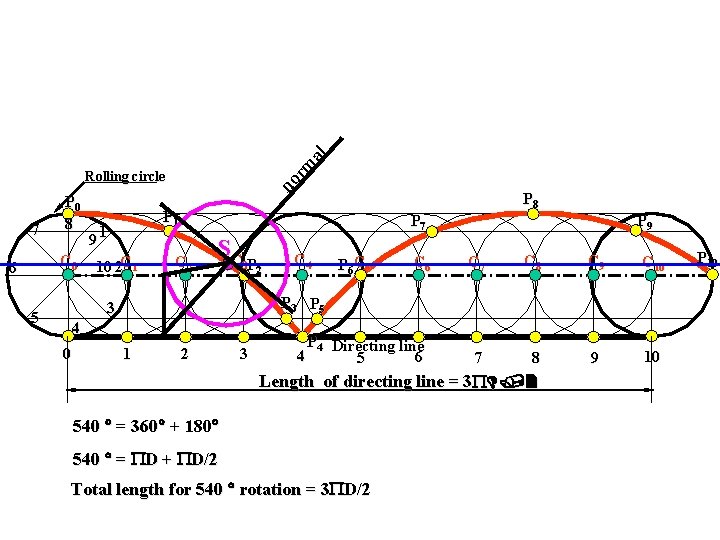
Problem : 2 Draw a cycloid for a rolling circle, 60 mm diameter rolling along a straight line without slipping for 540° revolution. Take initial position of the tracing point at the highest point on the rolling circle. Draw tangent & normal to the curve at a point 35 mm above the directing line.
First Step : Draw a circle having diameter of 60 mm. Second step: Draw a straight line tangential to the circle from bottom horizontally equal to (540 x ) x 60 mm= 282. 6 mm i. e. 1. 5 x x 60 mm 360 Third step : take the point P at the top of the circle.
rm al 7 P 0 8 C 0 6 no Rolling circle P 1 91 10 2 C 1 C 2 SC 3 3 P 2 C 4 P 6 C 5 C 6 C 7 C 8 C 9 C 10 7 8 9 10 P 3 P 5 4 0 P 9 P 7 3 5 P 8 1 2 3 P 4 Directing line 4 6 5 Length of directing line = 3 D/2 540 = 360 + 180 540 = D + D/2 Total length for 540 rotation = 3 D/2 P 10