
Engineering Design Workshop for students Quality Design Projects

- Slides: 33
Engineering Design Workshop for students Quality Design Projects for Engineering Fairs Sponsored by Santa Clara Valley Science and Engineering Fair Association Bruce Kawanami
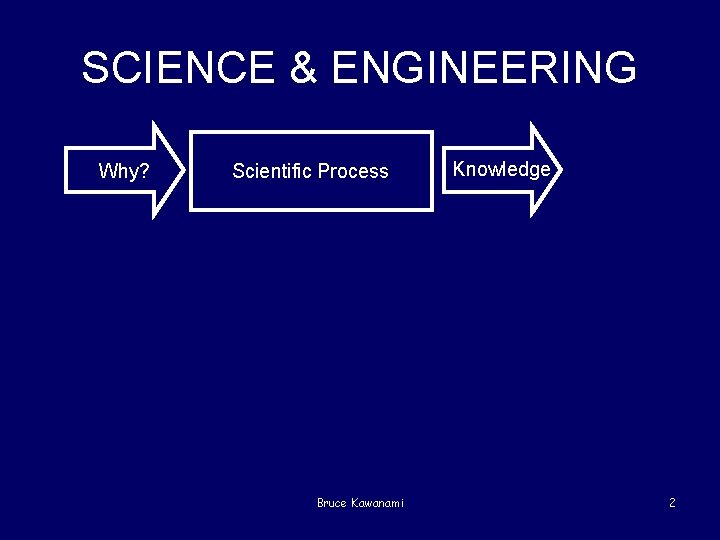
SCIENCE & ENGINEERING Why? Scientific Process Bruce Kawanami Knowledge 2
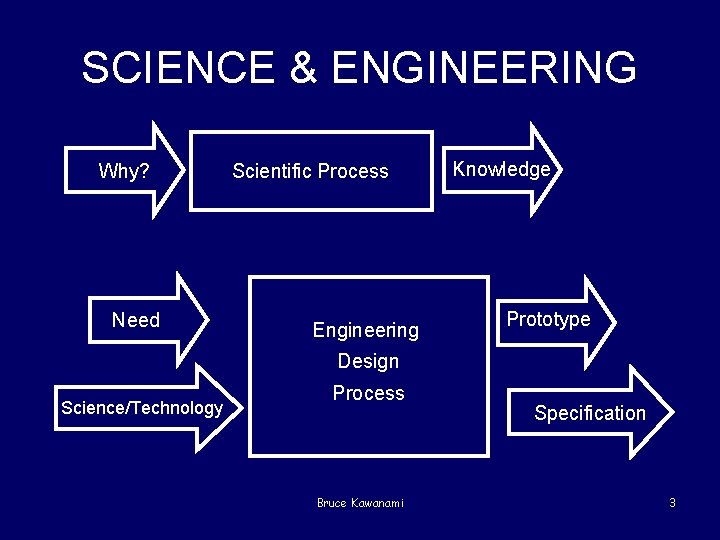
SCIENCE & ENGINEERING Why? Need Scientific Process Engineering Knowledge Prototype Design Science/Technology Process Bruce Kawanami Specification 3
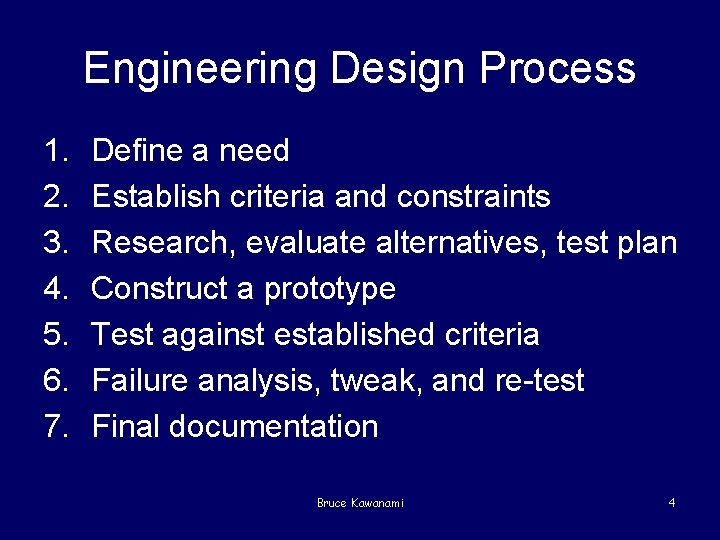
Engineering Design Process 1. 2. 3. 4. 5. 6. 7. Define a need Establish criteria and constraints Research, evaluate alternatives, test plan Construct a prototype Test against established criteria Failure analysis, tweak, and re-test Final documentation Bruce Kawanami 4
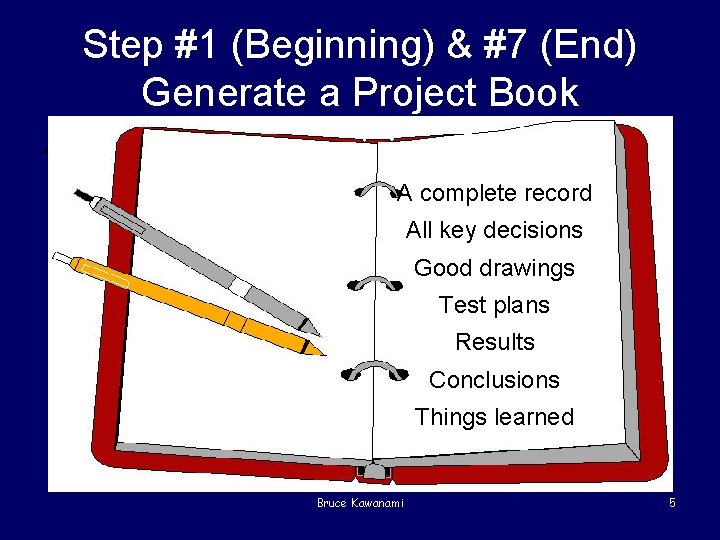
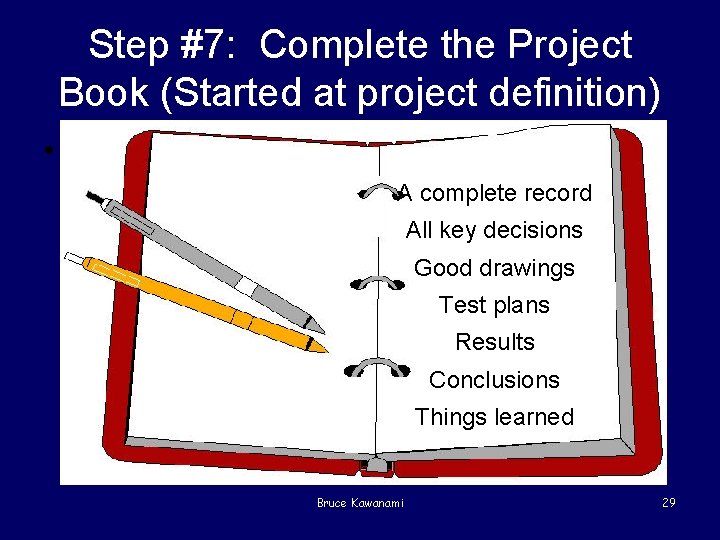
Step #1 (Beginning) & #7 (End) Generate a Project Book • Project data book A complete record All key decisions Good drawings Test plans Results Conclusions Things learned Bruce Kawanami 5
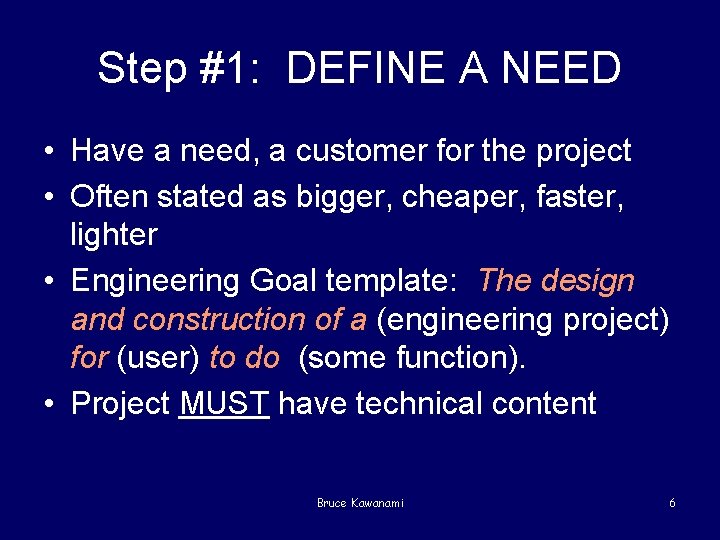
Step #1: DEFINE A NEED • Have a need, a customer for the project • Often stated as bigger, cheaper, faster, lighter • Engineering Goal template: The design and construction of a (engineering project) for (user) to do (some function). • Project MUST have technical content Bruce Kawanami 6
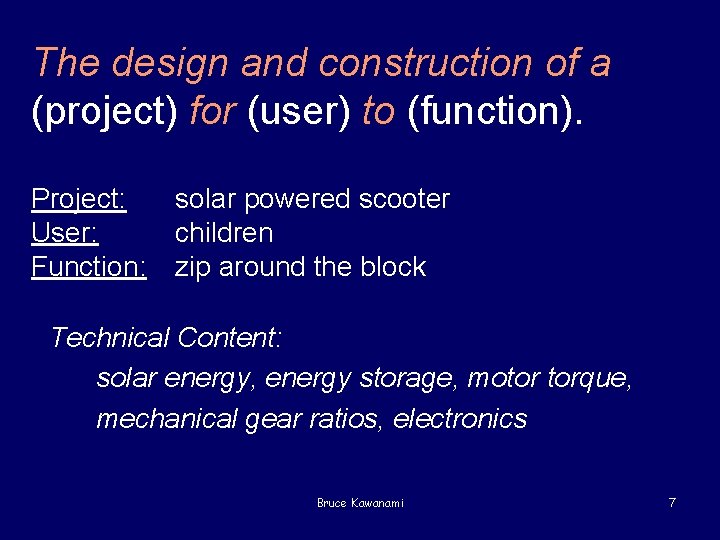
The design and construction of a (project) for (user) to (function). Project: User: Function: solar powered scooter children zip around the block Technical Content: solar energy, energy storage, motor torque, mechanical gear ratios, electronics Bruce Kawanami 7
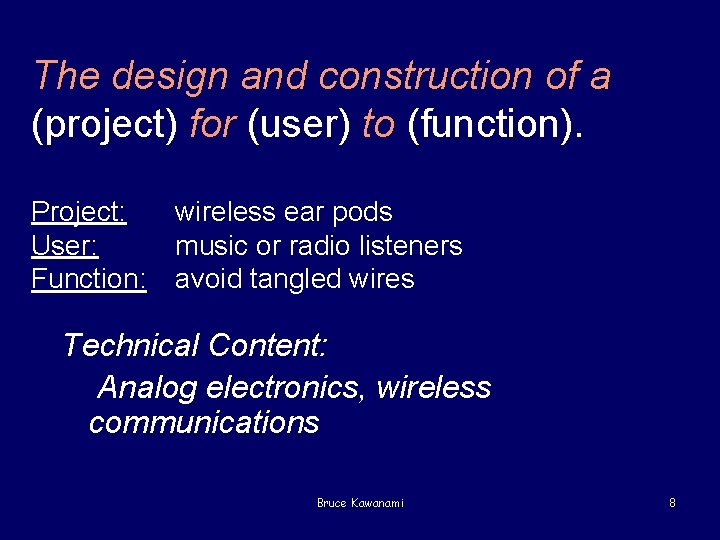
The design and construction of a (project) for (user) to (function). Project: User: Function: wireless ear pods music or radio listeners avoid tangled wires Technical Content: Analog electronics, wireless communications Bruce Kawanami 8
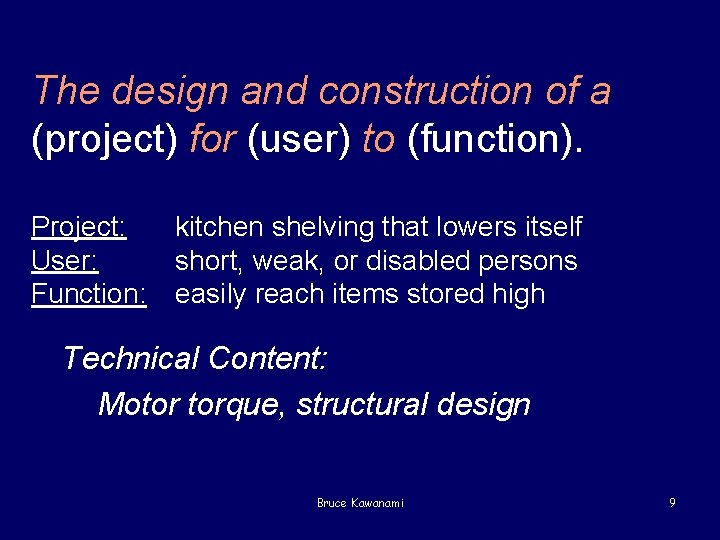
The design and construction of a (project) for (user) to (function). Project: User: Function: kitchen shelving that lowers itself short, weak, or disabled persons easily reach items stored high Technical Content: Motor torque, structural design Bruce Kawanami 9
ENGINEERING GOAL STATEMENT EXERCISE Bruce Kawanami
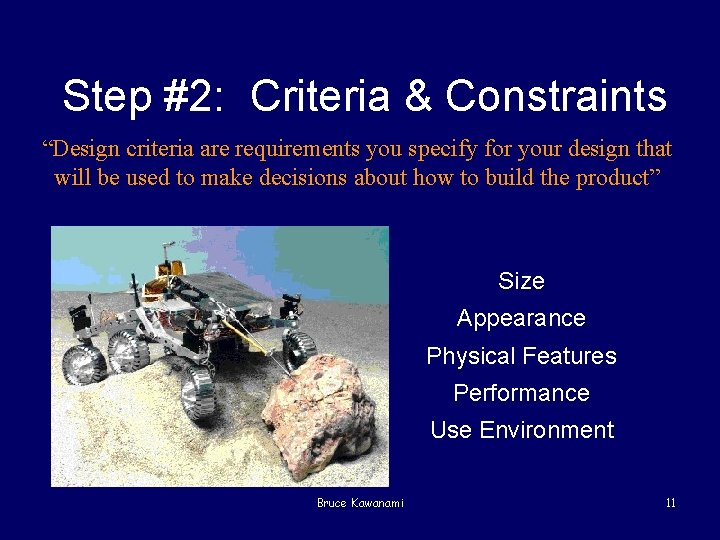
Step #2: Criteria & Constraints “Design criteria are requirements you specify for your design that will be used to make decisions about how to build the product” Size Appearance Physical Features Performance Use Environment Bruce Kawanami 11
Some Design Constraints • Cost • Time Bruce Kawanami 12
Criteria & Constraints for Solar Powered Scooter 1. 2. 3. 4. 5. Transport up to 35 kg rider Speed of at least 8 kph on level surfaces Travels through 10 meters of shade Material cost Testing completed by Feb 28 Bruce Kawanami 13
Criteria & Constraints for Wireless Earpods 1. 2. 3. 4. 5. Transmits 10 meter radius Receiver weighs < 75 grams No dropouts, ‘good fidelity’ Material cost Testing completed by Feb 28 Bruce Kawanami 14
Criteria & Constraints for Lowering Shelf 1. 2. 3. 4. 5. All shelves lower 45 cm Safely move 16 kg up and down Shelves will tilt < 10 degrees Material cost Testing completed by Feb 28 Bruce Kawanami 15
Step #3: List Alternatives • Research reveals what has been done • Likely to find good alternatives for cheapest, fastest, or lightest • Select best alternatives that meet the design criteria and constraints • Create a test plan based on the design criteria from Step #2 Bruce Kawanami 16
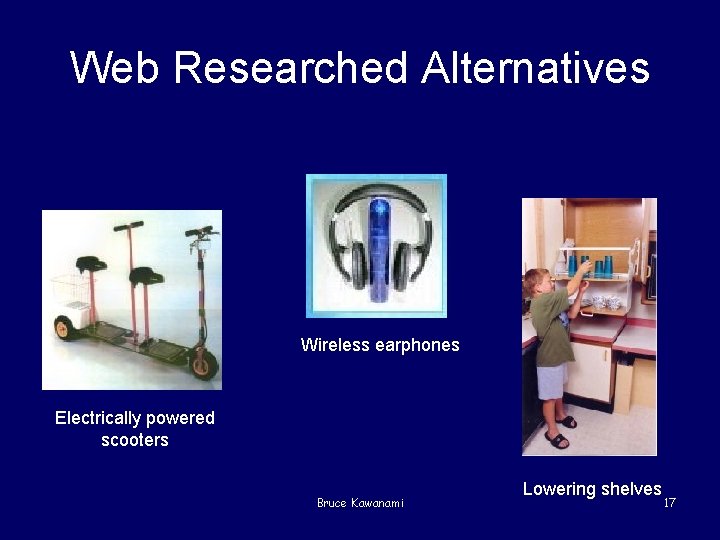
Web Researched Alternatives Wireless earphones Electrically powered scooters Bruce Kawanami Lowering shelves 17
Solar Powered Scooter Test Plan 1. Transport up to 35 kg rider Test Plan: Transport a 35 kg load 2. Speed of at least 8 kph on level surfaces Test Plan: 100 m distance should take less than 45 seconds 3. Travels through 10 meters of shade Test Plan: Charge up battery. With 35 kg rider, ride through 10 m of shade Bruce Kawanami 18
Wireless Earpod Test Plan 1. Transmits 10 meter radius Test Plan: Walk receiver in a 10 m radius around transmitter 2. Receiver weighs < 75 grams Test Plan: Weigh completed assembly 3. No dropouts, ‘good fidelity’ Test Plan: Survey student peers, likely customers Bruce Kawanami 19
Lowering Shelf Test Plan 1. All shelves lower 45 cm Test Plan: Design motor to travel 45 cm 2. Safely move 16 kg up and down Test Plan: Select motor to lift 16 kg 3. Shelves will tilt < 10 degrees Test Plan: Design in leveling guides and careful construction techniques Bruce Kawanami 20
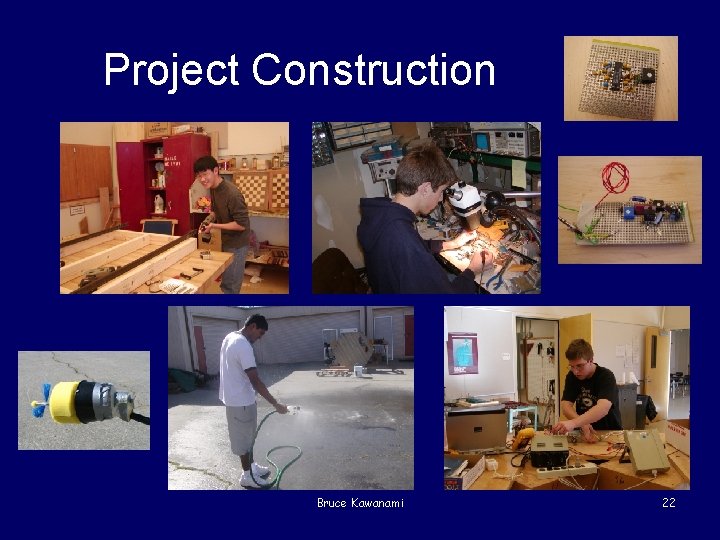
Step #4: Construct Prototype • Prototype is implementation of chosen design alternative • It is a proof of design, production and suitability Bruce Kawanami 21
Project Construction Bruce Kawanami 22
Step #5: Test it Well • Execute the developed Test Plan • Learn beyond minimum requirements! Characterize the limits of your project. Bruce Kawanami 23
Solar Powered Scooter Testing 1. Transport 35 kg rider. Exceeds Test Plan: Maximum mass transported 2. Speed. Exceeds Test Plan: Measure and plot speed vs. rider mass. 3. Travels through shade. Exceeds Test Plan: Measure and plot distance in shade travel vs. rider mass. • Extra Knowledge: solar energy, storing energy, electric motor torque, gears Bruce Kawanami 24
Wireless Earpod Testing 1. Transmits 10 meter. Exceeds Test Plan: Measure maximum transmission distance. 2. Receiver weight. Exceeds Test Plan: Know the weight of each component and alternatives. 3. No dropouts, ‘good fidelity. ’ Exceeds Test Plan: Higher number of surveys. • Extra Knowledge: capacitors, inductors, antenna, ordering free samples, soldering Bruce Kawanami 25
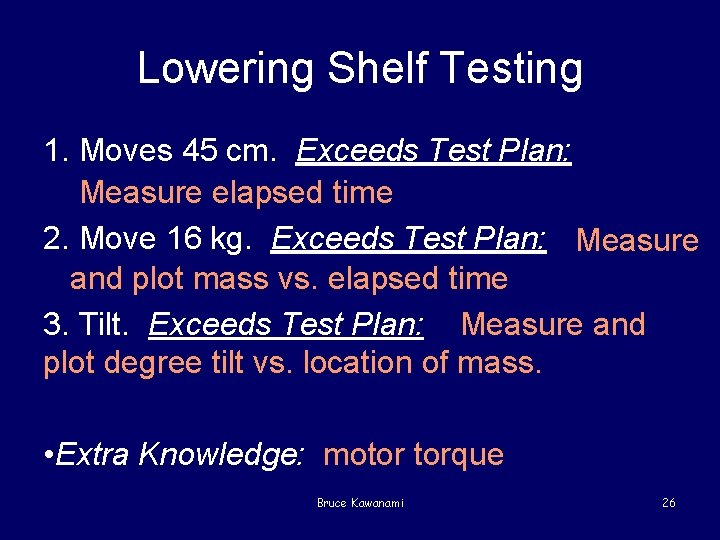
Lowering Shelf Testing 1. Moves 45 cm. Exceeds Test Plan: Measure elapsed time 2. Move 16 kg. Exceeds Test Plan: Measure and plot mass vs. elapsed time 3. Tilt. Exceeds Test Plan: Measure and plot degree tilt vs. location of mass. • Extra Knowledge: motor torque Bruce Kawanami 26
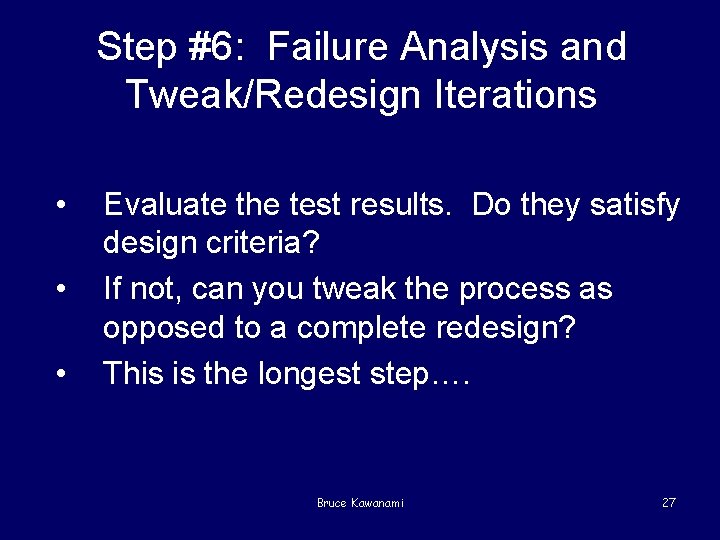
Step #6: Failure Analysis and Tweak/Redesign Iterations • • • Evaluate the test results. Do they satisfy design criteria? If not, can you tweak the process as opposed to a complete redesign? This is the longest step…. Bruce Kawanami 27
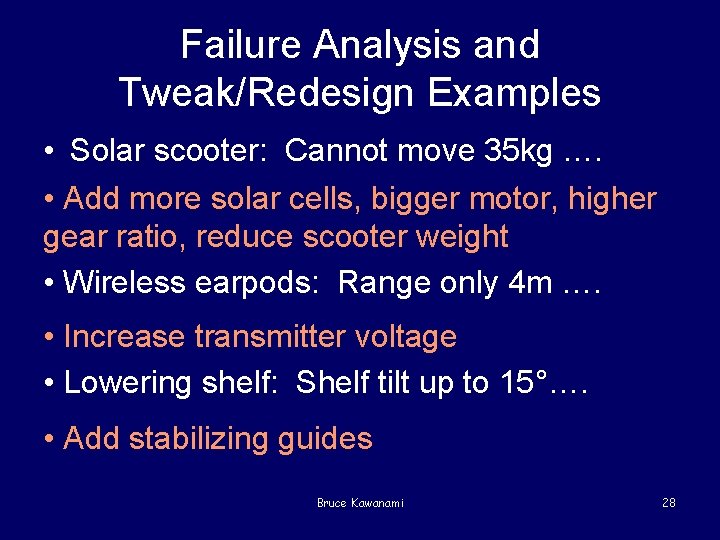
Failure Analysis and Tweak/Redesign Examples • Solar scooter: Cannot move 35 kg …. • Add more solar cells, bigger motor, higher gear ratio, reduce scooter weight • Wireless earpods: Range only 4 m …. • Increase transmitter voltage • Lowering shelf: Shelf tilt up to 15°…. • Add stabilizing guides Bruce Kawanami 28
Step #7: Complete the Project Book (Started at project definition) • Project data book A complete record All key decisions Good drawings Test plans Results Conclusions Things learned Bruce Kawanami 29
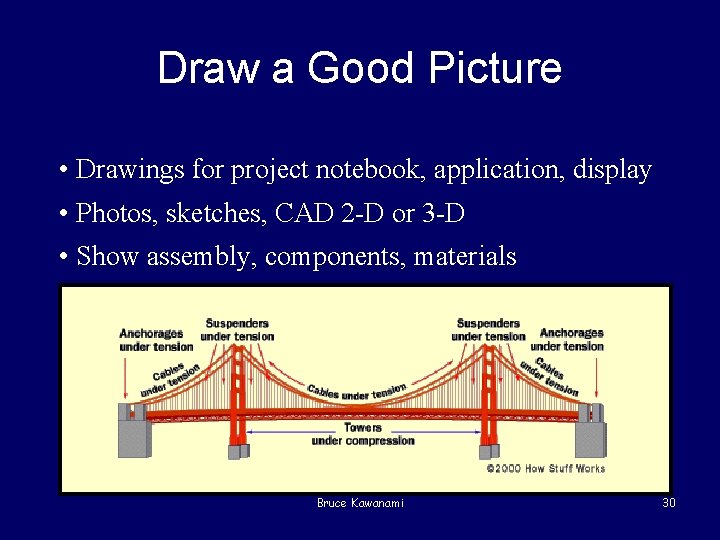
Draw a Good Picture • Drawings for project notebook, application, display • Photos, sketches, CAD 2 -D or 3 -D • Show assembly, components, materials Bruce Kawanami 30
Summary Bruce Kawanami
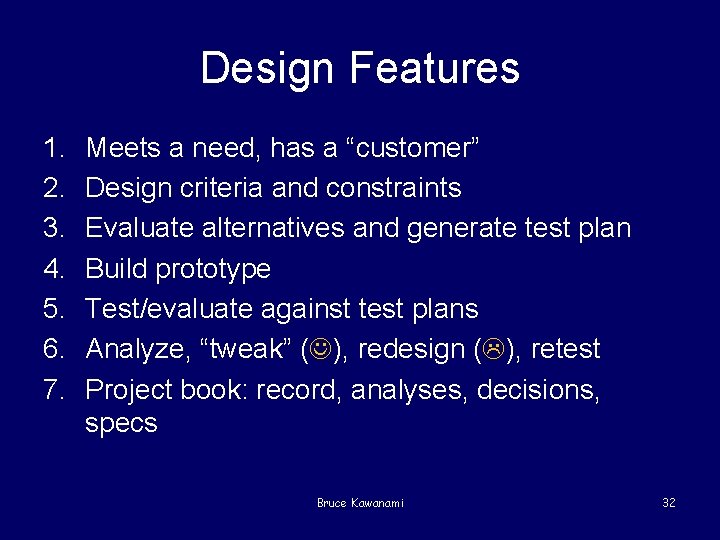
Design Features 1. 2. 3. 4. 5. 6. 7. Meets a need, has a “customer” Design criteria and constraints Evaluate alternatives and generate test plan Build prototype Test/evaluate against test plans Analyze, “tweak” ( ), redesign ( ), retest Project book: record, analyses, decisions, specs Bruce Kawanami 32
Best of Luck Engineering is exciting! Use creative problem solving! Ignite your passion! Bruce Kawanami 33