
Engineering Design Topic2 1 Session 2 Learning Outcomes
- Slides: 29
Engineering Design Topic-2 1
Session # 2 Learning Outcomes At the end of this session, the learner will be able to � Understand What is Engineering Design � Understand broadly the process involved in Engineering Design
Introduction What is design? 3
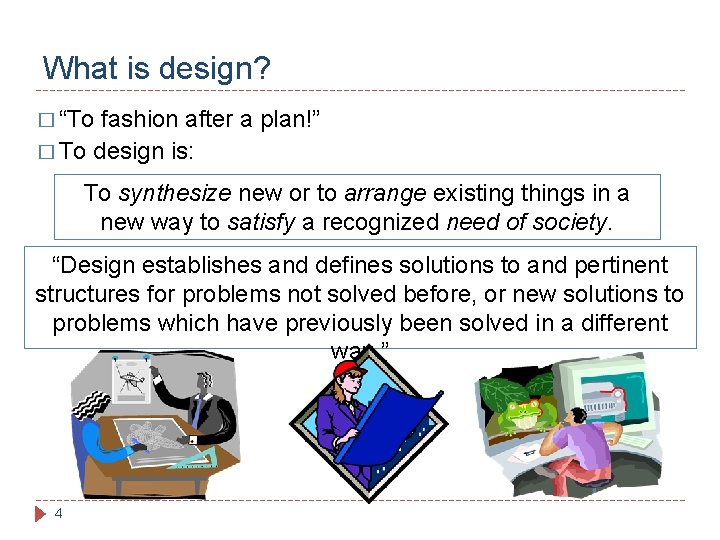
What is design? � “To fashion after a plan!” � To design is: To synthesize new or to arrange existing things in a new way to satisfy a recognized need of society. “Design establishes and defines solutions to and pertinent structures for problems not solved before, or new solutions to problems which have previously been solved in a different way. ” 4
ABET Definition of Engineering Design � Engineering design is the process of devising a system, component, or process to meet desired needs. � It is a decision-making process (often iterative), in which the basic sciences and mathematics, and engineering sciences are applied to convert resources optimally to meet a stated objective. � Among the fundamental elements of the design process are the establishment of objectives and criteria, synthesis, analysis, construction, testing, and evaluation. � The engineering design component of a curriculum must include: � 5 � development of student creativity, use of open-ended problems, � development and use of modern design theory and methodology, � formulation of design problem statements and specifications, � consideration of alternative solutions, feasibility considerations, � production processes, concurrent engineering design, and detailed system descriptions. Further, it is essential to include a variety of realistic constraints, such as economic factors, safety, reliability, aesthetics, ethics, and social impact.
The Four C’s of Design � Creativity Requires creation of something that has not existed before or has not existed in the designer’s mind before. � Complexity Requires decisions on many variables and parameters. � Choice Requires making choices between many possible solutions at all levels, from basic concepts to the smallest detail of shape. � Compromise Requires balancing multiple and sometimes conflicting requirements. 6
Engineering Design Process Why is engineering design process needed? 7
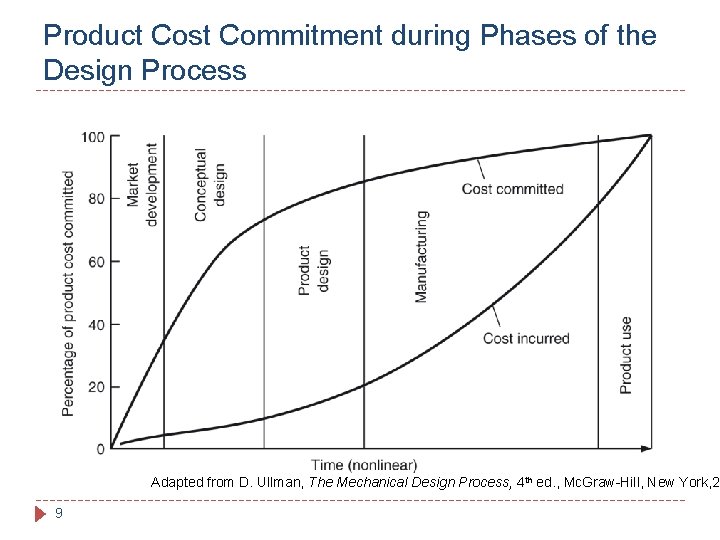
Importance of the Engineering Design Process � Decisions made in the design process cost very little in terms of the overall product cost but have a major effect on the cost of the product. � You cannot compensate in manufacturing for defects introduced in the design phase. � The design process should be conducted so as to develop quality, cost-competitive products in the shortest time possible. 8
Product Cost Commitment during Phases of the Design Process Adapted from D. Ullman, The Mechanical Design Process, 4 th ed. , Mc. Graw-Hill, New York, 20 9
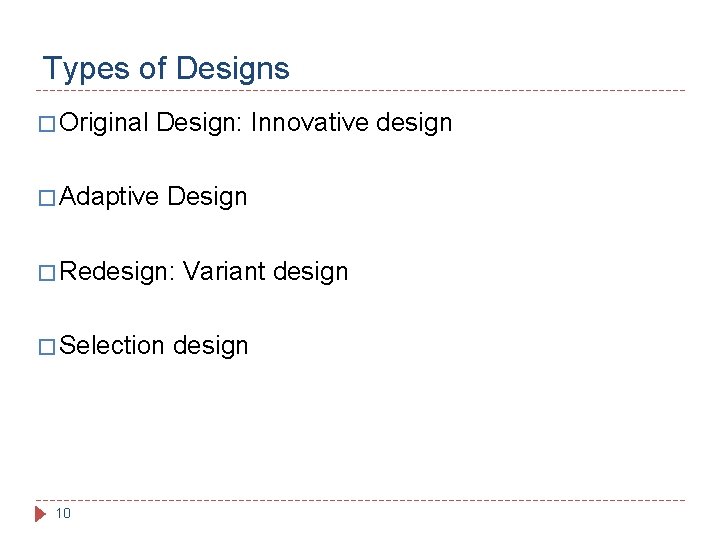
Types of Designs � Original Design: Innovative design � Adaptive Design � Redesign: � Selection 10 Variant design
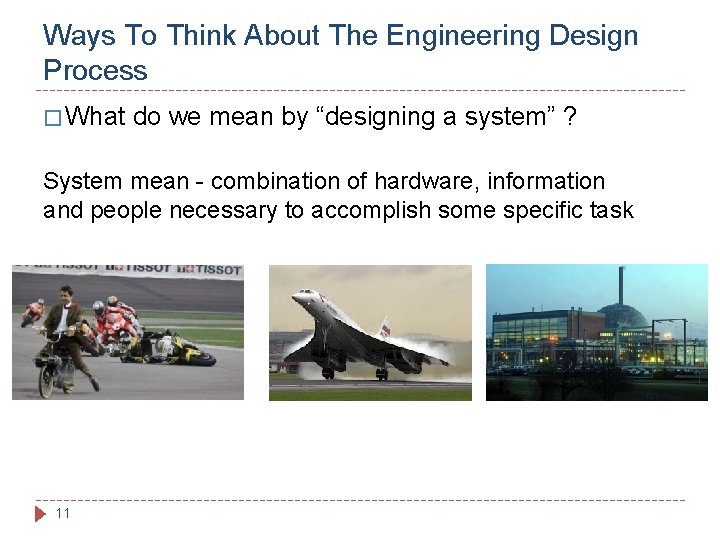
Ways To Think About The Engineering Design Process � What do we mean by “designing a system” ? System mean - combination of hardware, information and people necessary to accomplish some specific task 11
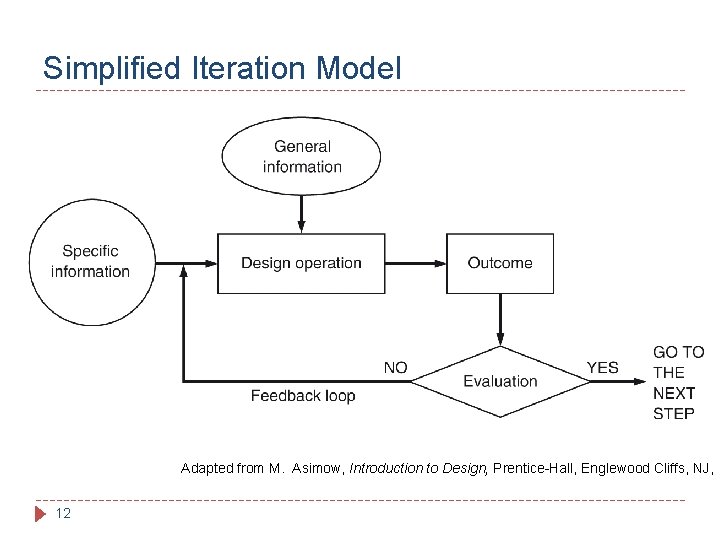
Simplified Iteration Model Adapted from M. Asimow, Introduction to Design, Prentice-Hall, Englewood Cliffs, NJ, 1 12
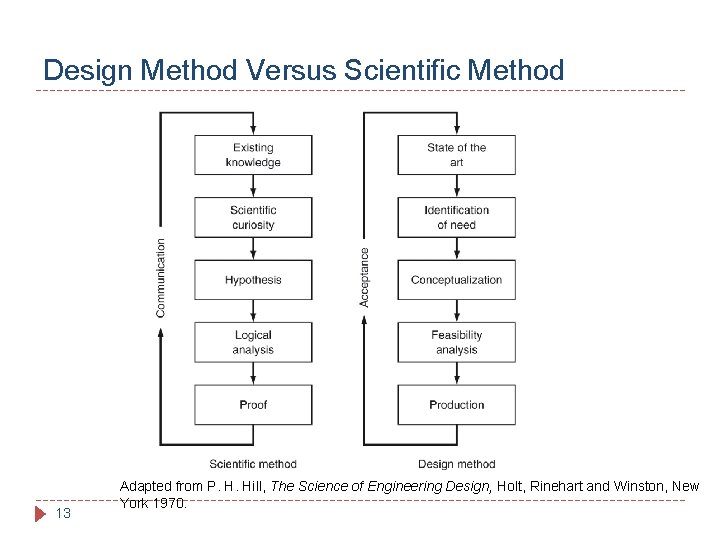
Design Method Versus Scientific Method 13 Adapted from P. H. Hill, The Science of Engineering Design, Holt, Rinehart and Winston, New York 1970.
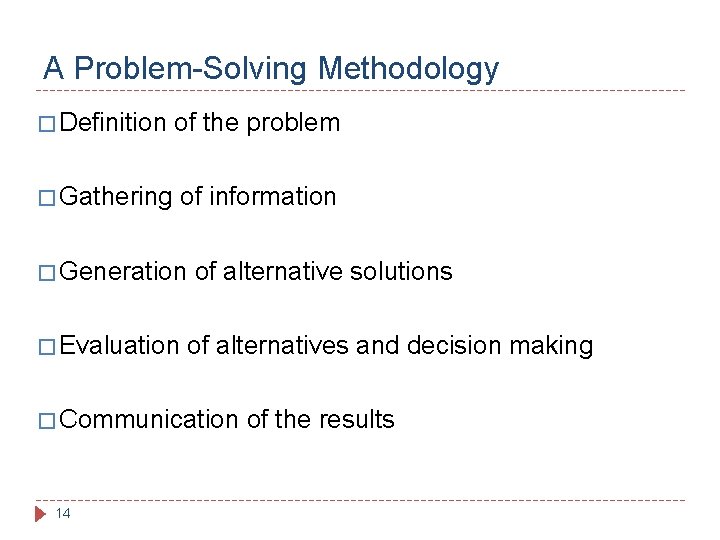
A Problem-Solving Methodology � Definition of the problem � Gathering of information � Generation � Evaluation of alternative solutions of alternatives and decision making � Communication 14 of the results
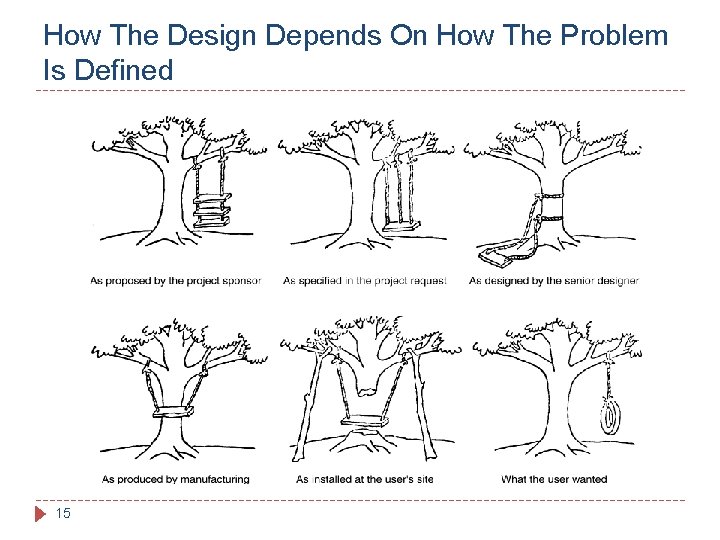
How The Design Depends On How The Problem Is Defined 15
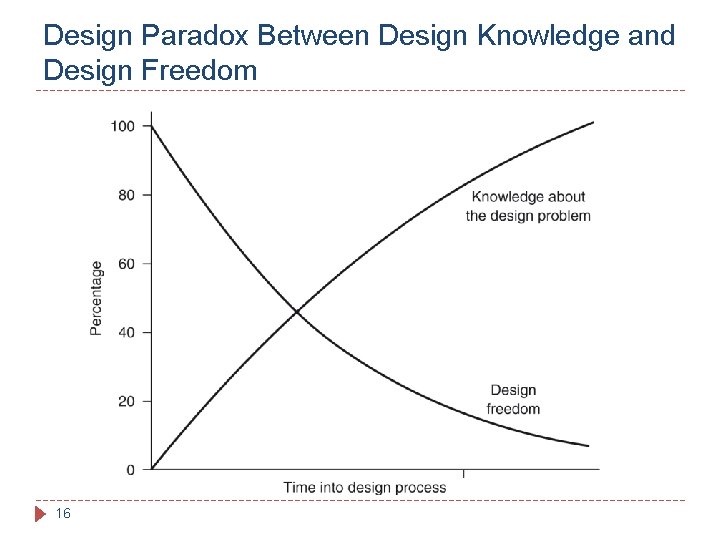
Design Paradox Between Design Knowledge and Design Freedom 16
Description of Design Process What are the steps of Design Process? 17
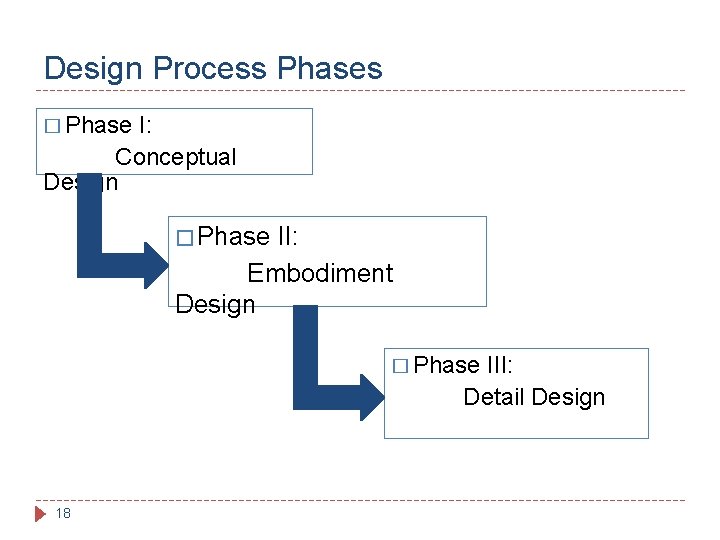
Design Process Phases � Phase I: Conceptual Design � Phase II: Embodiment Design � Phase III: Detail Design 18
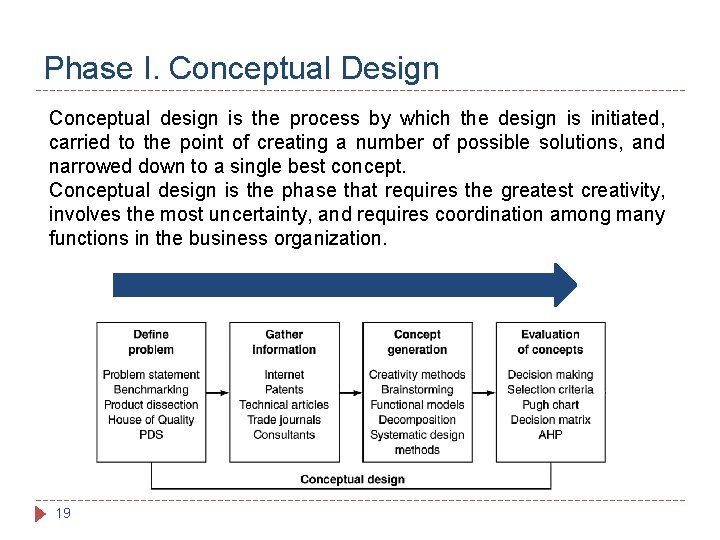
Phase I. Conceptual Design Conceptual design is the process by which the design is initiated, carried to the point of creating a number of possible solutions, and narrowed down to a single best concept. Conceptual design is the phase that requires the greatest creativity, involves the most uncertainty, and requires coordination among many functions in the business organization. 19
Steps in Conceptual Design Identification of customer needs : The goal of this activity is to completely understand the customers’ needs and to communicate them to the design team. � Problem definition : The goal of this activity is to create a statement that describes what has to be accomplished to satisfy the needs of the customer. This involves analysis of competitive products, the establishment of target specifications, and the listing of constraints and trade-offs. � � Quality function deployment (QFD) is a valuable tool for linking customer needs with design requirements. A detailed listing of the product requirements is called a product design specification (PDS). Gathering information: Engineering design presents special requirements over engineering research in the need to acquire a broad spectrum of information. � Conceptualization : Concept generation involves creating a broad set of concepts that potentially satisfy the problem statement. Team 20 based creativity methods, combined with efficient information gathering, are the key activities. �
Steps in Conceptual Design Concept selection : Evaluation of the design concepts, modifying and evolving into a single preferred concept, are the activities in this step. The process usually requires several iterations. � Refinement of the PDS : The product design specification is revisited after the concept has been selected. The design team must commit to achieving certain critical values of design parameters, usually called critical-to-quality (CTQ) parameters, and to living with trade-offs between cost and performance. � Design review : Before committing funds to move to the next design phase, a design review will be held. The design review will assure that the design is physically realizable and that it is economically worthwhile. It will also look at a detailed product development schedule. This is needed to devise a strategy to minimize product cycle time and to identify the resources in people, equipment, and money needed to complete the project. � 21
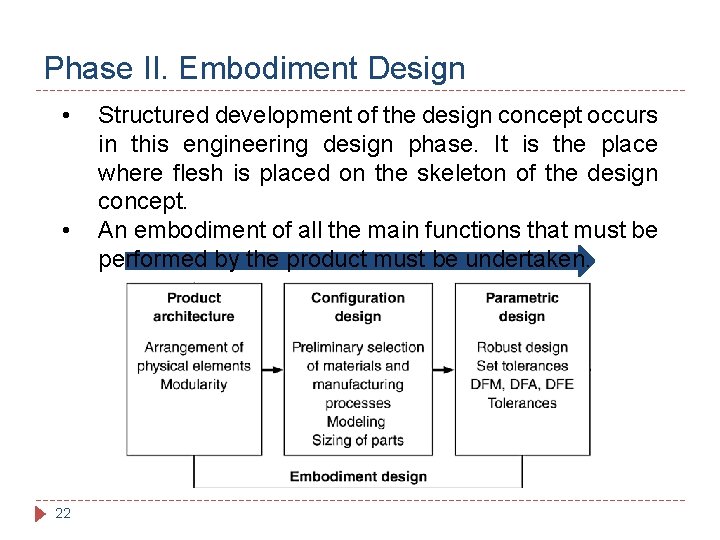
Phase II. Embodiment Design • • 22 Structured development of the design concept occurs in this engineering design phase. It is the place where flesh is placed on the skeleton of the design concept. An embodiment of all the main functions that must be performed by the product must be undertaken.
Embodiment Design… � It is in this design phase that decisions are made on strength, material selection, size, shape, and spatial compatibility. � Beyond this design phase, major changes become very expensive. This design phase is sometimes called preliminary design. � Embodiment design is concerned with three major tasks—product architecture, configuration design, and parametric design. 23
Stages in Embodiment Design � Product architecture : Product architecture is concerned with dividing the overall design system into subsystems or modules. In this step we decide how the physical components of the design are to be arranged and combined to carry out the functional duties of the design. � Configuration design of parts and components : Configuring a part means to determine what features (like holes, ribs, splines and curves) will be present and how those features are to be arranged in space relative to each other. While modeling and simulation may be performed in this stage to check out function and spatial constraints, only approximate sizes are determined to assure that the part satisfies the PDS. Also, more specificity about materials and manufacturing is given here. The generation of a physical model of the part with rapid prototyping processes may be appropriate. 24
Stages in Embodiment Design � Parametric design of parts : Parametric design starts with information on the configuration of the part and aims to establish its exact dimensions and tolerances. � Final decisions on the material and manufacturing processes are also established if this has not been done previously. � An important aspect of parametric design is to examine the part, assembly, and system for design robustness. � Robustness refers to how consistently a component performs under variable conditions in its service environment. The methods developed by Dr. Genichi Taguchi for achieving robustness and establishing the optimum tolerance. � Parametric design also deals with determining the aspects of the design that could lead to failure. Another important consideration in parametric design is to design in such a way that manufacturability is enhanced. � 25
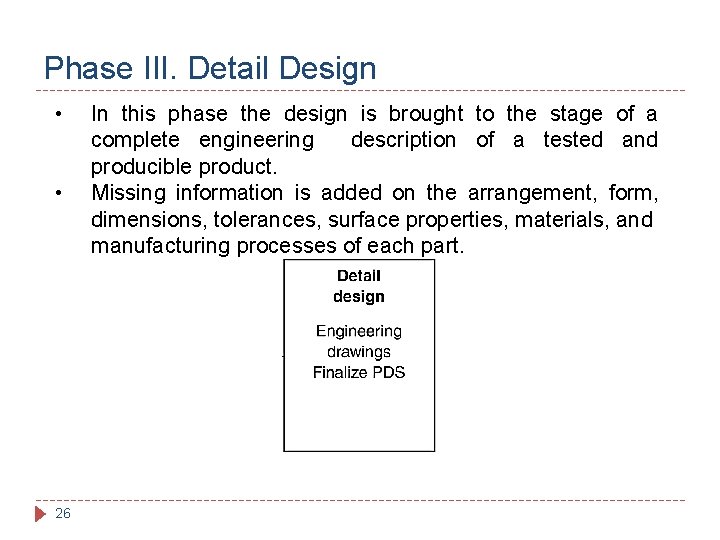
Phase III. Detail Design • • 26 In this phase the design is brought to the stage of a complete engineering description of a tested and producible product. Missing information is added on the arrangement, form, dimensions, tolerances, surface properties, materials, and manufacturing processes of each part.
Activities in Detail Design � Detailed engineering drawings suitable for manufacturing, include threedimensional CAD models. � Verification testing of prototypes is successfully completed and verification data is submitted. � Assembly drawings and assembly instructions also will be completed. The bill of materials for all assemblies will be completed. � A detailed product specification, updated with all the changes made since the conceptual design phase, will be prepared. � Decisions on whether to make each part internally or to buy from an external supplier will be made. � With the preceding information, a detailed cost estimate for the product will be carried out. � Finally, detail design concludes with a design review before the decision is made to pass the design information on to manufacturing. 27
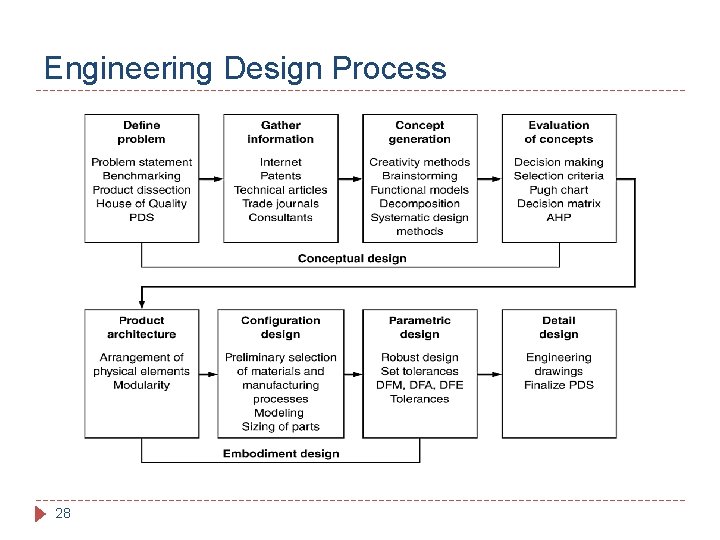
Engineering Design Process 28
In next session we will learn about various Design processes 29