
Engineering Design Process Presentation 4 2 2 Explanation
- Slides: 24
Engineering Design Process Presentation 4. 2. 2 Explanation © 2011 International Technology and Engineering Educators Association, STEM Center for Teaching and Learning™ Foundations of Technology
The Unit Big Idea The Engineering Design Process is a systematic, iterative problem solving method which produces solutions to meet human wants and desires. © 2011 International Technology and Engineering Educators Association, STEM Center for Teaching and Learning™ Foundations of Technology
The Lesson Big Idea The Engineering Design Process is a systematic, iterative problem solving method which produces solutions to meet human wants and desires. © 2011 International Technology and Engineering Educators Association, STEM Center for Teaching and Learning™ Foundations of Technology
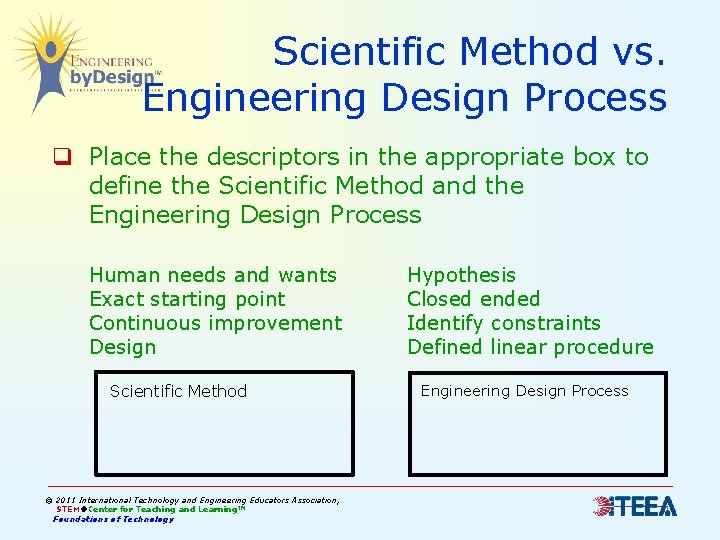
Scientific Method vs. Engineering Design Process q Place the descriptors in the appropriate box to define the Scientific Method and the Engineering Design Process Human needs and wants Exact starting point Continuous improvement Design Scientific Method © 2011 International Technology and Engineering Educators Association, STEM Center for Teaching and Learning™ Foundations of Technology Hypothesis Closed ended Identify constraints Defined linear procedure Engineering Design Process
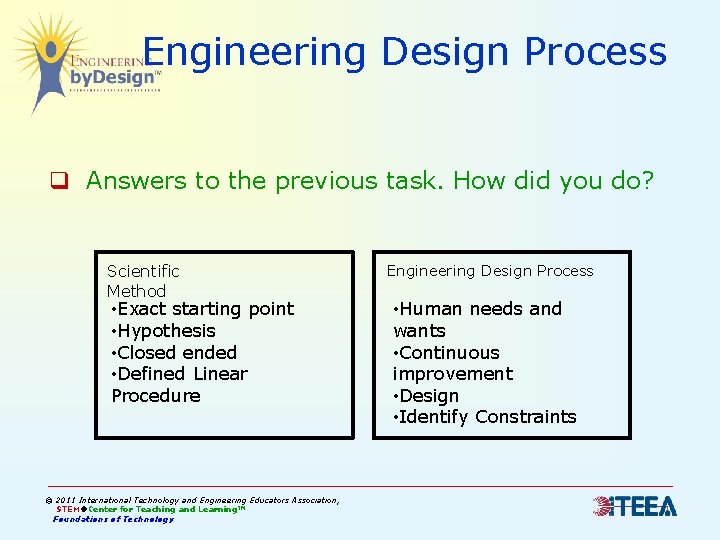
Engineering Design Process q Answers to the previous task. How did you do? Scientific Method • Exact starting point • Hypothesis • Closed ended • Defined Linear Procedure © 2011 International Technology and Engineering Educators Association, STEM Center for Teaching and Learning™ Foundations of Technology Engineering Design Process • Human needs and wants • Continuous improvement • Design • Identify Constraints
Engineering Design Process q There a variety of formal and informal problem-solving strategies and models beyond the Scientific Method and the Engineering Design Process q The process of engineering design takes into account a number of factors. © 2011 International Technology and Engineering Educators Association, STEM Center for Teaching and Learning™ Foundations of Technology
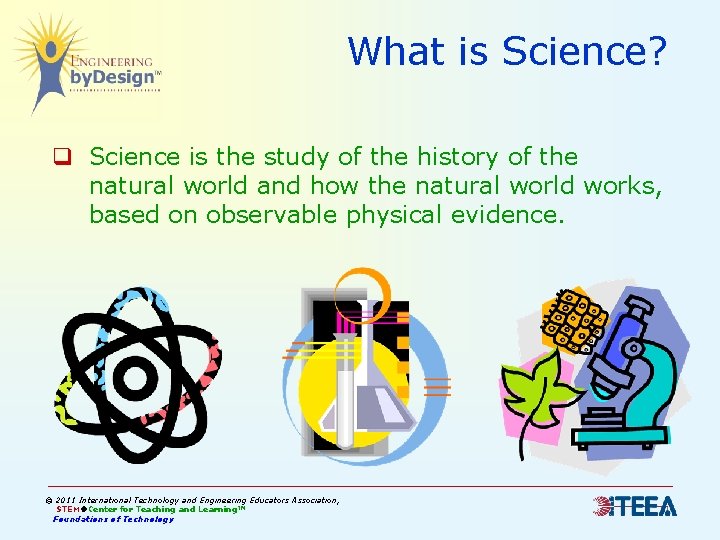
What is Science? q Science is the study of the history of the natural world and how the natural world works, based on observable physical evidence. © 2011 International Technology and Engineering Educators Association, STEM Center for Teaching and Learning™ Foundations of Technology
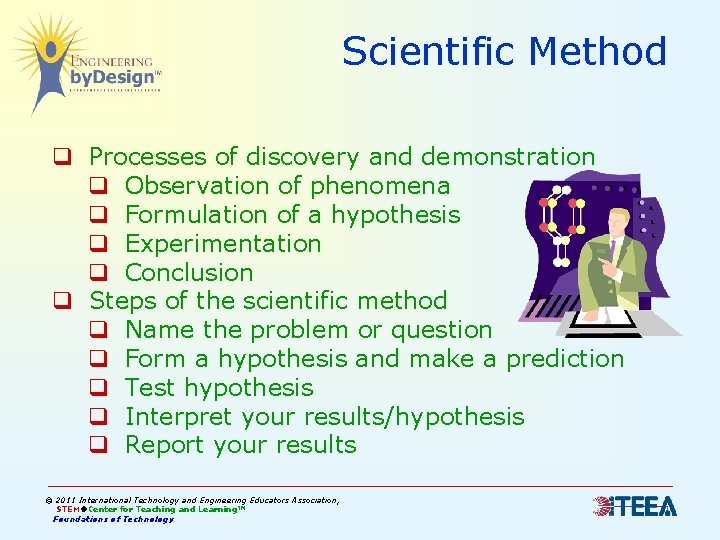
Scientific Method q Processes of discovery and demonstration q Observation of phenomena q Formulation of a hypothesis q Experimentation q Conclusion q Steps of the scientific method q Name the problem or question q Form a hypothesis and make a prediction q Test hypothesis q Interpret your results/hypothesis q Report your results © 2011 International Technology and Engineering Educators Association, STEM Center for Teaching and Learning™ Foundations of Technology
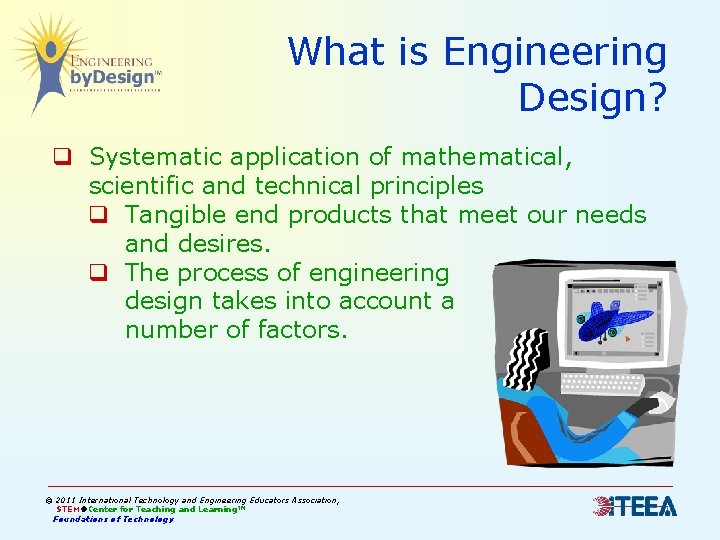
What is Engineering Design? q Systematic application of mathematical, scientific and technical principles q Tangible end products that meet our needs and desires. q The process of engineering design takes into account a number of factors. © 2011 International Technology and Engineering Educators Association, STEM Center for Teaching and Learning™ Foundations of Technology
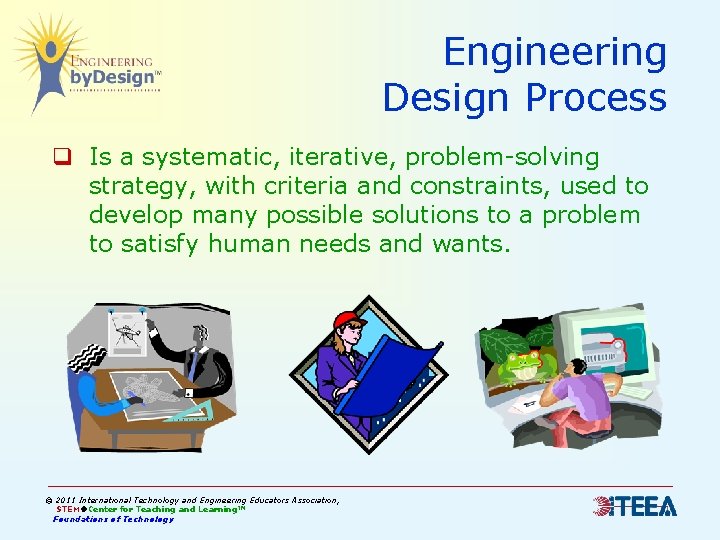
Engineering Design Process q Is a systematic, iterative, problem-solving strategy, with criteria and constraints, used to develop many possible solutions to a problem to satisfy human needs and wants. © 2011 International Technology and Engineering Educators Association, STEM Center for Teaching and Learning™ Foundations of Technology
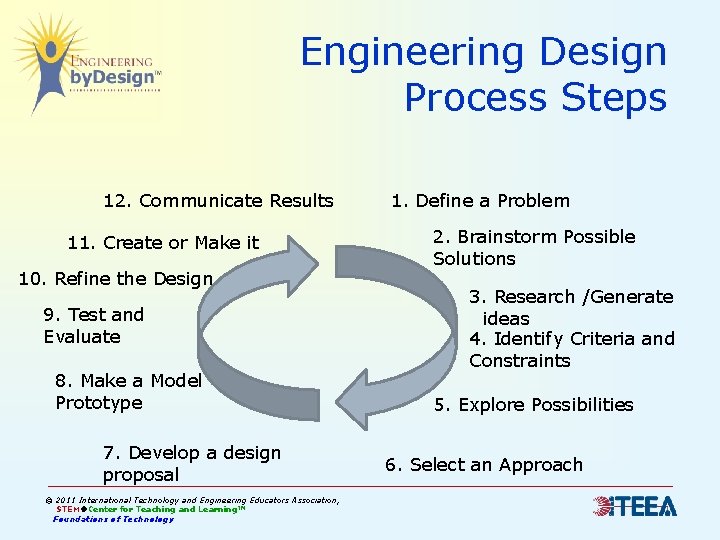
Engineering Design Process Steps 12. Communicate Results 11. Create or Make it 10. Refine the Design 9. Test and Evaluate 8. Make a Model Prototype 7. Develop a design proposal © 2011 International Technology and Engineering Educators Association, STEM Center for Teaching and Learning™ Foundations of Technology 1. Define a Problem 2. Brainstorm Possible Solutions 3. Research /Generate ideas 4. Identify Criteria and Constraints 5. Explore Possibilities 6. Select an Approach
Define the Problem q Designer clearly outlines what human need or want exists to solve the problem. q Often design problems are not clearly defined. Designers may have to investigate to define the problem. q For example, a company might call you in and ask you to solve the problem of the company losing money q Determine why the company is losing money q What problem needs fixing © 2011 International Technology and Engineering Educators Association, STEM Center for Teaching and Learning™ Foundations of Technology
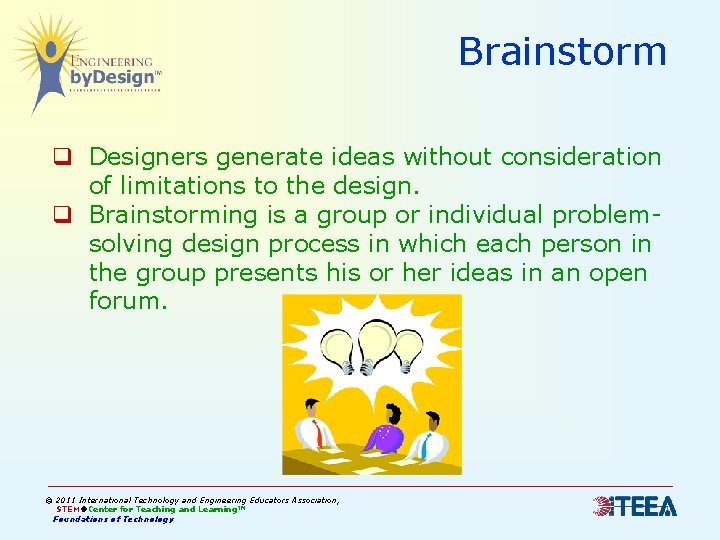
Brainstorm q Designers generate ideas without consideration of limitations to the design. q Brainstorming is a group or individual problemsolving design process in which each person in the group presents his or her ideas in an open forum. © 2011 International Technology and Engineering Educators Association, STEM Center for Teaching and Learning™ Foundations of Technology
Generate Ideas q This is a step where designers can let their imaginations run free with suggestions from the brainstorming session. © 2011 International Technology and Engineering Educators Association, STEM Center for Teaching and Learning™ Foundations of Technology
Research Ideas & Explore Possibilities q Research to determine if a solution to the problem already exists q Can another solution/product be adapted to solve the problem q Is there mathematical or scientific information related to the problem that needs to be collected through research? q Designers begin to explore the possibilities generated during the brainstorming session and the research gathered. © 2011 International Technology and Engineering Educators Association, STEM Center for Teaching and Learning™ Foundations of Technology
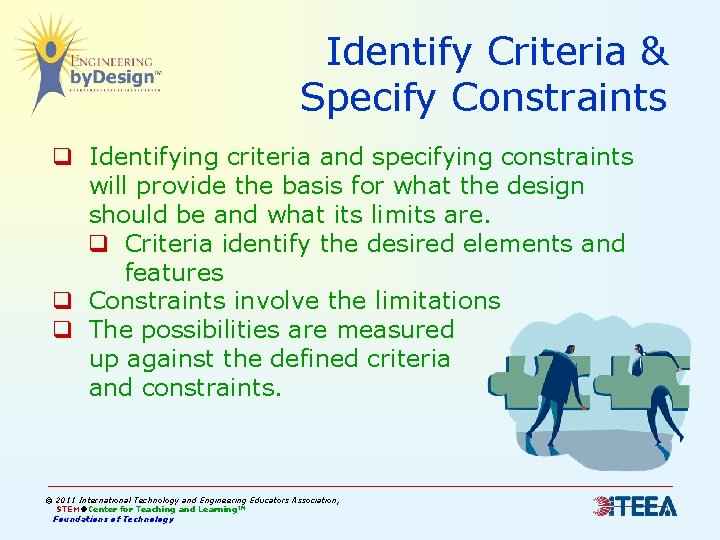
Identify Criteria & Specify Constraints q Identifying criteria and specifying constraints will provide the basis for what the design should be and what its limits are. q Criteria identify the desired elements and features q Constraints involve the limitations q The possibilities are measured up against the defined criteria and constraints. © 2011 International Technology and Engineering Educators Association, STEM Center for Teaching and Learning™ Foundations of Technology
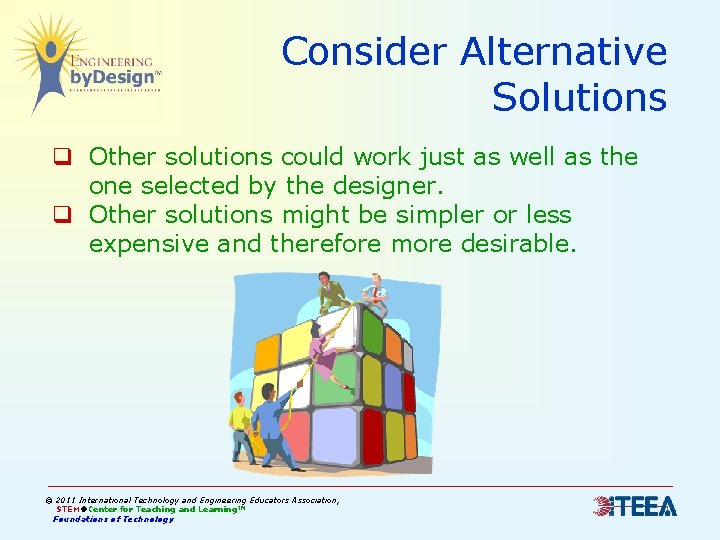
Consider Alternative Solutions q Other solutions could work just as well as the one selected by the designer. q Other solutions might be simpler or less expensive and therefore more desirable. © 2011 International Technology and Engineering Educators Association, STEM Center for Teaching and Learning™ Foundations of Technology
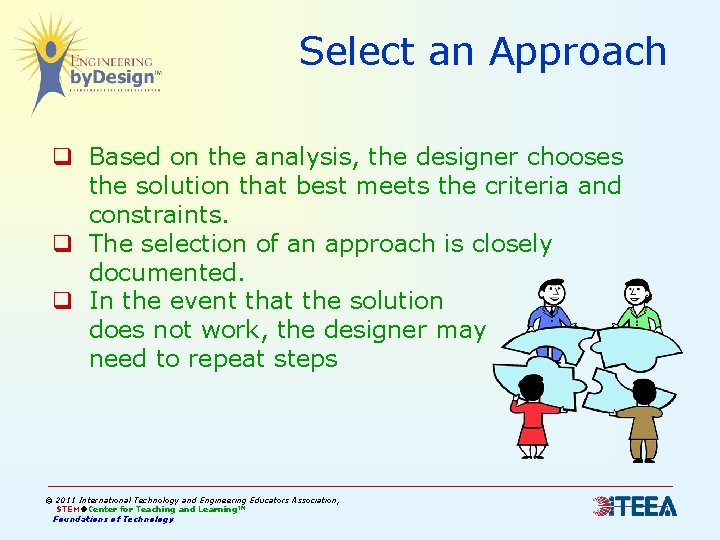
Select an Approach q Based on the analysis, the designer chooses the solution that best meets the criteria and constraints. q The selection of an approach is closely documented. q In the event that the solution does not work, the designer may need to repeat steps © 2011 International Technology and Engineering Educators Association, STEM Center for Teaching and Learning™ Foundations of Technology
Develop a Written Design Proposal q A design proposal is a written plan that specifies what the design will look like and what resources are needed to develop it. q It can be communicated through sketches, drawings, models and written instructions. © 2011 International Technology and Engineering Educators Association, STEM Center for Teaching and Learning™ Foundations of Technology
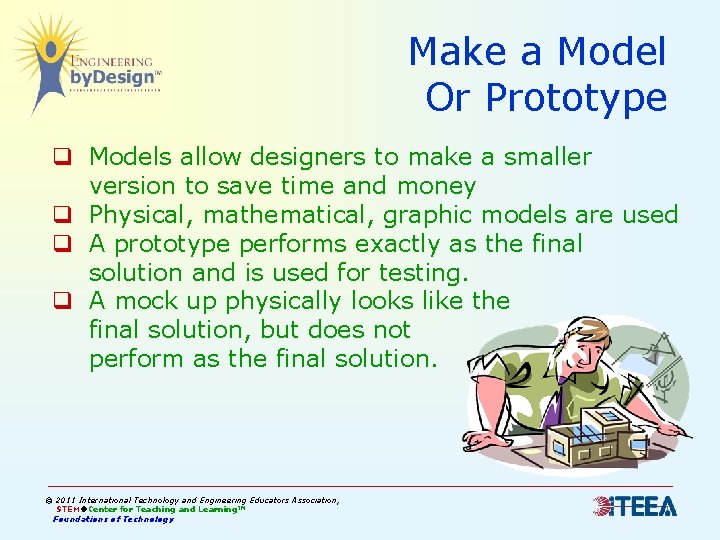
Make a Model Or Prototype q Models allow designers to make a smaller version to save time and money q Physical, mathematical, graphic models are used q A prototype performs exactly as the final solution and is used for testing. q A mock up physically looks like the final solution, but does not perform as the final solution. © 2011 International Technology and Engineering Educators Association, STEM Center for Teaching and Learning™ Foundations of Technology
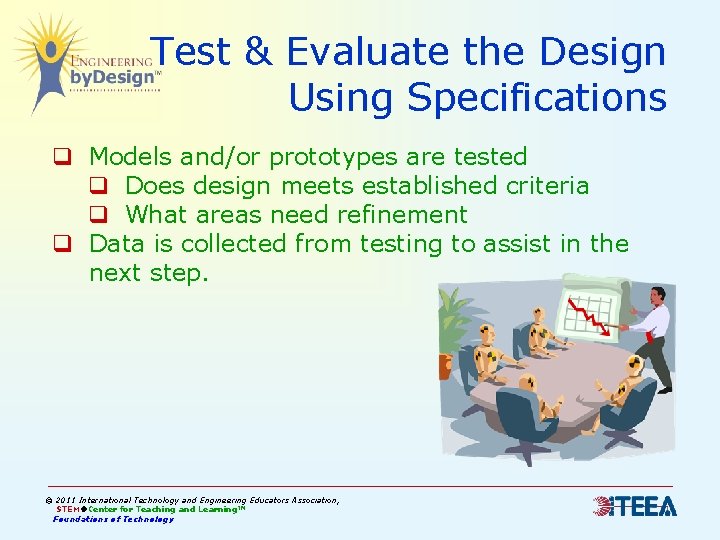
Test & Evaluate the Design Using Specifications q Models and/or prototypes are tested q Does design meets established criteria q What areas need refinement q Data is collected from testing to assist in the next step. © 2011 International Technology and Engineering Educators Association, STEM Center for Teaching and Learning™ Foundations of Technology
Refine/Create the Design q Based on the evaluation and testing results, designers refine the design of the product. q Refinement and optimization include q Function (making it work better) q Economic (giving it market appeal) q Ethical (making it safer) © 2011 International Technology and Engineering Educators Association, STEM Center for Teaching and Learning™ Foundations of Technology
Refine/Create the Design q The product is then mass produced to be sold to the target market. q Designers and Engineers work together to design a cost effective and time efficient process for producing the product. © 2011 International Technology and Engineering Educators Association, STEM Center for Teaching and Learning™ Foundations of Technology
Communicate the Results q Designers need to communicate their results to perpetuate innovation and so others with similar problems can learn from their design process. q Communication of the design process can include design portfolios, journals, drawings, sketches or schematics. © 2011 International Technology and Engineering Educators Association, STEM Center for Teaching and Learning™ Foundations of Technology