
Engineering Design Process Presentation 3 2 2 Explanation
- Slides: 24
Engineering Design Process Presentation 3. 2. 2 Explanation © 2011 International Technology and Engineering Educators Association, STEM Center for Teaching and Learning™ Foundations of Technology
The Unit Big Idea The Engineering Design Process is a systematic, iterative problem solving method which produces solutions to meet human wants and desires. © 2011 International Technology and Engineering Educators Association, STEM Center for Teaching and Learning™ Foundations of Technology
The Lesson Big Idea The Engineering Design Process is a systematic, iterative problem solving method which produces solutions to meet human wants and desires. © 2011 International Technology and Engineering Educators Association, STEM Center for Teaching and Learning™ Foundations of Technology
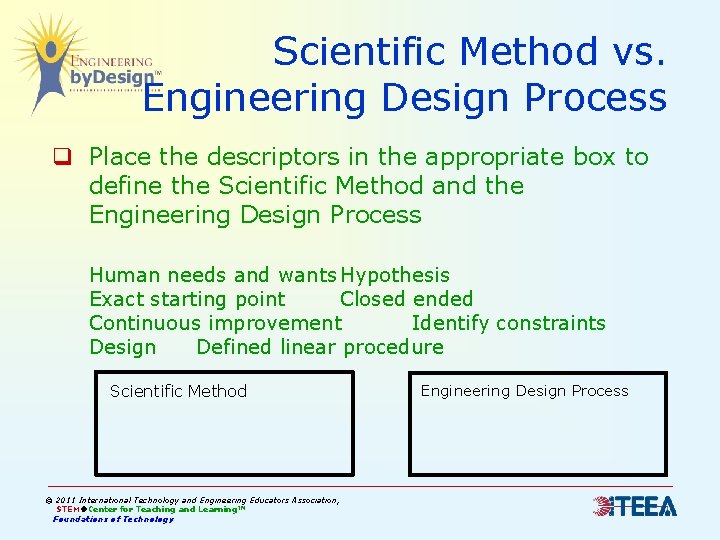
Scientific Method vs. Engineering Design Process q Place the descriptors in the appropriate box to define the Scientific Method and the Engineering Design Process Human needs and wants Hypothesis Exact starting point Closed ended Continuous improvement Identify constraints Design Defined linear procedure Scientific Method © 2011 International Technology and Engineering Educators Association, STEM Center for Teaching and Learning™ Foundations of Technology Engineering Design Process
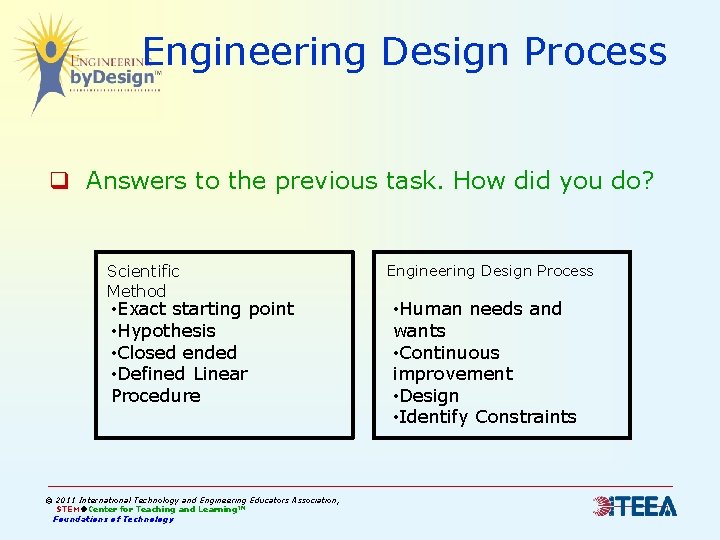
Engineering Design Process q Answers to the previous task. How did you do? Scientific Method • Exact starting point • Hypothesis • Closed ended • Defined Linear Procedure © 2011 International Technology and Engineering Educators Association, STEM Center for Teaching and Learning™ Foundations of Technology Engineering Design Process • Human needs and wants • Continuous improvement • Design • Identify Constraints
Engineering Design Process q There a variety of formal and informal problem-solving strategies and models beyond the Scientific Method and the Engineering Design Process q The process of engineering design takes into account a number of factors. © 2011 International Technology and Engineering Educators Association, STEM Center for Teaching and Learning™ Foundations of Technology
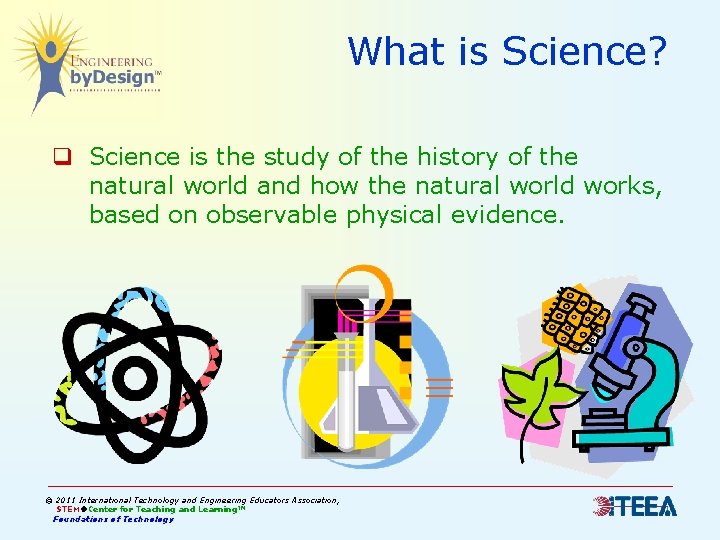
What is Science? q Science is the study of the history of the natural world and how the natural world works, based on observable physical evidence. © 2011 International Technology and Engineering Educators Association, STEM Center for Teaching and Learning™ Foundations of Technology
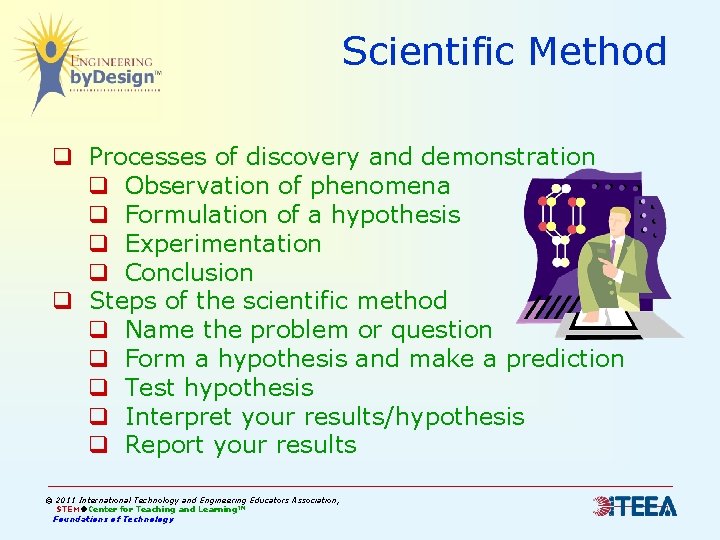
Scientific Method q Processes of discovery and demonstration q Observation of phenomena q Formulation of a hypothesis q Experimentation q Conclusion q Steps of the scientific method q Name the problem or question q Form a hypothesis and make a prediction q Test hypothesis q Interpret your results/hypothesis q Report your results © 2011 International Technology and Engineering Educators Association, STEM Center for Teaching and Learning™ Foundations of Technology
What is Engineering Design? q Systematic application of mathematical, scientific and technical principles q Tangible end products that meet our needs and desires. q The process of engineering design takes into account a number of factors. © 2011 International Technology and Engineering Educators Association, STEM Center for Teaching and Learning™ Foundations of Technology
Engineering Design Process q Is a systematic, iterative, problem-solving strategy, with criteria and constraints, used to develop many possible solutions to a problem to satisfy human needs and wants. © 2011 International Technology and Engineering Educators Association, STEM Center for Teaching and Learning™ Foundations of Technology
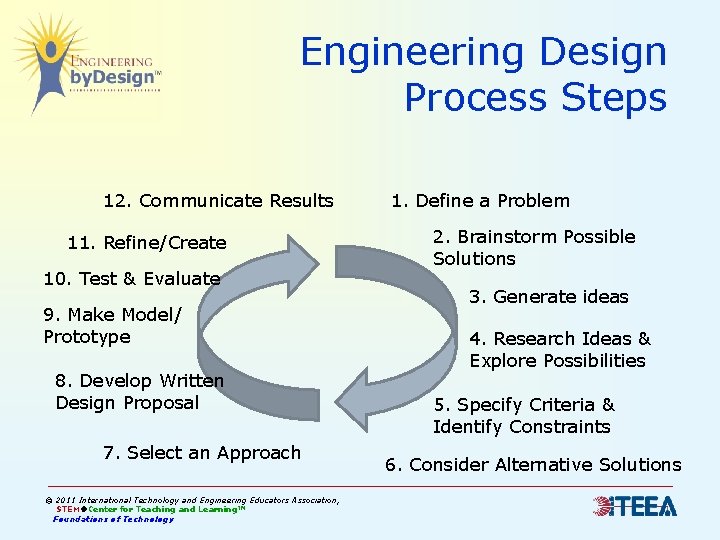
Engineering Design Process Steps 12. Communicate Results 11. Refine/Create 10. Test & Evaluate 9. Make Model/ Prototype 8. Develop Written Design Proposal 7. Select an Approach © 2011 International Technology and Engineering Educators Association, STEM Center for Teaching and Learning™ Foundations of Technology 1. Define a Problem 2. Brainstorm Possible Solutions 3. Generate ideas 4. Research Ideas & Explore Possibilities 5. Specify Criteria & Identify Constraints 6. Consider Alternative Solutions
Define the Problem q Designer clearly outlines what human need or want exists to solve the problem. q Often design problems are not clearly defined. Designers may have to investigate to define the problem. q For example, a company might call you in and ask you to solve the problem of the company losing money q Determine why the company is losing money q What problem needs fixing © 2011 International Technology and Engineering Educators Association, STEM Center for Teaching and Learning™ Foundations of Technology
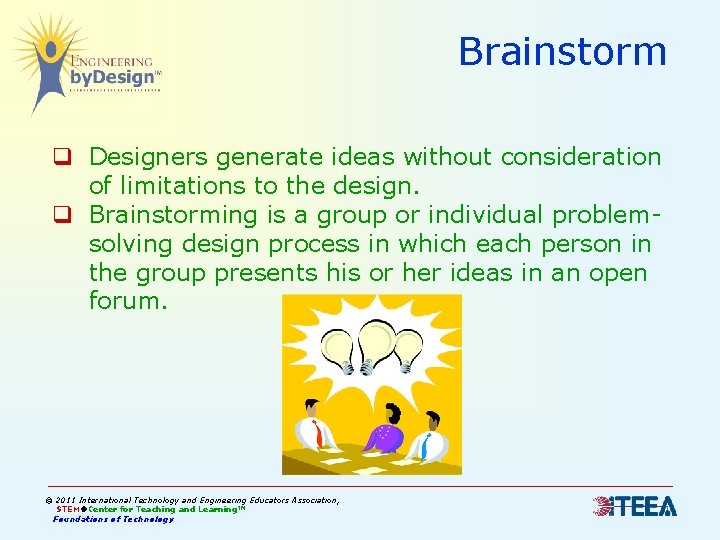
Brainstorm q Designers generate ideas without consideration of limitations to the design. q Brainstorming is a group or individual problemsolving design process in which each person in the group presents his or her ideas in an open forum. © 2011 International Technology and Engineering Educators Association, STEM Center for Teaching and Learning™ Foundations of Technology
Generate Ideas q This is a step where designers can let their imaginations run free with suggestions from the brainstorming session. © 2011 International Technology and Engineering Educators Association, STEM Center for Teaching and Learning™ Foundations of Technology
Research Ideas & Explore Possibilities q Research to determine if a solution to the problem already exists q Can another solution/product be adapted to solve the problem q Is there mathematical or scientific information related to the problem that needs to be collected through research? q Designers begin to explore the possibilities generated during the brainstorming session and the research gathered. © 2011 International Technology and Engineering Educators Association, STEM Center for Teaching and Learning™ Foundations of Technology
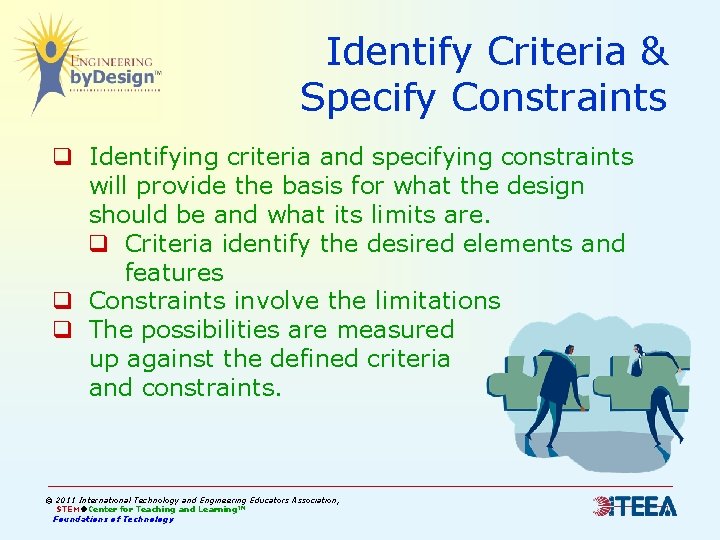
Identify Criteria & Specify Constraints q Identifying criteria and specifying constraints will provide the basis for what the design should be and what its limits are. q Criteria identify the desired elements and features q Constraints involve the limitations q The possibilities are measured up against the defined criteria and constraints. © 2011 International Technology and Engineering Educators Association, STEM Center for Teaching and Learning™ Foundations of Technology
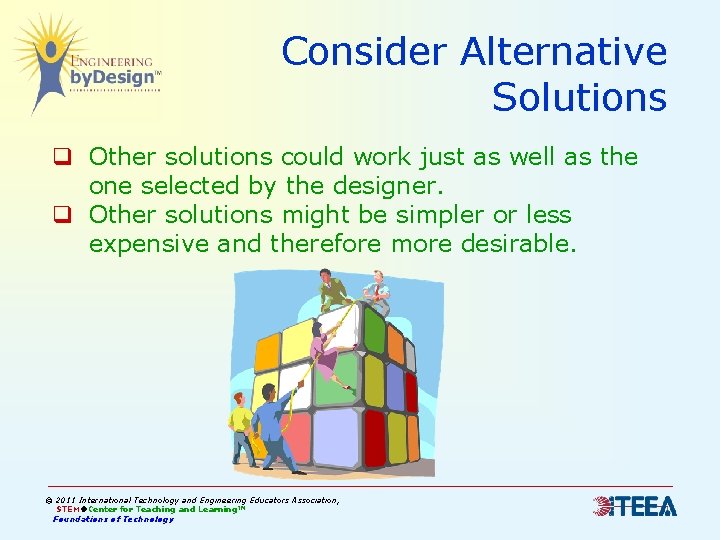
Consider Alternative Solutions q Other solutions could work just as well as the one selected by the designer. q Other solutions might be simpler or less expensive and therefore more desirable. © 2011 International Technology and Engineering Educators Association, STEM Center for Teaching and Learning™ Foundations of Technology
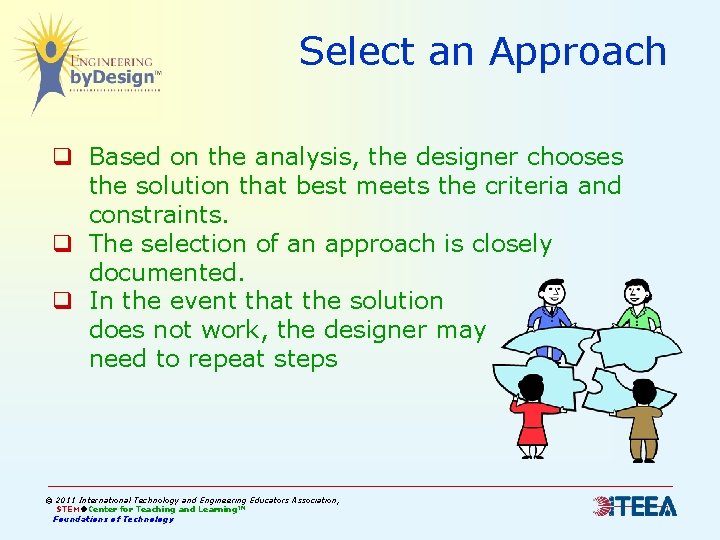
Select an Approach q Based on the analysis, the designer chooses the solution that best meets the criteria and constraints. q The selection of an approach is closely documented. q In the event that the solution does not work, the designer may need to repeat steps © 2011 International Technology and Engineering Educators Association, STEM Center for Teaching and Learning™ Foundations of Technology
Develop a Written Design Proposal q A design proposal is a written plan that specifies what the design will look like and what resources are needed to develop it. q It can be communicated through sketches, drawings, models and written instructions. © 2011 International Technology and Engineering Educators Association, STEM Center for Teaching and Learning™ Foundations of Technology
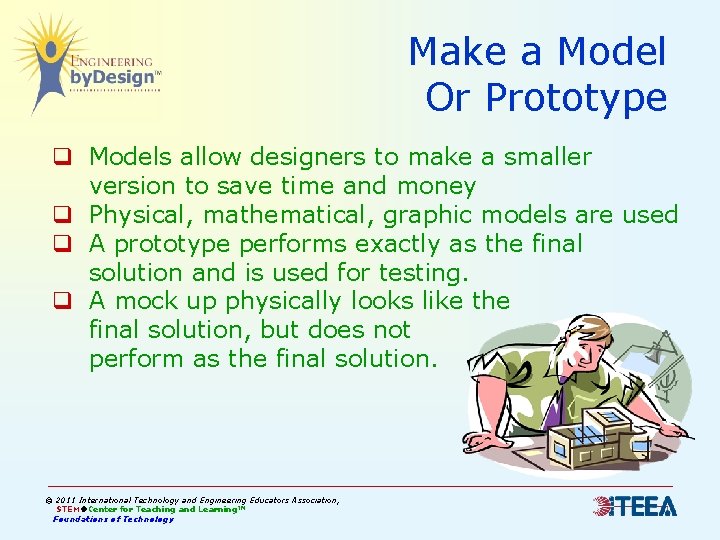
Make a Model Or Prototype q Models allow designers to make a smaller version to save time and money q Physical, mathematical, graphic models are used q A prototype performs exactly as the final solution and is used for testing. q A mock up physically looks like the final solution, but does not perform as the final solution. © 2011 International Technology and Engineering Educators Association, STEM Center for Teaching and Learning™ Foundations of Technology
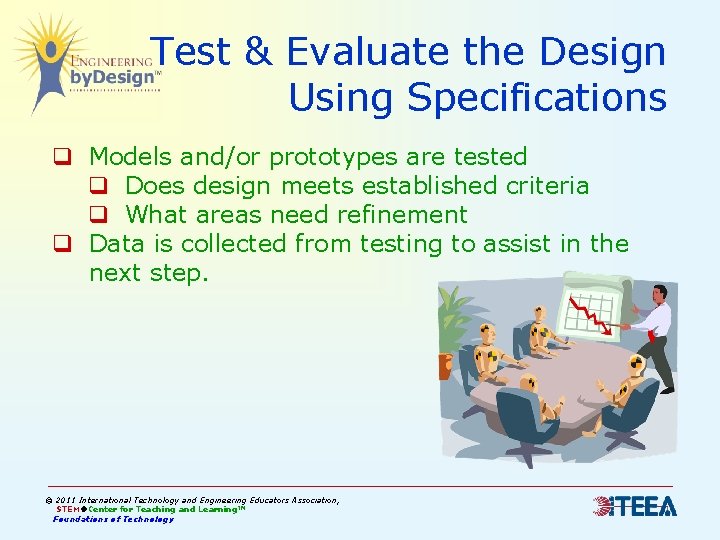
Test & Evaluate the Design Using Specifications q Models and/or prototypes are tested q Does design meets established criteria q What areas need refinement q Data is collected from testing to assist in the next step. © 2011 International Technology and Engineering Educators Association, STEM Center for Teaching and Learning™ Foundations of Technology
Refine/Create the Design q Based on the evaluation and testing results, designers refine the design of the product. q Refinement and optimization include q Function (making it work better) q Economic (giving it market appeal) q Ethical (making it safer) © 2011 International Technology and Engineering Educators Association, STEM Center for Teaching and Learning™ Foundations of Technology
Refine/Create the Design q The product is then mass produced to be sold to the target market. q Designers and Engineers work together to design a cost effective and time efficient process for producing the product. © 2011 International Technology and Engineering Educators Association, STEM Center for Teaching and Learning™ Foundations of Technology
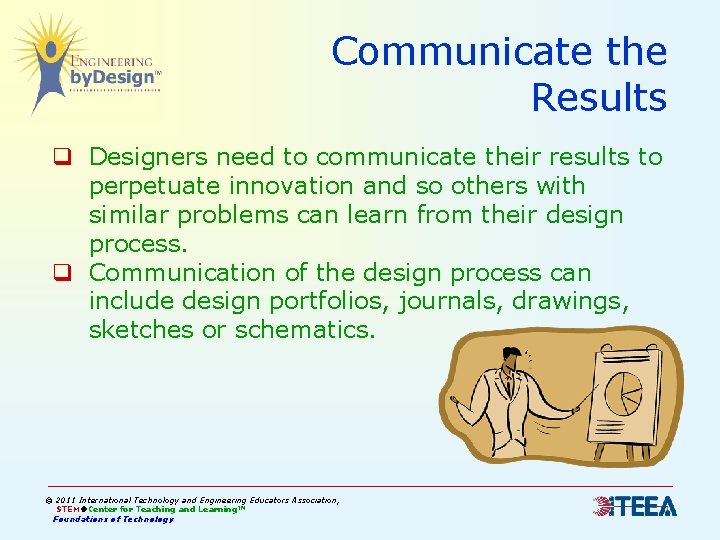
Communicate the Results q Designers need to communicate their results to perpetuate innovation and so others with similar problems can learn from their design process. q Communication of the design process can include design portfolios, journals, drawings, sketches or schematics. © 2011 International Technology and Engineering Educators Association, STEM Center for Teaching and Learning™ Foundations of Technology