
Engineering Design Considerations 2003 2004 2005 Plastics Pipe




- Slides: 71
Engineering Design Considerations © 2003, 2004, 2005 - Plastics Pipe and Fittings Association
• General Design Piping Practices Follow generally accepted engineering practices when designing with thermoplastic piping. These include: – – – – Selecting the proper material for the application Controlling pressure surges and velocities Identifying standards for piping components Selecting and proper sizing of pipe, valves and fittings Proper pipe supports, anchors, and guides Proper underground design considerations Selecting the most cost effective system for required service life – Following all applicable codes and standards 2 - Engineering Design Considerations © 2003, 2004, 2005 - Plastics Pipe and Fittings Association
Plastic Piping Design Practices • Plastic piping has several unique engineering properties compared to nonplastic materials. To ensure an effective and long lasting piping installation, the design engineer needs to be aware of these properties: 3 - Engineering Design Considerations – – – – Chemical Resistance Pipe and System Pressure Ratings Temperature Limits Temperature/Pressure Relationship Expansion/Contraction Pipe Support Underground Pipe Flexibility © 2003, 2004, 2005 - Plastics Pipe and Fittings Association
Chemical Resistance • Plastics in general have excellent chemical resistance; however, there are certain chemical environments that affect the properties of plastics in the following ways: – Chemical Attack: An environment that attacks certain active sites on the polymer chain. – Solvation: Absorption of a plastic by an organic solvent. – Plasticization: Results when a liquid hydrocarbon is mixed with a polymer but unable to dissolve it. 4 - Engineering Design Considerations – Environmental Stress-Cracking: A failure that occurs when tensile stresses combined with prolonged exposure to certain fluids generate localized surface © 2003, 2004, 2005 - Plastics Pipe and Fittings Association cracks.
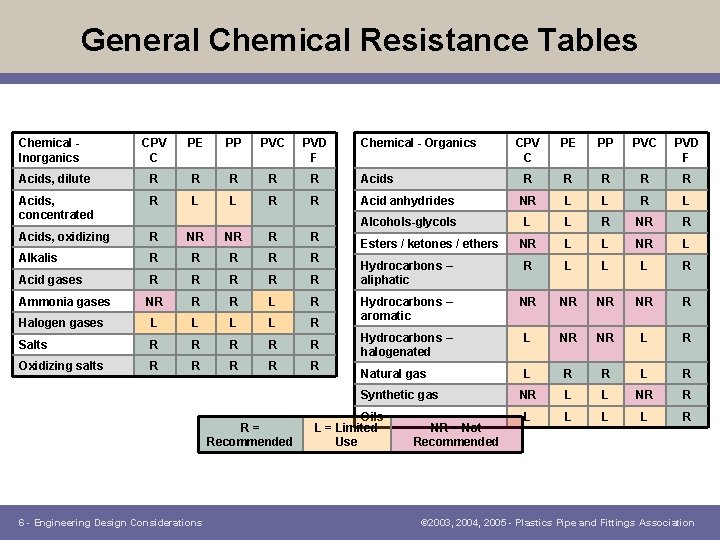
Chemical Resistance Tables • Many manufacturers have tested hundreds of reagents to determine their affect on plastics. These lists are readily available and act as a guide for the user and design engineer. Listed is a rather broad chemical resistance table of chemical groups and piping material. A recommended fluid is based on performance and safety factors. 5 - Engineering Design Considerations © 2003, 2004, 2005 - Plastics Pipe and Fittings Association
General Chemical Resistance Tables Chemical Inorganics Chemical - Organics CPV C PE PP PVC PVD F R R R Acid anhydrides NR L L R L Alcohols-glycols L L R NR L L NR L Hydrocarbons – aliphatic R L L L R Hydrocarbons – aromatic NR NR R Hydrocarbons – halogenated L NR NR L R Natural gas L R R L R NR L L NR R L L R CPV C PE PP PVC PVD F Acids, dilute R R R Acids, concentrated R L L R R Acids, oxidizing R NR NR R R Alkalis R R R Acid gases R R R NR R R L R Halogen gases L L R Salts R R R Oxidizing salts R R R Ammonia gases Esters / ketones / ethers Synthetic gas R= Recommended 6 - Engineering Design Considerations Oils L = Limited Use NR = Not Recommended © 2003, 2004, 2005 - Plastics Pipe and Fittings Association
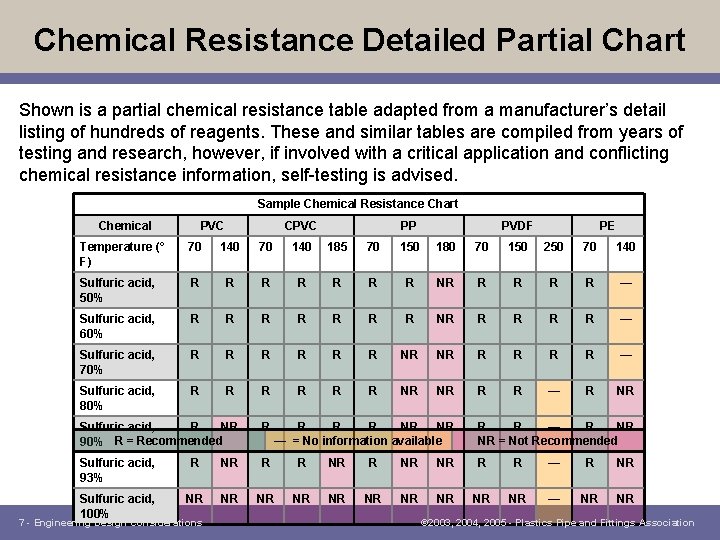
Chemical Resistance Detailed Partial Chart Shown is a partial chemical resistance table adapted from a manufacturer’s detail listing of hundreds of reagents. These and similar tables are compiled from years of testing and research, however, if involved with a critical application and conflicting chemical resistance information, self-testing is advised. Sample Chemical Resistance Chart Chemical PVC CPVC PP PVDF PE Temperature (° F) 70 140 185 70 150 180 70 150 250 70 140 Sulfuric acid, 50% R R R R NR R R — Sulfuric acid, 60% R R R R NR R R — Sulfuric acid, 70% R R R NR NR R R — Sulfuric acid, 80% R R R NR NR R R — R NR Sulfuric acid, R NR 90% R = Recommended R Sulfuric acid, 93% R NR NR R R — R NR Sulfuric acid, 100% NR NR NR — NR NR 7 - Engineering Design Considerations R R R NR NR — = No information available R R — R NR NR = Not Recommended © 2003, 2004, 2005 - Plastics Pipe and Fittings Association
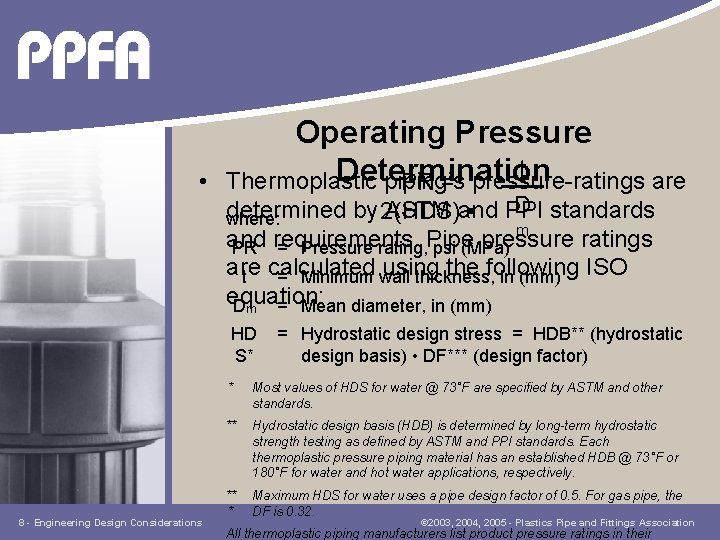
• Operating Pressure t Determination Thermoplastic piping’s PR = pressure-ratings are D standards by 2(HDS) ASTM and • PPI m and requirements. Pipe pressure ratings PR = Pressure rating, psi (MPa) are using the following t calculated = Minimum wall thickness, in (mm) ISO equation: Dm = Mean diameter, in (mm) determined where: HD S* 8 - Engineering Design Considerations = Hydrostatic design stress = HDB** (hydrostatic design basis) • DF*** (design factor) * Most values of HDS for water @ 73°F are specified by ASTM and other standards. ** Hydrostatic design basis (HDB) is determined by long-term hydrostatic strength testing as defined by ASTM and PPI standards. Each thermoplastic pressure piping material has an established HDB @ 73°F or 180°F for water and hot water applications, respectively. ** * Maximum HDS for water uses a pipe design factor of 0. 5. For gas pipe, the DF is 0. 32. © 2003, 2004, 2005 - Plastics Pipe and Fittings Association All thermoplastic piping manufacturers list product pressure ratings in their
Pressure Ratings of Thermoplastic Piping © 2003, 2004, 2005 - Plastics Pipe and Fittings Association
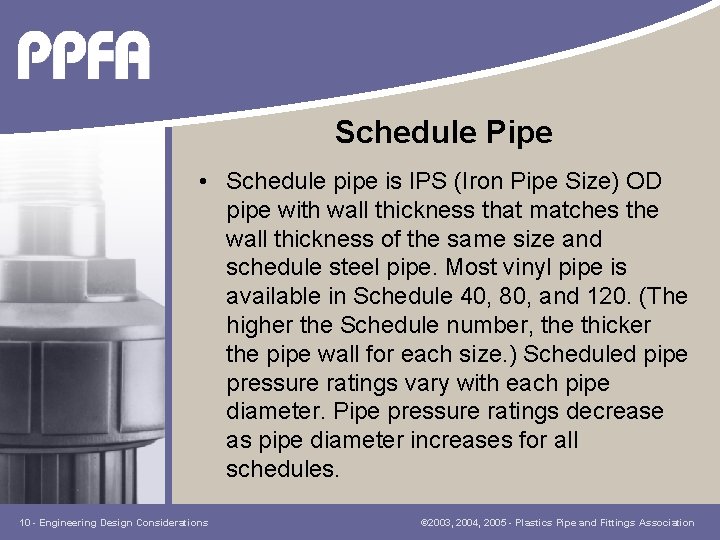
Schedule Pipe • Schedule pipe is IPS (Iron Pipe Size) OD pipe with wall thickness that matches the wall thickness of the same size and schedule steel pipe. Most vinyl pipe is available in Schedule 40, 80, and 120. (The higher the Schedule number, the thicker the pipe wall for each size. ) Scheduled pipe pressure ratings vary with each pipe diameter. Pipe pressure ratings decrease as pipe diameter increases for all schedules. 10 - Engineering Design Considerations © 2003, 2004, 2005 - Plastics Pipe and Fittings Association
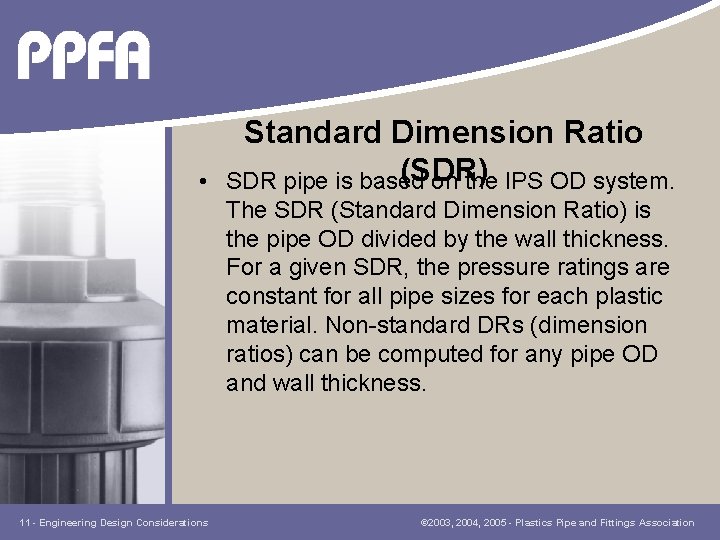
• Standard Dimension Ratio (SDR) SDR pipe is based on the IPS OD system. The SDR (Standard Dimension Ratio) is the pipe OD divided by the wall thickness. For a given SDR, the pressure ratings are constant for all pipe sizes for each plastic material. Non-standard DRs (dimension ratios) can be computed for any pipe OD and wall thickness. 11 - Engineering Design Considerations © 2003, 2004, 2005 - Plastics Pipe and Fittings Association
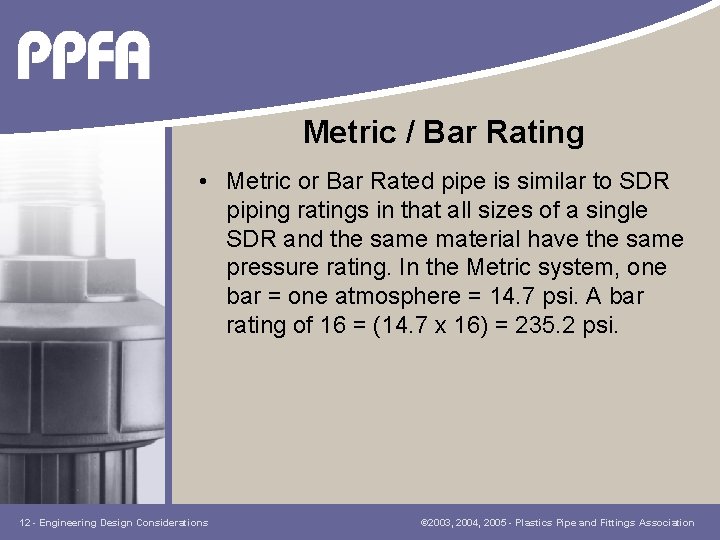
Metric / Bar Rating • Metric or Bar Rated pipe is similar to SDR piping ratings in that all sizes of a single SDR and the same material have the same pressure rating. In the Metric system, one bar = one atmosphere = 14. 7 psi. A bar rating of 16 = (14. 7 x 16) = 235. 2 psi. 12 - Engineering Design Considerations © 2003, 2004, 2005 - Plastics Pipe and Fittings Association
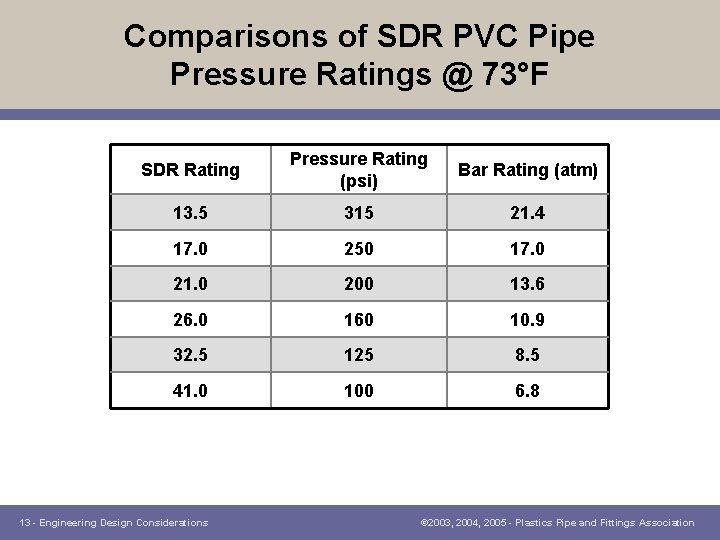
Comparisons of SDR PVC Pipe Pressure Ratings @ 73°F SDR Rating Pressure Rating (psi) Bar Rating (atm) 13. 5 315 21. 4 17. 0 250 17. 0 21. 0 200 13. 6 26. 0 160 10. 9 32. 5 125 8. 5 41. 0 100 6. 8 13 - Engineering Design Considerations © 2003, 2004, 2005 - Plastics Pipe and Fittings Association
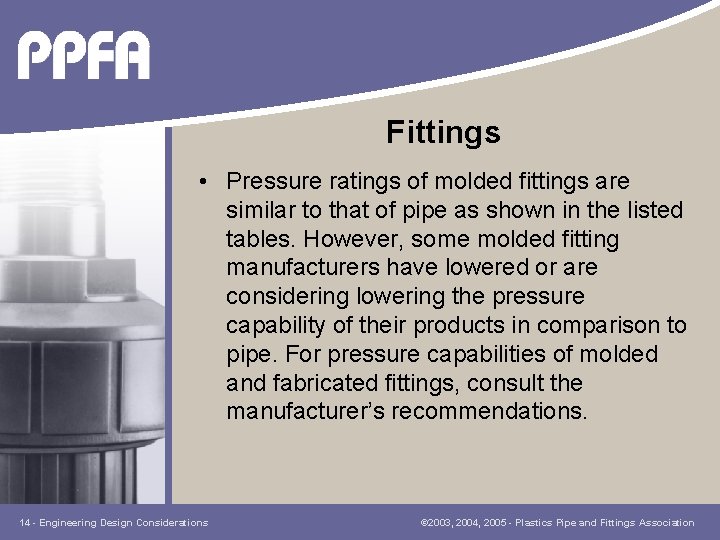
Fittings • Pressure ratings of molded fittings are similar to that of pipe as shown in the listed tables. However, some molded fitting manufacturers have lowered or are considering lowering the pressure capability of their products in comparison to pipe. For pressure capabilities of molded and fabricated fittings, consult the manufacturer’s recommendations. 14 - Engineering Design Considerations © 2003, 2004, 2005 - Plastics Pipe and Fittings Association
Other • Other plastic piping systems have differing outside diameter dimensions and pressure ratings such as Copper Tube Size (CTS), Cast Iron (CI) and Sewer & Drain. Plastic piping made to most of these piping systems are used for non-industrial applications. 15 - Engineering Design Considerations © 2003, 2004, 2005 - Plastics Pipe and Fittings Association
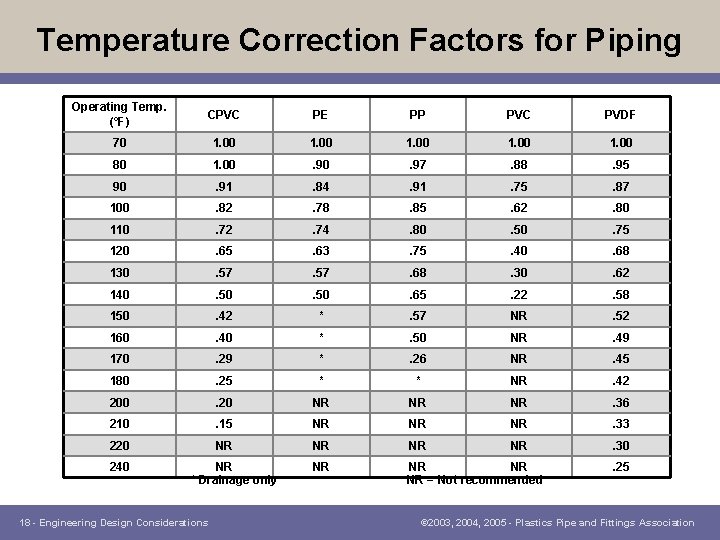
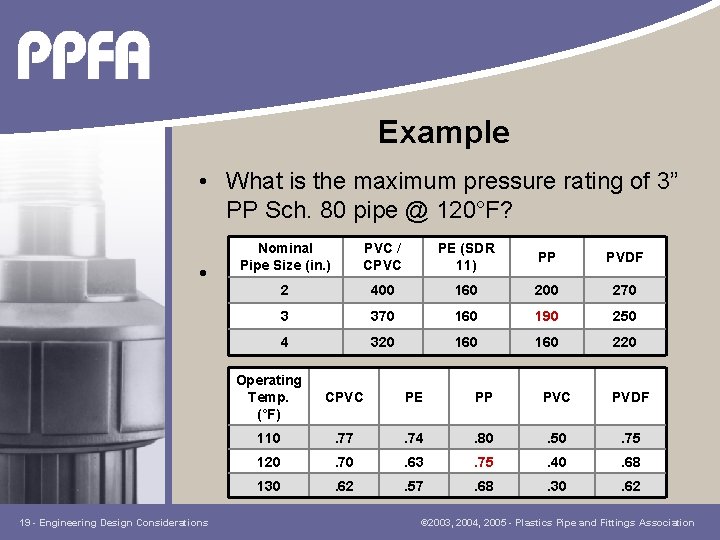
Temperature Ratings of Plastic Piping • Thermoplastic piping materials decrease in tensile strength as temperature increases, and increase in tensile strength as temperature decreases. This characteristic must be considered when designing TIPS. The correction factor for each temperature and material is calculated. To determine the maximum suggested design pressure at a particular temperature, multiply the base pressure by the correction factor. 16 - Engineering Design Considerations © 2003, 2004, 2005 - Plastics Pipe and Fittings Association
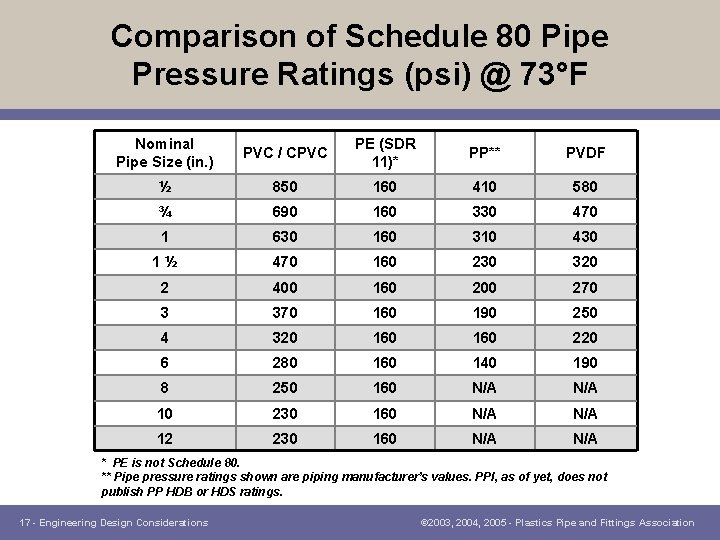
Comparison of Schedule 80 Pipe Pressure Ratings (psi) @ 73°F Nominal Pipe Size (in. ) PVC / CPVC PE (SDR 11)* PP** PVDF ½ 850 160 410 580 ¾ 690 160 330 470 1 630 160 310 430 1½ 470 160 230 320 2 400 160 200 270 3 370 160 190 250 4 320 160 220 6 280 160 140 190 8 250 160 N/A 10 230 160 N/A 12 230 160 N/A * PE is not Schedule 80. ** Pipe pressure ratings shown are piping manufacturer’s values. PPI, as of yet, does not publish PP HDB or HDS ratings. 17 - Engineering Design Considerations © 2003, 2004, 2005 - Plastics Pipe and Fittings Association
Temperature Correction Factors for Piping Operating Temp. (°F) CPVC PE PP PVC PVDF 70 1. 00 80 1. 00 . 97 . 88 . 95 90 . 91 . 84 . 91 . 75 . 87 100 . 82 . 78 . 85 . 62 . 80 110 . 72 . 74 . 80 . 50 . 75 120 . 65 . 63 . 75 . 40 . 68 130 . 57 . 68 . 30 . 62 140 . 50 . 65 . 22 . 58 150 . 42 * . 57 NR . 52 160 . 40 * . 50 NR . 49 170 . 29 * . 26 NR . 45 180 . 25 * * NR . 42 200 . 20 NR NR NR . 36 210 . 15 NR NR NR . 33 220 NR NR . 30 NR NR = Not recommended 240 NR * Drainage only 18 - Engineering Design Considerations . 25 © 2003, 2004, 2005 - Plastics Pipe and Fittings Association
Example • What is the maximum pressure rating of 3” PP Sch. 80 pipe @ 120°F? Nominal Pipe Size (in. ) PVC / CPVC PE (SDR 11) • Maximum Pressure Rating: 2 400 160 0. 75(190) = 142. 5 psi 160 3 370 4 19 - Engineering Design Considerations 320 160 PP PVDF 200 270 190 250 160 220 Operating Temp. (°F) CPVC PE PP PVC PVDF 110 . 77 . 74 . 80 . 50 . 75 120 . 70 . 63 . 75 . 40 . 68 130 . 62 . 57 . 68 . 30 . 62 © 2003, 2004, 2005 - Plastics Pipe and Fittings Association
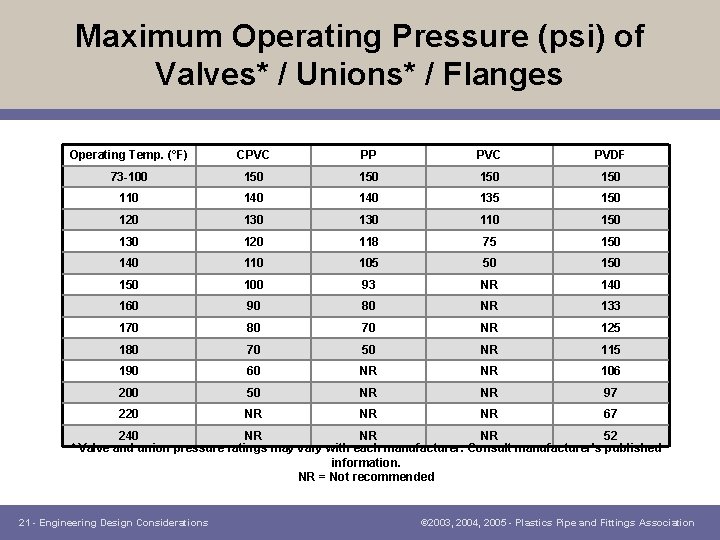
Operating Pressure of Valves, Unions, and Flanges • One of the limiting pressure ratings of TIPS and other piping systems is the 150 -psi pressure rating of most valves, unions and flanges (some manufacturers list some valves and unions at higher pressure ratings). As in pipe, as the temperature goes up, the pressure rating goes down. 20 - Engineering Design Considerations © 2003, 2004, 2005 - Plastics Pipe and Fittings Association
Maximum Operating Pressure (psi) of Valves* / Unions* / Flanges Operating Temp. (°F) CPVC PP PVC PVDF 73 -100 150 150 110 140 135 150 120 130 110 150 130 120 118 75 150 140 110 105 50 150 100 93 NR 140 160 90 80 NR 133 170 80 70 NR 125 180 70 50 NR 115 190 60 NR NR 106 200 50 NR NR 97 220 NR NR NR 67 240 NR NR NR 52 * Valve and union pressure ratings may vary with each manufacturer. Consult manufacturer’s published information. NR = Not recommended 21 - Engineering Design Considerations © 2003, 2004, 2005 - Plastics Pipe and Fittings Association
Operating Pressure of Threaded • Direct threading of. Pipe thermoplastic piping is 22 - Engineering Design Considerations accomplished using only proper threading equipment. However, do not thread pipe below the thickness of a Schedule 80 pipe wall. Threading vinyl pipe reduces operating pressures by 50%. With most other Schedule 80 thermoplastic piping, threading reduces operating pressure for all pipe sizes to 20 -psi or less. If threaded thermoplastic piping systems must be used, increased working pressure could be obtained using transition fittings such as 2004, 2005 - Plastics Pipe and Fittings Association molded unions and© 2003, adapters.
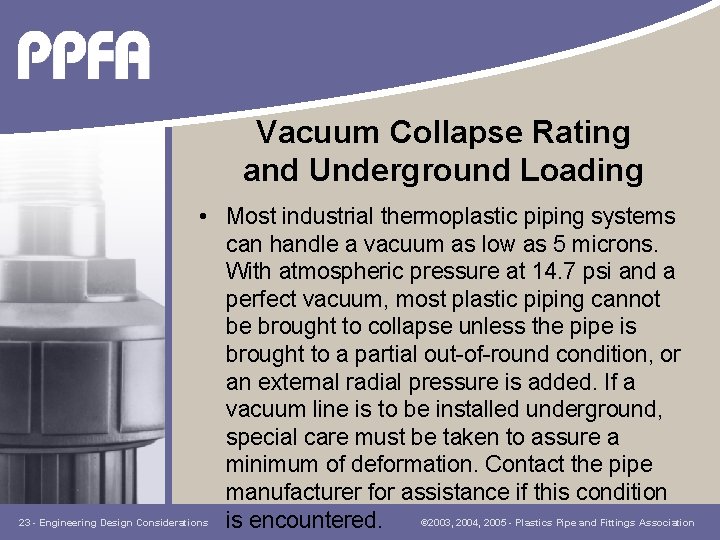
Vacuum Collapse Rating and Underground Loading • Most industrial thermoplastic piping systems can handle a vacuum as low as 5 microns. With atmospheric pressure at 14. 7 psi and a perfect vacuum, most plastic piping cannot be brought to collapse unless the pipe is brought to a partial out-of-round condition, or an external radial pressure is added. If a vacuum line is to be installed underground, special care must be taken to assure a minimum of deformation. Contact the pipe manufacturer for assistance if this condition 23 - Engineering Design Considerations © 2003, 2004, 2005 - Plastics Pipe and Fittings Association is encountered.
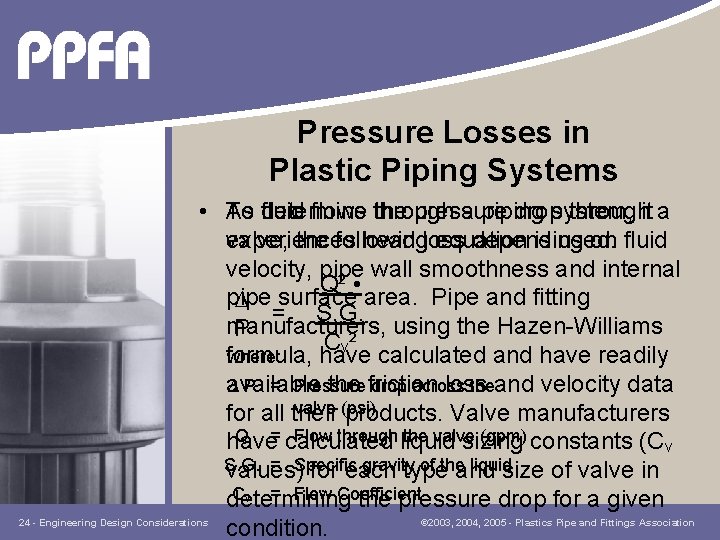
Pressure Losses in Plastic Piping Systems • As To determine fluid flows through the pressure a piping dropsystem, throughit a experiences valve, the following head loss equation depending is used: on fluid velocity, pipe wall smoothness and internal Q² • pipe ∆ surface area. Pipe and fitting = S. G. manufacturers, using the Hazen-Williams P C v² formula, have calculated and have readily where: available the friction loss ∆ P = Pressure drop across theand velocity data valve (psi) for all their products. Valve manufacturers Q = calculated Flow through liquid the valve (gpm) constants (C have sizing v S. G. = Specific gravity of the liquid values) for each type and size of valve in Cv = Flow Coefficient determining the pressure drop for a given 24 - Engineering Design Considerations © 2003, 2004, 2005 - Plastics Pipe and Fittings Association condition.
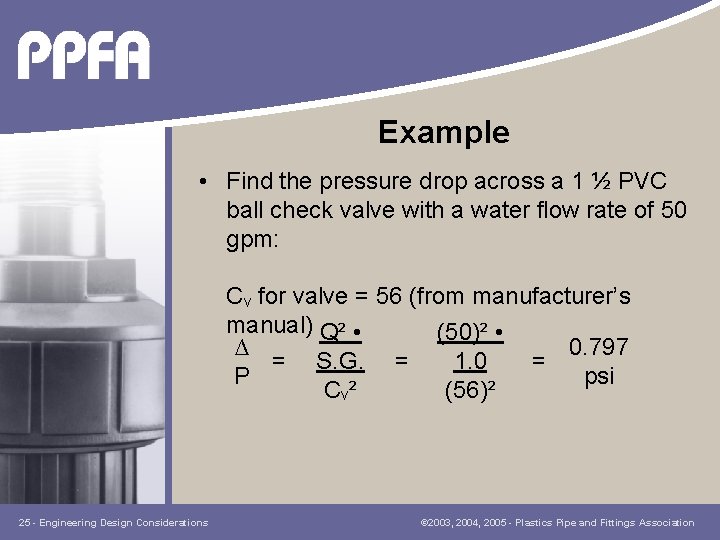
Example • Find the pressure drop across a 1 ½ PVC ball check valve with a water flow rate of 50 gpm: Cv for valve = 56 (from manufacturer’s manual) Q² • (50)² • ∆ 0. 797 = S. G. = 1. 0 = P psi C v² (56)² 25 - Engineering Design Considerations © 2003, 2004, 2005 - Plastics Pipe and Fittings Association
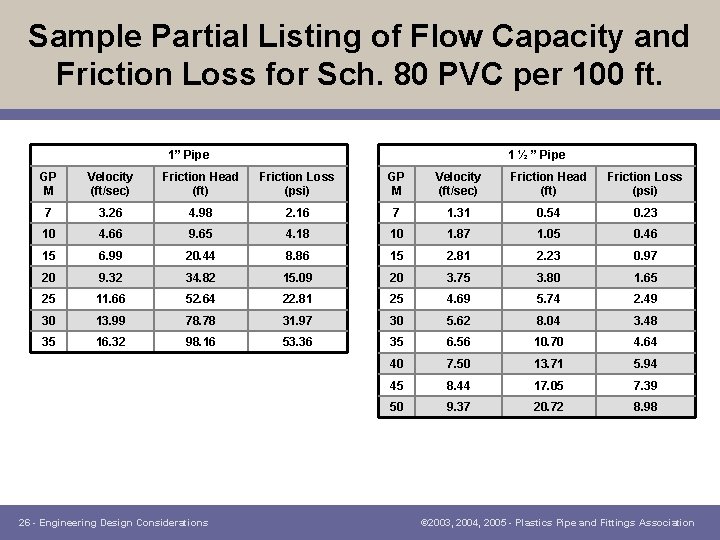
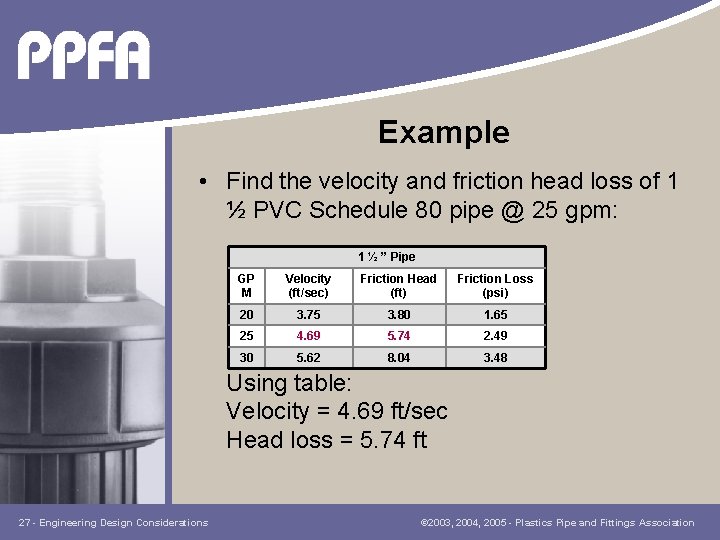
Sample Partial Listing of Flow Capacity and Friction Loss for Sch. 80 PVC per 100 ft. 1 ½ ” Pipe 1” Pipe GP M Velocity (ft/sec) Friction Head (ft) Friction Loss (psi) 7 3. 26 4. 98 2. 16 7 1. 31 0. 54 0. 23 10 4. 66 9. 65 4. 18 10 1. 87 1. 05 0. 46 15 6. 99 20. 44 8. 86 15 2. 81 2. 23 0. 97 20 9. 32 34. 82 15. 09 20 3. 75 3. 80 1. 65 25 11. 66 52. 64 22. 81 25 4. 69 5. 74 2. 49 30 13. 99 78. 78 31. 97 30 5. 62 8. 04 3. 48 35 16. 32 98. 16 53. 36 35 6. 56 10. 70 4. 64 40 7. 50 13. 71 5. 94 45 8. 44 17. 05 7. 39 50 9. 37 20. 72 8. 98 26 - Engineering Design Considerations © 2003, 2004, 2005 - Plastics Pipe and Fittings Association
Example • Find the velocity and friction head loss of 1 ½ PVC Schedule 80 pipe @ 25 gpm: 1 ½ ” Pipe GP M Velocity (ft/sec) Friction Head (ft) Friction Loss (psi) 20 3. 75 3. 80 1. 65 25 4. 69 5. 74 2. 49 30 5. 62 8. 04 3. 48 Using table: Velocity = 4. 69 ft/sec Head loss = 5. 74 ft 27 - Engineering Design Considerations © 2003, 2004, 2005 - Plastics Pipe and Fittings Association
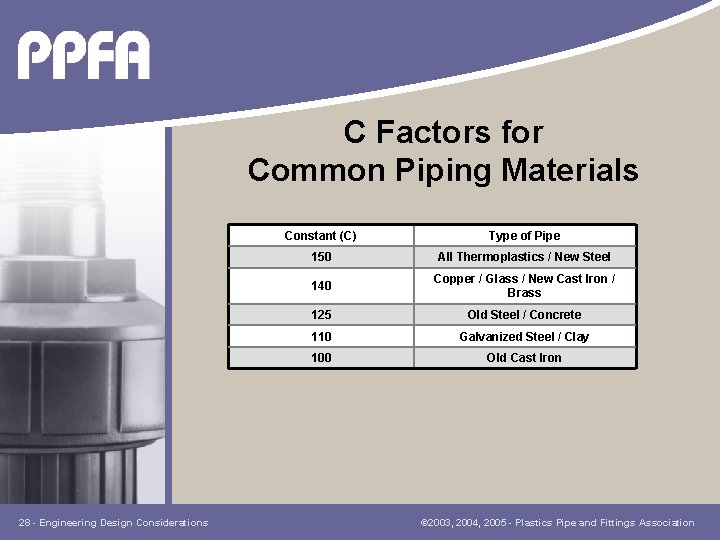
C Factors for Common Piping Materials 28 - Engineering Design Considerations Constant (C) Type of Pipe 150 All Thermoplastics / New Steel 140 Copper / Glass / New Cast Iron / Brass 125 Old Steel / Concrete 110 Galvanized Steel / Clay 100 Old Cast Iron © 2003, 2004, 2005 - Plastics Pipe and Fittings Association
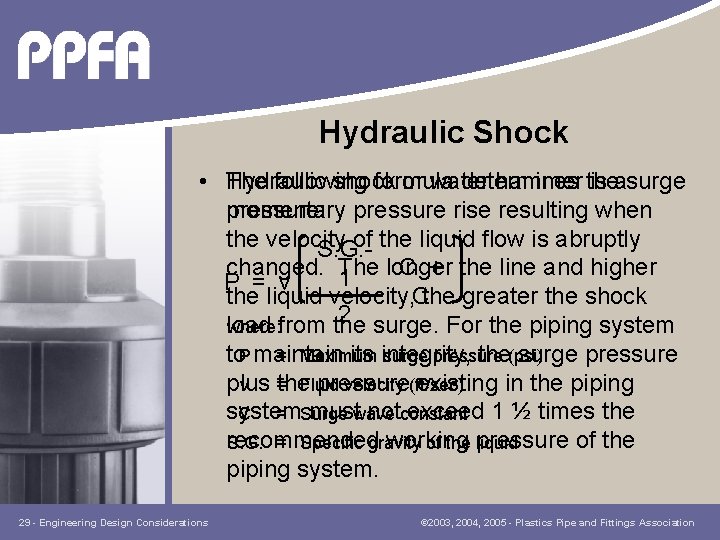
Hydraulic Shock • Hydraulic The following shock formula or water determines hammer the is asurge momentary pressure rise resulting when pressure: the velocity of the liquid flow is abruptly S. G. C + the line and higher changed. The longer 1 P = v the liquid velocity, Cthe greater the shock 2 load where: from the surge. For the piping system to. P maintain its integrity, the(psi) surge pressure = Maximum surge pressure plus the. Fluid pressure existing in the piping v = velocity (ft/sec) system mustwave notconstant exceed 1 ½ times the C = Surge recommended working of the S. G. = Specific gravity of the pressure liquid piping system. 29 - Engineering Design Considerations © 2003, 2004, 2005 - Plastics Pipe and Fittings Association
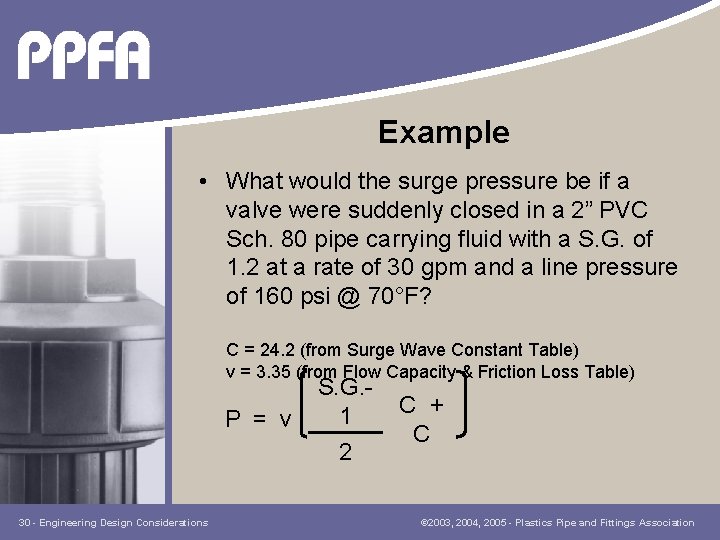
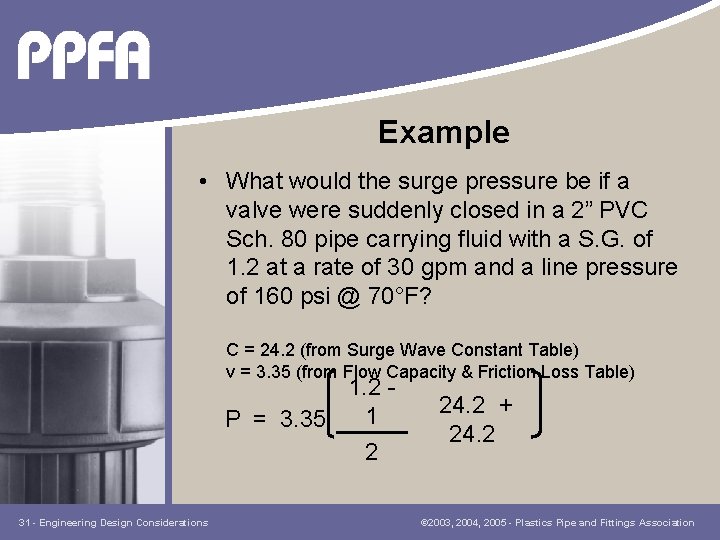
Example • What would the surge pressure be if a valve were suddenly closed in a 2” PVC Sch. 80 pipe carrying fluid with a S. G. of 1. 2 at a rate of 30 gpm and a line pressure of 160 psi @ 70°F? C = 24. 2 (from Surge Wave Constant Table) v = 3. 35 (from Flow Capacity & Friction Loss Table) P = v S. G. 1 2 30 - Engineering Design Considerations C + C © 2003, 2004, 2005 - Plastics Pipe and Fittings Association
Example • What would the surge pressure be if a valve were suddenly closed in a 2” PVC Sch. 80 pipe carrying fluid with a S. G. of 1. 2 at a rate of 30 gpm and a line pressure of 160 psi @ 70°F? C = 24. 2 (from Surge Wave Constant Table) v = 3. 35 (from Flow Capacity & Friction Loss Table) 1. 2 1 P = 3. 35 2 31 - Engineering Design Considerations 24. 2 + 24. 2 © 2003, 2004, 2005 - Plastics Pipe and Fittings Association
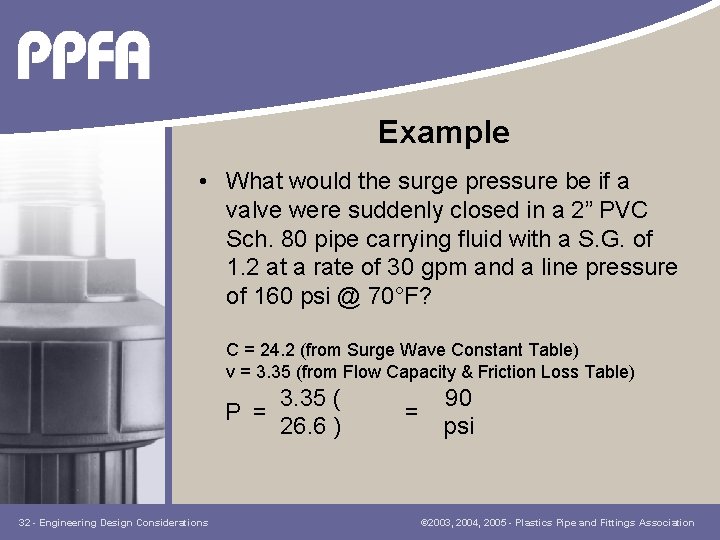
Example • What would the surge pressure be if a valve were suddenly closed in a 2” PVC Sch. 80 pipe carrying fluid with a S. G. of 1. 2 at a rate of 30 gpm and a line pressure of 160 psi @ 70°F? C = 24. 2 (from Surge Wave Constant Table) v = 3. 35 (from Flow Capacity & Friction Loss Table) 3. 35 ( P = 26. 6 ) 32 - Engineering Design Considerations = 90 psi © 2003, 2004, 2005 - Plastics Pipe and Fittings Association
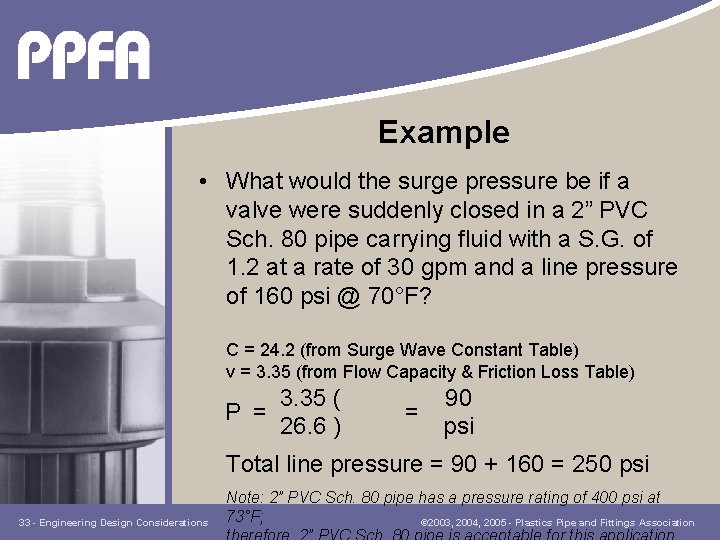
Example • What would the surge pressure be if a valve were suddenly closed in a 2” PVC Sch. 80 pipe carrying fluid with a S. G. of 1. 2 at a rate of 30 gpm and a line pressure of 160 psi @ 70°F? C = 24. 2 (from Surge Wave Constant Table) v = 3. 35 (from Flow Capacity & Friction Loss Table) 3. 35 ( P = 26. 6 ) = 90 psi Total line pressure = 90 + 160 = 250 psi 33 - Engineering Design Considerations Note: 2” PVC Sch. 80 pipe has a pressure rating of 400 psi at 73°F; © 2003, 2004, 2005 - Plastics Pipe and Fittings Association
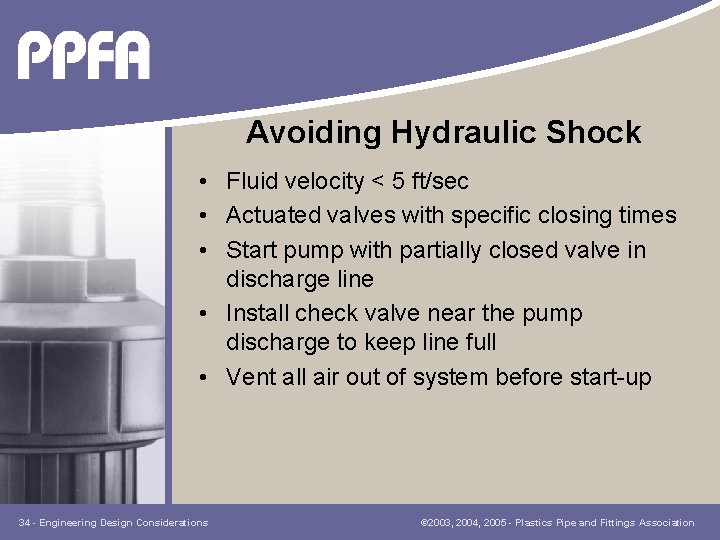
Avoiding Hydraulic Shock • Fluid velocity < 5 ft/sec • Actuated valves with specific closing times • Start pump with partially closed valve in discharge line • Install check valve near the pump discharge to keep line full • Vent all air out of system before start-up 34 - Engineering Design Considerations © 2003, 2004, 2005 - Plastics Pipe and Fittings Association
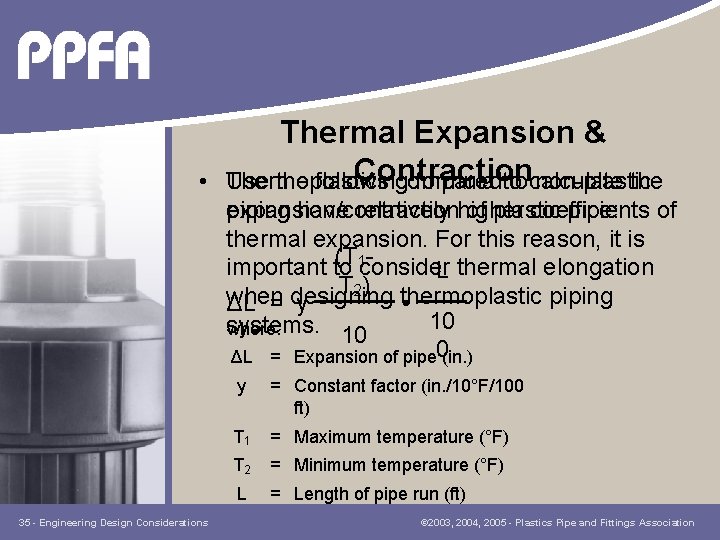
• Thermal Expansion & Contraction Thermoplastics Use the following compared formula to tocalculate non-plastic the expansion/contraction piping have relatively higher of plastic coefficients pipe: of thermal expansion. For this reason, it is (T 1 consider important to L thermal elongation T 2) thermoplastic piping when designing ΔL = y • 10 systems. where: 10 ΔL = Expansion of pipe 0(in. ) 35 - Engineering Design Considerations y = Constant factor (in. /10°F/100 ft) T 1 = Maximum temperature (°F) T 2 = Minimum temperature (°F) L = Length of pipe run (ft) © 2003, 2004, 2005 - Plastics Pipe and Fittings Association
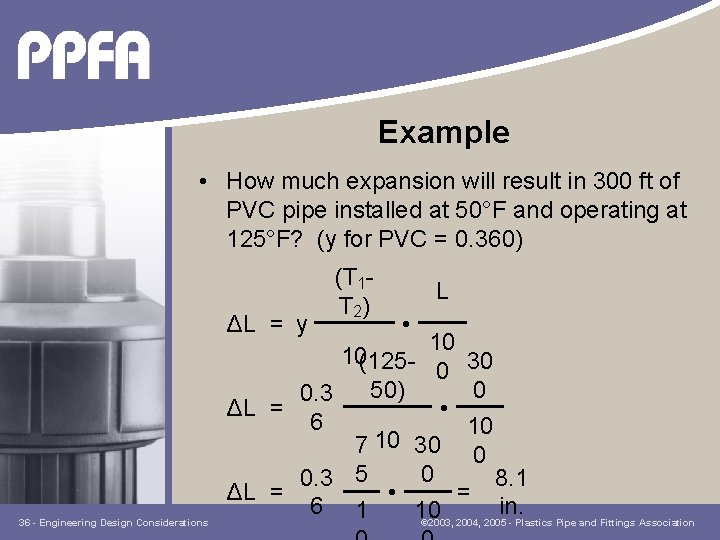
Example • How much expansion will result in 300 ft of PVC pipe installed at 50°F and operating at 125°F? (y for PVC = 0. 360) ΔL = y 36 - Engineering Design Considerations ΔL = 0. 3 6 (T 1 T 2) L • 10 10(1250 30 50) 0 • 10 7 10 30 0 5 0 8. 1 • = in. 1 10 © 2003, 2004, 2005 - Plastics Pipe and Fittings Association
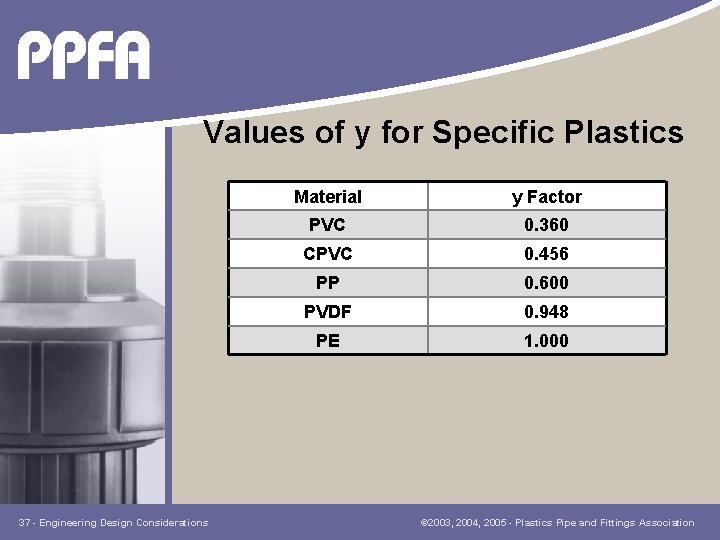
Values of y for Specific Plastics 37 - Engineering Design Considerations Material y Factor PVC 0. 360 CPVC 0. 456 PP 0. 600 PVDF 0. 948 PE 1. 000 © 2003, 2004, 2005 - Plastics Pipe and Fittings Association
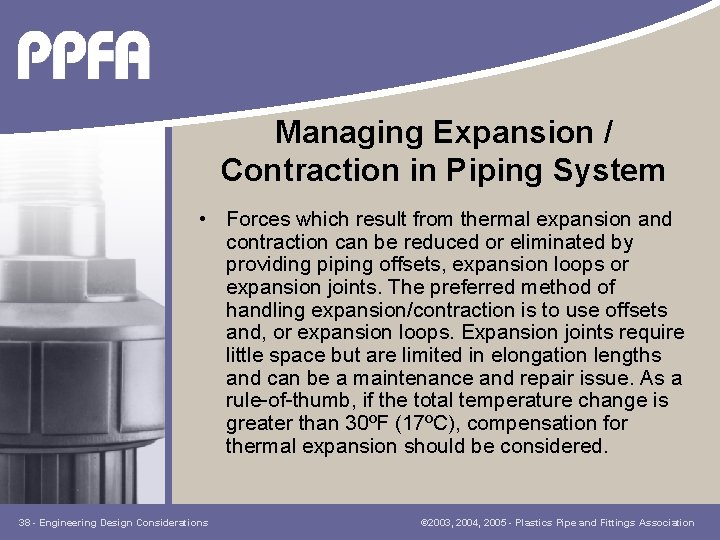
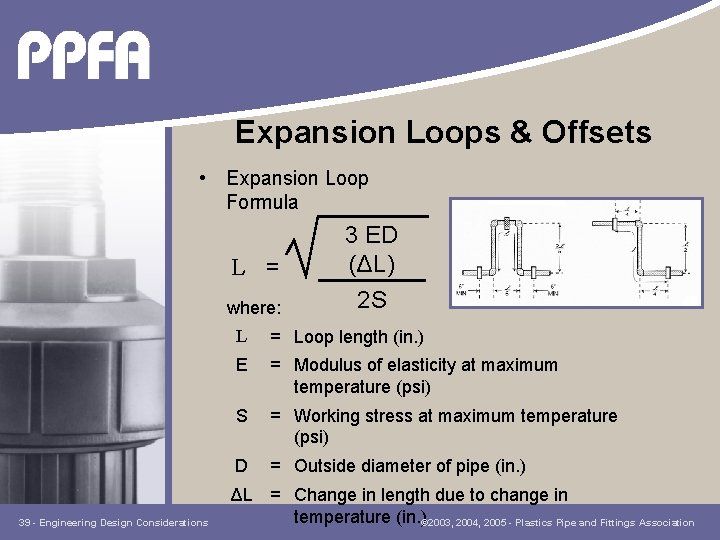
Managing Expansion / Contraction in Piping System • Forces which result from thermal expansion and contraction can be reduced or eliminated by providing piping offsets, expansion loops or expansion joints. The preferred method of handling expansion/contraction is to use offsets and, or expansion loops. Expansion joints require little space but are limited in elongation lengths and can be a maintenance and repair issue. As a rule-of-thumb, if the total temperature change is greater than 30ºF (17ºC), compensation for thermal expansion should be considered. 38 - Engineering Design Considerations © 2003, 2004, 2005 - Plastics Pipe and Fittings Association
Expansion Loops & Offsets • Expansion Loop Formula 39 - Engineering Design Considerations L = 3 ED (ΔL) where: 2 S L = Loop length (in. ) E = Modulus of elasticity at maximum temperature (psi) S = Working stress at maximum temperature (psi) D = Outside diameter of pipe (in. ) ΔL = Change in length due to change in temperature (in. )© 2003, 2004, 2005 - Plastics Pipe and Fittings Association
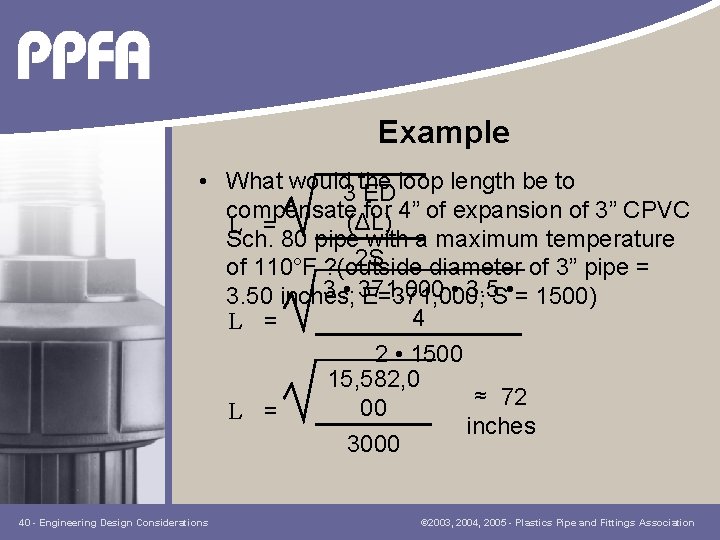
Example • What would 3 the ED loop length be to compensate(ΔL) for 4” of expansion of 3” CPVC L = Sch. 80 pipe with a maximum temperature 2 S of 110°F ? (outside diameter of 3” pipe = 3 • 371, 000 • 3. 5 S • = 1500) 3. 50 inches; E=371, 000; 4 L = 2 • 1500 15, 582, 0 ≈ 72 00 L = inches 3000 40 - Engineering Design Considerations © 2003, 2004, 2005 - Plastics Pipe and Fittings Association
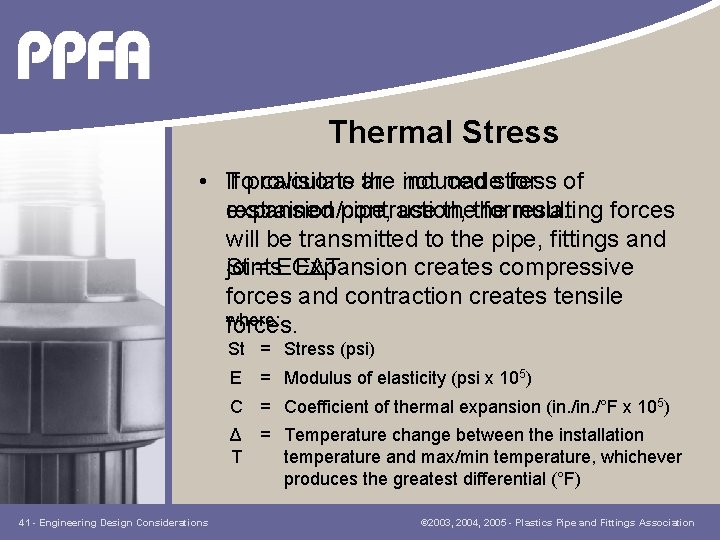
Thermal Stress • If Toprovisions calculate are the induced not madestress for of expansion/contraction, restrained pipe, use thethe formula: resulting forces will be transmitted to the pipe, fittings and joints. St = ECΔT Expansion creates compressive forces and contraction creates tensile where: forces. St = Stress (psi) E = Modulus of elasticity (psi x 105) C = Coefficient of thermal expansion (in. /°F x 105) Δ = Temperature change between the installation T temperature and max/min temperature, whichever produces the greatest differential (°F) 41 - Engineering Design Considerations © 2003, 2004, 2005 - Plastics Pipe and Fittings Association
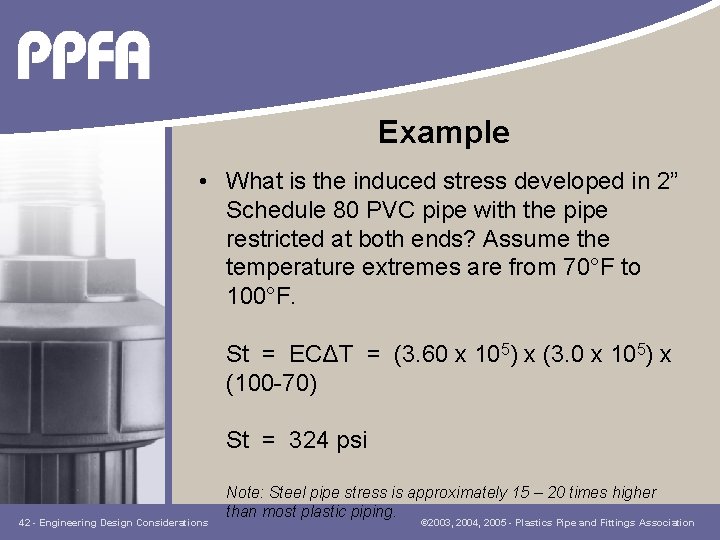
Example • What is the induced stress developed in 2” Schedule 80 PVC pipe with the pipe restricted at both ends? Assume the temperature extremes are from 70°F to 100°F. St = ECΔT = (3. 60 x 105) x (3. 0 x 105) x (100 -70) St = 324 psi 42 - Engineering Design Considerations Note: Steel pipe stress is approximately 15 – 20 times higher than most plastic piping. © 2003, 2004, 2005 - Plastics Pipe and Fittings Association
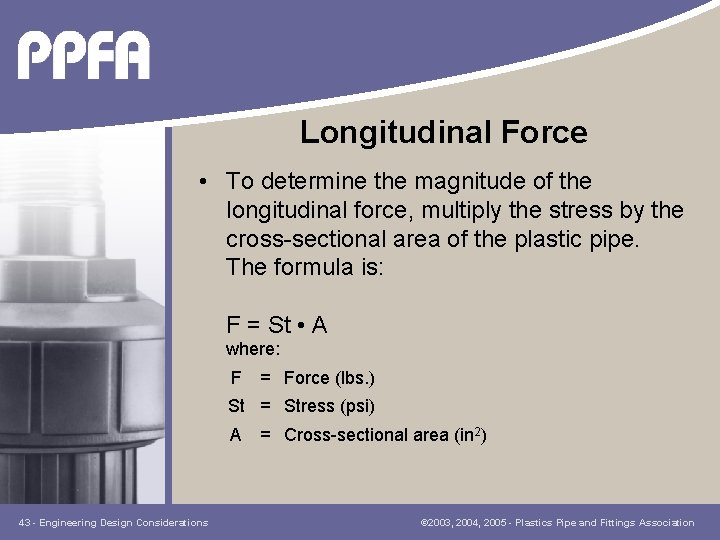
Longitudinal Force • To determine the magnitude of the longitudinal force, multiply the stress by the cross-sectional area of the plastic pipe. The formula is: F = St • A where: F = Force (lbs. ) St = Stress (psi) A = Cross-sectional area (in 2) 43 - Engineering Design Considerations © 2003, 2004, 2005 - Plastics Pipe and Fittings Association
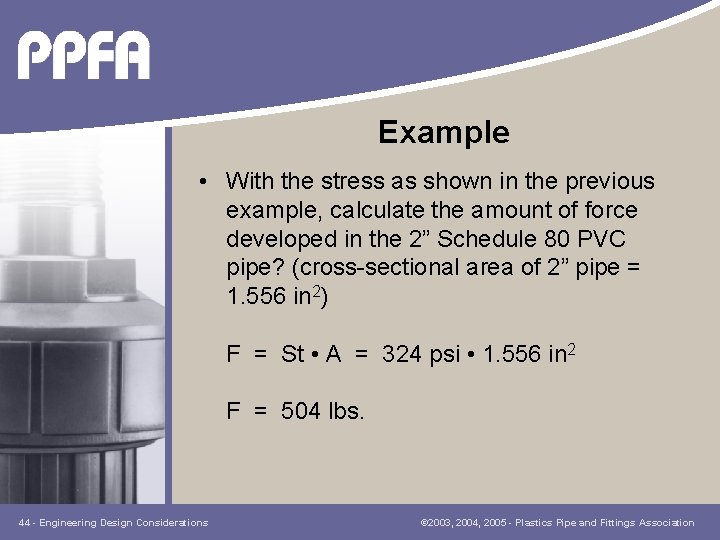
Example • With the stress as shown in the previous example, calculate the amount of force developed in the 2” Schedule 80 PVC pipe? (cross-sectional area of 2” pipe = 1. 556 in 2) F = St • A = 324 psi • 1. 556 in 2 F = 504 lbs. 44 - Engineering Design Considerations © 2003, 2004, 2005 - Plastics Pipe and Fittings Association
Above-ground Design © 2003, 2004, 2005 - Plastics Pipe and Fittings Association
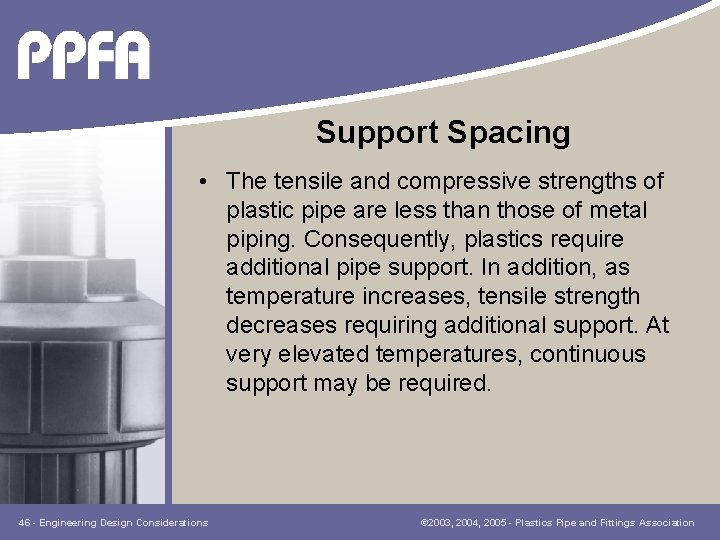
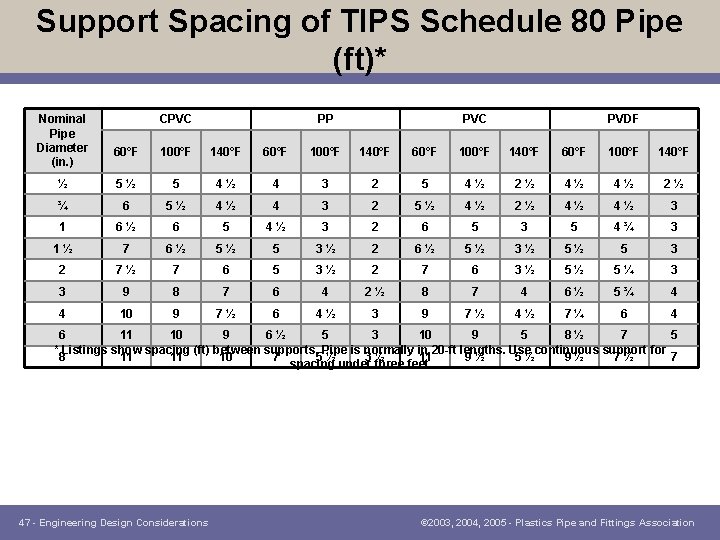
Support Spacing • The tensile and compressive strengths of plastic pipe are less than those of metal piping. Consequently, plastics require additional pipe support. In addition, as temperature increases, tensile strength decreases requiring additional support. At very elevated temperatures, continuous support may be required. 46 - Engineering Design Considerations © 2003, 2004, 2005 - Plastics Pipe and Fittings Association
Support Spacing of TIPS Schedule 80 Pipe (ft)* Nominal Pipe Diameter (in. ) CPVC PP PVC PVDF 60°F 100°F 140°F ½ 5½ 5 4½ 4 3 2 5 4½ 2½ 4½ 4½ 2½ ¾ 6 5½ 4½ 4 3 2 5½ 4½ 2½ 4½ 4½ 3 1 6½ 6 5 4½ 3 2 6 5 3 5 4¾ 3 1½ 7 6½ 5½ 5 3½ 2 6½ 5½ 3½ 5½ 5 3 2 7½ 7 6 5 3½ 2 7 6 3½ 5½ 5¼ 3 3 9 8 7 6 4 2½ 8 7 4 6½ 5¾ 4 4 10 9 7½ 6 4½ 3 9 7½ 4½ 7¼ 6 4 6 11 10 9 6½ 5 3 10 9 5 8½ 7 5 * Listings show spacing (ft) between supports. Pipe is normally in 20 -ft lengths. Use continuous support for 8 11 11 10 7 5½ 3½ 11 9½ 5½ 9½ 7½ 7 spacing under three feet. 47 - Engineering Design Considerations © 2003, 2004, 2005 - Plastics Pipe and Fittings Association
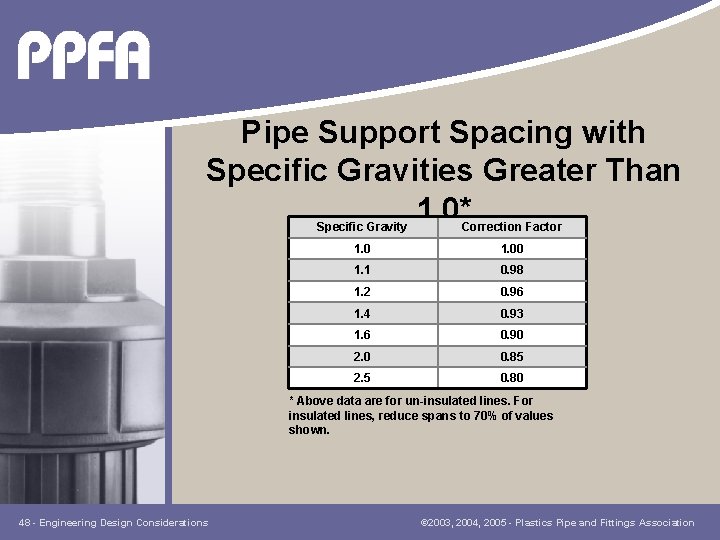
Pipe Support Spacing with Specific Gravities Greater Than 1. 0* Specific Gravity Correction Factor 1. 00 1. 1 0. 98 1. 2 0. 96 1. 4 0. 93 1. 6 0. 90 2. 0 0. 85 2. 5 0. 80 * Above data are for un-insulated lines. For insulated lines, reduce spans to 70% of values shown. 48 - Engineering Design Considerations © 2003, 2004, 2005 - Plastics Pipe and Fittings Association
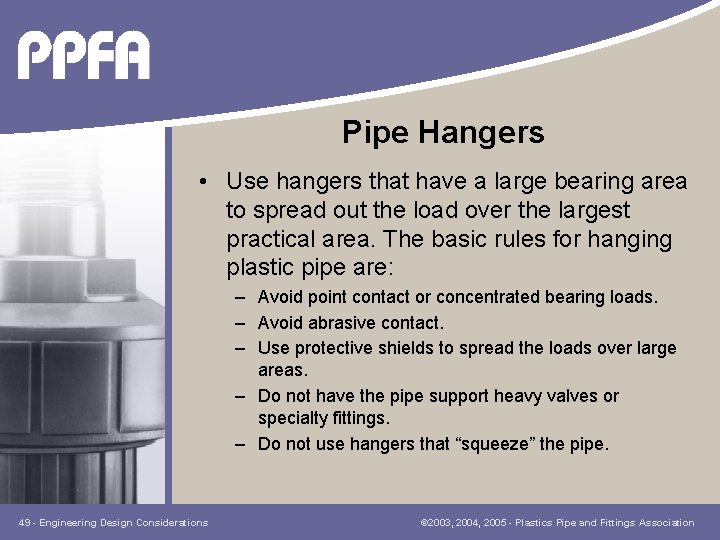
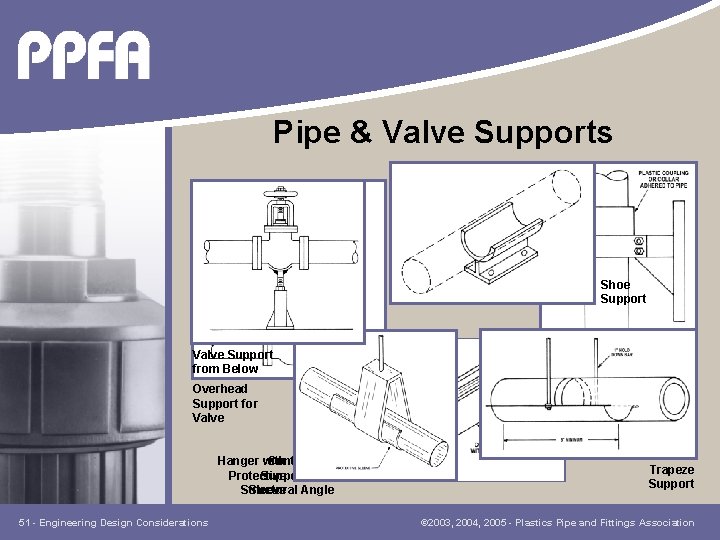
Pipe Hangers • Use hangers that have a large bearing area to spread out the load over the largest practical area. The basic rules for hanging plastic pipe are: – Avoid point contact or concentrated bearing loads. – Avoid abrasive contact. – Use protective shields to spread the loads over large areas. – Do not have the pipe support heavy valves or specialty fittings. – Do not use hangers that “squeeze” the pipe. 49 - Engineering Design Considerations © 2003, 2004, 2005 - Plastics Pipe and Fittings Association
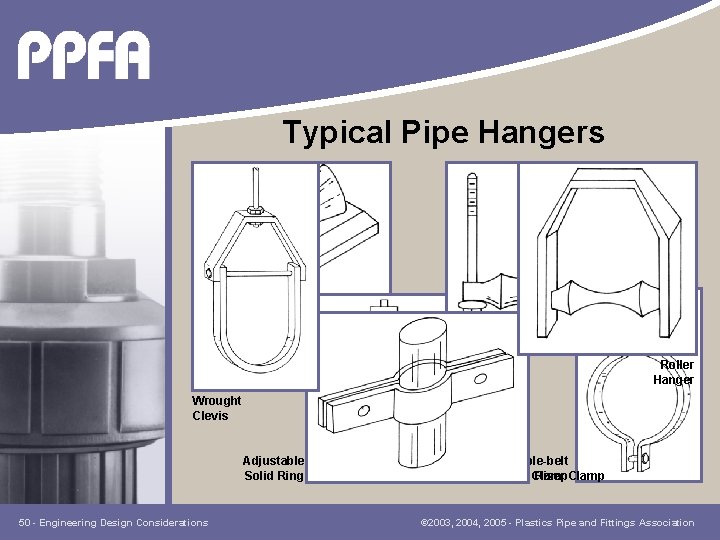
Typical Pipe Hangers Single Pipe Roll & Plate Roller Hanger Wrought Clevis Adjustable Solid Ring 50 - Engineering Design Considerations Double-belt Riser Clamp Pipe Clamp © 2003, 2004, 2005 - Plastics Pipe and Fittings Association
Pipe & Valve Supports Shoe Support Valve Support from Below Overhead Support for Valve Continuous Hanger with Support with Protective Structural Sleeve Angle 51 - Engineering Design Considerations Supporting Plastic Pipe Vertically Trapeze Support © 2003, 2004, 2005 - Plastics Pipe and Fittings Association
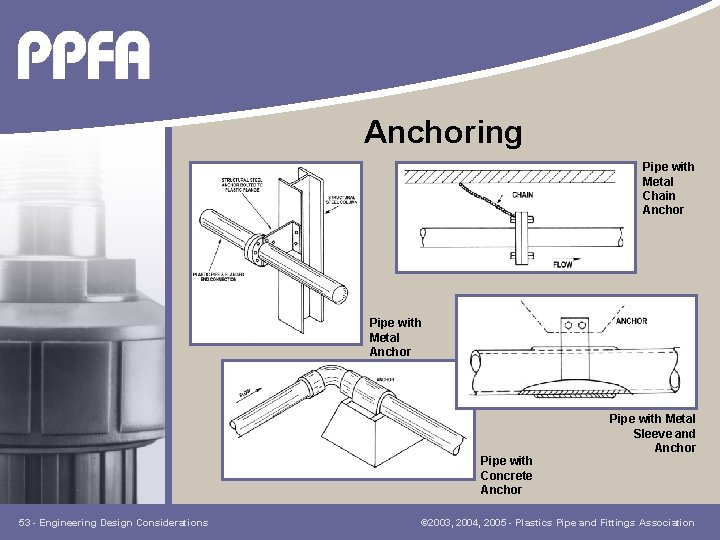
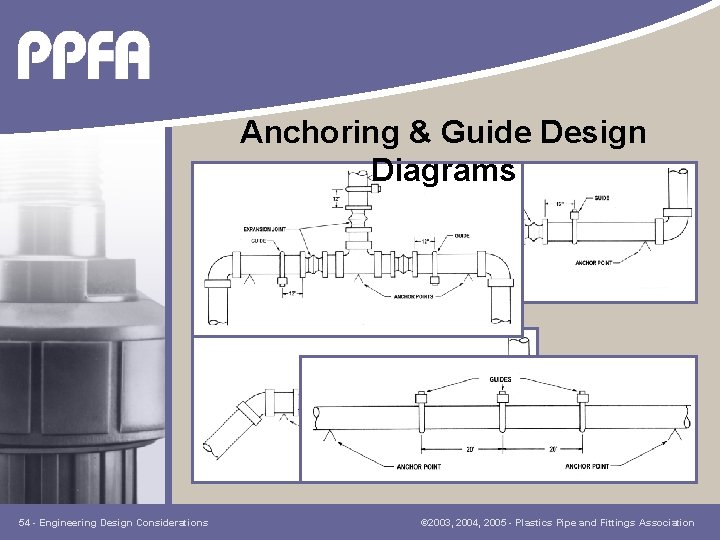
Anchors & Guides • Anchors direct movement of pipe within a defined reference frame. At the anchoring point, there is no axial or transverse movement. Guides allow axial movement of pipe but prevent transverse movement. Use guides and anchors whenever expansion joints are utilized and on long runs and directional changes in pipe. 52 - Engineering Design Considerations © 2003, 2004, 2005 - Plastics Pipe and Fittings Association
Anchoring Pipe with Metal Chain Anchor Pipe with Metal Anchor Pipe with Concrete Anchor 53 - Engineering Design Considerations Pipe with Metal Sleeve and Anchor © 2003, 2004, 2005 - Plastics Pipe and Fittings Association
Anchoring & Guide Design Diagrams 54 - Engineering Design Considerations © 2003, 2004, 2005 - Plastics Pipe and Fittings Association
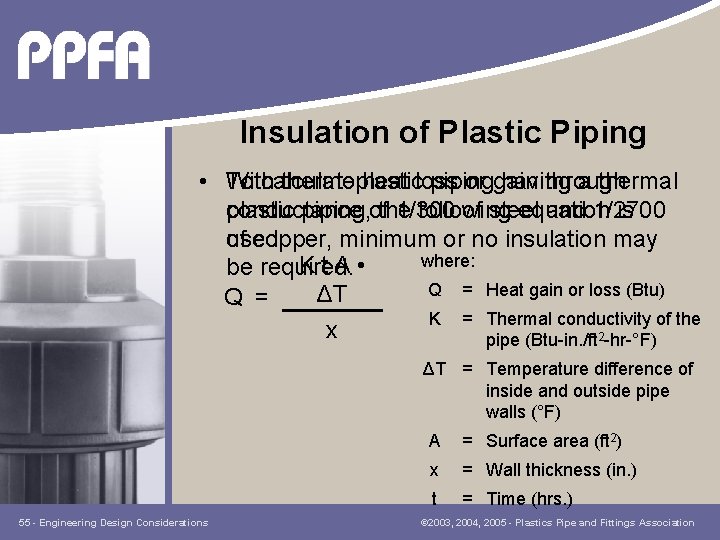
Insulation of Plastic Piping • With To calculate thermoplastic heat loss piping or gain having through a thermal conductance plastic piping, ofthe 1/300 following of steel equation and 1/2700 is of copper, minimum or no insulation may used: where: Kt. A • be required. Q = Heat gain or loss (Btu) ΔT Q = K = Thermal conductivity of the x pipe (Btu-in. /ft 2 -hr-°F) ΔT = Temperature difference of inside and outside pipe walls (°F) 55 - Engineering Design Considerations A = Surface area (ft 2) x = Wall thickness (in. ) t = Time (hrs. ) © 2003, 2004, 2005 - Plastics Pipe and Fittings Association
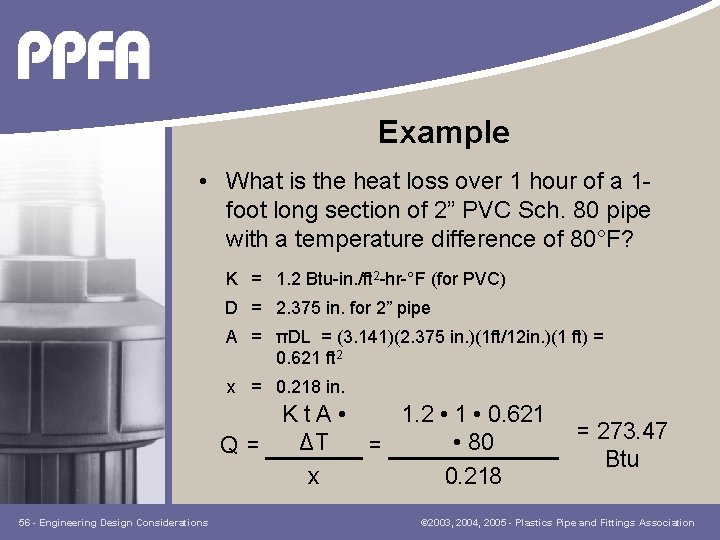
Example • What is the heat loss over 1 hour of a 1 foot long section of 2” PVC Sch. 80 pipe with a temperature difference of 80°F? K = 1. 2 Btu-in. /ft 2 -hr-°F (for PVC) D = 2. 375 in. for 2” pipe A = πDL = (3. 141)(2. 375 in. )(1 ft/12 in. )(1 ft) = 0. 621 ft 2 x = 0. 218 in. Kt. A • 1. 2 • 1 • 0. 621 ΔT • 80 Q= = x 0. 218 56 - Engineering Design Considerations = 273. 47 Btu © 2003, 2004, 2005 - Plastics Pipe and Fittings Association
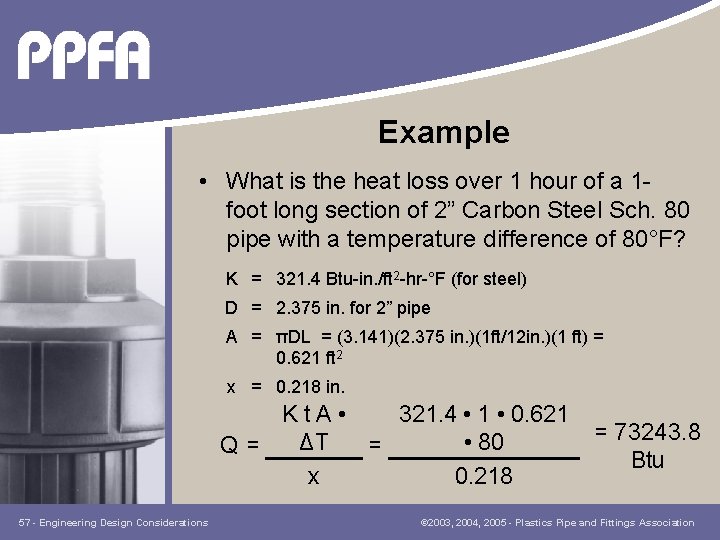
Example • What is the heat loss over 1 hour of a 1 foot long section of 2” Carbon Steel Sch. 80 pipe with a temperature difference of 80°F? K = 321. 4 Btu-in. /ft 2 -hr-°F (for steel) D = 2. 375 in. for 2” pipe A = πDL = (3. 141)(2. 375 in. )(1 ft/12 in. )(1 ft) = 0. 621 ft 2 x = 0. 218 in. Kt. A • 321. 4 • 1 • 0. 621 ΔT • 80 Q= = x 0. 218 57 - Engineering Design Considerations = 73243. 8 Btu © 2003, 2004, 2005 - Plastics Pipe and Fittings Association
Other Above-ground Design Considerations © 2003, 2004, 2005 - Plastics Pipe and Fittings Association
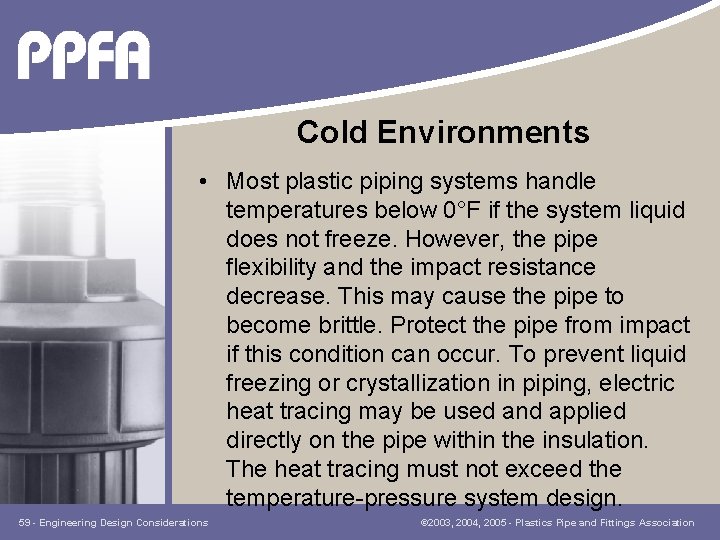
Cold Environments • Most plastic piping systems handle temperatures below 0°F if the system liquid does not freeze. However, the pipe flexibility and the impact resistance decrease. This may cause the pipe to become brittle. Protect the pipe from impact if this condition can occur. To prevent liquid freezing or crystallization in piping, electric heat tracing may be used and applied directly on the pipe within the insulation. The heat tracing must not exceed the temperature-pressure system design. 59 - Engineering Design Considerations © 2003, 2004, 2005 - Plastics Pipe and Fittings Association
Hot Environments • When pressure-piping applications exceed 285°F, the use of thermoplastic piping is limited. Make sure, in temperatures above 100°F, that expansion/ contraction, reduced working pressures and support spacing are considered. 60 - Engineering Design Considerations © 2003, 2004, 2005 - Plastics Pipe and Fittings Association
Outdoor Environments • Most TIPS are formulated for protection against the harmful ultraviolet rays from the sun. However, long periods of exposure to direct sunlight can oxidize the surface of the piping, causing discoloration and reduced impact resistance. To prevent these phenomena, opaque tape or paint can be applied. Be sure to use acrylic or water-based paints. Do not use oil-based paints as they may cause harm to some plastic piping. 61 - Engineering Design Considerations © 2003, 2004, 2005 - Plastics Pipe and Fittings Association
Compressed Air • Except for specially designed and designated plastic piping systems, most manufacturers do not recommend their product for handling of or testing with any compressed gases. 62 - Engineering Design Considerations © 2003, 2004, 2005 - Plastics Pipe and Fittings Association
Below-ground Considerations © 2003, 2004, 2005 - Plastics Pipe and Fittings Association
Below-ground Design • Plastic Pipe deflection pipe in most or compression instances isdepends considered on a flexible any one or pipe a combination rather than a ofrigid threepiping factors: – Pipe stiffness material. Flexible pipe is pipe that is able Soil stiffness (soilbreaking density along the uses sides ofthe pipe) to– bend without and – Load the pipe medium (earth/static/live) wall andonburied to sustain external loads. When installed properly, plastic develops support from the surrounding soil. 64 - Engineering Design Considerations © 2003, 2004, 2005 - Plastics Pipe and Fittings Association
Pipe Stiffness • Pipe stiffness is the force in psi divided by the vertical deflection in inches. An arbitrary data point of 5% deflection is used as a comparison of pipe stiffness values in flexible piping. Each pressure piping material has a different pipe stiffness value that is based on the material’s flexural modulus. For any given SDR, the pipe stiffness remains constant for all sizes. 65 - Engineering Design Considerations © 2003, 2004, 2005 - Plastics Pipe and Fittings Association
Soil Stiffness • Soil stiffness is the soil’s ability to resist compaction. There is a formula (Spangler’s) to determine the “E” values or deflection of buried flexible pipe in terms of soil stiffness independent of pipe size. The “E” value is also referred to as the modulus of soil reactions. The soil backfill type and amount of compaction directly affect these values. 66 - Engineering Design Considerations © 2003, 2004, 2005 - Plastics Pipe and Fittings Association
Pipe Loading • Earth loads may be calculated using Marston’s load formula. Static loads are calculated using Boussinesq’s Equation. Live or dynamic loads are also calculated using Boussinesq’s Equation, by multiplying the superimposed load (W) by 1 ½. There are many existing tables available from pipe manufacturers for various piping materials listing soil conditions, soil compaction, pipe stiffness values, maximum height of cover recommendations and other useful data to 67 - Engineering Design Considerations © 2003, 2004, 2005 - Plastics Pipe and Fittings Association design underground plastic piping systems.
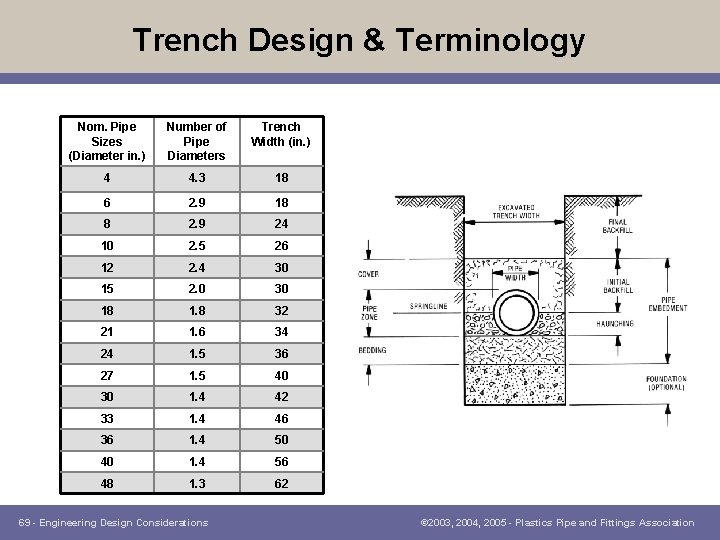
Trench Design & Terminology • Trenches should be of adequate width to allow the proper bedding and backfilling of plastic pipe, while being as narrow as practical. A trench width of two or three times the piping diameter is a good rule of thumb in determining the trench width. Following is a table listing minimum trench widths for various pipe sizes and a crosssection showing pipe trench terminology. 68 - Engineering Design Considerations © 2003, 2004, 2005 - Plastics Pipe and Fittings Association
Trench Design & Terminology Nom. Pipe Sizes (Diameter in. ) Number of Pipe Diameters Trench Width (in. ) 4 4. 3 18 6 2. 9 18 8 2. 9 24 10 2. 5 26 12 2. 4 30 15 2. 0 30 18 1. 8 32 21 1. 6 34 24 1. 5 36 27 1. 5 40 30 1. 4 42 33 1. 4 46 36 1. 4 50 40 1. 4 56 48 1. 3 62 69 - Engineering Design Considerations © 2003, 2004, 2005 - Plastics Pipe and Fittings Association
Minimum Cover of Buried Pipe • The following guidelines may be used when burying plastic pipe: – Locate pipe below the frost line – A minimum cover of 18 in. or one pipe diameter (whichever is greater) when there is no overland traffic – A minimum cover of 36 in. or one pipe diameter (whichever is greater) when truck traffic may be expected – A minimum cover of 60 in. when heavy truck or locomotive traffic is possible 70 - Engineering Design Considerations © 2003, 2004, 2005 - Plastics Pipe and Fittings Association
TIPS are. . . • • • 71 - Engineering Design Considerations Environmentally sound Easy and safe to install Reliable Long-lasting Cost-effective © 2003, 2004, 2005 - Plastics Pipe and Fittings Association