
Engineering Design Brief Case Study What is the
Engineering Design Brief Case Study: What is the Engineering Design Process and Why is it Critical? Rochester Institute of Technology Mechanical Engineering Department Rochester, NY USA R. I. T Mechanical Engineering
Questions… R. I. T Mechanical Engineering

Session Objectives • • • Design process overview Problem statement Voice of the Customer Voice of the Engineer Generate and Select Concept R. I. T Mechanical Engineering
Session Objectives • • • Design process overview Problem statement Voice of the Customer Voice of the Engineer Generate and Select Concept R. I. T Mechanical Engineering
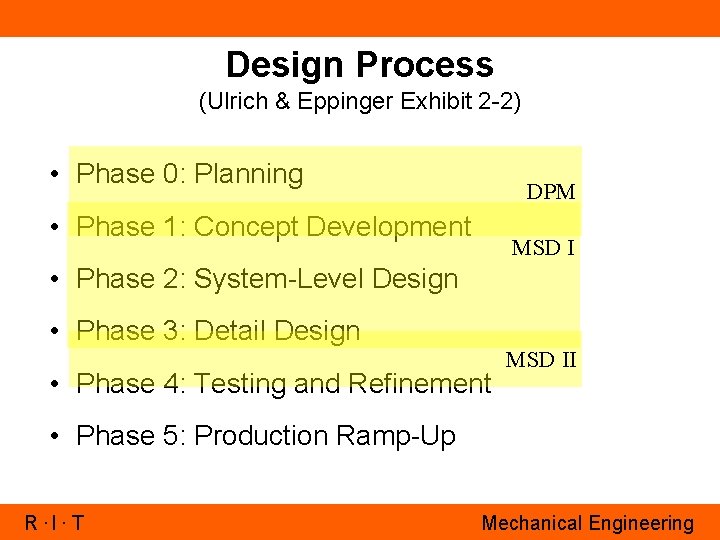
Design Process (Ulrich & Eppinger Exhibit 2 -2) • Phase 0: Planning DPM • Phase 1: Concept Development MSD I • Phase 2: System-Level Design • Phase 3: Detail Design • Phase 4: Testing and Refinement MSD II • Phase 5: Production Ramp-Up R. I. T Mechanical Engineering
Planning (U&E) • • • Doing this now! Identify market opportunities Consider product platform and architecture Assess new technologies Research available technologies Identify production constraints R. I. T Mechanical Engineering
Concept Development (U&E) • • • Identify Customer Needs Establish Target Specifications Generate Product Concepts Select Product Concepts Test Product Concepts Set Final Specifications R. I. T Mechanical Engineering
Session Objectives • • • Design process overview Problem statement Voice of the Customer Voice of the Engineer Generate and Select Concept R. I. T Mechanical Engineering
“We need a better ladder” • Take 2 minutes and design a better ladder. R. I. T Mechanical Engineering
Read handout • What’s changed…? R. I. T Mechanical Engineering
Session Objectives • • • Design process overview Problem statement Voice of the Customer Voice of the Engineer Generate and Select Concept R. I. T Mechanical Engineering
Read handout • What’s changed…? • Customer/market • Can capture the Voice of the Customer • Take 4 minutes • Write a set of 4 -5 customer needs for your client. • Prepare a brief statement to the class: describe customer and needs. R. I. T Mechanical Engineering
“We need a better ladder” • Take 2 minutes and design a better ladder R. I. T Mechanical Engineering
Was this easier? • Hopefully yes! • Can we do better? Yes! R. I. T Mechanical Engineering
---Break-- • Take 10 minutes and come back for the Voice of the Engineer R. I. T Mechanical Engineering
Session Objectives • • • Design process overview Problem statement Voice of the Customer Voice of the Engineer Generate and Select Concept R. I. T Mechanical Engineering
Voice of the Engineer • Functional decomposition: • What functions does the product/process need to perform? • What constraints are present? • Core function of a ladder (all scenarios)? • Ask, “How is the device going to do that? ” R. I. T Mechanical Engineering
Function Tree • Take 5 minutes and come up with a list of functions that YOUR ladder needs to perform • Function is an active statement: verb-noun • Note: We will spend more time on this in class, so don’t worry if it’s not perfect today! R. I. T Mechanical Engineering
Metrics and Specifications • How are you going to measure how well those functions are performed? (Metric) • What is your threshold for success? (Specification) • These require feasibility analysis R. I. T Mechanical Engineering
Session Objectives • • • Design process overview Problem statement Voice of the Customer Voice of the Engineer Generate and Select Concept R. I. T Mechanical Engineering
Concept Generation • Take 2 minutes: each team member brainstorm how to perform a single function on your ladder’s function tree • Ex: 5 team members can develop ideas for 5 functions • The process has provided structure for solving your problem – this should be much easier! R. I. T Mechanical Engineering
Morphological Chart • A tool that will allow you to assemble complete system ideas from your list of function concepts. • More on this later… R. I. T Mechanical Engineering
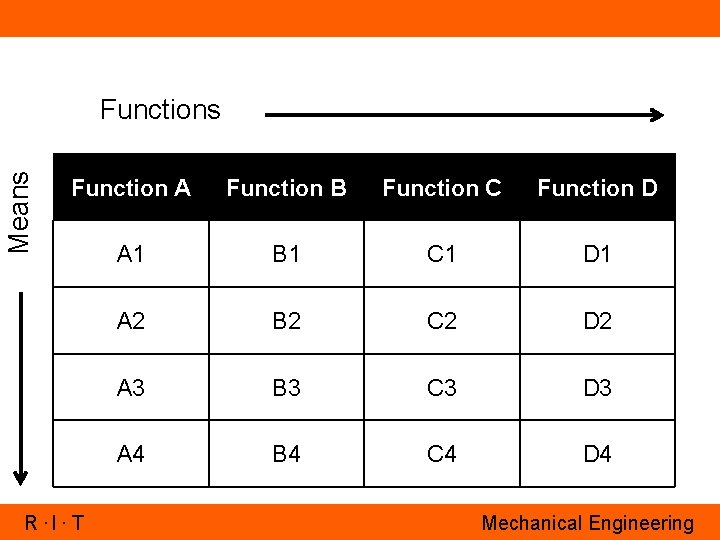
Means Function A Function B Function C Function D A 1 B 1 C 1 D 1 A 2 B 2 C 2 D 2 A 3 B 3 C 3 D 3 A 4 B 4 C 4 D 4 R. I. T Mechanical Engineering
Design a Better Ladder • These system concepts are ideas for better ladders. R. I. T Mechanical Engineering
Concept Selection • Take 2 minutes and decide which concept is the best • What was your team’s process? R. I. T Mechanical Engineering
Selection Criteria • Evaluate each system concept against a predetermined set of criteria • Objective, not subjective • May require some feasibility analysis • Allows you to look at the good and bad of each system, and iterate and improve on your ideas • You will not do a complete concept selection in DPM! R. I. T Mechanical Engineering
Hand-Off from DPM to MSD • You are now delivering a well-thought-out project. • You know there are feasible solutions • You have reviewed the customer needs and specifications • You are more confident that you are solving the correct problem. R. I. T Mechanical Engineering
Design Process (Ulrich & Eppinger Exhibit 2 -2) • Phase 0: Planning • Phase 1: Concept Development • Phase 2: System-Level Design • Phase 3: Detail Design • Phase 4: Testing and Refinement • Phase 5: Production Ramp-Up R. I. T Mechanical Engineering
Questions? R. I. T Mechanical Engineering
- Slides: 29