
Engineering applications of SOS polynomials Georgina Hall DYOGENE





- Slides: 38
Engineering applications of SOS polynomials Georgina Hall DYOGENE, INRIA/Decision Sciences, INSEAD 1
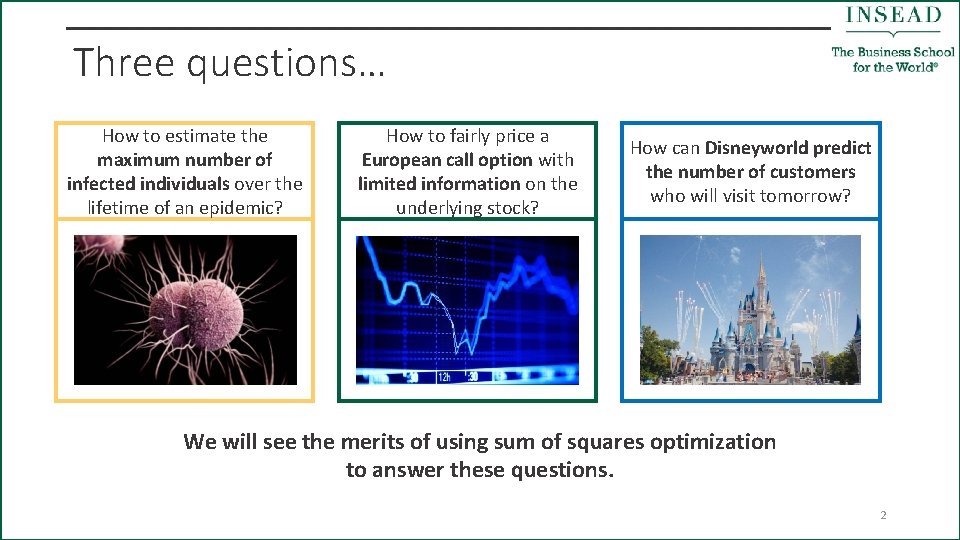
Three questions… How to estimate the maximum number of infected individuals over the lifetime of an epidemic? How to fairly price a European call option with limited information on the underlying stock? How can Disneyworld predict the number of customers who will visit tomorrow? We will see the merits of using sum of squares optimization to answer these questions. 2
Goals of this lecture The how-tos I would like you to take away from this lecture: • How to recognize problems that could be tackled using sum of squares techniques. • How to reformulate such a problem as a sum of squares optimization problem. • How to use software to solve sum of squares optimization problems. The key message I would like to convince you of: Sum of squares polynomials are used in many different areas, provide strong guarantees, and may be relevant for your work! 3
Structure of this lecture • Overview of some fundamental tools • Then, for each problem: • Come up with a mathematical model. • Express the question as an optimization problem. • Reformulate as a sum of squares optimization problem. • Solve a numerical example. • Wrapping up (very brief): sum of squares software and implementation challenges 4
Overview of some fundamental tools Optimizing over nonnegative polynomials 5
Optimization with sum of squares (1/5) • Recall from Greg Blekherman’s talk: Replace with sos • Generalization of this problem (polynomial optimization problems): Replace with sos “obviously nonnegative polynomials” 6
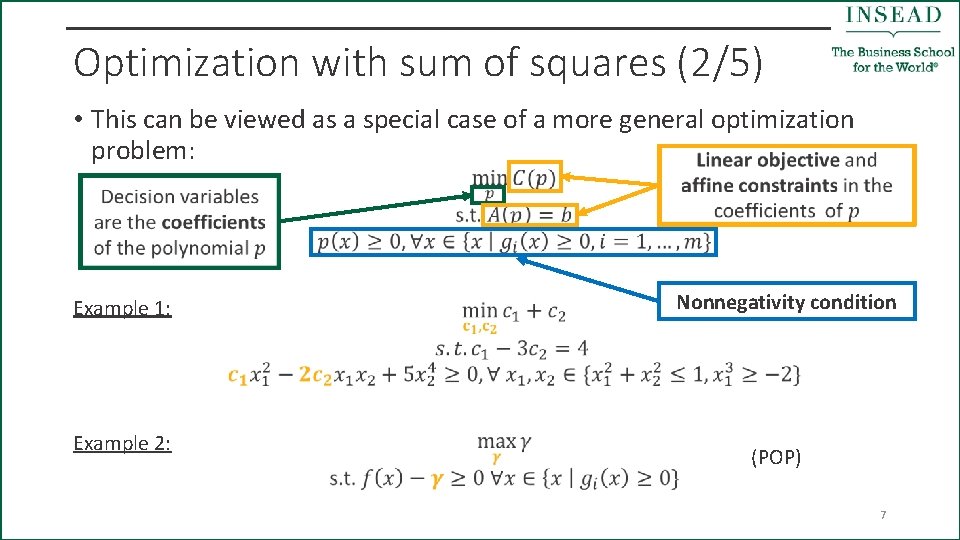
Optimization with sum of squares (2/5) • This can be viewed as a special case of a more general optimization problem: Nonnegativity condition Example 1: Example 2: (POP) 7
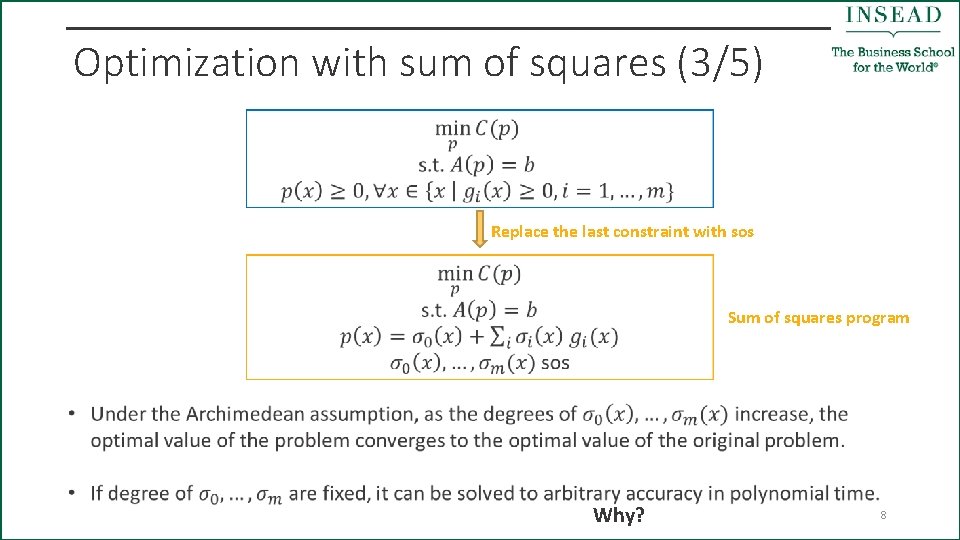
Optimization with sum of squares (3/5) Replace the last constraint with sos Sum of squares program Why? 8
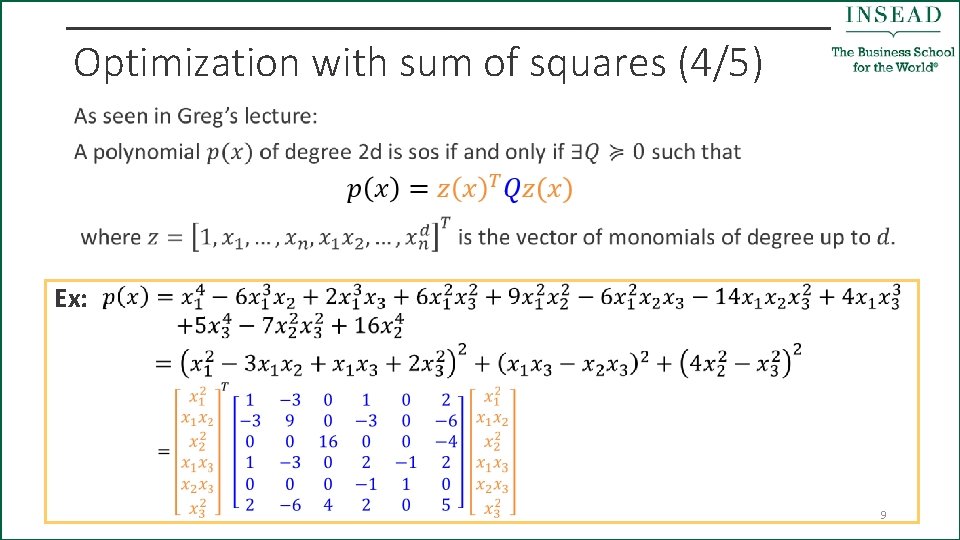
Optimization with sum of squares (4/5) • Ex: 9
Optimization with sum of squares (5/5) Sum of squares program Semidefinite program And semidefinite programs can be solved to arbitrary accuracy in polynomial time! 10
Example 1 How to estimate the maximum number of infected individuals over the lifetime of an epidemic? 11
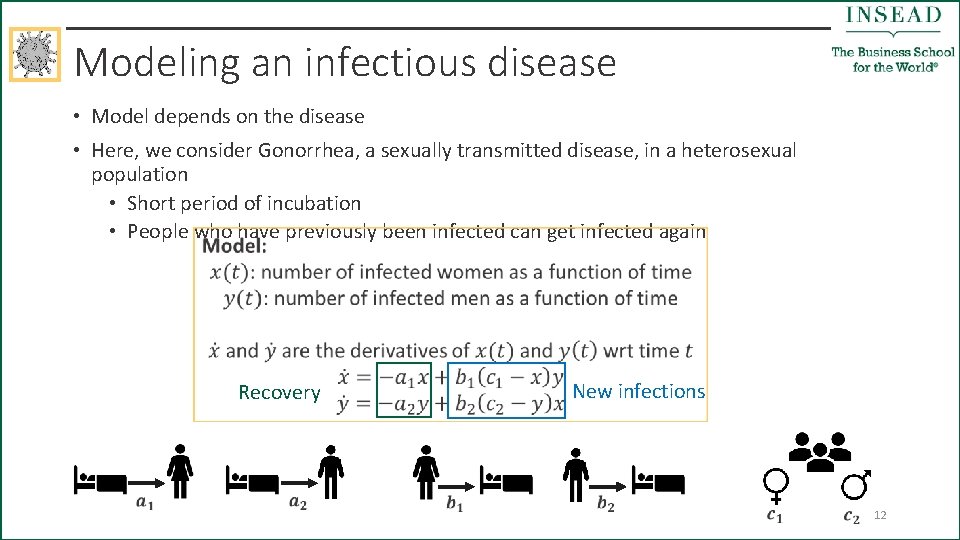
Modeling an infectious disease • Model depends on the disease • Here, we consider Gonorrhea, a sexually transmitted disease, in a heterosexual population • Short period of incubation • People who have previously been infected can get infected again New infections Recovery 12
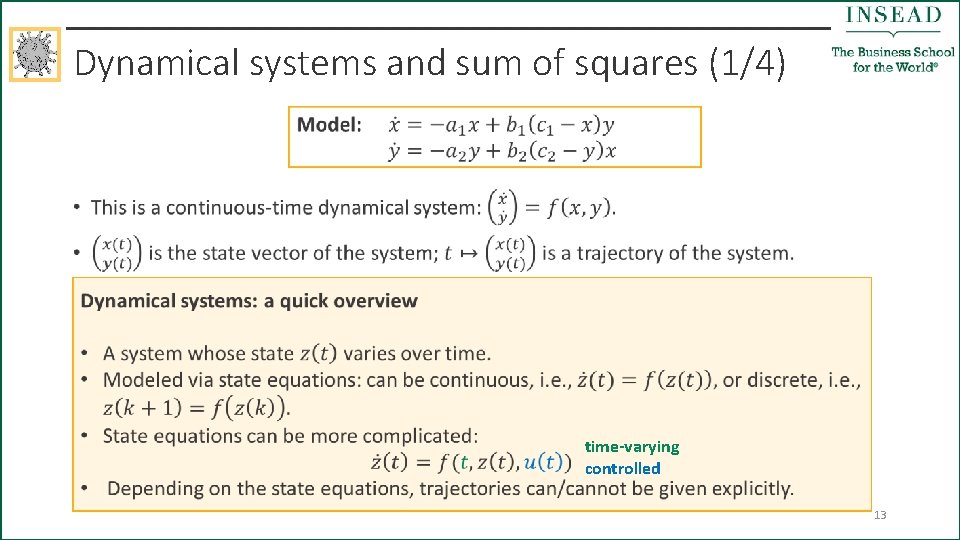
Dynamical systems and sum of squares (1/4) • time-varying controlled 13
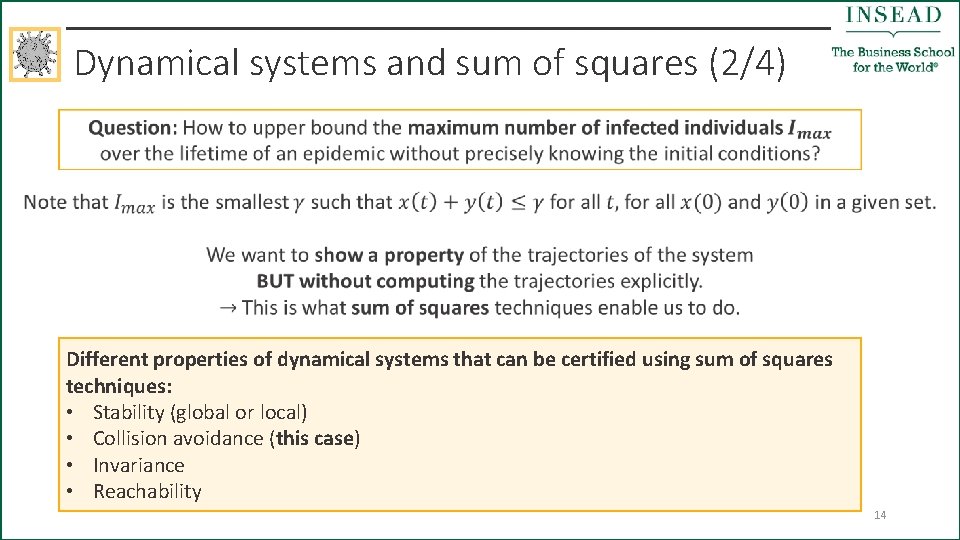
Dynamical systems and sum of squares (2/4) Different properties of dynamical systems that can be certified using sum of squares techniques: • Stability (global or local) • Collision avoidance (this case) • Invariance • Reachability 14
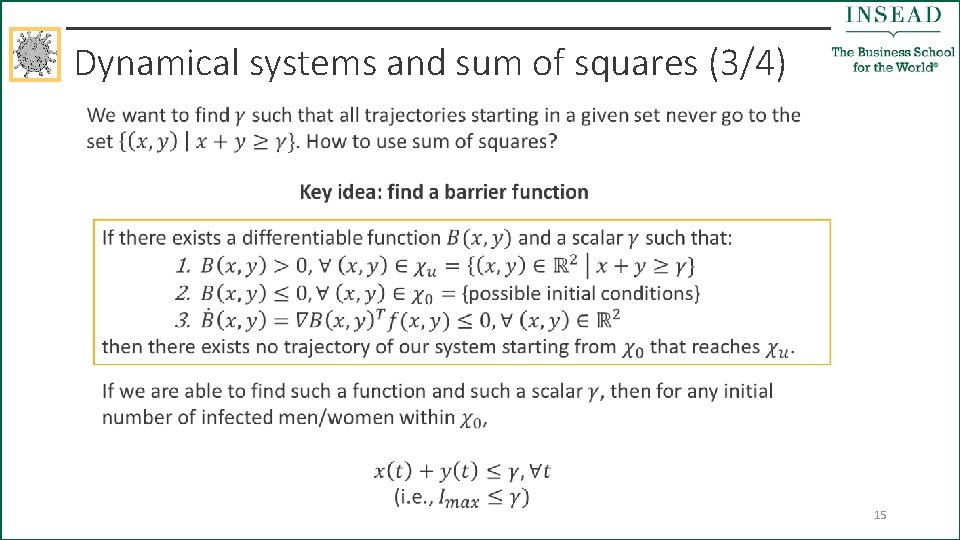
Dynamical systems and sum of squares (3/4) 15
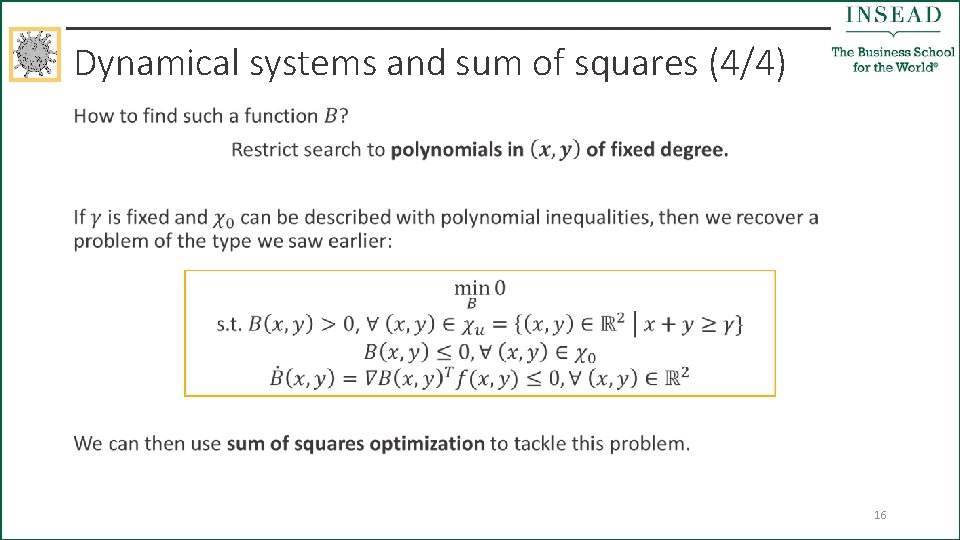
Dynamical systems and sum of squares (4/4) • 16
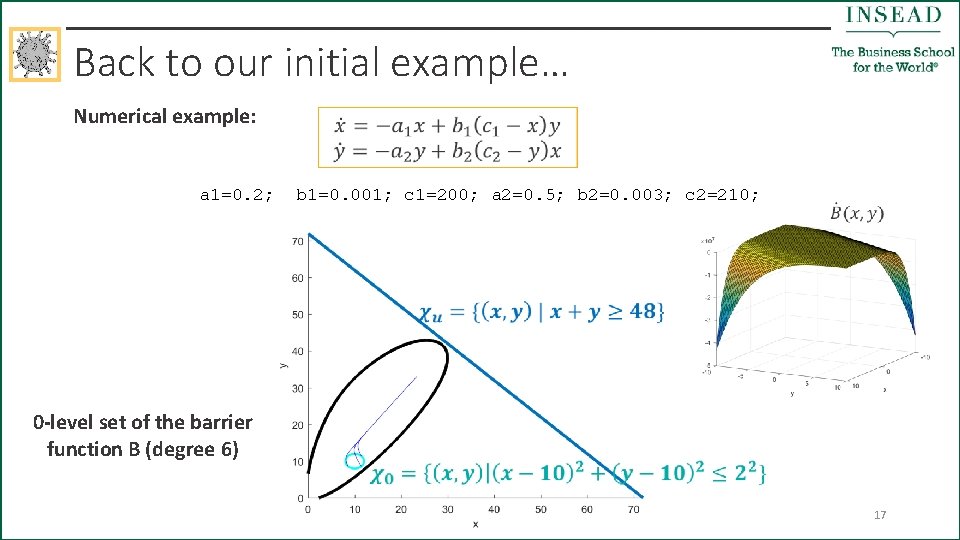
Back to our initial example… Numerical example: a 1=0. 2; b 1=0. 001; c 1=200; a 2=0. 5; b 2=0. 003; c 2=210; 0 -level set of the barrier function B (degree 6) 17
Example 2 How to fairly price a European call option with limited information on the underlying stock? 18
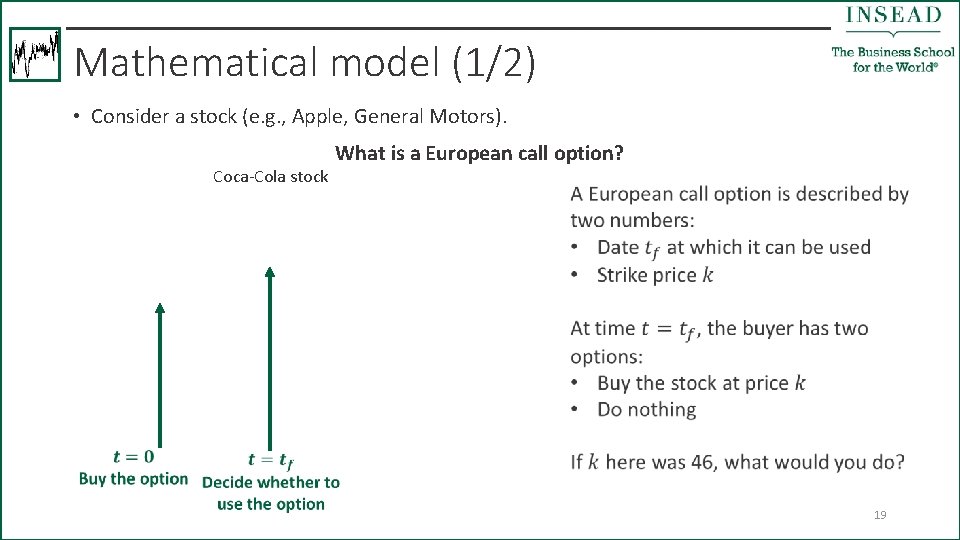
Mathematical model (1/2) • Consider a stock (e. g. , Apple, General Motors). Coca-Cola stock What is a European call option? 19
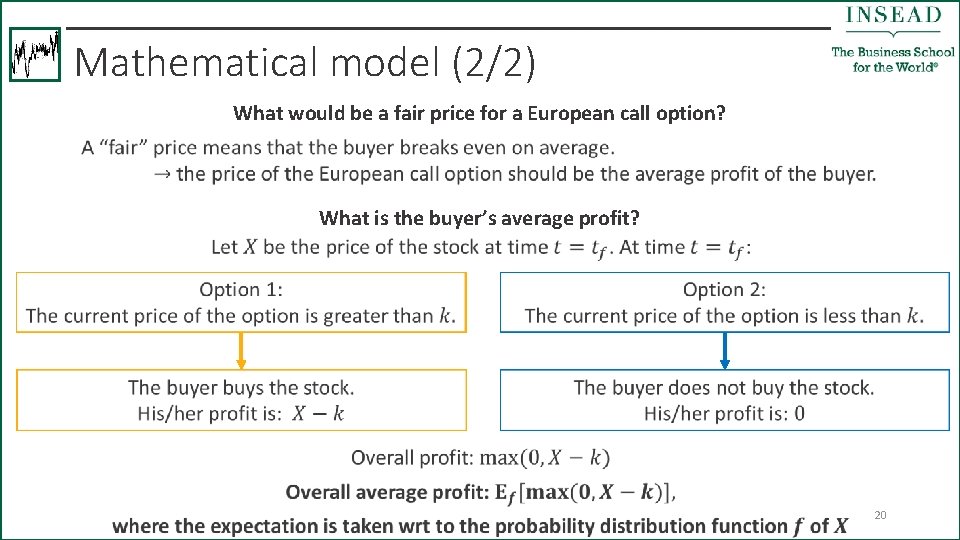
Mathematical model (2/2) What would be a fair price for a European call option? What is the buyer’s average profit? 20
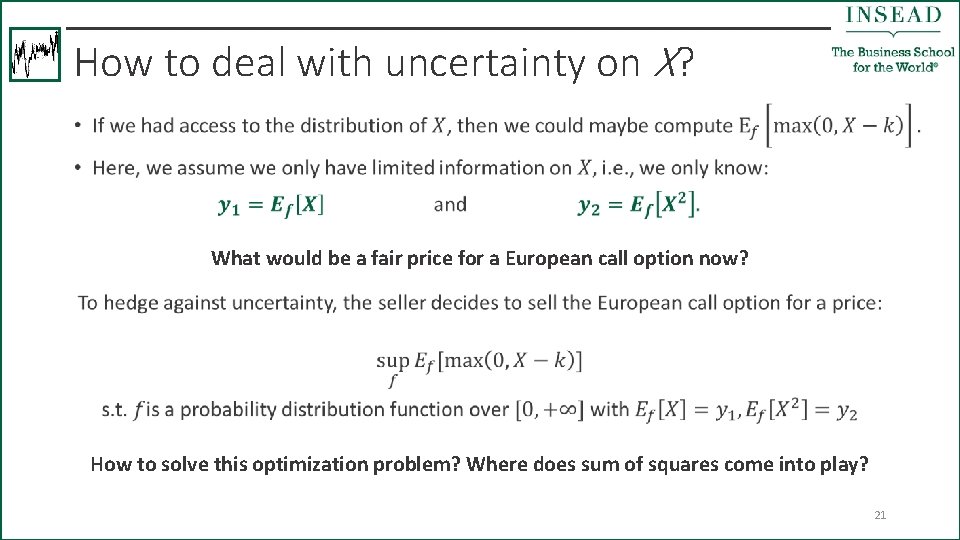
How to deal with uncertainty on X? • What would be a fair price for a European call option now? How to solve this optimization problem? Where does sum of squares come into play? 21
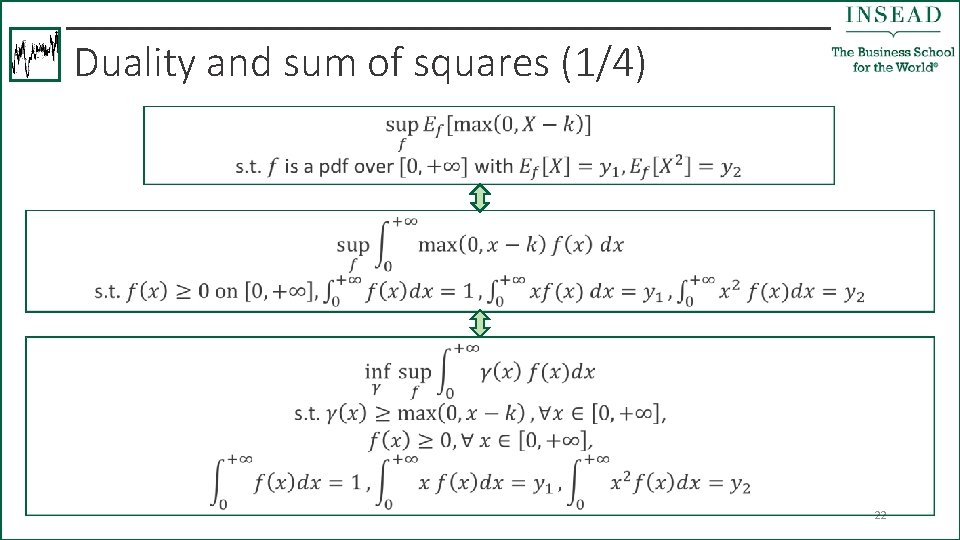
Duality and sum of squares (1/4) 22
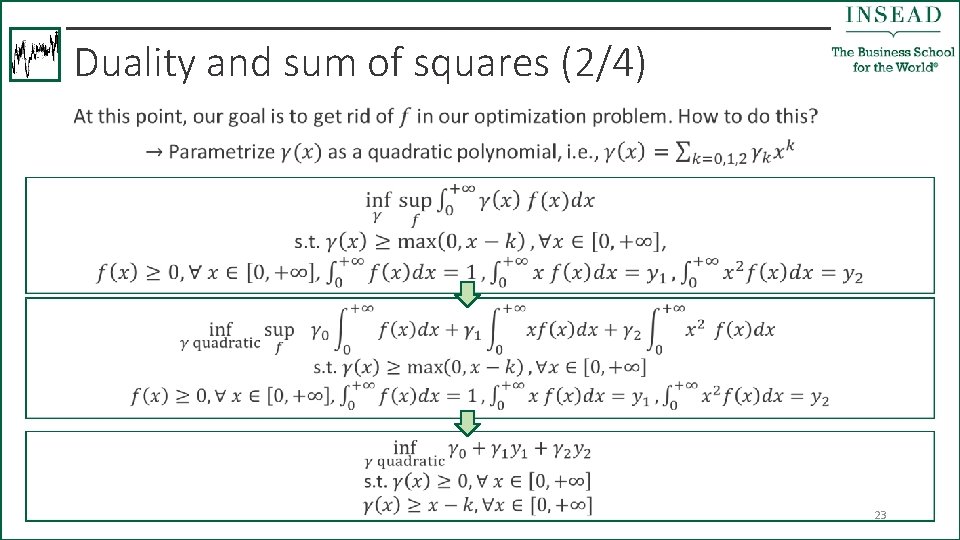
Duality and sum of squares (2/4) • 23
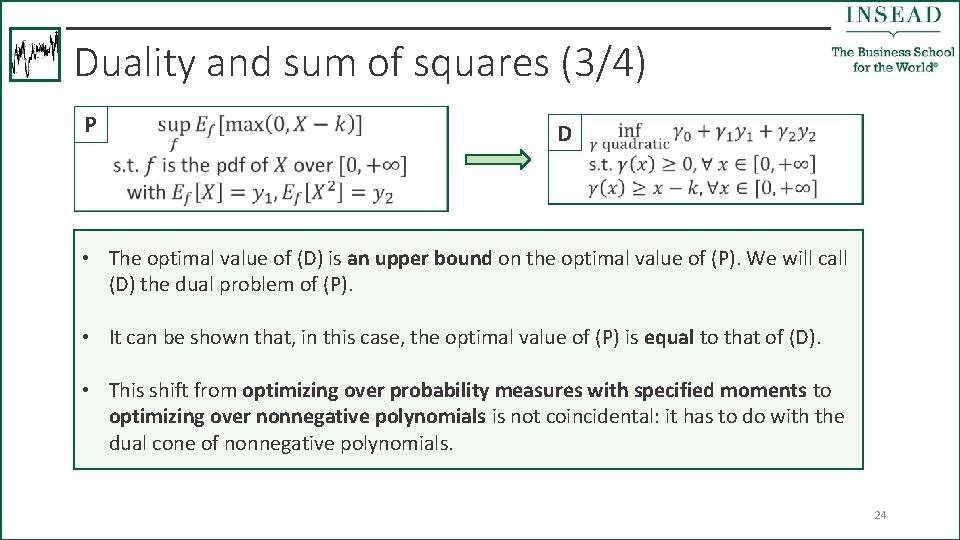
Duality and sum of squares (3/4) P D • The optimal value of (D) is an upper bound on the optimal value of (P). We will call (D) the dual problem of (P). • It can be shown that, in this case, the optimal value of (P) is equal to that of (D). • This shift from optimizing over probability measures with specified moments to optimizing over nonnegative polynomials is not coincidental: it has to do with the dual cone of nonnegative polynomials. 24
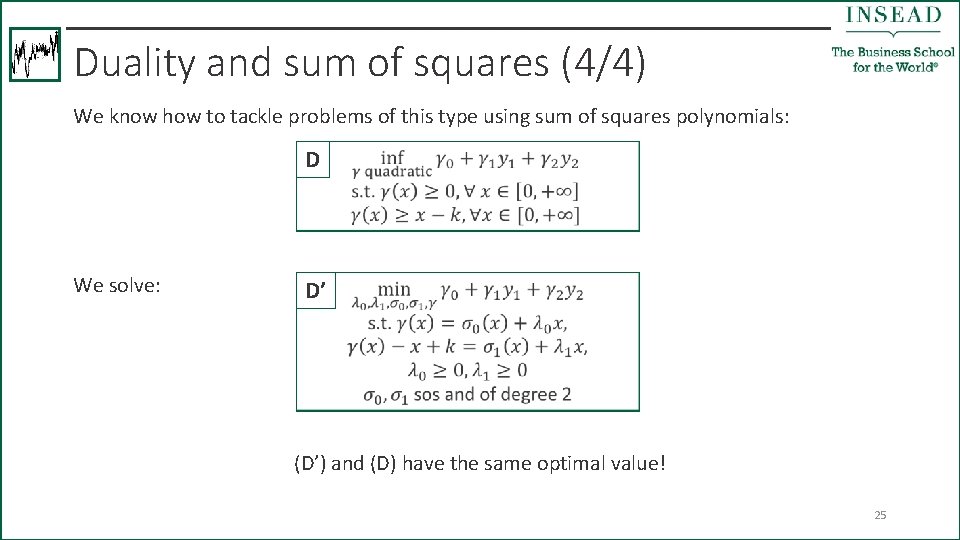
Duality and sum of squares (4/4) We know how to tackle problems of this type using sum of squares polynomials: D We solve: D’ (D’) and (D) have the same optimal value! 25
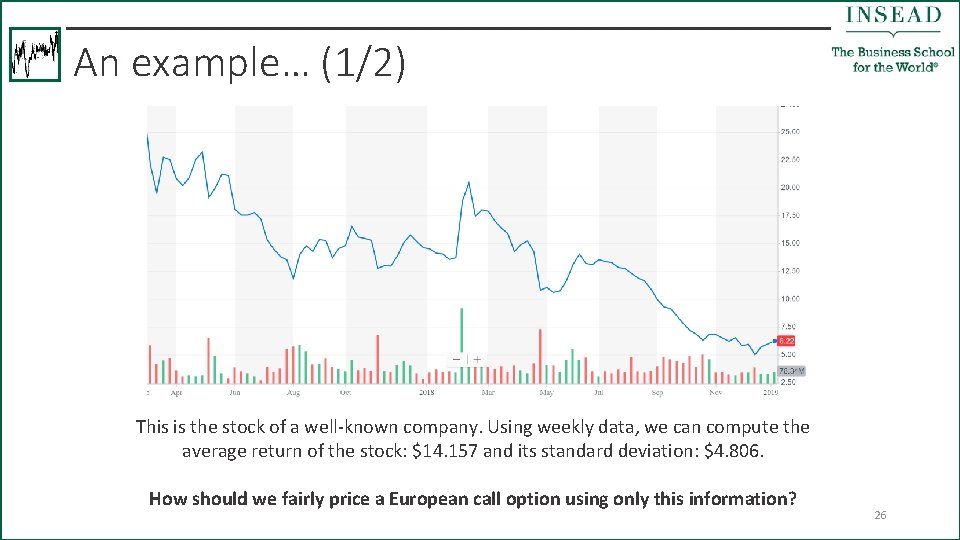
An example… (1/2) This is the stock of a well-known company. Using weekly data, we can compute the average return of the stock: $14. 157 and its standard deviation: $4. 806. How should we fairly price a European call option using only this information? 26
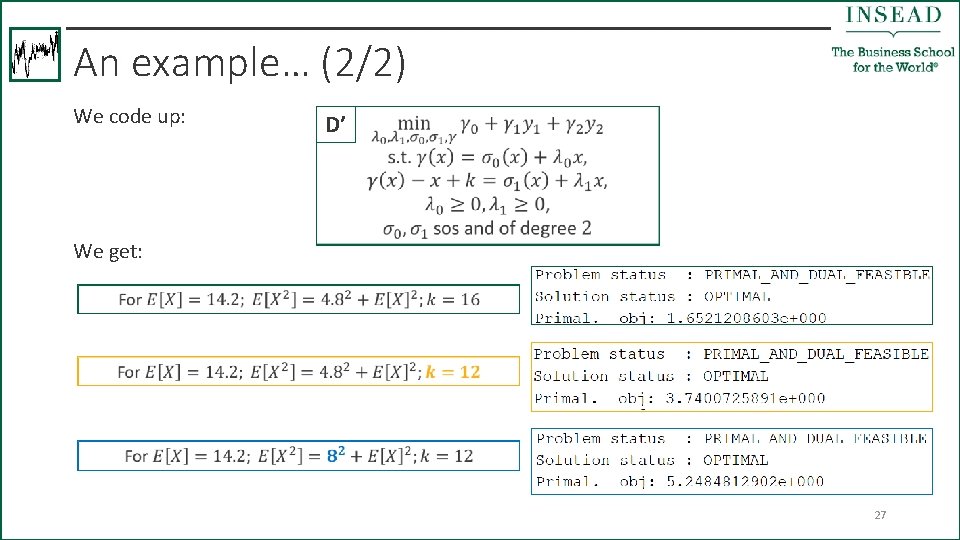
An example… (2/2) We code up: D’ We get: 27
Example 3 How can Disneyworld predict the number of customers who will visit tomorrow? 28
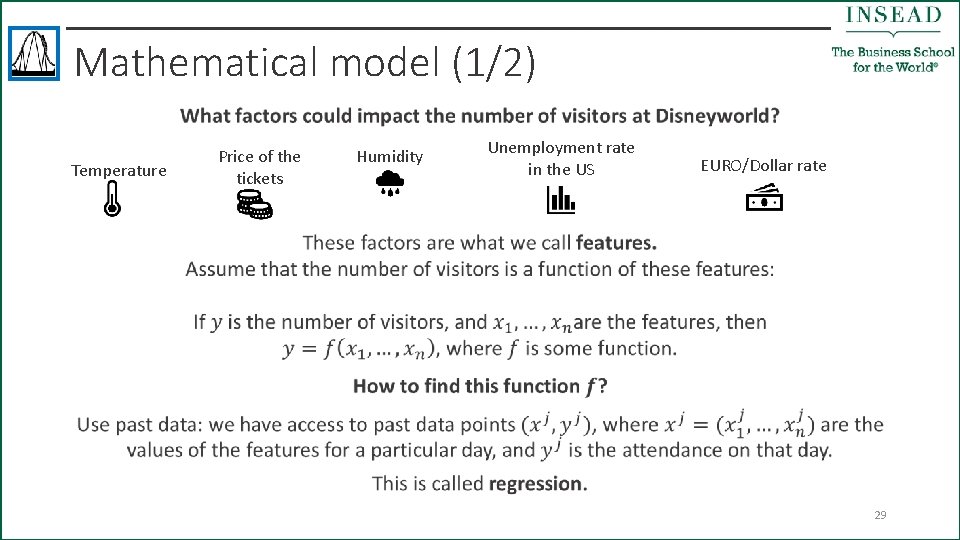
Mathematical model (1/2) • Temperature Price of the tickets Humidity Unemployment rate in the US EURO/Dollar rate 29
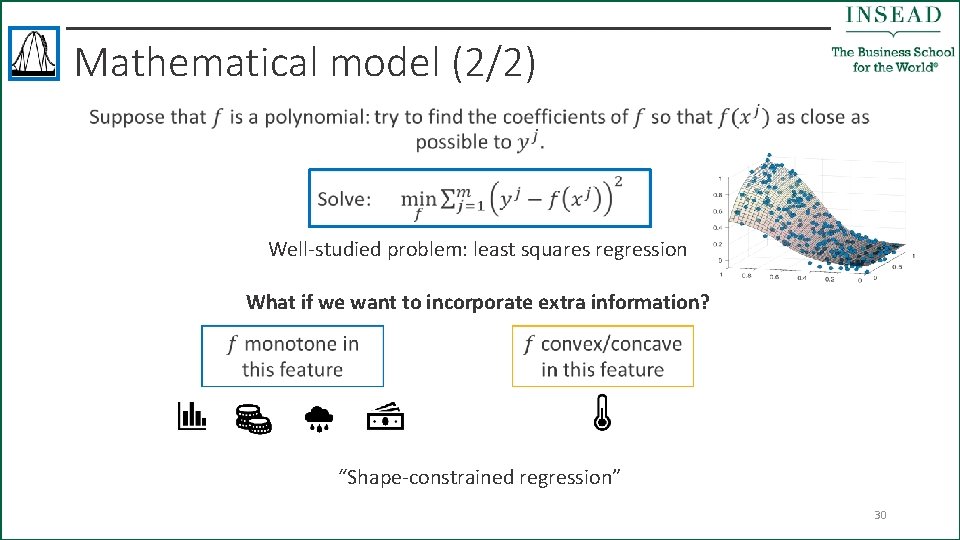
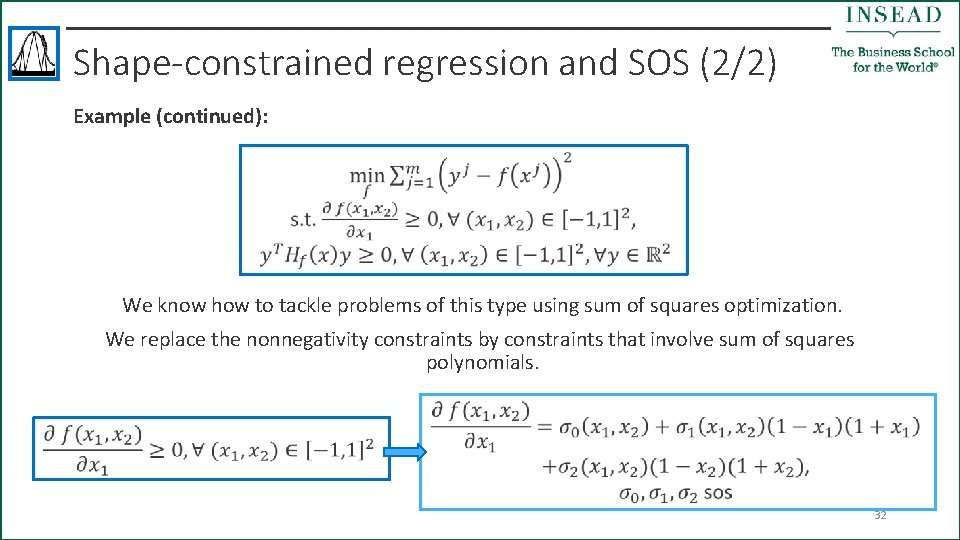
Mathematical model (2/2) • Well-studied problem: least squares regression What if we want to incorporate extra information? “Shape-constrained regression” 30
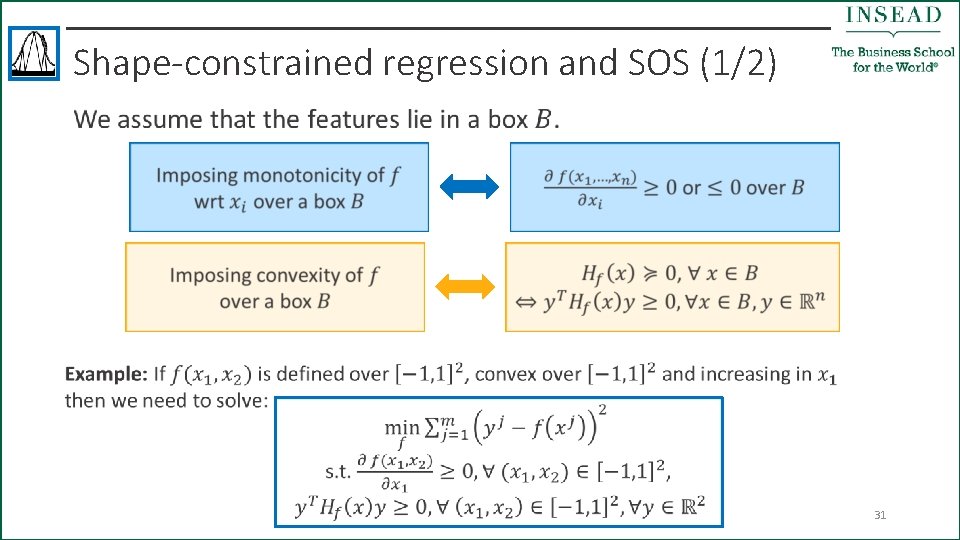
Shape-constrained regression and SOS (1/2) • 31
Shape-constrained regression and SOS (2/2) Example (continued): We know how to tackle problems of this type using sum of squares optimization. We replace the nonnegativity constraints by constraints that involve sum of squares polynomials. 32
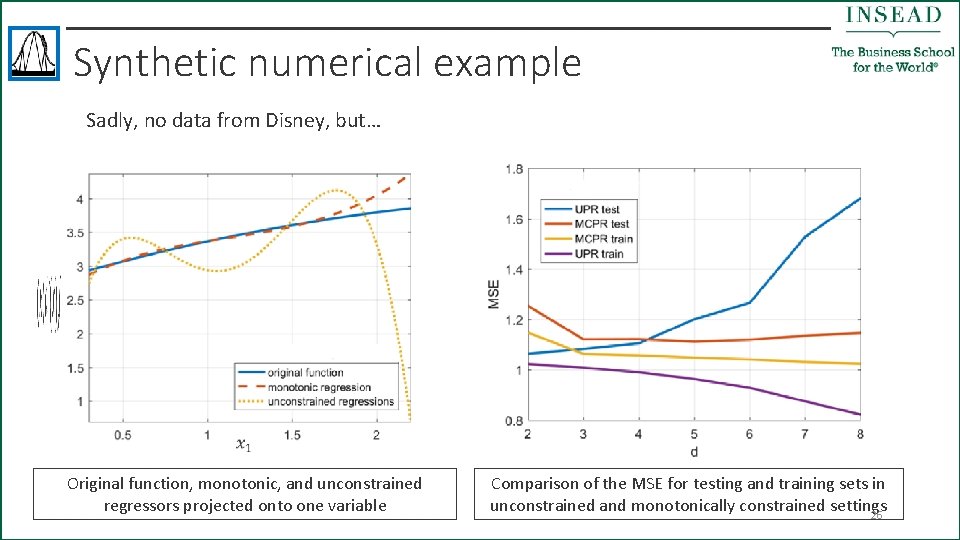
Synthetic numerical example Sadly, no data from Disney, but… Original function, monotonic, and unconstrained regressors projected onto one variable Comparison of the MSE for testing and training sets in unconstrained and monotonically constrained settings 26
Wrapping up Sum of squares software and implementation challenges 34
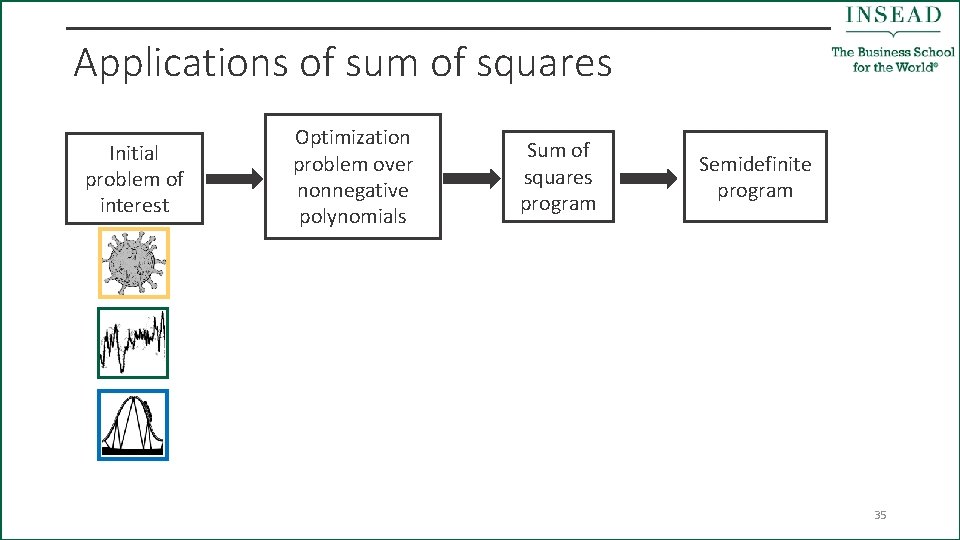
Applications of sum of squares Initial problem of interest Optimization problem over nonnegative polynomials Sum of squares program Semidefinite program 35
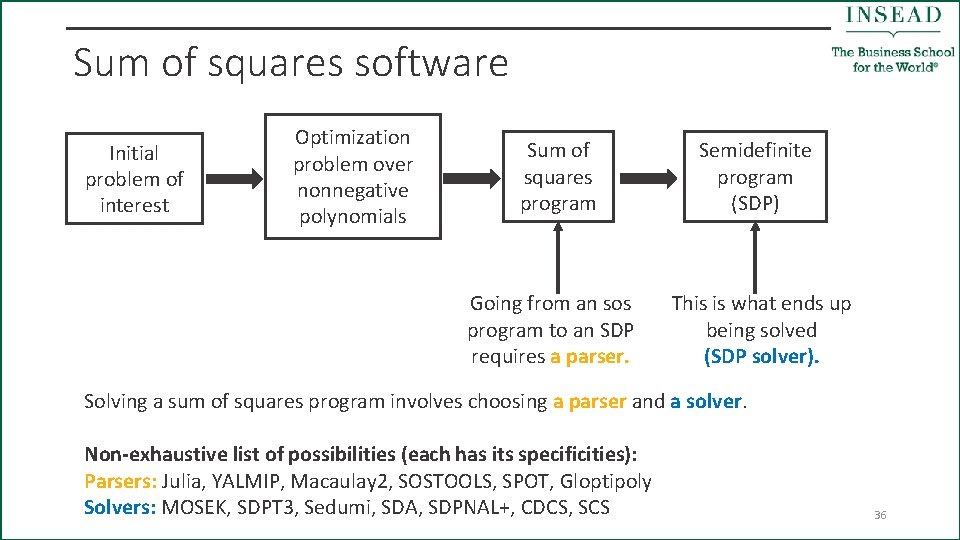
Sum of squares software Initial problem of interest Optimization problem over nonnegative polynomials Sum of squares program Semidefinite program (SDP) Going from an sos program to an SDP requires a parser. This is what ends up being solved (SDP solver). Solving a sum of squares program involves choosing a parser and a solver. Non-exhaustive list of possibilities (each has its specificities): Parsers: Julia, YALMIP, Macaulay 2, SOSTOOLS, SPOT, Gloptipoly Solvers: MOSEK, SDPT 3, Sedumi, SDA, SDPNAL+, CDCS, SCS 36
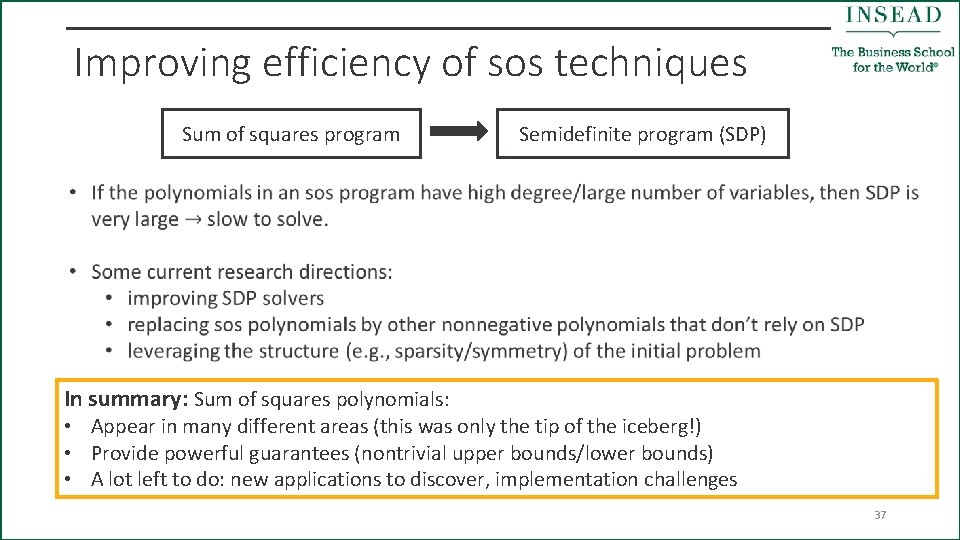
Improving efficiency of sos techniques Sum of squares program Semidefinite program (SDP) In summary: Sum of squares polynomials: • Appear in many different areas (this was only the tip of the iceberg!) • Provide powerful guarantees (nontrivial upper bounds/lower bounds) • A lot left to do: new applications to discover, implementation challenges 37
Thank you for listening Questions? Want to learn more? https: //sites. google. com/view/georgina-hall 38