
ENGINEERING AND PHYSICAL SCIENCES RESEARCH COUNCIL EPSRC Strategy




- Slides: 30
ENGINEERING AND PHYSICAL SCIENCES RESEARCH COUNCIL EPSRC Strategy and Priorities for our next Delivery Plan CPHC Conference 27 April 2015 Engineering and Physical Sciences Research Council
What I am going to talk about What we are facing EPSRC bid ICT Theme Looking ahead
What is about to happen? UK General Election on 7 May (Comprehensive) Spending Review Settlement for science Settlement for each Research Council Next EPSRC Delivery Plan
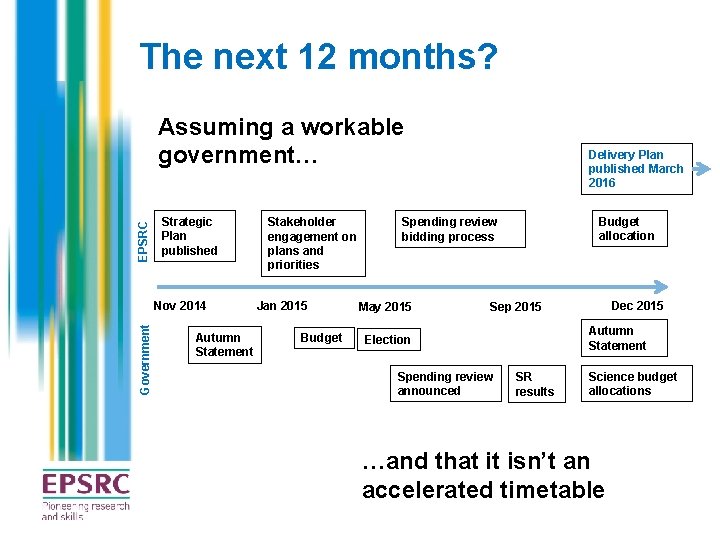
The next 12 months? EPSRC Assuming a workable government… Strategic Plan published Government Nov 2014 Autumn Statement Stakeholder engagement on plans and priorities Jan 2015 Budget Delivery Plan published March 2016 Budget allocation Spending review bidding process May 2015 Dec 2015 Sep 2015 Autumn Statement Election Spending review announced SR results Science budget allocations …and that it isn’t an accelerated timetable
Some context….
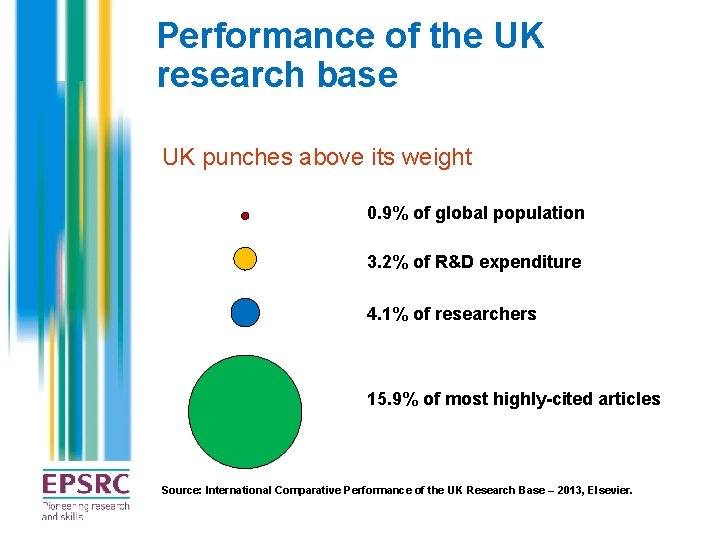
Performance of the UK research base UK punches above its weight 0. 9% of global population 3. 2% of R&D expenditure 4. 1% of researchers 15. 9% of most highly-cited articles Source: International Comparative Performance of the UK Research Base – 2013, Elsevier.
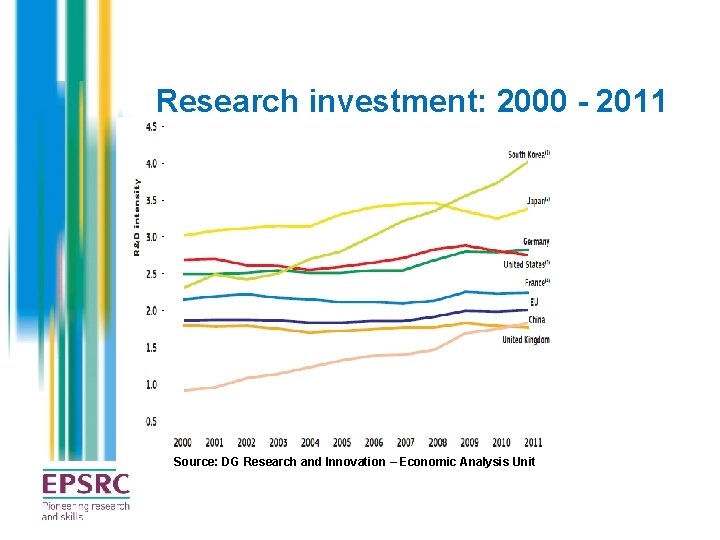
Research investment: 2000 - 2011 Source: DG Research and Innovation – Economic Analysis Unit
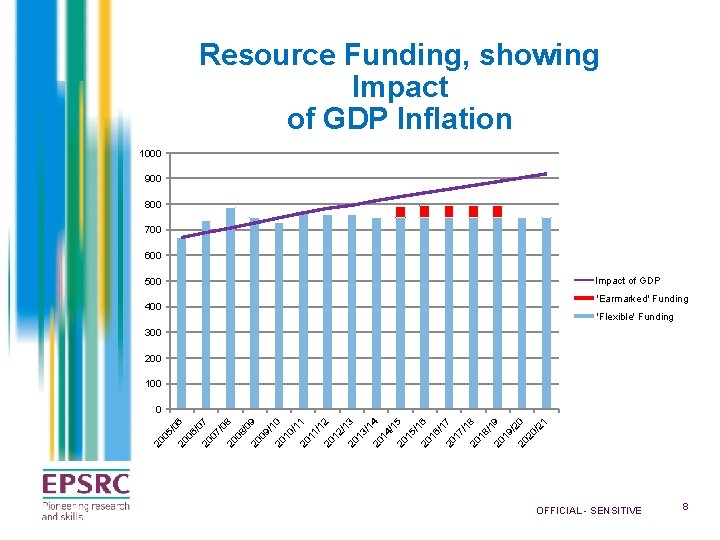
Resource Funding, showing Impact of GDP Inflation 1000 900 800 700 600 Impact of GDP 500 'Earmarked' Funding 400 'Flexible' Funding 300 200 100 0 20 8 08 /0 20 9 09 /1 20 0 10 /1 20 1 11 /1 20 2 12 /1 20 3 13 /1 20 4 14 /1 20 5 15 /1 20 6 16 /1 20 7 17 /1 20 8 18 /1 20 9 19 /2 20 0 20 /2 1 07 / 07 20 06 / 20 20 05 / 06 0 OFFICIAL - SENSITIVE 8
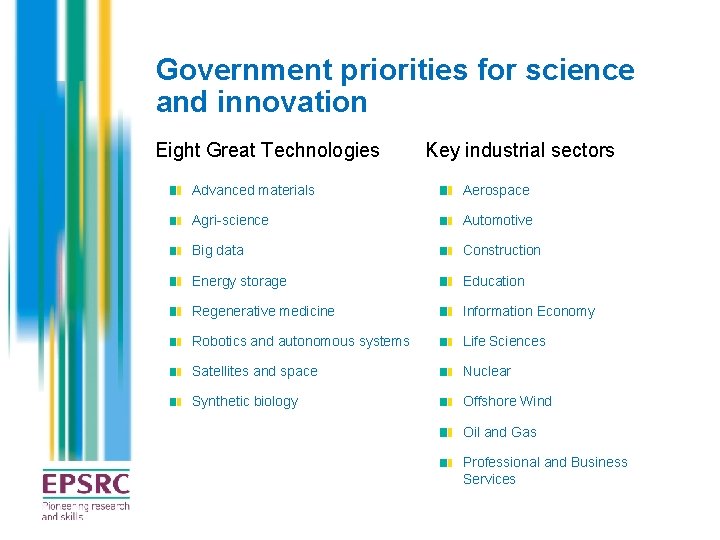
Government priorities for science and innovation Eight Great Technologies Key industrial sectors Advanced materials Aerospace Agri-science Automotive Big data Construction Energy storage Education Regenerative medicine Information Economy Robotics and autonomous systems Life Sciences Satellites and space Nuclear Synthetic biology Offshore Wind Oil and Gas Professional and Business Services
EPSRC strategy and priorities
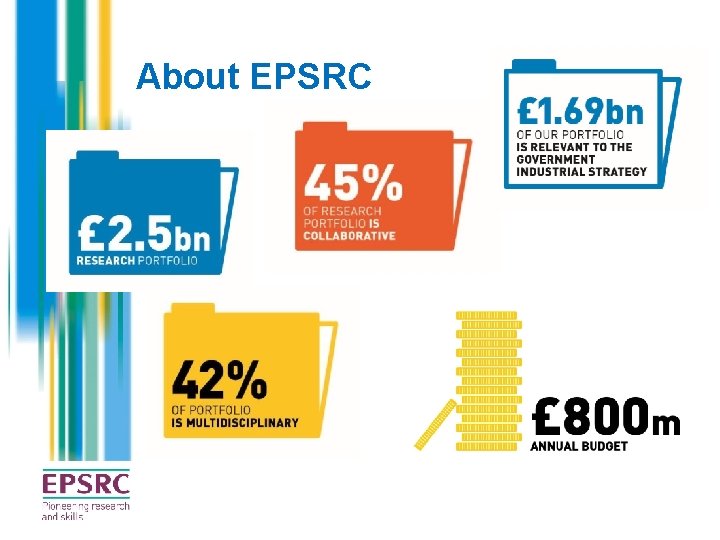
About EPSRC
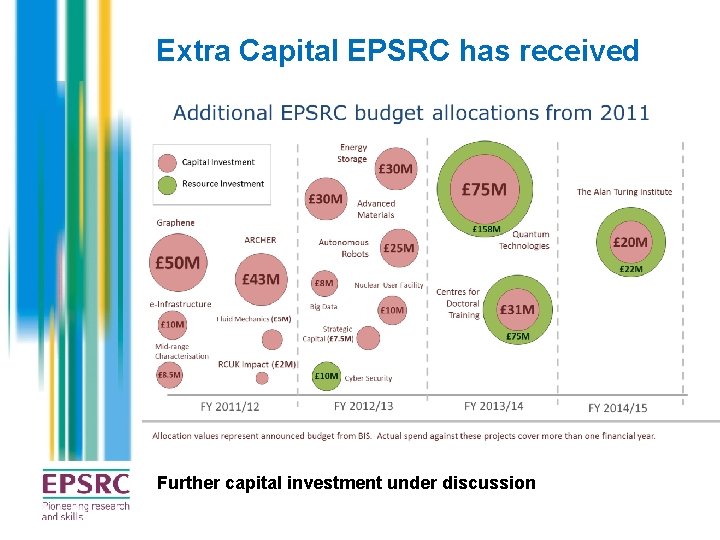
Extra Capital EPSRC has received Further capital investment under discussion
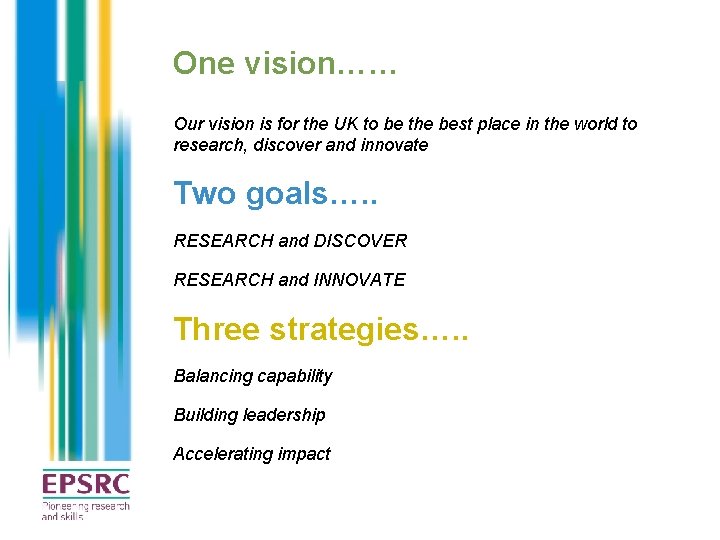
One vision…… Our vision is for the UK to be the best place in the world to research, discover and innovate Two goals…. . RESEARCH and DISCOVER RESEARCH and INNOVATE Three strategies…. . Balancing capability Building leadership Accelerating impact
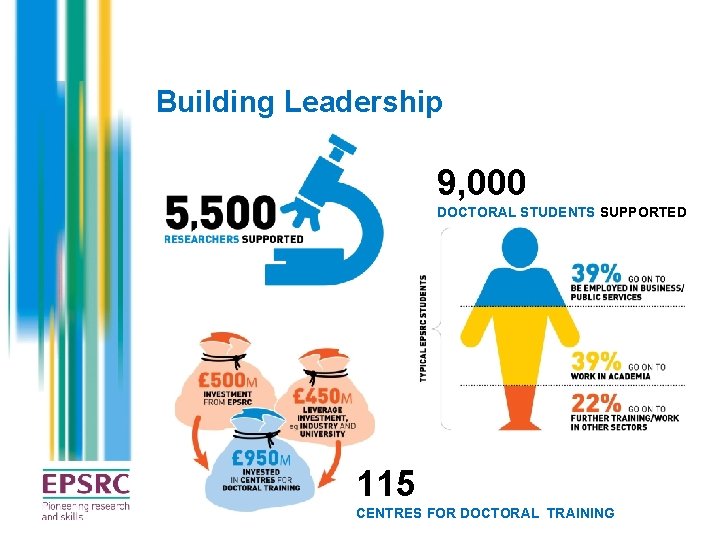
Building Leadership 9, 000 DOCTORAL STUDENTS SUPPORTED 115 CENTRES FOR DOCTORAL TRAINING
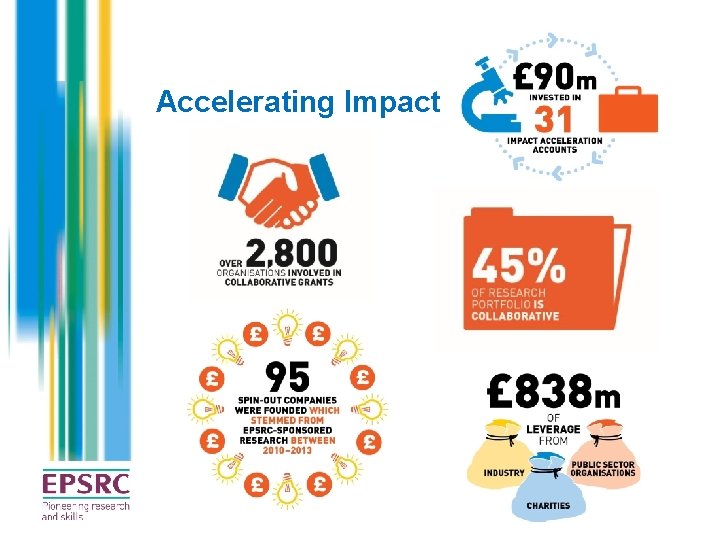
Accelerating Impact
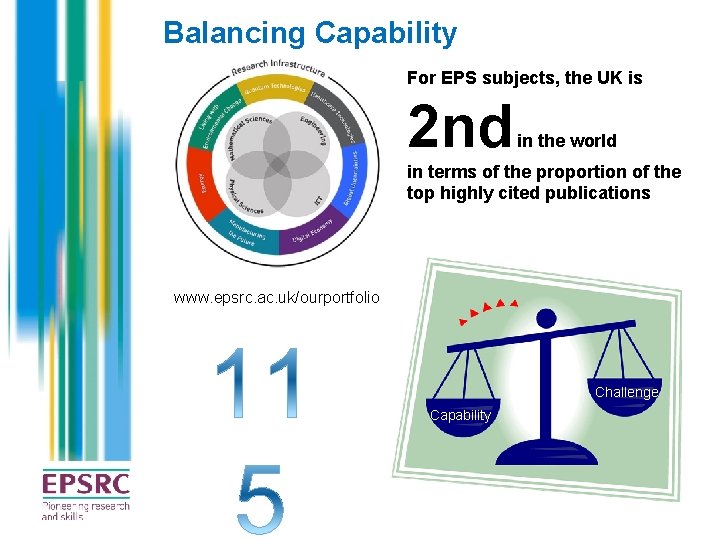
Balancing Capability For EPS subjects, the UK is 2 nd in the world in terms of the proportion of the top highly cited publications www. epsrc. ac. uk/ourportfolio Challenge Capability
Our single message Strong economies are science economies. They invest in research, discovery and innovation. Strong economies are built on the growth and productivity driven by the engineering and physical sciences EPSRC is the most effective means of delivering a world leading, innovative research base that can build a strong UK economy
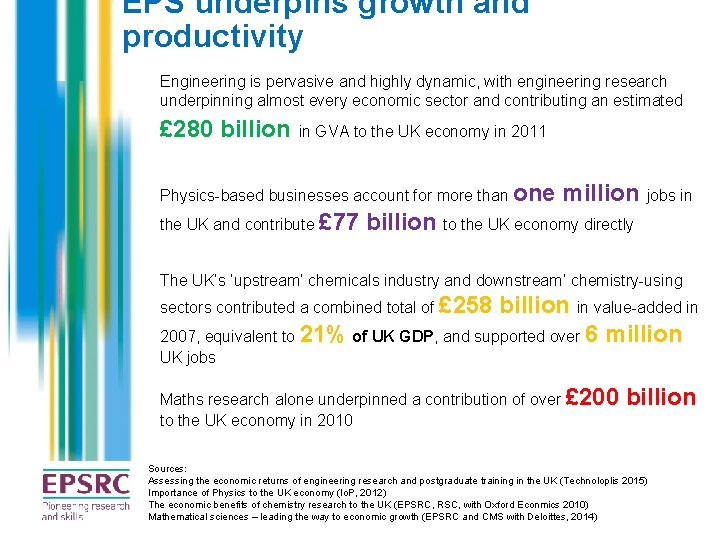
EPS underpins growth and productivity Engineering is pervasive and highly dynamic, with engineering research underpinning almost every economic sector and contributing an estimated £ 280 billion in GVA to the UK economy in 2011 Physics-based businesses account for more than one the UK and contribute £ 77 million jobs in billion to the UK economy directly The UK’s ‘upstream’ chemicals industry and downstream’ chemistry-using sectors contributed a combined total of £ 258 billion in value-added in 2007, equivalent to 21% of UK GDP, and supported over 6 million UK jobs Maths research alone underpinned a contribution of over £ 200 to the UK economy in 2010 billion Sources: Assessing the economic returns of engineering research and postgraduate training in the UK (Technoloplis 2015) Importance of Physics to the UK economy (Io. P, 2012) The economic benefits of chemistry research to the UK (EPSRC, RSC, with Oxford Econmics 2010) Mathematical sciences – leading the way to economic growth (EPSRC and CMS with Deloittes, 2014)
ICT Theme strategy and priorities
What we are and have been doing Our governing body, EPSRC Council, asked us to start doing some thinking in preparation for the spending review They gave us a framework to do our thinking against We were asked to engage with Strategic Advisory Teams initially Following this, we have been engaging more widely, through workshops, visits and other meetings So at this stage, we have our current thinking, which we are sharing, to discuss and get the research communities’ impressions of
Current thinking for next Delivery Plan Main priorities for the ICT Theme Ensuring the ICT academic research ecosystem in the UK is healthy, works effectively, and has impact Ensuring it is at the heart of UK efforts to contribute to a world leading capability in key strategic areas Ensuring the ICT academic research landscape adapts to scientific progress in fundamental areas and technological developments arising from other disciplines and in practice Ensuring the ICT Theme makes a positive contribution to the health of other disciplines and Themes
Key strategic areas Ensuring the ICT Theme is at the heart of UK efforts to contribute to a world leading capability in key strategic areas Big Data Analytics - where the contribution of ICT researchers is integral to the development of capability and capacity Future Intelligent Technologies – including robotics and autonomous systems, where the smart element of these is critical to their effectiveness The Internet of Things - which builds on strength across a range of ICT research areas Human-like Computing - offering the prospect of computation which is akin to that of humans, where learning and making sense of information about the world around us can match our human performance Safe and Secure ICT – ensuring the reliable and responsible development of ICT, including cyber-security
How might we do this? Depends on what sort of settlement we get, but…
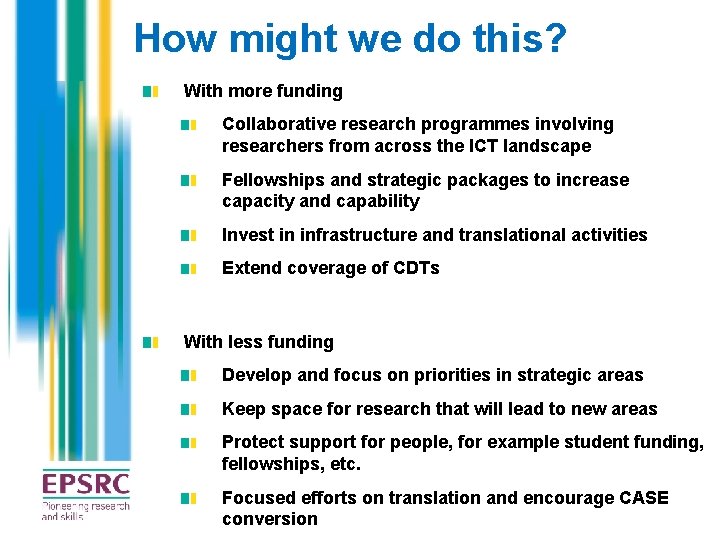
How might we do this? With more funding Collaborative research programmes involving researchers from across the ICT landscape Fellowships and strategic packages to increase capacity and capability Invest in infrastructure and translational activities Extend coverage of CDTs With less funding Develop and focus on priorities in strategic areas Keep space for research that will lead to new areas Protect support for people, for example student funding, fellowships, etc. Focused efforts on translation and encourage CASE conversion
What next?
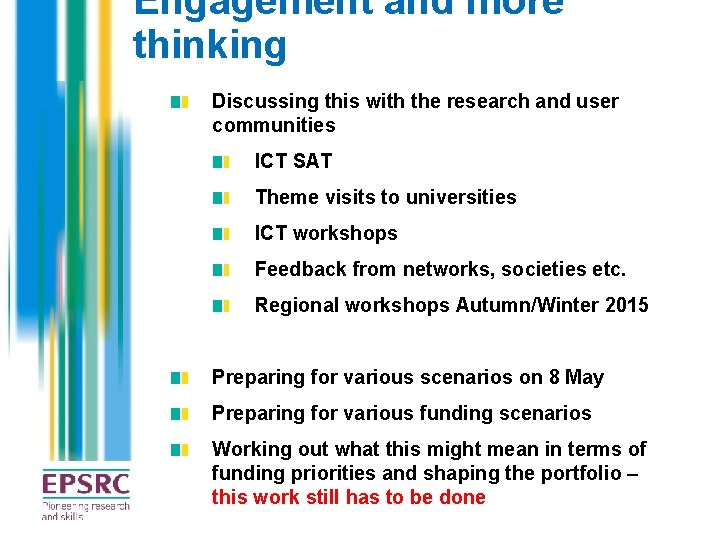
Engagement and more thinking Discussing this with the research and user communities ICT SAT Theme visits to universities ICT workshops Feedback from networks, societies etc. Regional workshops Autumn/Winter 2015 Preparing for various scenarios on 8 May Preparing for various funding scenarios Working out what this might mean in terms of funding priorities and shaping the portfolio – this work still has to be done
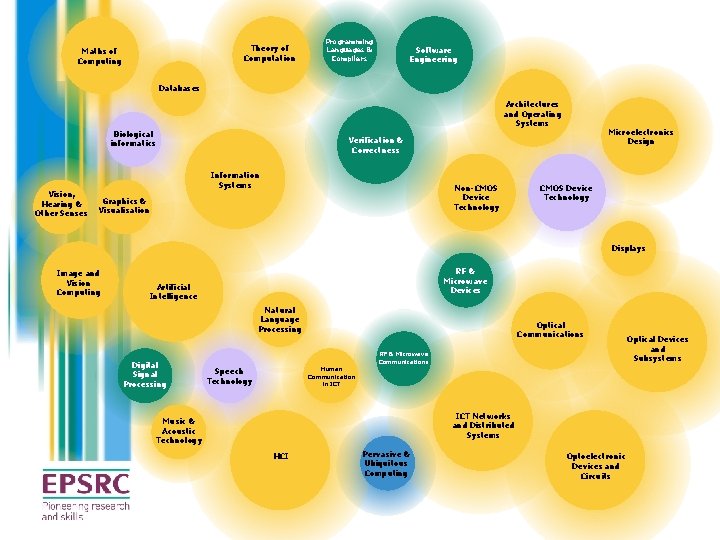
Theory of Computation Maths ofof Computing Programming Languages & Compilers Software Engineering Databases Architectures Operation and Operating Systems Biological informatics Vision, Hearing & Other Senses Microelectronics Design Verification & Correctness Information Systems Non-CMOS Device Technology Graphics & Visualisation CMOS Device Technology Displays Image and Vision Computing RF & Microwave Devices Artificial Intelligence Natural Language Processing Digital Signal Processing Optical Communications RF & Microwave Communications Human Communication in ICT Speech Technology ICT Networks and Distributed Systems Music & Acoustic Technology HCI Pervasive & Ubiquitous Computing Optoelectronic Devices and Circuits Optical Devices and Subsystems
AND Getting the funding settlement we think we should get
Which means Demonstrating the benefit to the UK that: Has been delivered from research and research training that HAS been funded Will, and is being, delivered from research and research training being funded NOW Will arise from research and research training that we will fund in the FUTURE
Thank you for listening! Dr Liam Blackwell ICT Theme Leader Tel: 01793 444217 e-mail: liam. blackwell@epsrc. ac. uk