
Engineering and Applied Science Richard M Murray Chair
- Slides: 14
Engineering and Applied Science Richard M. Murray Chair, Division of Engineering and Applied Science http: //www. eas. caltech. edu/ file: //yukon/murray/isat/uncmgmt-28 feb 01. ppt Wan in Lab, 5 Mar 03 Richard Murray, Caltech
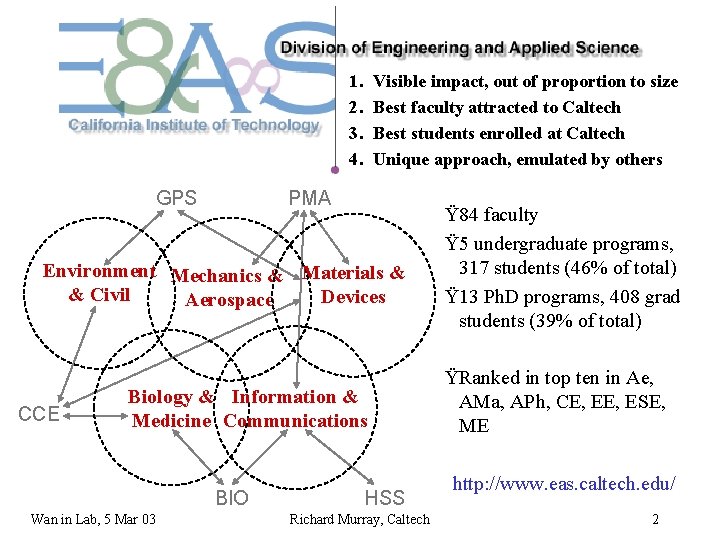
1. 2. 3. 4. GPS Visible impact, out of proportion to size Best faculty attracted to Caltech Best students enrolled at Caltech Unique approach, emulated by others PMA Environment Mechanics & Materials & & Civil Devices Aerospace CCE Biology & Information & Medicine Communications BIO Wan in Lab, 5 Mar 03 HSS Richard Murray, Caltech Ÿ 84 faculty Ÿ 5 undergraduate programs, 317 students (46% of total) Ÿ 13 Ph. D programs, 408 grad students (39% of total) ŸRanked in top ten in Ae, AMa, APh, CE, ESE, ME http: //www. eas. caltech. edu/ 2
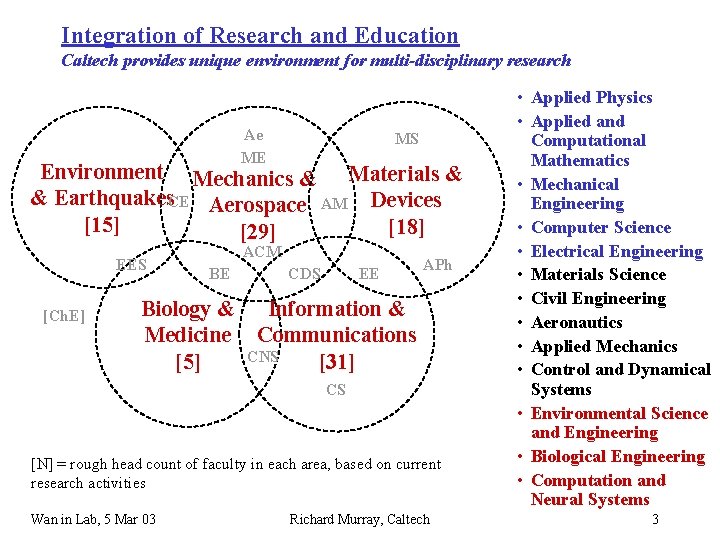
Integration of Research and Education Caltech provides unique environment for multi-disciplinary research Ae ME MS Environment Mechanics & Materials & & Earthquakes. CE Aerospace AM Devices [15] [18] [29] EES [Ch. E] ACM BE CDS EE APh Biology & Information & Medicine Communications CNS [5] [31] CS [N] = rough head count of faculty in each area, based on current research activities Wan in Lab, 5 Mar 03 Richard Murray, Caltech • Applied Physics • Applied and Computational Mathematics • Mechanical Engineering • Computer Science • Electrical Engineering • Materials Science • Civil Engineering • Aeronautics • Applied Mechanics • Control and Dynamical Systems • Environmental Science and Engineering • Biological Engineering • Computation and Neural Systems 3
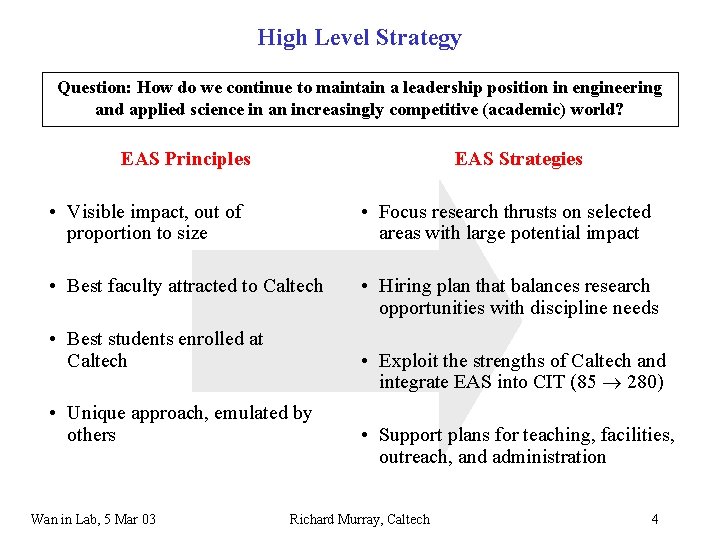
High Level Strategy Question: How do we continue to maintain a leadership position in engineering and applied science in an increasingly competitive (academic) world? EAS Principles EAS Strategies • Visible impact, out of proportion to size • Focus research thrusts on selected areas with large potential impact • Best faculty attracted to Caltech • Hiring plan that balances research opportunities with discipline needs • Best students enrolled at Caltech • Exploit the strengths of Caltech and integrate EAS into CIT (85 280) • Unique approach, emulated by others Wan in Lab, 5 Mar 03 • Support plans for teaching, facilities, outreach, and administration Richard Murray, Caltech 4
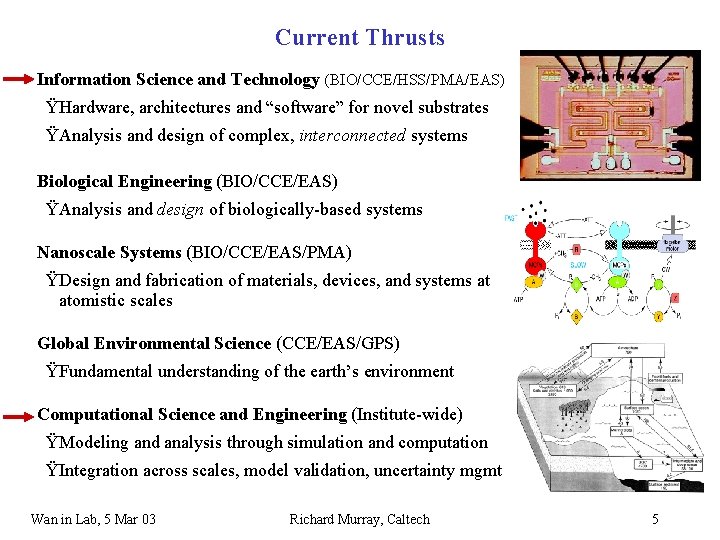
Current Thrusts Information Science and Technology (BIO/CCE/HSS/PMA/EAS) ŸHardware, architectures and “software” for novel substrates ŸAnalysis and design of complex, interconnected systems Biological Engineering (BIO/CCE/EAS) ŸAnalysis and design of biologically-based systems Nanoscale Systems (BIO/CCE/EAS/PMA) ŸDesign and fabrication of materials, devices, and systems at atomistic scales Global Environmental Science (CCE/EAS/GPS) ŸFundamental understanding of the earth’s environment Computational Science and Engineering (Institute-wide) ŸModeling and analysis through simulation and computation ŸIntegration across scales, model validation, uncertainty mgmt Wan in Lab, 5 Mar 03 Richard Murray, Caltech 5
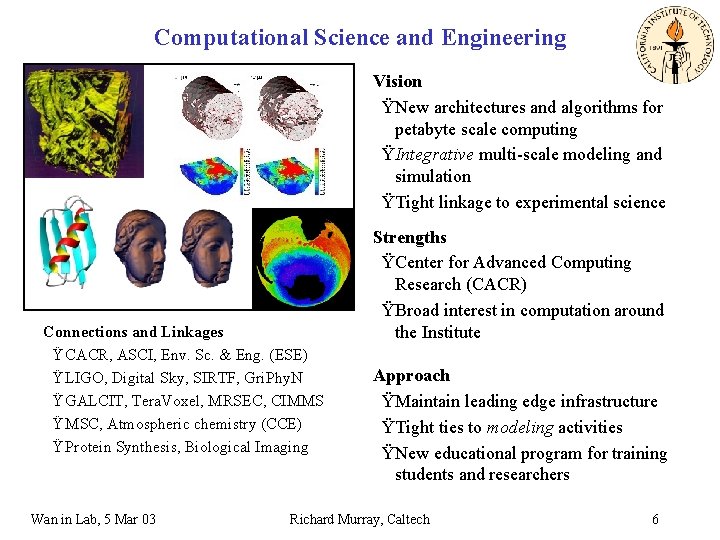
Computational Science and Engineering Vision ŸNew architectures and algorithms for petabyte scale computing ŸIntegrative multi-scale modeling and simulation ŸTight linkage to experimental science Connections and Linkages Ÿ CACR, ASCI, Env. Sc. & Eng. (ESE) Ÿ LIGO, Digital Sky, SIRTF, Gri. Phy. N Ÿ GALCIT, Tera. Voxel, MRSEC, CIMMS Ÿ MSC, Atmospheric chemistry (CCE) Ÿ Protein Synthesis, Biological Imaging Wan in Lab, 5 Mar 03 Strengths ŸCenter for Advanced Computing Research (CACR) ŸBroad interest in computation around the Institute Approach ŸMaintain leading edge infrastructure ŸTight ties to modeling activities ŸNew educational program for training students and researchers Richard Murray, Caltech 6
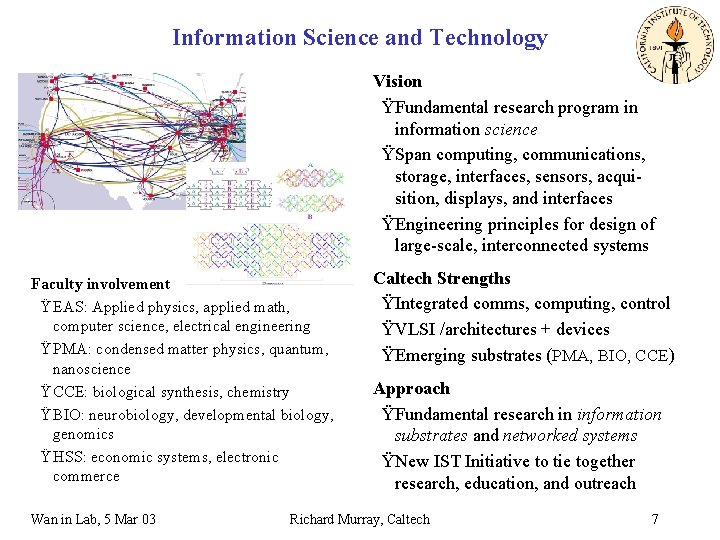
Information Science and Technology Vision ŸFundamental research program in information science ŸSpan computing, communications, storage, interfaces, sensors, acquisition, displays, and interfaces ŸEngineering principles for design of large-scale, interconnected systems Faculty involvement Ÿ EAS: Applied physics, applied math, computer science, electrical engineering Ÿ PMA: condensed matter physics, quantum, nanoscience Ÿ CCE: biological synthesis, chemistry Ÿ BIO: neurobiology, developmental biology, genomics Ÿ HSS: economic systems, electronic commerce Wan in Lab, 5 Mar 03 Caltech Strengths ŸIntegrated comms, computing, control ŸVLSI /architectures + devices ŸEmerging substrates (PMA, BIO, CCE) Approach ŸFundamental research in information substrates and networked systems ŸNew IST Initiative to tie together research, education, and outreach Richard Murray, Caltech 7
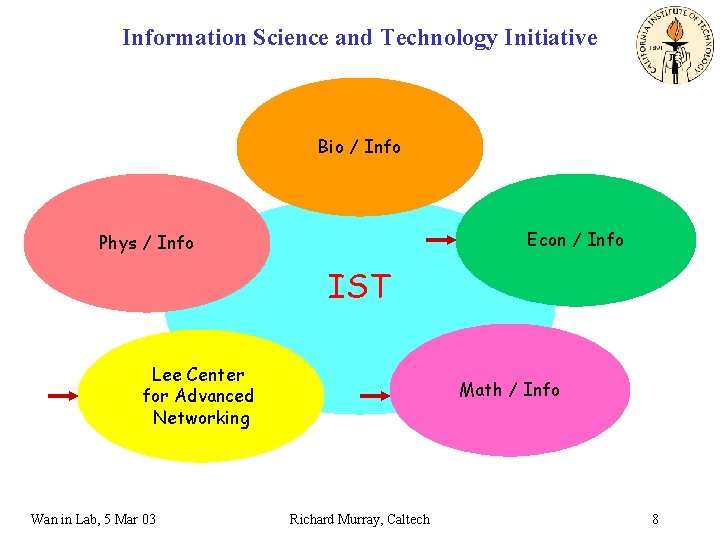
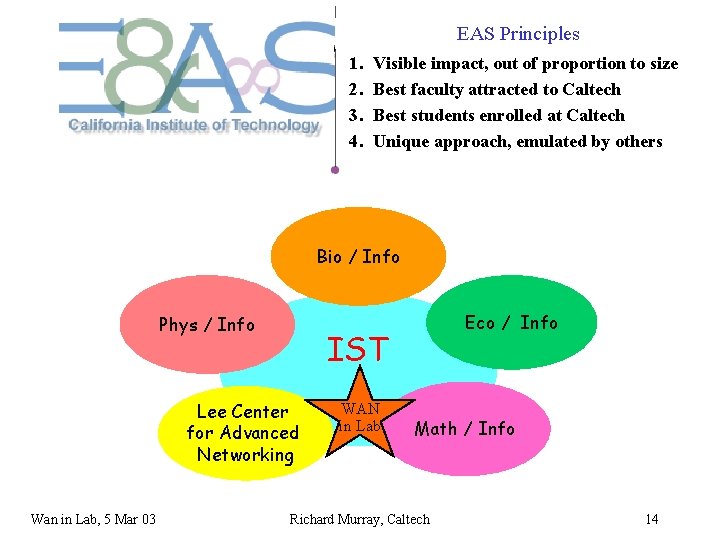
Information Science and Technology Initiative Bio / Info Econ / Info Phys / Info IST Lee Center for Advanced Networking Wan in Lab, 5 Mar 03 Math / Info Richard Murray, Caltech 8
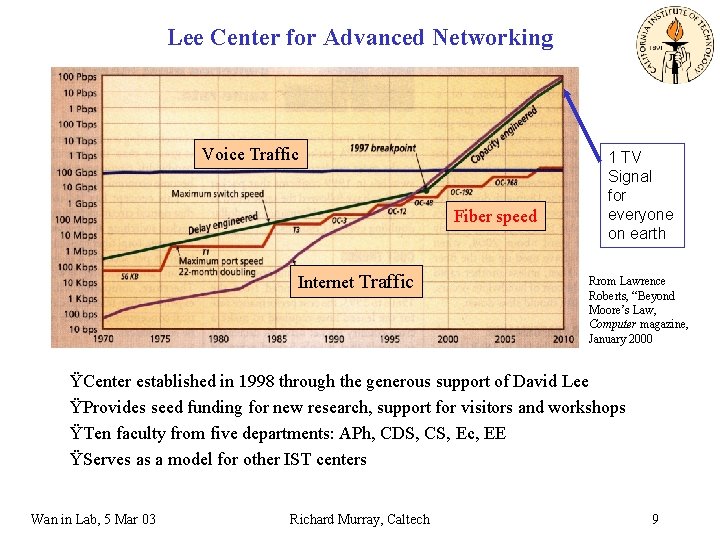
Lee Center for Advanced Networking Voice Traffic Fiber speed Internet Traffic 1 TV Signal for everyone on earth Rrom Lawrence Roberts, “Beyond Moore’s Law, Computer magazine, January 2000 ŸCenter established in 1998 through the generous support of David Lee ŸProvides seed funding for new research, support for visitors and workshops ŸTen faculty from five departments: APh, CDS, CS, Ec, EE ŸServes as a model for other IST centers Wan in Lab, 5 Mar 03 Richard Murray, Caltech 9
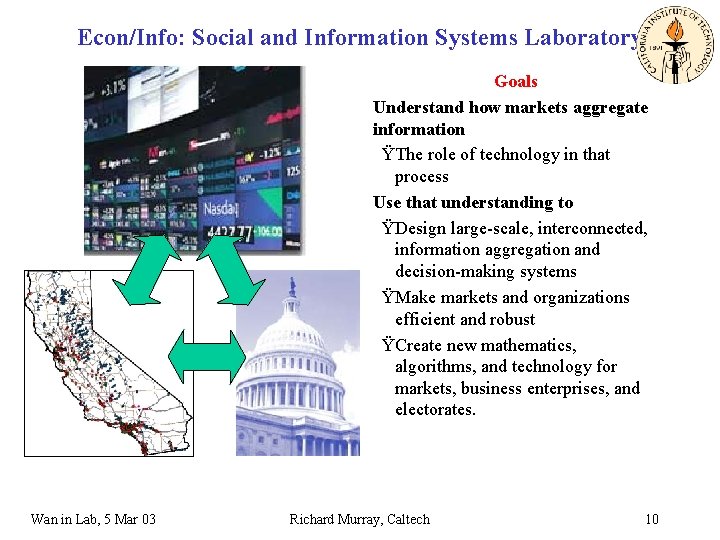
Econ/Info: Social and Information Systems Laboratory Goals Understand how markets aggregate information ŸThe role of technology in that process Use that understanding to ŸDesign large-scale, interconnected, information aggregation and decision-making systems ŸMake markets and organizations efficient and robust ŸCreate new mathematics, algorithms, and technology for markets, business enterprises, and electorates. Wan in Lab, 5 Mar 03 Richard Murray, Caltech 10
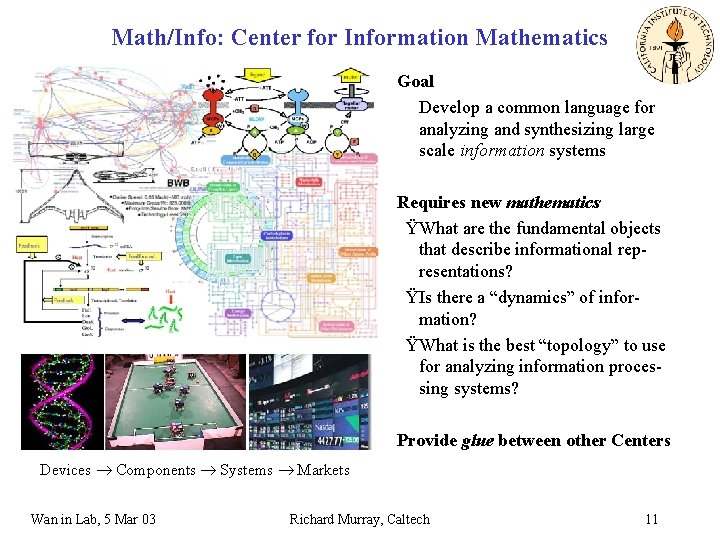
Math/Info: Center for Information Mathematics Goal Develop a common language for analyzing and synthesizing large scale information systems Requires new mathematics ŸWhat are the fundamental objects that describe informational representations? ŸIs there a “dynamics” of information? ŸWhat is the best “topology” to use for analyzing information processing systems? Provide glue between other Centers Devices Components Systems Markets Wan in Lab, 5 Mar 03 Richard Murray, Caltech 11
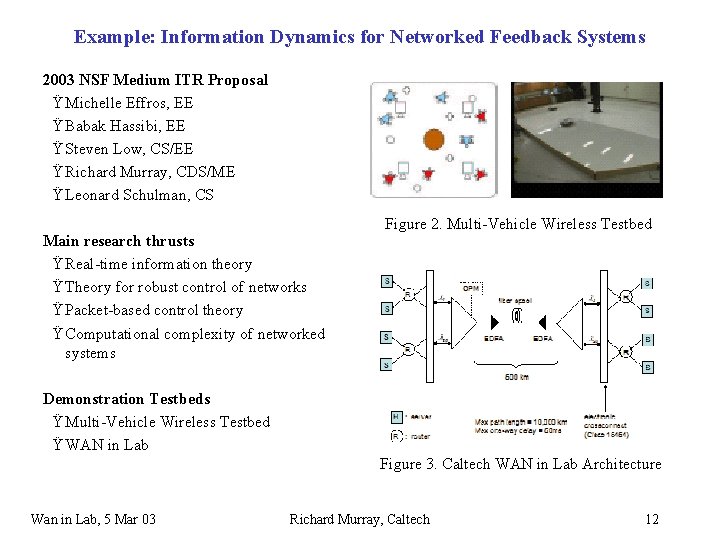
Example: Information Dynamics for Networked Feedback Systems 2003 NSF Medium ITR Proposal Ÿ Michelle Effros, EE Ÿ Babak Hassibi, EE Ÿ Steven Low, CS/EE Ÿ Richard Murray, CDS/ME Ÿ Leonard Schulman, CS Main research thrusts Ÿ Real-time information theory Ÿ Theory for robust control of networks Ÿ Packet-based control theory Ÿ Computational complexity of networked systems Figure 2. Multi-Vehicle Wireless Testbed Demonstration Testbeds Ÿ Multi-Vehicle Wireless Testbed Ÿ WAN in Lab Figure 3. Caltech WAN in Lab Architecture Wan in Lab, 5 Mar 03 Richard Murray, Caltech 12
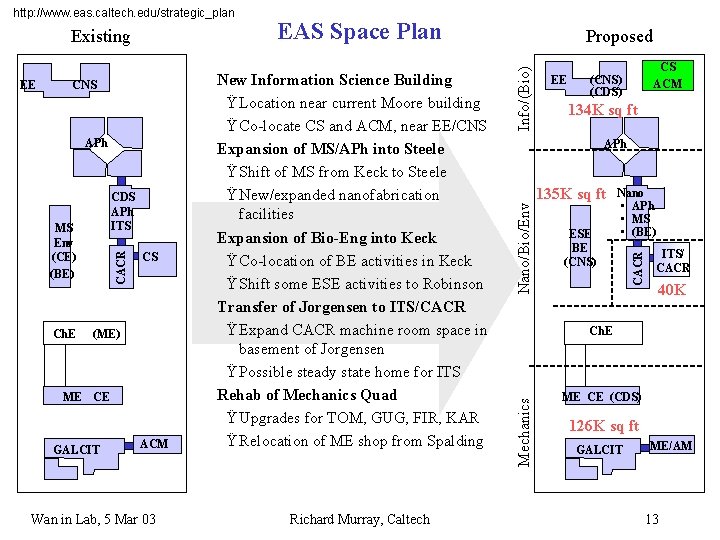
APh CDS APh ITS Ch. E CACR MS Env (CE) (BE) CS (ME) ME CE GALCIT ACM Wan in Lab, 5 Mar 03 New Information Science Building Ÿ Location near current Moore building Ÿ Co-locate CS and ACM, near EE/CNS Expansion of MS/APh into Steele Ÿ Shift of MS from Keck to Steele Ÿ New/expanded nanofabrication facilities Expansion of Bio-Eng into Keck Ÿ Co-location of BE activities in Keck Ÿ Shift some ESE activities to Robinson Transfer of Jorgensen to ITS/CACR Ÿ Expand CACR machine room space in basement of Jorgensen Ÿ Possible steady state home for ITS Rehab of Mechanics Quad Ÿ Upgrades for TOM, GUG, FIR, KAR Ÿ Relocation of ME shop from Spalding Richard Murray, Caltech EE CS ACM (CNS) (CDS) 134 K sq ft APh 135 K sq ft ESE BE (CNS) Nano • APh • MS • (BE) CACR CNS Proposed Info/(Bio) EE EAS Space Plan Nano/Bio/Env Existing ITS/ CACR 40 K Ch. E Mechanics http: //www. eas. caltech. edu/strategic_plan ME CE (CDS) 126 K sq ft GALCIT ME/AM 13
EAS Principles 1. 2. 3. 4. Visible impact, out of proportion to size Best faculty attracted to Caltech Best students enrolled at Caltech Unique approach, emulated by others Bio / Info Phys / Info IST Lee Center for Advanced Networking Wan in Lab, 5 Mar 03 Eco / Info WAN in Lab Math / Info Richard Murray, Caltech 14