
Engineering Alloys 307 Lecture 10 Hexagonal Materials David
- Slides: 21
Engineering Alloys (307) Lecture 10 Hexagonal Materials David Dye Department of Materials, Imperial College Royal School of Mines, Prince Consort Road, London SW 7 2 BP, UK +44 (207) 594 -6811, david. dye@imperial. ac. uk © Imperial College London
Synopsis 2 © Imperial College London • Hexagonal Materials: axial ratios: deformation systems • Effect of Al on twin/slip secondary deformation modes in α-Ti. • Zr: Zircaloy and Zr-2. 5 Nb. Nuclear Applications. Similarity with Ti. ω Phase in Zr. • Be: Properties and uses. Health hazards. Processing • Mg: die casting alloy. Mg sheet. Expansion of use of Mg in the auto industry. Extraction and supply issues. Alloys.
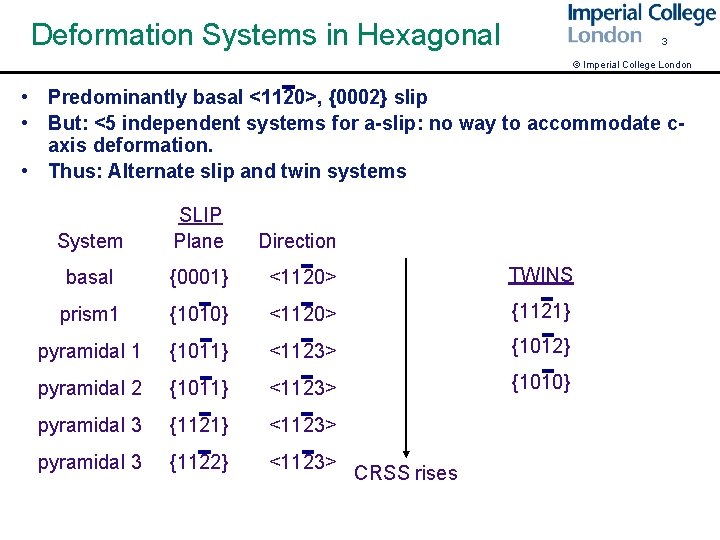
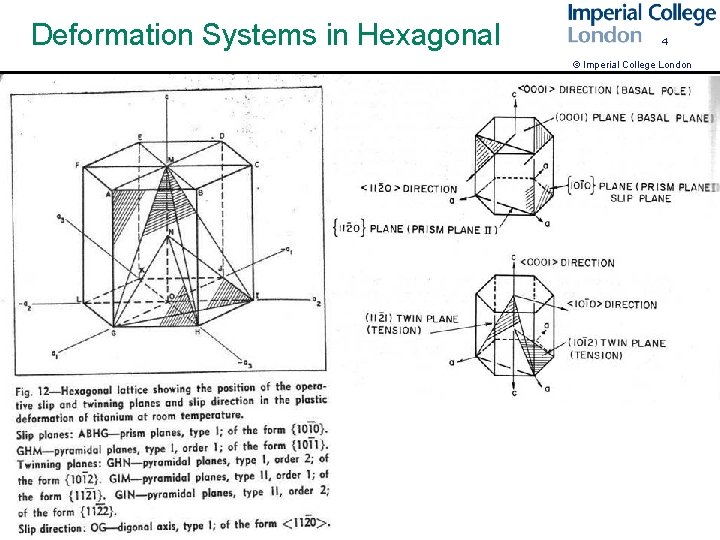
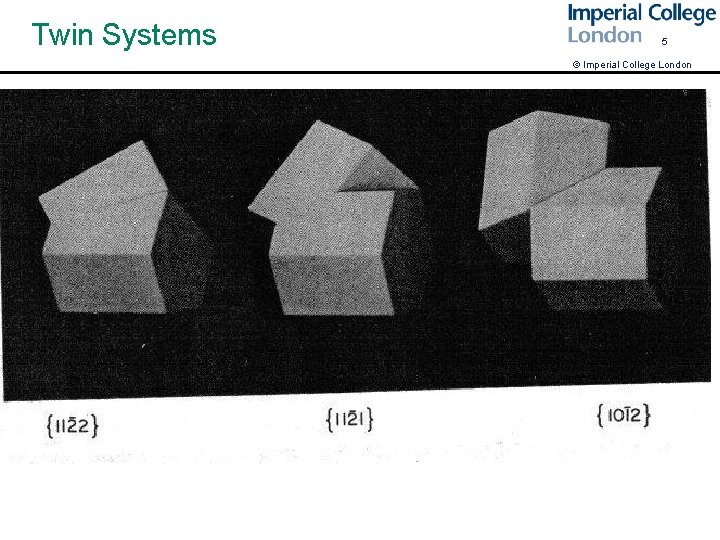
Deformation Systems in Hexagonal 3 © Imperial College London • Predominantly basal <1120>, {0002} slip • But: <5 independent systems for a-slip: no way to accommodate caxis deformation. • Thus: Alternate slip and twin systems System SLIP Plane Direction basal {0001} <1120> TWINS prism 1 {1010} <1120> {1121} pyramidal 1 {1011} <1123> {1012} pyramidal 2 {1011} <1123> {1010} pyramidal 3 {1121} <1123> pyramidal 3 {1122} <1123> CRSS rises
Deformation Systems in Hexagonal 4 © Imperial College London
Twin Systems 5 © Imperial College London
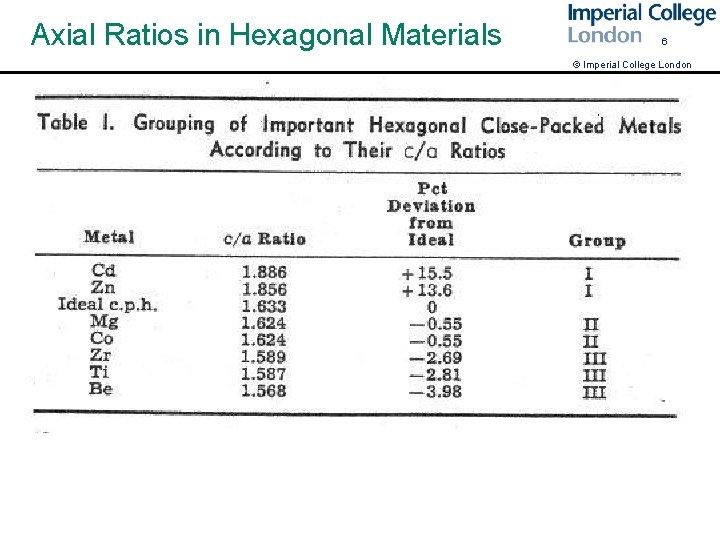
Axial Ratios in Hexagonal Materials 6 © Imperial College London
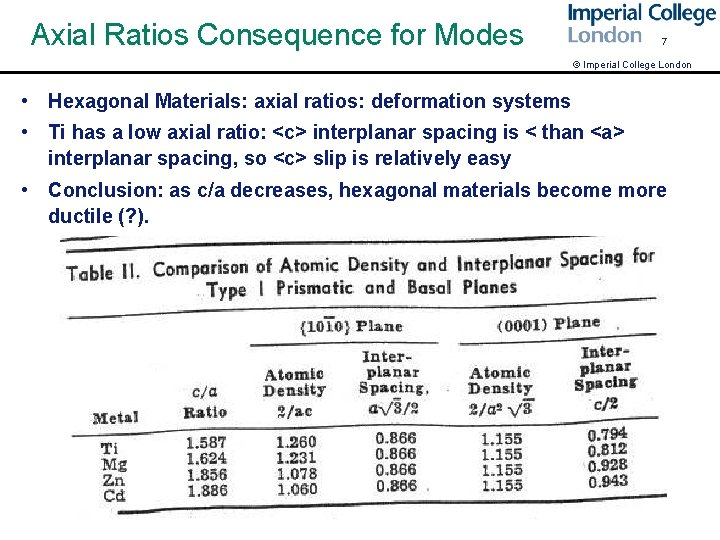
Axial Ratios Consequence for Modes 7 © Imperial College London • Hexagonal Materials: axial ratios: deformation systems • Ti has a low axial ratio: <c> interplanar spacing is < than <a> interplanar spacing, so <c> slip is relatively easy • Conclusion: as c/a decreases, hexagonal materials become more ductile (? ).
Effect of Alloying: example in Ti 8 © Imperial College London • Ti: usually deforms by prism <a> slip • Effect of Al is to increase favourability of slip of twinning • Also increases strength by Solid Solution strengthening • Increasing Al content also promotes basal slip over prism slip
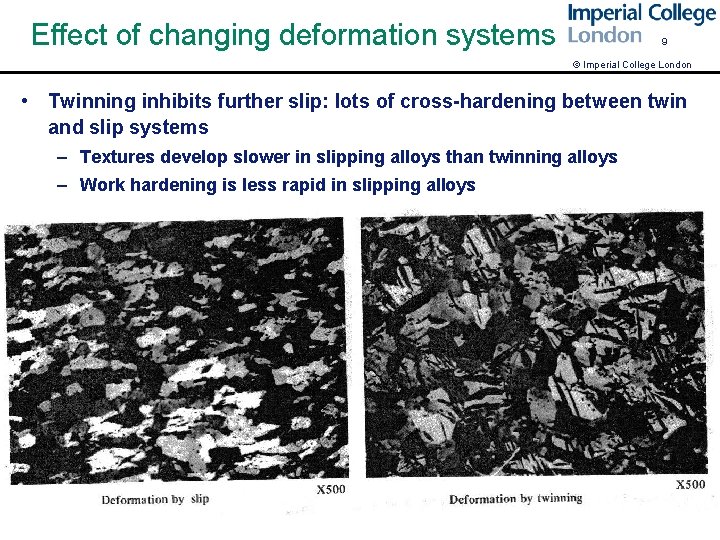
Effect of changing deformation systems 9 © Imperial College London • Twinning inhibits further slip: lots of cross-hardening between twin and slip systems – Textures develop slower in slipping alloys than twinning alloys – Work hardening is less rapid in slipping alloys
Zirconium 10 © Imperial College London • Two main alloys: Zircaloy and Zr-2. 5 Nb • Poor neutron adsorber (good elastic scatterer): used as a fuel can material and for CANDU pressure tubes • Creep resistance of Zr-2. 5 Nb is good up to ~330 C when extruded • Creep ductility of Zircaloy is high: use as fuel can
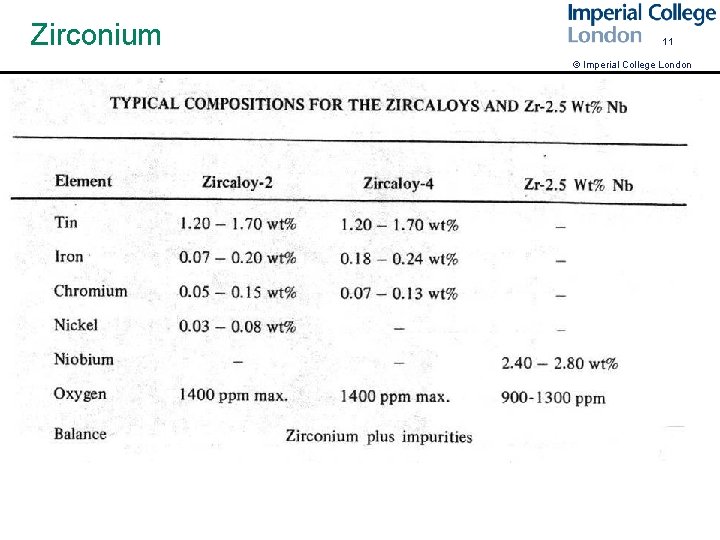
Zirconium 11 © Imperial College London
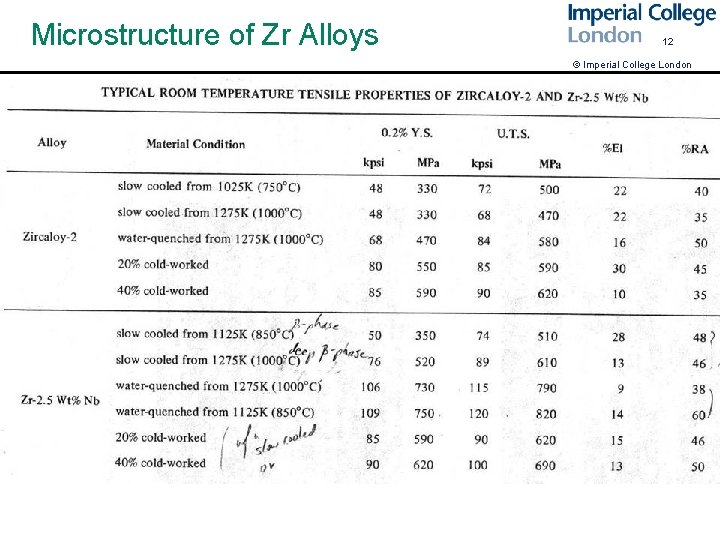
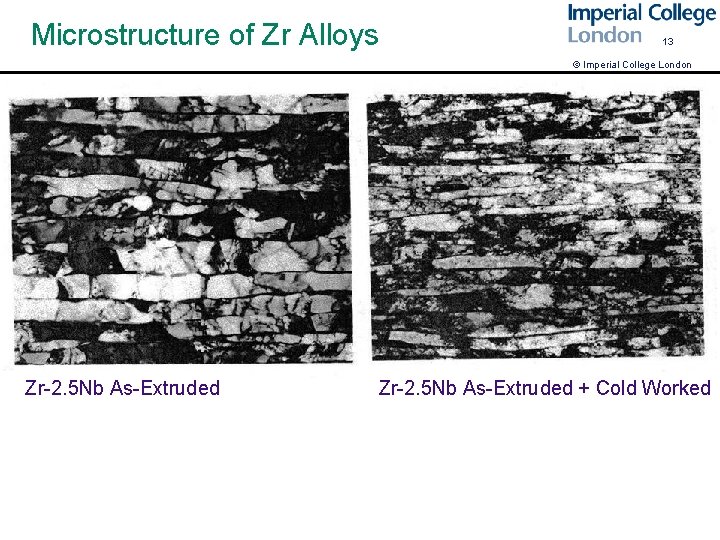
Microstructure of Zr Alloys 12 © Imperial College London
Microstructure of Zr Alloys 13 © Imperial College London Zr-2. 5 Nb As-Extruded + Cold Worked
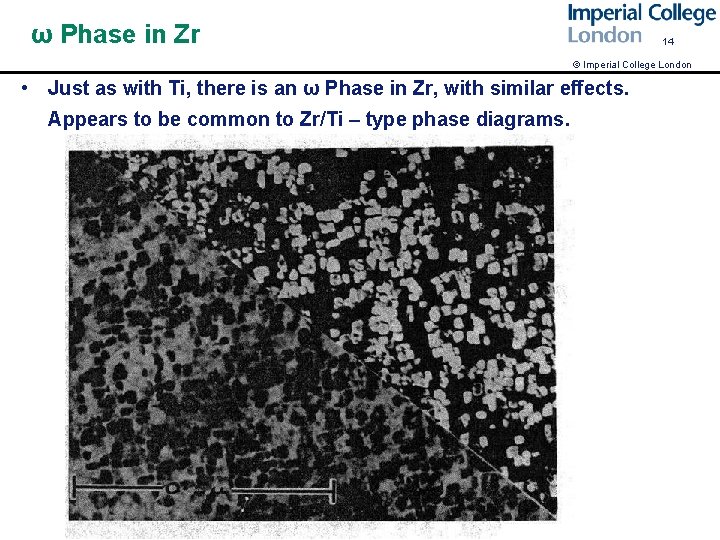
ω Phase in Zr 14 © Imperial College London • Just as with Ti, there is an ω Phase in Zr, with similar effects. Appears to be common to Zr/Ti – type phase diagrams.
Be 15 © Imperial College London • Almost 0 adsorbtion cross section, almost 0 inelastic scattering, high elastic scattering cross section: used as a neutron reflector • Problem of Berylyosis: asbestosis-like disease affecting ~1% of the population when exposed to Be dust • Very O-affinitive: use attriding rather than plasma spraying to produce powder (avoidance of ~100 nm oxide layer)
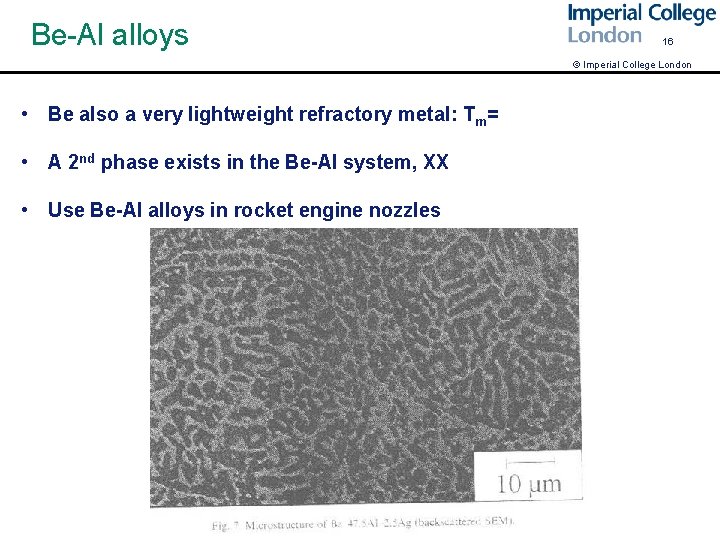
Be-Al alloys 16 © Imperial College London • Be also a very lightweight refractory metal: Tm= • A 2 nd phase exists in the Be-Al system, XX • Use Be-Al alloys in rocket engine nozzles
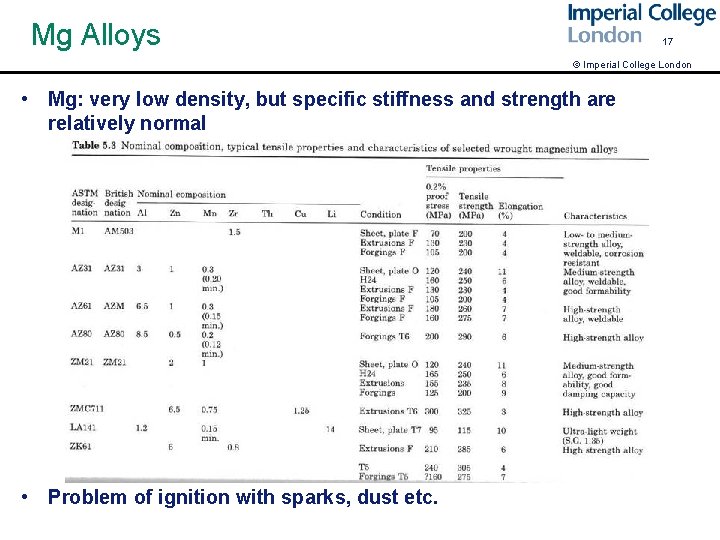
Mg Alloys 17 © Imperial College London • Mg: very low density, but specific stiffness and strength are relatively normal • Problem of ignition with sparks, dust etc.
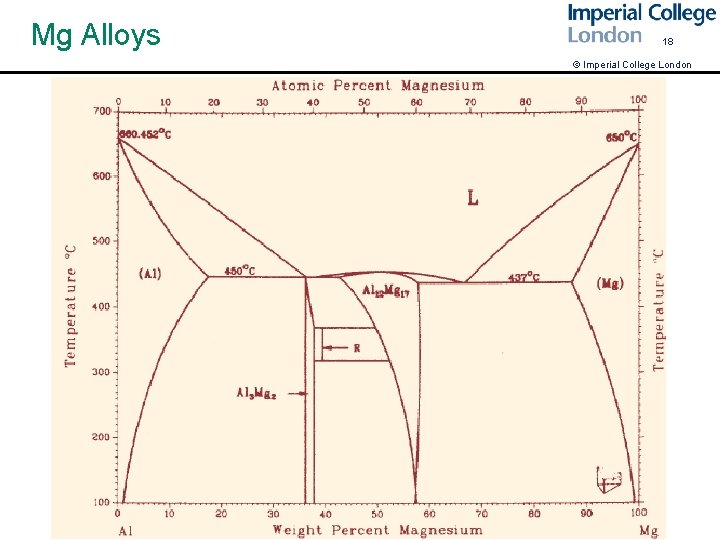
Mg Alloys 18 © Imperial College London
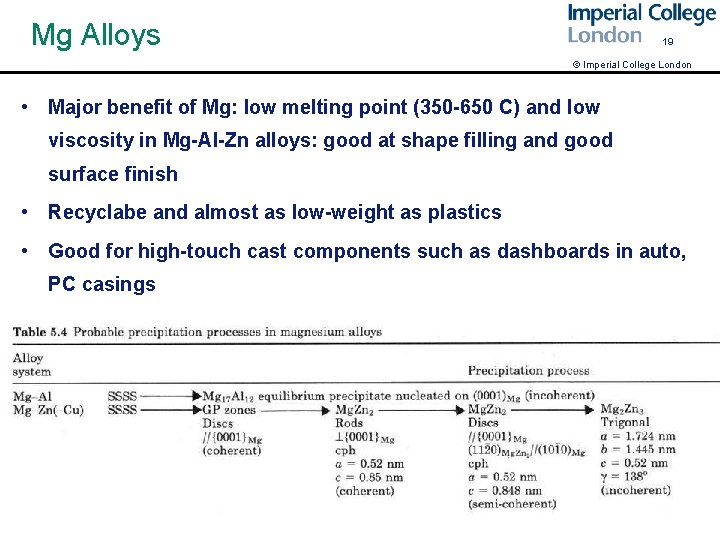
Mg Alloys 19 © Imperial College London • Major benefit of Mg: low melting point (350 -650 C) and low viscosity in Mg-Al-Zn alloys: good at shape filling and good surface finish • Recyclabe and almost as low-weight as plastics • Good for high-touch cast components such as dashboards in auto, PC casings
World Mg supplies 20 © Imperial College London • Currently rapidly increasing demand for Mg • … but if new mines open, they cannot recoup their cost of capital (current prices too low to justify investment) • … if prices rise, demand will not come through (auto very costsensitive) • … and Chinese production is ramping up, but does not meet quality / trace element requirements • … dilemma! Uncertain as to what will occur
Synopsis 21 © Imperial College London • Hexagonal Materials: axial ratios: deformation systems • Effect of Al, O on twin/slip secondary deformation modes in α-Ti. • Zr: Zircaloy and Zr-2. 5 Nb. Nuclear Applications. Similarity with Ti. ω Phase in Zr. • Be: Properties and uses. Health hazards. Processing • Mg: die casting alloy. Mg sheet. Expansion of use of Mg in the auto industry. Extraction and supply issues. Alloys.