
Engine Parameters www thecartech com 1 VC Gasket
- Slides: 26
Engine Parameters www. thecartech. com 1
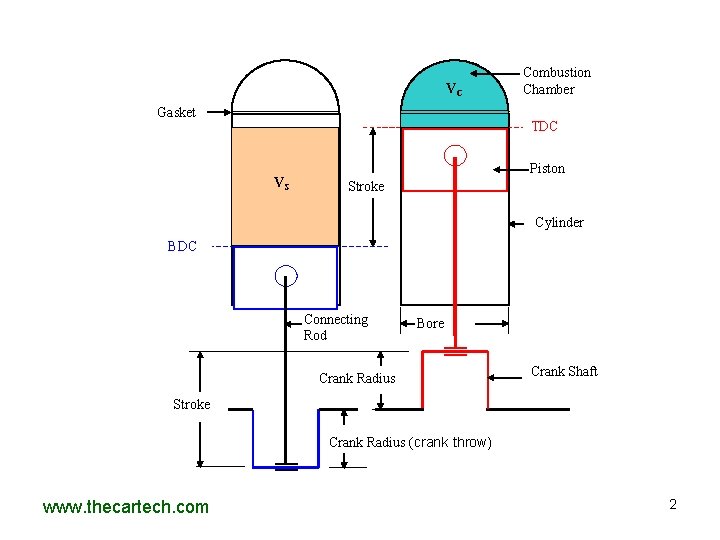
VC Gasket Combustion Chamber TDC VS Piston Stroke Cylinder BDC Connecting Rod Bore Crank Radius Crank Shaft Stroke Crank Radius (crank throw) www. thecartech. com 2
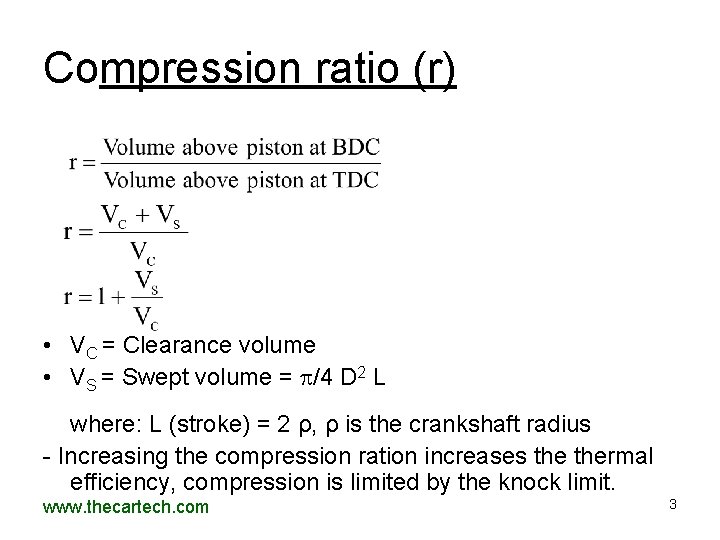
Compression ratio (r) • VC = Clearance volume • VS = Swept volume = /4 D 2 L where: L (stroke) = 2 ρ, ρ is the crankshaft radius - Increasing the compression ration increases thermal efficiency, compression is limited by the knock limit. www. thecartech. com 3
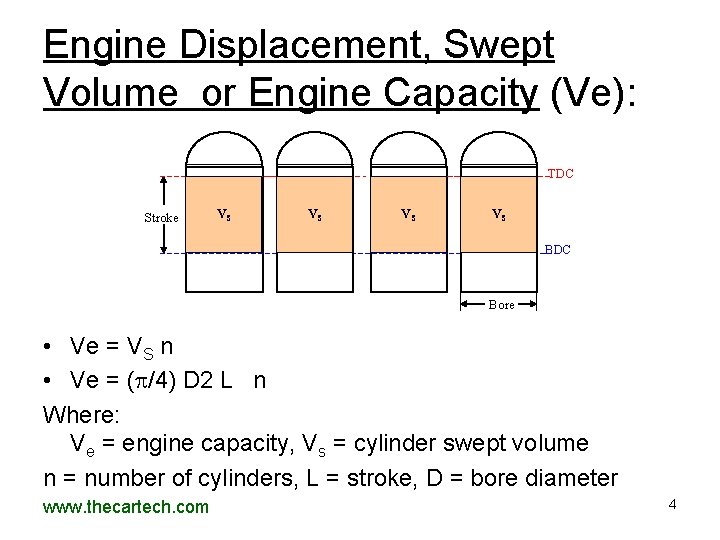
Engine Displacement, Swept Volume or Engine Capacity (Ve): TDC Stroke VS VS BDC Bore • Ve = VS n • Ve = ( /4) D 2 L n Where: Ve = engine capacity, Vs = cylinder swept volume n = number of cylinders, L = stroke, D = bore diameter www. thecartech. com 4
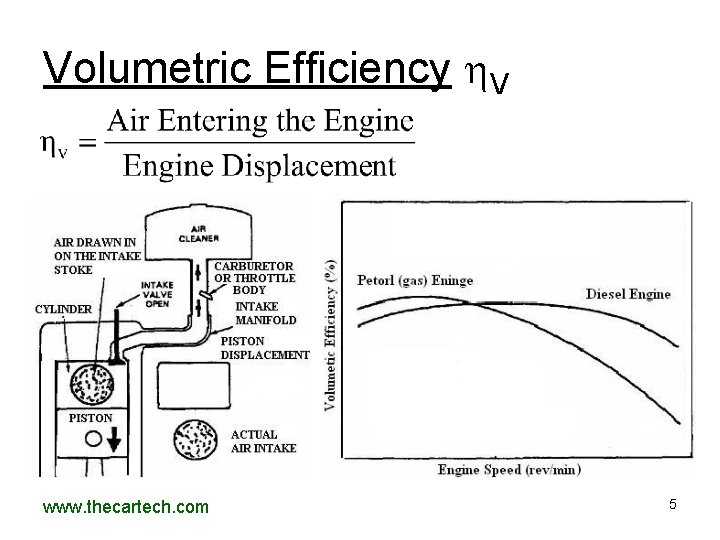
Volumetric Efficiency V www. thecartech. com 5
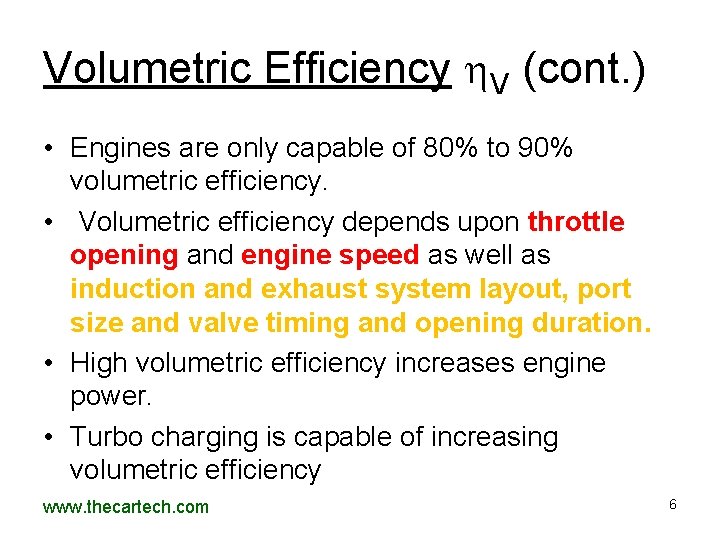
Volumetric Efficiency V (cont. ) • Engines are only capable of 80% to 90% volumetric efficiency. • Volumetric efficiency depends upon throttle opening and engine speed as well as induction and exhaust system layout, port size and valve timing and opening duration. • High volumetric efficiency increases engine power. • Turbo charging is capable of increasing volumetric efficiency www. thecartech. com 6
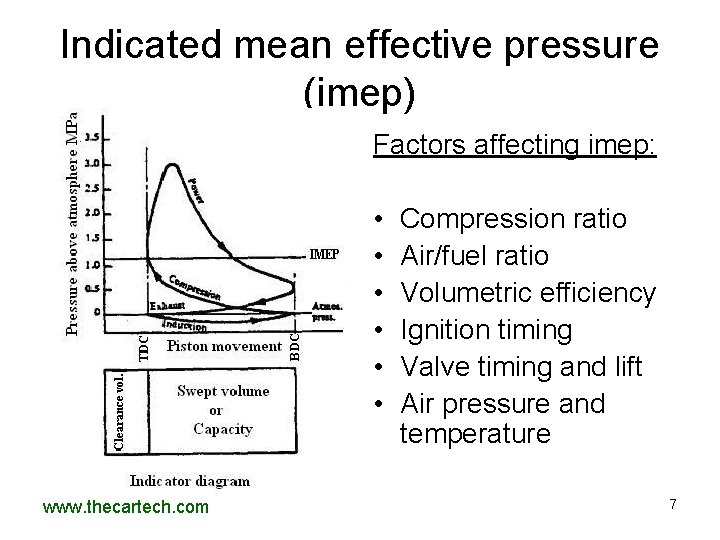
Indicated mean effective pressure (imep) Factors affecting imep: • • • www. thecartech. com Compression ratio Air/fuel ratio Volumetric efficiency Ignition timing Valve timing and lift Air pressure and temperature 7
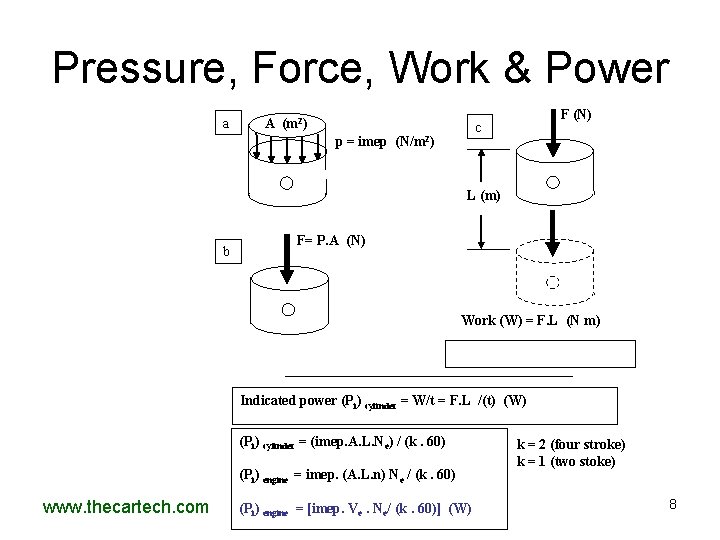
Pressure, Force, Work & Power a A (m 2) F (N) c p = imep (N/m 2) L (m) b F= P. A (N) Work (W) = F. L (N m) Indicated power (Pi) cylinder = W/t = F. L /(t) (W) (Pi) cylinder = (imep. A. L. Ne) / (k. 60) (Pi) engine = imep. (A. L. n) Ne / (k. 60) www. thecartech. com (Pi) engine = [imep. Ve. Ne/ (k. 60)] (W) k = 2 (four stroke) k = 1 (two stoke) 8
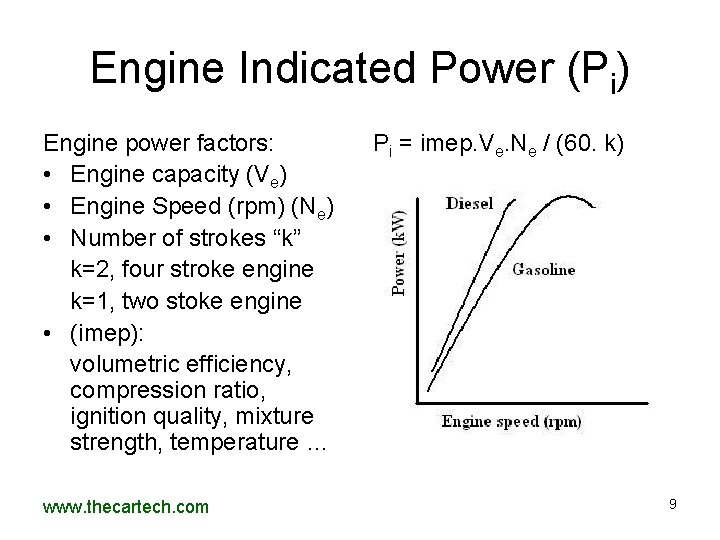
Engine Indicated Power (Pi) Engine power factors: • Engine capacity (Ve) • Engine Speed (rpm) (Ne) • Number of strokes “k” k=2, four stroke engine k=1, two stoke engine • (imep): volumetric efficiency, compression ratio, ignition quality, mixture strength, temperature … www. thecartech. com Pi = imep. Ve. Ne / (60. k) 9
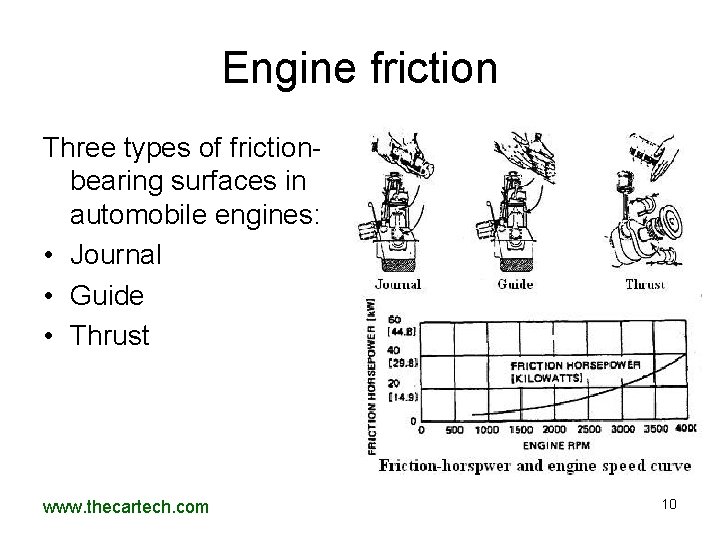
Engine friction Three types of frictionbearing surfaces in automobile engines: • Journal • Guide • Thrust www. thecartech. com 10
Engine Brake Power (Pb) -This is the power developed at the crankshaft or flywheel. -The term brake originated from the method used to determine an engine’s power output by measuring the torque using some form of friction dynamometer. www. thecartech. com 11
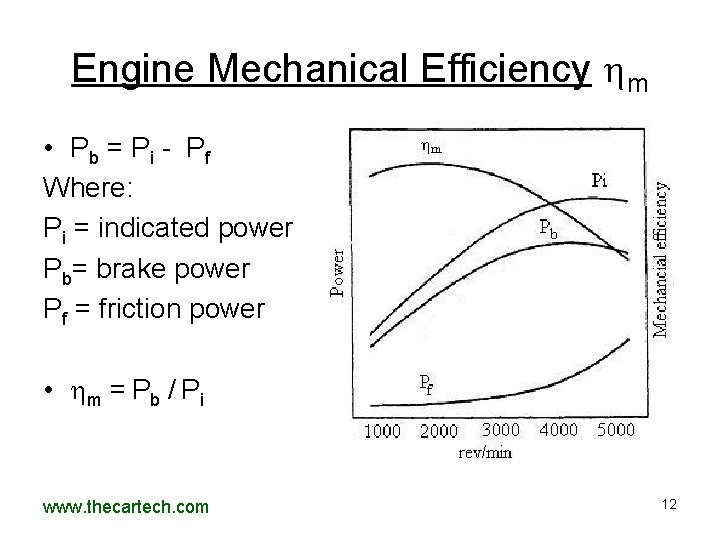
Engine Mechanical Efficiency m • Pb = P i - P f Where: Pi = indicated power Pb= brake power Pf = friction power • m = P b / P i www. thecartech. com 12
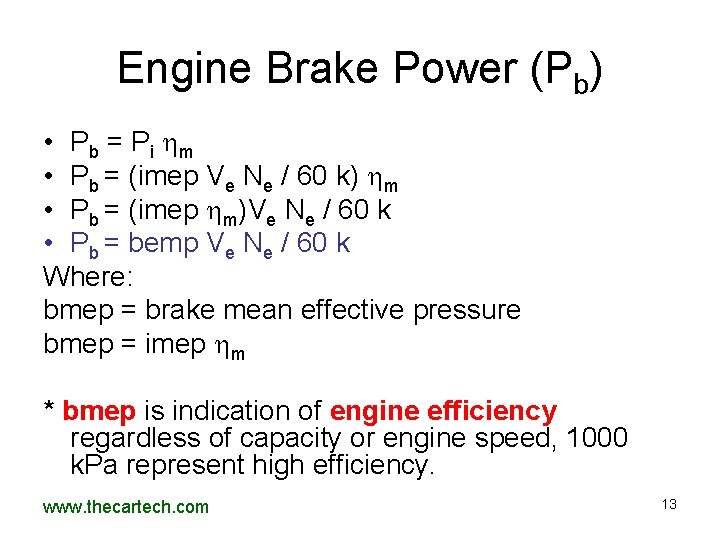
Engine Brake Power (Pb) • P b = P i m • Pb = (imep Ve Ne / 60 k) m • Pb = (imep m)Ve Ne / 60 k • Pb = bemp Ve Ne / 60 k Where: bmep = brake mean effective pressure bmep = imep m * bmep is indication of engine efficiency regardless of capacity or engine speed, 1000 k. Pa represent high efficiency. www. thecartech. com 13
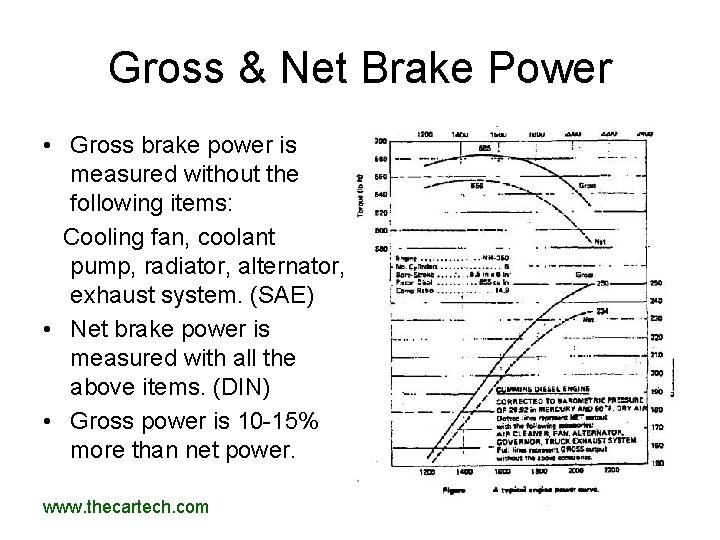
Gross & Net Brake Power • Gross brake power is measured without the following items: Cooling fan, coolant pump, radiator, alternator, exhaust system. (SAE) • Net brake power is measured with all the above items. (DIN) • Gross power is 10 -15% more than net power. www. thecartech. com 14
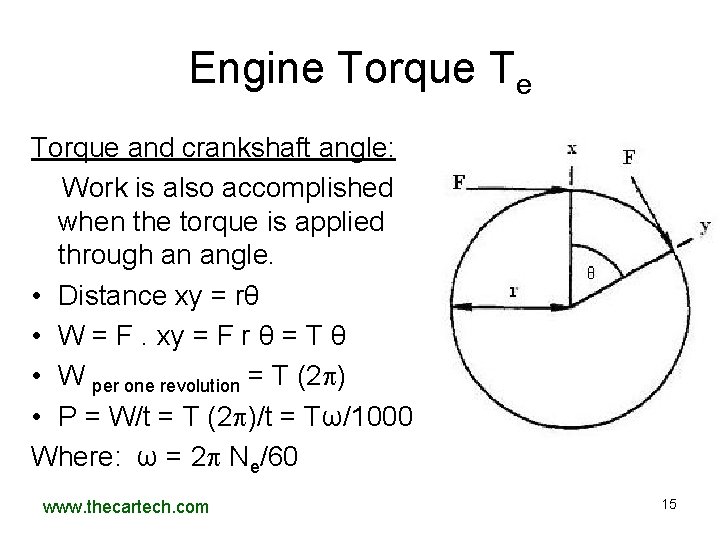
Engine Torque Te Torque and crankshaft angle: Work is also accomplished when the torque is applied through an angle. • Distance xy = rθ • W = F. xy = F r θ = T θ • W per one revolution = T (2 ) • P = W/t = T (2 )/t = Tω/1000 Where: ω = 2 Ne/60 www. thecartech. com 15
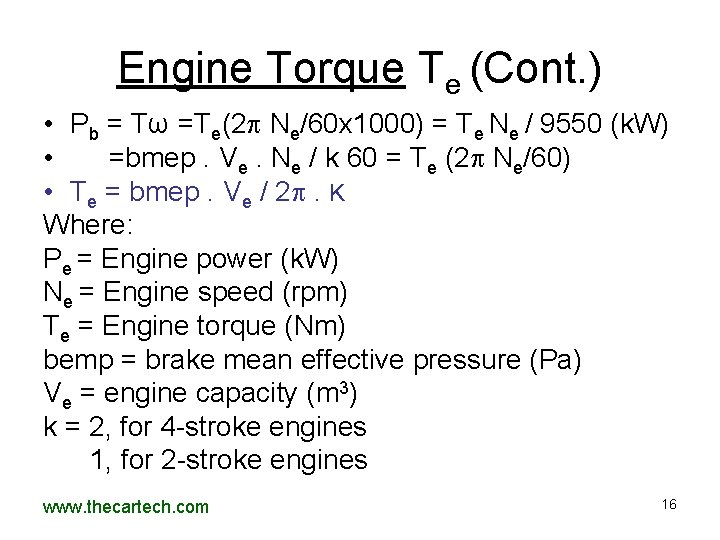
Engine Torque Te (Cont. ) • Pb = Tω =Te(2 Ne/60 x 1000) = Te Ne / 9550 (k. W) • =bmep. Ve. Ne / k 60 = Te (2 Ne/60) • Te = bmep. Ve / 2 . K Where: Pe = Engine power (k. W) Ne = Engine speed (rpm) Te = Engine torque (Nm) bemp = brake mean effective pressure (Pa) Ve = engine capacity (m 3) k = 2, for 4 -stroke engines 1, for 2 -stroke engines www. thecartech. com 16
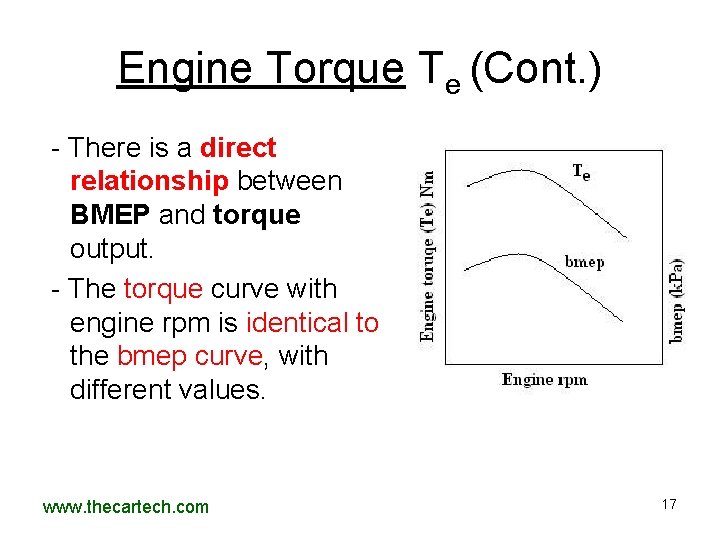
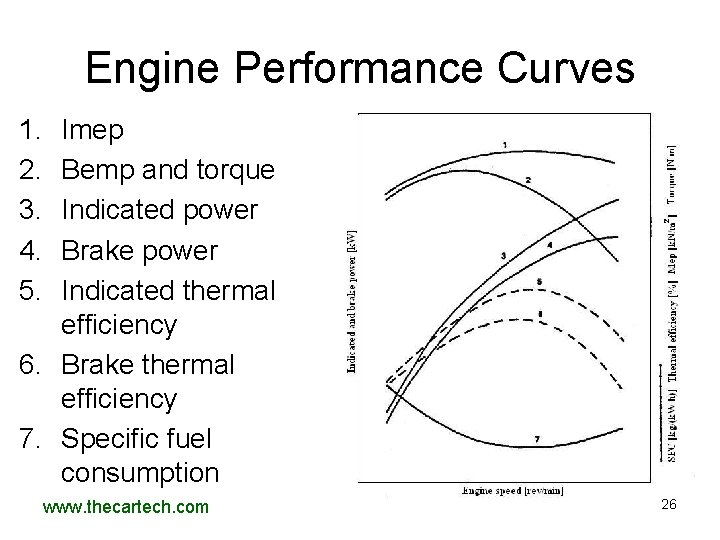
Engine Torque Te (Cont. ) - There is a direct relationship between BMEP and torque output. - The torque curve with engine rpm is identical to the bmep curve, with different values. www. thecartech. com 17
Engine Fuel consumption (FC) The amount of fuel an engine consumes can be measured by: • volume (cm 3 or liter) per (sec. or mint, or hr) or • mass (kg) per (sec, or mint, or hr). www. thecartech. com 18
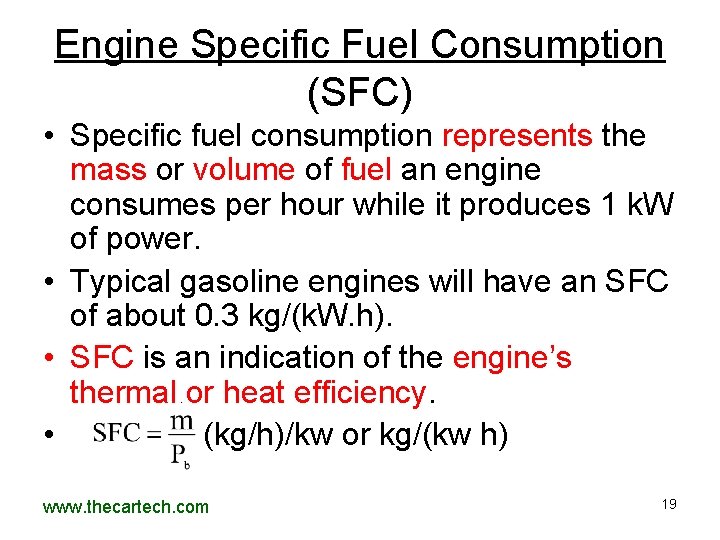
Engine Specific Fuel Consumption (SFC) • Specific fuel consumption represents the mass or volume of fuel an engine consumes per hour while it produces 1 k. W of power. • Typical gasoline engines will have an SFC of about 0. 3 kg/(k. W. h). • SFC is an indication of the engine’s thermal or heat efficiency. • (kg/h)/kw or kg/(kw h) www. thecartech. com 19
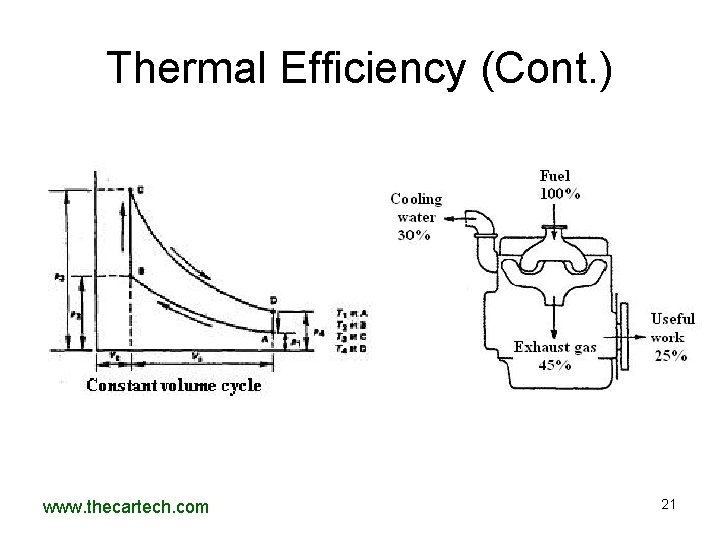
Engine Thermal Efficiency ( th) • The efficiency of an engine in converting the heat energy contained in the liquid fuel into mechanical energy is termed its thermal efficiency. • The petrol engine is particularly inefficient and at its best may reach 25% efficiency. • The thermal efficiency of a diesel engine can reach 35% due to its higher compression ratio. www. thecartech. com 20
Thermal Efficiency (Cont. ) www. thecartech. com 21
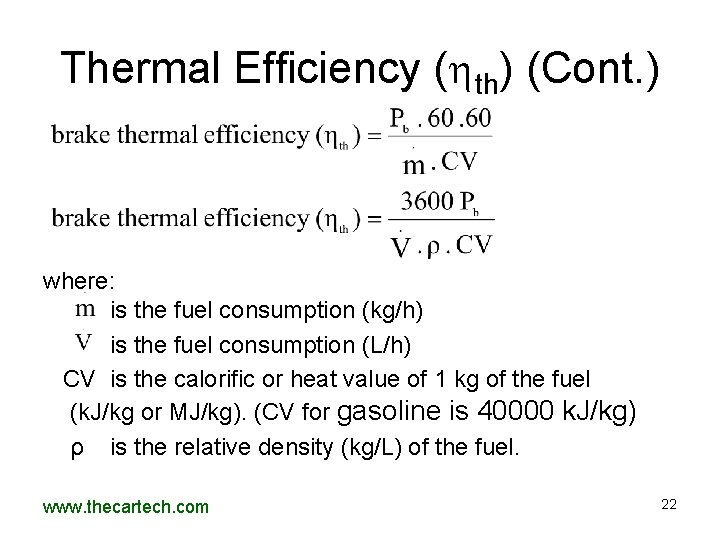
Thermal Efficiency ( th) (Cont. ) where: is the fuel consumption (kg/h) is the fuel consumption (L/h) CV is the calorific or heat value of 1 kg of the fuel (k. J/kg or MJ/kg). (CV for gasoline is 40000 k. J/kg) ρ is the relative density (kg/L) of the fuel. www. thecartech. com 22
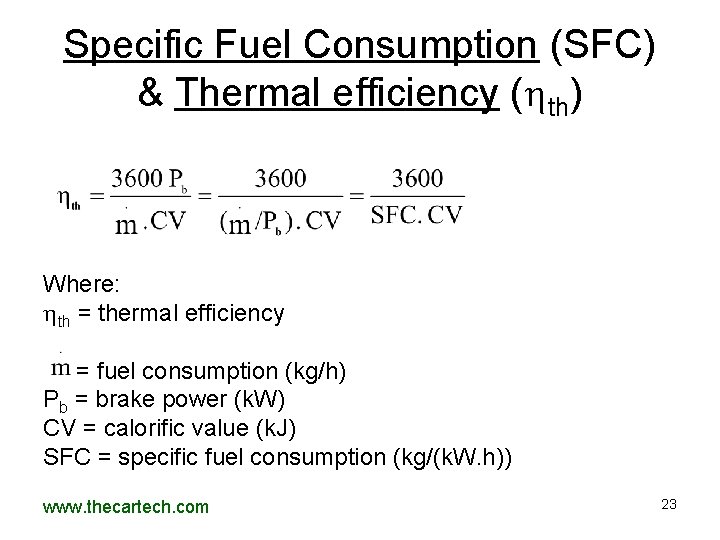
Specific Fuel Consumption (SFC) & Thermal efficiency ( th) Where: th = thermal efficiency = fuel consumption (kg/h) Pb = brake power (k. W) CV = calorific value (k. J) SFC = specific fuel consumption (kg/(k. W. h)) www. thecartech. com 23
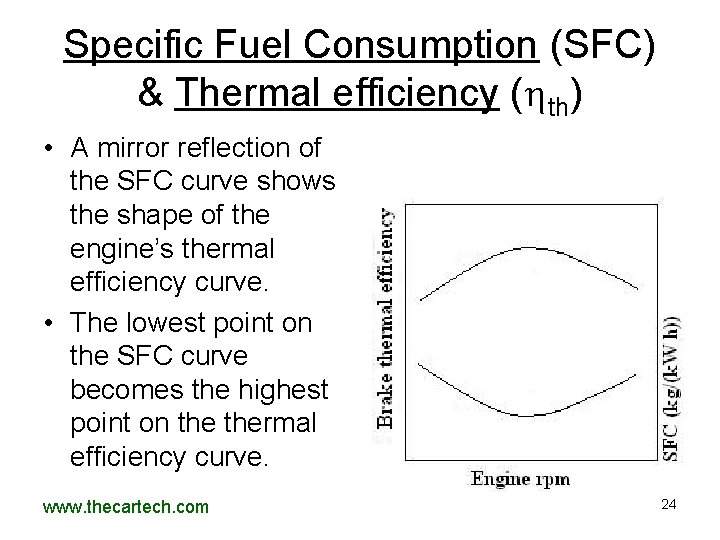
Specific Fuel Consumption (SFC) & Thermal efficiency ( th) • A mirror reflection of the SFC curve shows the shape of the engine’s thermal efficiency curve. • The lowest point on the SFC curve becomes the highest point on thermal efficiency curve. www. thecartech. com 24
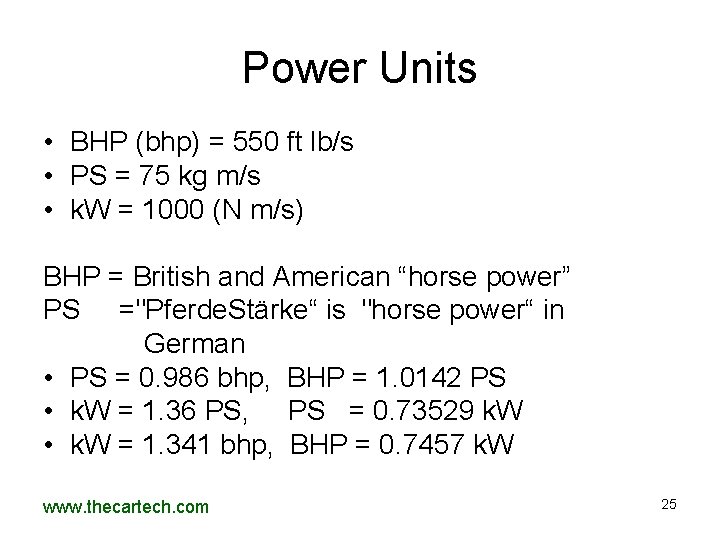
Power Units • BHP (bhp) = 550 ft lb/s • PS = 75 kg m/s • k. W = 1000 (N m/s) BHP = British and American “horse power” PS ="Pferde. Stärke“ is "horse power“ in German • PS = 0. 986 bhp, BHP = 1. 0142 PS • k. W = 1. 36 PS, PS = 0. 73529 k. W • k. W = 1. 341 bhp, BHP = 0. 7457 k. W www. thecartech. com 25
Engine Performance Curves 1. 2. 3. 4. 5. Imep Bemp and torque Indicated power Brake power Indicated thermal efficiency 6. Brake thermal efficiency 7. Specific fuel consumption www. thecartech. com 26