
Engine friction and lubrication Dr Primal Fernando primaleng
Engine friction and lubrication Dr. Primal Fernando primal@eng. fsu. edu Ph: (081) 2393608 1
Background • Friction work is varies 10% at full load to 100% at idle (no load) • Good engine design has lower frictional loss • Large part of frictional losses appear as heat and removed in the oil cooler and radiator systems, thus influence the size of the cooling system. • Friction work = Work delivered to the piston while the working fluid is contained within (compression and expansion stroke) - usable work delivered to the drive shaft 2
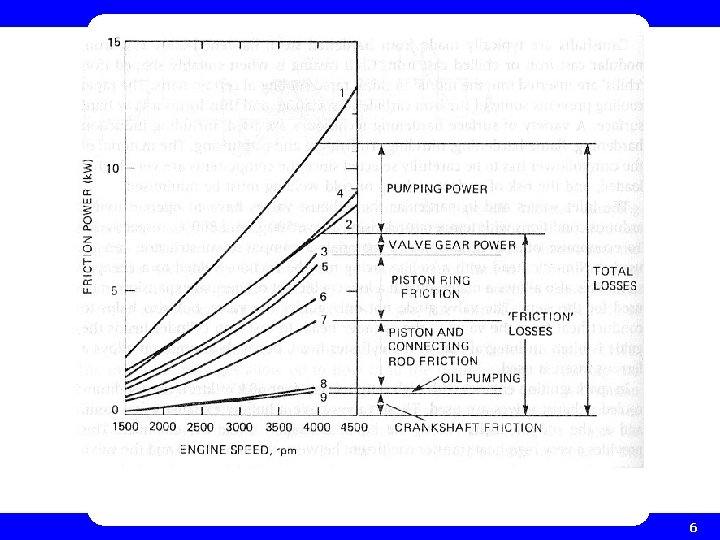
Work dissipated as heat • Pumping work (Wp): to draw the fresh mixture to the cylinder and to expel the burn gas from the cylinder • To overcome the resistance to relative motion (rubbing friction work- Wrf): friction between piston rings, piston skirt, and cylinder wall; friction in the wrist pin, big end, crankshaft and camshaft bearings; friction in the valve mechanism; friction in the gears, or pulleys and belts • To drive the engine accessories (accessory work-Wa): fan, water pump, oil pump, fuel pump, the generator, secondary air pump for emission control, power-steering pump, and air-conditioner Note: the absolute value of friction work varies with load, and increases as speed increases Wtf= Wp+ Wrf+ Wa 3
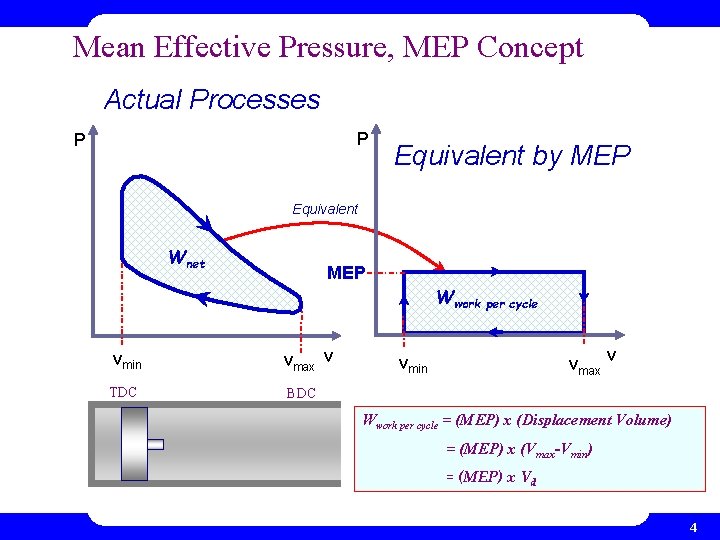
Mean Effective Pressure, MEP Concept Actual Processes P P Equivalent by MEP Equivalent Wnet MEP Wwork per cycle vmin TDC vmax v vmin BDC Wwork per cycle = (MEP) x (Displacement Volume) = (MEP) x (Vmax-Vmin) = (MEP) x Vd 4
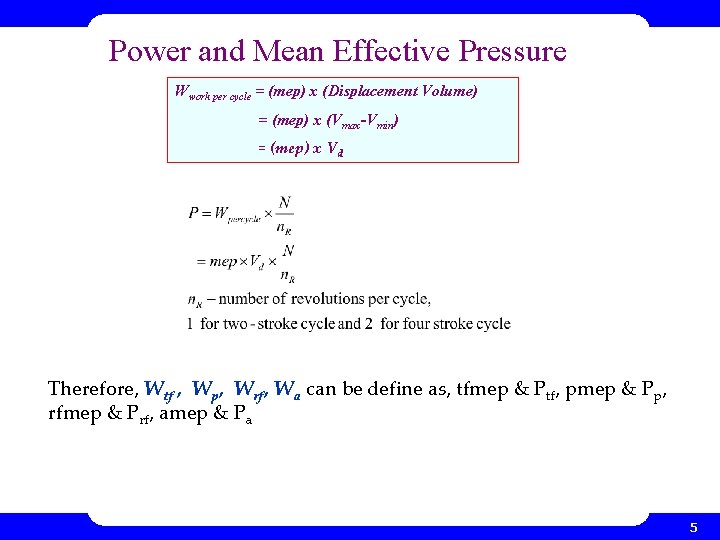
Power and Mean Effective Pressure Wwork per cycle = (mep) x (Displacement Volume) = (mep) x (Vmax-Vmin) = (mep) x Vd Therefore, Wtf , Wp, Wrf, Wa can be define as, tfmep & Ptf, pmep & Pp, rfmep & Prf, amep & Pa 5
6
Frictional losses can be classified in to two groups depending on dissipation 1. Friction between two metals in relative motion, with a lubricant in between 2. Turbulent dissipation-part of the total friction work is spent in pumping fluids through flow restrictions P v 2. 7
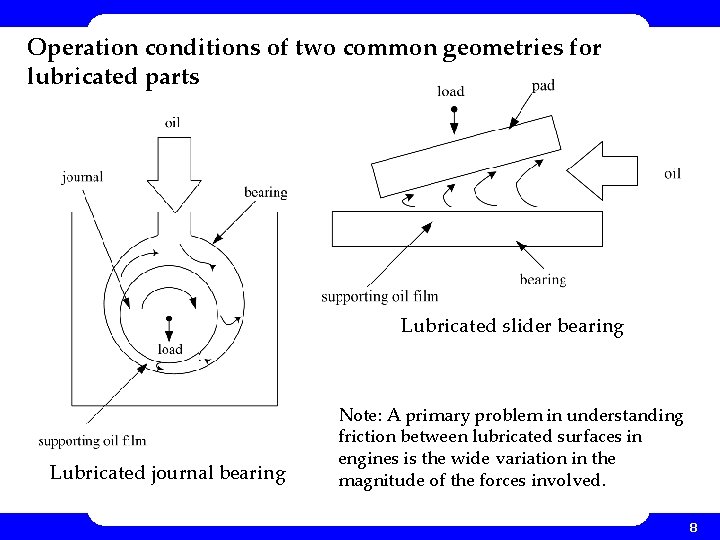
Operation conditions of two common geometries for lubricated parts Lubricated slider bearing Lubricated journal bearing Note: A primary problem in understanding friction between lubricated surfaces in engines is the wide variation in the magnitude of the forces involved. 8
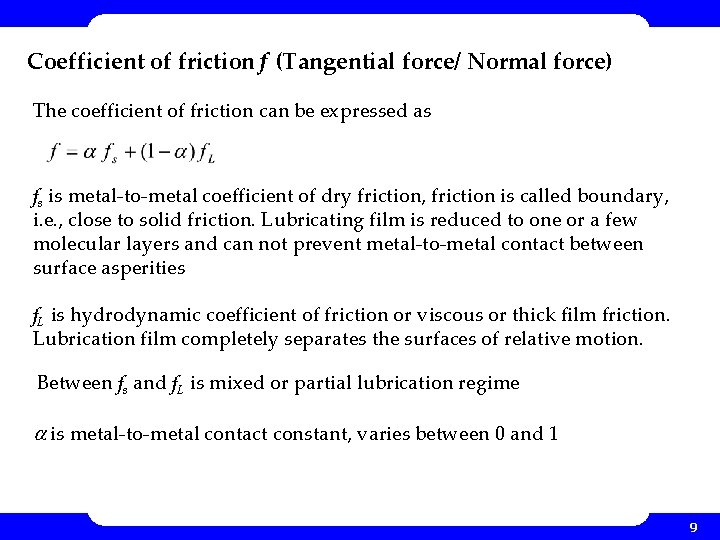
Coefficient of friction f (Tangential force/ Normal force) The coefficient of friction can be expressed as fs is metal-to-metal coefficient of dry friction, friction is called boundary, i. e. , close to solid friction. Lubricating film is reduced to one or a few molecular layers and can not prevent metal-to-metal contact between surface asperities f. L is hydrodynamic coefficient of friction or viscous or thick film friction. Lubrication film completely separates the surfaces of relative motion. Between fs and f. L is mixed or partial lubrication regime is metal-to-metal contact constant, varies between 0 and 1 9
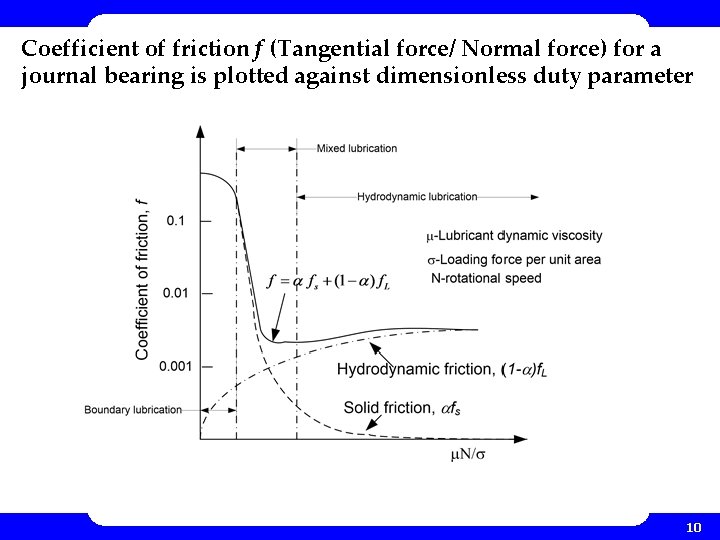
Coefficient of friction f (Tangential force/ Normal force) for a journal bearing is plotted against dimensionless duty parameter 10
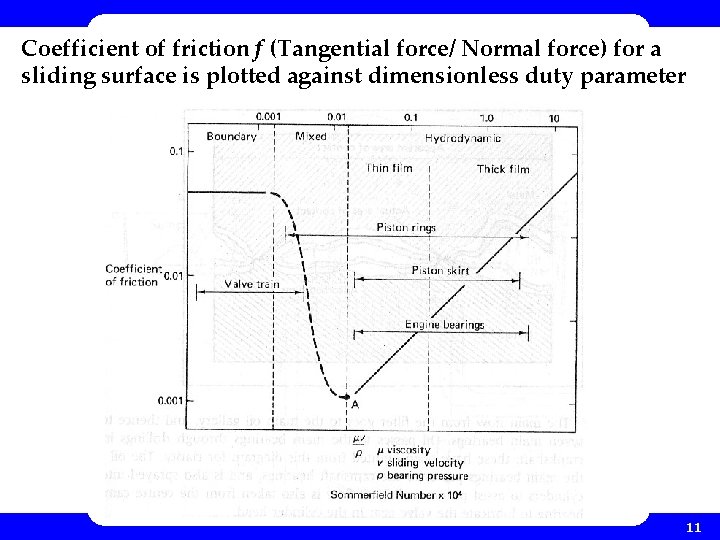
Coefficient of friction f (Tangential force/ Normal force) for a sliding surface is plotted against dimensionless duty parameter 11
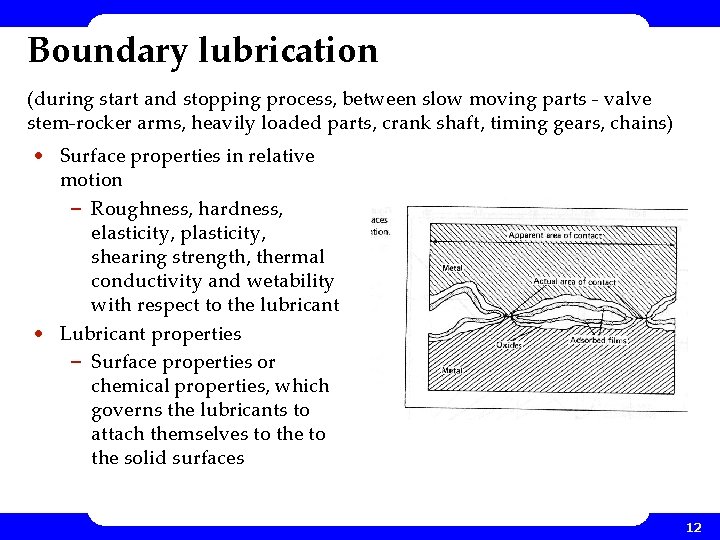
Boundary lubrication (during start and stopping process, between slow moving parts - valve stem-rocker arms, heavily loaded parts, crank shaft, timing gears, chains) • Surface properties in relative motion – Roughness, hardness, elasticity, plasticity, shearing strength, thermal conductivity and wetability with respect to the lubricant • Lubricant properties – Surface properties or chemical properties, which governs the lubricants to attach themselves to the solid surfaces 12
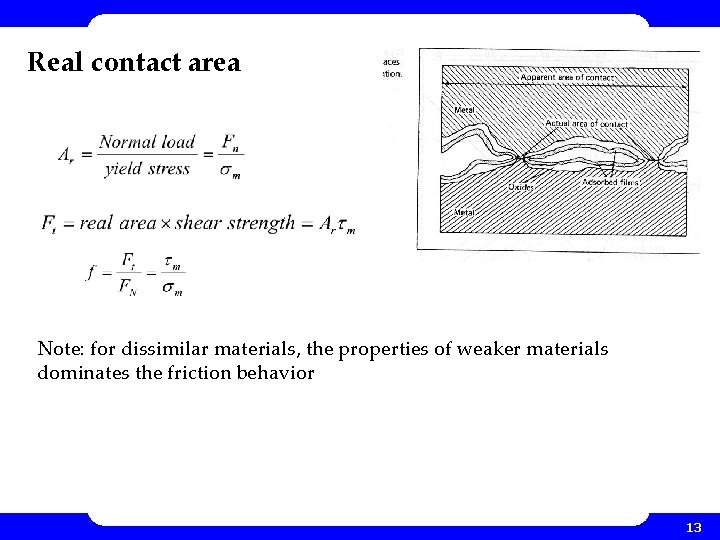
Real contact area Note: for dissimilar materials, the properties of weaker materials dominates the friction behavior 13
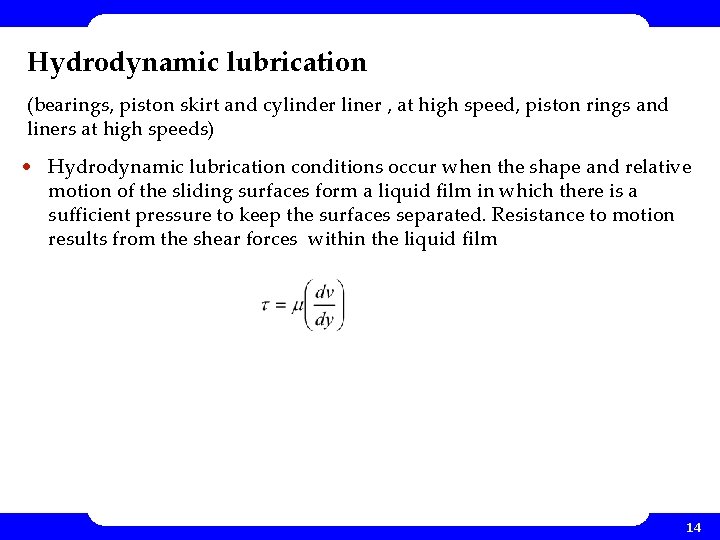
Hydrodynamic lubrication (bearings, piston skirt and cylinder liner , at high speed, piston rings and liners at high speeds) • Hydrodynamic lubrication conditions occur when the shape and relative motion of the sliding surfaces form a liquid film in which there is a sufficient pressure to keep the surfaces separated. Resistance to motion results from the shear forces within the liquid film 14
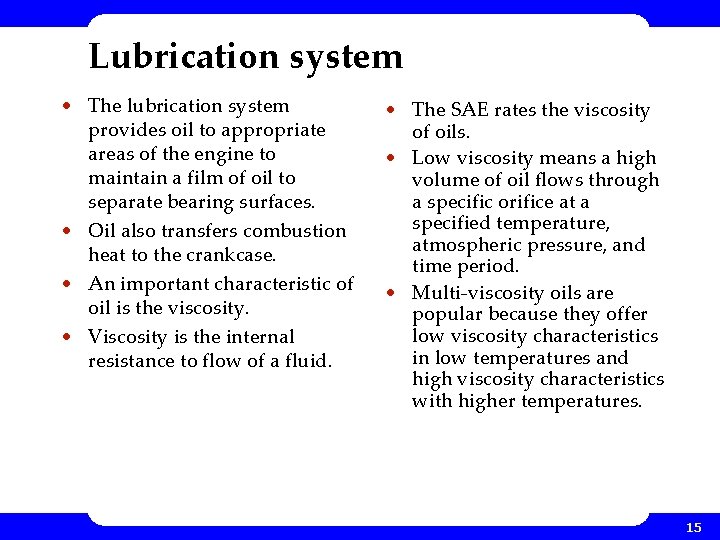
Lubrication system • The lubrication system provides oil to appropriate areas of the engine to maintain a film of oil to separate bearing surfaces. • Oil also transfers combustion heat to the crankcase. • An important characteristic of oil is the viscosity. • Viscosity is the internal resistance to flow of a fluid. • The SAE rates the viscosity of oils. • Low viscosity means a high volume of oil flows through a specific orifice at a specified temperature, atmospheric pressure, and time period. • Multi-viscosity oils are popular because they offer low viscosity characteristics in low temperatures and high viscosity characteristics with higher temperatures. 15
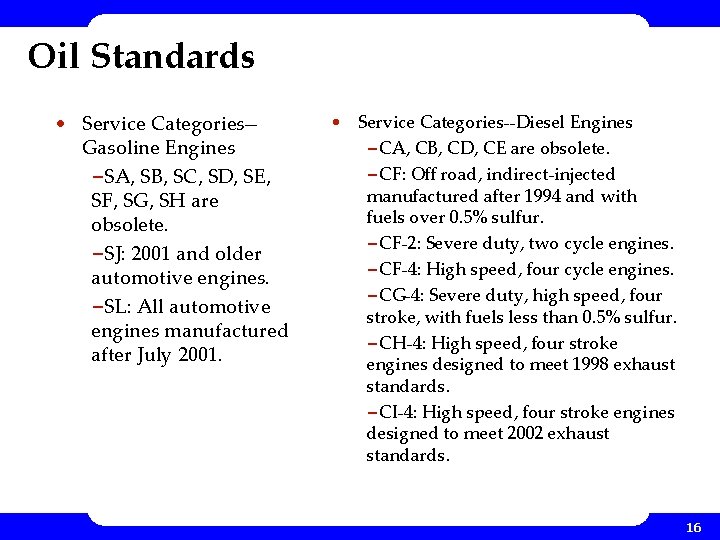
Oil Standards • Service Categories-Gasoline Engines –SA, SB, SC, SD, SE, SF, SG, SH are obsolete. –SJ: 2001 and older automotive engines. –SL: All automotive engines manufactured after July 2001. • Service Categories--Diesel Engines –CA, CB, CD, CE are obsolete. –CF: Off road, indirect-injected manufactured after 1994 and with fuels over 0. 5% sulfur. –CF-2: Severe duty, two cycle engines. –CF-4: High speed, four cycle engines. –CG-4: Severe duty, high speed, four stroke, with fuels less than 0. 5% sulfur. –CH-4: High speed, four stroke engines designed to meet 1998 exhaust standards. –CI-4: High speed, four stroke engines designed to meet 2002 exhaust standards. 16
- Slides: 16