
Engine Electronic Controlled Ignition systems THE CONSTANT ENERGY
- Slides: 35
Engine Electronic Controlled
Ignition systems • THE CONSTANT ENERGY IGNITION SYSTEM • DIGITAL (PROGRAMMED) IGNITION SYSTEM • DISTRIBUTORLESS IGNITION SYSTEM
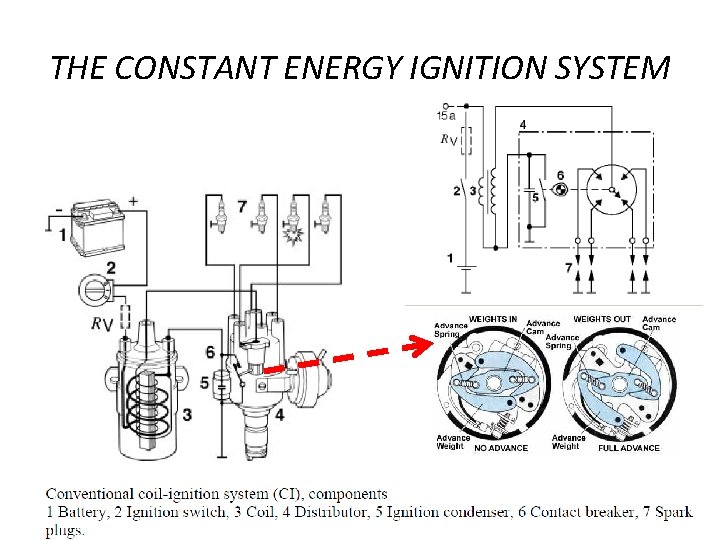
THE CONSTANT ENERGY IGNITION SYSTEM
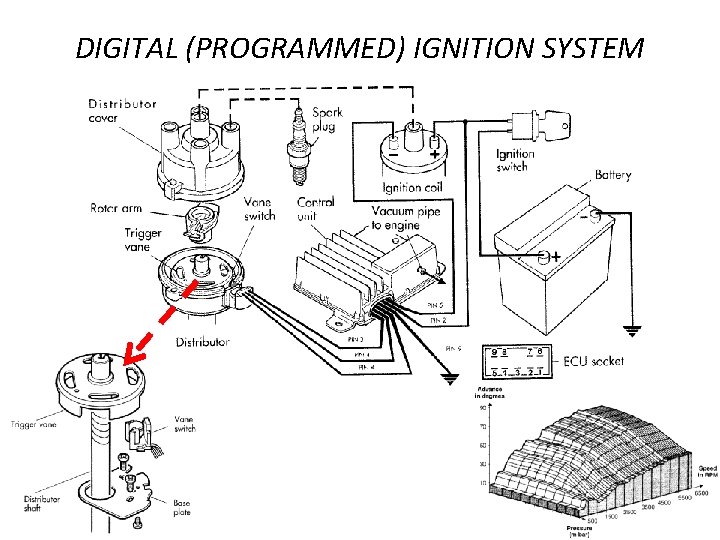
DIGITAL (PROGRAMMED) IGNITION SYSTEM
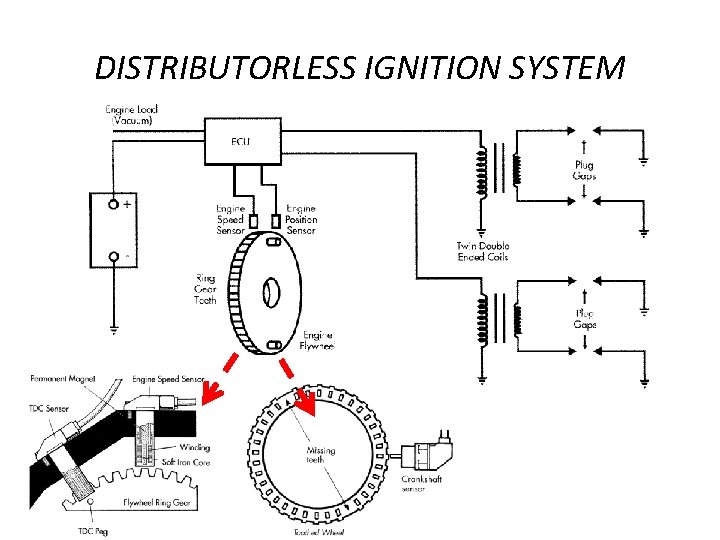
DISTRIBUTORLESS IGNITION SYSTEM
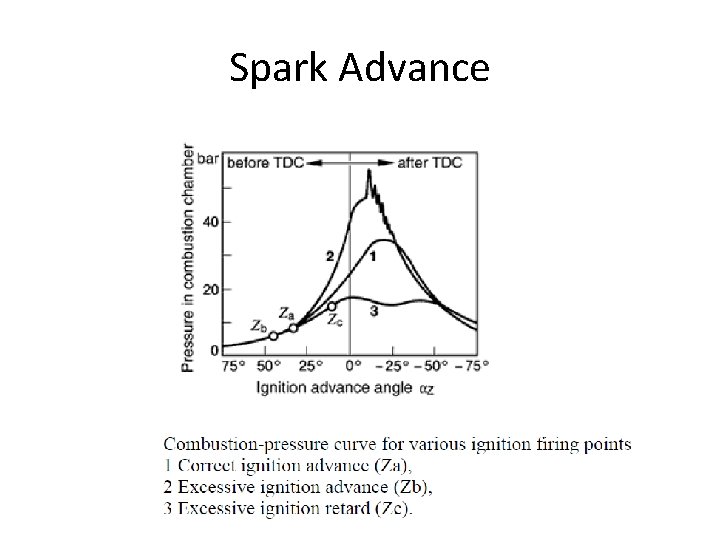
Spark Advance
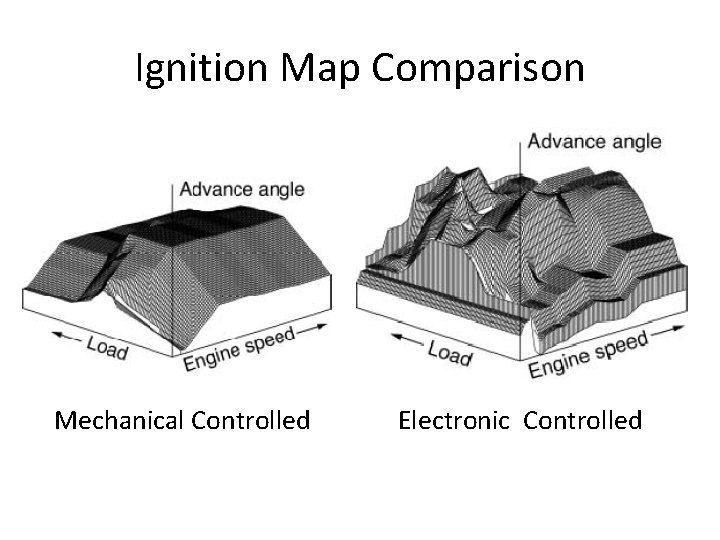
Ignition Map Comparison Mechanical Controlled Electronic Controlled
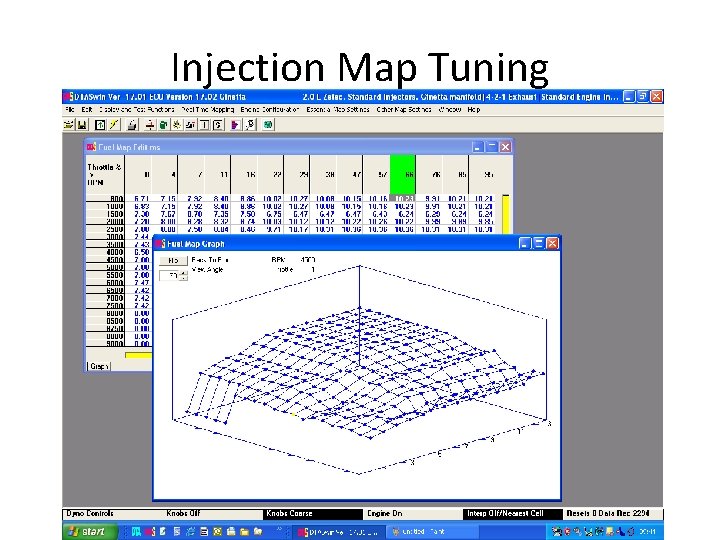
Injection Map Tuning
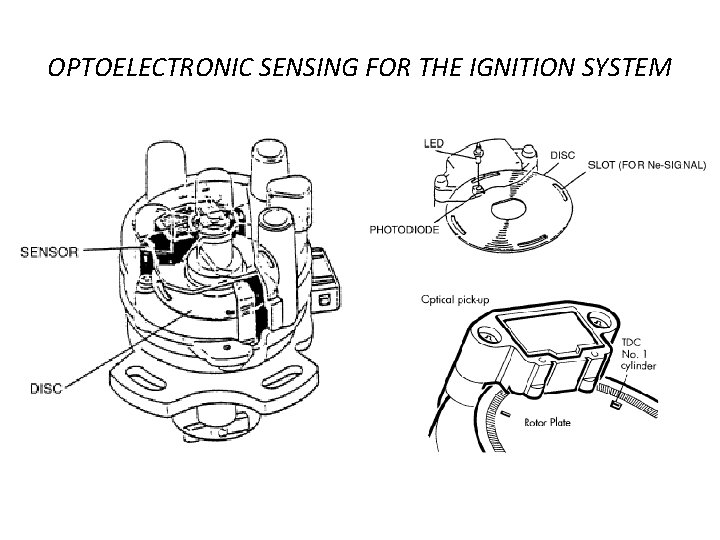
OPTOELECTRONIC SENSING FOR THE IGNITION SYSTEM
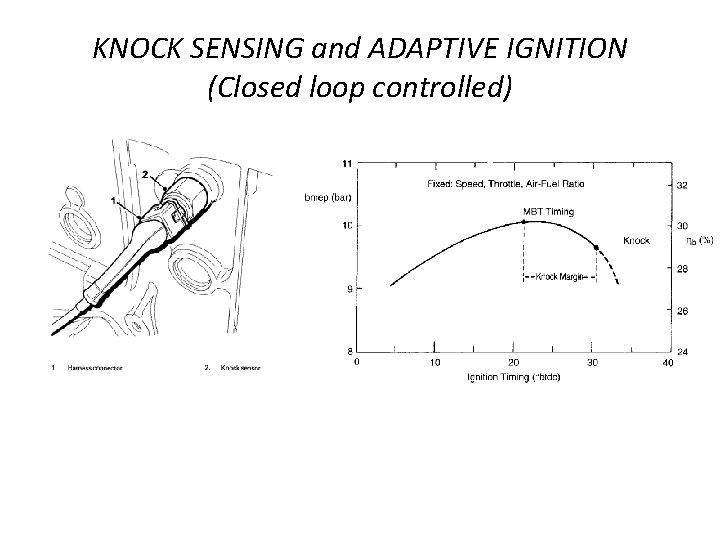
KNOCK SENSING and ADAPTIVE IGNITION (Closed loop controlled)
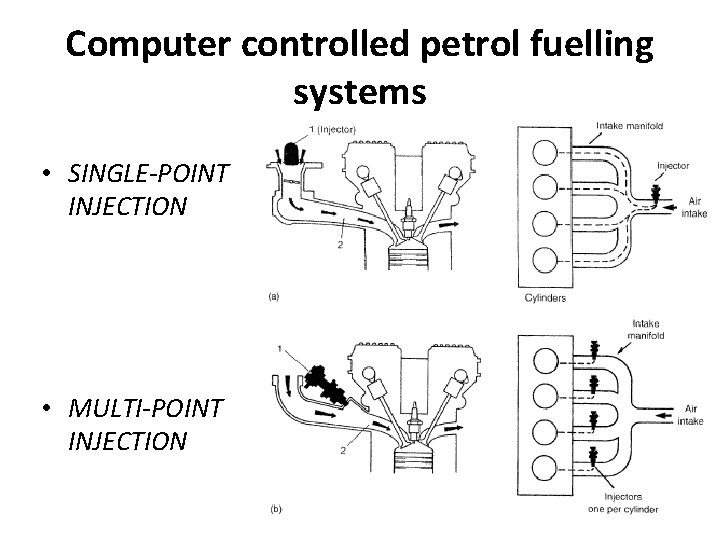
Computer controlled petrol fuelling systems • SINGLE-POINT INJECTION • MULTI-POINT INJECTION
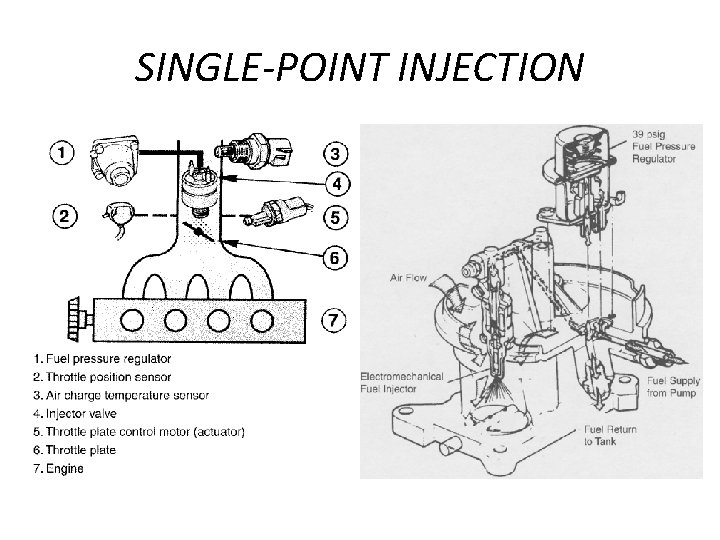
SINGLE-POINT INJECTION
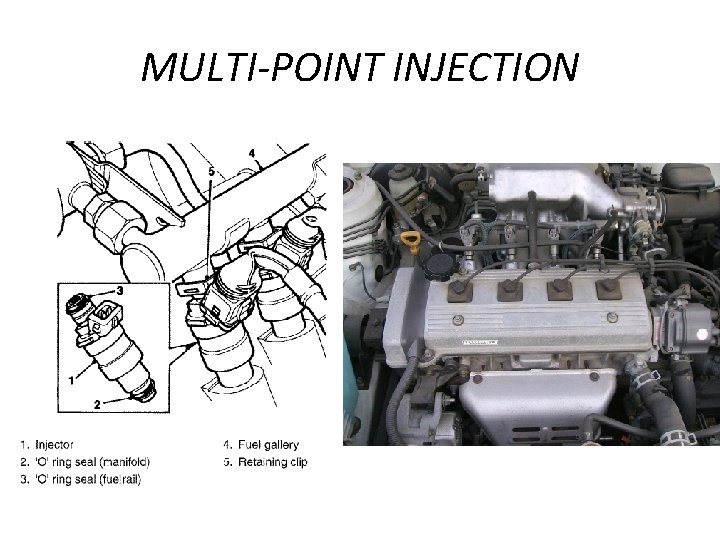
MULTI-POINT INJECTION
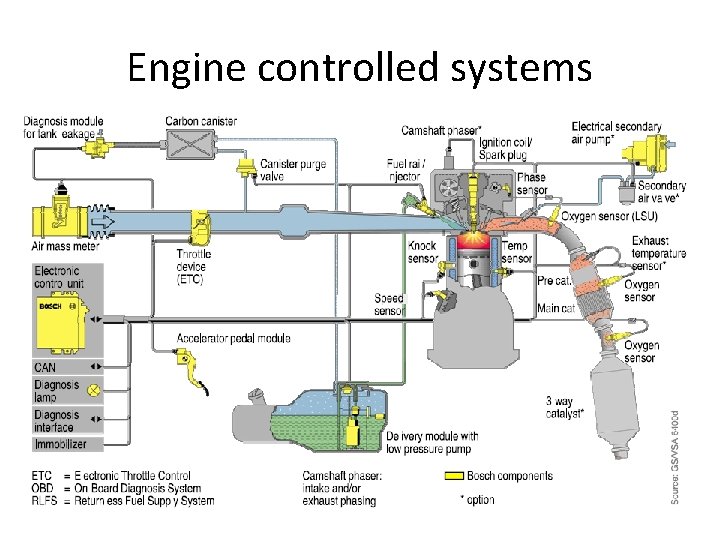
Engine controlled systems
Other controls • • EGR Variable valve timing Variable intake manifold Automatic Transmission ABS Traction Cruise
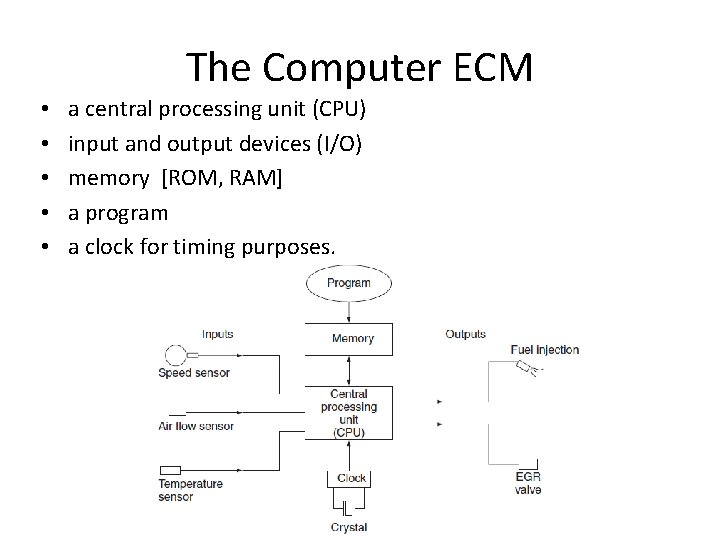
The Computer ECM • • • a central processing unit (CPU) input and output devices (I/O) memory [ROM, RAM] a program a clock for timing purposes.
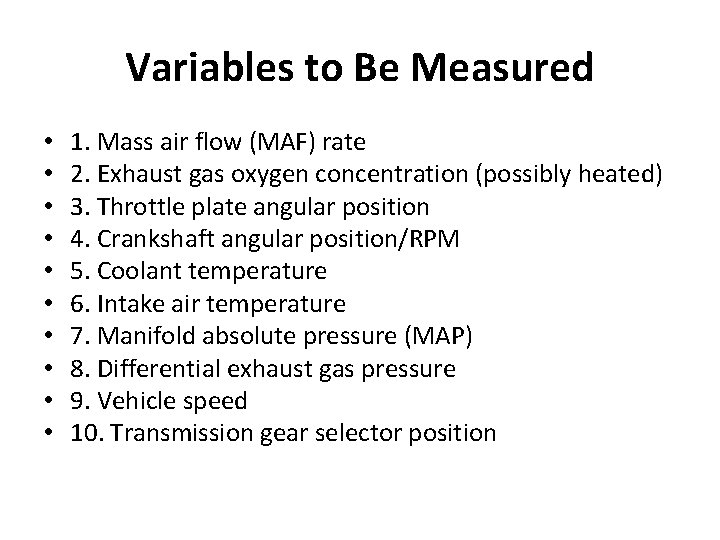
Variables to Be Measured • • • 1. Mass air flow (MAF) rate 2. Exhaust gas oxygen concentration (possibly heated) 3. Throttle plate angular position 4. Crankshaft angular position/RPM 5. Coolant temperature 6. Intake air temperature 7. Manifold absolute pressure (MAP) 8. Differential exhaust gas pressure 9. Vehicle speed 10. Transmission gear selector position
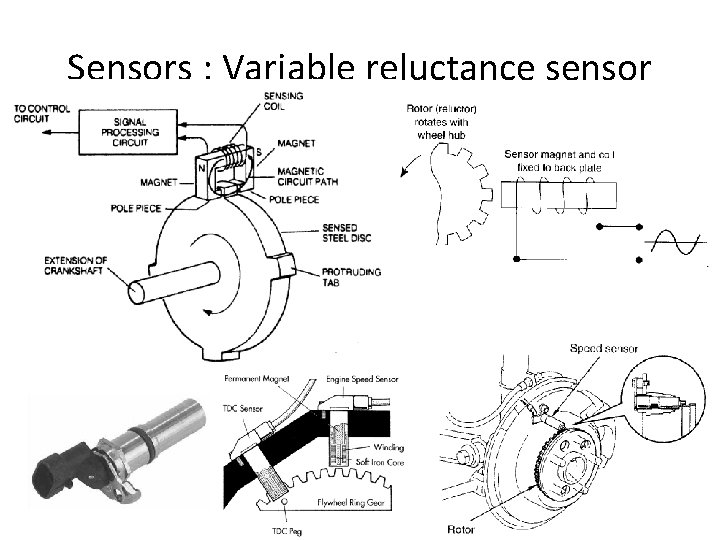
Sensors : Variable reluctance sensor
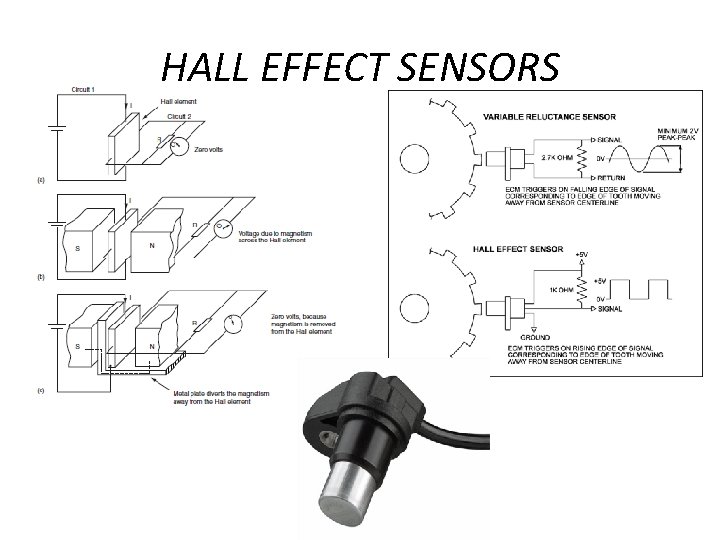
HALL EFFECT SENSORS
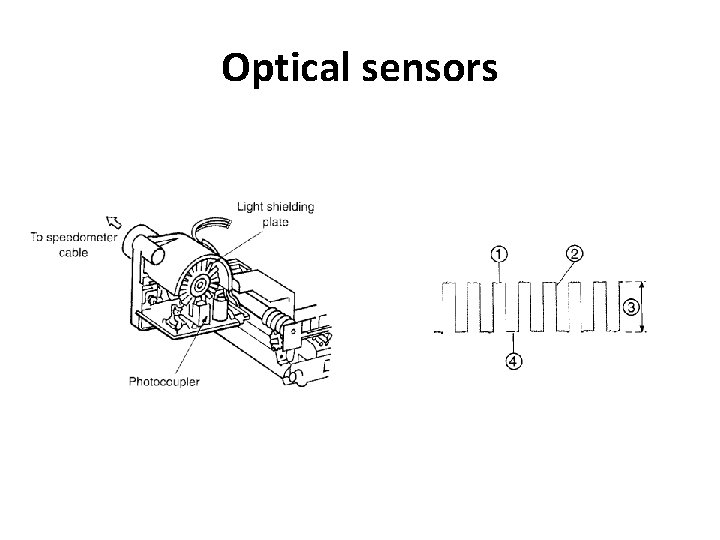
Optical sensors
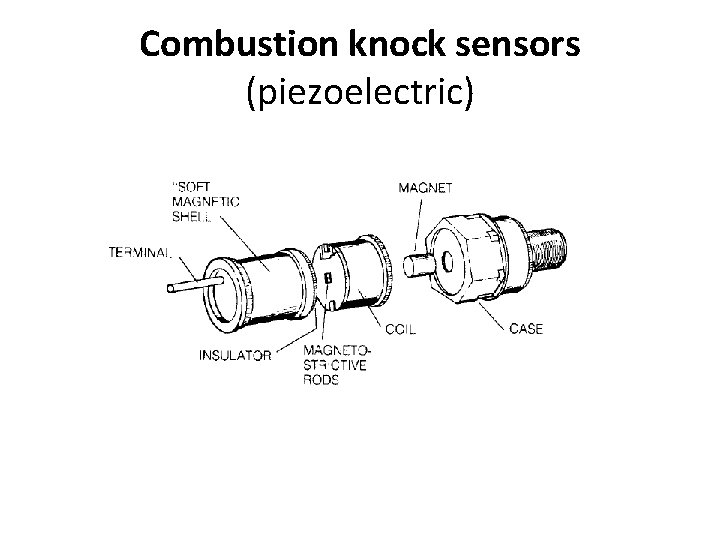
Combustion knock sensors (piezoelectric)
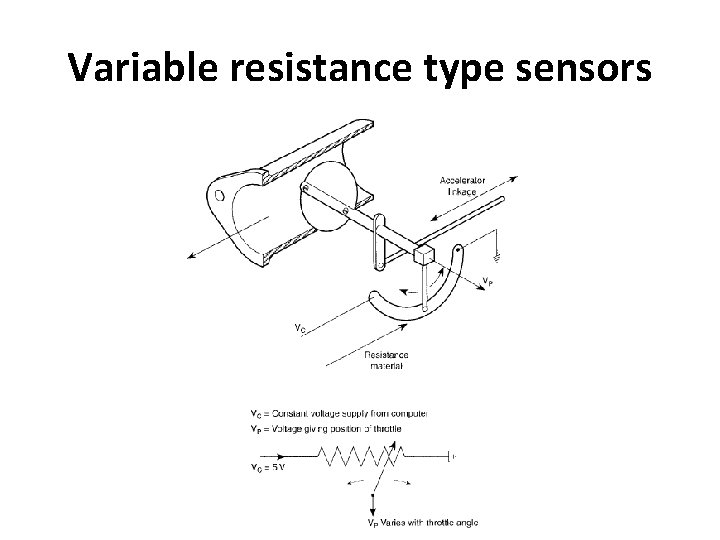
Variable resistance type sensors
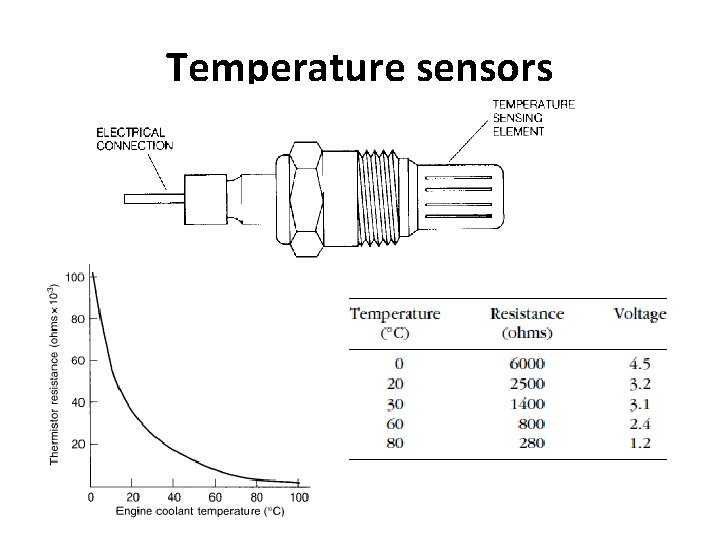
Temperature sensors
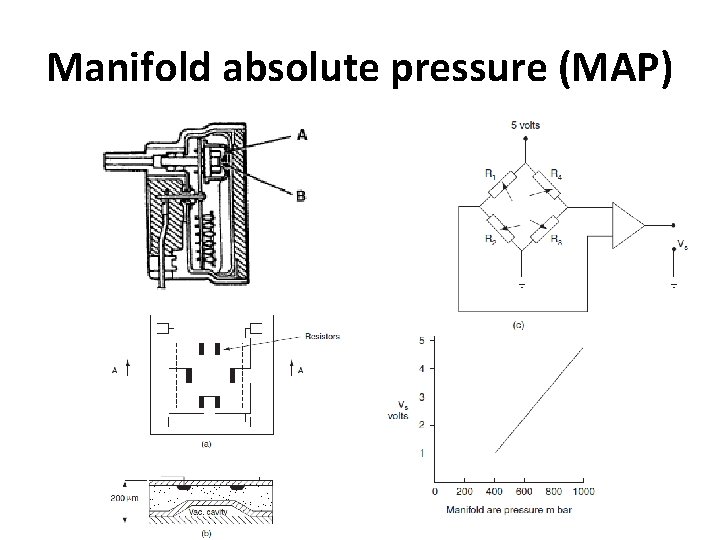
Manifold absolute pressure (MAP)
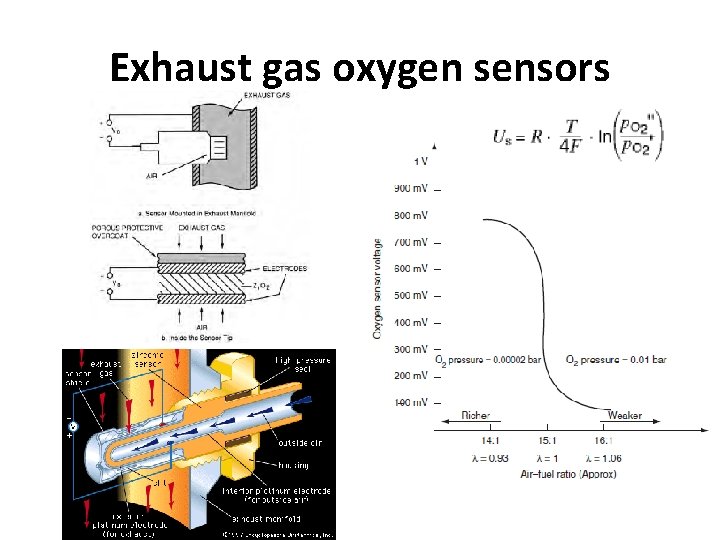
Exhaust gas oxygen sensors
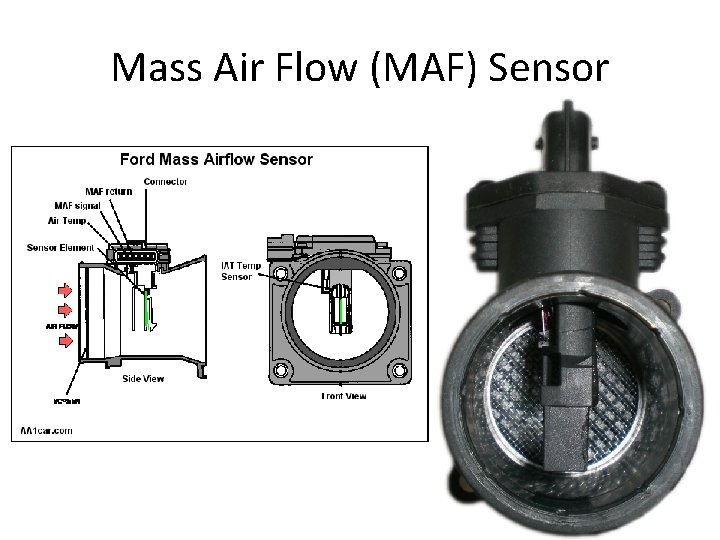
Mass Air Flow (MAF) Sensor
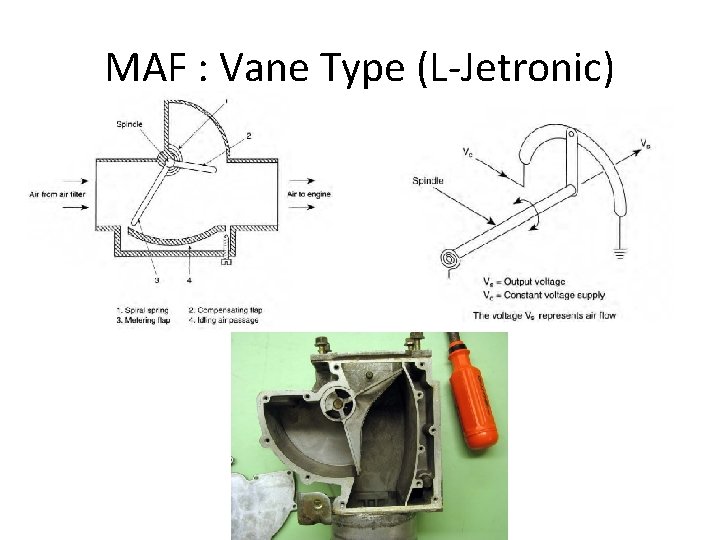
MAF : Vane Type (L-Jetronic)
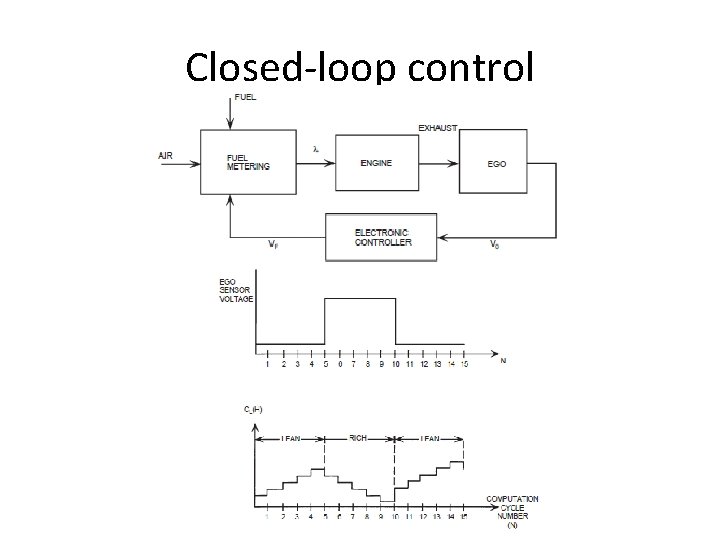
Closed-loop control
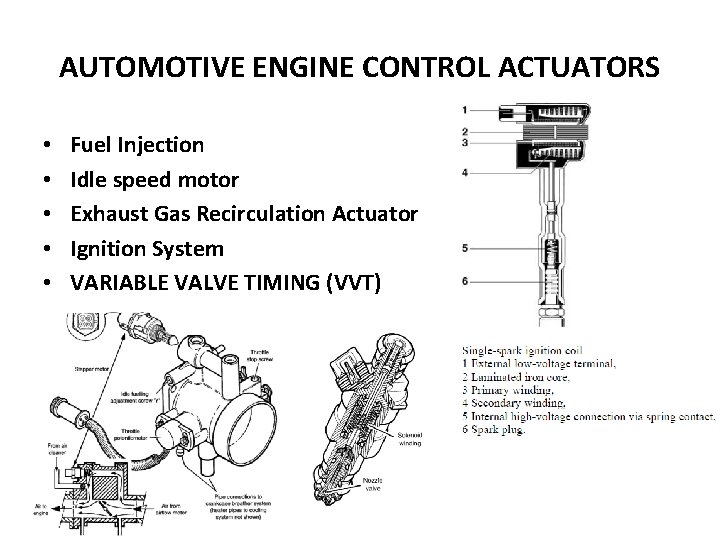
AUTOMOTIVE ENGINE CONTROL ACTUATORS • • • Fuel Injection Idle speed motor Exhaust Gas Recirculation Actuator Ignition System VARIABLE VALVE TIMING (VVT)
CONTROL MODES: Engine Crank (Start) The following list is a summary of the engine operations in the engine crank (starting) mode. Here, the primary control concern is reliable engine start. • • 1. Engine RPM at cranking speed. 2. Engine coolant at low temperature. 3. Air/fuel ratio low. 4. Spark retarded. 5. EGR off. 6. Secondary air to exhaust manifold. 7. Fuel economy not closely controlled. 8. Emissions not closely controlled.
Engine Warm-Up While the engine is warming up, the engine temperature is rising to its normal operating value. Here, the primary control concern is rapid and smooth engine warm-up. A summary of the engine operations during this period follows: • • 1. Engine RPM above cranking speed at command of driver. 2. Engine coolant temperature rises to minimum threshold. 3. Air/fuel ratio low. 4. Spark timing set by controller. 5. EGR off. 6. Secondary air to exhaust manifold. 7. Fuel economy not closely controlled. 8. Emissions not closely controlled.
Open-Loop Control The following list summarizes the engine operations when the engine is being controlled with an open-loop system. This is before the EGO sensor has reached the correct temperature for closed-loop operation. Fuel economy and emissions are closely controlled. • • 1. Engine RPM at command of driver. 2. Engine temperature above warm-up threshold. 3. Air/fuel ratio controlled by an open-loop system to 14. 7. 4. EGO sensor temperature less than minimum threshold. 5. Spark timing set by controller. 6. EGR controlled. 7. Secondary air to catalytic converter. 8. Fuel economy controlled.
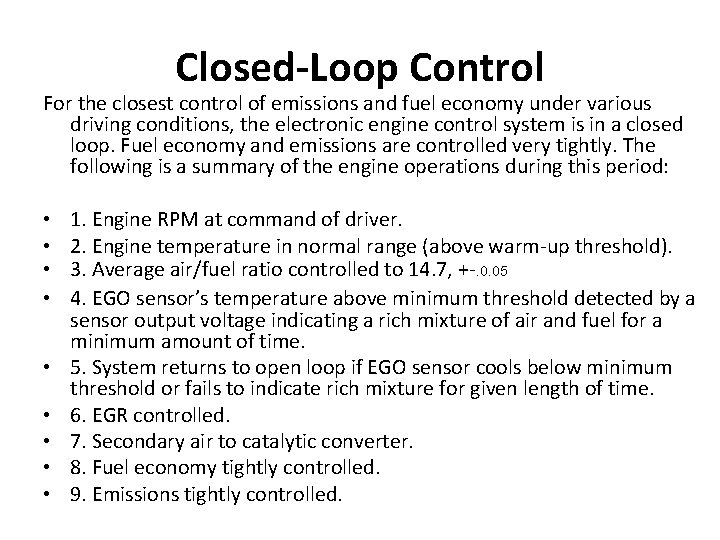
Closed-Loop Control For the closest control of emissions and fuel economy under various driving conditions, the electronic engine control system is in a closed loop. Fuel economy and emissions are controlled very tightly. The following is a summary of the engine operations during this period: • • • 1. Engine RPM at command of driver. 2. Engine temperature in normal range (above warm-up threshold). 3. Average air/fuel ratio controlled to 14. 7, +-. 0. 05 4. EGO sensor’s temperature above minimum threshold detected by a sensor output voltage indicating a rich mixture of air and fuel for a minimum amount of time. 5. System returns to open loop if EGO sensor cools below minimum threshold or fails to indicate rich mixture for given length of time. 6. EGR controlled. 7. Secondary air to catalytic converter. 8. Fuel economy tightly controlled. 9. Emissions tightly controlled.
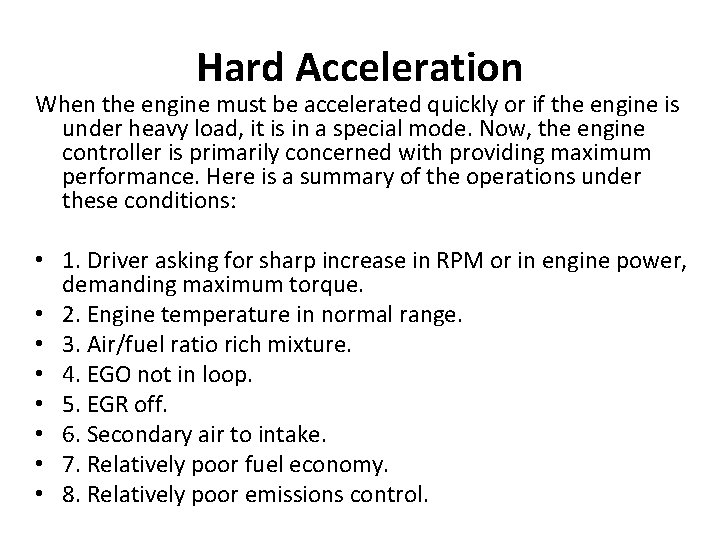
Hard Acceleration When the engine must be accelerated quickly or if the engine is under heavy load, it is in a special mode. Now, the engine controller is primarily concerned with providing maximum performance. Here is a summary of the operations under these conditions: • 1. Driver asking for sharp increase in RPM or in engine power, demanding maximum torque. • 2. Engine temperature in normal range. • 3. Air/fuel ratio rich mixture. • 4. EGO not in loop. • 5. EGR off. • 6. Secondary air to intake. • 7. Relatively poor fuel economy. • 8. Relatively poor emissions control.
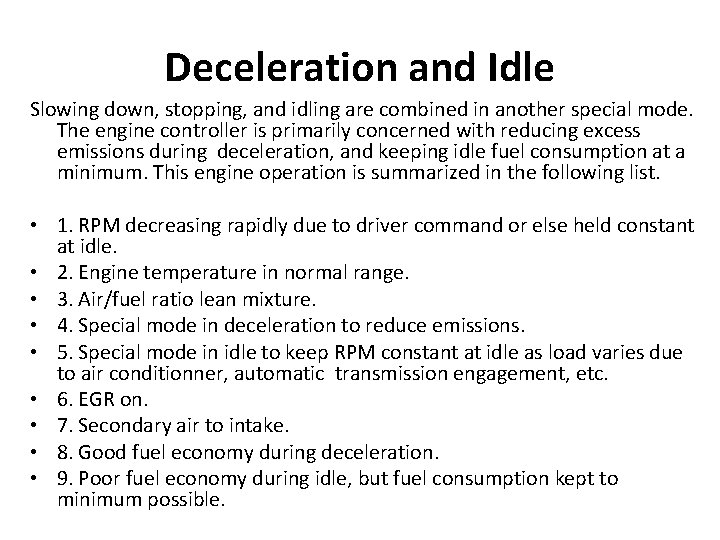
Deceleration and Idle Slowing down, stopping, and idling are combined in another special mode. The engine controller is primarily concerned with reducing excess emissions during deceleration, and keeping idle fuel consumption at a minimum. This engine operation is summarized in the following list. • 1. RPM decreasing rapidly due to driver command or else held constant at idle. • 2. Engine temperature in normal range. • 3. Air/fuel ratio lean mixture. • 4. Special mode in deceleration to reduce emissions. • 5. Special mode in idle to keep RPM constant at idle as load varies due to air conditionner, automatic transmission engagement, etc. • 6. EGR on. • 7. Secondary air to intake. • 8. Good fuel economy during deceleration. • 9. Poor fuel economy during idle, but fuel consumption kept to minimum possible.