
ENGIN 112 Intro to Electrical and Computer Engineering
- Slides: 13
ENGIN 112 Intro to Electrical and Computer Engineering Lecture 12 Circuit Analysis Procedure ENGIN 112 L 12: Circuit Analysis Procedure September 29, 2003
Overview ° Important concept – analyze digital circuits • Given a circuit - Create a truth table - Create a minimized circuit ° Approaches • Boolean expression approach • Truth table approach ° Leads to minimized hardware ° Provides insights on how to design hardware • Tie in with K-maps (next time) ENGIN 112 L 12: Circuit Analysis Procedure September 29, 2003
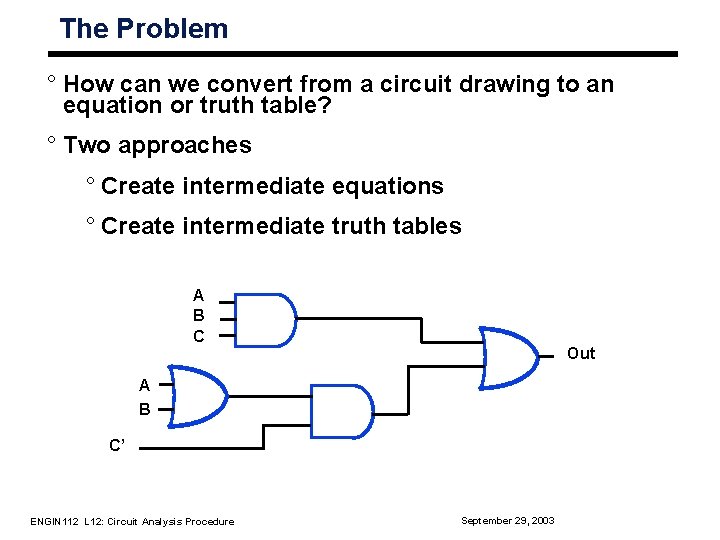
The Problem ° How can we convert from a circuit drawing to an equation or truth table? ° Two approaches ° Create intermediate equations ° Create intermediate truth tables A B C Out A B C’ ENGIN 112 L 12: Circuit Analysis Procedure September 29, 2003
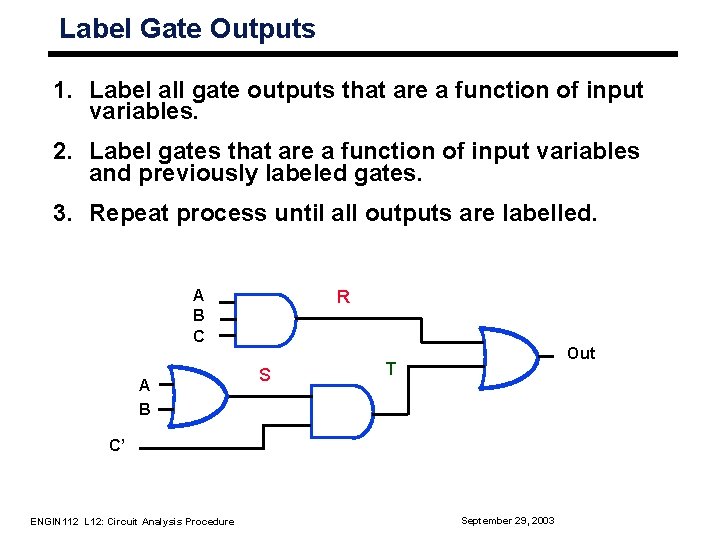
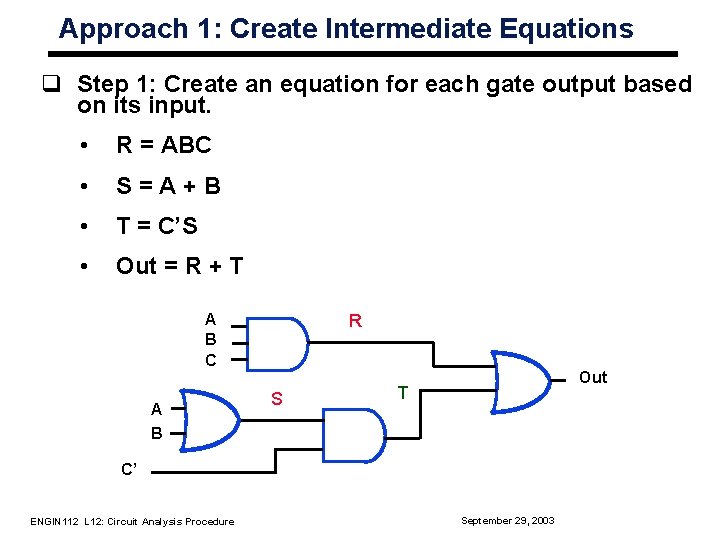
Label Gate Outputs 1. Label all gate outputs that are a function of input variables. 2. Label gates that are a function of input variables and previously labeled gates. 3. Repeat process until all outputs are labelled. A B C A B R S Out T C’ ENGIN 112 L 12: Circuit Analysis Procedure September 29, 2003
Approach 1: Create Intermediate Equations q Step 1: Create an equation for each gate output based on its input. • R = ABC • S=A+B • T = C’S • Out = R + T A B C A B R S Out T C’ ENGIN 112 L 12: Circuit Analysis Procedure September 29, 2003
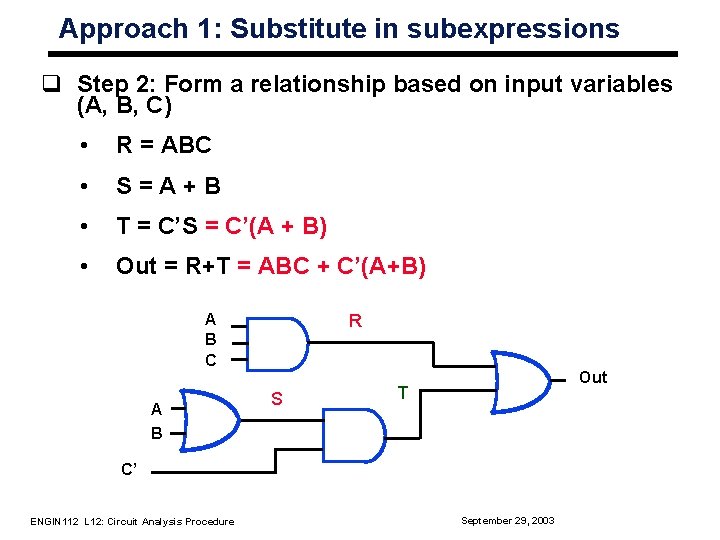
Approach 1: Substitute in subexpressions q Step 2: Form a relationship based on input variables (A, B, C) • R = ABC • S=A+B • T = C’S = C’(A + B) • Out = R+T = ABC + C’(A+B) A B C A B R S Out T C’ ENGIN 112 L 12: Circuit Analysis Procedure September 29, 2003
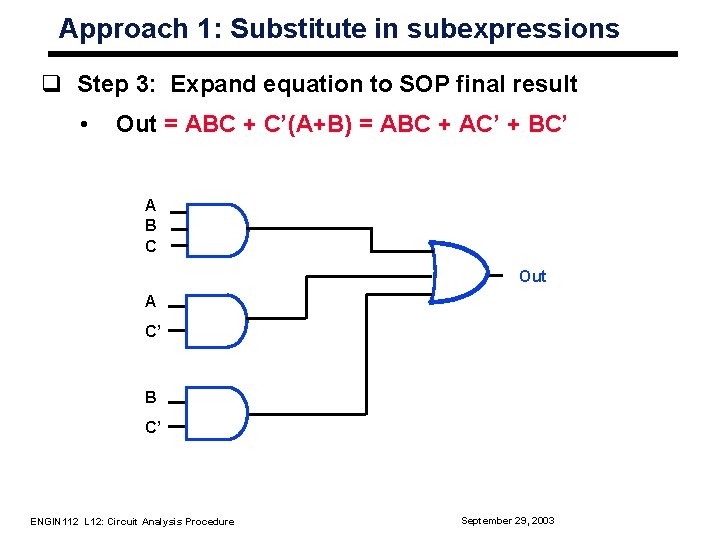
Approach 1: Substitute in subexpressions q Step 3: Expand equation to SOP final result • Out = ABC + C’(A+B) = ABC + AC’ + BC’ A B C Out A C’ B C’ ENGIN 112 L 12: Circuit Analysis Procedure September 29, 2003
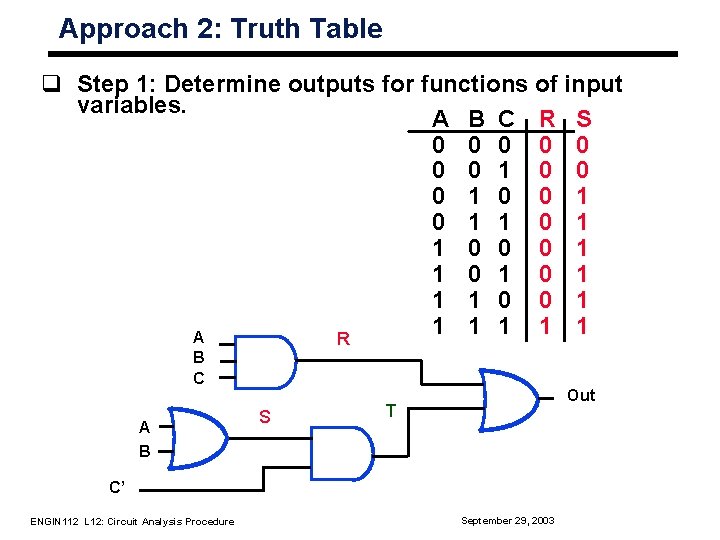
Approach 2: Truth Table q Step 1: Determine outputs for functions of input variables. A B C R S 0 0 0 0 1 0 1 1 0 0 0 1 1 1 0 0 1 1 1 A R B C A B S Out T C’ ENGIN 112 L 12: Circuit Analysis Procedure September 29, 2003
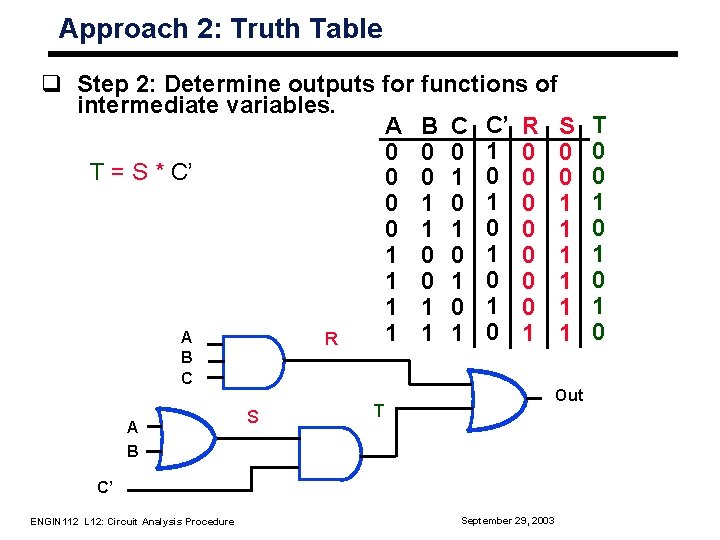
Approach 2: Truth Table q Step 2: Determine outputs for functions of intermediate variables. A B C C’ R S 0 0 0 1 0 0 T = S * C’ 0 0 1 0 1 0 1 1 0 0 1 1 1 0 1 1 A R B C A B S Out T C’ ENGIN 112 L 12: Circuit Analysis Procedure September 29, 2003 T 0 0 1 0 1 0
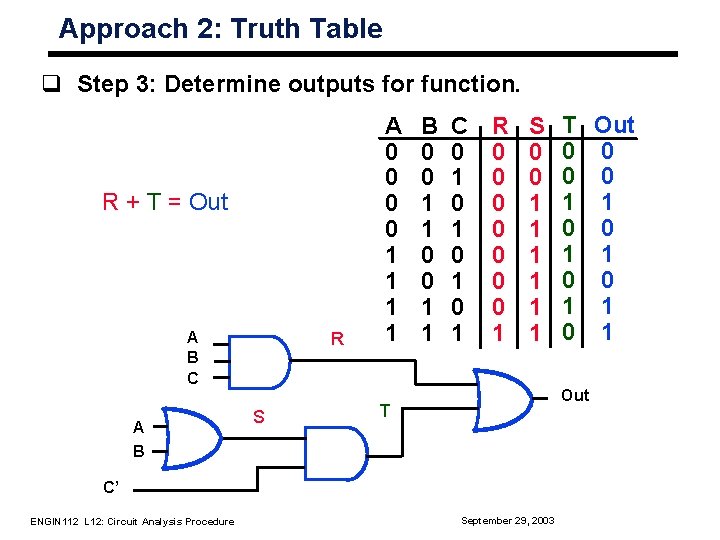
Approach 2: Truth Table q Step 3: Determine outputs for function. R + T = Out A B C A B R S A 0 0 1 1 B 0 0 1 1 C 0 1 0 1 R 0 0 0 0 1 S 0 0 1 1 1 Out T C’ ENGIN 112 L 12: Circuit Analysis Procedure T 0 0 1 0 1 0 September 29, 2003 Out 0 0 1 0 1 1
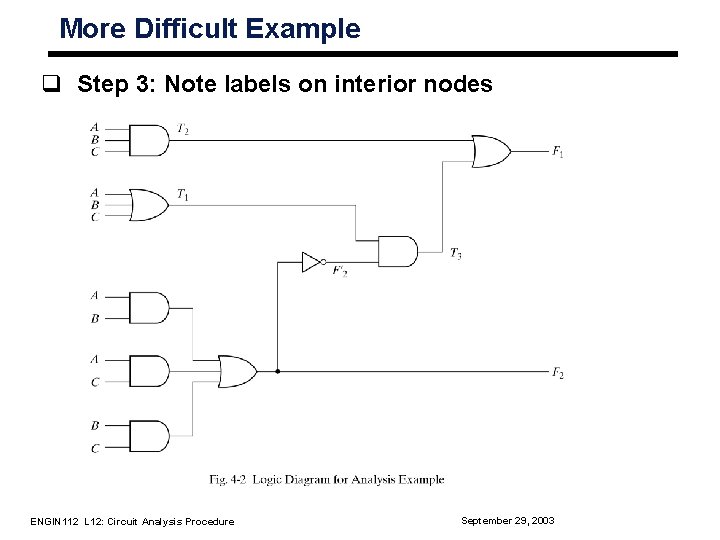
More Difficult Example q Step 3: Note labels on interior nodes ENGIN 112 L 12: Circuit Analysis Procedure September 29, 2003
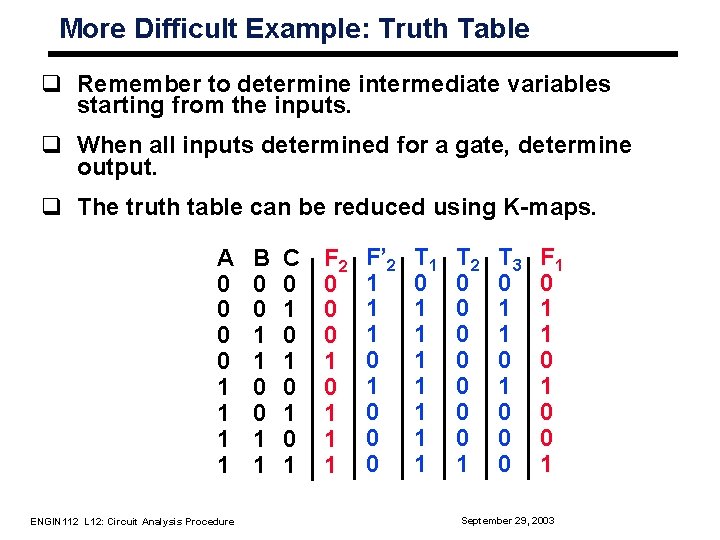
More Difficult Example: Truth Table q Remember to determine intermediate variables starting from the inputs. q When all inputs determined for a gate, determine output. q The truth table can be reduced using K-maps. A 0 0 1 1 ENGIN 112 L 12: Circuit Analysis Procedure B 0 0 1 1 C 0 1 0 1 F 2 0 0 0 1 1 1 F’ 2 1 1 1 0 0 0 T 1 0 1 1 1 1 T 2 0 0 0 0 1 T 3 0 1 1 0 0 0 F 1 0 1 0 0 1 September 29, 2003
Summary ° Important to be able to convert circuits into truth table and equation form • WHY? ---- leads to minimized sum of product representation ° Two approaches illustrated • Approach 1: Create an equation with circuit output dependent on circuit inputs • Approach 2: Create a truth table which shows relationship between circuit inputs and circuit outputs ° Both results can then be minimized using K-maps. ° Next time: develop a minimized SOP representation from a high level description ENGIN 112 L 12: Circuit Analysis Procedure September 29, 2003