
ENGG 2013 Unit 8 2 x 2 Determinant
- Slides: 31
ENGG 2013 Unit 8 2 x 2 Determinant Jan, 2011.
Last time • Invertible matrix (a. k. a. non-singular matrix) – Represents reversible linear transformation • Gauss-Jordan elimination – Algorithm for compute matrix inverse kshum ENGG 2013 2
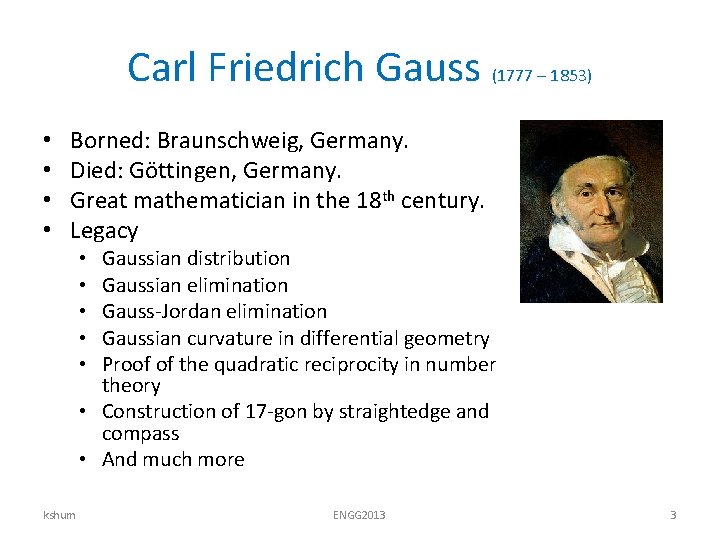
Carl Friedrich Gauss (1777 – 1853) • • Borned: Braunschweig, Germany. Died: Göttingen, Germany. Great mathematician in the 18 th century. Legacy Gaussian distribution Gaussian elimination Gauss-Jordan elimination Gaussian curvature in differential geometry Proof of the quadratic reciprocity in number theory • Construction of 17 -gon by straightedge and compass • And much more • • • kshum ENGG 2013 3
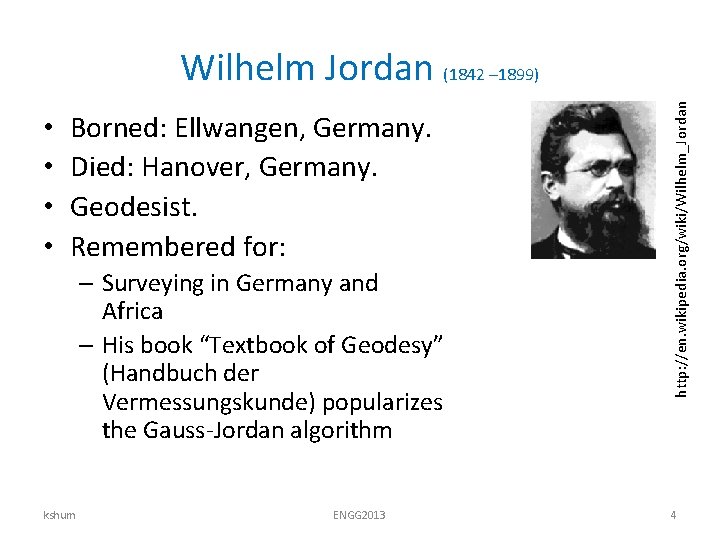
• • Borned: Ellwangen, Germany. Died: Hanover, Germany. Geodesist. Remembered for: – Surveying in Germany and Africa – His book “Textbook of Geodesy” (Handbuch der Vermessungskunde) popularizes the Gauss-Jordan algorithm kshum ENGG 2013 http: //en. wikipedia. org/wiki/Wilhelm_Jordan Wilhelm Jordan (1842 – 1899) 4
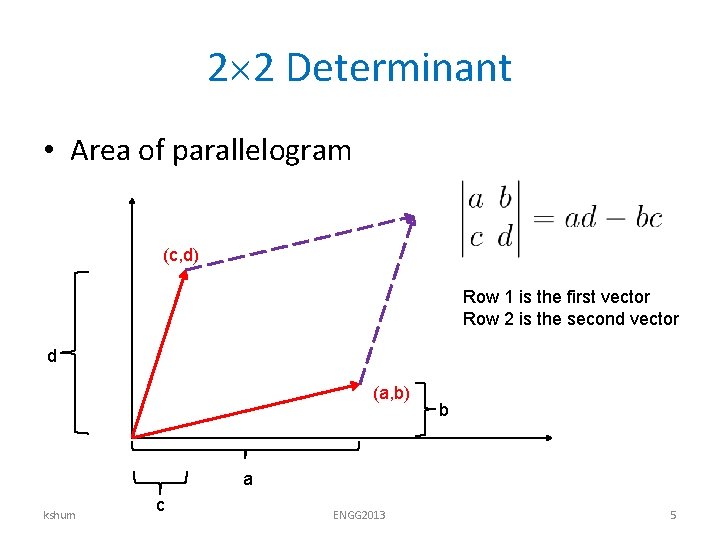
2 2 Determinant • Area of parallelogram (c, d) Row 1 is the first vector Row 2 is the second vector d (a, b) b a kshum c ENGG 2013 5
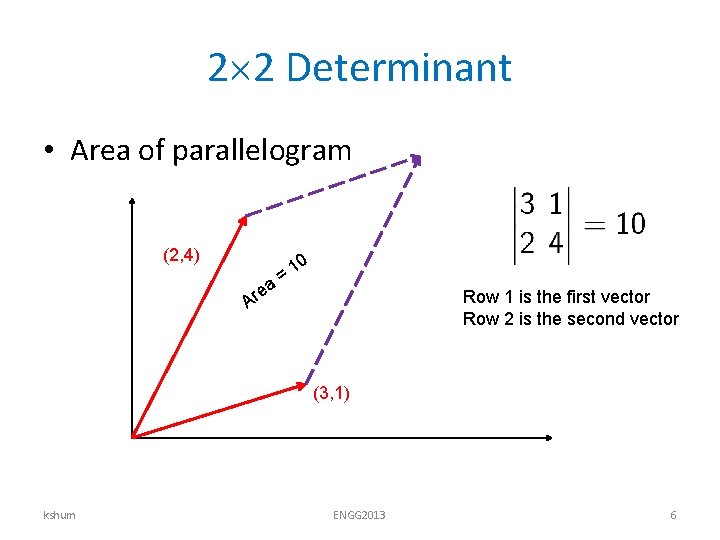
2 2 Determinant • Area of parallelogram (2, 4) ea Ar = 10 Row 1 is the first vector Row 2 is the second vector (3, 1) kshum ENGG 2013 6
Outline • Computing 2 2 matrix inverse via determinant • Properties of determinant • Explain why the absolute value of determinant is the area of parallelogram? kshum ENGG 2013 7
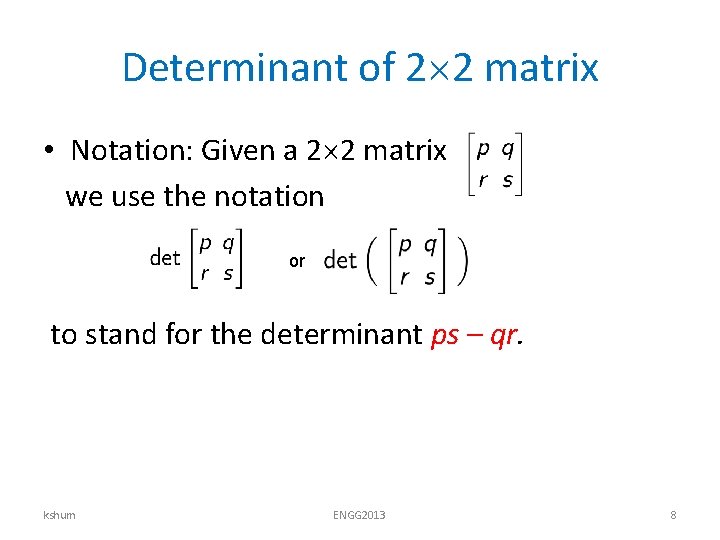
Determinant of 2 2 matrix • Notation: Given a 2 2 matrix we use the notation or to stand for the determinant ps – qr. kshum ENGG 2013 8
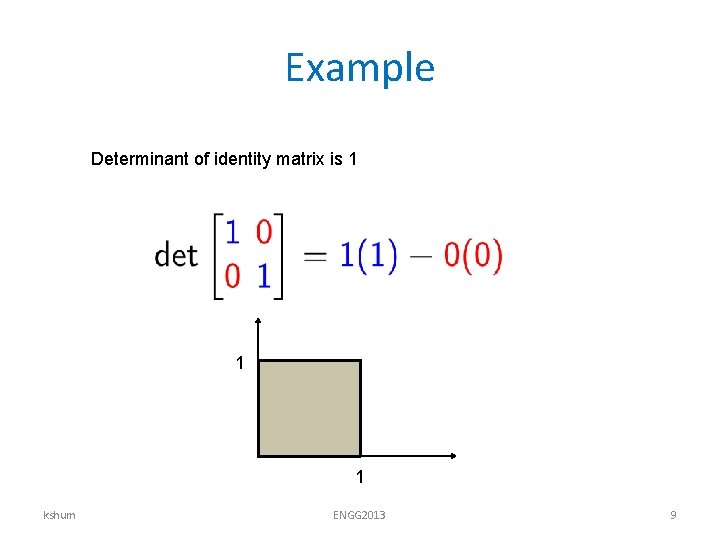
Example Determinant of identity matrix is 1 1 1 kshum ENGG 2013 9
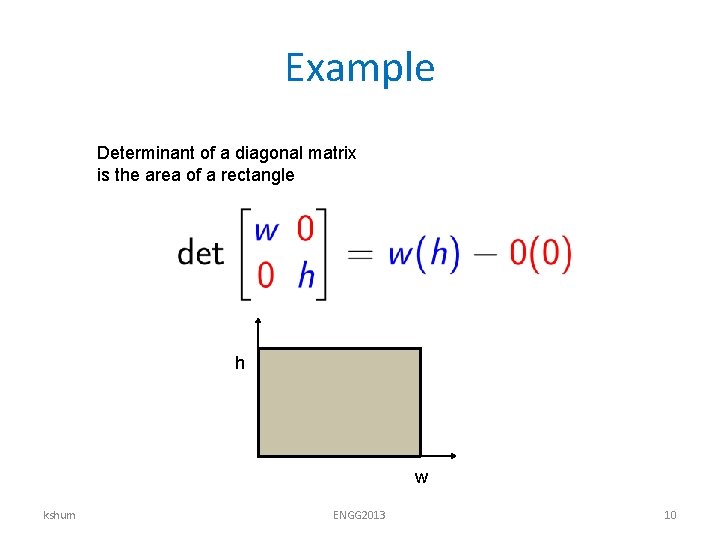
Example Determinant of a diagonal matrix is the area of a rectangle h w kshum ENGG 2013 10
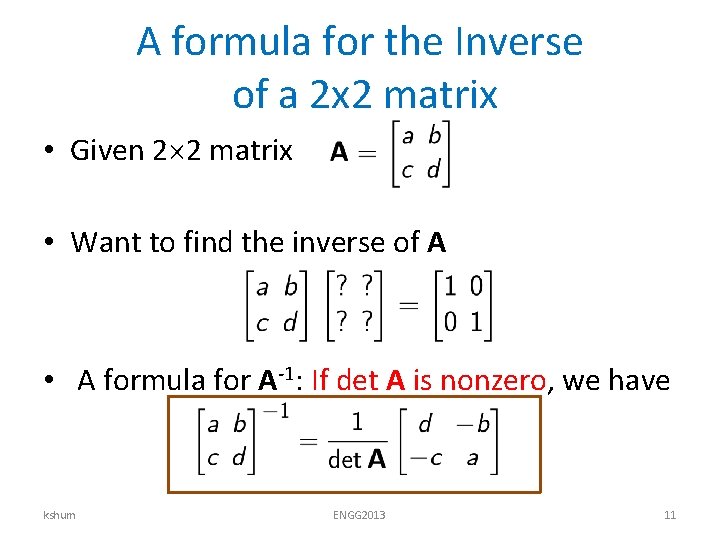
A formula for the Inverse of a 2 x 2 matrix • Given 2 2 matrix • Want to find the inverse of A • A formula for A-1: If det A is nonzero, we have kshum ENGG 2013 11
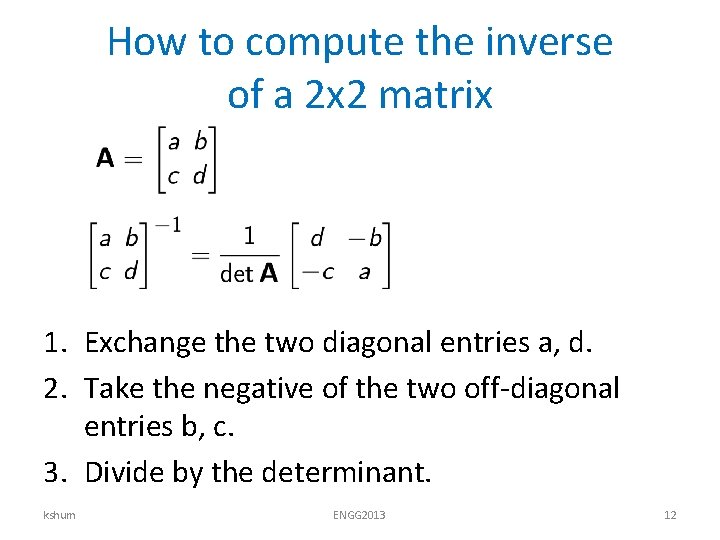
How to compute the inverse of a 2 x 2 matrix 1. Exchange the two diagonal entries a, d. 2. Take the negative of the two off-diagonal entries b, c. 3. Divide by the determinant. kshum ENGG 2013 12
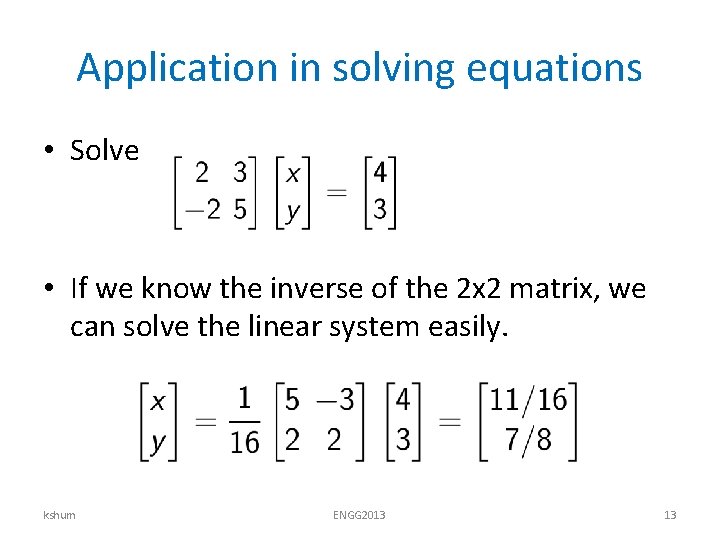
Application in solving equations • Solve • If we know the inverse of the 2 x 2 matrix, we can solve the linear system easily. kshum ENGG 2013 13
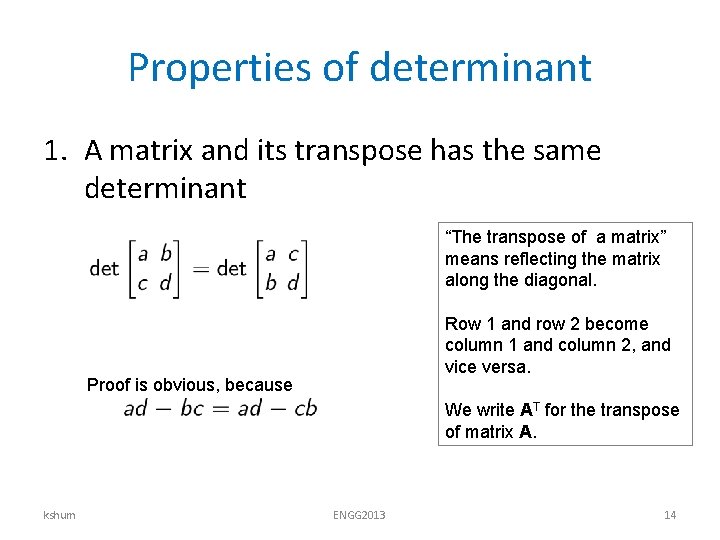
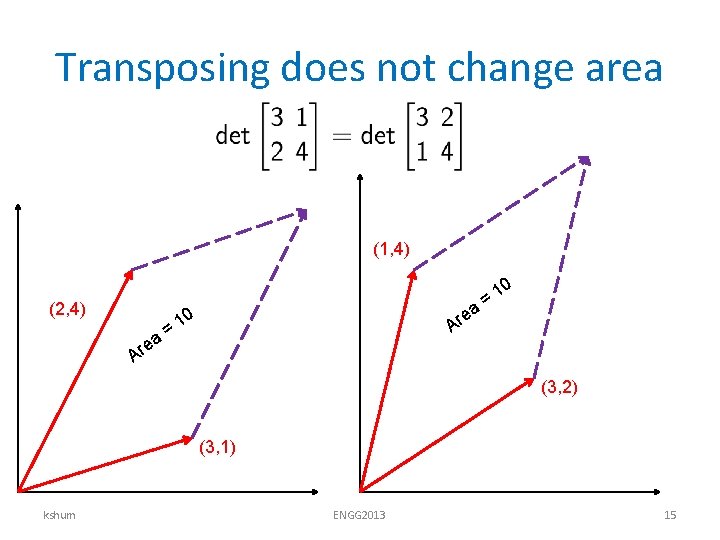
Properties of determinant 1. A matrix and its transpose has the same determinant “The transpose of a matrix” means reflecting the matrix along the diagonal. Row 1 and row 2 become column 1 and column 2, and vice versa. Proof is obvious, because We write AT for the transpose of matrix A. kshum ENGG 2013 14
Transposing does not change area (1, 4) (2, 4) ea r A = ea 10 Ar = 10 (3, 2) (3, 1) kshum ENGG 2013 15
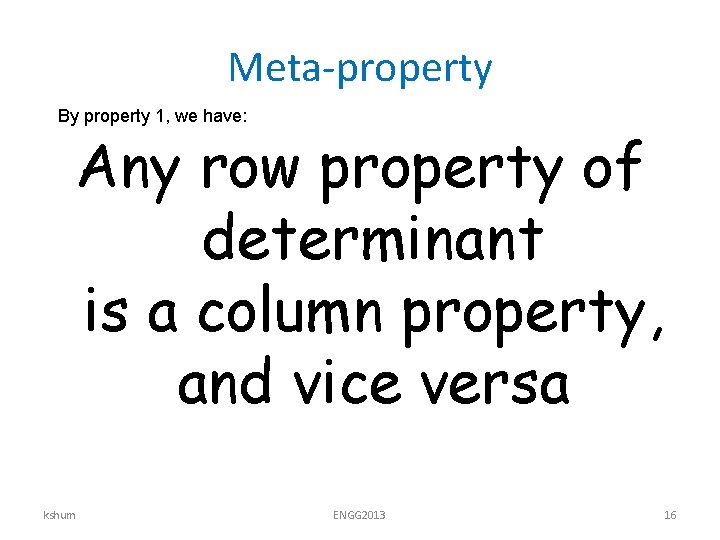
Meta-property By property 1, we have: Any row property of determinant is a column property, and vice versa kshum ENGG 2013 16
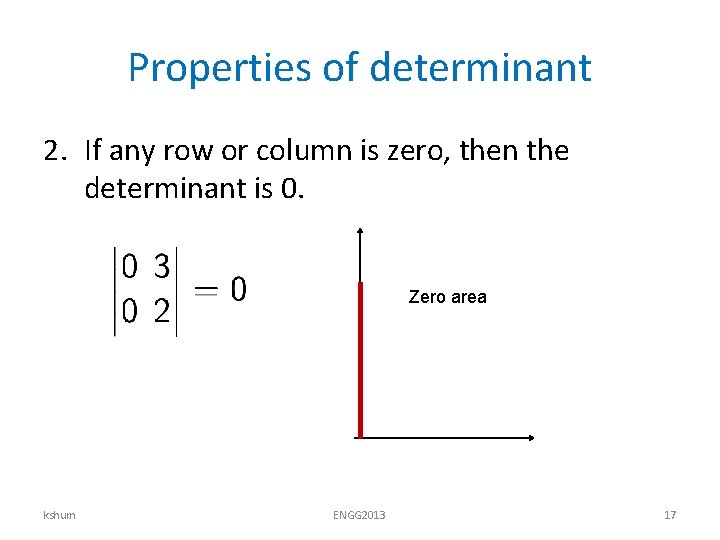
Properties of determinant 2. If any row or column is zero, then the determinant is 0. Zero area kshum ENGG 2013 17
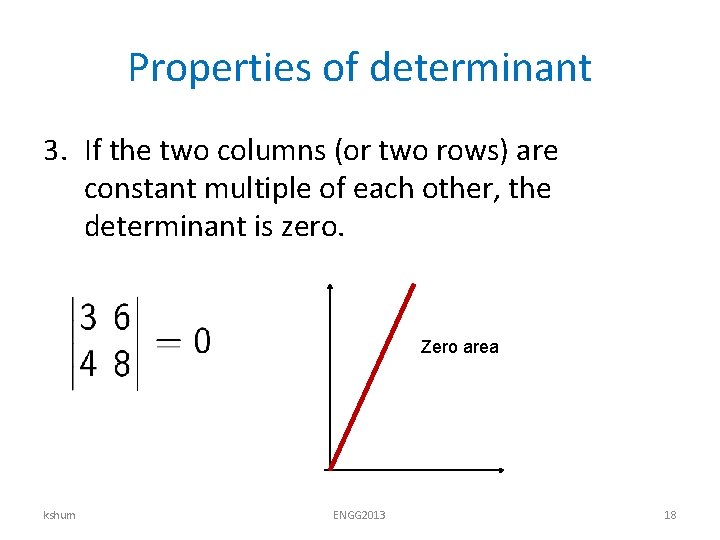
Properties of determinant 3. If the two columns (or two rows) are constant multiple of each other, the determinant is zero. Zero area kshum ENGG 2013 18
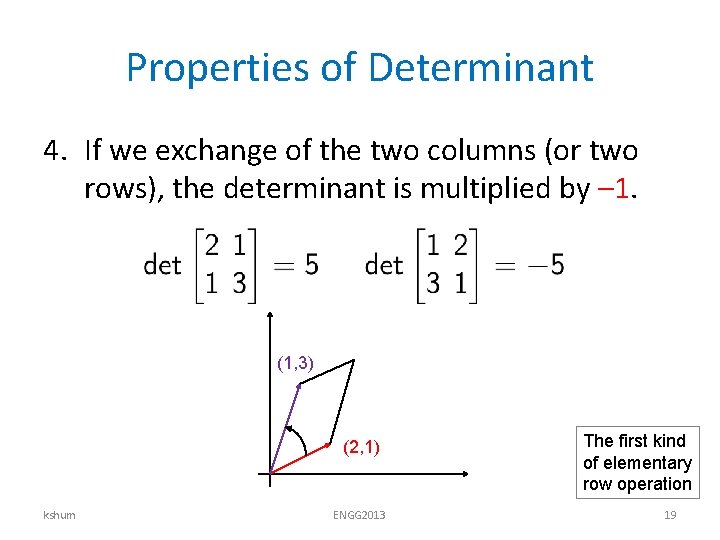
Properties of Determinant 4. If we exchange of the two columns (or two rows), the determinant is multiplied by – 1. (1, 3) (2, 1) kshum ENGG 2013 The first kind of elementary row operation 19
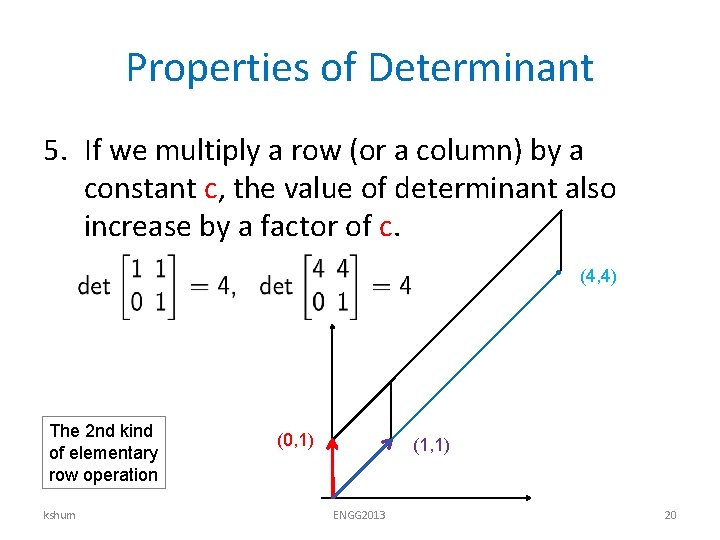
Properties of Determinant 5. If we multiply a row (or a column) by a constant c, the value of determinant also increase by a factor of c. (4, 4) The 2 nd kind of elementary row operation kshum (0, 1) (1, 1) ENGG 2013 20
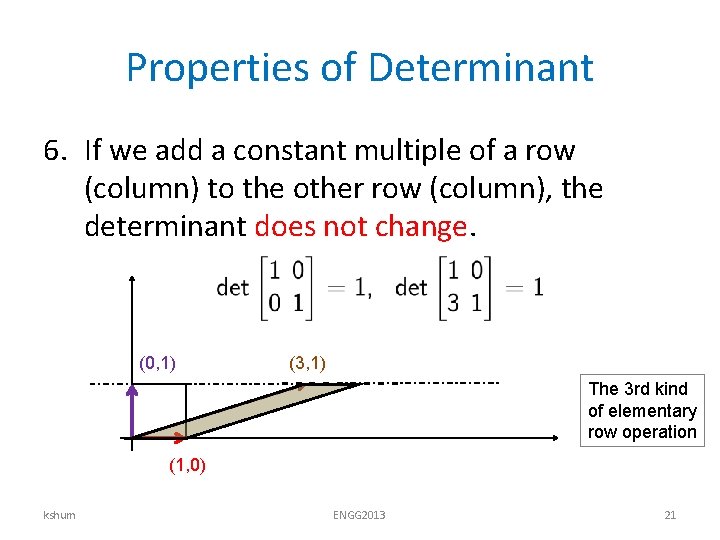
Properties of Determinant 6. If we add a constant multiple of a row (column) to the other row (column), the determinant does not change. (0, 1) (3, 1) The 3 rd kind of elementary row operation (1, 0) kshum ENGG 2013 21
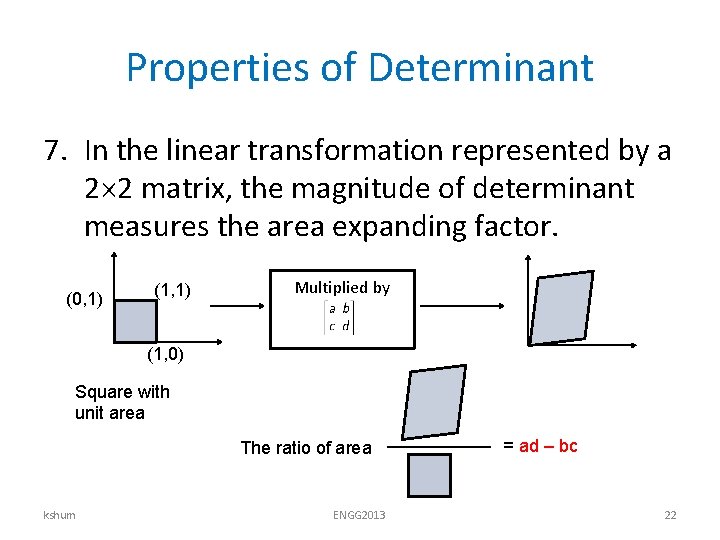
Properties of Determinant 7. In the linear transformation represented by a 2 2 matrix, the magnitude of determinant measures the area expanding factor. (0, 1) (1, 1) Multiplied by (1, 0) Square with unit area The ratio of area kshum ENGG 2013 = ad – bc 22
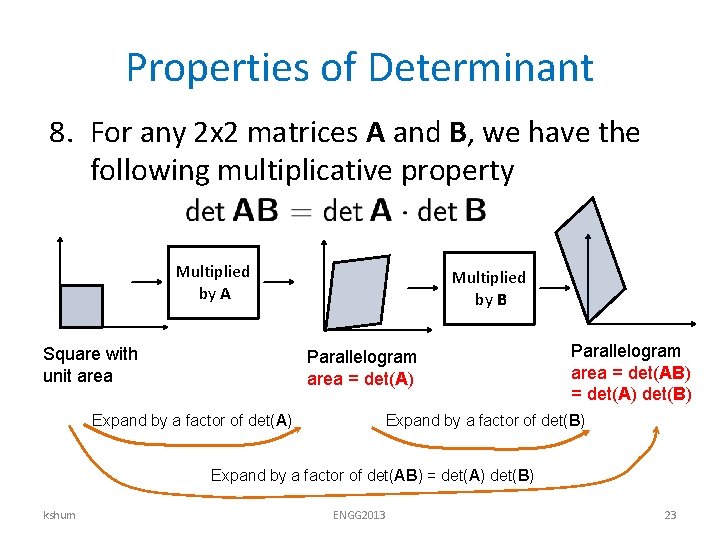
Properties of Determinant 8. For any 2 x 2 matrices A and B, we have the following multiplicative property Multiplied by A Square with unit area Multiplied by B Parallelogram area = det(A) Expand by a factor of det(A) Parallelogram area = det(AB) = det(A) det(B) Expand by a factor of det(AB) = det(A) det(B) kshum ENGG 2013 23
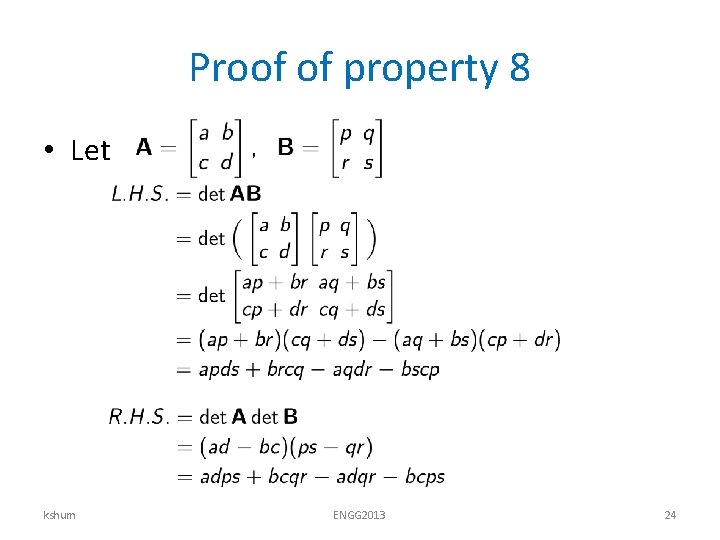
Proof of property 8 • Let kshum ENGG 2013 24
Determinant as area • Using the properties in previous pages, we are now ready to show that the absolute value of det(M) is equal to the area of parallelogram whose sides are the two rows of M. • We divide the argument into two steps – The two rows are perpendicular (special case). – The two rows are not perpendicular (general case). kshum ENGG 2013 25
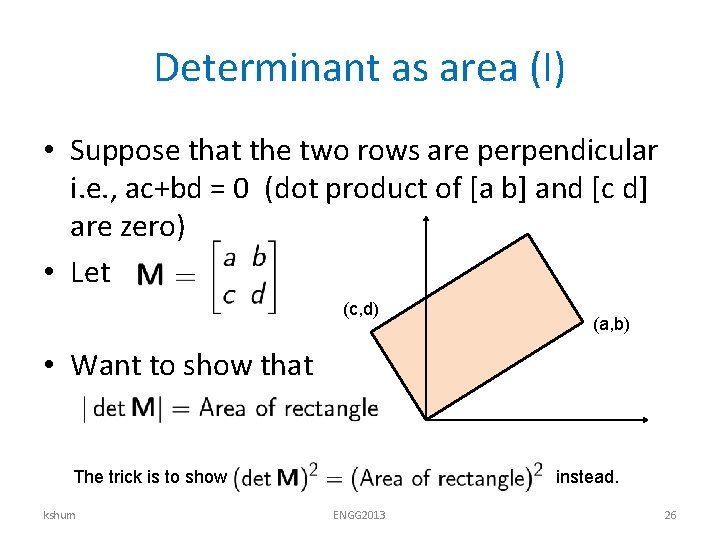
Determinant as area (I) • Suppose that the two rows are perpendicular i. e. , ac+bd = 0 (dot product of [a b] and [c d] are zero) • Let (c, d) (a, b) • Want to show that The trick is to show kshum instead. ENGG 2013 26
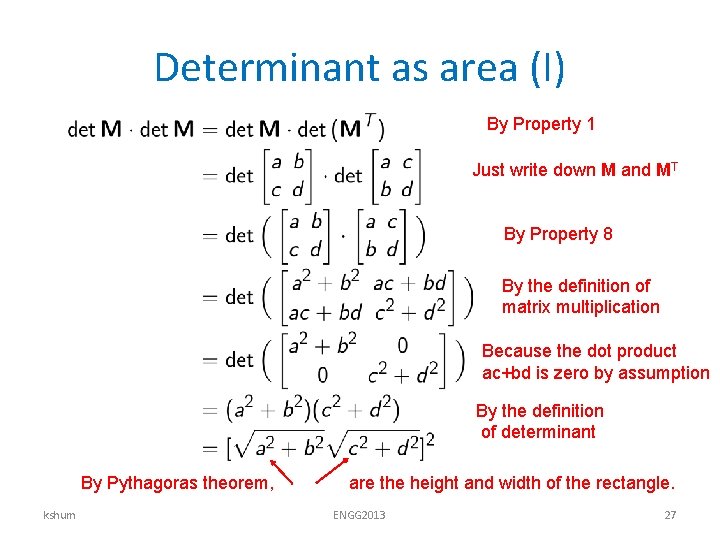
Determinant as area (I) By Property 1 Just write down M and MT By Property 8 By the definition of matrix multiplication Because the dot product ac+bd is zero by assumption By the definition of determinant By Pythagoras theorem, kshum are the height and width of the rectangle. ENGG 2013 27
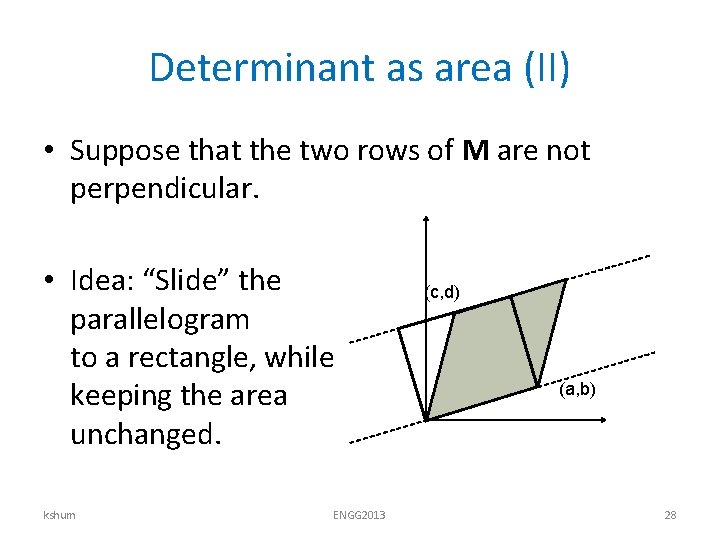
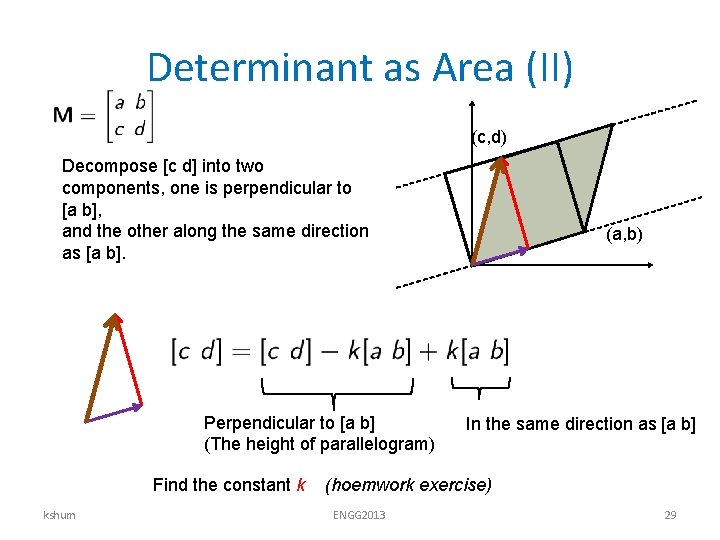
Determinant as area (II) • Suppose that the two rows of M are not perpendicular. • Idea: “Slide” the parallelogram to a rectangle, while keeping the area unchanged. kshum ENGG 2013 (c, d) (a, b) 28
Determinant as Area (II) (c, d) Decompose [c d] into two components, one is perpendicular to [a b], and the other along the same direction as [a b]. Perpendicular to [a b] (The height of parallelogram) Find the constant k kshum (a, b) In the same direction as [a b] (hoemwork exercise) ENGG 2013 29
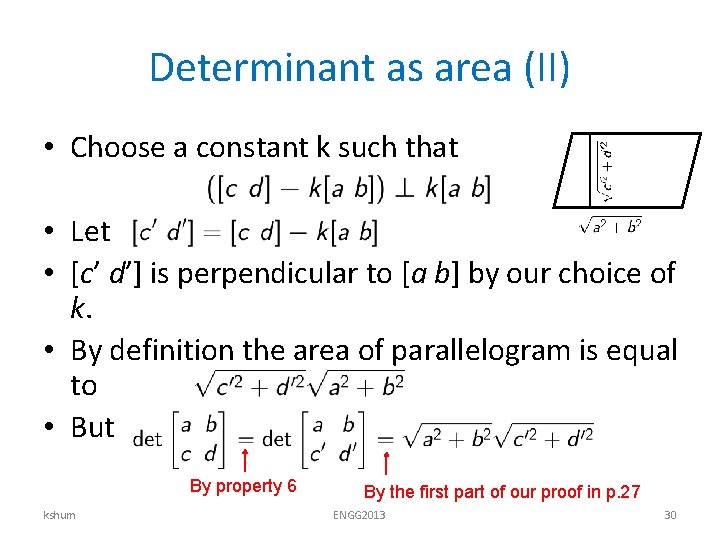
Determinant as area (II) • Choose a constant k such that • Let • [c’ d’] is perpendicular to [a b] by our choice of k. • By definition the area of parallelogram is equal to • But By property 6 kshum By the first part of our proof in p. 27 ENGG 2013 30
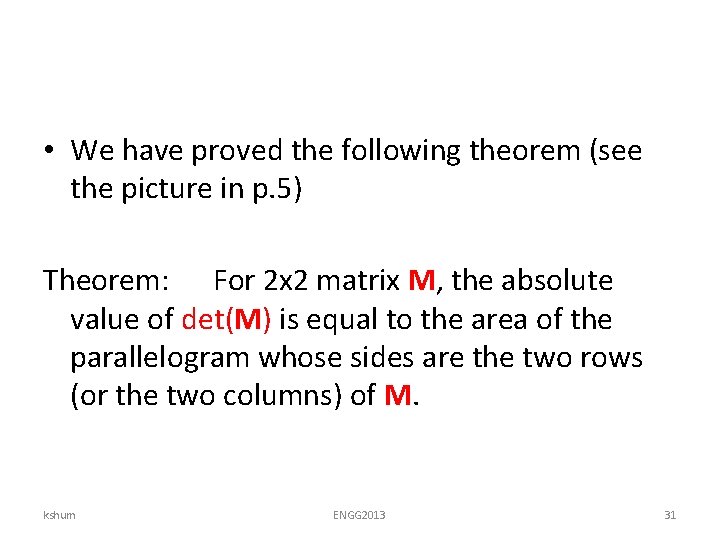
• We have proved the following theorem (see the picture in p. 5) Theorem: For 2 x 2 matrix M, the absolute value of det(M) is equal to the area of the parallelogram whose sides are the two rows (or the two columns) of M. kshum ENGG 2013 31