
Engaging Young Men in Pregnancy Prevention Making Referrals
![Introductions [Insert Trainer Names, Organizations, and Contact Information] 2](https://slidetodoc.com/presentation_image_h/74ba0ecbab3a486654188ec080a41b29/image-2.jpg "Introductions [Insert Trainer Names, Organizations, and Contact Information] 2")
![Local Health Care Providers [List local health care providers that serve young men]](https://slidetodoc.com/presentation_image_h/74ba0ecbab3a486654188ec080a41b29/image-52.jpg "Local Health Care Providers [List local health care providers that serve young men]")
![Services Available to Young Men [List services available to young men]](https://slidetodoc.com/presentation_image_h/74ba0ecbab3a486654188ec080a41b29/image-53.jpg "Services Available to Young Men [List services available to young men]")
![[Insert Pictures of Clinic]](https://slidetodoc.com/presentation_image_h/74ba0ecbab3a486654188ec080a41b29/image-54.jpg "[Insert Pictures of Clinic]")
![For More Information [Include contact information for key clinic representatives]](https://slidetodoc.com/presentation_image_h/74ba0ecbab3a486654188ec080a41b29/image-55.jpg "For More Information [Include contact information for key clinic representatives]")


- Slides: 61
Engaging Young Men in Pregnancy Prevention: Making Referrals for Sexual and Reproductive Health Services This presentation was made possible by Cooperative Agreement Number 1 U 38 OT 000188 -01 funded by the Centers for Disease Control and Prevention. Its contents are solely the responsibility of the authors and do not necessarily represent the official views of the Centers for Disease Control and Prevention or the 1 Department of Health and Human Services.
Introductions [Insert Trainer Names, Organizations, and Contact Information] 2
Introductions • Your name • Where you work and your role • Expectations for the day 3
Training Goal To increase the ability of youth-serving professionals to deliver 2 -3 key sexual/reproductive health (SRH) messages to young men, ages 15 -24, and refer them to SRH services. 4
Training Objectives As a result of this training, participants will be able to: • Describe at least 2 reasons to proactively identify and address the needs of young men with regard to pregnancy planning and STI/HIV prevention • Identify at least 2 -3 key messages to deliver to young men about fatherhood intentions, contraception, and STI/HIV prevention • Describe at least 2 ways to refer and link young men to SRH services 5
Where Do Young Men Fit into Pregnancy Prevention?
What Does It Mean to Be a Man?
Perspectives on Young Men and Addressing SRH
Why Address Fatherhood and SRH with Young Men? 9
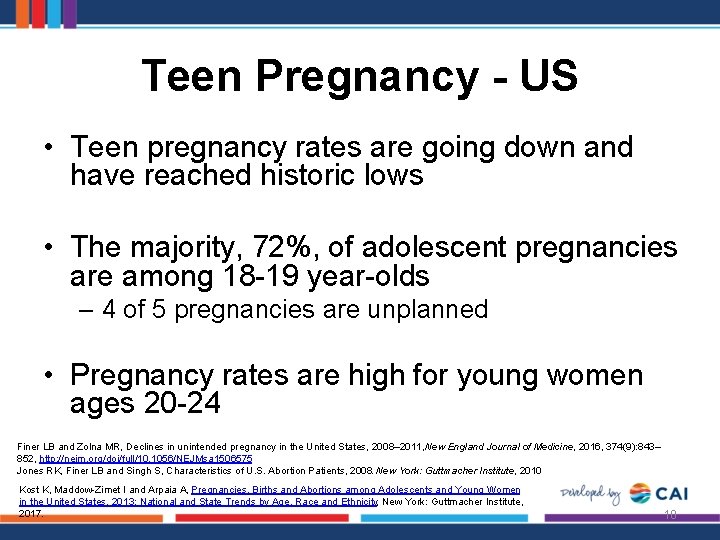
Teen Pregnancy - US • Teen pregnancy rates are going down and have reached historic lows • The majority, 72%, of adolescent pregnancies are among 18 -19 year-olds – 4 of 5 pregnancies are unplanned • Pregnancy rates are high for young women ages 20 -24 Finer LB and Zolna MR, Declines in unintended pregnancy in the United States, 2008– 2011, New England Journal of Medicine, 2016, 374(9): 843– 852, http: //nejm. org/doi/full/10. 1056/NEJMsa 1506575 Jones RK, Finer LB and Singh S, Characteristics of U. S. Abortion Patients, 2008. New York: Guttmacher Institute, 2010 Kost K, Maddow-Zimet I and Arpaia A, Pregnancies, Births and Abortions among Adolescents and Young Women in the United States, 2013: National and State Trends by Age, Race and Ethnicity, New York: Guttmacher Institute, 2017. 10
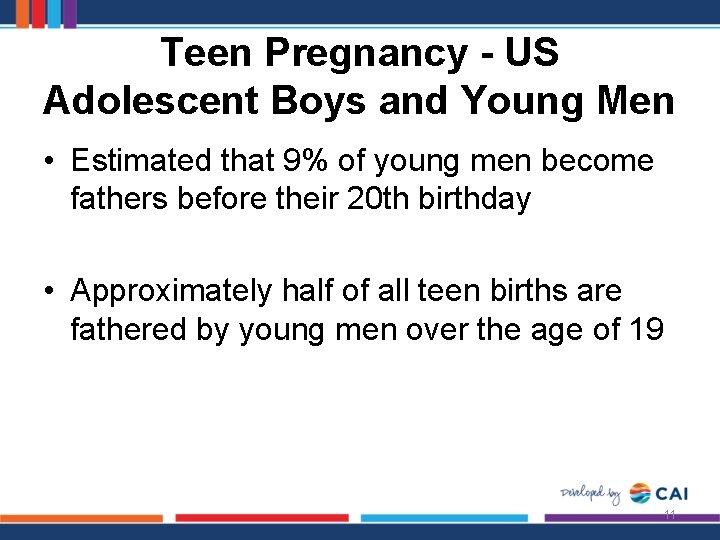
Teen Pregnancy - US Adolescent Boys and Young Men • Estimated that 9% of young men become fathers before their 20 th birthday • Approximately half of all teen births are fathered by young men over the age of 19 11
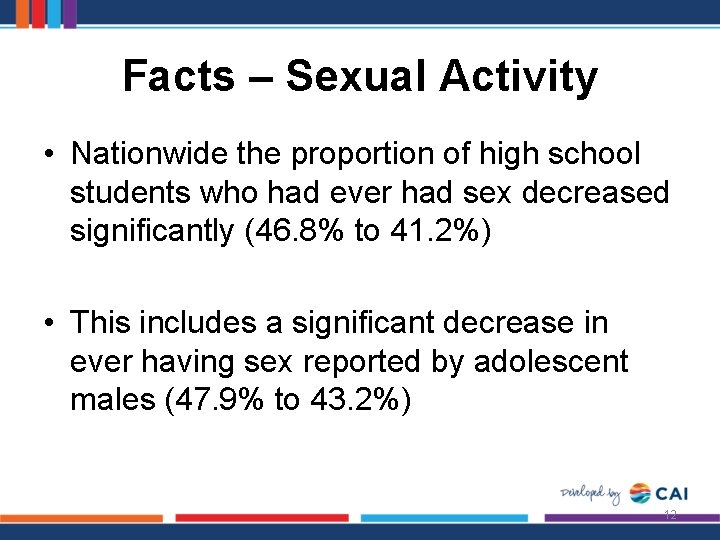
Facts – Sexual Activity • Nationwide the proportion of high school students who had ever had sex decreased significantly (46. 8% to 41. 2%) • This includes a significant decrease in ever having sex reported by adolescent males (47. 9% to 43. 2%) 12
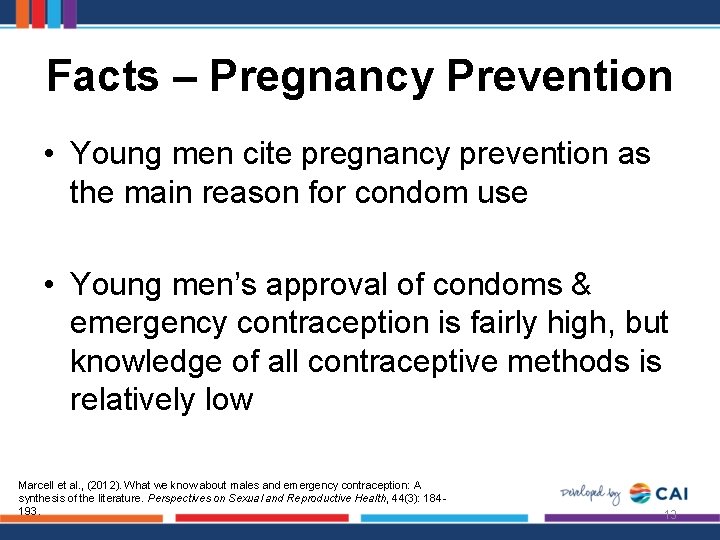
Facts – Pregnancy Prevention • Young men cite pregnancy prevention as the main reason for condom use • Young men’s approval of condoms & emergency contraception is fairly high, but knowledge of all contraceptive methods is relatively low Marcell et al. , (2012). What we know about males and emergency contraception: A synthesis of the literature. Perspectives on Sexual and Reproductive Health, 44(3): 184193. 13
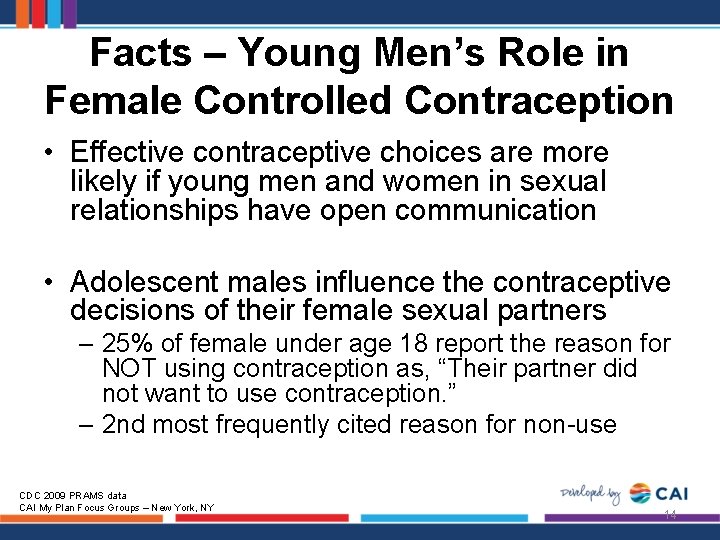
Facts – Young Men’s Role in Female Controlled Contraception • Effective contraceptive choices are more likely if young men and women in sexual relationships have open communication • Adolescent males influence the contraceptive decisions of their female sexual partners – 25% of female under age 18 report the reason for NOT using contraception as, “Their partner did not want to use contraception. ” – 2 nd most frequently cited reason for non-use CDC 2009 PRAMS data CAI My Plan Focus Groups – New York, NY 14
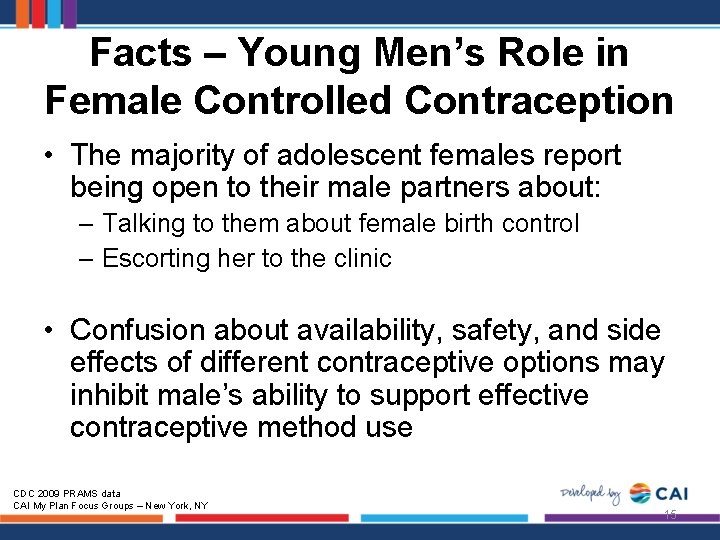
Facts – Young Men’s Role in Female Controlled Contraception • The majority of adolescent females report being open to their male partners about: – Talking to them about female birth control – Escorting her to the clinic • Confusion about availability, safety, and side effects of different contraceptive options may inhibit male’s ability to support effective contraceptive method use CDC 2009 PRAMS data CAI My Plan Focus Groups – New York, NY 15
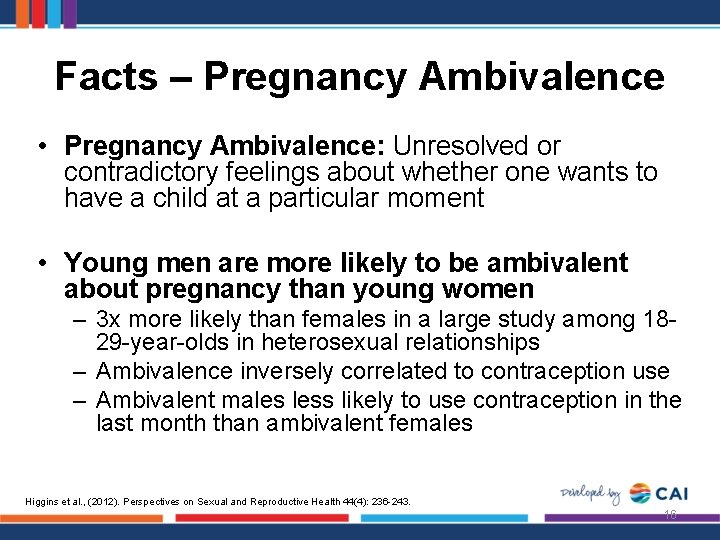
Facts – Pregnancy Ambivalence • Pregnancy Ambivalence: Unresolved or contradictory feelings about whether one wants to have a child at a particular moment • Young men are more likely to be ambivalent about pregnancy than young women – 3 x more likely than females in a large study among 1829 -year-olds in heterosexual relationships – Ambivalence inversely correlated to contraception use – Ambivalent males less likely to use contraception in the last month than ambivalent females Higgins et al. , (2012). Perspectives on Sexual and Reproductive Health 44(4): 236 -243. 16
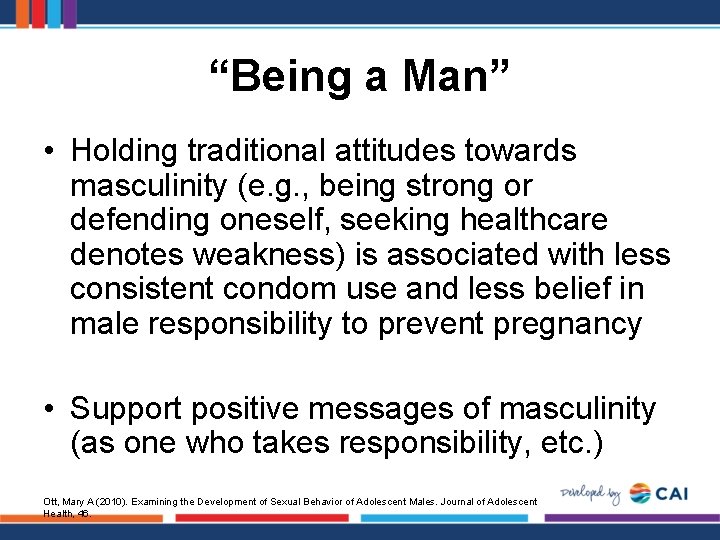
“Being a Man” • Holding traditional attitudes towards masculinity (e. g. , being strong or defending oneself, seeking healthcare denotes weakness) is associated with less consistent condom use and less belief in male responsibility to prevent pregnancy • Support positive messages of masculinity (as one who takes responsibility, etc. ) Ott, Mary A (2010). Examining the Development of Sexual Behavior of Adolescent Males. Journal of Adolescent Health, 46.
Facts – Teen Fathers • Most young fathers are 18 -19 years old at birth of child • Approximately one-half are members of racial/ethnic minority groups • Most teen fathers are not living with partner at birth of child Scott et al (2012). The Characteristics and Circumstances of Teen Fathers: At the Birth of Their First Child and Beyond. Child Trends Research Brief. Publication #2012 -19 18
Facts – Trauma and Fatherhood • Childhood experience of physical abuse, sexual abuse, or having witnessed your mother being abused increased the likelihood of being involved in a teen pregnancy by 70 -140% compared to those who hadn’t experienced abuse – Men who reported experiencing all three types of trauma in childhood were over 2 x more likely to be involved in a teen pregnancy F Anda, R & J Felitti, V & P Chapman, D & B Croft, J & F Williamson, D & Santelli, John & Dietz, Patricia & S Marks, J. (2001). Abused Boys, Battered Mothers, and Male Involvement in Teen Pregnancy. Pediatrics. 107. E 19. 10. 1542/peds. 107. 2. e 19.
Provide Pregnancy Prevention Regardless of Sexual Orientation • Young men who have sex with men and women are more likely than their heterosexual peers to be involved in an unintended pregnancy • At greater risk for STIs/HIV
Facts – Parents Want Our Help • Good care for teens includes validating the role of parents • Parents are our partners and need support – They are experiencing their own adjustment to their child’s adolescence • The more parents understand about the need for confidentiality, the more supportive they become Duncan RE, Vandeleur M, Derks A, Sawyer S. Confidentiality with adolescents in the medical setting: what do parents think? J Adolesc Health 2011; 49: 428 -30. Physicians for Reproductive Health. Providing Confidential Reproductive Health Care to Adolescents. Retrieved from: https: //prh. org/wp-content/uploads/Providing-Confidential-RH-Care. pptx
Facts – Parents Want Our Help • Research indicates that many parents or guardians are aware of teens’ intentions to seek SRH services – In one study, 60% of minors reported that a parent or guardian knew they were accessing sexual health services at a clinic Duncan RE, Vandeleur M, Derks A, Sawyer S. Confidentiality with adolescents in the medical setting: what do parents think? J Adolesc Health 2011; 49: 428 -30. Physicians for Reproductive Health. Providing Confidential Reproductive Health Care to Adolescents. Retrieved from: https: //prh. org/wp-content/uploads/Providing-Confidential-RH-Care. pptx
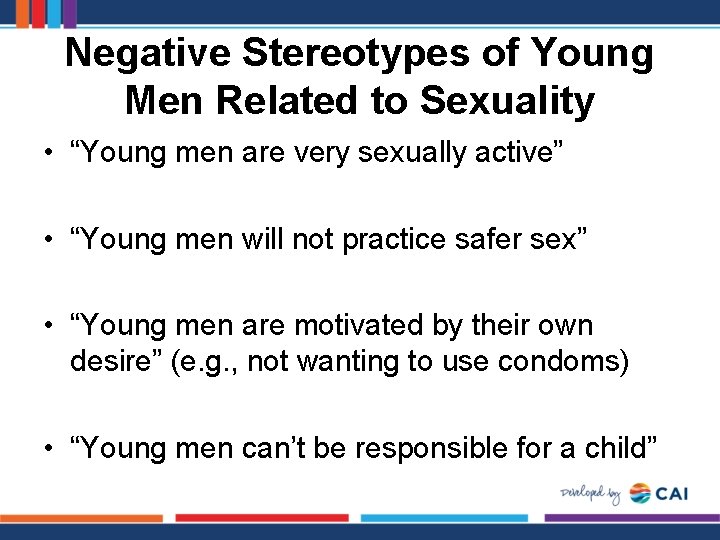
Negative Stereotypes of Young Men Related to Sexuality • “Young men are very sexually active” • “Young men will not practice safer sex” • “Young men are motivated by their own desire” (e. g. , not wanting to use condoms) • “Young men can’t be responsible for a child”
Influence of Negative Stereotypes How might these stereotypes affect our practice? 24
Integrating SRH into Your Conversations 25
Where Does Fatherhood and SRH Come Up in Conversation? 26
Questions to Consider in Your Small Groups • Where has fatherhood, contraception, STIs/HIV, and/or sexual relationships come up in your conversations with young men? • If this has not come up, consider a time when your gut said “something is going on” with a young male client, or you’ve been concerned for them with regard to STIs, unintended pregnancy, or other SRH. Share more about this experience. 27
Steps in Making a Referral 28
What is a Referral? • The term “referral” is used to describe a process of assisting youth in obtaining preventive health services through a variety of activities, including, but not limited to, connecting students to youthfriendly providers and support services. 29
Active and Passive Referrals • Active Referrals – Supporting a young person through a process of helping them to identify needed services and connecting with the service provider • Passive Referrals – Providing a young person with resources or information they need to take charge of pursuing needed services on their own 30
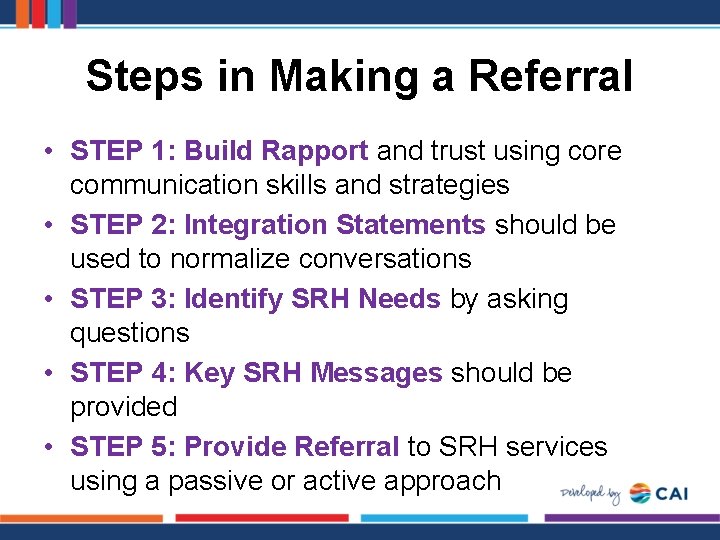
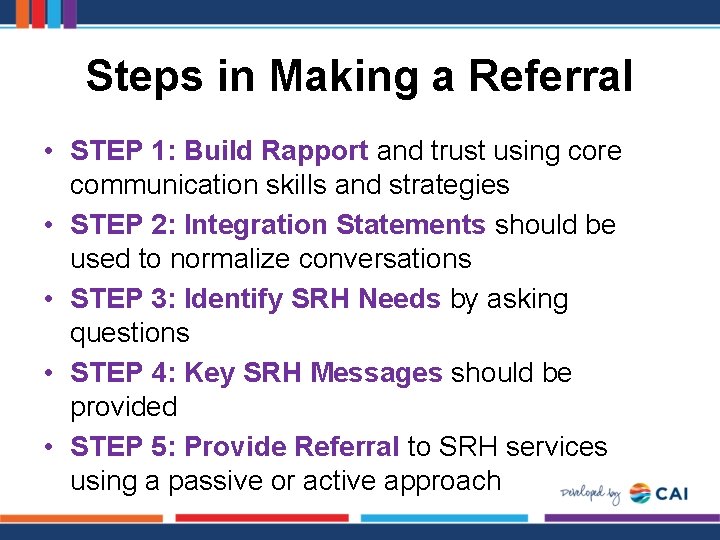
Steps in Making a Referral • STEP 1: Build Rapport and trust using core communication skills and strategies • STEP 2: Integration Statements should be used to normalize conversations • STEP 3: Identify SRH Needs by asking questions • STEP 4: Key SRH Messages should be provided • STEP 5: Provide Referral to SRH services using a passive or active approach
STEP 1: Build Rapport 32
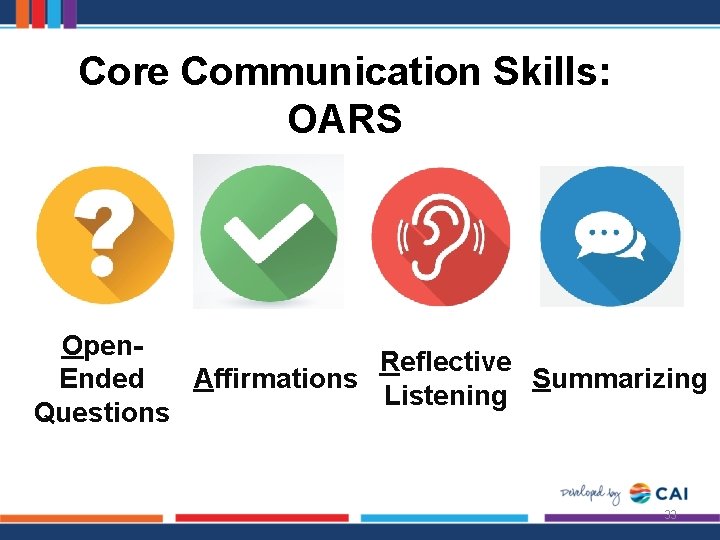
Core Communication Skills: OARS Open. Reflective Ended Affirmations Summarizing Listening Questions 33
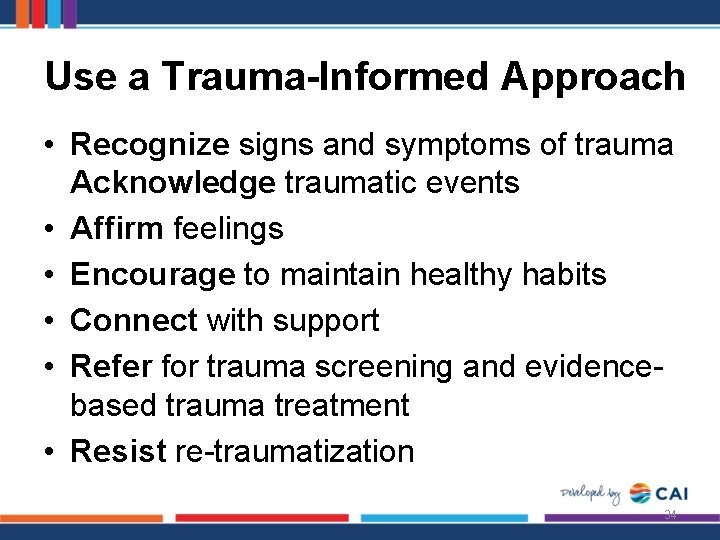
Use a Trauma-Informed Approach • Recognize signs and symptoms of trauma Acknowledge traumatic events • Affirm feelings • Encourage to maintain healthy habits • Connect with support • Refer for trauma screening and evidencebased trauma treatment • Resist re-traumatization 34
LGBTQI • LGBTQI stands for: – Lesbian – Gay – Bisexual – Transgender – Queer – Intersex 35
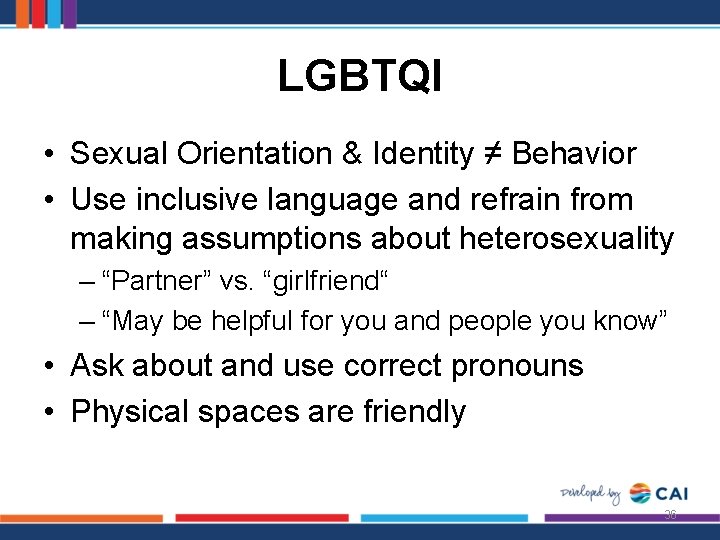
LGBTQI • Sexual Orientation & Identity ≠ Behavior • Use inclusive language and refrain from making assumptions about heterosexuality – “Partner” vs. “girlfriend“ – “May be helpful for you and people you know” • Ask about and use correct pronouns • Physical spaces are friendly 36
STEP 2: Integration Statements 37
What Does the Conversation Look Like? • How do we integrate a conversation about fatherhood and contraception into the conversations you are already having with young men? • How can we let the client know that they are not being “singled out” for this discussion? 38
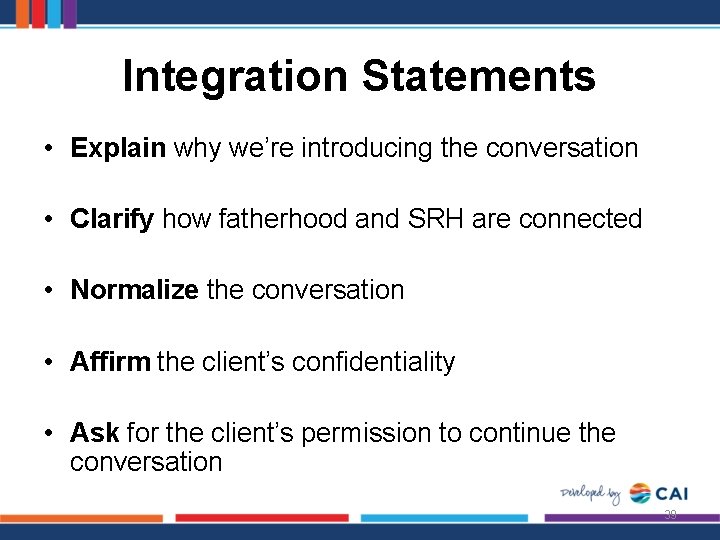
Integration Statements • Explain why we’re introducing the conversation • Clarify how fatherhood and SRH are connected • Normalize the conversation • Affirm the client’s confidentiality • Ask for the client’s permission to continue the conversation 39
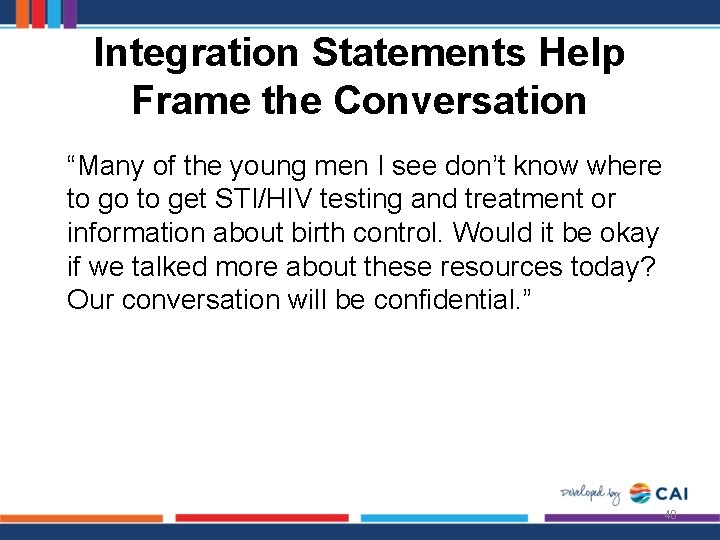
Integration Statements Help Frame the Conversation “Many of the young men I see don’t know where to go to get STI/HIV testing and treatment or information about birth control. Would it be okay if we talked more about these resources today? Our conversation will be confidential. ” 40
Let’s Practice Integration Statements 41
STEP 3: Identify SRH Needs 42
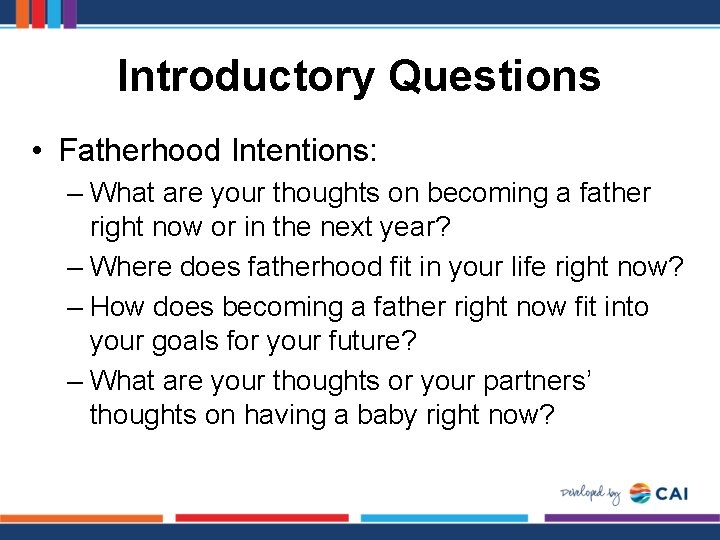
Introductory Questions • Fatherhood Intentions: – What are your thoughts on becoming a father right now or in the next year? – Where does fatherhood fit in your life right now? – How does becoming a father right now fit into your goals for your future? – What are your thoughts or your partners’ thoughts on having a baby right now?
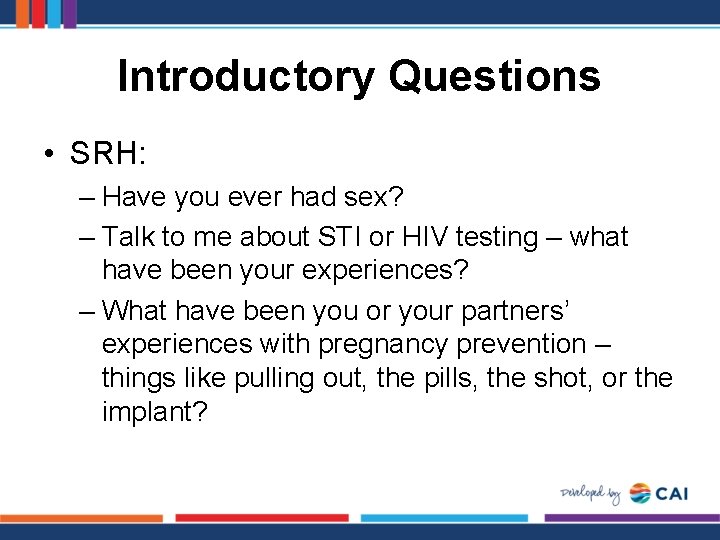
Introductory Questions • SRH: – Have you ever had sex? – Talk to me about STI or HIV testing – what have been your experiences? – What have been you or your partners’ experiences with pregnancy prevention – things like pulling out, the pills, the shot, or the implant?
STEP 4: Key SRH Messages 45
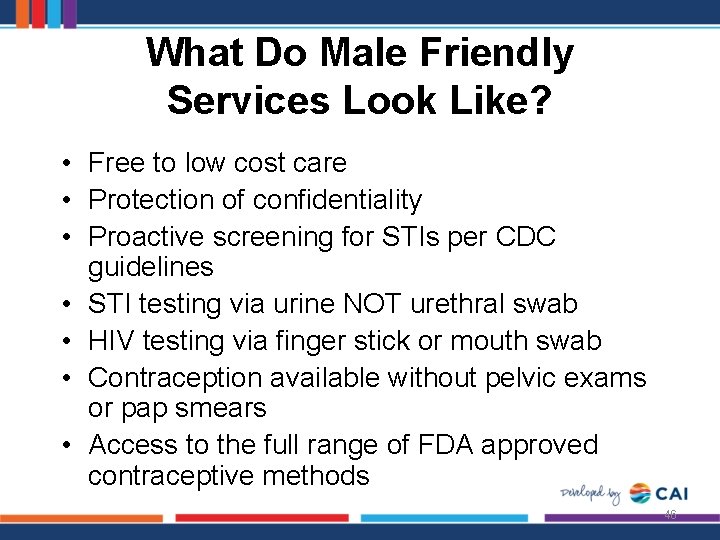
What Do Male Friendly Services Look Like? • Free to low cost care • Protection of confidentiality • Proactive screening for STIs per CDC guidelines • STI testing via urine NOT urethral swab • HIV testing via finger stick or mouth swab • Contraception available without pelvic exams or pap smears • Access to the full range of FDA approved contraceptive methods 46
Developing Key SRH Messages 47
Core Concepts When Delivering Messages to Young Men • Normalize the conversation and ask permission – Integration statements help! • Keep focus on their goals related to fatherhood, SRH, and how good health can help them achieve their goals in life 48
Core Concepts When Delivering Messages to Young Men • Be factual – Know you don’t need to be the expert, but you do know where to connect young men to experts who can assist them 49
Sexual and Reproductive Health Care Services Available For Young Men In Our Community
Minors’ Rights in Our State [Include a brief overview of laws regarding minors’ rights to SRH in your state]
Local Health Care Providers [List local health care providers that serve young men]
Services Available to Young Men [List services available to young men]
[Insert Pictures of Clinic]
For More Information [Include contact information for key clinic representatives]
STEP 5: Provide Referral 56
Steps in Making a Referral • STEP 1: Build Rapport and trust using core communication skills and strategies • STEP 2: Integration Statements should be used to normalize conversations • STEP 3: Identify SRH Needs by asking questions • STEP 4: Key SRH Messages should be provided • STEP 5: Provide Referral to SRH services using a passive or active approach
Skills and Strategies • • • Normalize Use OARS Be factual You don’t have to be the expert Use a trauma-informed approach Use LGBTQI+ inclusive language 58
Making a Referral: Role Plays 59
What Are We Taking Away? 60
THANK YOU! 61