
ENGAGING WITH GENERATION Y Face Book the Cool
ENGAGING WITH GENERATION Y Face. Book the Cool Tool
Engaging with Generation Y Today’s presentation focuses on the positive promise of social network sites namely the use of Face. Book in order to engage successfully with Generation Y
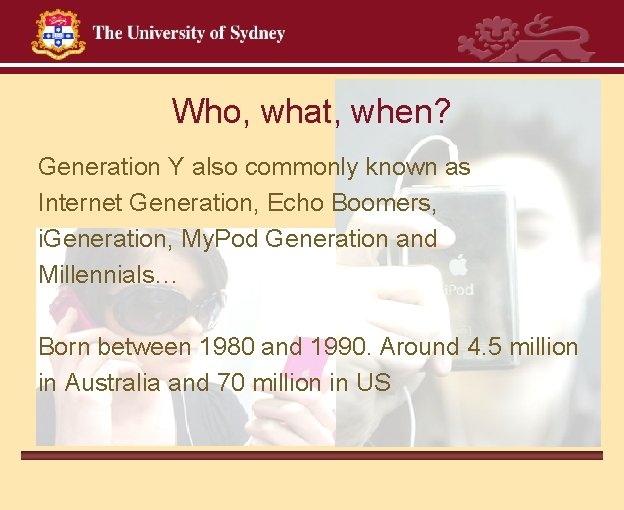
Who, what, when? Generation Y also commonly known as Internet Generation, Echo Boomers, i. Generation, My. Pod Generation and Millennials… Born between 1980 and 1990. Around 4. 5 million in Australia and 70 million in US
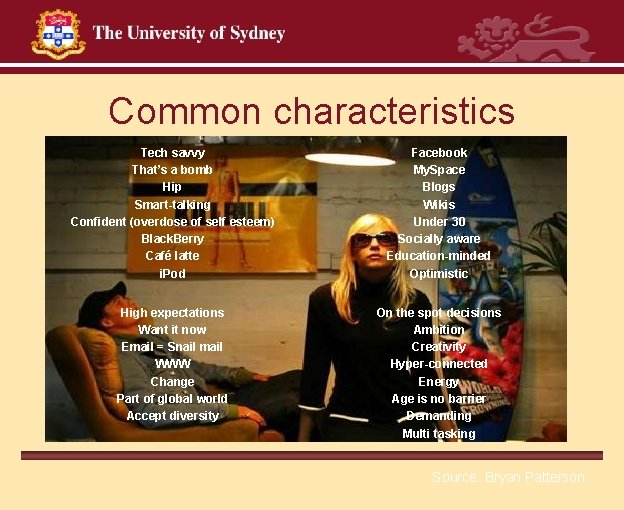
Common characteristics Tech savvy That’s a bomb Hip Smart-talking Confident (overdose of self esteem) Black. Berry Café latte i. Pod Facebook My. Space Blogs Wikis Under 30 Socially aware Education-minded Optimistic High expectations Want it now Email = Snail mail WWW Change Part of global world Accept diversity On the spot decisions Ambition Creativity Hyper-connected Energy Age is no barrier Demanding Multi tasking Source: Bryan Patterson
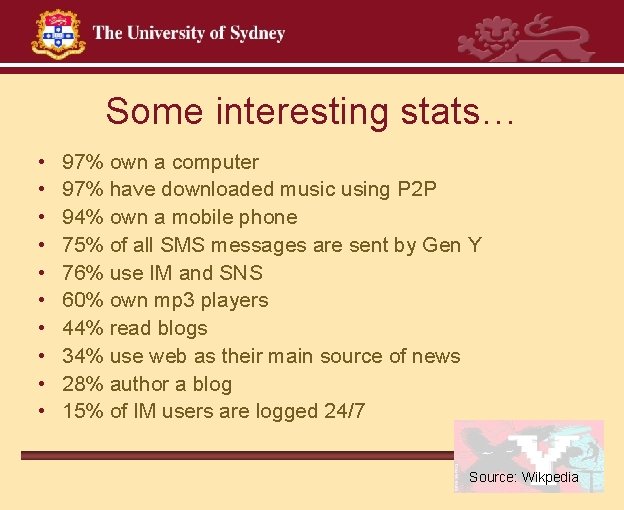
Some interesting stats… • • • 97% own a computer 97% have downloaded music using P 2 P 94% own a mobile phone 75% of all SMS messages are sent by Gen Y 76% use IM and SNS 60% own mp 3 players 44% read blogs 34% use web as their main source of news 28% author a blog 15% of IM users are logged 24/7 Source: Wikpedia
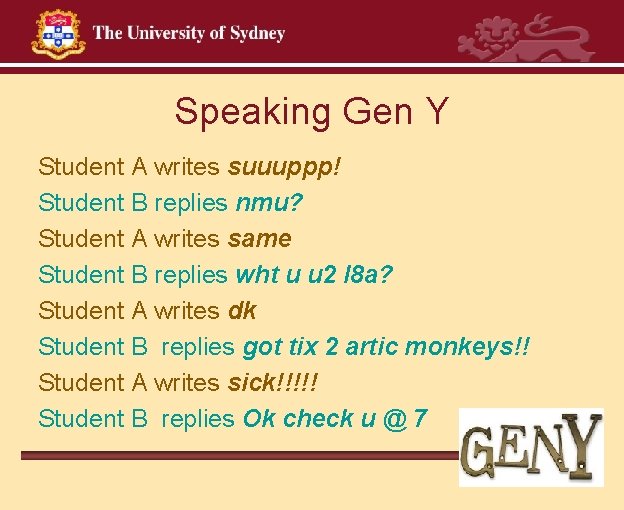
Speaking Gen Y Student A writes suuuppp! Student B replies nmu? Student A writes same Student B replies wht u u 2 l 8 a? Student A writes dk Student B replies got tix 2 artic monkeys!! Student A writes sick!!!!! Student B replies Ok check u @ 7
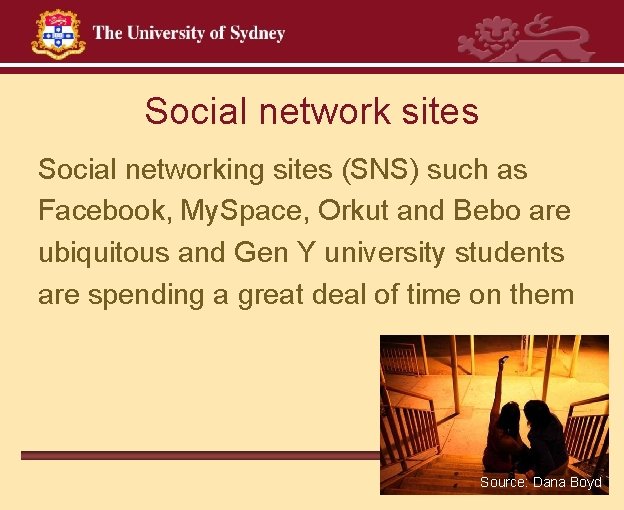
Social network sites Social networking sites (SNS) such as Facebook, My. Space, Orkut and Bebo are ubiquitous and Gen Y university students are spending a great deal of time on them Source: Dana Boyd
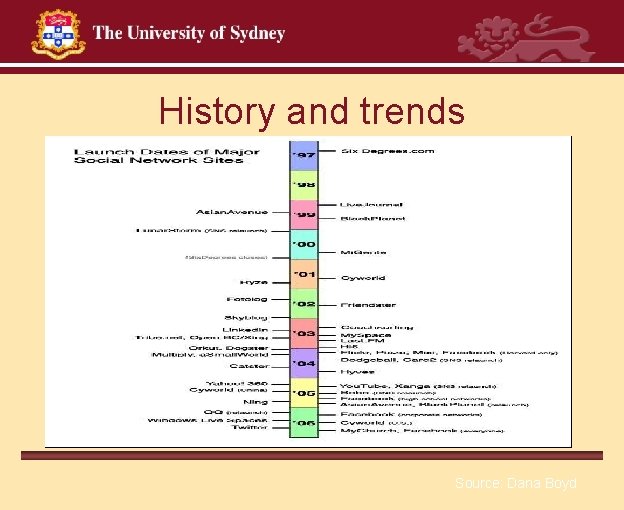
History and trends Source: Dana Boyd
Face. Book stats… • • More than 100 million active users 4 th most-trafficked website Most-trafficked SNS in the world Over 55, 000 regional, work-related, university and high school networks • Top photo sharing application • More than 24 million photos uploaded daily • More than 6 million active user groups
Cornell’s guidelines The IT Department of Cornell University highlighted the following 5 areas: 1. Invincibility 2. Caching 3. Freedom 4. Responsibility 5. The Law
Stutzman’s guidelines 1. Facebook is not going away. Students are curious and social networking is part of their life 2. Most of your undergraduates are already on Facebook 3. Students may not be smart about their privacy 4. Students do and say stupid things on these networks 5. Facebook has a unique culture
Stutzman’s Guidelines 6. Sometimes there are very positive and touching moments on social networking tools 7. Your campus IT does not offer anything like this for students 8. Students are trying out their identities on these networks 9. Figure out how to use these networks for positive learning interactions and provide guidance to your students 10. Do not try to kick students out of school, but, also, do not turn a blind eye to the phenomenon
Why Face. Book? Let’s take a common study abroad scenario…Anna will spend her next semester studying at the University of Sydney…
How does it work? Live demonstration…The University of Sydney’s 2008 Study Abroad and Exchange Facebook Group www. facebook. com
Random comments Chris said…I am a college Freshman going to Boston University. I often use Facebook to check up on friends status and parties in the works. What is surprising about Facebook is that at BU the Dean of Public Safety have over 100 friends from BU and colleges in the area. It is a great tool to use to get in contact with him if you ever needed…
Random comments CR said. . . I just heard a faculty member at another university mention that he uses Facebook for his advisees/majors. He posts general information and updates to help direct these students about upcoming events, appointment scheduling, and changes. By using Facebook, students receive (and read!? ) the information within 2 minutes, rather than using Blackboard and only get the information after they log in (and if they read the Announcements)…
Random comments Robert French said…Facebook’s reach within the college population is stunning. They have penetrated the market so completely that it has become part of the college experience…
Conclusions • • • Improve social capital Build connections and friendships with other students Create new relationships and affinities Help students to improve their sense of belonging Educate students on appropriate citizenship in online communities Collect and share information Send messages to targeted groups Help establish connections to alumni Develop potential opportunities for professional development and networking
Resources • Facebook www. facebook. com • Bryan Patterson, A-Z of Generation http: //www. news. com. au/heraldsun/story/0, 219 85, 22034750 -5006016, 00. html • Fred Stutzman How University Administrators Should Approach the Facebook: Ten Rules http: //fstutzman. com • Danah Boyd http: //www. danah. org/ • Educause www. educause. edu/eli
- Slides: 19