
Engaging UCSF and Community Partners in Effective Workplace
- Slides: 28
Engaging UCSF and Community Partners in Effective Workplace Learning Christy Boscardin, Ph. D Naomi Wortis, MD Bridget O’Brien, Ph. D
Creative Commons License Engaging UCSF and Community Partners in Effective Workplace Learning is licensed under a Creative Commons Attribution-Non. Commercial-Share. Alike 4. 0 International License. You are free to: • Share — copy and redistribute the material in any medium or format • Adapt — remix, transform, and build upon the material The licensor cannot revoke these freedoms as long as you follow the license terms. Under the following terms: • • Attribution — You must give appropriate credit, provide a link to the license, and indicate if changes were made. You may do so in any reasonable manner, but not in any way that suggests the licensor endorses you or your use. Non. Commercial — You may not use the material for commercial purposes. Share. Alike — If you remix, transform, or build upon the material, you must distribute your contributions under the same license as the original. No additional restrictions — You may not apply legal terms or technological measures that legally restrict others from doing anything the license permits.
Workshop Objectives • Describe key principles of community engaged workplace learning • Discuss the benefits of conducting needs and resource assessments of both learners and sites • Develop a plan for placement of learners at a site • Devise a placement guideline template that can be used for a range of placements • Identify existing resources to help prepare learners and sites
Workshop Agenda • • Introductions Presentations Introduction of template examples Small group work on template/checklist development • Report back to large group and refine template • Future plans and evaluation
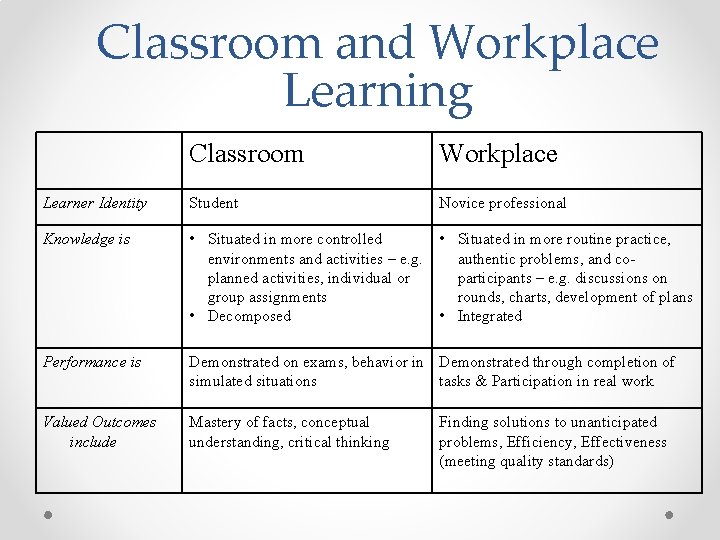
Classroom and Workplace Learning Classroom Workplace Learner Identity Student Novice professional Knowledge is • Situated in more controlled environments and activities – e. g. planned activities, individual or group assignments • Decomposed • Situated in more routine practice, authentic problems, and coparticipants – e. g. discussions on rounds, charts, development of plans • Integrated Performance is Demonstrated on exams, behavior in Demonstrated through completion of simulated situations tasks & Participation in real work Valued Outcomes include Mastery of facts, conceptual understanding, critical thinking Finding solutions to unanticipated problems, Efficiency, Effectiveness (meeting quality standards)
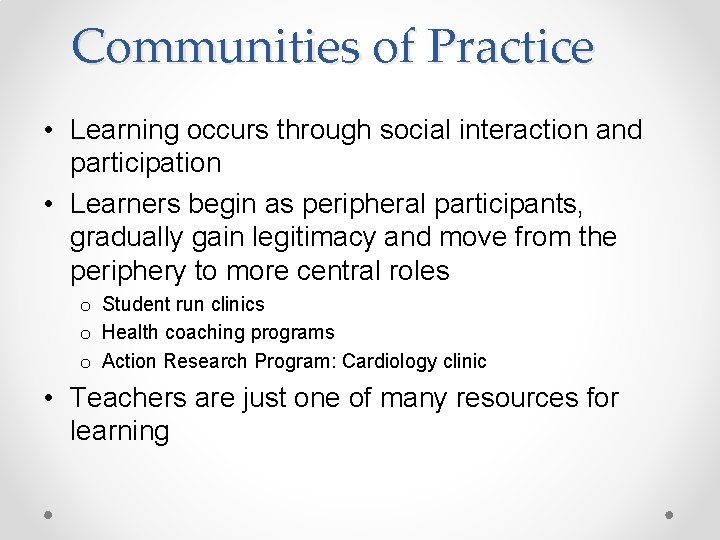
Communities of Practice • Learning occurs through social interaction and participation • Learners begin as peripheral participants, gradually gain legitimacy and move from the periphery to more central roles o Student run clinics o Health coaching programs o Action Research Program: Cardiology clinic • Teachers are just one of many resources for learning
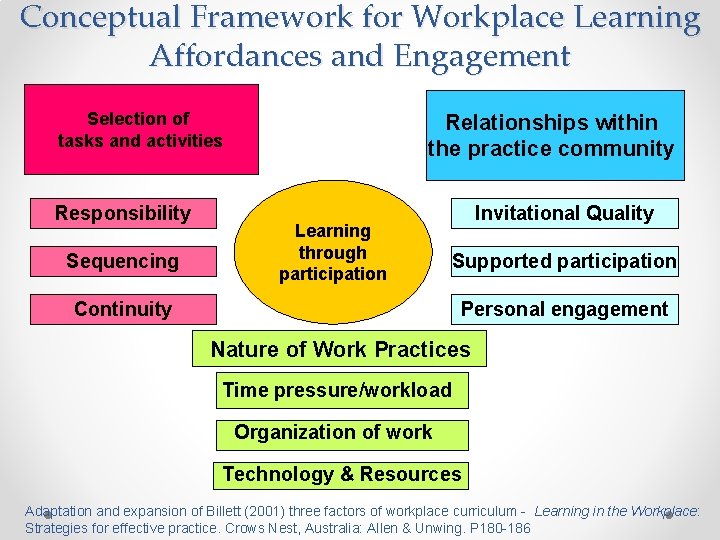
Conceptual Framework for Workplace Learning Affordances and Engagement Selection of tasks and activities Responsibility Sequencing Relationships within the practice community Learning through participation Continuity Invitational Quality Supported participation Personal engagement Nature of Work Practices Time pressure/workload Organization of work Technology & Resources Adaptation and expansion of Billett (2001) three factors of workplace curriculum - Learning in the Workplace: Strategies for effective practice. Crows Nest, Australia: Allen & Unwing. P 180 -186
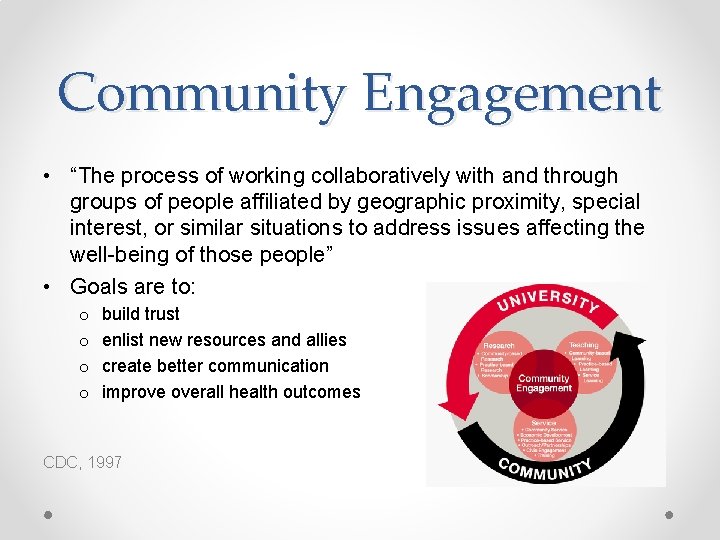
Community Engagement • “The process of working collaboratively with and through groups of people affiliated by geographic proximity, special interest, or similar situations to address issues affecting the well-being of those people” • Goals are to: o o build trust enlist new resources and allies create better communication improve overall health outcomes CDC, 1997
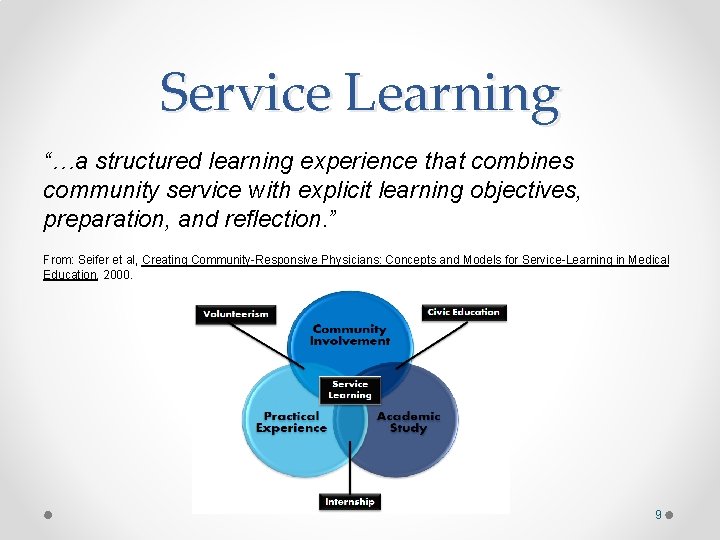
Service Learning “…a structured learning experience that combines community service with explicit learning objectives, preparation, and reflection. ” From: Seifer et al, Creating Community-Responsive Physicians: Concepts and Models for Service-Learning in Medical Education, 2000. 9
Service Learning… • Developed, implemented, and evaluated in collaboration with the community • Responds to community-identified concerns • Attempts to balance the service that is provided and the learning that takes place • Enhances the curriculum by extending learning beyond the lecture hall and allowing students to apply what they are learning to real-world situations • Provides opportunities for critical reflection 10
Service Learning v. Traditional Clinical Education • Balance between service and learning objectives • Emphasis on reciprocal learning • Emphasis on more than individual interactions • Emphasis on reflective practice • Integral role of community partners 11
Service Learning Opportunities • Community Partners o Service, economic, and social benefits o Opportunity to teach next generation of health professionals o Increased awareness of institutional assets/limitations • Students o Transformational learning experiences o Awareness of determinants of health o Become more community-responsive, culturally competent health professionals • Faculty o Increased understanding of community issues o New scholarship directions • All o Wonderful relationships—linking complementary skills and resources o New/better ways to solve problems o Capacity building 12
Example
Tips for Successful Service Learning Partnerships • • Point people for communication continuity Shared understanding and expectations from outset Community guides project design & implementation Clear plan for tangible product of use to community Be flexible and open Mutual respect Cultural humility 14
Principles of Partnership UCSF’s University Community Partnership Office encourages all partners to adhere to the following principles of partnership, adapted from Community Campus Partnerships for Health: • • • Partners have agreed upon mission, values, goals and measurable outcomes for the partnership. The relationship between partners is characterized by mutual trust, respect, genuineness and commitment. The partnership builds upon identified strengths and assets, but also addresses areas that need improvement. The partnership balances power among partners and enables resources among partners to be shared. There is clear, open and accessible communication between partners, making it an ongoing priority to listen to each need, develop a common language and validate/clarify the meaning of terms. Roles, norms, and processes for the partnership are established with the input and agreement of all partners. There is feedback to, among, and from all stakeholders in the partnership, with the goal of continuously improving the partnership and its outcomes. Partners share the credit for the partnership's accomplishments. Partnerships take time to develop and evolve over time. Partners embrace the art of evaluation, documenting whenever possible their process and measuring their interventions to create transparency, accountability and replicability. Partners plan together the dissemination of research findings into translatable and practical applications with the community. Sources: Community-Campus Partnerships for Health, Community Partnership Resource Center and University Community Partnerships at UCSF CCPH: https: //ccph. memberclicks. net/principles-of-partnership
Assessment of Needs and Resources • Yours and theirs • Benefits o Address need prioritized by the site o Understand context o Build on existing resources; don’t reinvent them o Increase chance of sustainable change
Partnership Clarity • Who are we separately? o What are our missions/goals? o What are our needs? o What are our resources? • Who are we together? Do we have a shared mission/goal? • How will we agree to proceed? o What will we do together? o What are our respective roles? o How will we keep communication open? • What will we both get out of this partnership? • How will we share power and/or redress power imbalances? 17
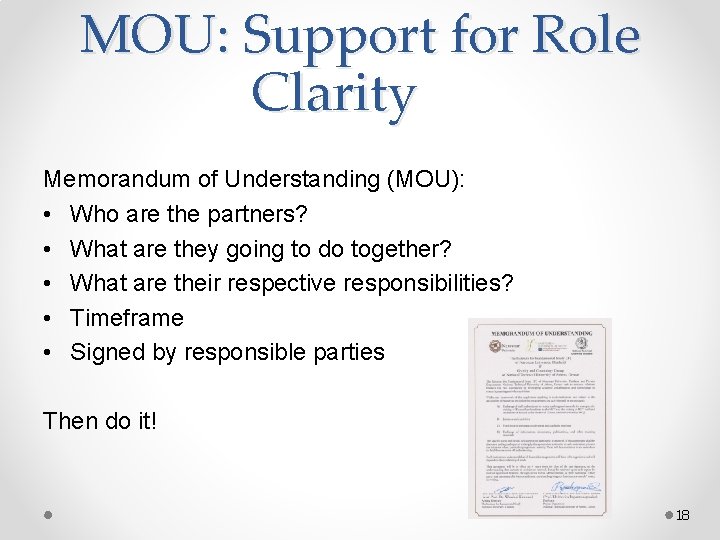
MOU: Support for Role Clarity Memorandum of Understanding (MOU): • Who are the partners? • What are they going to do together? • What are their respective responsibilities? • Timeframe • Signed by responsible parties Then do it! 18
Existing UCSF Resources • UCSF Office of University Community Partnerships (UCP) o http: //partnerships. ucsf. edu/ • UCP Community Engagement online modules o https: //courses. ucsf. edu/course/view. php? id=42 o http: //partnerships. ucsf. edu/cemodules (for those outside UCSF) • UCSF CTSI Community Engagement & Health Policy Program o http: //ctsi. ucsf. edu/about-us/programs/community-engagement-health-policy
University Community Partnerships Office • Our Vision To actively improve the quality of life and promote health equity throughout our communities by cultivating, sustaining and advancing strong collaborative partnerships that model excellence in University and community engagement. • Our Mission To build collaborative relationships between UCSF and the community, promoting civic engagement, fostering community health and well-being, and enhancing the environment for education, patient care, research, and employment at UCSF. The Office serves as a bridge between UCSF and local communities, emphasizing partnerships that value and respect the assets and diversity of both. 20
UCP CE Modules • Modules include: 1. Introduction to Community Engagement 2. Introduction to San Francisco’s Diverse Communities 3. Health Communication 4. Community Assessment 5. Partnering with UCSF (for community partners) • Each module runs approximately 20 -30 minutes
Action Research Program • Implementation Science courses within Training in Clinical Research Program • Increase experiential learning component to focus on the unique culture/context that define specific settings • Partnering with the health care setting to improve their own practices/environment • Designed for MS 1 s and MS 2 s
Community-Based Participatory Research (CBPR) • Contexts: Clinical context, Capacity and Readiness, Importance of the problem identified. • Group Dynamics: Incorporate equitable partnerships, decision-making, problem identification, and reciprocal learning • Intervention: Fits local and cultural beliefs, norms, and practice • Outcomes: System and capacity changes, sustainability, community empowerment
Action Research Program in Cardiology • Cardiology leadership and staff identified clinic improvement areas: patient satisfaction, provider satisfaction, staff recognition • Conducted clinic observations • Co-designed a pilot intervention • Co-developed intervention protocols: List of training components for the Clinic vs. ARP team • Co-developed logic model to identify appropriate outcomes
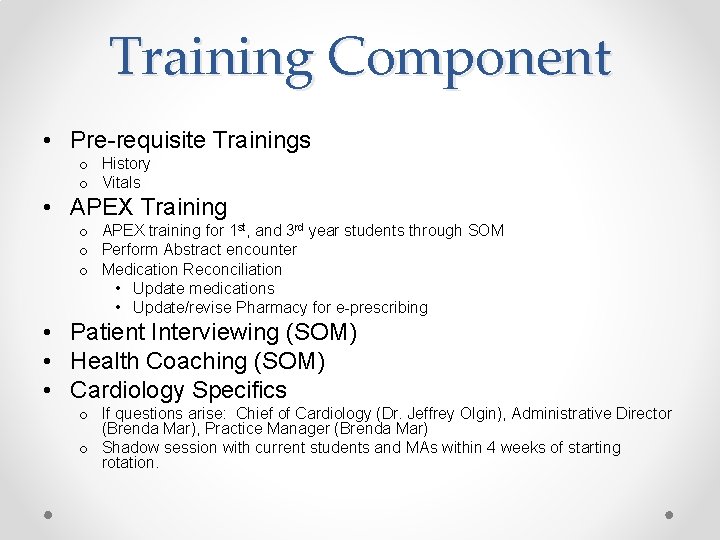
Training Component • Pre-requisite Trainings o History o Vitals • APEX Training o APEX training for 1 st, and 3 rd year students through SOM o Perform Abstract encounter o Medication Reconciliation • Update medications • Update/revise Pharmacy for e-prescribing • Patient Interviewing (SOM) • Health Coaching (SOM) • Cardiology Specifics o If questions arise: Chief of Cardiology (Dr. Jeffrey Olgin), Administrative Director (Brenda Mar), Practice Manager (Brenda Mar) o Shadow session with current students and MAs within 4 weeks of starting rotation.
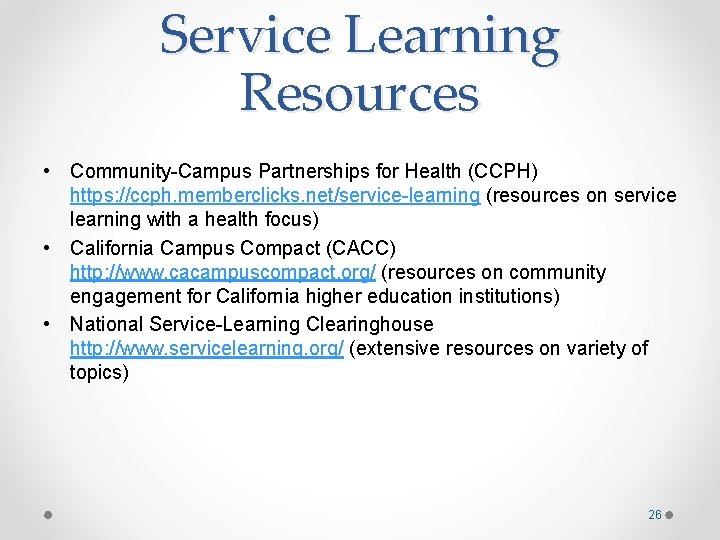
Service Learning Resources • Community-Campus Partnerships for Health (CCPH) https: //ccph. memberclicks. net/service-learning (resources on service learning with a health focus) • California Campus Compact (CACC) http: //www. cacampuscompact. org/ (resources on community engagement for California higher education institutions) • National Service-Learning Clearinghouse http: //www. servicelearning. org/ (extensive resources on variety of topics) 26
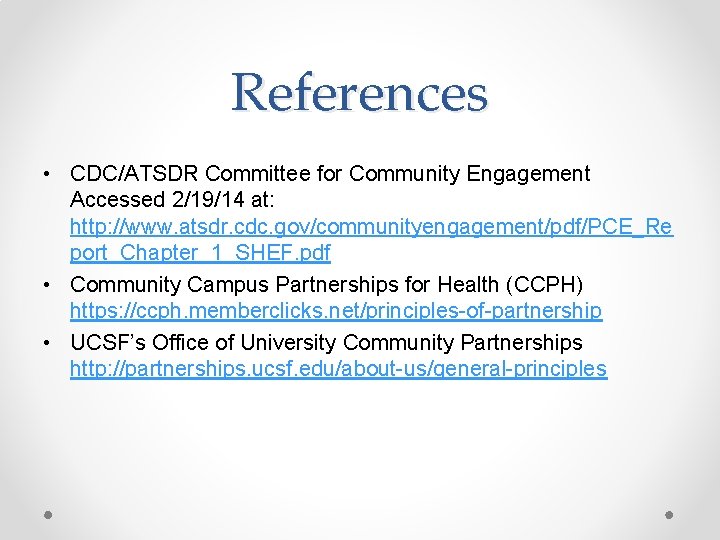
References • CDC/ATSDR Committee for Community Engagement Accessed 2/19/14 at: http: //www. atsdr. cdc. gov/communityengagement/pdf/PCE_Re port_Chapter_1_SHEF. pdf • Community Campus Partnerships for Health (CCPH) https: //ccph. memberclicks. net/principles-of-partnership • UCSF’s Office of University Community Partnerships http: //partnerships. ucsf. edu/about-us/general-principles
Introduce Templates