
Engaging the Online Learner Building Community through Asynchronous
Engaging the Online Learner: Building Community through Asynchronous Discussion Glenna Decker Danielle Lake
How do you define / describe student engagement? How important is it to student learning?
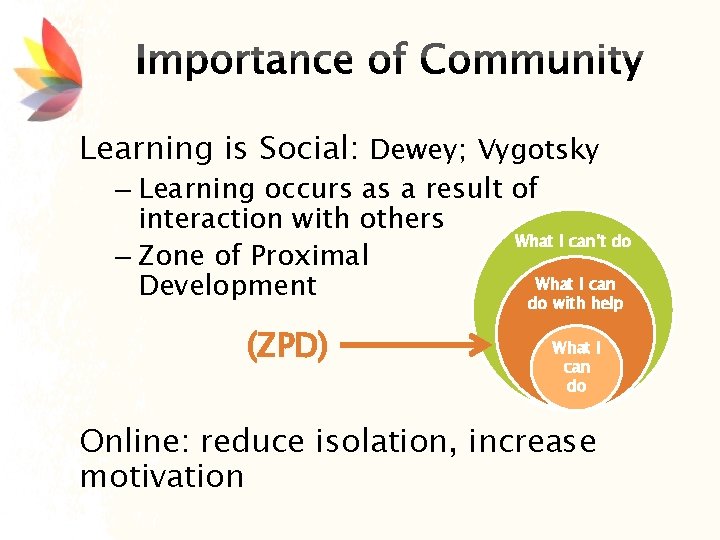
Learning is Social: Dewey; Vygotsky – Learning occurs as a result of interaction with others What I can’t do – Zone of Proximal What I can Development do with help (ZPD) What I can do Online: reduce isolation, increase motivation

The “traditional ideal in higher education has been discourse and reflection in a collaborative community of scholars. It is argued here that constructivist approaches and community are necessary for creating and confirming meaning and are essential for achieving effective critical thinking. Therefore, constructivist approaches and community must be necessary parts of higher education. In online higher education, building community is particularly important because it cannot be taken for Swan & Garrison granted”
US 201: Danielle Lake Students pre-/post-survey designed to track • their feelings about social class issues • their place in their virtual or face-to-face classroom (do they see themselves as outsiders or as a part of a community? ), • their willingness to speak honestly and openly, and • their own perceptions about how varied course content and dialogue impacted their perspective on social class.
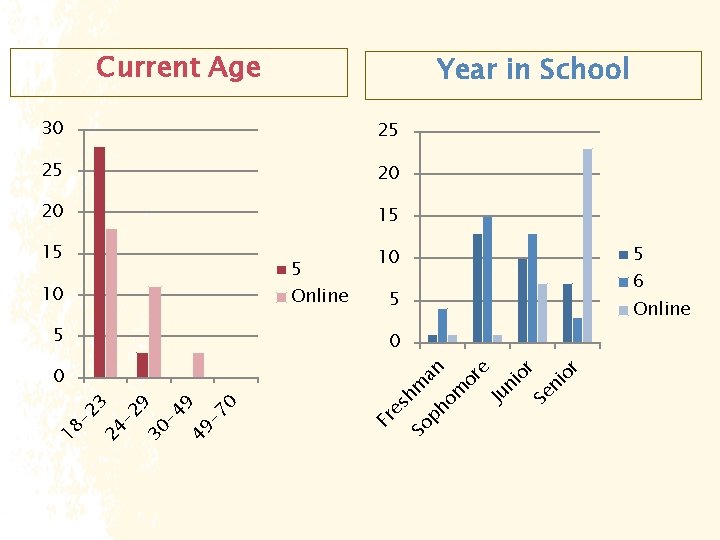
Current Age Year in School 30 25 25 20 20 15 15 10 Online 5 5 6 5 Online or r Se ni ni o Ju om So ph es h Fr 70 49 - 49 30 - 29 24 - 18 - 23 m an 0 or e 0
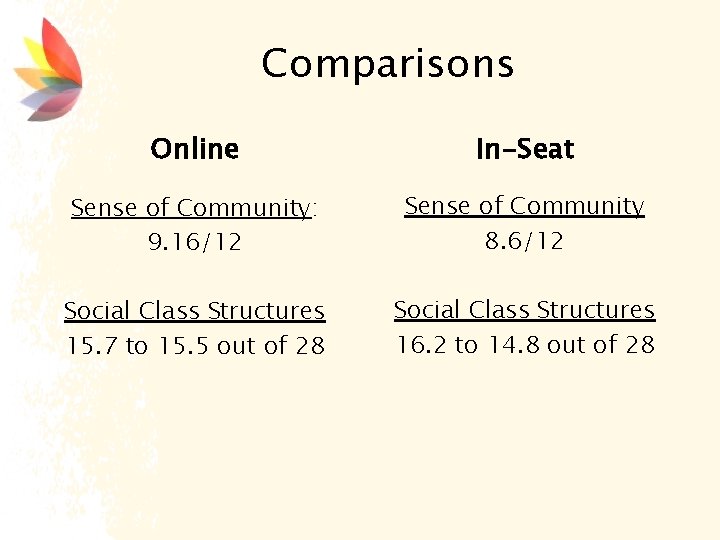
Comparisons Online In-Seat Sense of Community: 9. 16/12 Sense of Community 8. 6/12 Social Class Structures 15. 7 to 15. 5 out of 28 Social Class Structures 16. 2 to 14. 8 out of 28
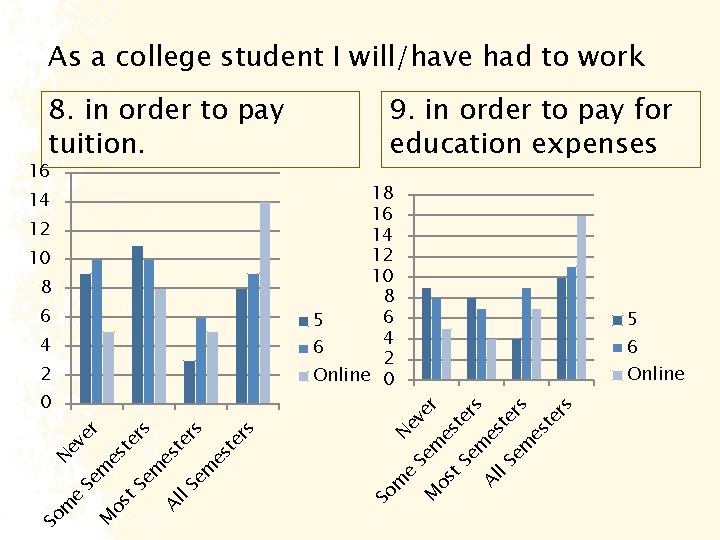
As a college student I will/have had to work 8. in order to pay tuition. 16 9. in order to pay for education expenses 18 16 14 12 10 8 6 5 4 6 2 Online 0 14 12 10 8 6 4 2 6 Online M te rs Al e l S ste em rs es te rs os t. S m Se em es ev N e m So es te t. S em rs es Al te l. S em rs es te rs os M So m e Se m N ev er er 0 5
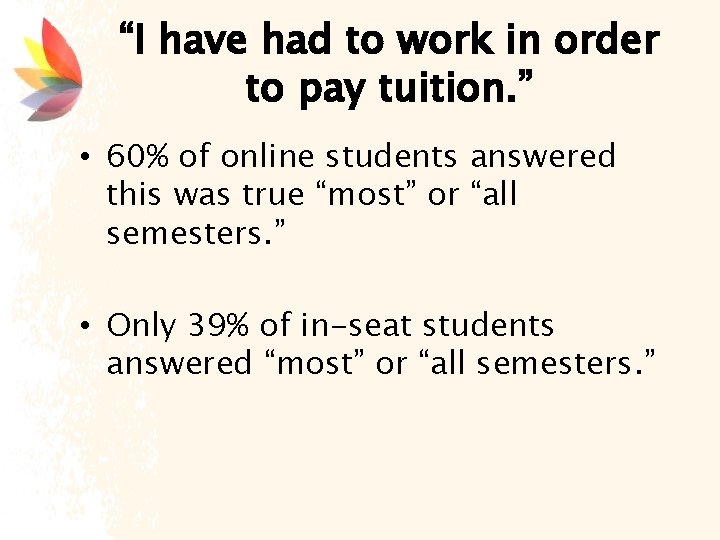
“I have had to work in order to pay tuition. ” • 60% of online students answered this was true “most” or “all semesters. ” • Only 39% of in-seat students answered “most” or “all semesters. ”
GROUND RULE SAMPLES • Acknowledge our OWN biases. • Respond thoughtfully to one another. • Try not to be experts. Feel free to think out loud. • Adopt a “not-knowing stance. ” • Ask questions of GENUINE INTEREST. • Acknowledge the complexities and inconsistencies in our own views. • Speak only from our own experience. • Create a safe space for honest reflection by respecting confidentiality.
Online Differences • Instructor de-centered • Instructor can be “everywhere” • Students’ contributions – more equitable – Often more articulate, nuanced, detailed • Student-student, student-content, student-instructor interactions more seamlessly interwoven
Moving Forward • Case Studies? • Personal voice, narrative, poetry, story, movies • Dialogue with the goal of collective problem solving?
Community of Inquiry (Co. I) Framework http: //communitiesofinquiry. com/ • A process model of learning • Grounded in a social-constructivist epistemology • Assumes effective learning requires the development of a community of learners that supports meaningful inquiry • Learning occurs because of the interaction of social, cognitive and teaching presence Garrison, Anderson & Archer, 2000
Community … community means meaningful association, association based on common interest and endeavor. The essence of community is communication… John Dewey, 1916 Vaughn, N. (2011) Designing for an inquiry-based approach to blended learning. Presentation at New York University
Inquiry • Is problem or question driven • Includes critical discourse • Incorporates research methods such as information gathering and synthesis of ideas Vaughn, N. (2011) Designing for an inquiry-based approach to blended learning. Presentation at New York University
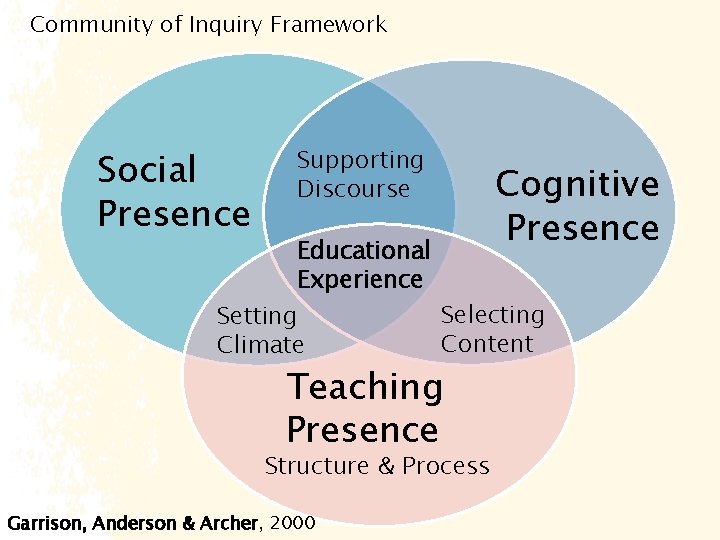
Community of Inquiry Framework Social Presence Supporting Discourse Educational Experience Setting Climate Cognitive Presence Selecting Content Teaching Presence Structure & Process Garrison, Anderson & Archer, 2000
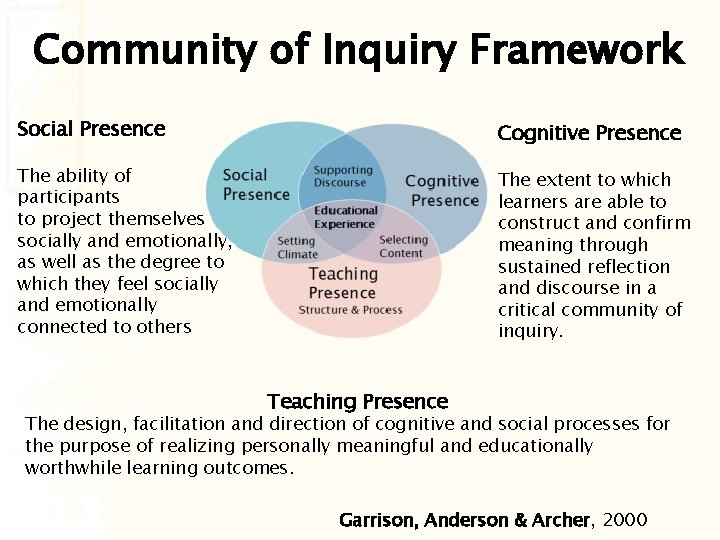
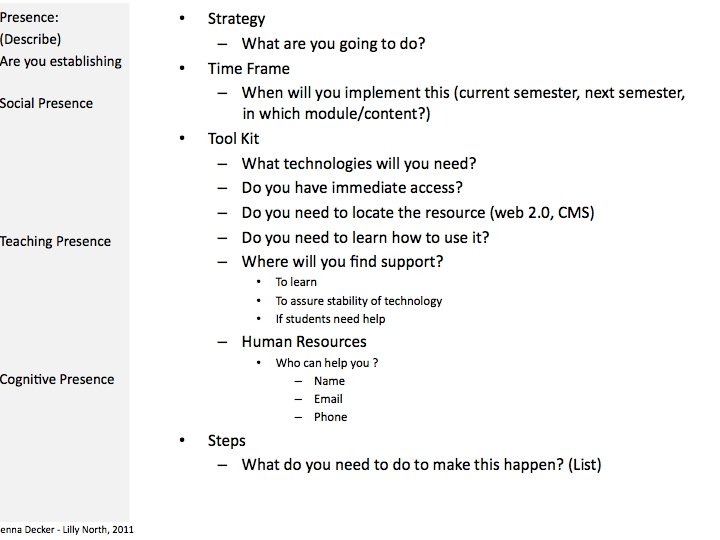
Community of Inquiry Framework Social Presence Cognitive Presence The ability of participants to project themselves socially and emotionally, as well as the degree to which they feel socially and emotionally connected to others The extent to which learners are able to construct and confirm meaning through sustained reflection and discourse in a critical community of inquiry. Teaching Presence The design, facilitation and direction of cognitive and social processes for the purpose of realizing personally meaningful and educationally worthwhile learning outcomes. Garrison, Anderson & Archer, 2000
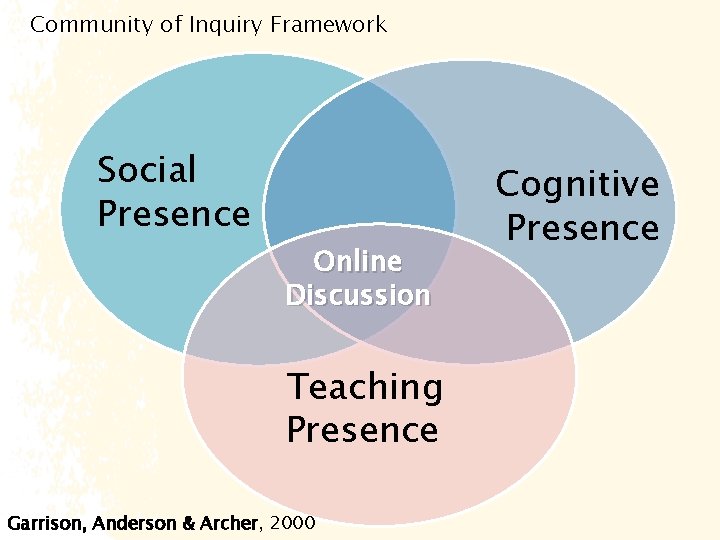
Community of Inquiry Framework Social Presence Online Discussion Teaching Presence Garrison, Anderson & Archer, 2000 Cognitive Presence
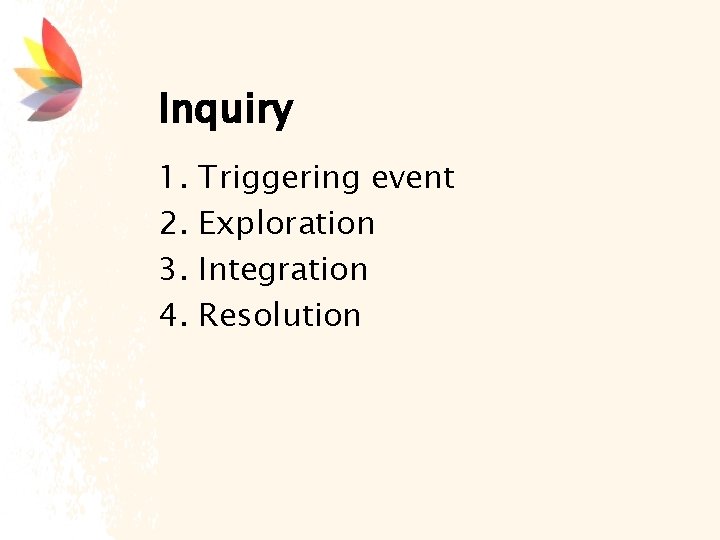
Inquiry 1. Triggering event 2. Exploration 3. Integration 4. Resolution
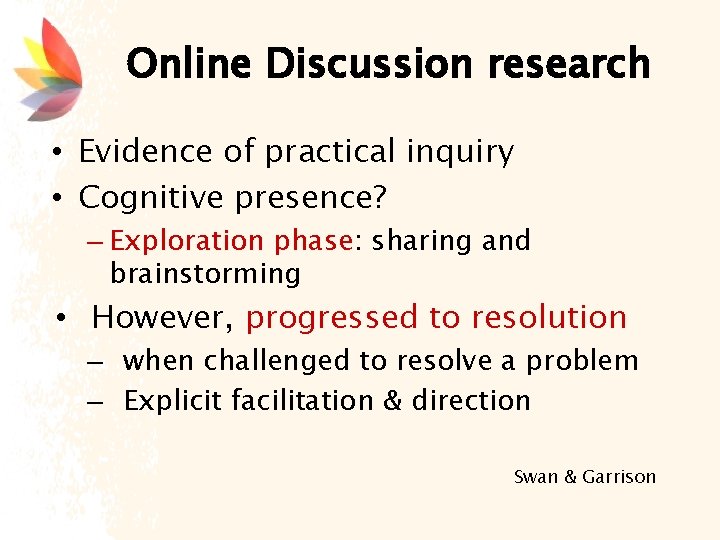
Online Discussion research • Evidence of practical inquiry • Cognitive presence? – Exploration phase: sharing and brainstorming • However, progressed to resolution – when challenged to resolve a problem – Explicit facilitation & direction Swan & Garrison

Considerations for ONLINE DISCUSSION
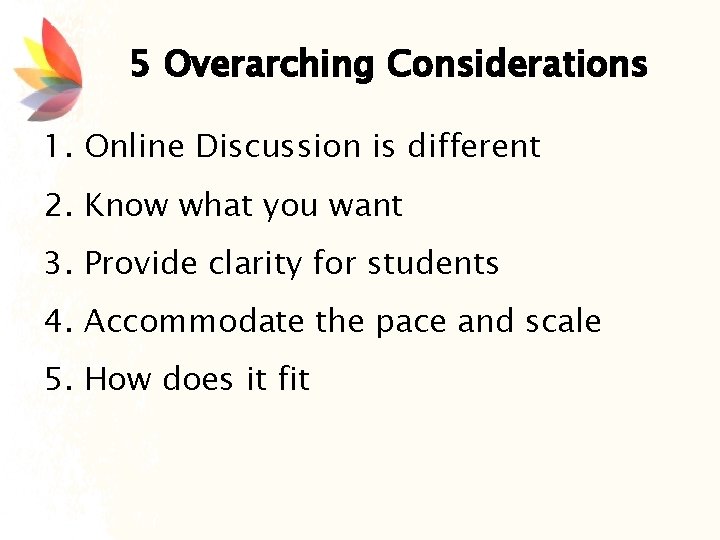
5 Overarching Considerations 1. Online Discussion is different 2. Know what you want 3. Provide clarity for students 4. Accommodate the pace and scale 5. How does it fit
1. Online Discussion is different. • Online discussion is fundamentally different from a traditional in-seat class discussion • We assign the same paradigm to two very different approaches because we use similar language for them • Use the medium for its own strengths
2. Know what you want • What are your objectives? • Exploration? Integration ? Resolution ? • Discussion, dialogue, and discourse • Formal? Informal? Structurally, grammatically correct? Citations? Opinion? Informed by literature, research, or fact?

Deliberation/Dialogue • Dialogue – focus on mutual understanding • Deliberation – Shared problem, and – Developing a solution
Signs of good deliberation 1. Reasons expressed 2. References cited 3. Disagreement 4. Equitable contributions 5. On-topic 6. Student-Student engagement
3. Provide clarity for students • Be clear about your expectations • Provide specific guidelines – Quality & Quantity – Time frame • Rubric
4. Accommodate the pace and scale • Adapt the course to include online discussion • Course-and-a-half syndrome • Schedule enough time for the discussion
5. How does it fit • Consider the whole of your course – Online, hybrid, or web enhanced? • How will you integrate it? • How much do you value it? • Model it. Presence.
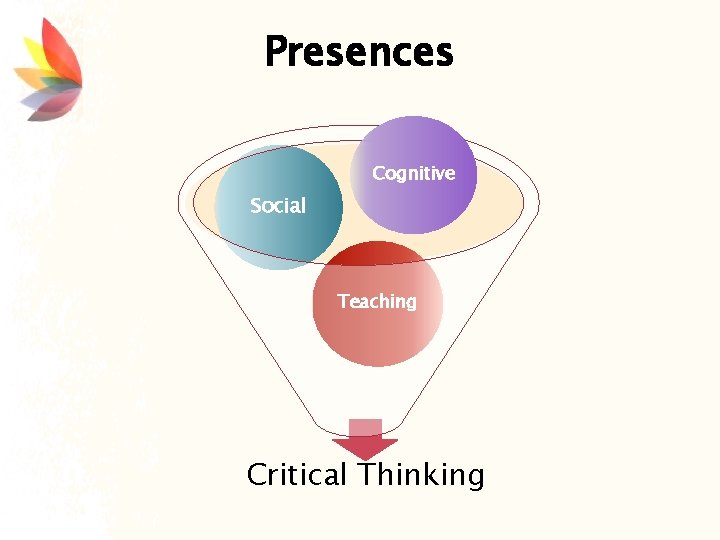
Presences Cognitive Social Teaching Critical Thinking
From the Critical Thinking Guide: 3 Types of Questions • One System: – there is a correct answer • No System: – A subjective opinion • Multi-system: – Requires evidence and reasoning within multiple systems
http: //www. criticalthinking. org/files/Concepts_Tools. pdf Paul, R. & Elder. L. The Miniature Guide to Critical Thinking Concepts and Tools, Foundation for Critical Thinking, Dillon Beach, CA, 2009, 5 th Ed.

Critical Thinking • Clarity – Could you elaborate further? • Accuracy – How could we verify or test this? • Precision – Could you be more specific? • Relevance – How does that relate to the problem? • Depth – What factors make this a difficult problem?
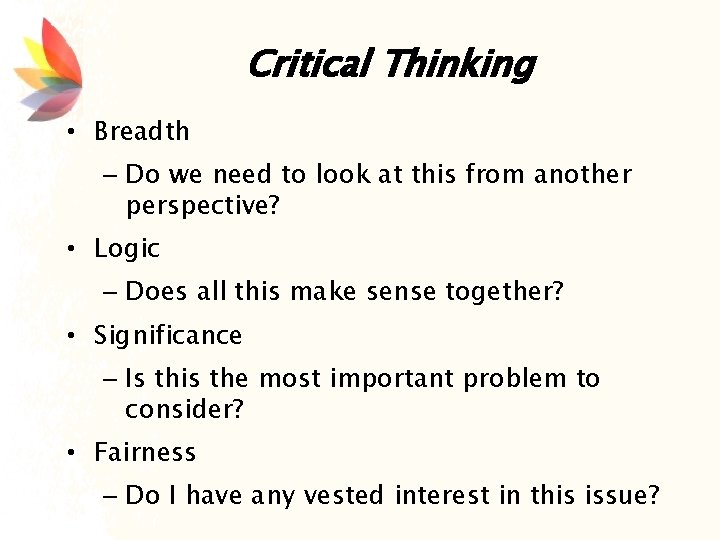
Critical Thinking • Breadth – Do we need to look at this from another perspective? • Logic – Does all this make sense together? • Significance – Is this the most important problem to consider? • Fairness – Do I have any vested interest in this issue?
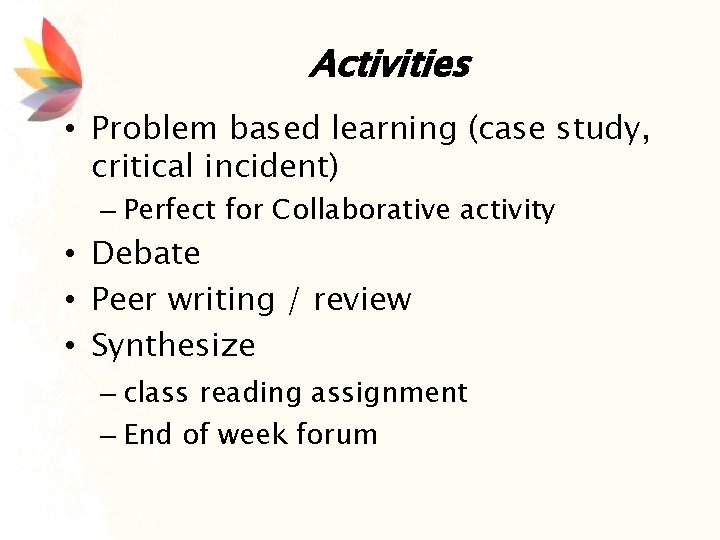
Activities • Problem based learning (case study, critical incident) – Perfect for Collaborative activity • Debate • Peer writing / review • Synthesize – class reading assignment – End of week forum
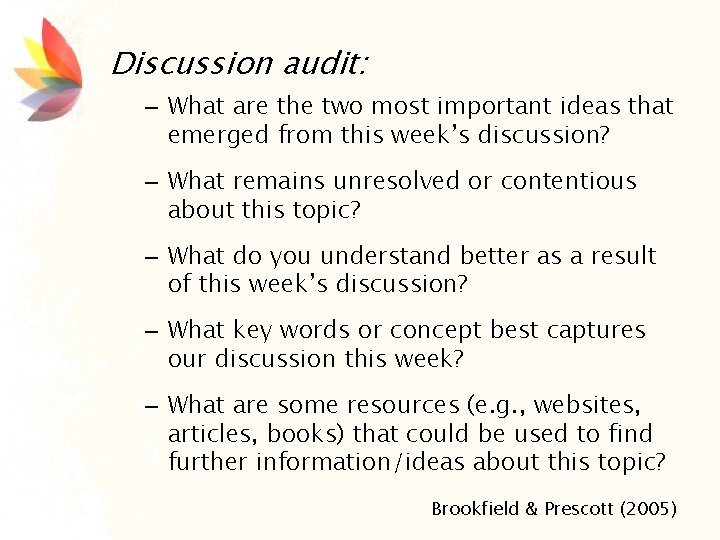
Discussion audit: – What are the two most important ideas that emerged from this week’s discussion? – What remains unresolved or contentious about this topic? – What do you understand better as a result of this week’s discussion? – What key words or concept best captures our discussion this week? – What are some resources (e. g. , websites, articles, books) that could be used to find further information/ideas about this topic? Brookfield & Prescott (2005)
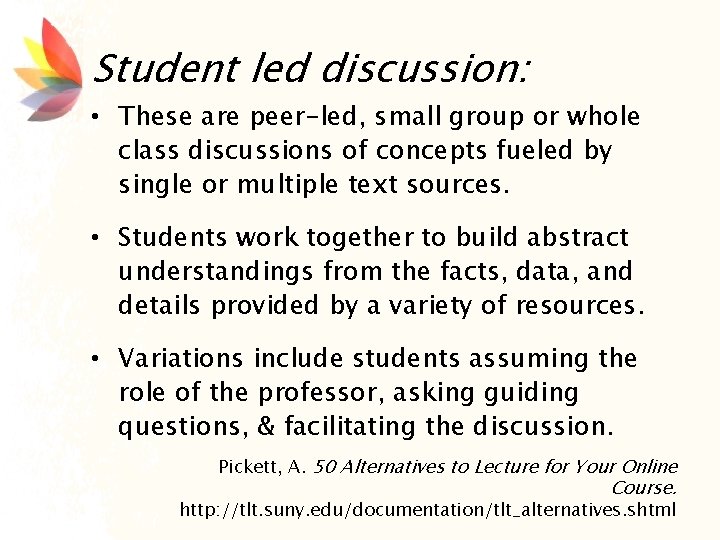
Student led discussion: • These are peer-led, small group or whole class discussions of concepts fueled by single or multiple text sources. • Students work together to build abstract understandings from the facts, data, and details provided by a variety of resources. • Variations include students assuming the role of the professor, asking guiding questions, & facilitating the discussion. Pickett, A. 50 Alternatives to Lecture for Your Online Course. http: //tlt. suny. edu/documentation/tlt_alternatives. shtml
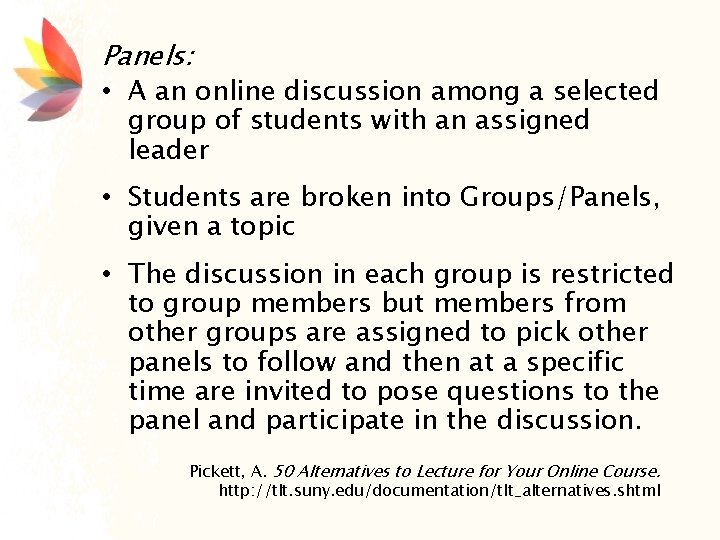
Panels: • A an online discussion among a selected group of students with an assigned leader • Students are broken into Groups/Panels, given a topic • The discussion in each group is restricted to group members but members from other groups are assigned to pick other panels to follow and then at a specific time are invited to pose questions to the panel and participate in the discussion. Pickett, A. 50 Alternatives to Lecture for Your Online Course. http: //tlt. suny. edu/documentation/tlt_alternatives. shtml
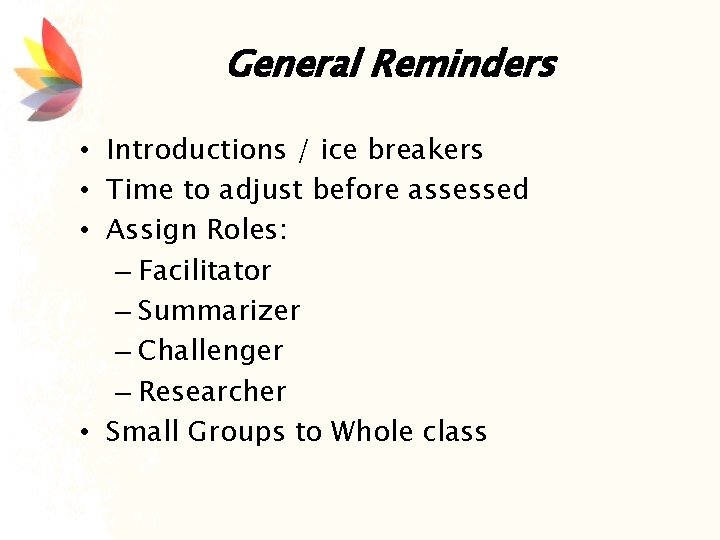
General Reminders • Introductions / ice breakers • Time to adjust before assessed • Assign Roles: – Facilitator – Summarizer – Challenger – Researcher • Small Groups to Whole class
References Dewey, J. (1916). Democracy and education: An introduction to the philosophy of education. New York: Macmillan. Arbaugh, J. B. , Cleveland-Innes, M. , Diaz, S. R. , Garrison, D. R. , Ice, P. , Richardson, & Swan, K. P. (2008). Developing a community of inquiry instrument: Testing a measure of the Community of Inquiry framework using a multi-institutional sample. The Internet and higher Education, 11(34), 133 -136. Archibald, D. (2010). Fostering the development of cognitive presence: Initial findings using the community of inquiry survey instrument. The Internet & Higher Education, 13(1 -2), 73 -74.
Akyol, Z. , Garrison, D. R. (2011). Understanding Cognitive Presence in an Online and Blended Community of Inquiry: Assessing Outcomes and Processes for Deep Approaches to Learning. British Journal of Educational Technology, 42(2), 233 -250. Brookfield, S. D. , & Preskill, S. (2005). Discussion as a way of Teaching (2 nd ed. ). San Francisco: Jossey-Bass. (Original work published 1999) Garrison, D. R. , Anderson, T. , & Archer, W. (2000). Critical inquiry in a text-based environment: Computer conferencing in higher education. The Internet and Higher Education, 2(2 -3), 87 -105 Garrison, D. R. (2011). E–Learning in the 21 st century: A framework for research and practice (2 nd Edition). London: Routledge/Falmer.
Garrison, D. R. , Arbaugh, J. B. (2007). Researching the community of Inquiry Framework: Review, Issues, and Future Directions. The Internet and Higher Education, 10(3), 157 -172. Ice, P. (2010). Co. I Theory & Practice. Lecture presented at the Sloan-C course “Using the Community of Inquiry Survey for Multi-Level Institutional Evaluation”, Online through the Sloan Consortium, http: //sloanconsortium. org/. Lehman, R. M. , Conceicao, S. (2010) Creating a sense of presence in online teaching. San Francisco, Jossey-Bass.
Paul, R. & Elder, L. (2009). The miniature guide to critical thinking: Concepts and tools. (6 th ed). Foundation for Critical Thinking, Dillon Beach, CA. Richardson, J. C. , Ice, P. (2010) "Investigating students' level of critical thinking across instructional strategies in online discussions. " The Internet and Higher Education 13(1 -2) 52 -59. Swan, K. & Shih, L. F. (2005). On the nature and development of social presence in online course discussions. Journal of Asynchronous Learning Networks, 9 (3), 115 -136.

Glenna Decker deckerg@gvsu. edu 616. 331. 2598 Danielle Lake lakeda@gvsu. edu 616. 331.
- Slides: 46