
Engaging Parents as Partners Using Motivational Interviewing Presented
- Slides: 57
Engaging Parents as Partners Using Motivational Interviewing Presented by: Rachel Galanter Executive Director Exchange Family Center Member, Motivational Interviewing Network of Trainers
Who is the trainer? Rachel Galanter (MPH, Maternal and Child Health), Exchange Family Center’s Executive Director, is an NC Parenting Education Network certified Parenting Educator with over 25 years experience with children, youth, and families. She uses Motivational Interviewing, anger management, bio-feedback and the Community Resilience Model to help families address the stress and emotional issues that can be barriers to making change. She employs proven models—Attachment Bio-Behavioral Catch Up, Safe. Care, Language Is the Key, Triple P and Parent Child Interaction Therapy—to help families transform and to improve relationships between caregivers and children. A member of the Motivational Interviewing Network of Trainers, she provides training and coaching to professionals on parent engagement, coaching, and cultural awareness. In addition to her local efforts, she is a sought-after speaker for national conferences including: the National Birth to Three Institute, the National Head Start Association Parent Engagement Institute, the National Exchange Clubs Symposium, and to her peers at the Motivational Interviewing Network of Trainers Forum. Prevent Child Abuse North Carolina awarded her the Donna J Stone award in 2013 for going above and beyond to support families in their efforts to provide their children with the safe, stable, nurturing environments they need if they are going to be successful.
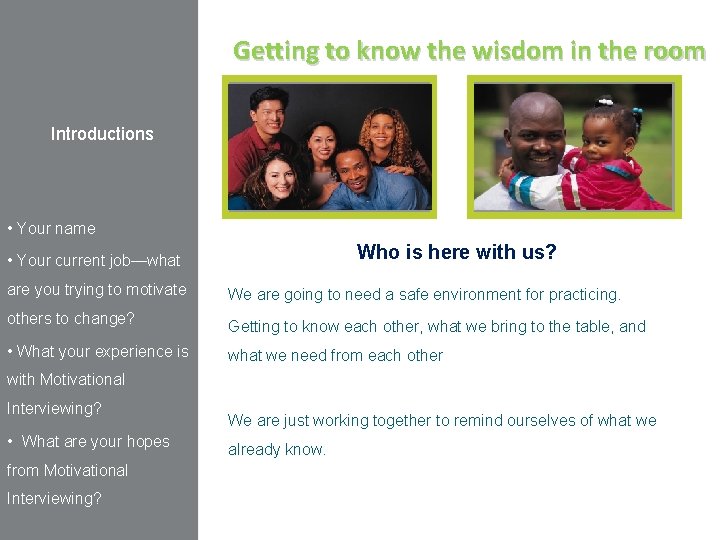
Getting to know the wisdom in the room I’ll add fun graphics here And here…. Introductions • Your name • Your current job—what are you trying to motivate others to change? • What your experience is Who is here with us? Let’s not forget the spectrum We are going to need a safe environment for practicing. Getting to know each other, what we bring to the table, and what we need from each other with Motivational Interviewing? • What are your hopes from Motivational Interviewing? We are just working together to remind ourselves of what we already know.
Health and Safety Quiz 1. Do you have a smoke detector in your home and change the batteries at least once a year? 2. Do you buckle up every time you are in a car, even in the back seat? 3. Do you exercise at least 30 minutes 3 times a week? 4. Do you wear a bicycle helmet every time you ride a bike? 5. Do you wear a personal flotation device every time you get in a boat? 6. Do you make sure every child who rides in your car up to 8 years old and 80 lbs is in an appropriate car seat or booster every time you drive? 7. Do you have a fire extinguisher in your kitchen? 8. Do you floss daily? 9. Have you practiced a fire safety plan at home and picked a meeting spot outside your home in case of fire? 10. Do you abstain from using your cell phone while driving?
Why don’t we do what we know is healthy/safe? �Not enough time CONCLUSIONS: �Don’t think the bad INFORMATION IS NOT outcome will happen to ENOUGH OF A us REASON TO DO THINGS �Think we’re safe enough anyway �Others aren’t supportive WE ALL HAVE GOOD REASONS TO AVOID �Used to, but it didn’t feel MAKING CHANGE like it paid off �Other reasons
Motivational Interviewing (MI) is: � a common sense, practical, evidence-based method � originally used in substance abuse treatment � then adopted for health behaviors . . . to partner with people to make and sustain behavioral 6
Where did Motivational Interviewing come from? �Influenced by pyschologist Carl Rogers �Empathy �Unconditional positive regard �Genuineness However, it is more directed on moving toward a goal
PACE is the Heart of Motivational Interviewing? Partnership � working together with mutual respect 8 Photo: EHS NRC
PACE Acceptance �Absolute Worth: the person is valuable �Accurate Empathy: the person is really heard �Autonomy Support: the person gets to decide �Affirmation: we pay attention, verbally acknowledge strengths, acknowledge barriers, demonstrate respect 9
PACE Compassion �looking out for families’ best interests 10
PACE Evocation �elicit ideas and potential plans from families instead of providing them 11
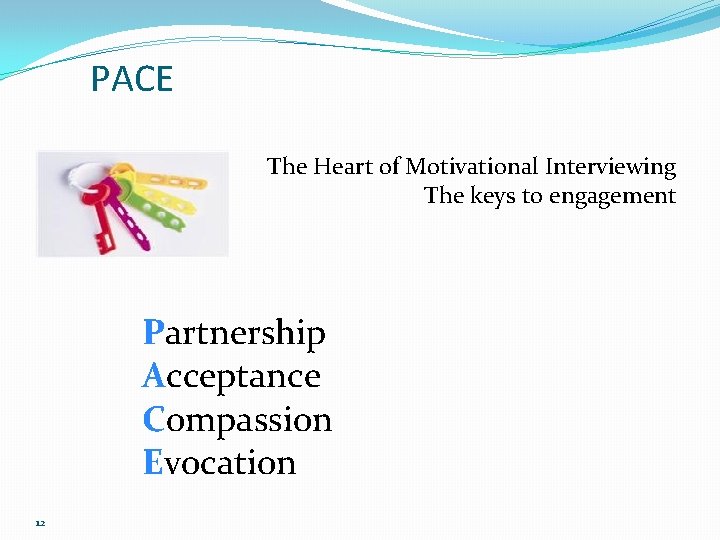
PACE The Heart of Motivational Interviewing The keys to engagement Partnership Acceptance Compassion Evocation 12
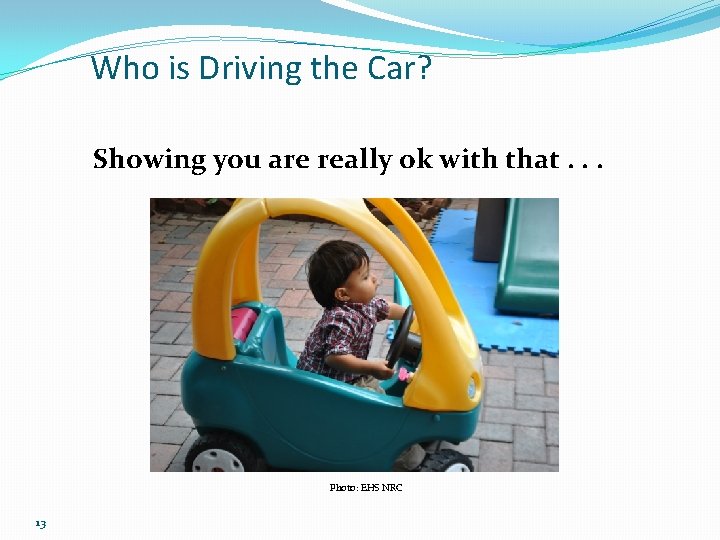
Who is Driving the Car? Showing you are really ok with that. . . Photo: EHS NRC 13
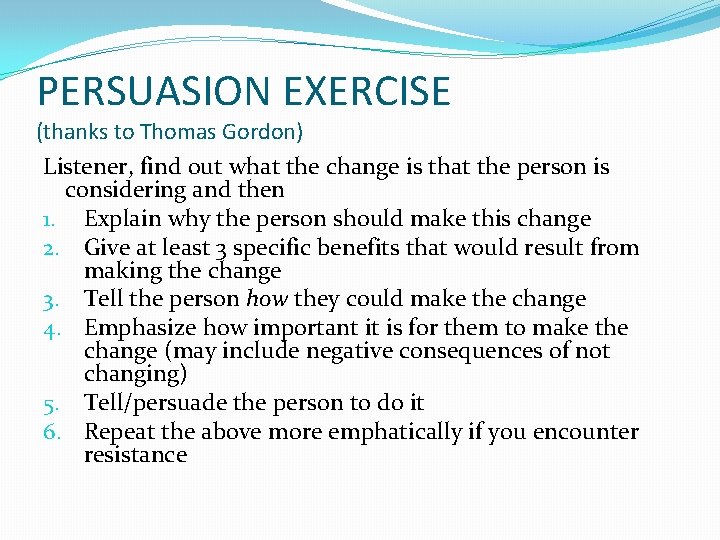
PERSUASION EXERCISE (thanks to Thomas Gordon) Listener, find out what the change is that the person is considering and then 1. Explain why the person should make this change 2. Give at least 3 specific benefits that would result from making the change 3. Tell the person how they could make the change 4. Emphasize how important it is for them to make the change (may include negative consequences of not changing) 5. Tell/persuade the person to do it 6. Repeat the above more emphatically if you encounter resistance
How do you this our volunteer felt being persuaded? appreciated? scolded? shamed? talked at? motivated?
How likely is the volunteer to follow Rachel’s advice? �Not going to do it �Unlikely �Possibly �Very likely �Definitely
Based on this conversation, will this person prioritize talking to Rachel again? �No, he/she will avoid Rachel. �He/She will only respond if there is a deadline. �He/She will only respond if there is a penalty if she doesn’t. �He/She will happily return Rachel’s calls, but not show up for the appointments. �He/She will set up and make new times to meet with Rachel.
Now check in: �First the person being persuaded: �How did you feel? �Did you move toward or away from change? �Do you want to talk about this more with this person? �The person who persuaded: �How did you feel? �Did you think the person moved toward or away from change? �Observer �Did the persuader use all the techniques (give details)? �What did you see happening? �Do you think the person moved toward or away from change?
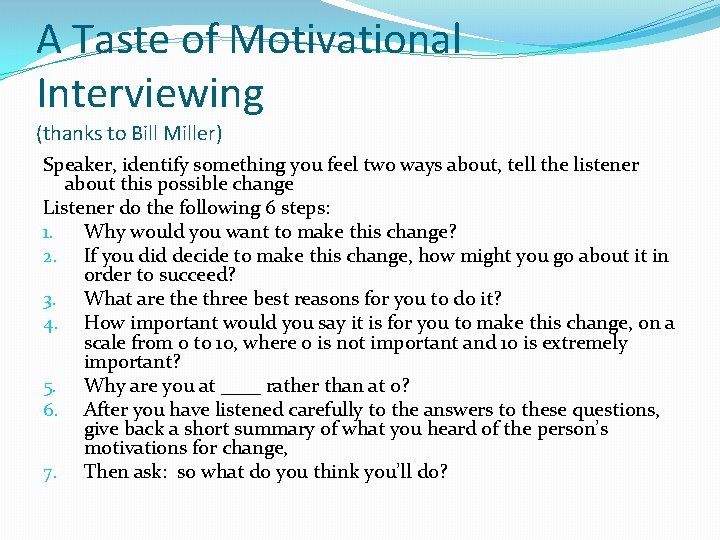
A Taste of Motivational Interviewing (thanks to Bill Miller) Speaker, identify something you feel two ways about, tell the listener about this possible change Listener do the following 6 steps: 1. Why would you want to make this change? 2. If you did decide to make this change, how might you go about it in order to succeed? 3. What are three best reasons for you to do it? 4. How important would you say it is for you to make this change, on a scale from 0 to 10, where 0 is not important and 10 is extremely important? 5. Why are you at ____ rather than at 0? 6. After you have listened carefully to the answers to these questions, give back a short summary of what you heard of the person’s motivations for change, 7. Then ask: so what do you think you’ll do?
How do you this our volunteer felt after this conversation? appreciated? scolded? shamed? talked at? motivated?
How likely is the volunteer to take steps toward change? �Not going to do it �Unlikely �Possibly �Very likely �Definitely
Based on this conversation, will this person prioritize talking to Rachel again? �No, he/she will avoid Rachel. �He/She will only respond if there is a deadline. �He/She will only respond if there is a penalty if she doesn’t. �He/She will happily return Rachel’s calls, but not show up for the appointments. �He/She will set up and make new times to meet with Rachel.
Now check in: �First the person considering change: �How did you feel? �Did you move toward or away from change? �Do you want to talk about this more with this person? �The person who did Motivational Interviewing: �How did you feel? �Did you think the person moved toward or away from change? �Observer �Did the person using MI use all the techniques (give details)? �What did you see happening? �Do you think the person moved toward or away from change?
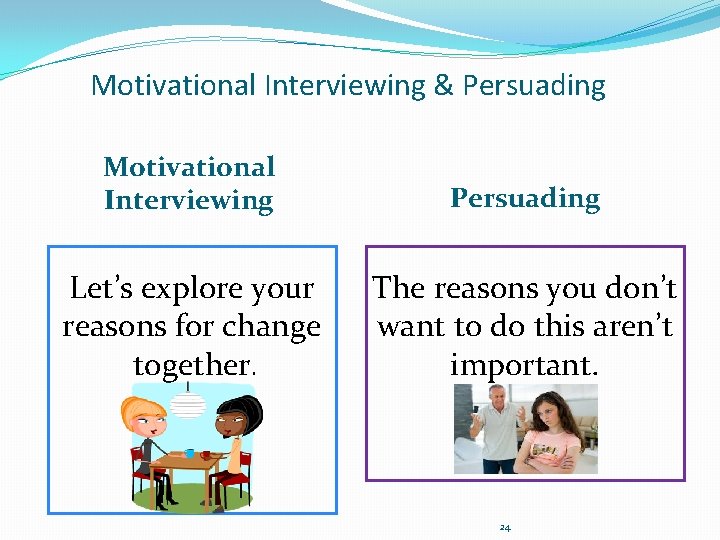
Motivational Interviewing & Persuading Motivational Interviewing Persuading Let’s explore your reasons for change together. The reasons you don’t want to do this aren’t important. 24
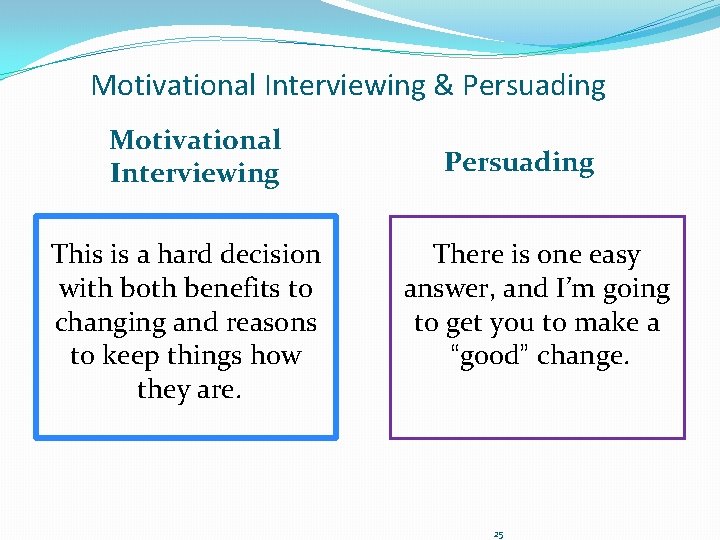
Motivational Interviewing & Persuading Motivational Interviewing This is a hard decision with both benefits to changing and reasons to keep things how they are. Persuading There is one easy answer, and I’m going to get you to make a “good” change. 25
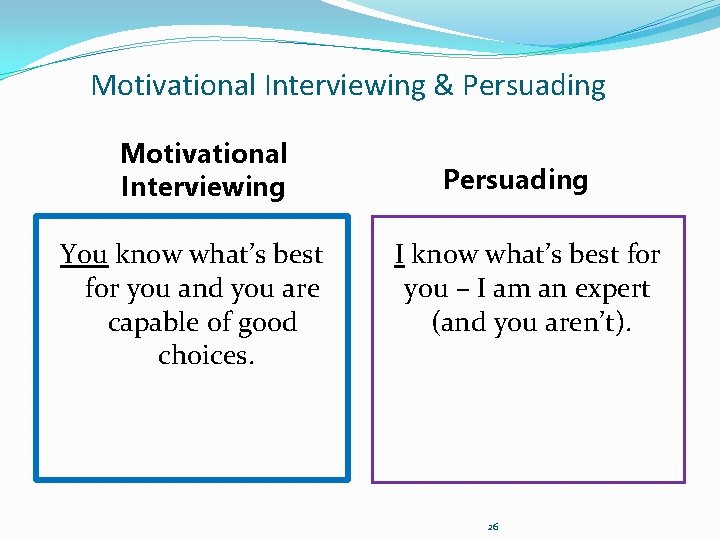
Motivational Interviewing & Persuading Motivational Interviewing Persuading You know what’s best for you and you are capable of good choices. I know what’s best for you – I am an expert (and you aren’t). 26
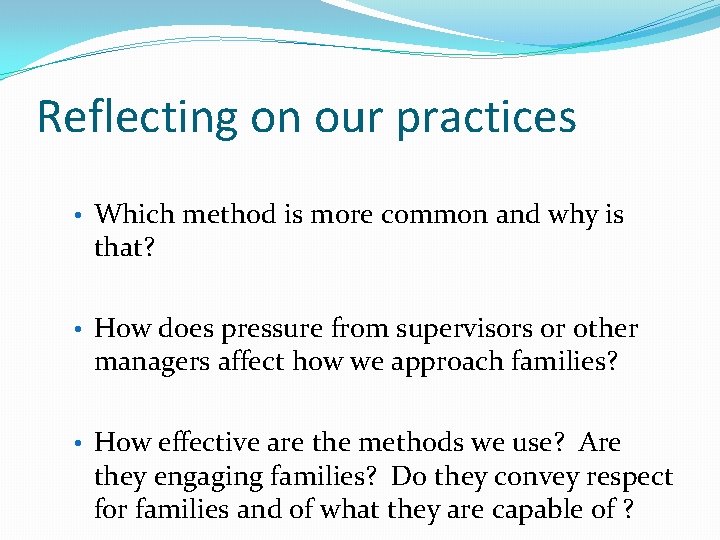
Reflecting on our practices • Which method is more common and why is that? • How does pressure from supervisors or other managers affect how we approach families? • How effective are the methods we use? Are they engaging families? Do they convey respect for families and of what they are capable of ?
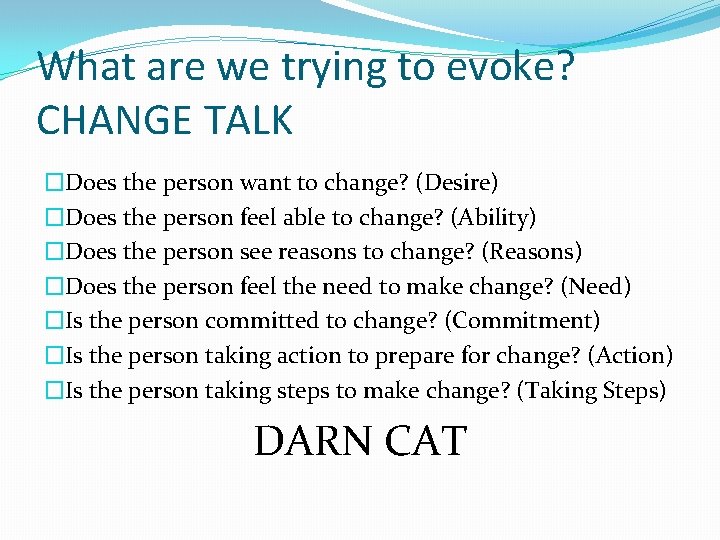
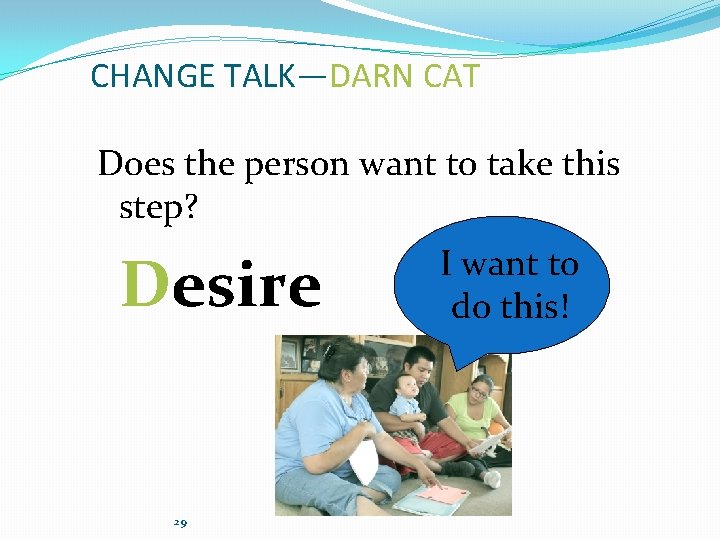
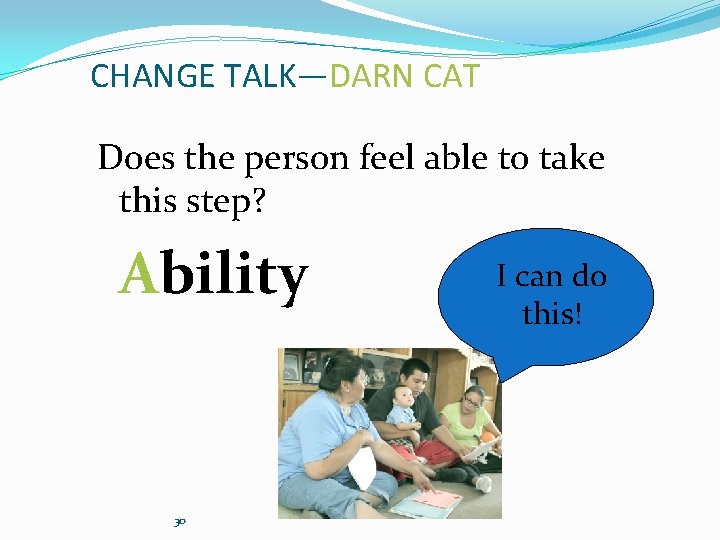
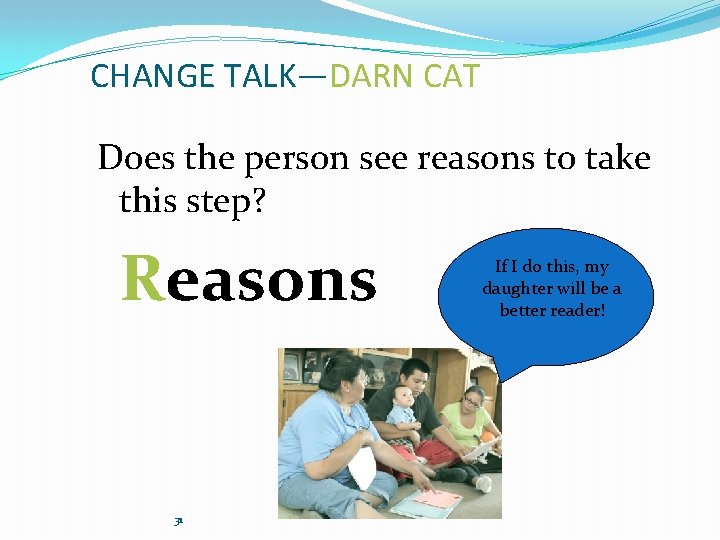
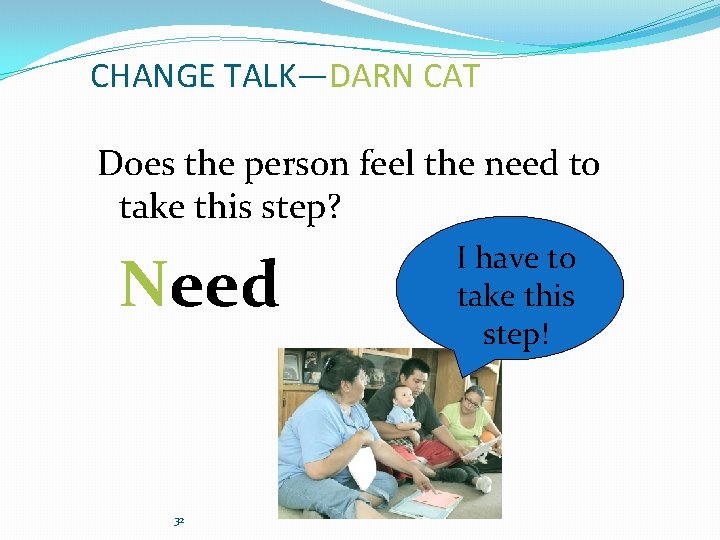
What are we trying to evoke? CHANGE TALK �Does the person want to change? (Desire) �Does the person feel able to change? (Ability) �Does the person see reasons to change? (Reasons) �Does the person feel the need to make change? (Need) �Is the person committed to change? (Commitment) �Is the person taking action to prepare for change? (Action) �Is the person taking steps to make change? (Taking Steps) DARN CAT
CHANGE TALK—DARN CAT Does the person want to take this step? Desire 29 I want to do this!
CHANGE TALK—DARN CAT Does the person feel able to take this step? Ability 30 I can do this!
CHANGE TALK—DARN CAT Does the person see reasons to take this step? Reasons 31 If I do this, my daughter will be a better reader!
CHANGE TALK—DARN CAT Does the person feel the need to take this step? Need 32 I have to take this step!
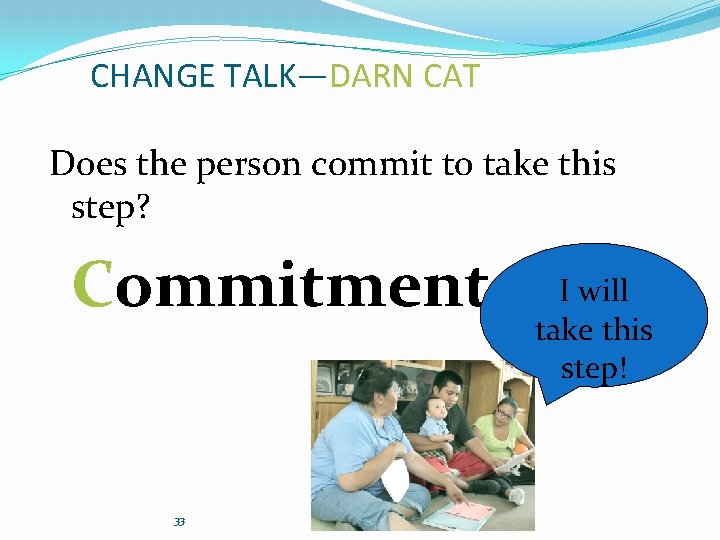
CHANGE TALK—DARN CAT Does the person commit to take this step? Commitment 33 I will take this step!
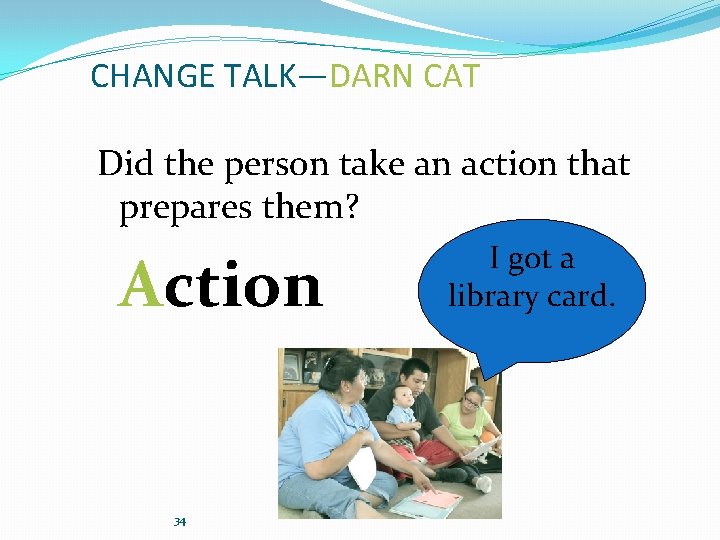
CHANGE TALK—DARN CAT Did the person take an action that prepares them? Action 34 I got a library card.
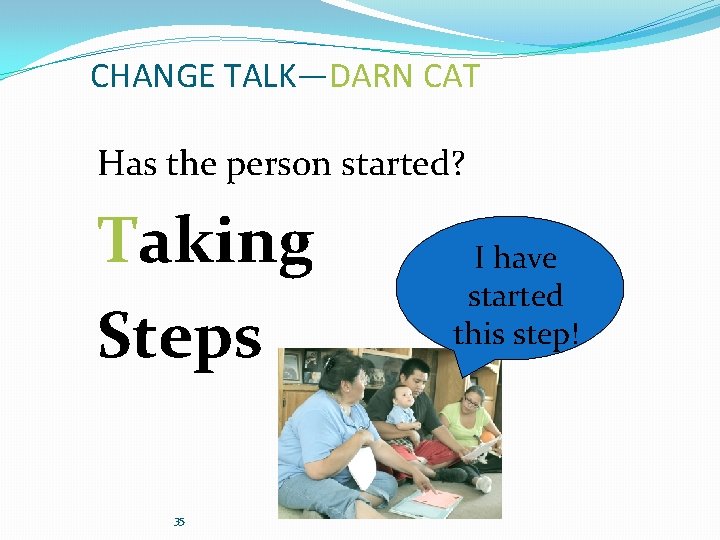
CHANGE TALK—DARN CAT Has the person started? Taking Steps 35 I have started this step!
Successful Uses of Motivational Interviewing �Substance use (tobacco, alcohol, other drugs) �Gambling �Diet �Exercise �Safe sex �Engaging in therapy/treatment (medication compliance, parenting classes, etc. ) 36 Photos: Microsoft Clip Art
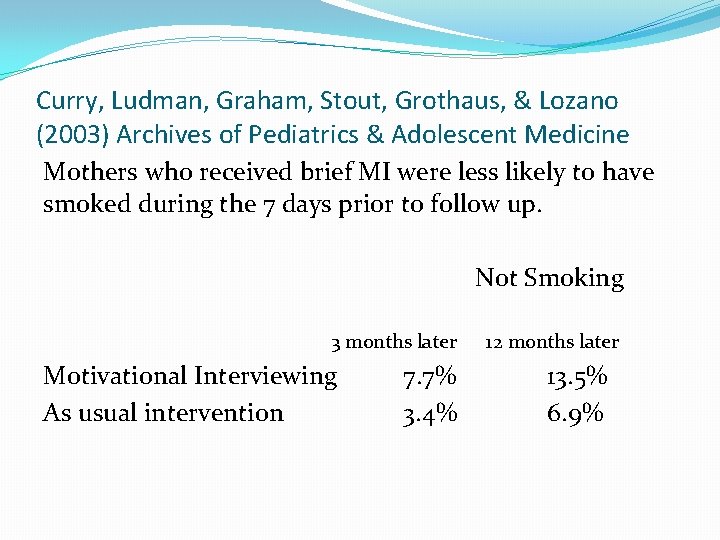
Curry, Ludman, Graham, Stout, Grothaus, & Lozano (2003) Archives of Pediatrics & Adolescent Medicine Mothers who received brief MI were less likely to have smoked during the 7 days prior to follow up. Not Smoking 3 months later 12 months later Motivational Interviewing As usual intervention 7. 7% 3. 4% 13. 5% 6. 9%
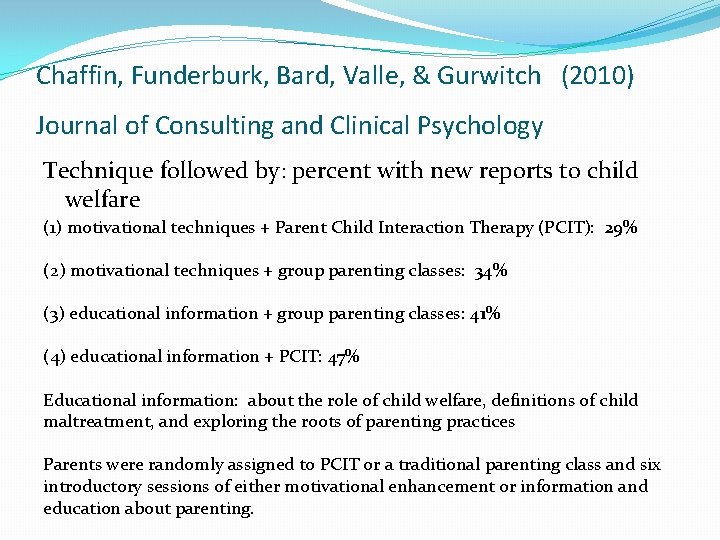
Chaffin, Funderburk, Bard, Valle, & Gurwitch (2010) Journal of Consulting and Clinical Psychology Technique followed by: percent with new reports to child welfare (1) motivational techniques + Parent Child Interaction Therapy (PCIT): 29% (2) motivational techniques + group parenting classes: 34% (3) educational information + group parenting classes: 41% (4) educational information + PCIT: 47% Educational information: about the role of child welfare, definitions of child maltreatment, and exploring the roots of parenting practices Parents were randomly assigned to PCIT or a traditional parenting class and six introductory sessions of either motivational enhancement or information and education about parenting.
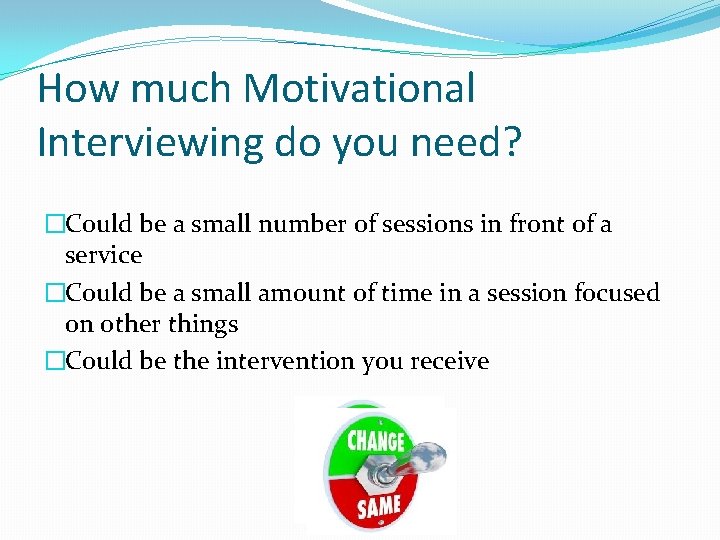
How much Motivational Interviewing do you need? �Could be a small number of sessions in front of a service �Could be a small amount of time in a session focused on other things �Could be the intervention you receive
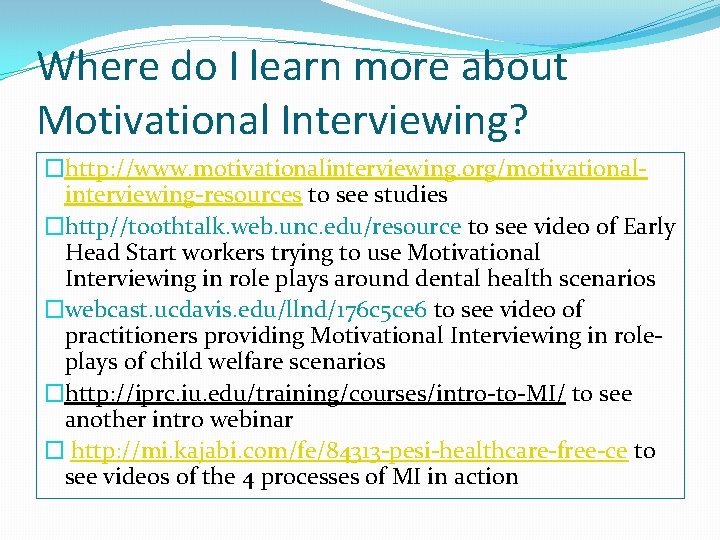
Where do I learn more about Motivational Interviewing? �http: //www. motivationalinterviewing. org/motivationalinterviewing-resources to see studies �http//toothtalk. web. unc. edu/resource to see video of Early Head Start workers trying to use Motivational Interviewing in role plays around dental health scenarios �webcast. ucdavis. edu/llnd/176 c 5 ce 6 to see video of practitioners providing Motivational Interviewing in roleplays of child welfare scenarios �http: //iprc. iu. edu/training/courses/intro-to-MI/ to see another intro webinar � http: //mi. kajabi. com/fe/84313 -pesi-healthcare-free-ce to see videos of the 4 processes of MI in action
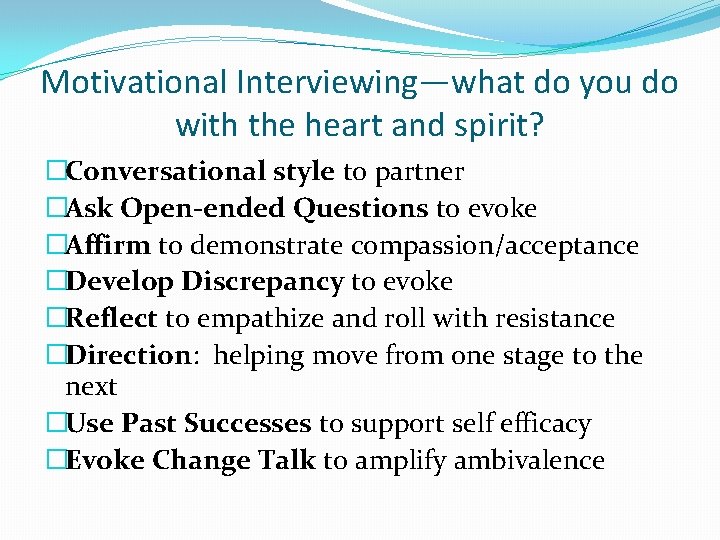
Motivational Interviewing—what do you do with the heart and spirit? �Conversational style to partner �Ask Open-ended Questions to evoke �Affirm to demonstrate compassion/acceptance �Develop Discrepancy to evoke �Reflect to empathize and roll with resistance �Direction: helping move from one stage to the next �Use Past Successes to support self efficacy �Evoke Change Talk to amplify ambivalence
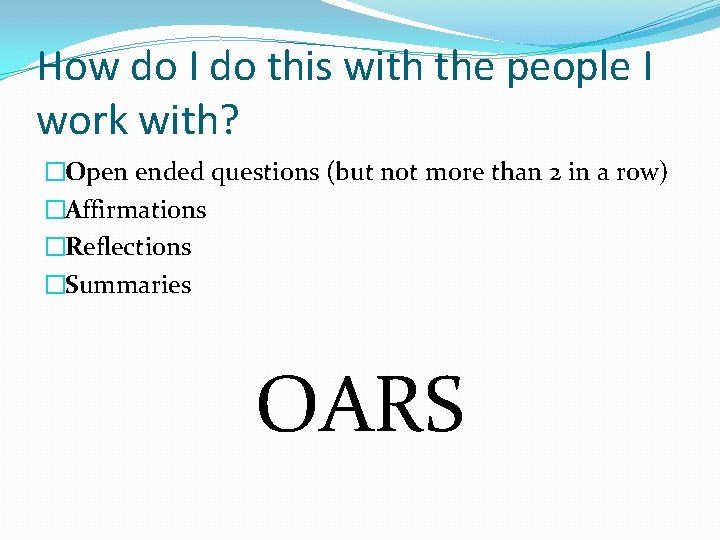
How do I do this with the people I work with? �Open ended questions (but not more than 2 in a row) �Affirmations �Reflections �Summaries OARS
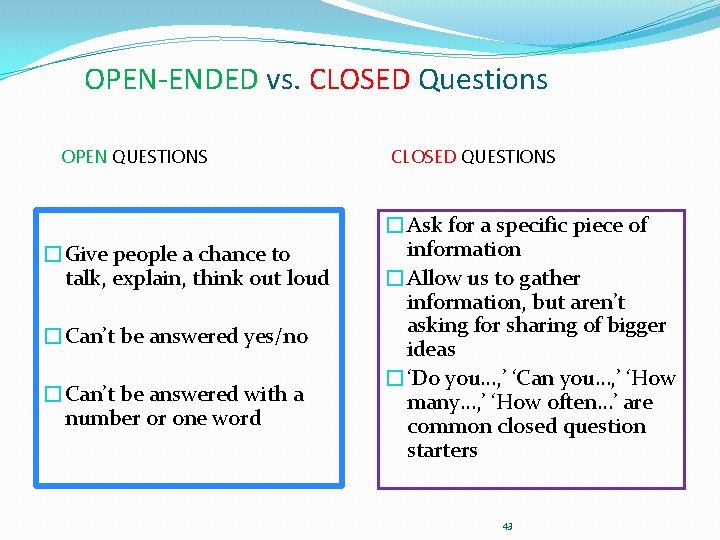
OPEN-ENDED vs. CLOSED Questions OPEN QUESTIONS �Give people a chance to talk, explain, think out loud �Can’t be answered yes/no �Can’t be answered with a number or one word CLOSED QUESTIONS �Ask for a specific piece of information �Allow us to gather information, but aren’t asking for sharing of bigger ideas �‘Do you…, ’ ‘Can you…, ’ ‘How many…, ’ ‘How often…’ are common closed question starters 43
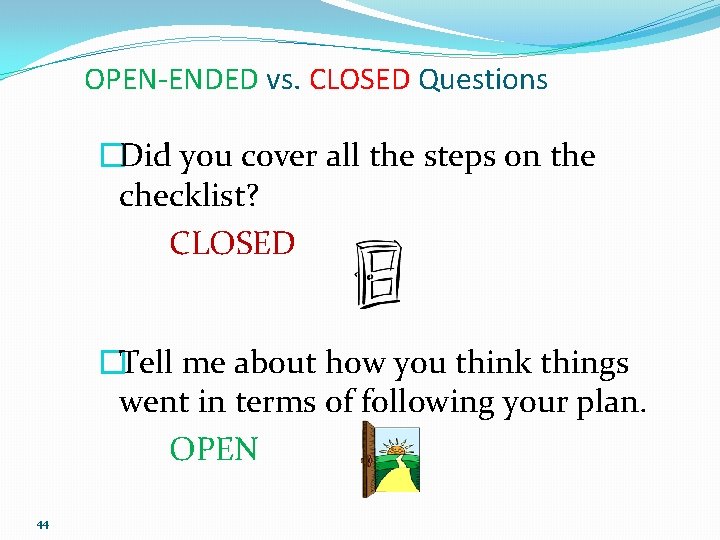
OPEN-ENDED vs. CLOSED Questions �Did you cover all the steps on the checklist? CLOSED �Tell me about how you think things went in terms of following your plan. OPEN 44
OPEN-ENDED vs. CLOSED Questions �Did you make an appointment for his shots? CLOSED �Tell me about your plan to get him his shots. OPEN 45
OPEN-ENDED vs. CLOSED Questions �What are your three best reasons to get places on time? OPEN �Did you know you’ve been late five times this month? CLOSED 46
OPEN-ENDED vs. CLOSED Questions �How many days a week do you exercise? CLOSED �When you’ve decided to exercise regularly, what made it work? OPEN 47
Develop Discrepancy �I’m curious. . . �I’m confused. . . �Help me understand. . .
Affirmations (Labeled Praise for Adults) �Help person see and build on success �Demonstrate compassion or sympathy for difficulties �Build positive feelings �People like more when they are learning a new skill �Are like salt
Reflections Reflecting is holding mirror to what the person said - - building alliance letting the person hear another person say it. checking in to be sure you understood also known as “active listening”
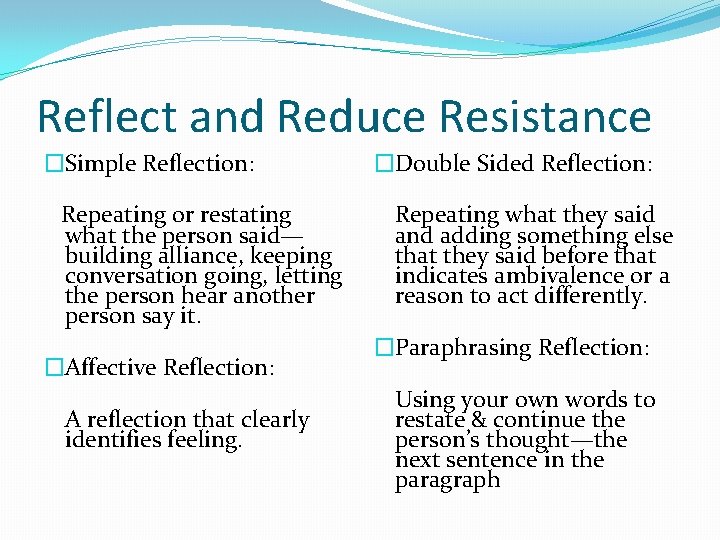
Reflect and Reduce Resistance �Simple Reflection: Repeating or restating what the person said— building alliance, keeping conversation going, letting the person hear another person say it. �Affective Reflection: A reflection that clearly identifies feeling. �Double Sided Reflection: Repeating what they said and adding something else that they said before that indicates ambivalence or a reason to act differently. �Paraphrasing Reflection: Using your own words to restate & continue the person’s thought—the next sentence in the paragraph
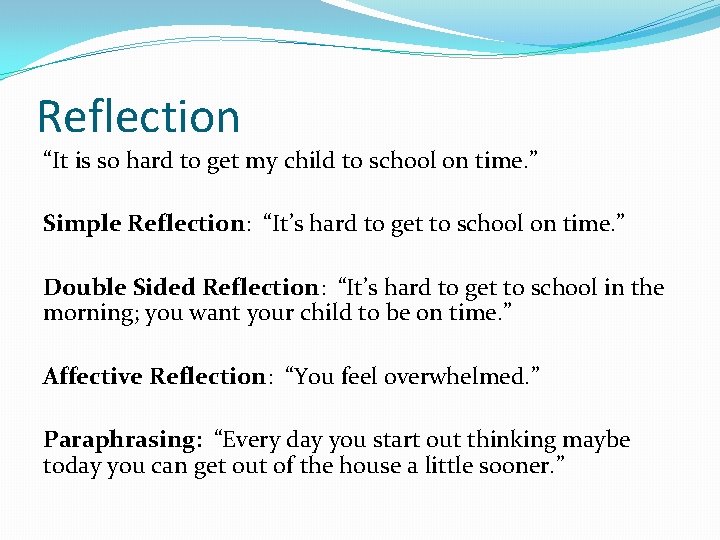
Reflection “It is so hard to get my child to school on time. ” Simple Reflection: “It’s hard to get to school on time. ” Double Sided Reflection: “It’s hard to get to school in the morning; you want your child to be on time. ” Affective Reflection: “You feel overwhelmed. ” Paraphrasing: “Every day you start out thinking maybe today you can get out of the house a little sooner. ”
Not Rolling with Resistance is �Likely to make the person defend their reasons not to change and give them a reason to say all those reasons aloud �Arguing �Unlikely to result in change �Unempathetic
Summaries A type of reflection that acknowledges there are barriers downsides while pulling together multiple motivations to change that you’ve heard. “You want to do this because ____. You see that ____ may make it hard. You worry ____ will happen if you don’t make a change. You believe that ____ will happen if you do make a change. You plan to _____. ”
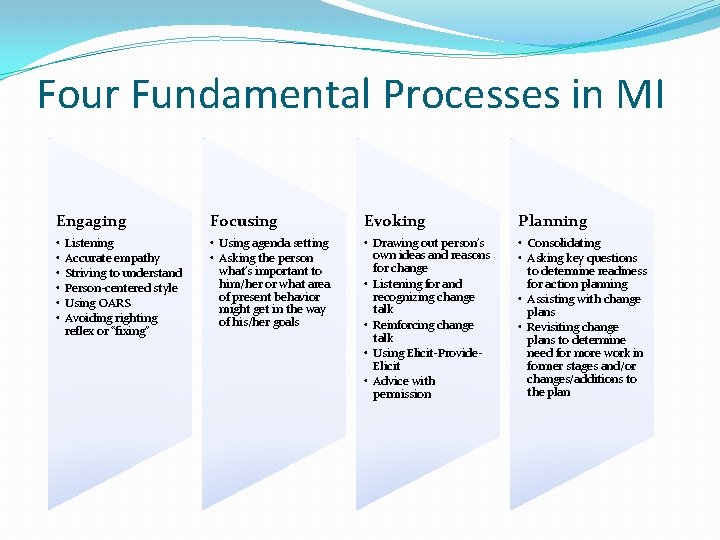
Four Fundamental Processes in MI Engaging Focusing Evoking Planning • • Using agenda setting • Asking the person what’s important to him/her or what area of present behavior might get in the way of his/her goals • Drawing out person’s own ideas and reasons for change • Listening for and recognizing change talk • Reinforcing change talk • Using Elicit-Provide. Elicit • Advice with permission • Consolidating • Asking key questions to determine readiness for action planning • Assisting with change plans • Revisiting change plans to determine need for more work in former stages and/or changes/additions to the plan Listening Accurate empathy Striving to understand Person-centered style Using OARS Avoiding righting reflex or “fixing”
Resources: For more information on Motivational Interviewing visit www. motivationalinterviewing. org If you have questions for Rachel Galanter reach out to her at rachelanna@exchangefamilycenter. org
If you want to learn MI, what are next steps? � Who on your staff needs to be trained and who needs full orientation to M. I. vs. advanced skill-building? � Get a qualified trainer to provide introductory training. � Schedule another workshop with a trainer to provide skill-building to work on practicing and to get comfortable. � Find a coach for staff. Could be a part of reflective supervision if already in place. � Use internal resources to help develop and carry out the MI implementation plan. � Audiotape yourself to get feedback from trainer or supervisor (parent consent required).