
Engaging Nurses in Evidence Developing an EBP Workshop
Engaging Nurses in Evidence: Developing an EBP Workshop Abigail Smith Upstate Medical University Health Sciences Library
Magnet Designation Upstate Medical University is pursuing Magnet designation from the American Nurses Credentialing Center. Magnet designation is the most prestigious distinction that healthcare organizations can receive for nursing excellence. Currently only 8% of US hospitals have Magnet designation.
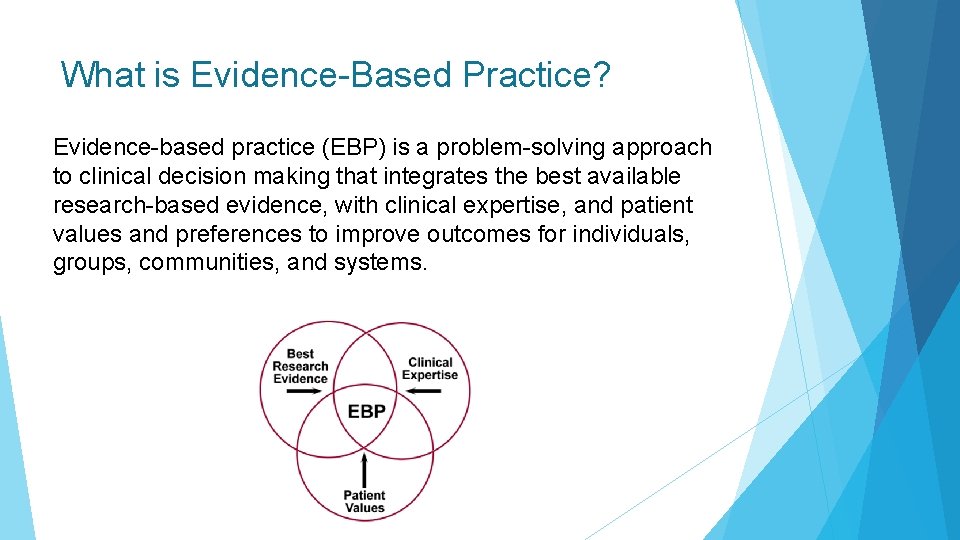
What is Evidence-Based Practice? Evidence-based practice (EBP) is a problem-solving approach to clinical decision making that integrates the best available research-based evidence, with clinical expertise, and patient values and preferences to improve outcomes for individuals, groups, communities, and systems.
Magnet Designation and Evidence-Based Practice Hospitals are required to have the infrastructure and resources to support the advancement of evidence-based practice (EBP) in all clinical settings. Nurses are expected to be able to speak to the concept of EBP and cite examples of how they use evidence in their practice to optimize patient outcomes. Hospitals seeking Magnet Designation are required to adopt an EBP model as part of their Magnet Journey.
Why is EBP so important? Estimated 17 year time lag from “bench” to “bedside. ” We use EBP to bridge the gap. EBP is related to • Improved patient outcomes • Lower Costs • Improved nursing satisfaction and greater group cohesion The National Academy of Medicine (IOM) has set the goal that by 2020, 90% of all health care decisions in the US will be evidence based.
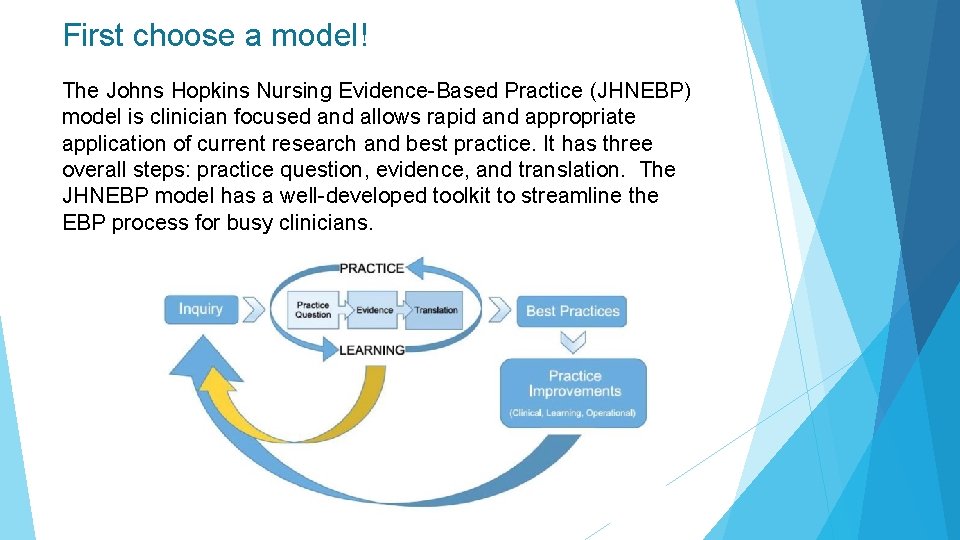
First choose a model! The Johns Hopkins Nursing Evidence-Based Practice (JHNEBP) model is clinician focused and allows rapid and appropriate application of current research and best practice. It has three overall steps: practice question, evidence, and translation. The JHNEBP model has a well-developed toolkit to streamline the EBP process for busy clinicians.
How do we educate 4000 nurses about EBP? We decided to work our problem through the model! Our question: In Registered Nurses, what are the most effective education methods for enhancing EBP understanding and engagement? What we found: Educational interventions, (particularly workshops) varying in length from 4 hours to 6 weeks, improve EBP readiness and knowledge. Mentors are needed to support EBP implementation and sustain EBP initiatives Integration of library staff is essential to guide identification and retrieval of literature.
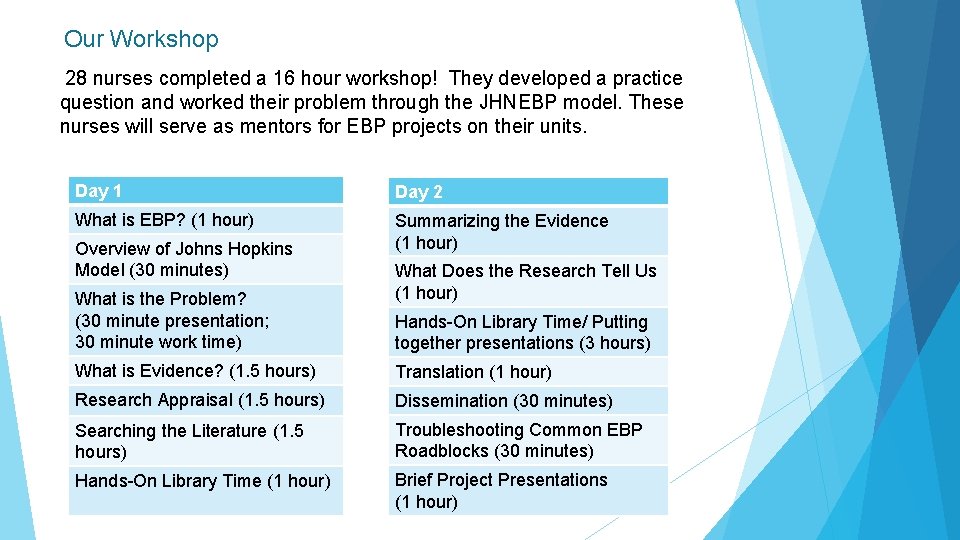
Our Workshop 28 nurses completed a 16 hour workshop! They developed a practice question and worked their problem through the JHNEBP model. These nurses will serve as mentors for EBP projects on their units. Day 1 Day 2 What is EBP? (1 hour) Summarizing the Evidence (1 hour) Overview of Johns Hopkins Model (30 minutes) What is the Problem? (30 minute presentation; 30 minute work time) What Does the Research Tell Us (1 hour) Hands-On Library Time/ Putting together presentations (3 hours) What is Evidence? (1. 5 hours) Translation (1 hour) Research Appraisal (1. 5 hours) Dissemination (30 minutes) Searching the Literature (1. 5 hours) Troubleshooting Common EBP Roadblocks (30 minutes) Hands-On Library Time (1 hour) Brief Project Presentations (1 hour)
Feedback from Workshop Participants Nurses appreciated the 16 hours of protected time to address practice questions and concerns. Nurses were eager to serve as EBP mentors and ambassadors on their units, but concerned that they would not have enough time to work practice problems through the JHNEBP model. Nurses felt a sense of connectedness to colleagues on other units, as they discussed common practice problems.
Practice Changes! The Nurse Manager for one of our cardiac units was interested in whether patients undergoing Percutaneous Coronary Intervention (PCI) could be candidates for same day discharge. Over the course of two days she worked her question through the JHNEBP model and found that overnights were unnecessary for most PCI patients. The Nurse Manager took this newfound knowledge back to her unit, met with the appropriate stakeholders, and now the standard clinical pathway for Upstate PCI patients includes same day discharge!
References Friesen, M. A. , Brady, J. M. , Milligan, R. , & Christensen, P. (2017). Findings From a Pilot Study: Bringing Evidence‐Based Practice to the Bedside. Worldviews on Evidence‐Based Nursing, 14(1), 22 -34. Kim, S. C. , Ecoff, L. , Brown, C. E. , Gallo, A. M. , Stichler, J. F. , & Davidson, J. E. (2017). Benefits of a regional evidence-based practice fellowship program: A test of the ARCC model. Worldviews on Evidence-Based Nursing, 14(2), 90 -98. doi: 10. 1111/wvn. 12199 [doi] Levin, R. F. , Wright, F. , Pecoraro, K. & Kopec, W. (2016). Maintaining perioperative normothermia: Sustaining an evidence-based practice improvement project. AORN Journal, 103(2) 213 -e 1. doi: 10. 1016/j. aorn. 2015. 12. 020 Melnyk, B. M. , Gallagher-Ford, L. , Long, L. E. , & Fineout-Overholt, E. (2014). The establishment of evidence-based practice competencies for practicing registered nurses and advanced practice nurses in real-world clinical settings: Proficiencies to improve healthcare quality, reliability, patient outcomes, and costs. Worldviews on Evidence-Based Nursing, 11(1), 5 -15. doi: 10. 1111/wvn. 12021 [doi] Morris, Z. S. , Wooding, S. & Grant, J. . (2011). The answer is 17 years, what is the question: Understanding time lags in translational research. Journal of the Royal Society of Medicine, 104, 510 -20. doi: 10. 1258/jrsm. 2011. 110180 Warren, J. I. , Mc. Laughlin, M. , Bardsley, J. , Eich, J. , Esche, C. A. , Kropkowski, L. & Risch, S. (2016). The strengths and challenges of implementing EBP in healthcare systems. Worldviews Evidence Based Nursing, 13, 15 -24. doi: 10. 1111/wvn. 12149 Wilson, M. , Sleutel, M. , Newcomb, P. , Behan, D. , Walsh, J. , Wells, J. N. , & Baldwin, K. M. (2015). Empowering Nurses With Evidence‐Based Practice Environments: Surveying Magnet®, Pathway to Excellence®, and Non‐Magnet Facilities in One Healthcare System. Worldviews on Evidence‐Based Nursing, 12(1), 12 -21

- Slides: 12