
Engaging all undergraduate science students in coursebased research
Engaging all undergraduate science students in course-based research projects Craig Ogilvie, Iowa State University, • Vision: Every time a student steps into a science classroom, they will be doing/discussing science with their peers • 1000+ students/yr research projects in last 5 -6 weeks of lab courses • Typology of research experiences • Assessment results: impact on students • Next steps 1 Nov 3, 2014
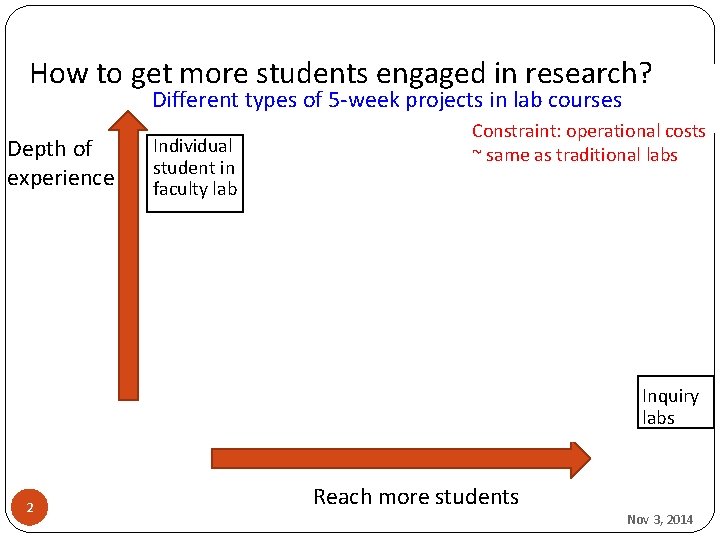
How to get more students engaged in research? Different types of 5 -week projects in lab courses Depth of experience 2 Individual student in faculty lab Constraint: operational costs ~ same as traditional labs Student research Class idea, done coopted in course into Class-wide, faculty lab linked projects Student extensions of inquiry labs Inquiry labs Reach more students Nov 3, 2014
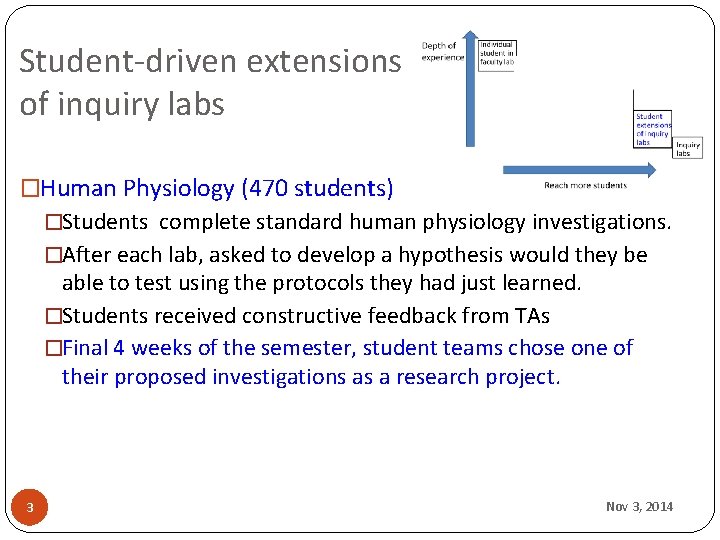
Student-driven extensions of inquiry labs �Human Physiology (470 students) �Students complete standard human physiology investigations. �After each lab, asked to develop a hypothesis would they be able to test using the protocols they had just learned. �Students received constructive feedback from TAs �Final 4 weeks of the semester, student teams chose one of their proposed investigations as a research project. 3 Nov 3, 2014
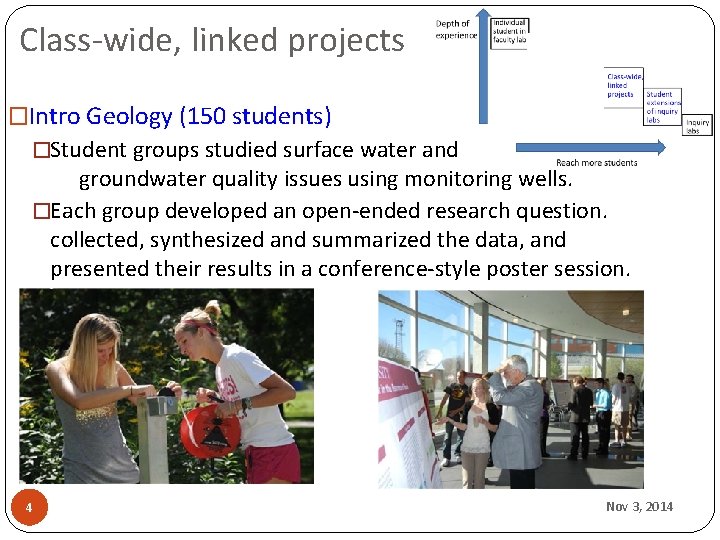
Class-wide, linked projects �Intro Geology (150 students) �Student groups studied surface water and groundwater quality issues using monitoring wells. �Each group developed an open-ended research question. collected, synthesized and summarized the data, and presented their results in a conference-style poster session. 4 Nov 3, 2014
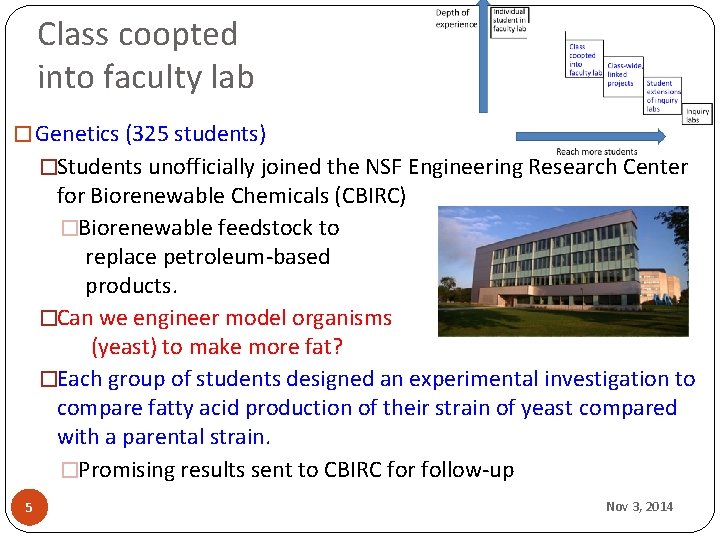
Class coopted into faculty lab � Genetics (325 students) �Students unofficially joined the NSF Engineering Research Center for Biorenewable Chemicals (CBIRC) �Biorenewable feedstock to replace petroleum-based products. �Can we engineer model organisms (yeast) to make more fat? �Each group of students designed an experimental investigation to compare fatty acid production of their strain of yeast compared with a parental strain. �Promising results sent to CBIRC for follow-up 5 Nov 3, 2014
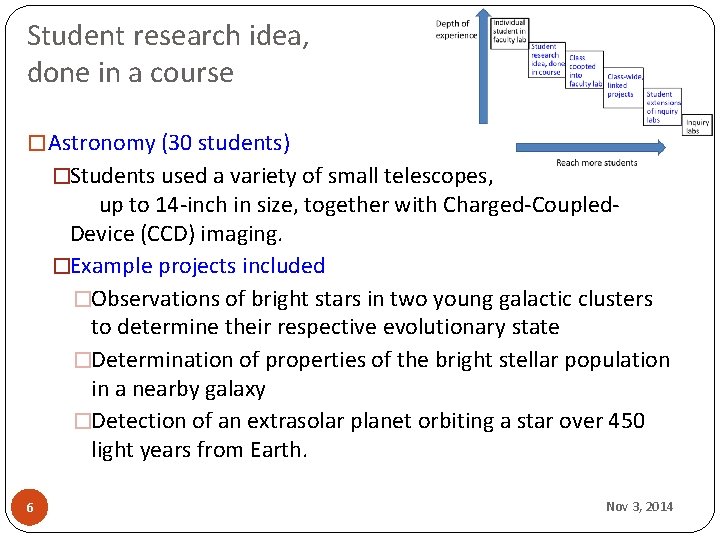
Student research idea, done in a course � Astronomy (30 students) �Students used a variety of small telescopes, up to 14 -inch in size, together with Charged-Coupled. Device (CCD) imaging. �Example projects included �Observations of bright stars in two young galactic clusters to determine their respective evolutionary state �Determination of properties of the bright stellar population in a nearby galaxy �Detection of an extrasolar planet orbiting a star over 450 light years from Earth. 6 Nov 3, 2014
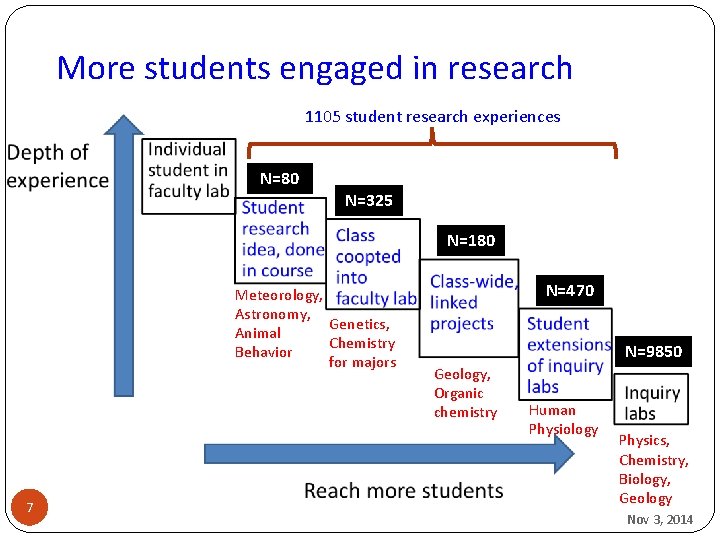
More students engaged in research 1105 student research experiences N=80 N=325 N=180 Meteorology, Astronomy, Genetics, Animal Chemistry Behavior for majors 7 N=470 N=9850 Geology, Organic chemistry Human Physiology Physics, Chemistry, Biology, Geology Nov 3, 2014
How implemented �Faculty Learning Community (FLC) meeting for 4 years �Plan, support first implementations, adjust, assess impact �Larger projects had startup help �Education postdoc or graduate student �Equipment �Operational costs kept ~ as original lab course �Graduate TA learning community �Discuss student learning, how to assist with research planning, changes, …. �Led by postdocs, senior TAs 8 Nov 3, 2014
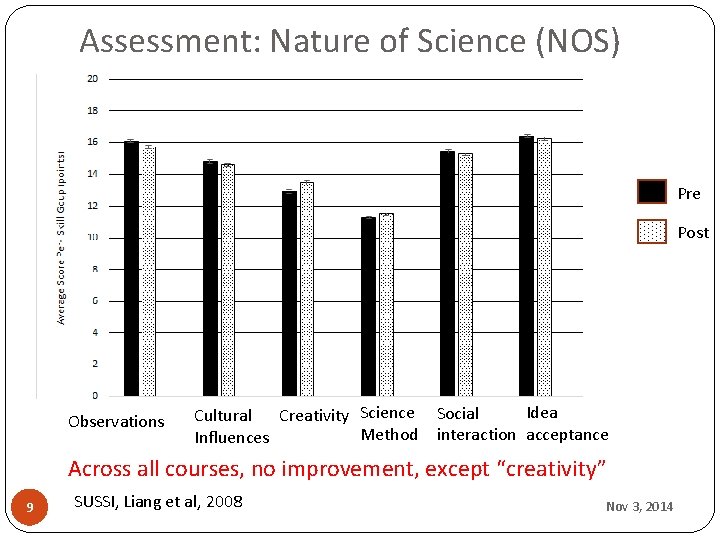
Assessment: Nature of Science (NOS) Pre Post Observations Idea Creativity Science Social Cultural Method interaction acceptance Influences Across all courses, no improvement, except “creativity” 9 SUSSI, Liang et al, 2008 Nov 3, 2014
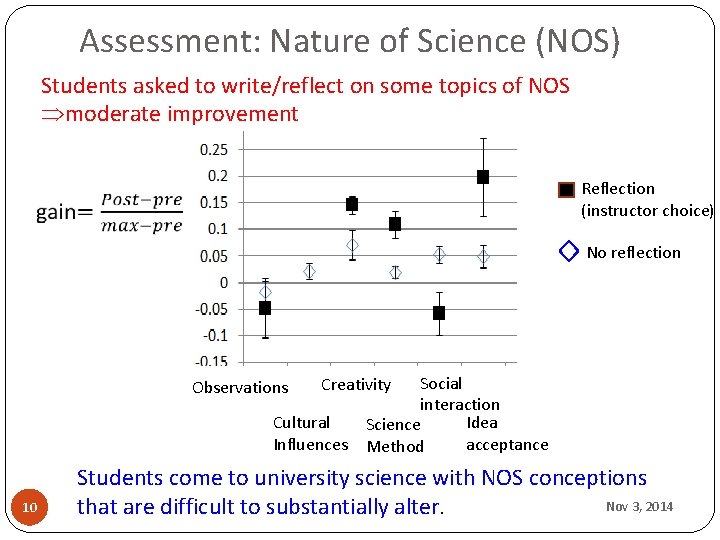
Assessment: Nature of Science (NOS) Students asked to write/reflect on some topics of NOS moderate improvement Reflection (instructor choice) No reflection Observations Cultural Influences 10 Social interaction Idea Science acceptance Method Creativity Students come to university science with NOS conceptions Nov 3, 2014 that are difficult to substantially alter.
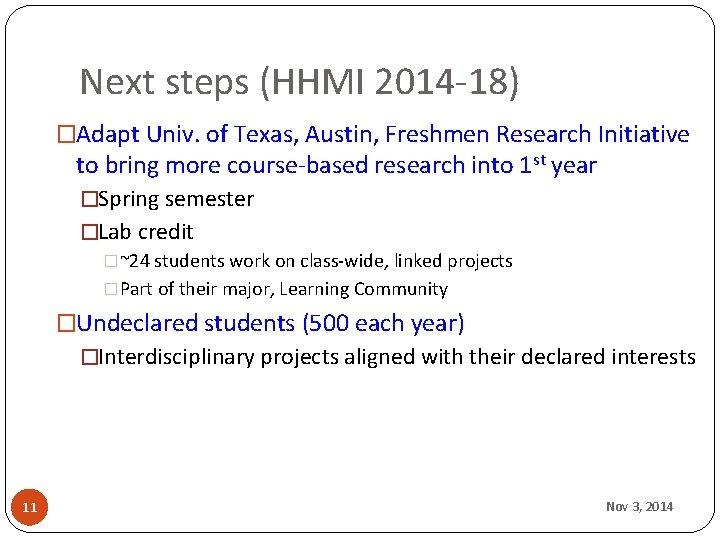
Next steps (HHMI 2014 -18) �Adapt Univ. of Texas, Austin, Freshmen Research Initiative to bring more course-based research into 1 st year �Spring semester �Lab credit �~24 students work on class-wide, linked projects �Part of their major, Learning Community �Undeclared students (500 each year) �Interdisciplinary projects aligned with their declared interests 11 Nov 3, 2014
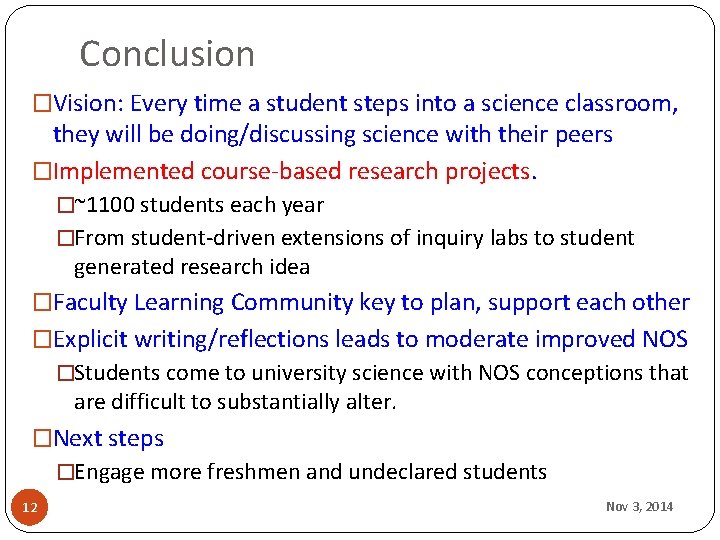
Conclusion �Vision: Every time a student steps into a science classroom, they will be doing/discussing science with their peers �Implemented course-based research projects. �~1100 students each year �From student-driven extensions of inquiry labs to student generated research idea �Faculty Learning Community key to plan, support each other �Explicit writing/reflections leads to moderate improved NOS �Students come to university science with NOS conceptions that are difficult to substantially alter. �Next steps �Engage more freshmen and undeclared students 12 Nov 3, 2014
Acknowledgments � HHMI grant 2010 -2014 � Cinzia Cervato, Tom Greenbowe, Jo Anne Powell-Coffman, Gene Takle � Facilitators of Faculty Learning Communities � Charles Kerton, Stan Harpole, Bill Gallus, Nikki Pohl, Diane Bassham, Jim Colbert, Tom Greenbowe, Doug Gentile, Paula Siklody, Nancy Boury, David Vleck, Phil Becraft, Soeren Prell, Tom Holme, Alex Travesset, Jason Chen, Clark Coffman, Cinzia Cervato � HHMI Science Teaching Fellows � Now faculty: Liz Addis, Mike Slade, Glene’ Mynhardt � Now Center for Teaching Learning: Emily Elliot � Current: Carol Chaffee, Jenny Brigham � Lab Staff: Linda Westgate, Paula Herrera, Steve Heideman, Teresa Fernando, Chanda Skelton � Deans of Liberal Arts and Sciences, College of Agriculture and Life Sciences � Chemistry Education postdocs � Kim Linenberger, Jeff Raker � Community College Leaders � Jermaine Johnson, Sally Willson, Chris Russell � CESMEE staff � Patsey Reilly, Tracie Miller, Stacy Renfro 13 Nov 3, 2014
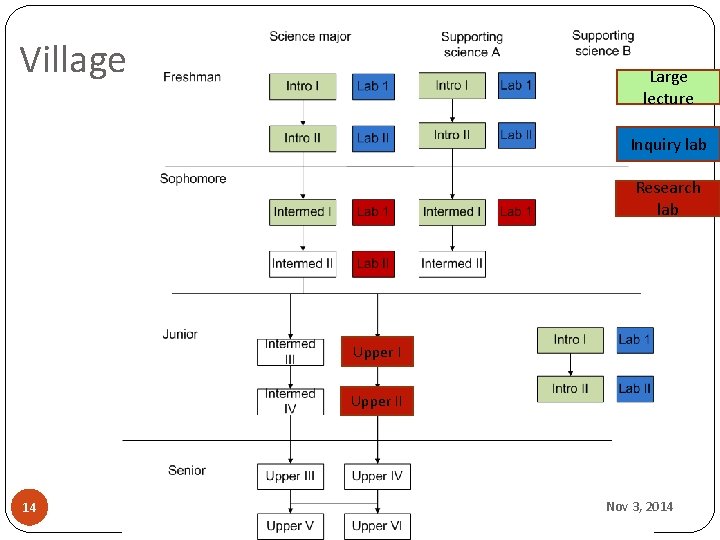
Village Large lecture Inquiry lab Research lab Upper II 14 Nov 3, 2014
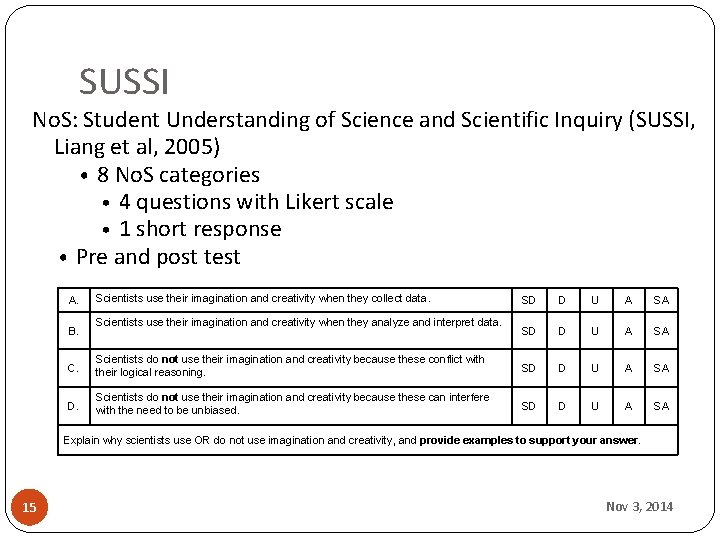
SUSSI No. S: Student Understanding of Science and Scientific Inquiry (SUSSI, Liang et al, 2005) • 8 No. S categories • 4 questions with Likert scale • 1 short response • Pre and post test A. B. Scientists use their imagination and creativity when they collect data. Scientists use their imagination and creativity when they analyze and interpret data. SD D U A SA C. Scientists do not use their imagination and creativity because these conflict with their logical reasoning. SD D U A SA D. Scientists do not use their imagination and creativity because these can interfere with the need to be unbiased. SD D U A SA Explain why scientists use OR do not use imagination and creativity, and provide examples to support your answer. 15 Nov 3, 2014
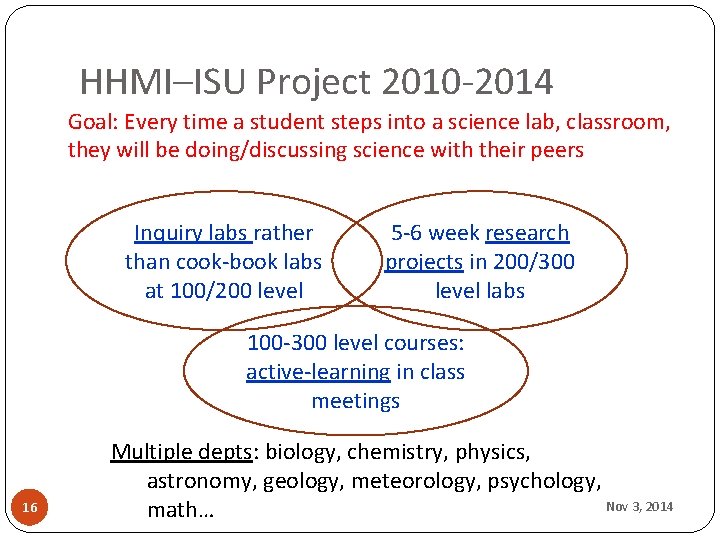
HHMI–ISU Project 2010 -2014 Goal: Every time a student steps into a science lab, classroom, they will be doing/discussing science with their peers Inquiry labs rather than cook-book labs at 100/200 level 5 -6 week research projects in 200/300 level labs 100 -300 level courses: active-learning in class meetings 16 Multiple depts: biology, chemistry, physics, astronomy, geology, meteorology, psychology, Nov 3, 2014 math…
- Slides: 16