
ENG 101 Final Exit Essay Prep ENG 101
- Slides: 13
ENG 101 Final Exit Essay Prep
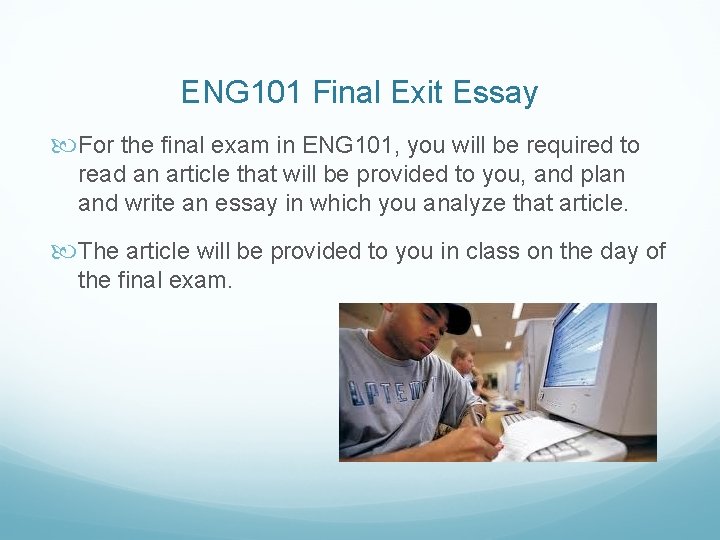
ENG 101 Final Exit Essay For the final exam in ENG 101, you will be required to read an article that will be provided to you, and plan and write an essay in which you analyze that article. The article will be provided to you in class on the day of the final exam.
Analysis Essay In an analysis essay, your job is to analyze and critique the work of another writer. Your essay should explain the main point of the source article and discuss how the author goes about making that point. Try to answer questions like: What is the topic of the source article? What is the author’s claim (main argument)? What facts or other evidence does the author provide to support his/her claim? Who is the intended audience? What is the larger conversation on this subject matter? What other things should be considered?
Read to understand First preview the article to get a general idea of what it is about. Then carefully read the article. Start from the beginning and do not skip sections. Annotate as you read. Underline key points and write notes in the margins. Be sure you have a clear understanding of the author’s thesis and major supporting points.
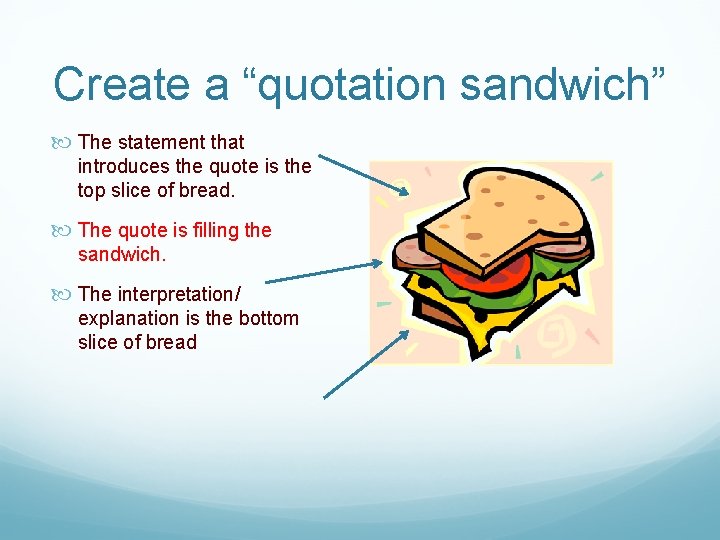
Create a “quotation sandwich” The statement that introduces the quote is the top slice of bread. The quote is filling the sandwich. The interpretation/ explanation is the bottom slice of bread
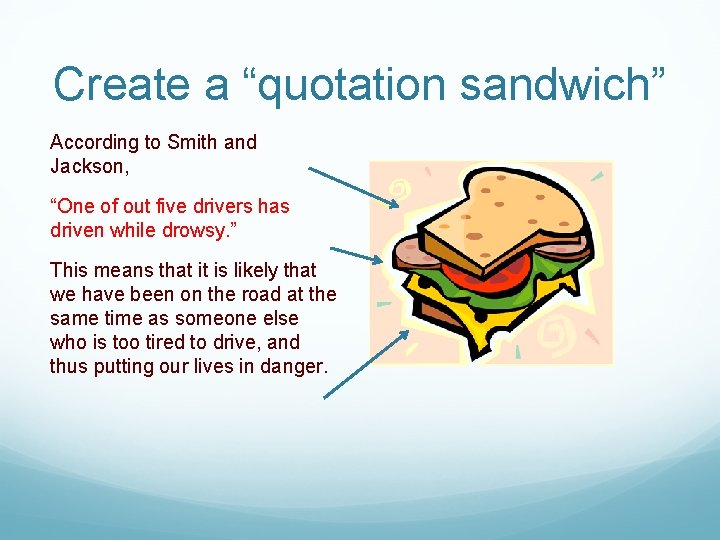
Create a “quotation sandwich” According to Smith and Jackson, “One of out five drivers has driven while drowsy. ” This means that it is likely that we have been on the road at the same time as someone else who is too tired to drive, and thus putting our lives in danger.
Examples of ways to introduce source material (in-text citation for quotes, summaries, and paraphrased material) X states, “_______” (73). The critic asserts, “_____” (Smith 3). X writes, “______” (73). In her article, “Time Suckers, ” X maintains that ______ (89). *It is better to vary the way you introduce source material. Don’t use the same approach every time!
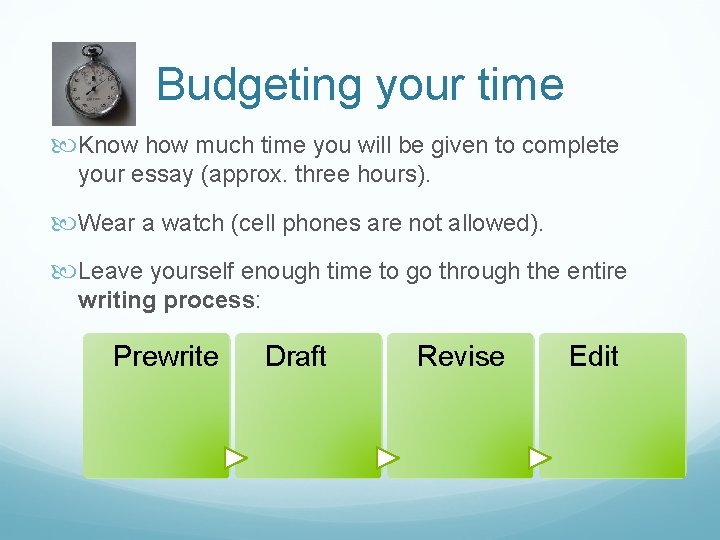
Budgeting your time Know how much time you will be given to complete your essay (approx. three hours). Wear a watch (cell phones are not allowed). Leave yourself enough time to go through the entire writing process: Prewrite Draft Revise Edit
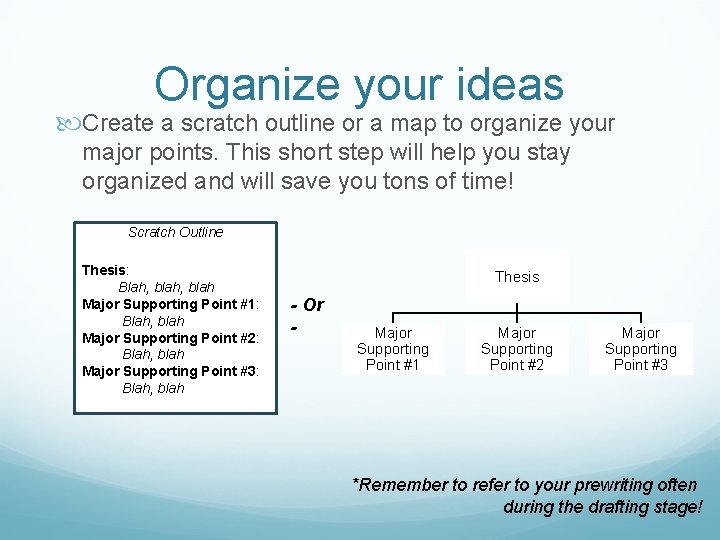
Organize your ideas Create a scratch outline or a map to organize your major points. This short step will help you stay organized and will save you tons of time! Scratch Outline Thesis: Blah, blah Major Supporting Point #1: Blah, blah Major Supporting Point #2: Blah, blah Major Supporting Point #3: Blah, blah Thesis - Or - Major Supporting Point #1 Major Supporting Point #2 Major Supporting Point #3 *Remember to refer to your prewriting often during the drafting stage!
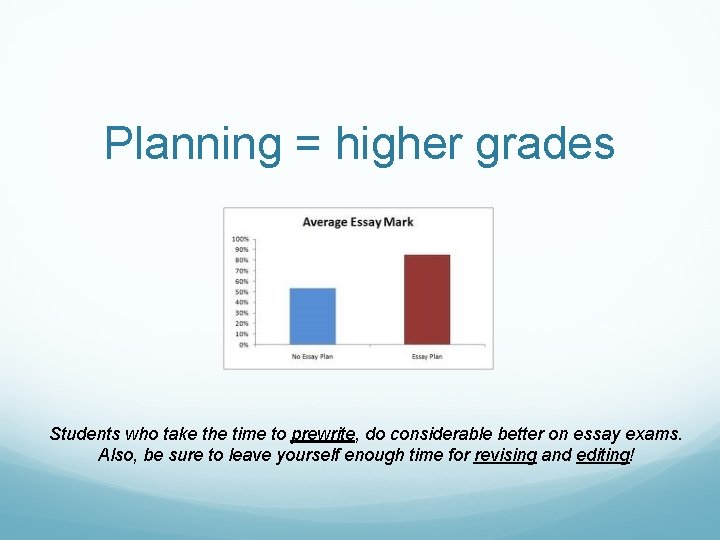
Planning = higher grades Students who take the time to prewrite, do considerable better on essay exams. Also, be sure to leave yourself enough time for revising and editing!
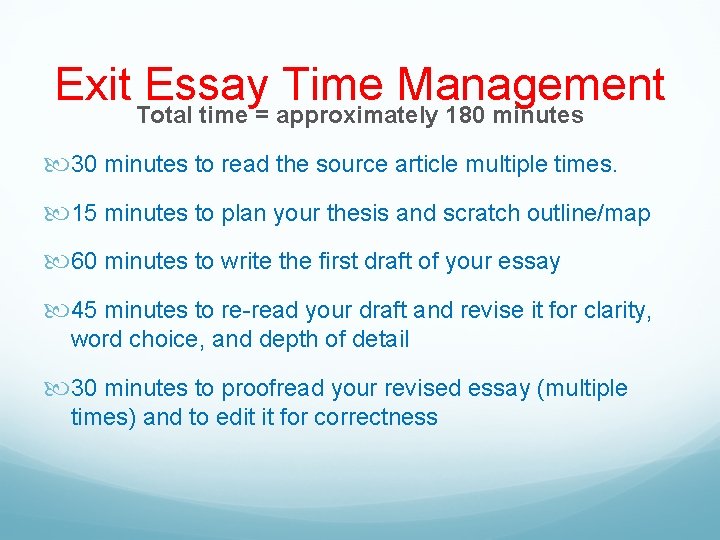
Exit Essay Time Management Total time = approximately 180 minutes 30 minutes to read the source article multiple times. 15 minutes to plan your thesis and scratch outline/map 60 minutes to write the first draft of your essay 45 minutes to re-read your draft and revise it for clarity, word choice, and depth of detail 30 minutes to proofread your revised essay (multiple times) and to edit it for correctness
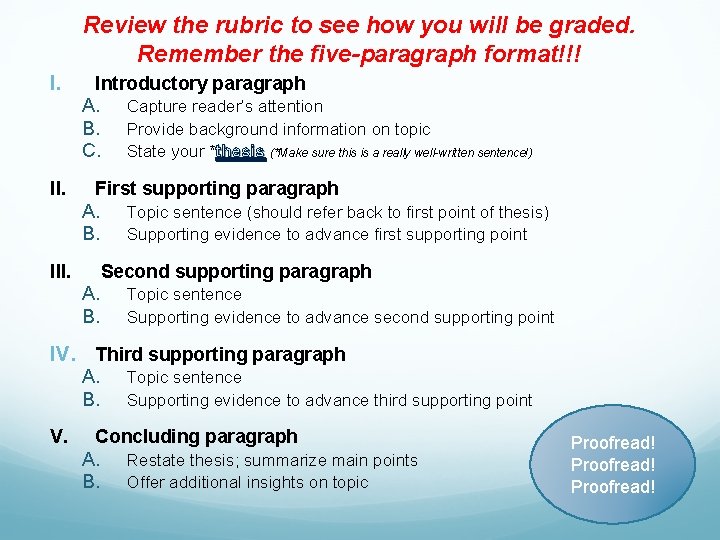
Review the rubric to see how you will be graded. Remember the five-paragraph format!!! I. Introductory paragraph A. Capture reader’s attention B. Provide background information on topic C. State your *thesis (*Make sure this is a really well-written sentence!) II. First supporting paragraph A. Topic sentence (should refer back to first point of thesis) B. Supporting evidence to advance first supporting point III. Second supporting paragraph A. B. Topic sentence Supporting evidence to advance second supporting point IV. Third supporting paragraph A. B. V. Topic sentence Supporting evidence to advance third supporting point Concluding paragraph A. Restate thesis; summarize main points B. Offer additional insights on topic Proofread!
Points to remember: Use a professional tone. Third person point-of-view is most appropriate for academic papers. Revise after you draft – how can you make your essay better, stronger, more clear? Proofread! You can do this!!! GOOD LUCK!