
ENG 100 GRAMMAR LESSONS COMMAS RULE 1 Use

- Slides: 56
ENG 100 GRAMMAR LESSONS
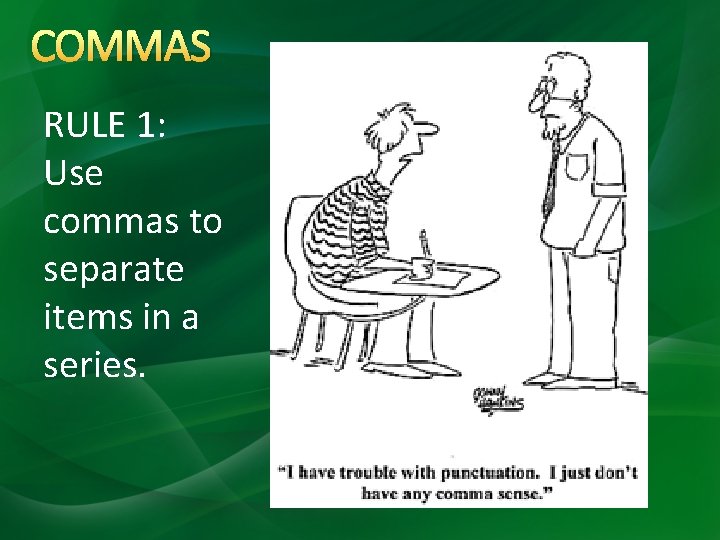
COMMAS RULE 1: Use commas to separate items in a series.
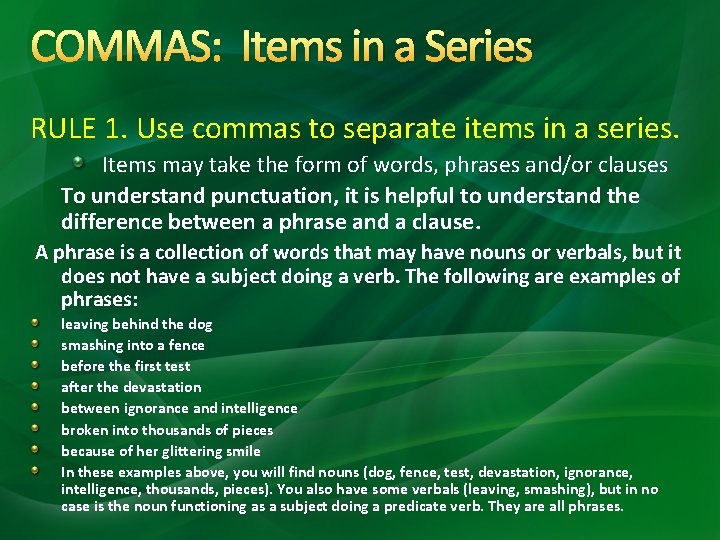
COMMAS: Items in a Series RULE 1. Use commas to separate items in a series. Items may take the form of words, phrases and/or clauses To understand punctuation, it is helpful to understand the difference between a phrase and a clause. A phrase is a collection of words that may have nouns or verbals, but it does not have a subject doing a verb. The following are examples of phrases: leaving behind the dog smashing into a fence before the first test after the devastation between ignorance and intelligence broken into thousands of pieces because of her glittering smile In these examples above, you will find nouns (dog, fence, test, devastation, ignorance, intelligence, thousands, pieces). You also have some verbals (leaving, smashing), but in no case is the noun functioning as a subject doing a predicate verb. They are all phrases.
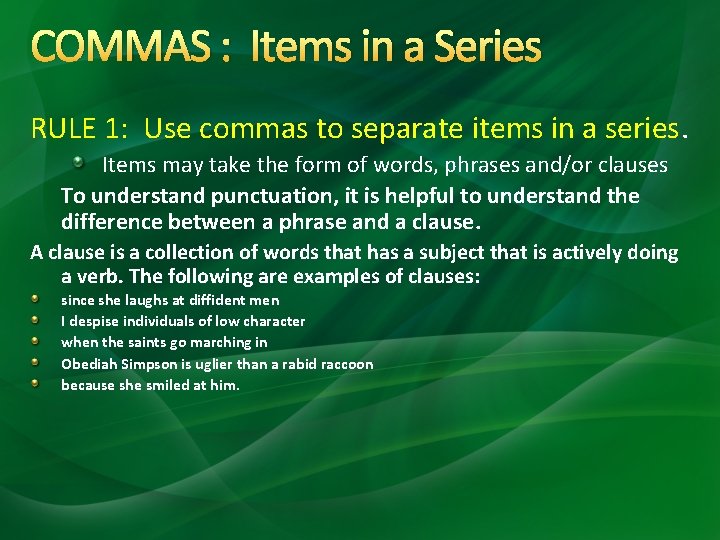
COMMAS : Items in a Series RULE 1: Use commas to separate items in a series. Items may take the form of words, phrases and/or clauses To understand punctuation, it is helpful to understand the difference between a phrase and a clause. A clause is a collection of words that has a subject that is actively doing a verb. The following are examples of clauses: since she laughs at diffident men I despise individuals of low character when the saints go marching in Obediah Simpson is uglier than a rabid raccoon because she smiled at him.
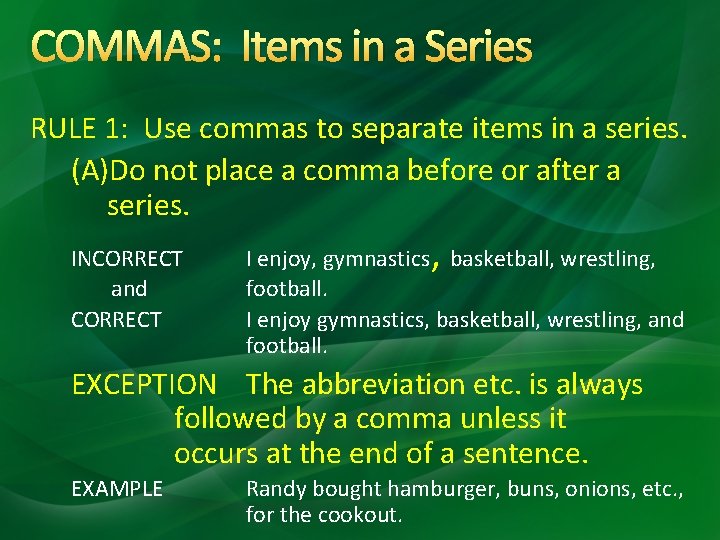
COMMAS: Items in a Series RULE 1: Use commas to separate items in a series. (A)Do not place a comma before or after a series. INCORRECT and CORRECT , I enjoy, gymnastics basketball, wrestling, football. I enjoy gymnastics, basketball, wrestling, and football. EXCEPTION The abbreviation etc. is always followed by a comma unless it occurs at the end of a sentence. EXAMPLE Randy bought hamburger, buns, onions, etc. , for the cookout.
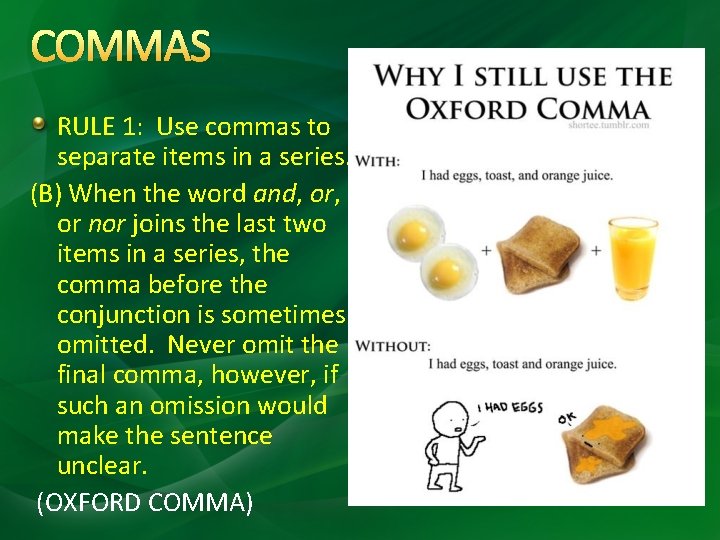
COMMAS RULE 1: Use commas to separate items in a series. (B) When the word and, or nor joins the last two items in a series, the comma before the conjunction is sometimes omitted. Never omit the final comma, however, if such an omission would make the sentence unclear. (OXFORD COMMA)
COMMAS: Items in a Series RULE 1: Use commas to separate items in a series. (B) OXFORD COMMA UNCLEAR Mother, Father and Uncle Matt went to town. [How many people went to town, two or three? Is Mother being addressed or enumerated? ] CLEAR Mother, Father, and Uncle Matt went to town. Note: Words customarily used in pairs are set off as one items in a series: pancakes and syrup, bread and butter, profit and loss, hand coat, pork and beans, etc. EXAMPLE Breakfast at the inn consists of orange juice, ham and eggs, toast, and coffee. #1
COMMAS RULE 2 : Use commas to separate two or more adjectives that modify the same noun. EXAMPLE Lana is an intelligent, responsible, sensitive director. NOTE A comma is unnecessary before a modifier so closely associated with the noun that the two words are thought of as a single concept. EXAMPLE She is an intelligent, sensitive young woman.
COMMAS: Items in a Series RULE 2: Use commas to separate two or more adjectives that modify the same noun. To determine whether two adjectives modify the noun equally, substitute and for the possible comma: intelligent (and) sensitive young woman. If this can be done, a comma is necessary. Also, if the order of the adjectives can be reversed, a comma is needed: She is a sensitive, intelligent young woman. #2
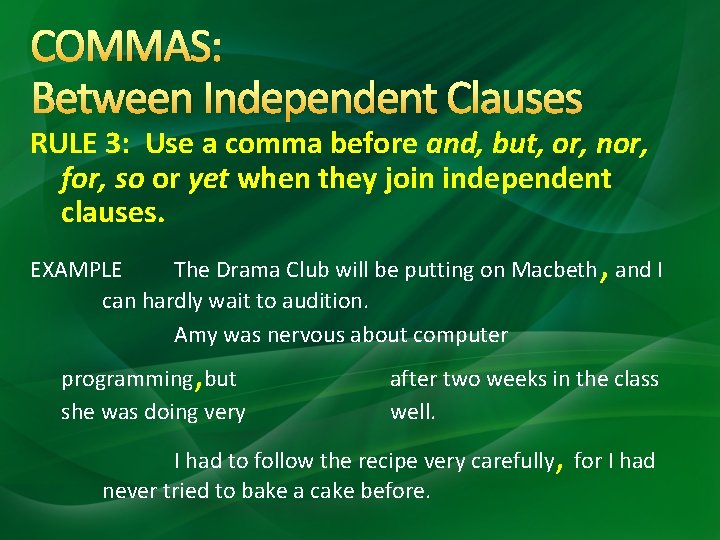
COMMAS: Between Independent Clauses RULE 3: Use a comma before and, but, or, nor, for, so or yet when they join independent clauses. , EXAMPLE The Drama Club will be putting on Macbeth and I can hardly wait to audition. Amy was nervous about computer , programming but she was doing very after two weeks in the class well. , I had to follow the recipe very carefully for I had never tried to bake a cake before.
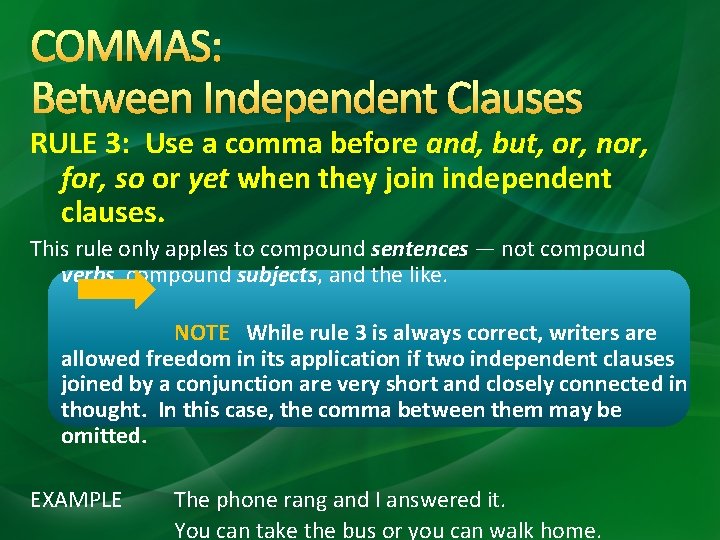
COMMAS: Between Independent Clauses RULE 3: Use a comma before and, but, or, nor, for, so or yet when they join independent clauses. This rule only apples to compound sentences — not compound verbs, compound subjects, and the like. NOTE While rule 3 is always correct, writers are allowed freedom in its application if two independent clauses joined by a conjunction are very short and closely connected in thought. In this case, the comma between them may be omitted. EXAMPLE The phone rang and I answered it. You can take the bus or you can walk home.
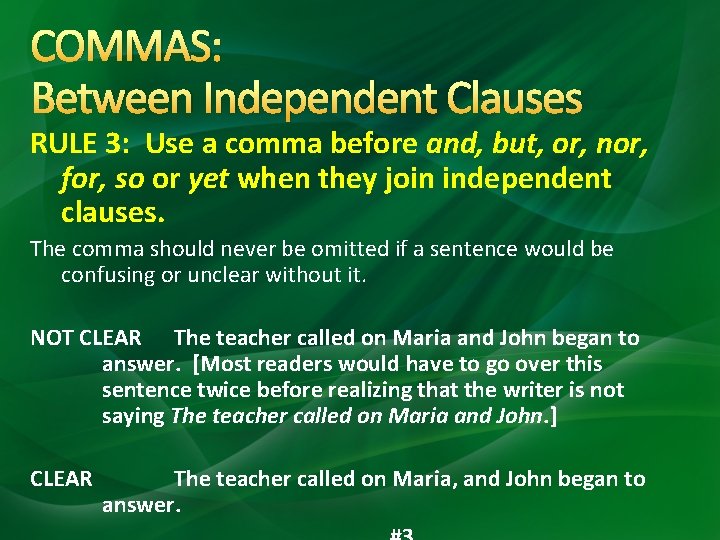
COMMAS: Between Independent Clauses RULE 3: Use a comma before and, but, or, nor, for, so or yet when they join independent clauses. The comma should never be omitted if a sentence would be confusing or unclear without it. NOT CLEAR The teacher called on Maria and John began to answer. [Most readers would have to go over this sentence twice before realizing that the writer is not saying The teacher called on Maria and John. ] CLEAR The teacher called on Maria, and John began to answer.
COMMAS Pick up the handout entitled “Commas Practice 1” from the tray on the bookcase. Please complete ON YOUR OWN. You may use your commas notes. #4
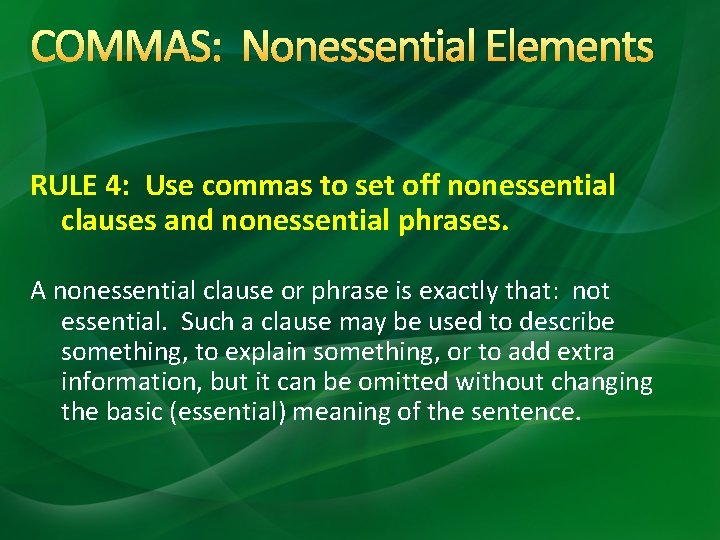
COMMAS: Nonessential Elements RULE 4: Use commas to set off nonessential clauses and nonessential phrases. A nonessential clause or phrase is exactly that: not essential. Such a clause may be used to describe something, to explain something, or to add extra information, but it can be omitted without changing the basic (essential) meaning of the sentence.
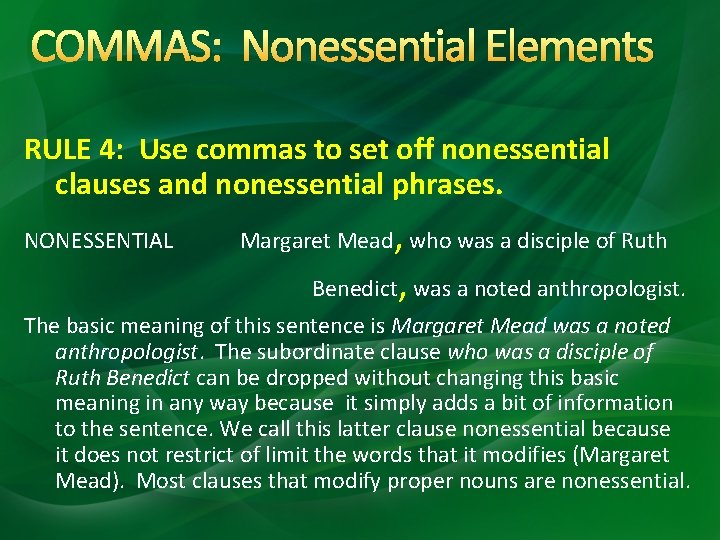
COMMAS: Nonessential Elements RULE 4: Use commas to set off nonessential clauses and nonessential phrases. NONESSENTIAL , Benedict, was a noted anthropologist. Margaret Mead who was a disciple of Ruth The basic meaning of this sentence is Margaret Mead was a noted anthropologist. The subordinate clause who was a disciple of Ruth Benedict can be dropped without changing this basic meaning in any way because it simply adds a bit of information to the sentence. We call this latter clause nonessential because it does not restrict of limit the words that it modifies (Margaret Mead). Most clauses that modify proper nouns are nonessential.
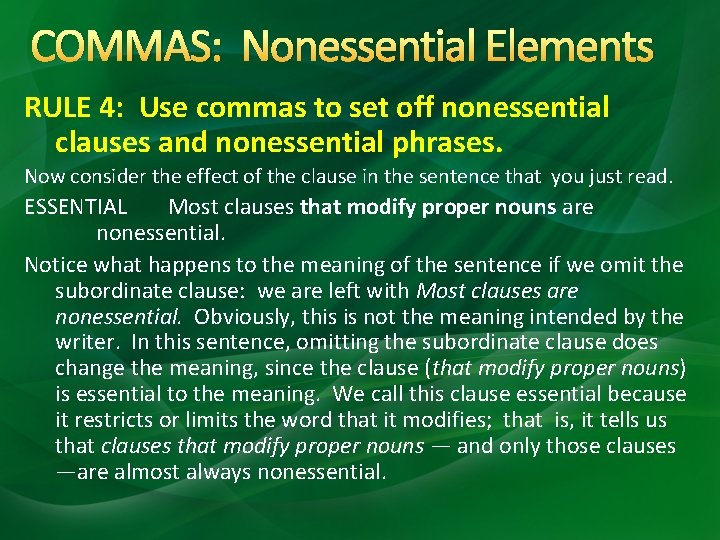
COMMAS: Nonessential Elements RULE 4: Use commas to set off nonessential clauses and nonessential phrases. Now consider the effect of the clause in the sentence that you just read. ESSENTIAL Most clauses that modify proper nouns are nonessential. Notice what happens to the meaning of the sentence if we omit the subordinate clause: we are left with Most clauses are nonessential. Obviously, this is not the meaning intended by the writer. In this sentence, omitting the subordinate clause does change the meaning, since the clause (that modify proper nouns) is essential to the meaning. We call this clause essential because it restricts or limits the word that it modifies; that is, it tells us that clauses that modify proper nouns — and only those clauses —are almost always nonessential.
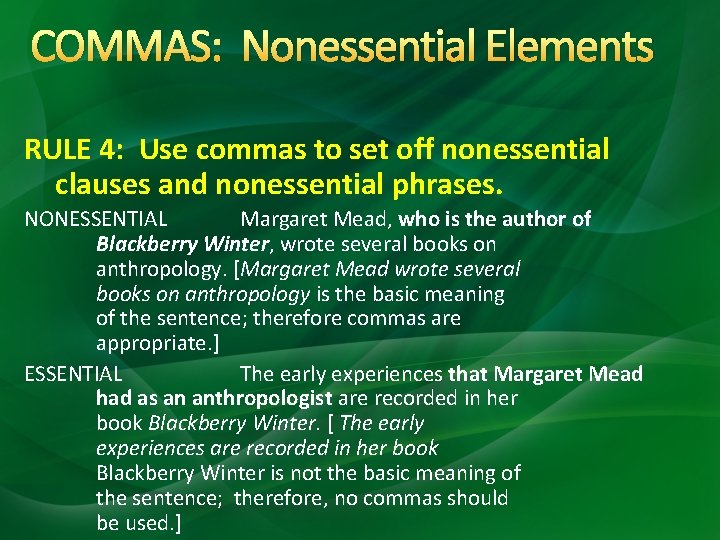
COMMAS: Nonessential Elements RULE 4: Use commas to set off nonessential clauses and nonessential phrases. NONESSENTIAL Margaret Mead, who is the author of Blackberry Winter, wrote several books on anthropology. [Margaret Mead wrote several books on anthropology is the basic meaning of the sentence; therefore commas are appropriate. ] ESSENTIAL The early experiences that Margaret Mead had as an anthropologist are recorded in her book Blackberry Winter. [ The early experiences are recorded in her book Blackberry Winter is not the basic meaning of the sentence; therefore, no commas should be used. ]
COMMAS: Nonessential Elements RULE 4: Use commas to set off nonessential clauses and nonessential phrases. NONESSENTIAL The Homecoming Parade, which is sponsored by the student council, will feature twentythree floats this year. ESSENTIAL Anyone who appreciates the color and movement will enjoy seeing Alexander Calder’s mobiles.
COMMAS: Nonessential Elements RULE 4: Use commas to set off nonessential clauses and nonessential phrases. Understanding the difference between essential and nonessential clauses can be a valuable help in expressing the exact meaning that you have in mind. If commas were never used, some clauses could often be interpreted as either essential or nonessential. EXAMPLE Science fiction writers (, ) who are concerned about machines dominating people (, ) frequently write about computer-controlled societies.
COMMAS: Nonessential Elements RULE 4: Use commas to set off nonessential clauses and nonessential phrases. EXAMPLE Science fiction writers (, ) who are concerned about machines dominating people (, ) frequently write about computer-controlled societies. Notice the commas in parentheses. If these commas are included in the sentence, we have one meaning; if they are omitted, we have another, and very different, meaning. When commas are used, the writer is saying that science fiction writers write about computercontrolled societies; the information in the subordinate clause merely explains why they do so. Without the commas, however, the subordinate clause is essential, and the meaning of the sentence is that only writers who are concerned about machines dominating people would write about computer-controlled societies.
COMMAS: Participial Phrases RULE 4: Use commas to set off nonessential clauses and nonessential phrases. A participle is a verb form that can be used as an adjective. EXAMPLES The waving campers boarded the bus. Waving, the campers boarded the bus. [In these sentences, waving, like the verb wave, expresses action; like an adjective, it modifies the noun campers. ] We could hear the wind howling. [Here howling expresses action, like a verb; it also modifies the wind. ]
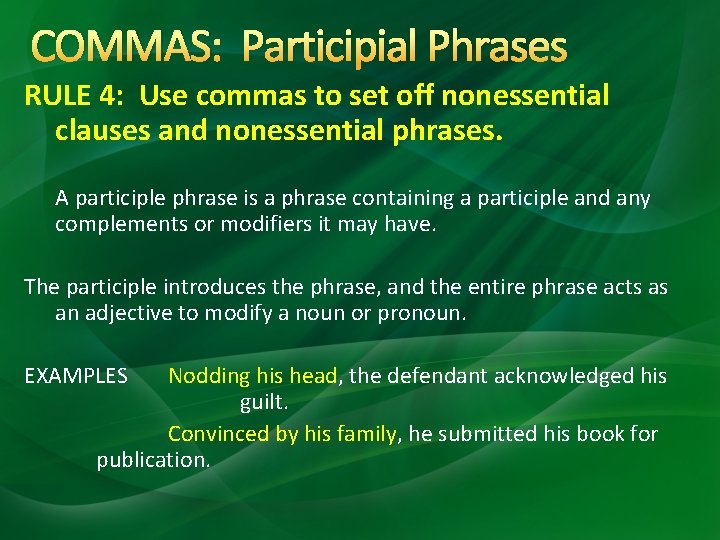
COMMAS: Participial Phrases RULE 4: Use commas to set off nonessential clauses and nonessential phrases. A participle phrase is a phrase containing a participle and any complements or modifiers it may have. The participle introduces the phrase, and the entire phrase acts as an adjective to modify a noun or pronoun. EXAMPLES Nodding his head, the defendant acknowledged his guilt. Convinced by his family, he submitted his book for publication.
COMMAS: Participial Phrases RULE 4: Use commas to set off nonessential clauses and nonessential phrases. Practice identifying Participial Phrases. #6
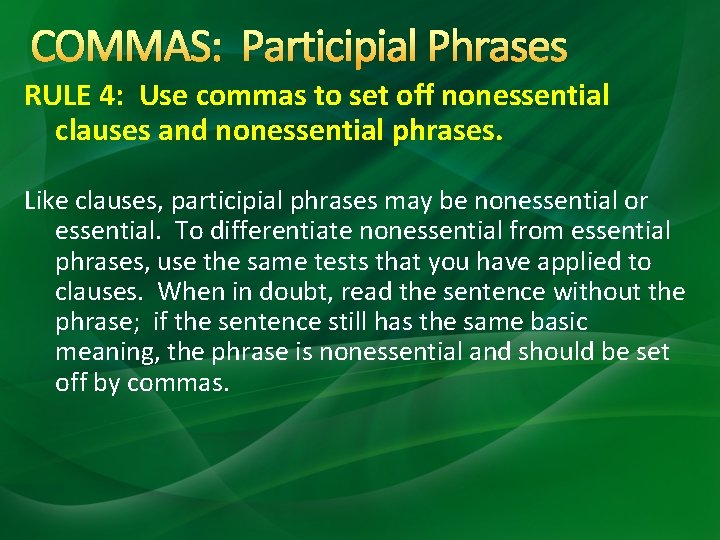
COMMAS: Participial Phrases RULE 4: Use commas to set off nonessential clauses and nonessential phrases. Like clauses, participial phrases may be nonessential or essential. To differentiate nonessential from essential phrases, use the same tests that you have applied to clauses. When in doubt, read the sentence without the phrase; if the sentence still has the same basic meaning, the phrase is nonessential and should be set off by commas.
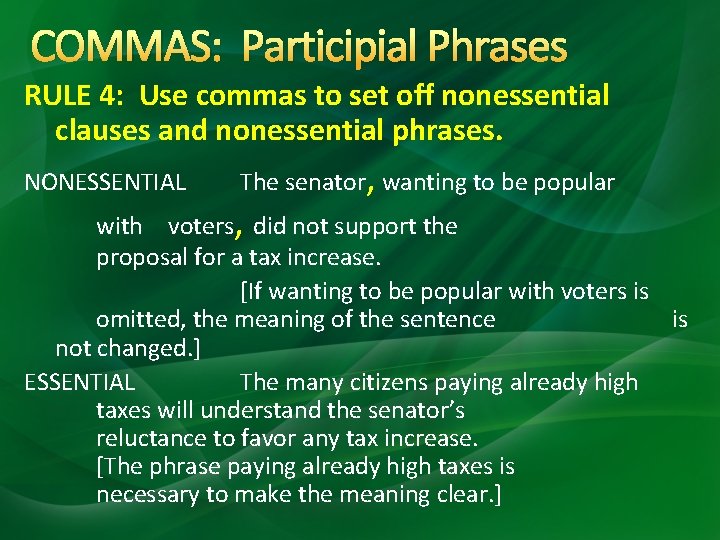
COMMAS: Participial Phrases RULE 4: Use commas to set off nonessential clauses and nonessential phrases. NONESSENTIAL The senator, wanting to be popular with voters, did not support the proposal for a tax increase. [If wanting to be popular with voters is omitted, the meaning of the sentence is not changed. ] ESSENTIAL The many citizens paying already high taxes will understand the senator’s reluctance to favor any tax increase. [The phrase paying already high taxes is necessary to make the meaning clear. ]
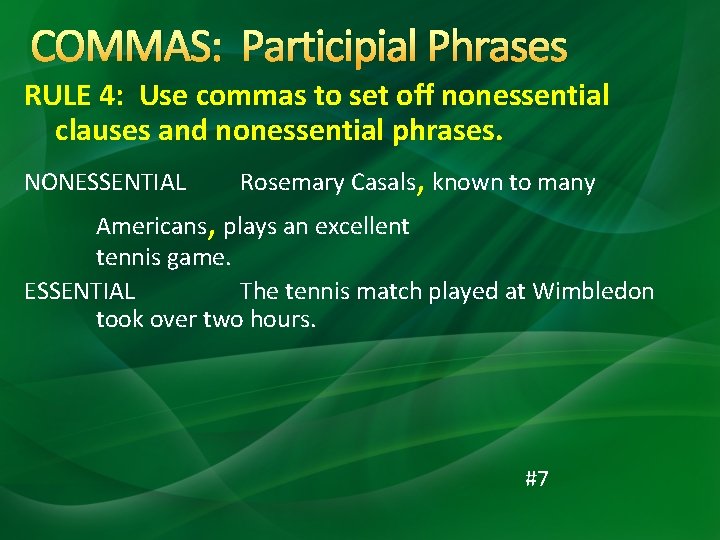
COMMAS: Participial Phrases RULE 4: Use commas to set off nonessential clauses and nonessential phrases. NONESSENTIAL Rosemary Casals, known to many Americans, plays an excellent tennis game. ESSENTIAL The tennis match played at Wimbledon took over two hours. #7
COMMAS Pick up the handout entitled “Commas Practice 3” from the tray on the bookcase. Please complete ON YOUR OWN. You may use your commas notes. #8
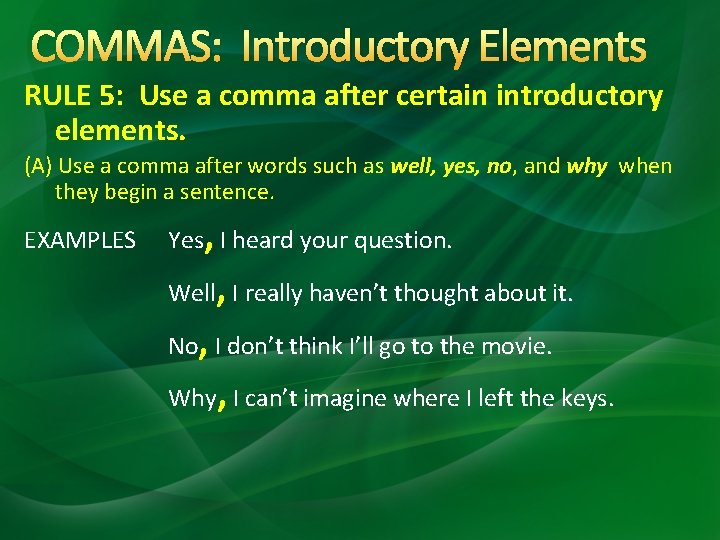
COMMAS: Introductory Elements RULE 5: Use a comma after certain introductory elements. (A) Use a comma after words such as well, yes, no, and why when they begin a sentence. EXAMPLES Yes, I heard your question. Well, I really haven’t thought about it. No, I don’t think I’ll go to the movie. Why, I can’t imagine where I left the keys.
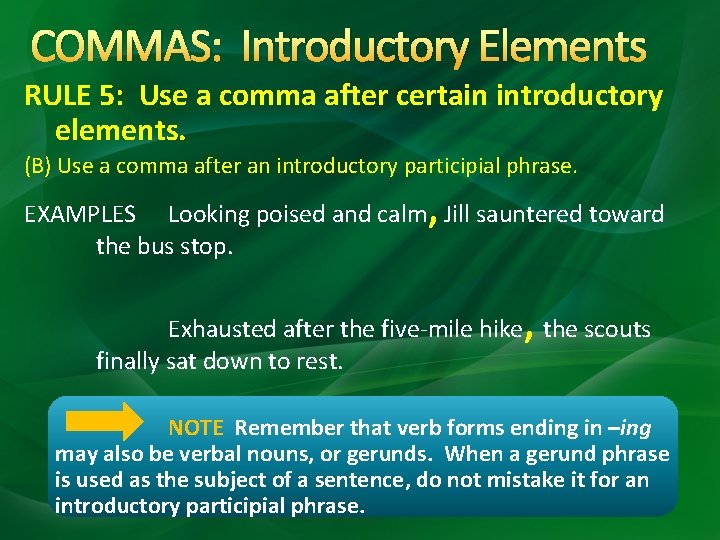
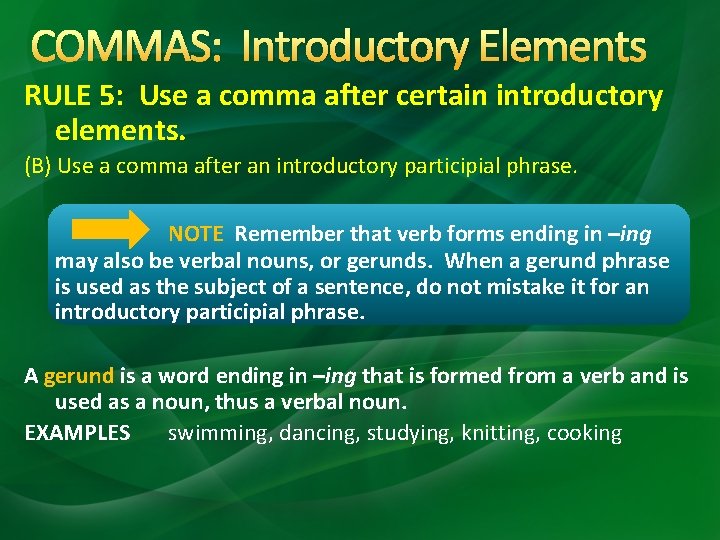
COMMAS: Introductory Elements RULE 5: Use a comma after certain introductory elements. (B) Use a comma after an introductory participial phrase. EXAMPLES Looking poised and calm, Jill sauntered toward the bus stop. Exhausted after the five-mile hike, the scouts finally sat down to rest. NOTE Remember that verb forms ending in –ing may also be verbal nouns, or gerunds. When a gerund phrase is used as the subject of a sentence, do not mistake it for an introductory participial phrase.
COMMAS: Introductory Elements RULE 5: Use a comma after certain introductory elements. (B) Use a comma after an introductory participial phrase. NOTE Remember that verb forms ending in –ing may also be verbal nouns, or gerunds. When a gerund phrase is used as the subject of a sentence, do not mistake it for an introductory participial phrase. A gerund is a word ending in –ing that is formed from a verb and is used as a noun, thus a verbal noun. EXAMPLES swimming, dancing, studying, knitting, cooking
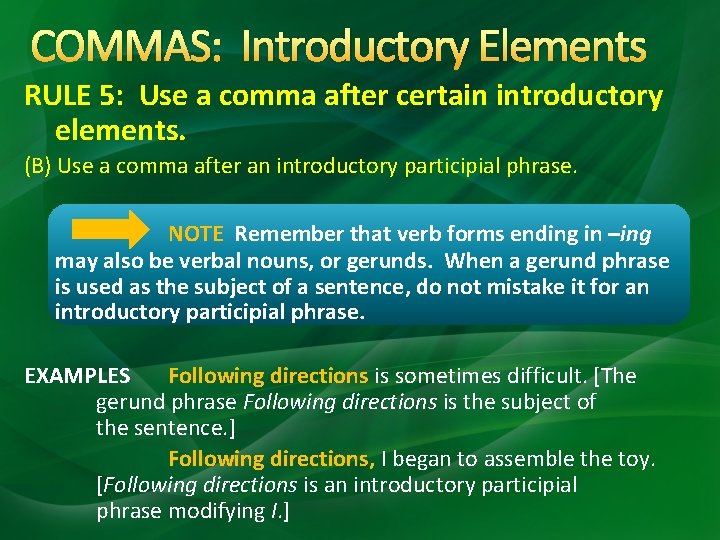
COMMAS: Introductory Elements RULE 5: Use a comma after certain introductory elements. (B) Use a comma after an introductory participial phrase. NOTE Remember that verb forms ending in –ing may also be verbal nouns, or gerunds. When a gerund phrase is used as the subject of a sentence, do not mistake it for an introductory participial phrase. EXAMPLES Following directions is sometimes difficult. [The gerund phrase Following directions is the subject of the sentence. ] Following directions, I began to assemble the toy. [Following directions is an introductory participial phrase modifying I. ]
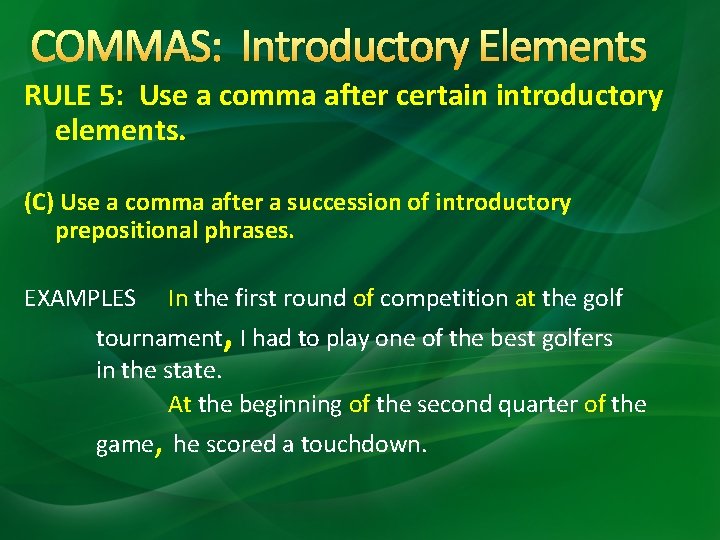
COMMAS: Introductory Elements RULE 5: Use a comma after certain introductory elements. (C) Use a comma after a succession of introductory prepositional phrases. EXAMPLES In the first round of competition at the golf tournament, I had to play one of the best golfers in the state. At the beginning of the second quarter of the game, he scored a touchdown.
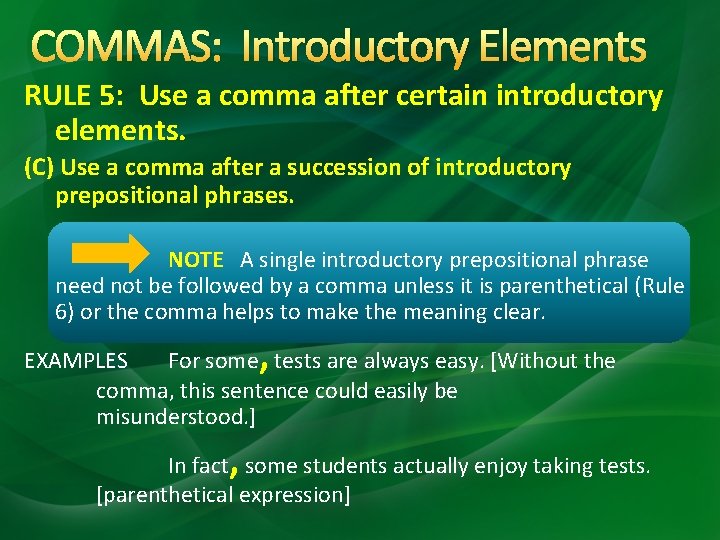
COMMAS: Introductory Elements RULE 5: Use a comma after certain introductory elements. (C) Use a comma after a succession of introductory prepositional phrases. NOTE A single introductory prepositional phrase need not be followed by a comma unless it is parenthetical (Rule 6) or the comma helps to make the meaning clear. , EXAMPLES For some tests are always easy. [Without the comma, this sentence could easily be misunderstood. ] , In fact some students actually enjoy taking tests. [parenthetical expression]
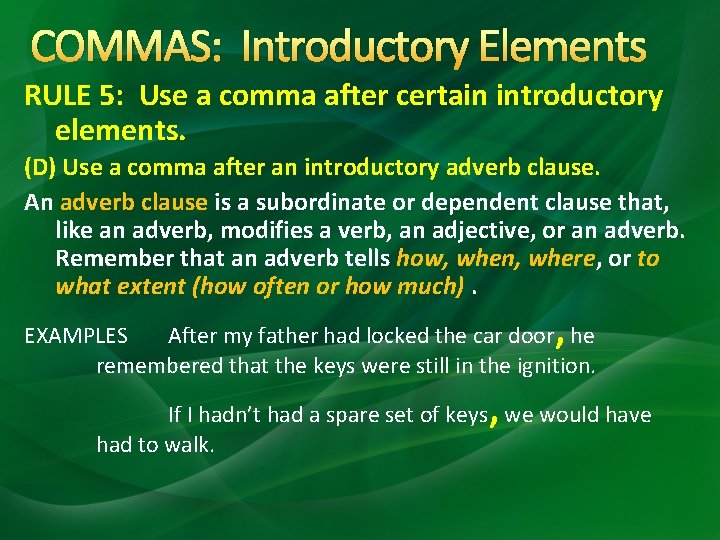
COMMAS: Introductory Elements RULE 5: Use a comma after certain introductory elements. (D) Use a comma after an introductory adverb clause. An adverb clause is a subordinate or dependent clause that, like an adverb, modifies a verb, an adjective, or an adverb. Remember that an adverb tells how, when, where, or to what extent (how often or how much). , EXAMPLES After my father had locked the car door he remembered that the keys were still in the ignition. , If I hadn’t had a spare set of keys we would have had to walk.
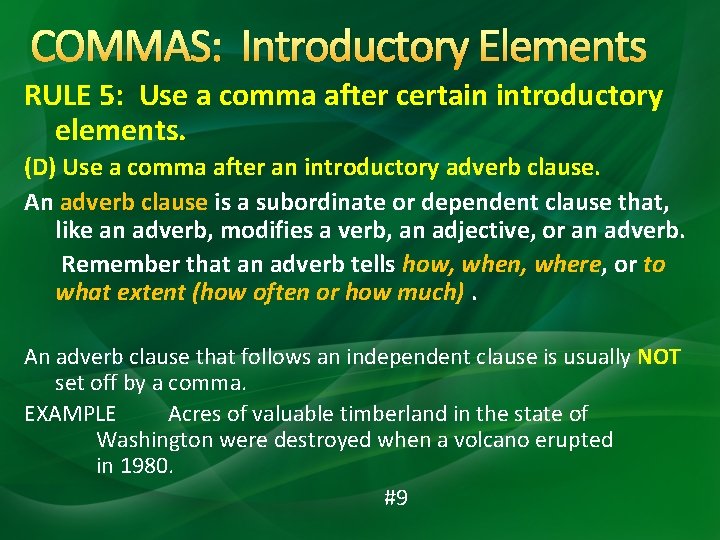
COMMAS: Introductory Elements RULE 5: Use a comma after certain introductory elements. (D) Use a comma after an introductory adverb clause. An adverb clause is a subordinate or dependent clause that, like an adverb, modifies a verb, an adjective, or an adverb. Remember that an adverb tells how, when, where, or to what extent (how often or how much). An adverb clause that follows an independent clause is usually NOT set off by a comma. EXAMPLE Acres of valuable timberland in the state of Washington were destroyed when a volcano erupted in 1980. #9
COMMAS Pick up the handout entitled “Review Exercise A” from the tray on the bookcase. Please complete ON YOUR OWN. You may use your commas notes. #10
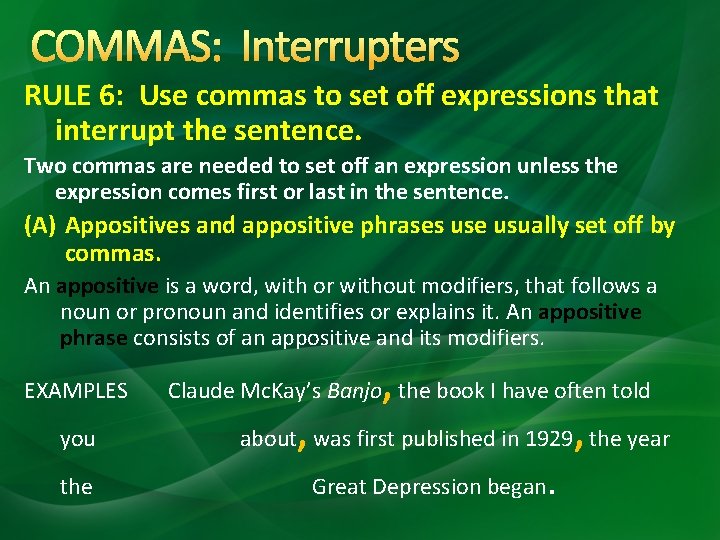
COMMAS: Interrupters RULE 6: Use commas to set off expressions that interrupt the sentence. Two commas are needed to set off an expression unless the expression comes first or last in the sentence. (A) Appositives and appositive phrases use usually set off by commas. An appositive is a word, with or without modifiers, that follows a noun or pronoun and identifies or explains it. An appositive phrase consists of an appositive and its modifiers. EXAMPLES you the , Claude Mc. Kay’s Banjo the book I have often told , , about was first published in 1929 the year Great Depression began .
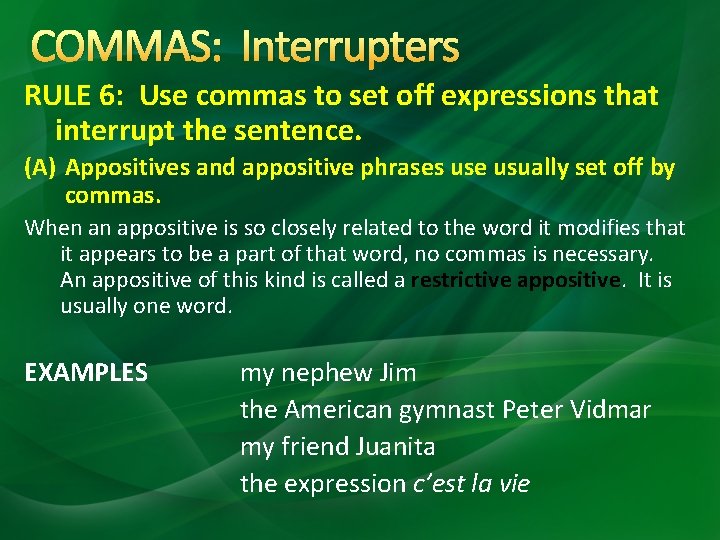
COMMAS: Interrupters RULE 6: Use commas to set off expressions that interrupt the sentence. (A) Appositives and appositive phrases use usually set off by commas. When an appositive is so closely related to the word it modifies that it appears to be a part of that word, no commas is necessary. An appositive of this kind is called a restrictive appositive. It is usually one word. EXAMPLES my nephew Jim the American gymnast Peter Vidmar my friend Juanita the expression c’est la vie
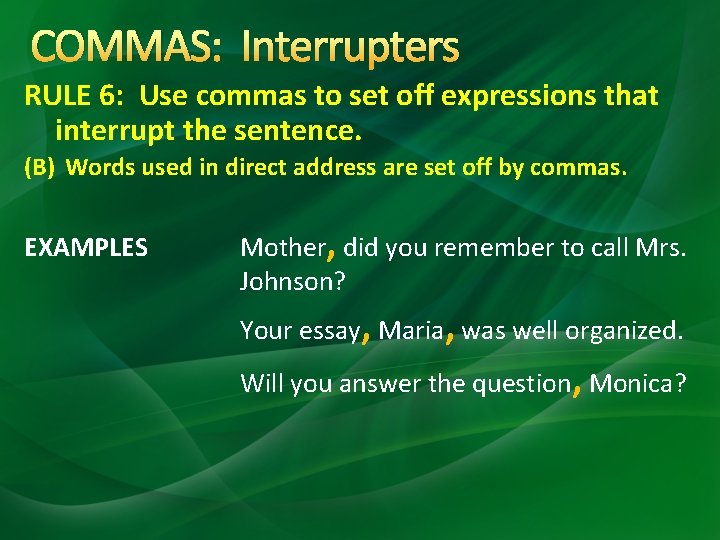
COMMAS: Interrupters RULE 6: Use commas to set off expressions that interrupt the sentence. (B) Words used in direct address are set off by commas. EXAMPLES Mother, did you remember to call Mrs. Johnson? Your essay, Maria, was well organized. Will you answer the question, Monica?
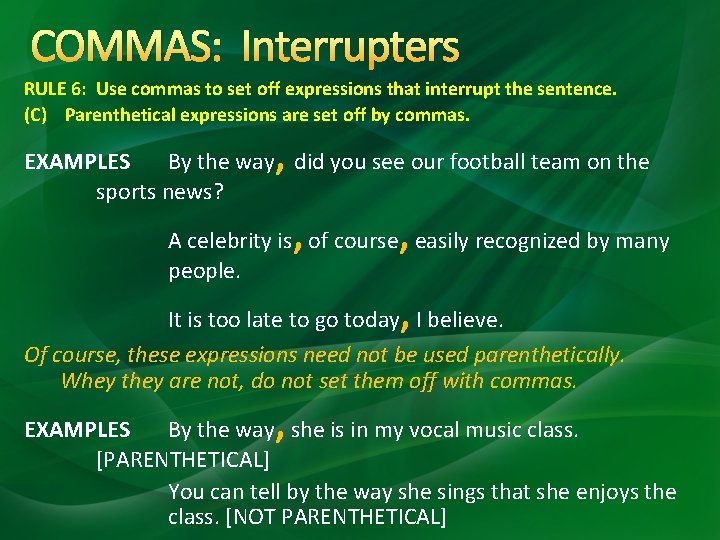
COMMAS: Interrupters RULE 6: Use commas to set off expressions that interrupt the sentence. (C) Parenthetical expressions are set off by commas. Many words and phrases are used parenthetically. Such expressions may serve as explanations or qualifications, but they do not affect the grammatical structure of the sentence in which they appear. The following slide contains a few commonly used parenthetical expressions.
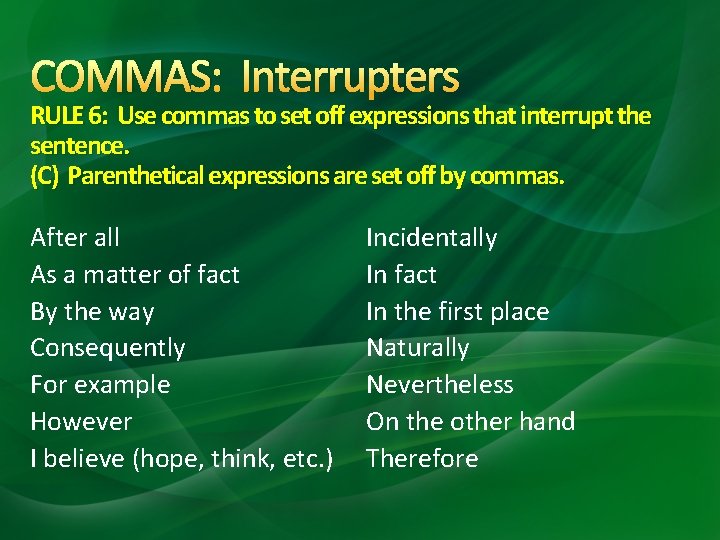
COMMAS: Interrupters RULE 6: Use commas to set off expressions that interrupt the sentence. (C) Parenthetical expressions are set off by commas. After all As a matter of fact By the way Consequently For example However I believe (hope, think, etc. ) Incidentally In fact In the first place Naturally Nevertheless On the other hand Therefore
COMMAS: Interrupters RULE 6: Use commas to set off expressions that interrupt the sentence. (C) Parenthetical expressions are set off by commas. , EXAMPLES By the way did you see our football team on the sports news? , , A celebrity is of course easily recognized by many people. , It is too late to go today I believe. Of course, these expressions need not be used parenthetically. Whey they are not, do not set them off with commas. , EXAMPLES By the way she is in my vocal music class. [PARENTHETICAL] You can tell by the way she sings that she enjoys the class. [NOT PARENTHETICAL]
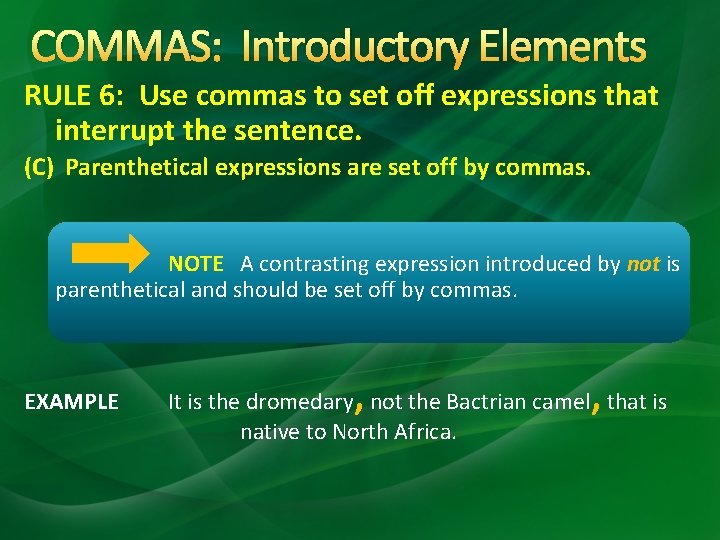
COMMAS: Introductory Elements RULE 6: Use commas to set off expressions that interrupt the sentence. (C) Parenthetical expressions are set off by commas. NOTE A contrasting expression introduced by not is parenthetical and should be set off by commas. EXAMPLE , , It is the dromedary not the Bactrian camel that is native to North Africa.
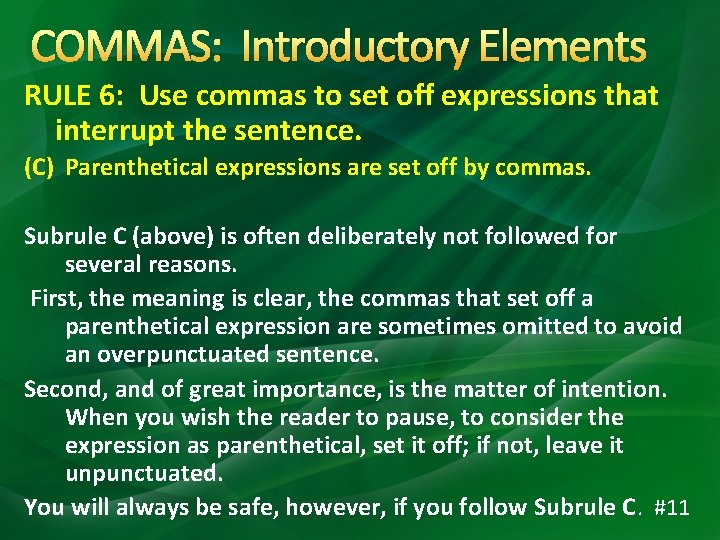
COMMAS: Introductory Elements RULE 6: Use commas to set off expressions that interrupt the sentence. (C) Parenthetical expressions are set off by commas. Subrule C (above) is often deliberately not followed for several reasons. First, the meaning is clear, the commas that set off a parenthetical expression are sometimes omitted to avoid an overpunctuated sentence. Second, and of great importance, is the matter of intention. When you wish the reader to pause, to consider the expression as parenthetical, set it off; if not, leave it unpunctuated. You will always be safe, however, if you follow Subrule C. #11
COMMAS Pick up the handout entitled “Commas Practice 4” from the tray on the bookcase. Please complete ON YOUR OWN. You may use your commas notes. #12
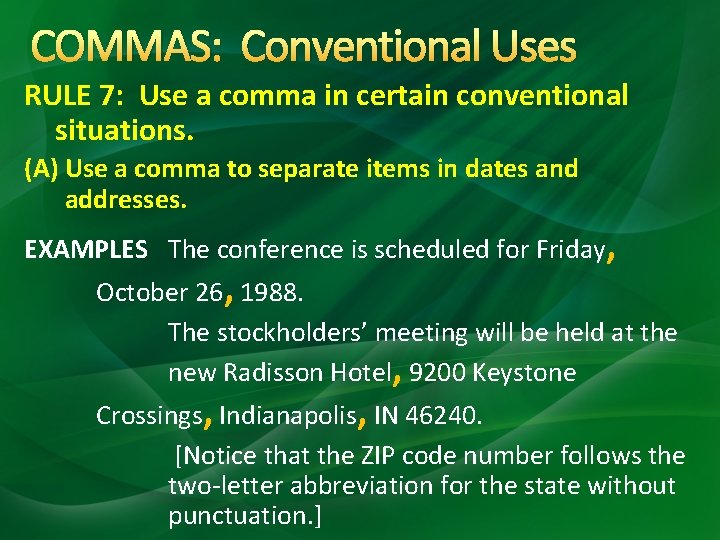
COMMAS: Conventional Uses RULE 7: Use a comma in certain conventional situations. (A) Use a comma to separate items in dates and addresses. EXAMPLES The conference is scheduled for Friday, October 26, 1988. The stockholders’ meeting will be held at the new Radisson Hotel, 9200 Keystone Crossings, Indianapolis, IN 46240. [Notice that the ZIP code number follows the two-letter abbreviation for the state without punctuation. ]
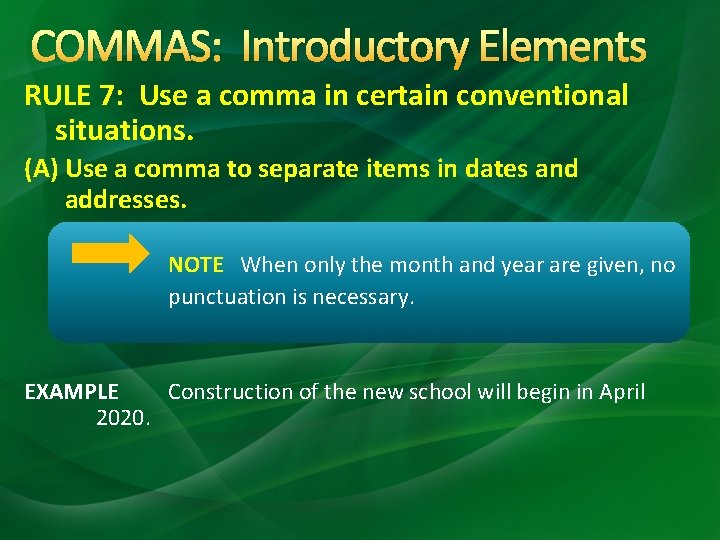
COMMAS: Introductory Elements RULE 7: Use a comma in certain conventional situations. (A) Use a comma to separate items in dates and addresses. NOTE When only the month and year are given, no punctuation is necessary. EXAMPLE Construction of the new school will begin in April 2020.
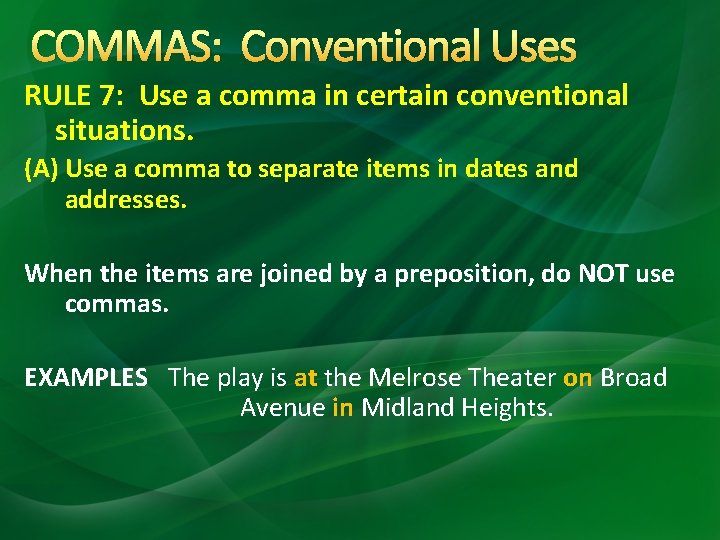
COMMAS: Conventional Uses RULE 7: Use a comma in certain conventional situations. (A) Use a comma to separate items in dates and addresses. When the items are joined by a preposition, do NOT use commas. EXAMPLES The play is at the Melrose Theater on Broad Avenue in Midland Heights.
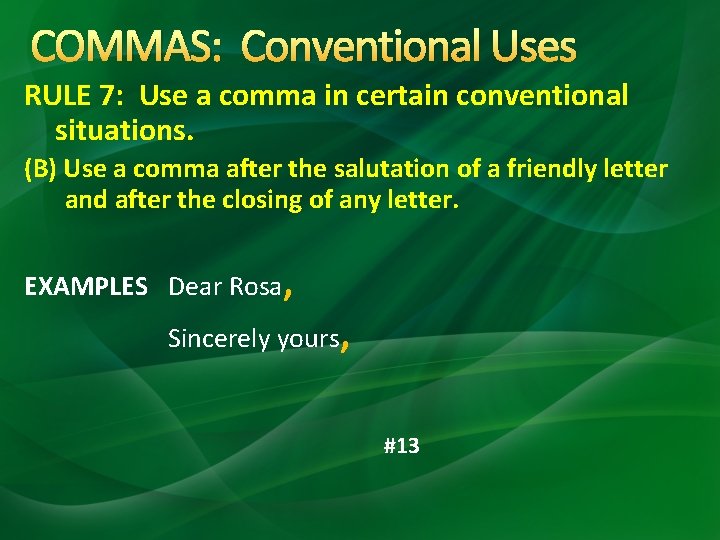
COMMAS: Conventional Uses RULE 7: Use a comma in certain conventional situations. (B) Use a comma after the salutation of a friendly letter and after the closing of any letter. EXAMPLES Dear Rosa, Sincerely yours, #13
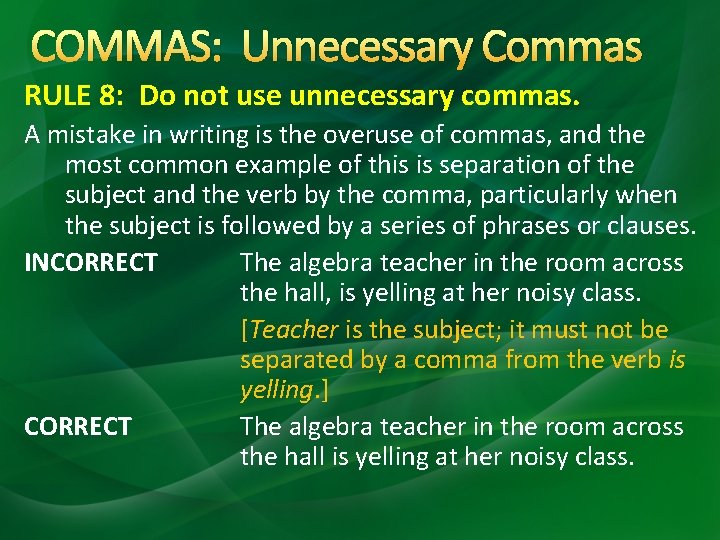
COMMAS: Unnecessary Commas RULE 8: Do not use unnecessary commas. A mistake in writing is the overuse of commas, and the most common example of this is separation of the subject and the verb by the comma, particularly when the subject is followed by a series of phrases or clauses. INCORRECT The algebra teacher in the room across the hall, is yelling at her noisy class. [Teacher is the subject; it must not be separated by a comma from the verb is yelling. ] CORRECT The algebra teacher in the room across the hall is yelling at her noisy class.
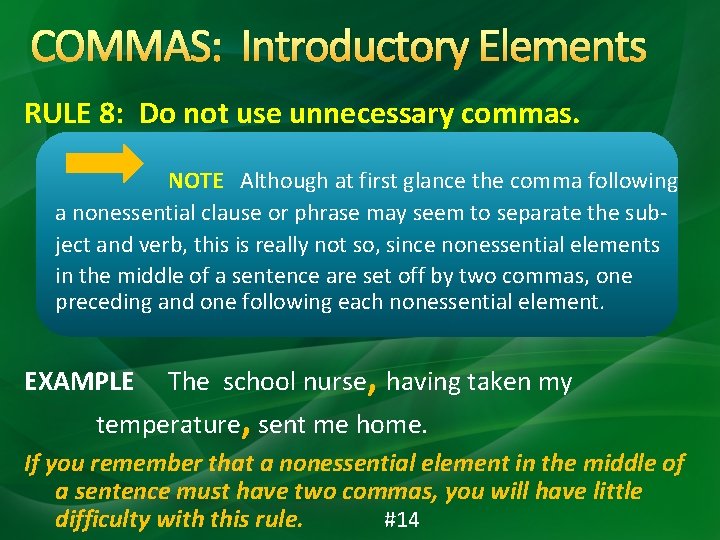
COMMAS: Introductory Elements RULE 8: Do not use unnecessary commas. NOTE Although at first glance the comma following a nonessential clause or phrase may seem to separate the subject and verb, this is really not so, since nonessential elements in the middle of a sentence are set off by two commas, one preceding and one following each nonessential element. EXAMPLE The school nurse, having taken my temperature, sent me home. If you remember that a nonessential element in the middle of a sentence must have two commas, you will have little difficulty with this rule. #14
COMMAS Pick up the handout entitled “Review Exercise B” from the tray on the bookcase. Please complete ON YOUR OWN. You may use your commas notes. #15
COMMAS Study commas rules for five minutes in preparation for quiz. #16
COMMAS Study commas rules for five minutes in preparation for quiz. #17
COMMAS Study commas rules for five minutes in preparation for quiz. #18
COMMAS Study commas rules for five minutes in preparation for quiz. When the timer goes off, remove all items from your desk but notebook paper and something to write with. #19