
ENFORCEMENT Role of the Inspector Level 1 B

ENFORCEMENT Role of the Inspector Level 1 B Recertification Effective August 2018 1
Purpose of the Inspector �The inspector is the key person in determining if the approved plan has been implemented properly �The inspector is the person who ensures the responsible party keeps the site in compliance �The inspector should be effective at communicating the issues present on site �The inspector should ensure that all sites are being evaluated fairly and consistently 2
Role of the Inspector Duties that can be expected of an inspector } } } Official Representative Fact Finder Provider of enforcement presence Enforcement case developer Technical educator Technical authority 3
Characteristics of an Exceptional Inspector � � � � Inquisitive Determined Professional appearance Integrity and impartiality Avoids conflicts of interest Maintains standards of conduct Consistently applies ordinance to all individuals 4
Certified Local Issuing Authorities �Per O. C. G. A. 12 -7 -7, one of the responsibilities of a certified LIA is to conduct inspections of all Land Disturbing Projects within its jurisdiction �Inspectors should be visiting sites at least once a week and after every rainfall to ensure the sites remain in compliance �All inspectors should be familiar with their Local Ordinance & the State Law 5
The Site Inspection Do’s & Don’ts Sequence What should be on site? Documentation 6
Before an Inspection } Review the approved ES&PC Plan ◦ Check contours, critical areas, delineated state waters } Have a copy of the Plan with you or on site at all times } Bring any inspection files or forms that will be needed } Secure any additional equipment you may need, such as cameras, hardhats, safety vests, etc… } Review all phases of the approved plan to understand the scope of the construction activity 7
Equipment �Field Inspection Equipment may include ◦ ◦ ◦ ◦ Cameras Logbook & Pen Tablet Tape measure �Crucial for checking proper installation and maintenance of BMPs GPS Sampling Equipment Turbidity Meter GSWCC Field Manual 8
st 1 Visit } Present your credentials and provide contact info } Walk the perimeter of the site } Start from the lowest point of the site and work your way up } Ensure that the initial sediment storage and perimeter control BMPs have been installed properly } Document any observations along the way ◦ Note date, time, and weather conditions 9
The ES&PC Plan �During every site inspection ◦ You should ask to see the approved ES&PC Plan ◦ Observe how the site has changed since the last inspection ◦ Confirm the site conditions match the plan ◦ Determine that all practices have been installed and are being maintained ◦ If any deficiencies are found, appropriate action must be taken to obtain compliance 10
What to Inspect } Construction exits } Inspect discharge points & downstream areas for impact } Walk the perimeter of the site } Inspect active areas } Inspect disturbed areas that are not currently being worked } Inspect areas that have undergone final stabilization } Take into account the entire site, phase of the Plan, and ensure that the project is reflective of the Plan 11
What Should Be On Site? �Approved ES&PC Plan ◦ These should be updated on site if there is ever a revision to the plan �At a minimum, one certified person shall be on site at all times when land disturbing activities are being conducted �The following slide lists all of the documents that must be kept on site or readily available at a designated alternative location until a NOT is submitted 12
What Should Be On Site? �LDA Permit �All NOIs submitted to the GA EPD �Design Professional 7 -day letter �Daily, weekly, and monthly inspection reports �Daily rainfall data �Any buffer variances or permits �Violation summaries and reports �All sampling and monitoring information, results, and reports 13
Documentation �A complete and factual record should be documented for the entire inspection ◦ ◦ Current activities at the site Any observations related to BMPs Any observations related to sediment leaving the site Any outcomes �These records support potential enforcement action �A way to communicate your findings to other ◦ Provides a “site history” for another inspector 14
Structural BMPs What to look for? 15
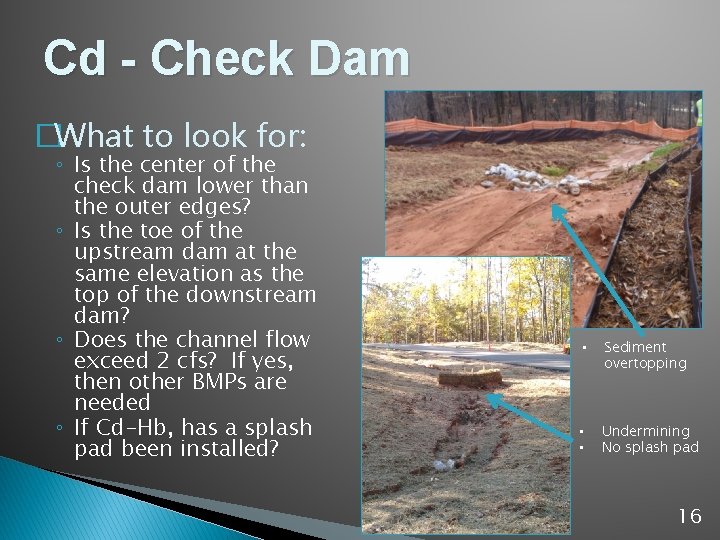
Cd - Check Dam �What to look for: ◦ Is the center of the check dam lower than the outer edges? ◦ Is the toe of the upstream dam at the same elevation as the top of the downstream dam? ◦ Does the channel flow exceed 2 cfs? If yes, then other BMPs are needed ◦ If Cd-Hb, has a splash pad been installed? • Sediment overtopping • • Undermining No splash pad 16
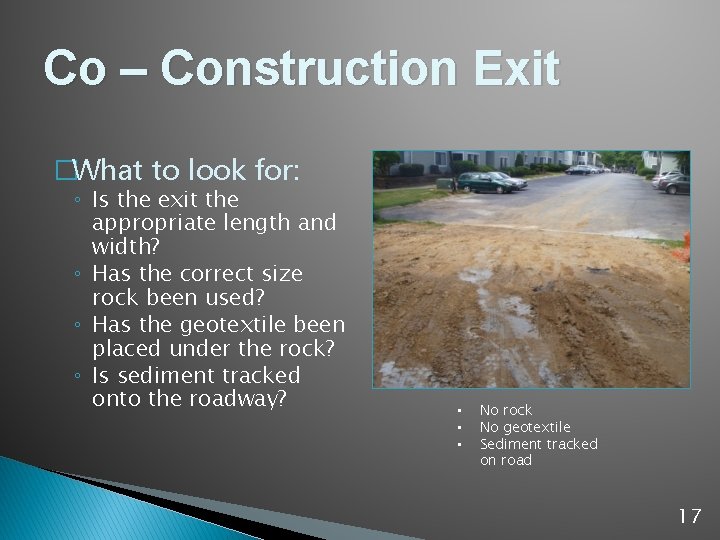
Co – Construction Exit �What to look for: ◦ Is the exit the appropriate length and width? ◦ Has the correct size rock been used? ◦ Has the geotextile been placed under the rock? ◦ Is sediment tracked onto the roadway? • • • No rock No geotextile Sediment tracked on road 17
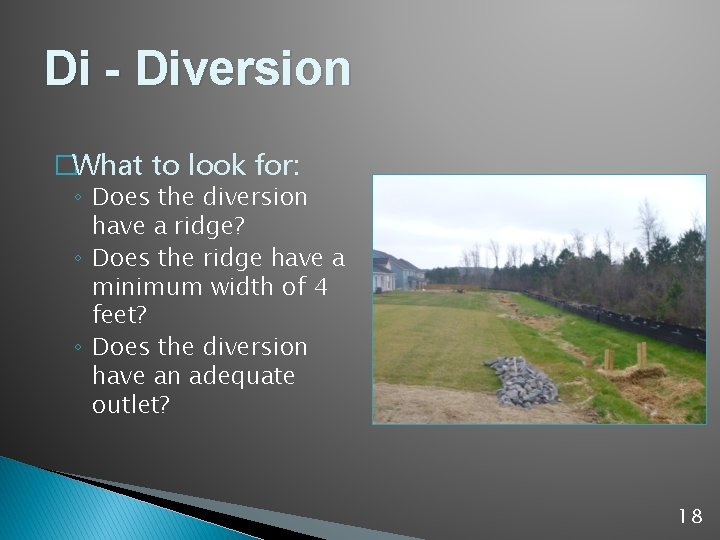
Di - Diversion �What to look for: ◦ Does the diversion have a ridge? ◦ Does the ridge have a minimum width of 4 feet? ◦ Does the diversion have an adequate outlet? 18
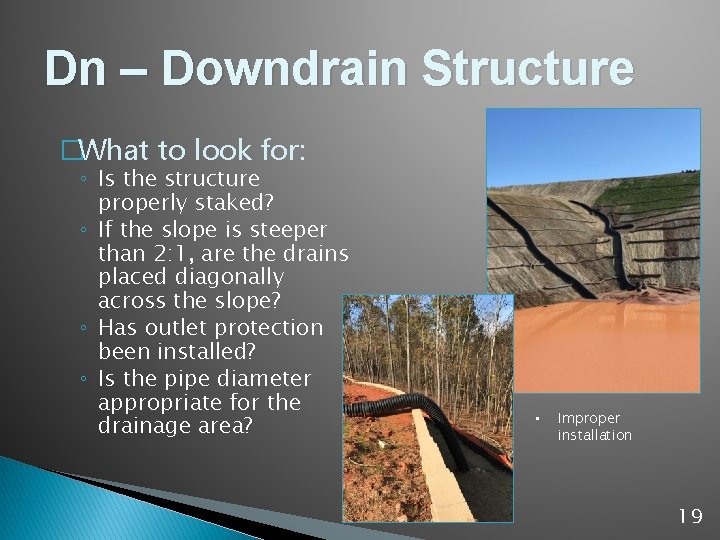
Dn – Downdrain Structure �What to look for: ◦ Is the structure properly staked? ◦ If the slope is steeper than 2: 1, are the drains placed diagonally across the slope? ◦ Has outlet protection been installed? ◦ Is the pipe diameter appropriate for the drainage area? • Improper installation 19
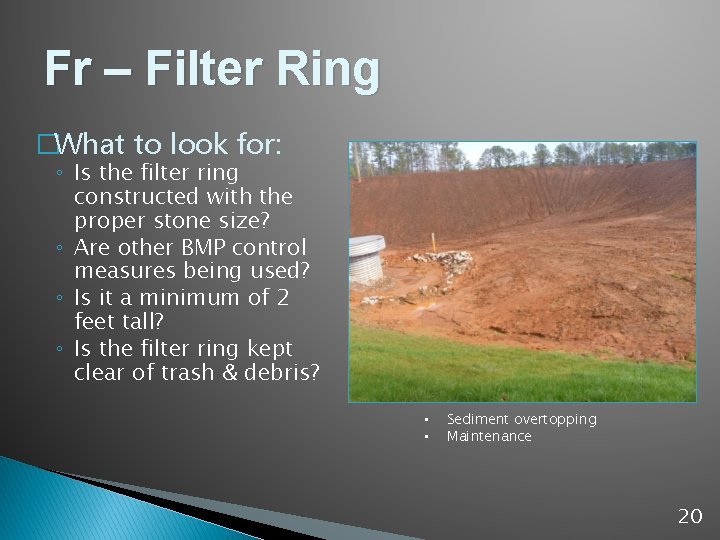
Fr – Filter Ring �What to look for: ◦ Is the filter ring constructed with the proper stone size? ◦ Are other BMP control measures being used? ◦ Is it a minimum of 2 feet tall? ◦ Is the filter ring kept clear of trash & debris? • • Sediment overtopping Maintenance 20
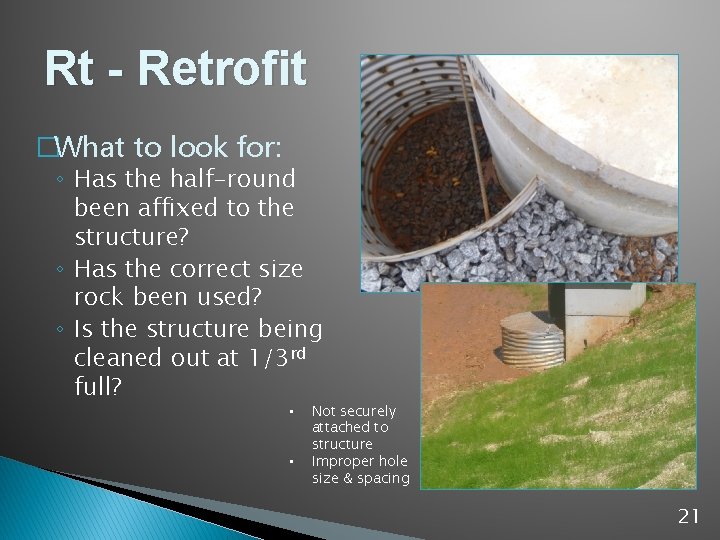
Rt - Retrofit �What to look for: ◦ Has the half-round been affixed to the structure? ◦ Has the correct size rock been used? ◦ Is the structure being cleaned out at 1/3 rd full? • • Not securely attached to structure Improper hole size & spacing 21
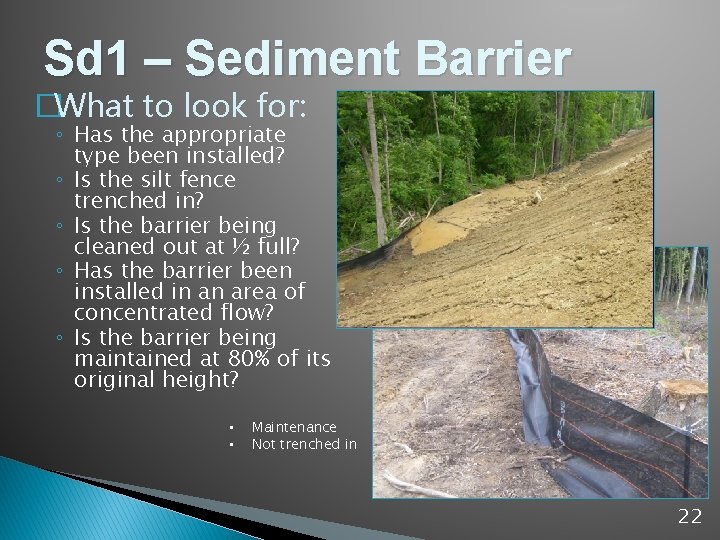
Sd 1 – Sediment Barrier �What to look for: ◦ Has the appropriate type been installed? ◦ Is the silt fence trenched in? ◦ Is the barrier being cleaned out at ½ full? ◦ Has the barrier been installed in an area of concentrated flow? ◦ Is the barrier being maintained at 80% of its original height? • • Maintenance Not trenched in 22
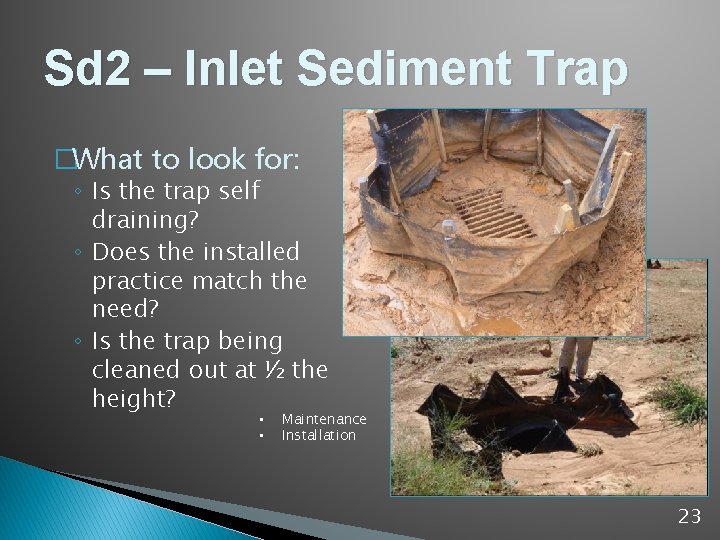
Sd 2 – Inlet Sediment Trap �What to look for: ◦ Is the trap self draining? ◦ Does the installed practice match the need? ◦ Is the trap being cleaned out at ½ the height? • • Maintenance Installation 23
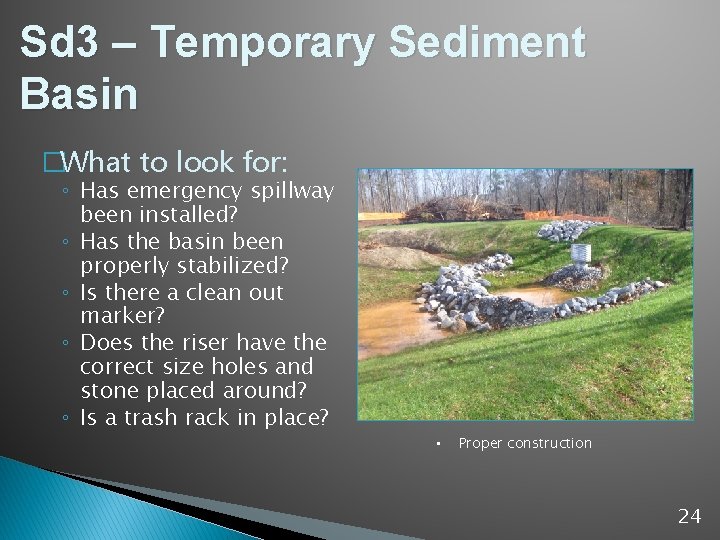
Sd 3 – Temporary Sediment Basin �What to look for: ◦ Has emergency spillway been installed? ◦ Has the basin been properly stabilized? ◦ Is there a clean out marker? ◦ Does the riser have the correct size holes and stone placed around? ◦ Is a trash rack in place? • Proper construction 24
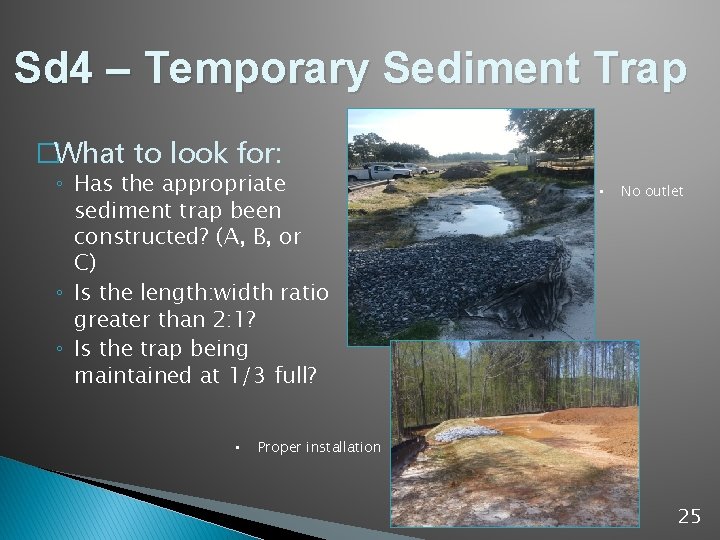
Sd 4 – Temporary Sediment Trap �What to look for: ◦ Has the appropriate sediment trap been constructed? (A, B, or C) ◦ Is the length: width ratio greater than 2: 1? ◦ Is the trap being maintained at 1/3 full? • • No outlet Proper installation 25
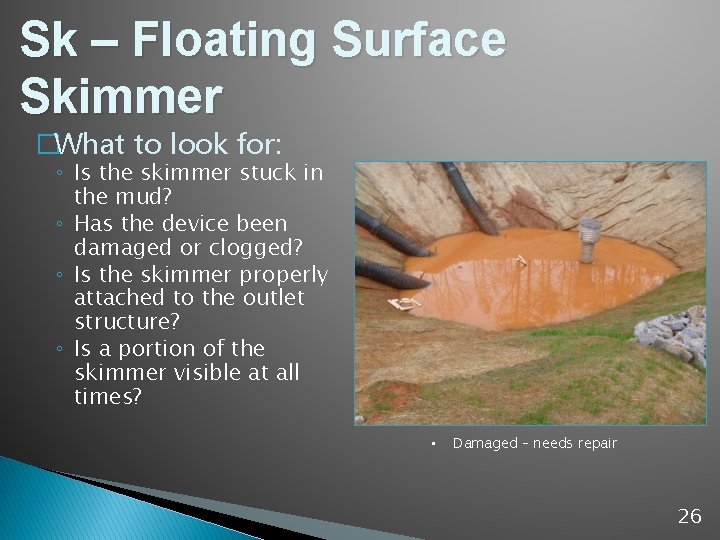
Sk – Floating Surface Skimmer �What to look for: ◦ Is the skimmer stuck in the mud? ◦ Has the device been damaged or clogged? ◦ Is the skimmer properly attached to the outlet structure? ◦ Is a portion of the skimmer visible at all times? • Damaged – needs repair 26
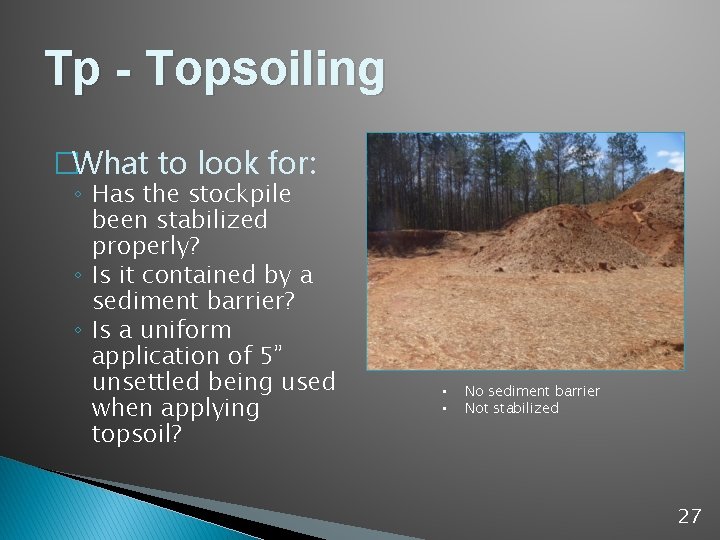
Tp - Topsoiling �What to look for: ◦ Has the stockpile been stabilized properly? ◦ Is it contained by a sediment barrier? ◦ Is a uniform application of 5” unsettled being used when applying topsoil? • • No sediment barrier Not stabilized 27

Vegetative Practices What to look for? 28
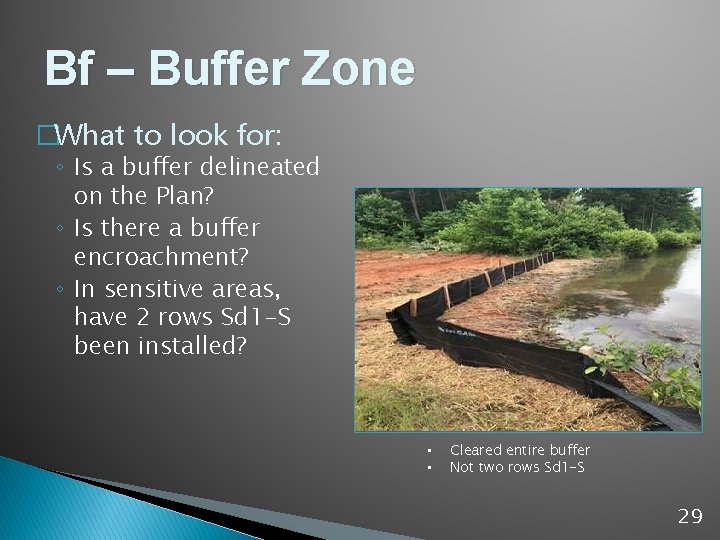
Bf – Buffer Zone �What to look for: ◦ Is a buffer delineated on the Plan? ◦ Is there a buffer encroachment? ◦ In sensitive areas, have 2 rows Sd 1 -S been installed? • • Cleared entire buffer Not two rows Sd 1 -S 29
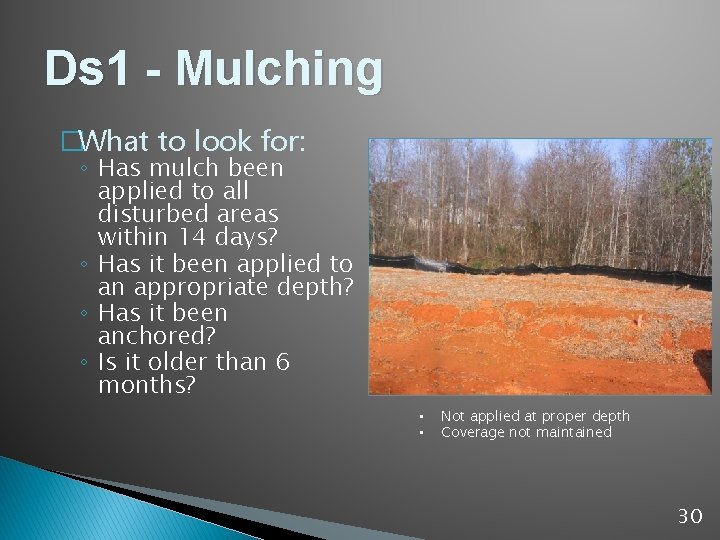
Ds 1 - Mulching �What to look for: ◦ Has mulch been applied to all disturbed areas within 14 days? ◦ Has it been applied to an appropriate depth? ◦ Has it been anchored? ◦ Is it older than 6 months? • • Not applied at proper depth Coverage not maintained 30
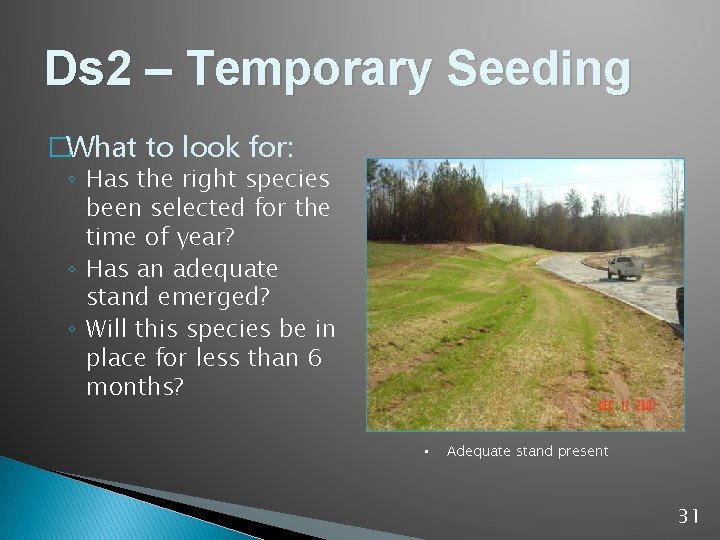
Ds 2 – Temporary Seeding �What to look for: ◦ Has the right species been selected for the time of year? ◦ Has an adequate stand emerged? ◦ Will this species be in place for less than 6 months? • Adequate stand present 31
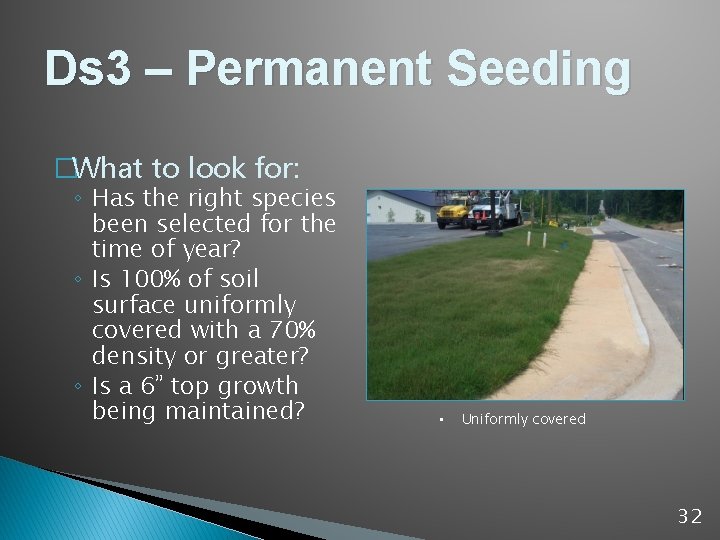
Ds 3 – Permanent Seeding �What to look for: ◦ Has the right species been selected for the time of year? ◦ Is 100% of soil surface uniformly covered with a 70% density or greater? ◦ Is a 6” top growth being maintained? • Uniformly covered 32
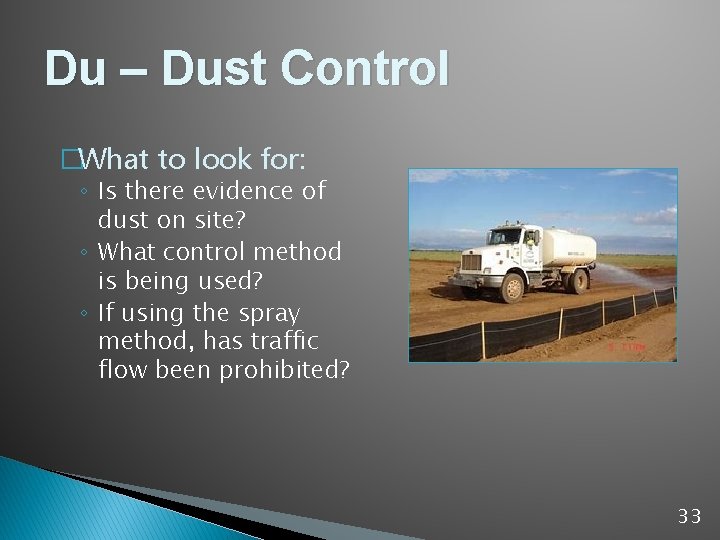
Du – Dust Control �What to look for: ◦ Is there evidence of dust on site? ◦ What control method is being used? ◦ If using the spray method, has traffic flow been prohibited? 33

Fl-Co – Flocculants & Coagulants �What to look for: ◦ Have only anionic forms been used? ◦ Has it been applied to surface waters of the state? ◦ Has it been applied in the appropriate storm water ditches or storage basins? 34
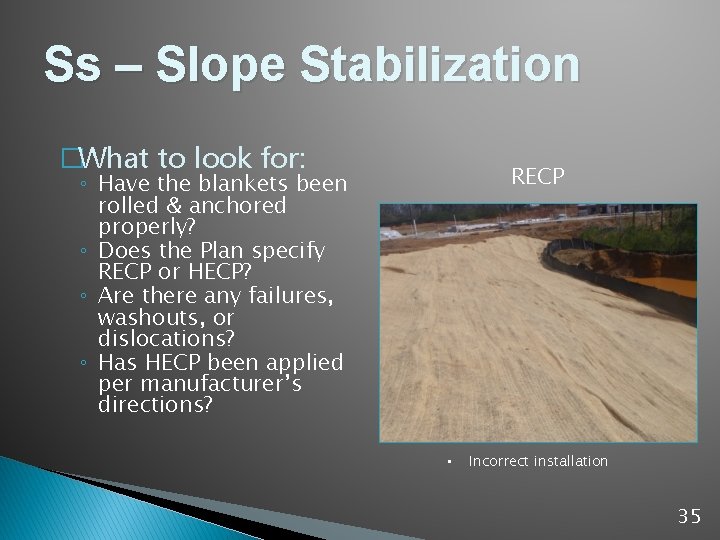
Ss – Slope Stabilization �What to look for: RECP ◦ Have the blankets been rolled & anchored properly? ◦ Does the Plan specify RECP or HECP? ◦ Are there any failures, washouts, or dislocations? ◦ Has HECP been applied per manufacturer’s directions? • Incorrect installation 35
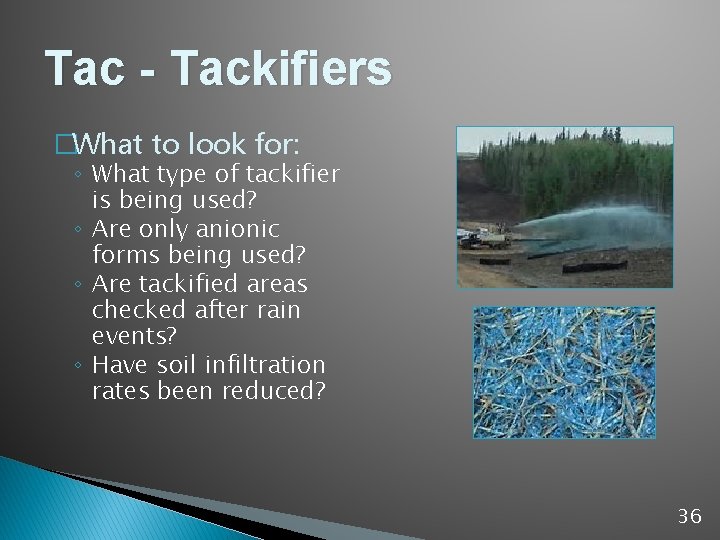
Tac - Tackifiers �What to look for: ◦ What type of tackifier is being used? ◦ Are only anionic forms being used? ◦ Are tackified areas checked after rain events? ◦ Have soil infiltration rates been reduced? 36
Enforcement Violations Interactions 37
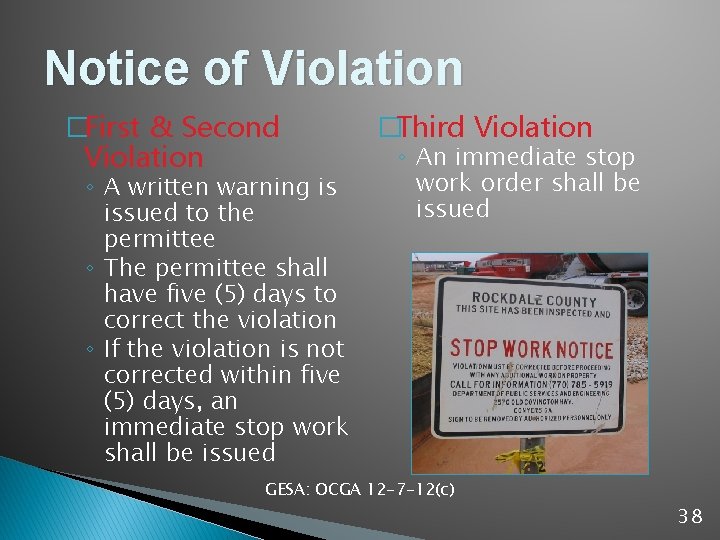
Notice of Violation �First & Second Violation ◦ A written warning is issued to the permittee ◦ The permittee shall have five (5) days to correct the violation ◦ If the violation is not corrected within five (5) days, an immediate stop work shall be issued �Third Violation ◦ An immediate stop work order shall be issued GESA: OCGA 12 -7 -12(c) 38
Handling Violations �The inspection records written by an inspector are the basis for enforcement and civil penalties �Remember ◦ Write a report for each inspection conducted at the site ◦ Take a substantial amount of pictures ◦ Always write the report at the site so that you don’t forget anything �For consultants, this is your client’s best defense against a violation 39
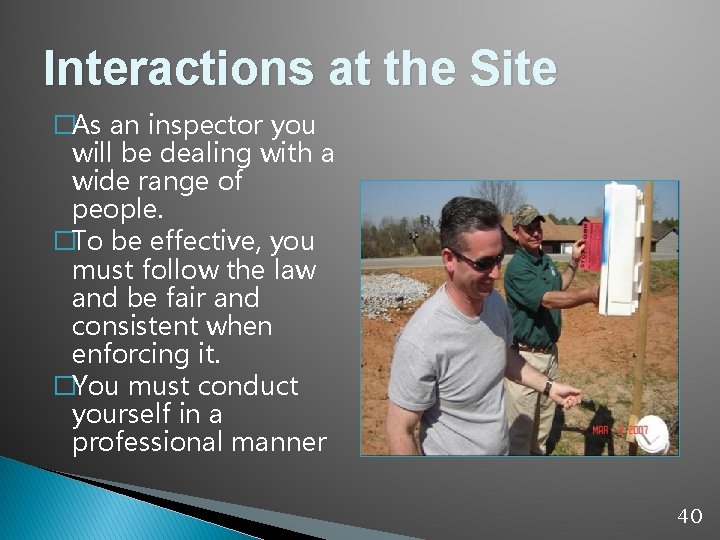
Interactions at the Site �As an inspector you will be dealing with a wide range of people. �To be effective, you must follow the law and be fair and consistent when enforcing it. �You must conduct yourself in a professional manner 40
Dealing with Difficult People �An inspector will often have to handle heated situations �Often times you will not have time to prepare a response and you must resolve the situation immediately. �The following are a list of steps that can be used to resolve a heated situation 41
Key Steps } Maintain a friendly and professional attitude ◦ ◦ ◦ Don’t argue with the person Show that you have interest in their problem State that you would like to help them solve it Don’t let their anger get to you Don’t take what they say personally 42
Key Steps } Acknowledge that a difficult situation exists ◦ ◦ ◦ Show that you take the complaint seriously Choose your words carefully Use a tone that demonstrates understanding Respond to what the person is saying If you owe an apology, apologize only for the specific incident 43
Key Steps } Calm the individual by questioning and verifying ◦ Demonstrate that you are willing to work with them ◦ Don’t assume anything, ask specific questions ◦ Respond to show that you understand the problem ◦ Be sure that you and the person are on the same page 44
Key Steps } Involve the person in solving the problem ◦ Ask the person to help you solve the problem ◦ Request suggestions and offer your assistance to correct the situation ◦ Explain the law and regulations and the reasoning behind them ◦ Continue to ask questions to keep their focus on the problem 45
Key Steps } Handle the problem ◦ Be positive ◦ Focus on the most feasible solution ◦ Decide on a follow-up action to ensure the problem has been resolved 46
References �Manual for Erosion and Sediment Control in Georgia ◦ 2016 Edition - GSWCC �NPDES Permits GAR 100001, 100002, 100003 �Conducting Environmental Compliance Inspections: Inspector’s Field Manual, International Edition ◦ Office of Enforcement and Compliance Assurance - Environmental Protection Agency �Florida Erosion and Sediment Control Inspector’s Manual ◦ Florida Department of Environmental Protection 47
Summary �Inspectors must be professional, fair and consistent �Inspectors must be technical authorities �Proper inspection procedures must be observed �Properly applied enforcement action promotes broader compliance �Knowing how to deal with people can go a long way 48
Questions? GSWCC Urban Program 4310 Lexington Road Athens, GA 30605 (706) 552 -4474 49
- Slides: 49