
Enfold Downclocking OFDM in Wi Fi Feng Lu
- Slides: 23
Enfold: Downclocking OFDM in Wi. Fi Feng Lu, Patrick Ling, Geoffrey M. Voelker, and Alex C. Snoeren UC San Diego
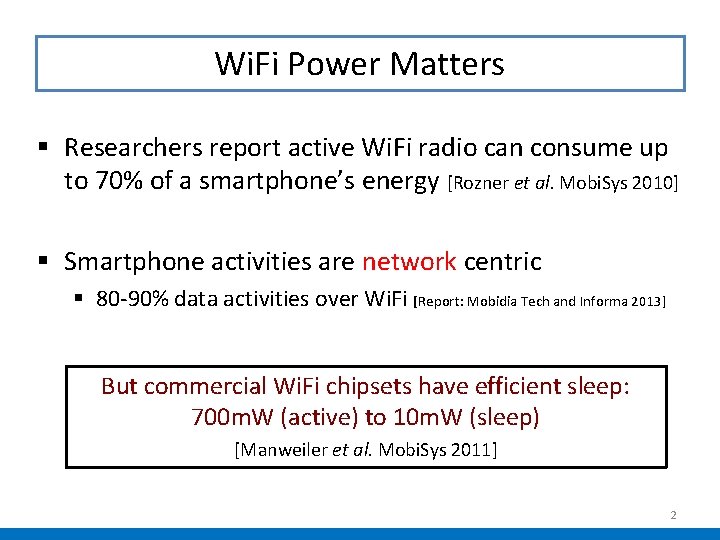
Wi. Fi Power Matters § Researchers report active Wi. Fi radio can consume up to 70% of a smartphone’s energy [Rozner et al. Mobi. Sys 2010] § Smartphone activities are network centric § 80 -90% data activities over Wi. Fi [Report: Mobidia Tech and Informa 2013] But commercial Wi. Fi chipsets have efficient sleep: 700 m. W (active) to 10 m. W (sleep) [Manweiler et al. Mobi. Sys 2011] 2
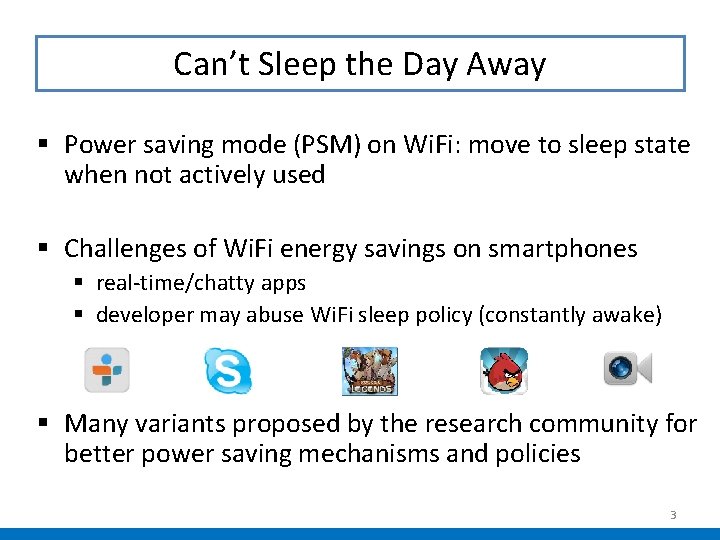
Can’t Sleep the Day Away § Power saving mode (PSM) on Wi. Fi: move to sleep state when not actively used § Challenges of Wi. Fi energy savings on smartphones § real-time/chatty apps § developer may abuse Wi. Fi sleep policy (constantly awake) § Many variants proposed by the research community for better power saving mechanisms and policies 3
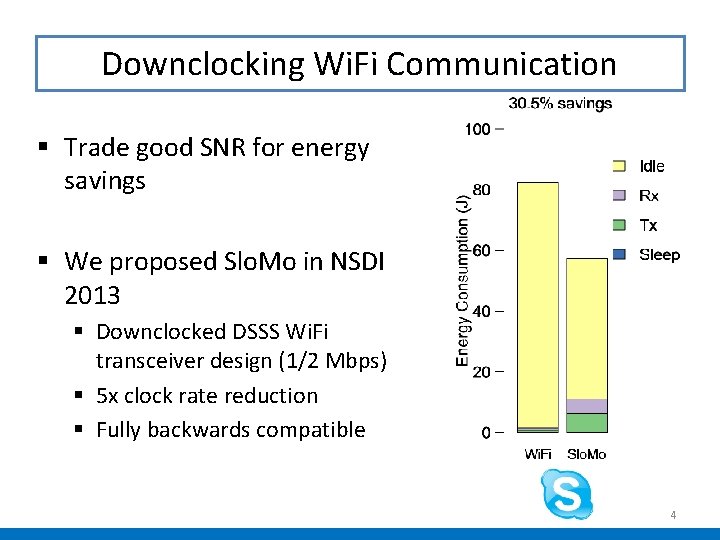
Downclocking Wi. Fi Communication § Trade good SNR for energy savings § We proposed Slo. Mo in NSDI 2013 § Downclocked DSSS Wi. Fi transceiver design (1/2 Mbps) § 5 x clock rate reduction § Fully backwards compatible 4
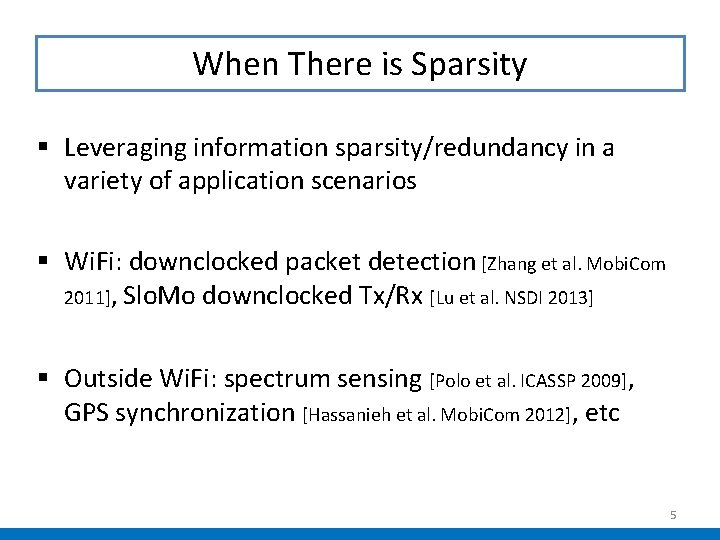
When There is Sparsity § Leveraging information sparsity/redundancy in a variety of application scenarios § Wi. Fi: downclocked packet detection [Zhang et al. Mobi. Com 2011], Slo. Mo downclocked Tx/Rx [Lu et al. NSDI 2013] § Outside Wi. Fi: spectrum sensing [Polo et al. ICASSP 2009], GPS synchronization [Hassanieh et al. Mobi. Com 2012], etc 5
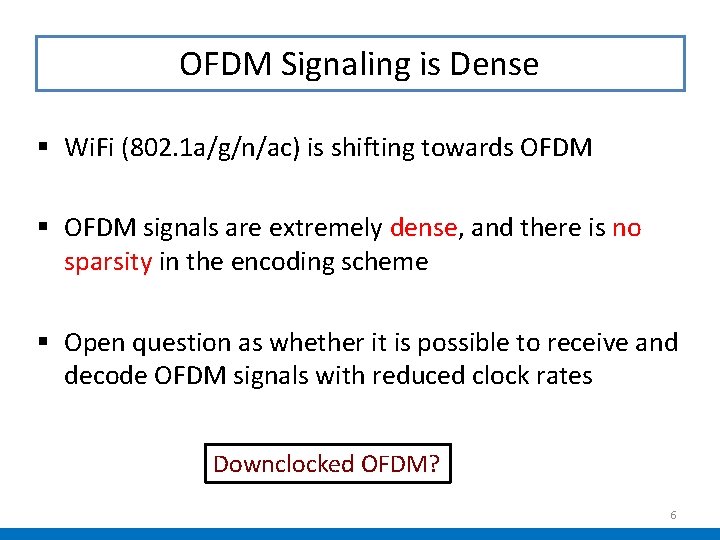
OFDM Signaling is Dense § Wi. Fi (802. 1 a/g/n/ac) is shifting towards OFDM § OFDM signals are extremely dense, and there is no sparsity in the encoding scheme § Open question as whether it is possible to receive and decode OFDM signals with reduced clock rates Downclocked OFDM? 6
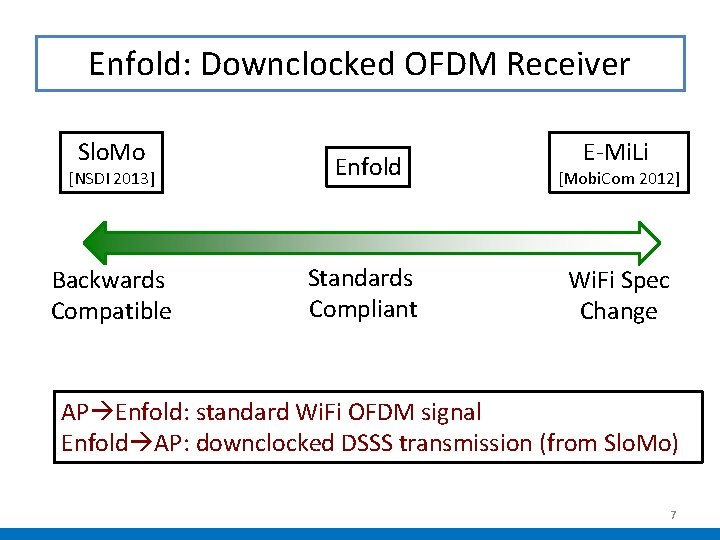
Enfold: Downclocked OFDM Receiver Slo. Mo [NSDI 2013] Backwards Compatible Enfold Standards Compliant E-Mi. Li [Mobi. Com 2012] Wi. Fi Spec Change AP Enfold: standard Wi. Fi OFDM signal Enfold AP: downclocked DSSS transmission (from Slo. Mo) 7
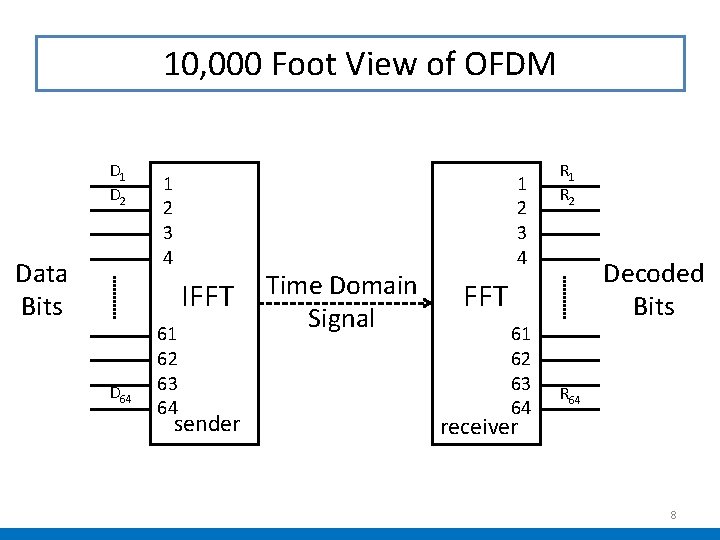
10, 000 Foot View of OFDM D 1 D 2 Data Bits 1 2 3 4 IFFT D 64 61 62 63 64 sender Time Domain Signal 1 2 3 4 R 1 R 2 Decoded Bits FFT 61 62 63 64 R 64 receiver 8
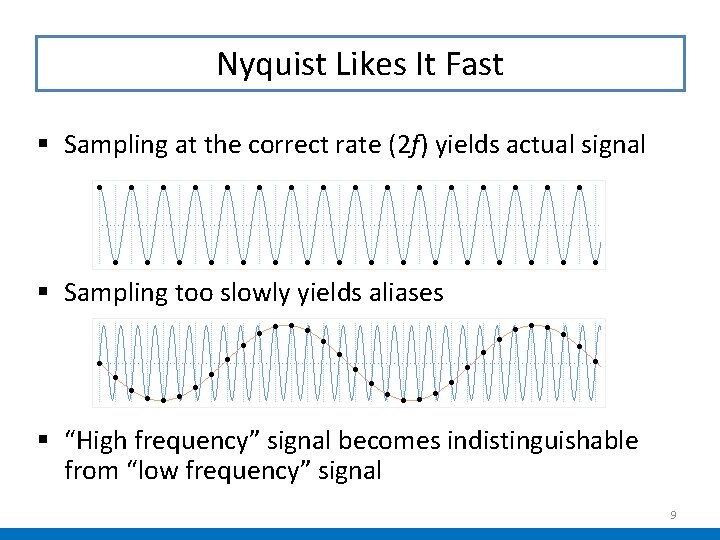
Nyquist Likes It Fast § Sampling at the correct rate (2 f) yields actual signal § Sampling too slowly yields aliases § “High frequency” signal becomes indistinguishable from “low frequency” signal 9
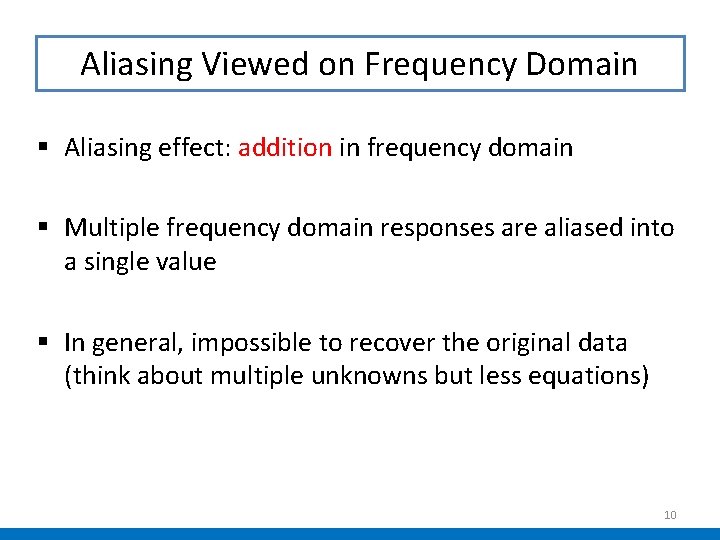
Aliasing Viewed on Frequency Domain § Aliasing effect: addition in frequency domain § Multiple frequency domain responses are aliased into a single value § In general, impossible to recover the original data (think about multiple unknowns but less equations) 10
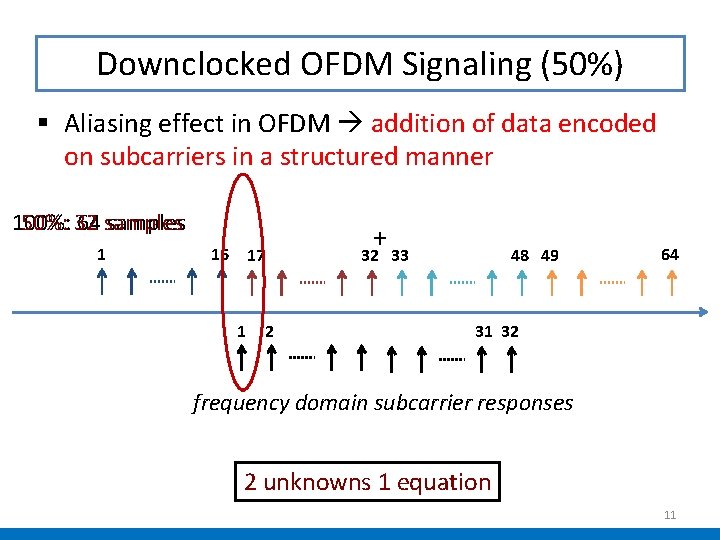
Downclocked OFDM Signaling (50%) § Aliasing effect in OFDM addition of data encoded on subcarriers in a structured manner 100%: 50%: 32 64 samples 1 16 17 1 2 + 48 49 32 33 64 31 32 frequency domain subcarrier responses 2 unknowns 1 equation 11
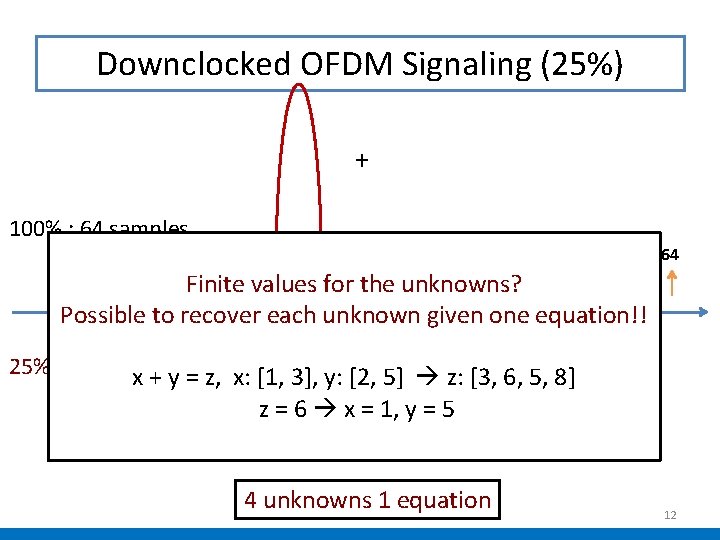
Downclocked OFDM Signaling (25%) + 100% : 64 samples 1 16 17 + 32 33 48 49 64 Finite values for the unknowns? Possible to recover each unknown given one equation!! + 25%: 16 samples x + y = z, x: [1, 3], y: [2, 5] z: [3, 6, 5, 8] frequency 1 x =subcarrier z = 6 domain 1, y 16= 5 responses 4 unknowns 1 equation 12
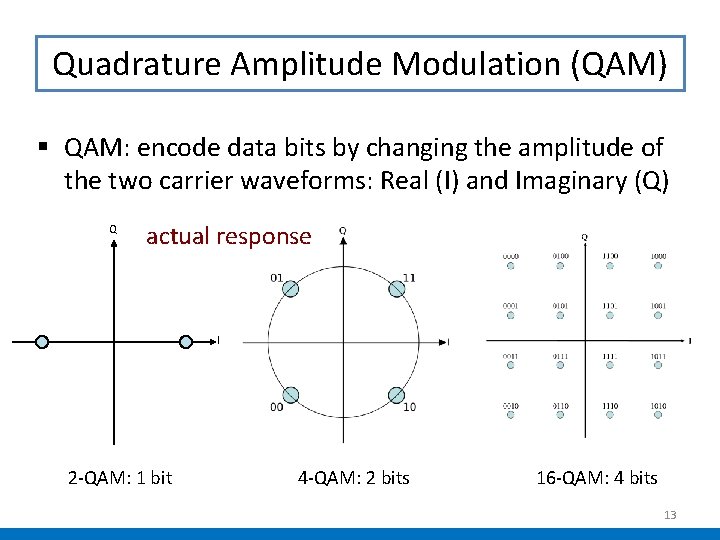
Quadrature Amplitude Modulation (QAM) § QAM: encode data bits by changing the amplitude of the two carrier waveforms: Real (I) and Imaginary (Q) Q actual response I 2 -QAM: 1 bit 4 -QAM: 2 bits 16 -QAM: 4 bits 13
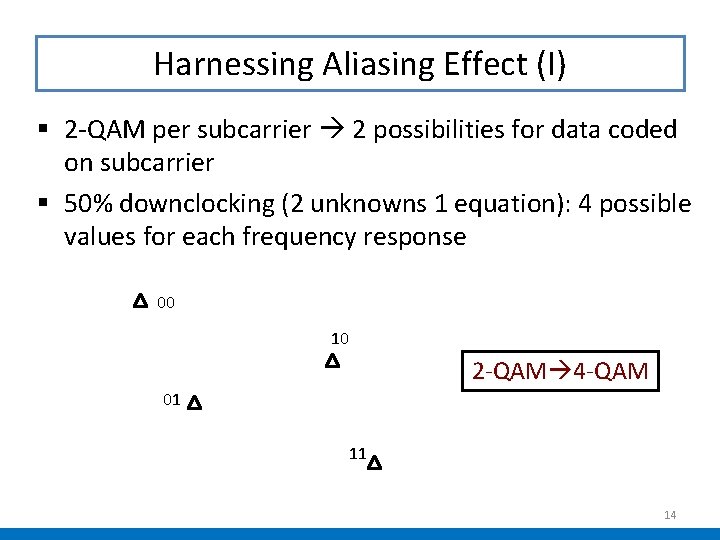
Harnessing Aliasing Effect (I) § 2 -QAM per subcarrier 2 possibilities for data coded on subcarrier § 50% downclocking (2 unknowns 1 equation): 4 possible values for each frequency response 00 10 2 -QAM 4 -QAM 01 11 14
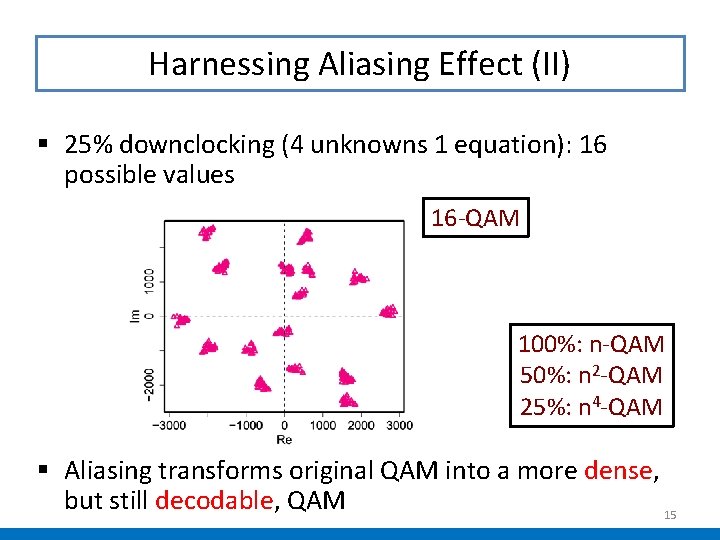
Harnessing Aliasing Effect (II) § 25% downclocking (4 unknowns 1 equation): 16 possible values 16 -QAM 100%: n-QAM 50%: n 2 -QAM 25%: n 4 -QAM § Aliasing transforms original QAM into a more dense, but still decodable, QAM 15
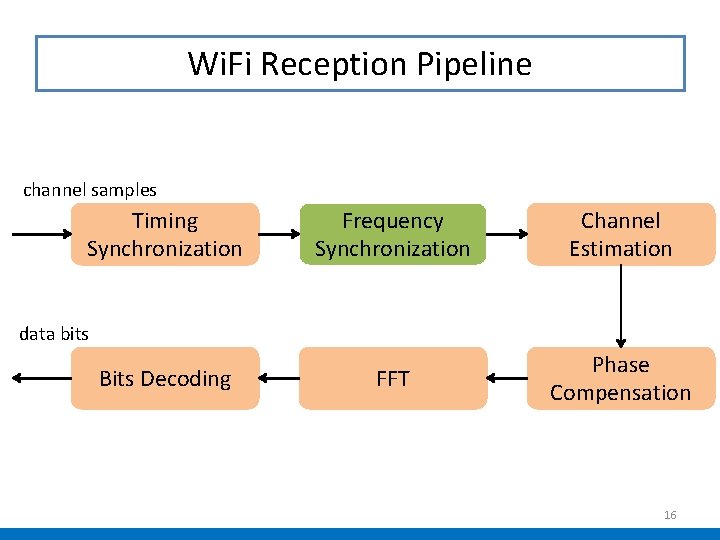
Wi. Fi Reception Pipeline channel samples Timing Synchronization Frequency Synchronization Channel Estimation FFT Phase Compensation data bits Bits Decoding 16
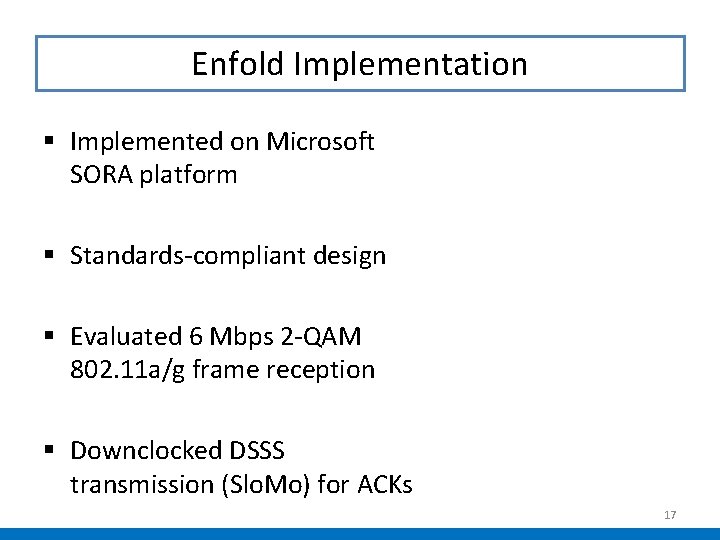
Enfold Implementation § Implemented on Microsoft SORA platform § Standards-compliant design § Evaluated 6 Mbps 2 -QAM 802. 11 a/g frame reception § Downclocked DSSS transmission (Slo. Mo) for ACKs 17
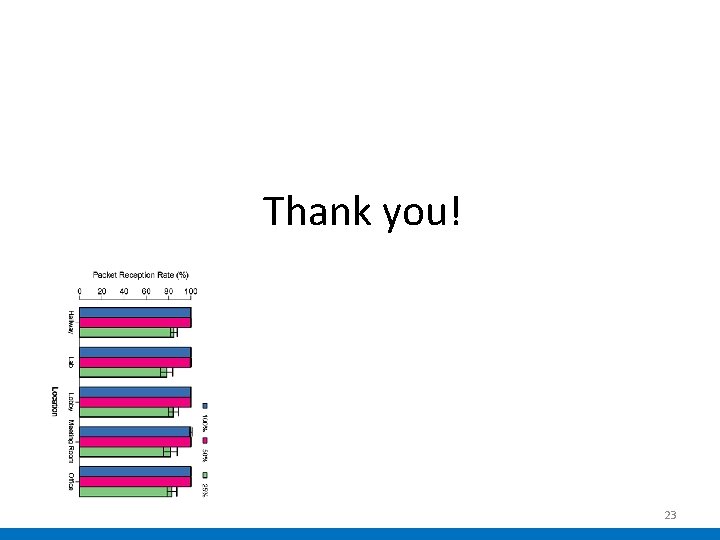
Packet Reception Rate vs SNR (100 -Bytes) Baseline: standard Wi. Fi implementation (@100% clock rate) 3 SNRs: 30/25/20 d. B. Well below typical SNR (40 d. B or more) [Pang et al. Mobi. Sys 2009] 18
Packet Reception Rate vs SNR (1000 -Byes) Baseline: standard Wi. Fi implementation (@100% clock rate) 3 SNRs: 30/25/20 d. B. Well below typical SNR (40 d. B or more) [Pang et al. Mobi. Sys 2009] 19
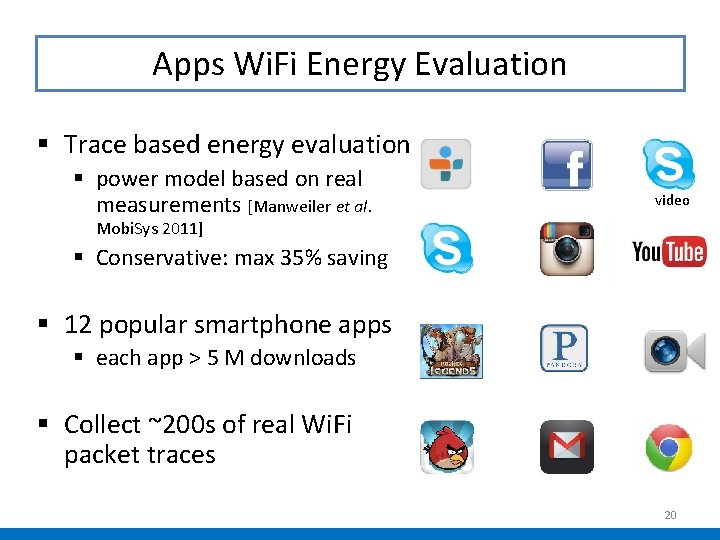
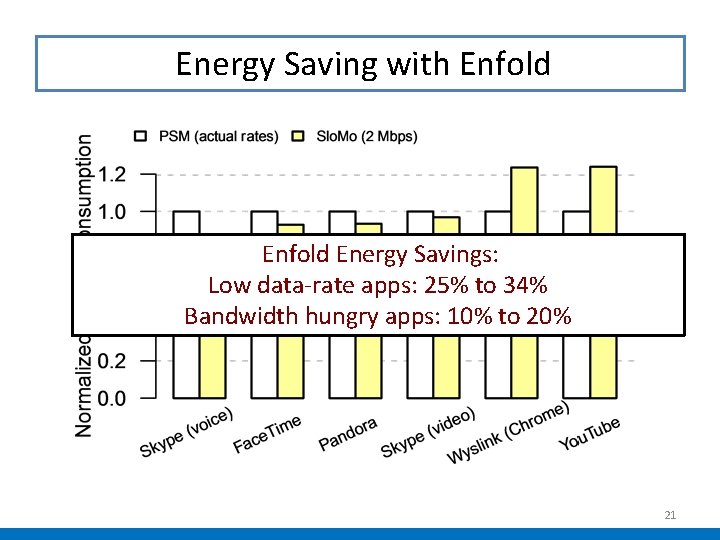
Apps Wi. Fi Energy Evaluation § Trace based energy evaluation § power model based on real measurements [Manweiler et al. video Mobi. Sys 2011] § Conservative: max 35% saving § 12 popular smartphone apps § each app > 5 M downloads § Collect ~200 s of real Wi. Fi packet traces 20
Energy Saving with Enfold Energy Savings: Low data-rate apps: 25% to 34% Bandwidth hungry apps: 10% to 20% 21
Conclusion § Downclocked OFDM Wi. Fi reception is both practical and beneficial for smartphones § up to 34% energy reduction at 25% clock rate § Tradeoff SNR (throughput) for energy savings using lower data rates while remain downclocked § a great tradeoff for many popular smartphone apps § Policy impact: introduce a downclocked state into existing Wi. Fi rate selection and power management framework § Applicable in other domains using OFDM 22
Thank you! 23