
Energybased Modeling of Tangential Compliance in 3 Dimensional
Energy-based Modeling of Tangential Compliance in 3 -Dimensional Impact Yan-Bin Jia Department of Computer Science Iowa State University Ames, IA 50010 Dec 14, 2010 Department of Computer Science, Iowa State University
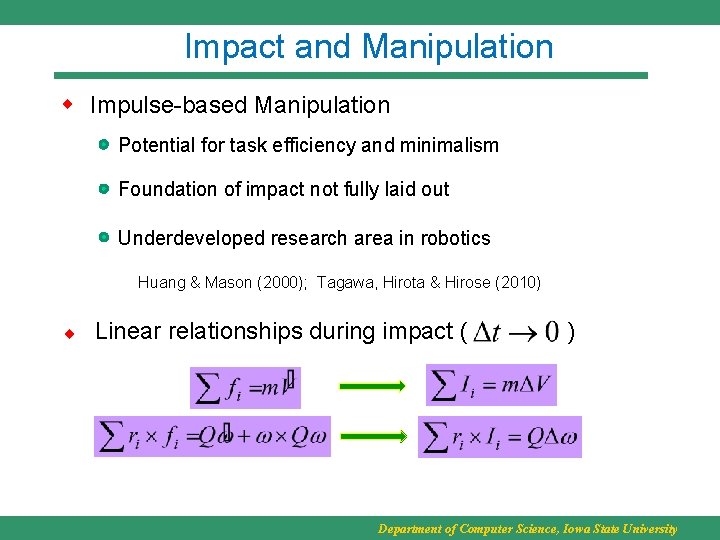
Impact and Manipulation Impulse-based Manipulation Potential for task efficiency and minimalism Foundation of impact not fully laid out Underdeveloped research area in robotics Huang & Mason (2000); Tagawa, Hirota & Hirose (2010) Linear relationships during impact ( ) Department of Computer Science, Iowa State University
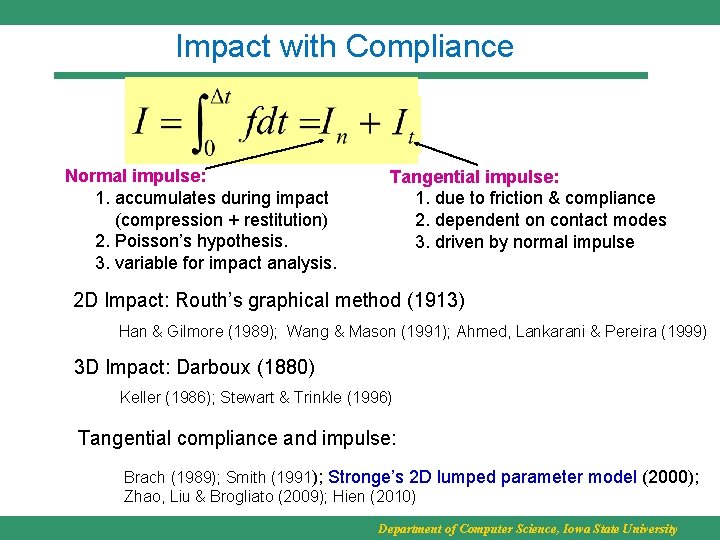
Impact with Compliance Normal impulse: 1. accumulates during impact (compression + restitution) 2. Poisson’s hypothesis. 3. variable for impact analysis. Tangential impulse: 1. due to friction & compliance 2. dependent on contact modes 3. driven by normal impulse 2 D Impact: Routh’s graphical method (1913) Han & Gilmore (1989); Wang & Mason (1991); Ahmed, Lankarani & Pereira (1999) 3 D Impact: Darboux (1880) Keller (1986); Stewart & Trinkle (1996) Tangential compliance and impulse: Brach (1989); Smith (1991); Stronge’s 2 D lumped parameter model (2000); Zhao, Liu & Brogliato (2009); Hien (2010) Department of Computer Science, Iowa State University
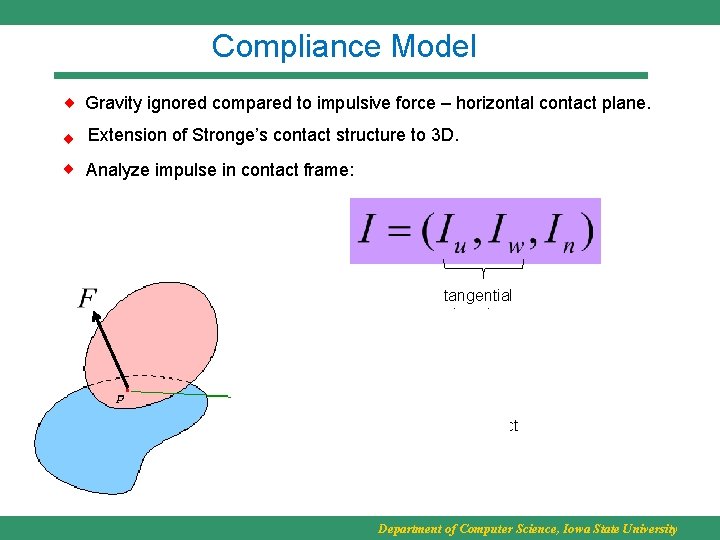
Compliance Model Gravity ignored compared to impulsive force – horizontal contact plane. Extension of Stronge’s contact structure to 3 D. Analyze impulse in contact frame: tangential impulse opposing initial tangential contact velocity massless particle Department of Computer Science, Iowa State University
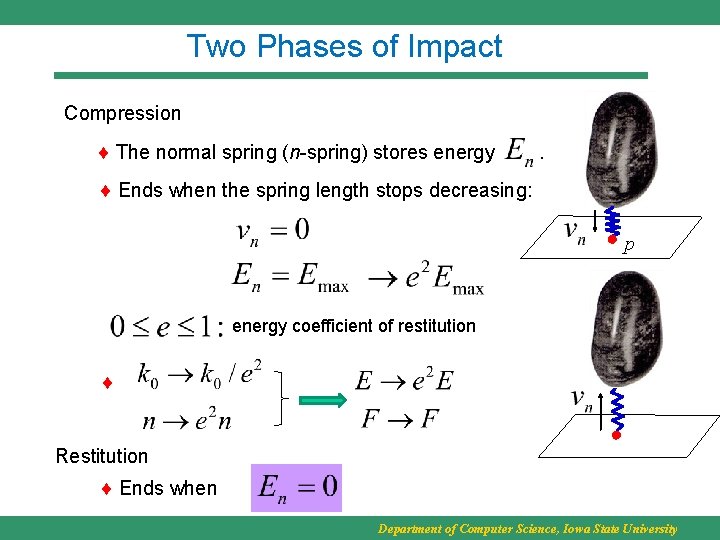
Two Phases of Impact Compression The normal spring (n-spring) stores energy . Ends when the spring length stops decreasing: p energy coefficient of restitution Restitution Ends when Department of Computer Science, Iowa State University
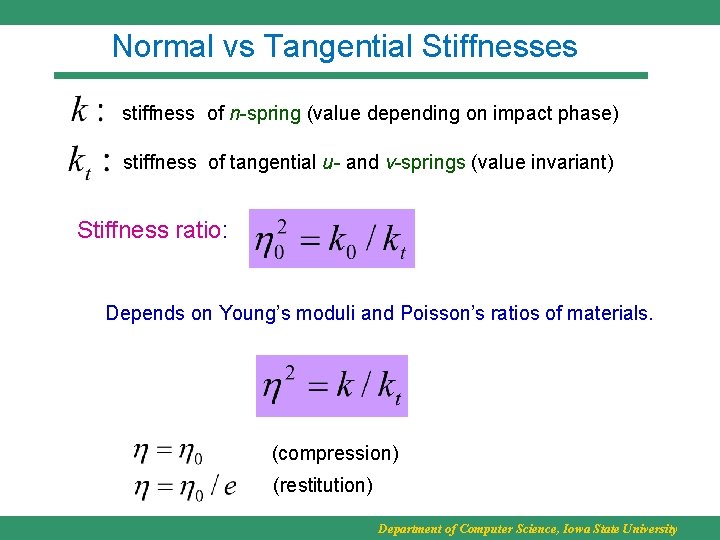
Normal vs Tangential Stiffnesses stiffness of n-spring (value depending on impact phase) stiffness of tangential u- and v-springs (value invariant) Stiffness ratio: Depends on Young’s moduli and Poisson’s ratios of materials. (compression) (restitution) Department of Computer Science, Iowa State University
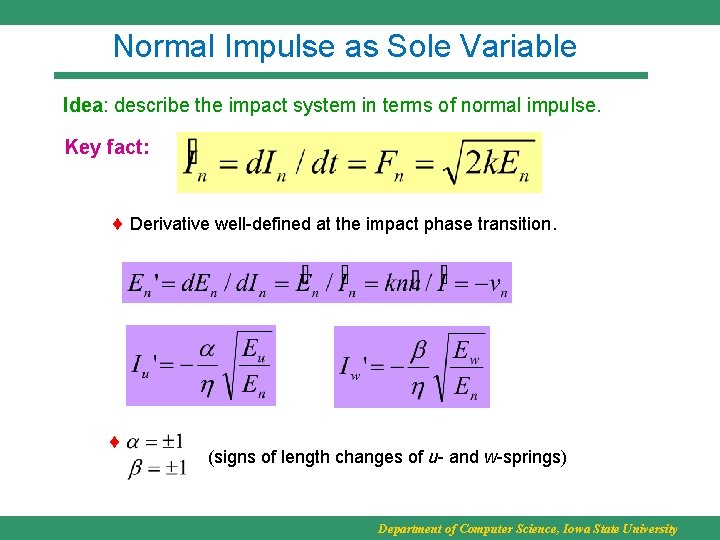
Normal Impulse as Sole Variable Idea: describe the impact system in terms of normal impulse. Key fact: Derivative well-defined at the impact phase transition. (signs of length changes of u- and w-springs) Department of Computer Science, Iowa State University
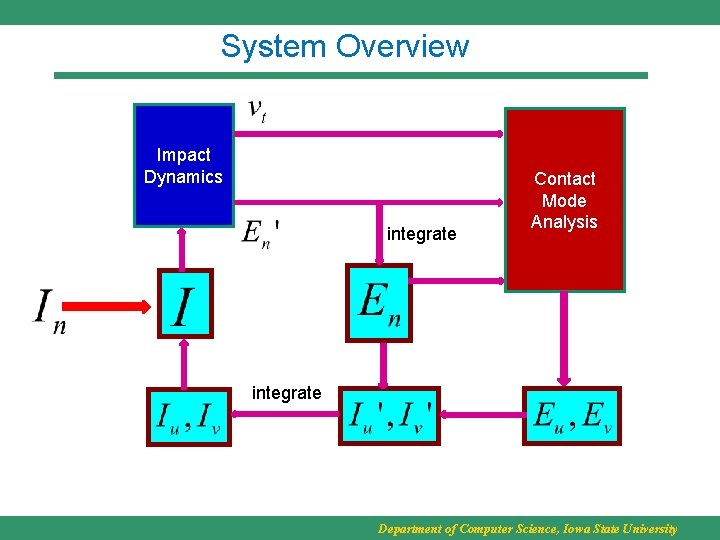
System Overview Impact Dynamics integrate Contact Mode Analysis integrate Department of Computer Science, Iowa State University
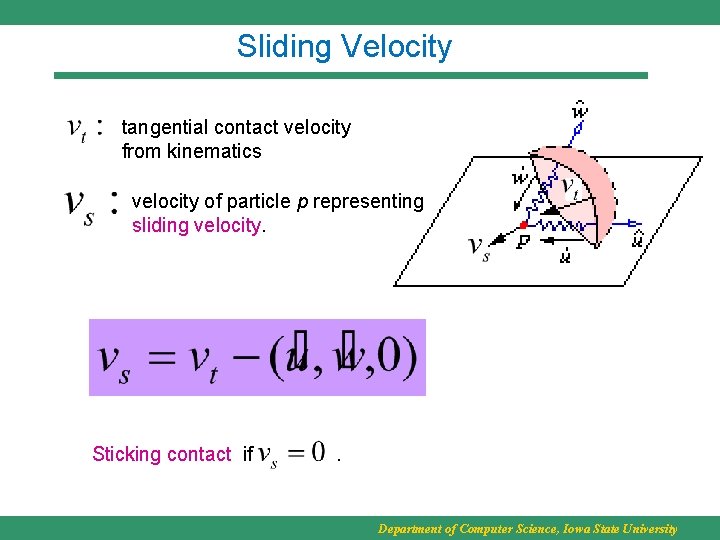
Sliding Velocity tangential contact velocity from kinematics velocity of particle p representing sliding velocity. Sticking contact if . Department of Computer Science, Iowa State University
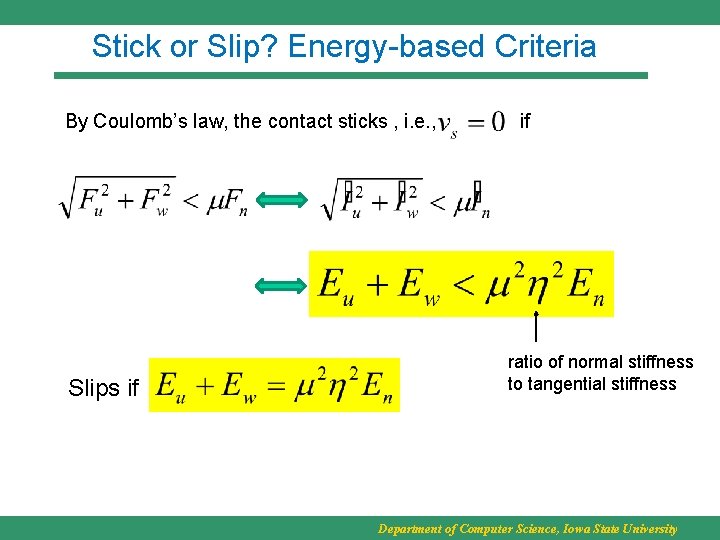
Stick or Slip? Energy-based Criteria By Coulomb’s law, the contact sticks , i. e. , Slips if if ratio of normal stiffness to tangential stiffness Department of Computer Science, Iowa State University
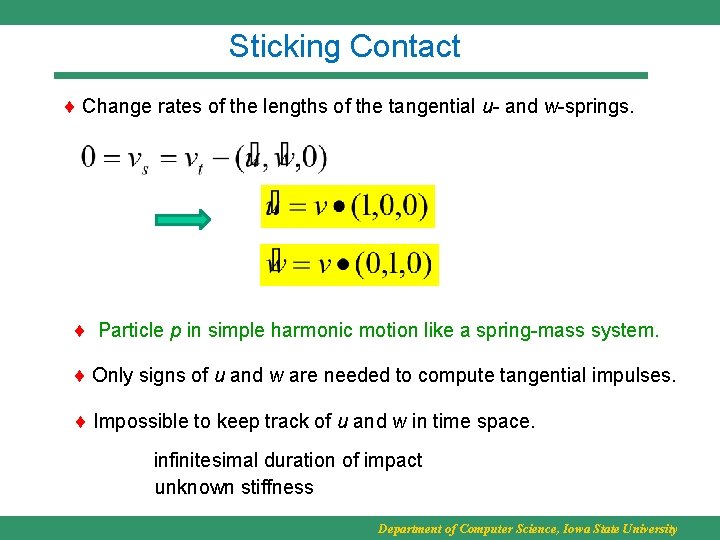
Sticking Contact Change rates of the lengths of the tangential u- and w-springs. Particle p in simple harmonic motion like a spring-mass system. Only signs of u and w are needed to compute tangential impulses. Impossible to keep track of u and w in time space. infinitesimal duration of impact unknown stiffness Department of Computer Science, Iowa State University
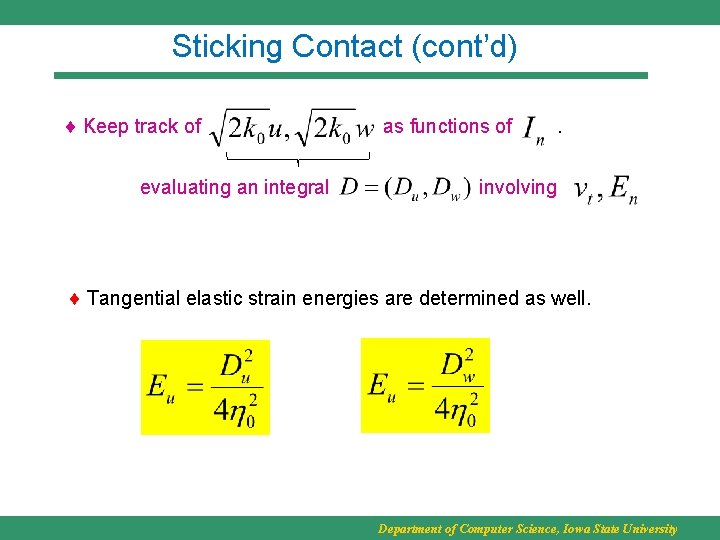
Sticking Contact (cont’d) Keep track of evaluating an integral as functions of . involving Tangential elastic strain energies are determined as well. Department of Computer Science, Iowa State University
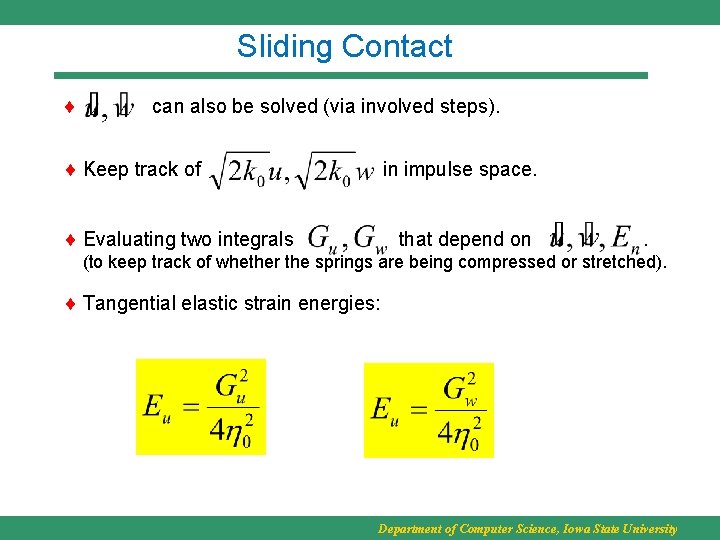
Sliding Contact can also be solved (via involved steps). Keep track of in impulse space. Evaluating two integrals that depend on . (to keep track of whether the springs are being compressed or stretched). Tangential elastic strain energies: Department of Computer Science, Iowa State University
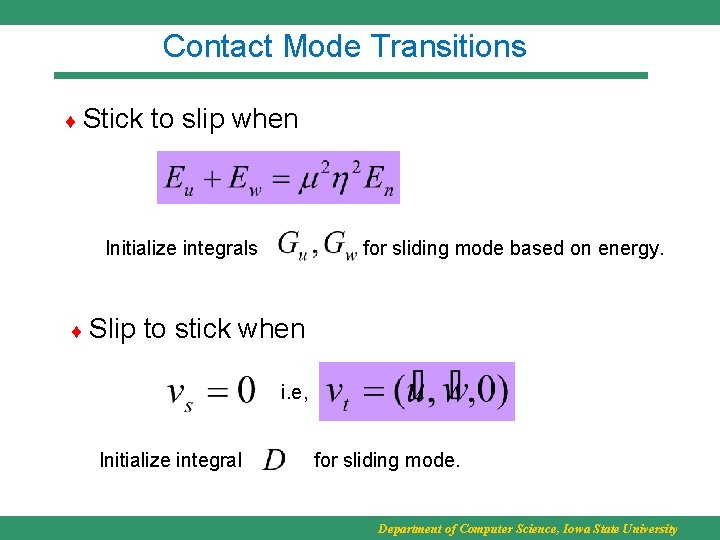
Contact Mode Transitions Stick to slip when Initialize integrals Slip for sliding mode based on energy. to stick when i. e, Initialize integral for sliding mode. Department of Computer Science, Iowa State University
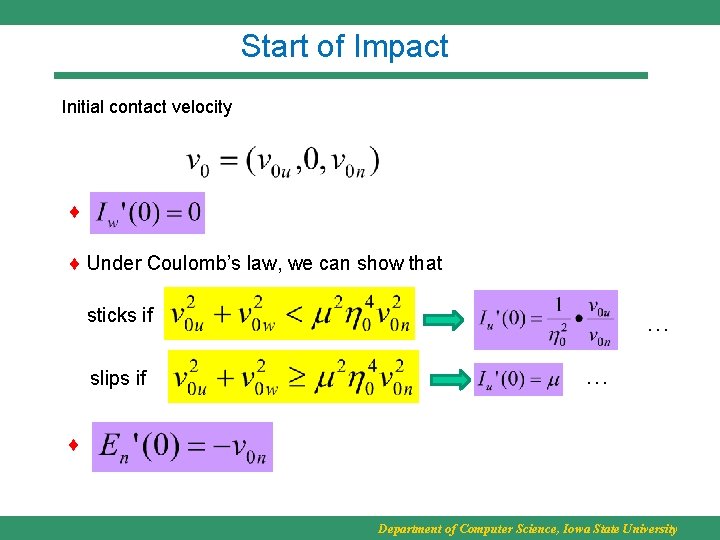
Start of Impact Initial contact velocity Under Coulomb’s law, we can show that sticks if slips if … … Department of Computer Science, Iowa State University
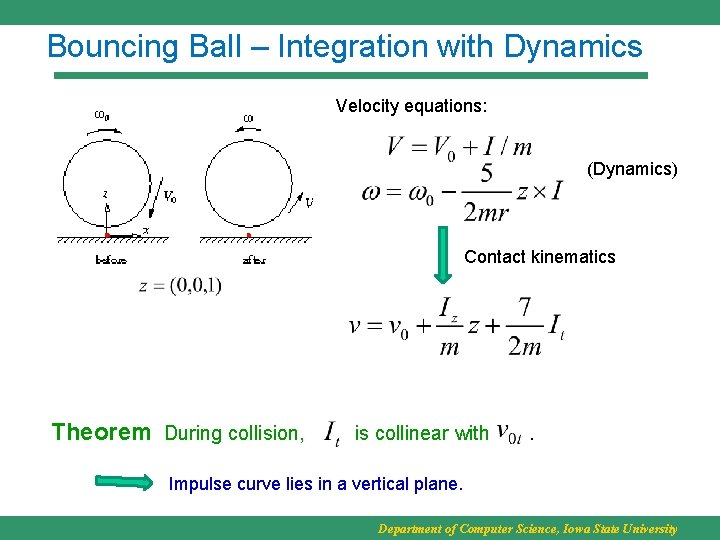
Bouncing Ball – Integration with Dynamics Velocity equations: (Dynamics) Contact kinematics Theorem During collision, is collinear with . Impulse curve lies in a vertical plane. Department of Computer Science, Iowa State University
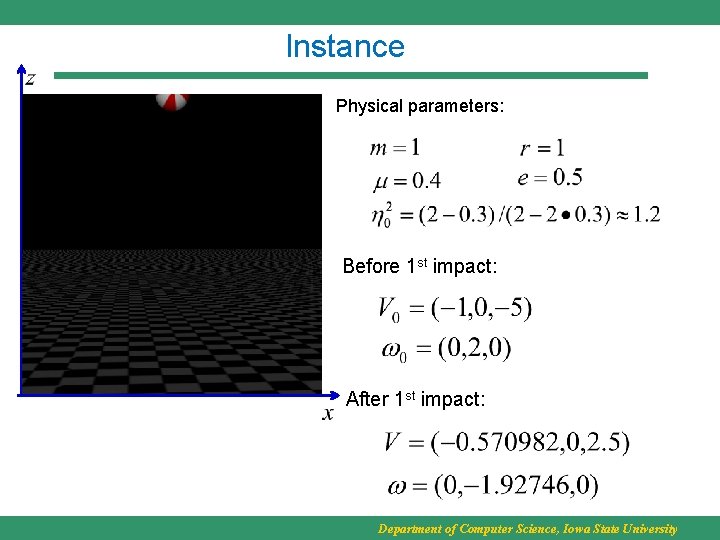
Instance Physical parameters: Before 1 st impact: After 1 st impact: Department of Computer Science, Iowa State University
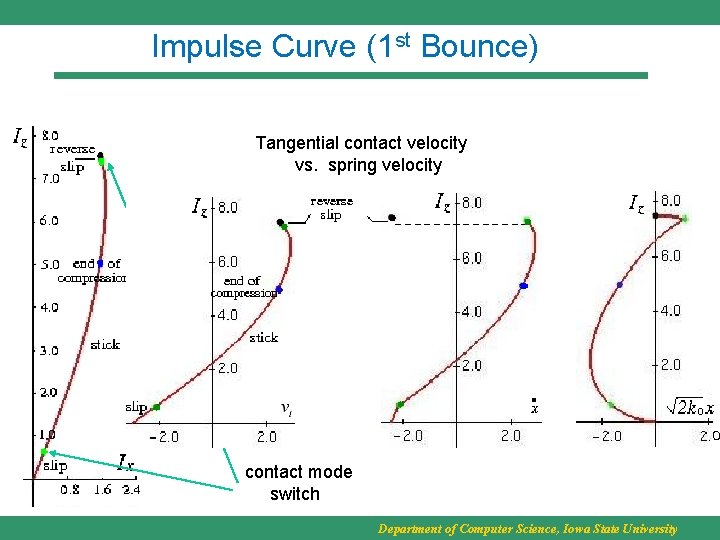
Impulse Curve (1 st Bounce) Tangential contact velocity vs. spring velocity contact mode switch Department of Computer Science, Iowa State University
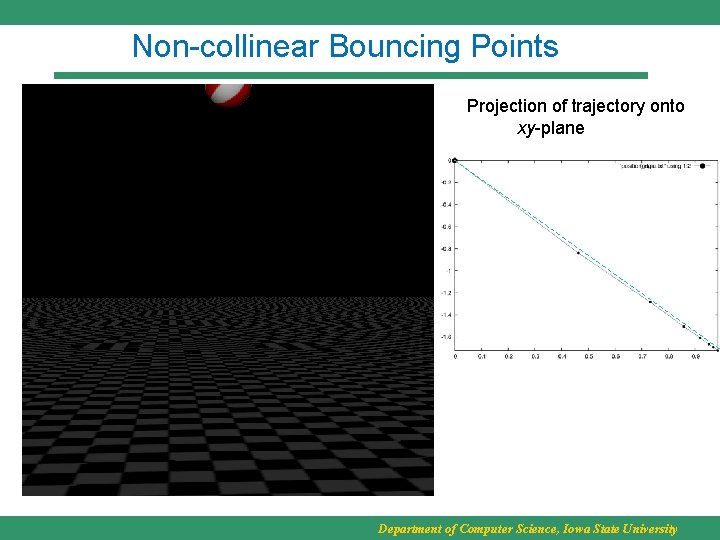
Non-collinear Bouncing Points Projection of trajectory onto xy-plane Department of Computer Science, Iowa State University
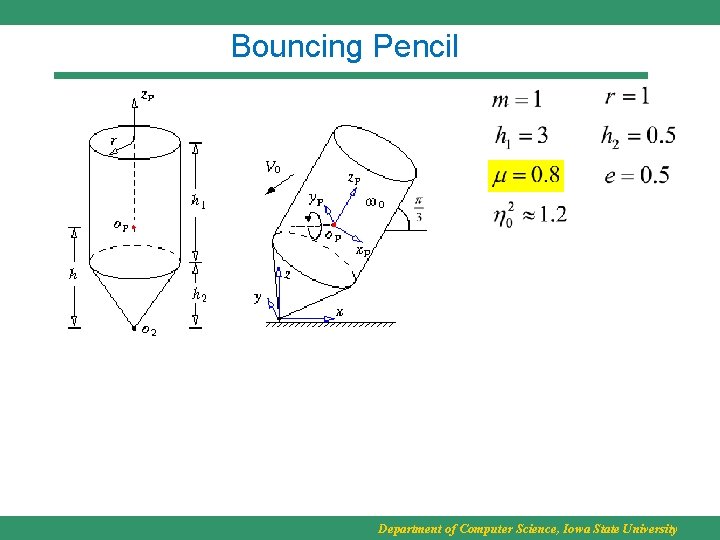
Bouncing Pencil Department of Computer Science, Iowa State University
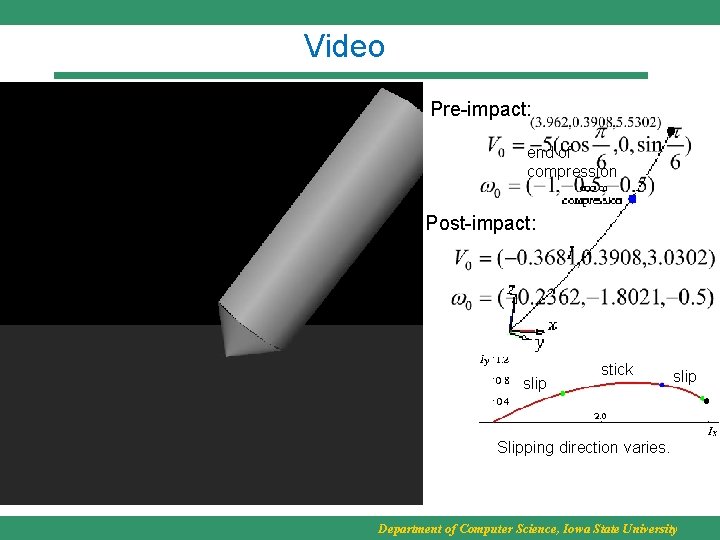
Video Pre-impact: end of compression Post-impact: slip stick slip Slipping direction varies. Department of Computer Science, Iowa State University
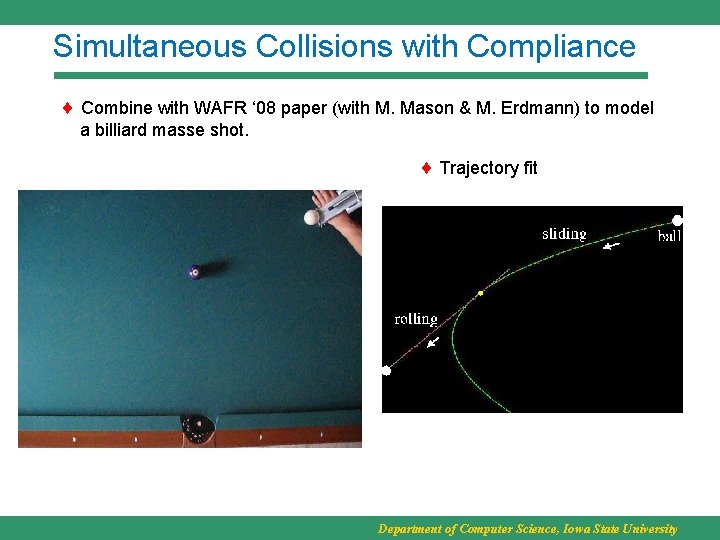
Simultaneous Collisions with Compliance Combine with WAFR ‘ 08 paper (with M. Mason & M. Erdmann) to model a billiard masse shot. Trajectory fit Department of Computer Science, Iowa State University
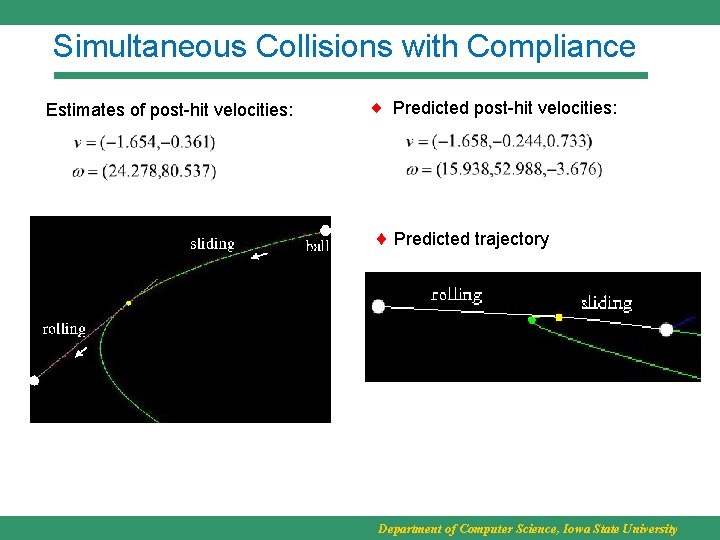
Simultaneous Collisions with Compliance Estimates of post-hit velocities: Predicted trajectory Department of Computer Science, Iowa State University
Conclusion • 3 D impact modeling with compliance extending Stronge’s spring-based contact structure. • Impulse-based not time-based (Stronge) and hence ready for impact analysis (quantitative) and computation. • • elastic spring energies contact mode analysis sliding velocity computable friction • Physical experiment. • Further integration of two impact models (for compliance and simultaneous impact). Department of Computer Science, Iowa State University
Acknowledgement Matt Mason (CMU) Rex Fernando (ISU sophomore) Department of Computer Science, Iowa State University
- Slides: 25